
CHAPTER THREE
Before examining Operation EPSOM’s second phase, it is necessary to briefly examine 49th Division’s progress on the Raury Spur during the afternoon of 26 September. The battle on the spur was to have an important impact on 11th Armoured Division, which was about to advance on the main axis.
During the morning, lacking sufficient artillery support, 49th Division’s renewed attack mounted by 8th Armoured Brigade and 7 DWR, had failed to dislodge the Hitlerjugend’s armour. Having returned to the area of their start line, 7 DWR supported by the Shermans of the Sherwood Rangers Yeomanry (SRY) were to attack St Nicholas Farm at 1500 hours for a second time. This time the Dukes were successful: benefiting from both artillery support and the redeployment of a high proportion of Hitlerjugend’spanzers to face the main EPSOM attack. Sensing a vacuum ahead of them, the SRY pressed on alone, up the ridge for a further mile to the Cheux – Tessel Road, halting five hundred yards short of Rauray. Unsupported they called for the infantry. Eventually, 11 DLI reached the SRY at 2100 hours and secured what was now a toehold on Spur’s northern end
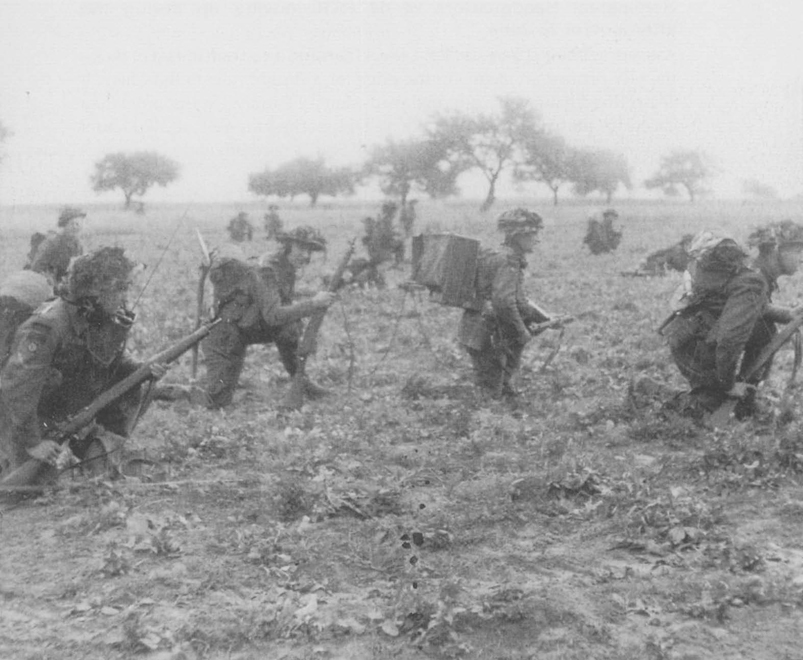
A Company headquarters awaiting orders to advance on the afternoon of 26 June.
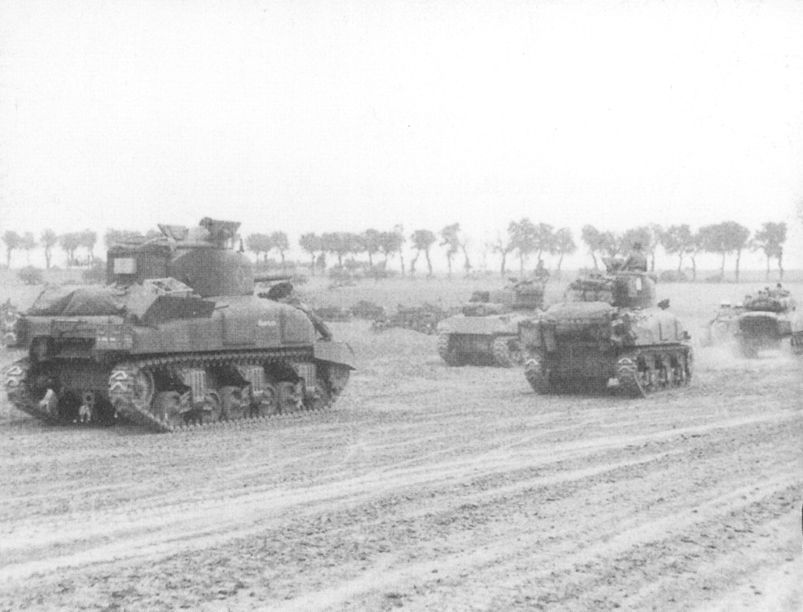
Regimental Headquarters of 44 RTR moving up during the afternoon of 26 June.
Phase Two – The Advance of 11th Armoured Division and 227 Highland Brigade
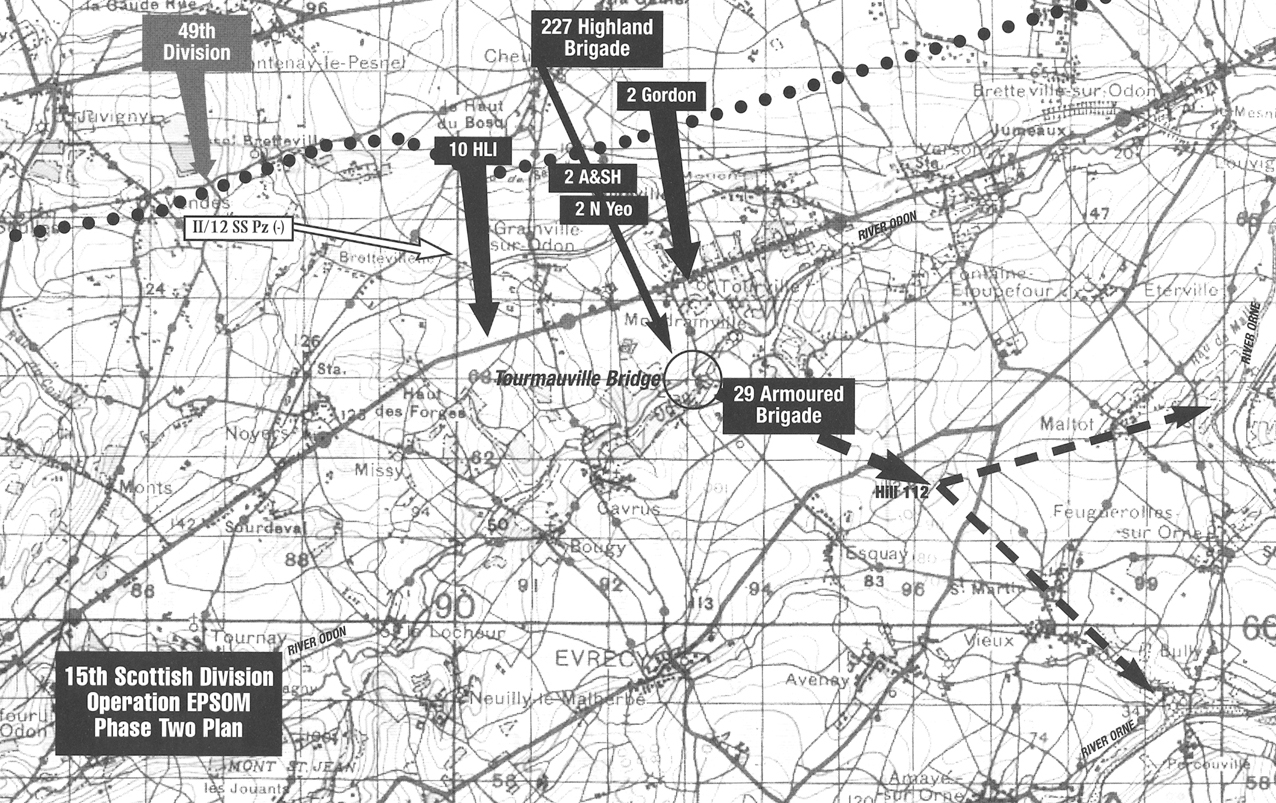
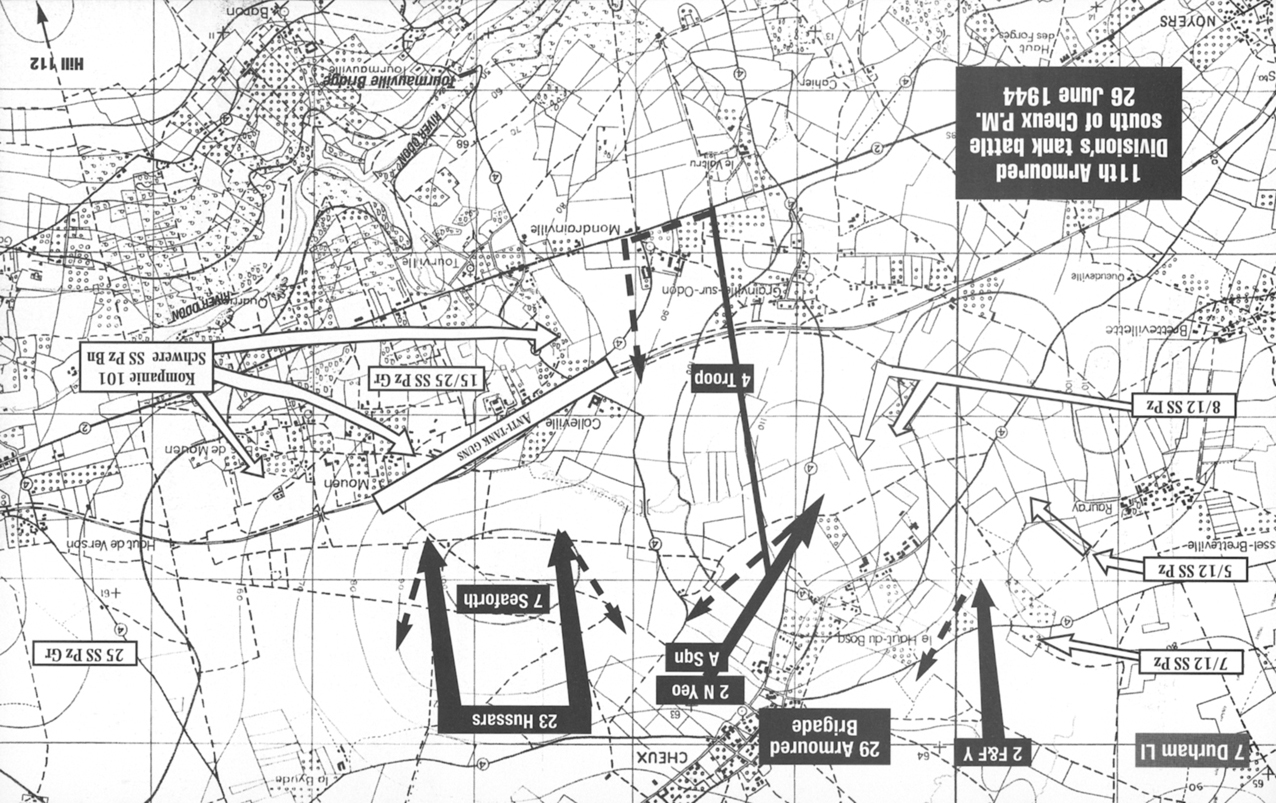
227 Highland Brigade and A Squadron of 11th Armoured Division’s recce regiment, 2nd Northamptonshire Yeomanry (2 N Yeo), had been following up behind 46 Brigade ready to take over the lead as quickly and seamlessly as possible. The divisional plan was that the Cromwells of A Squadron would dash from the Cheux area to the Odon bridges and, following them, 227 Brigade would advance with two battalions and clear the Odon Valley. Meanwhile, 29 Armoured Brigade was to be ready to advance to the Odon and then across Hill 112 to the Orne.
On the left flank, 2 Gordons, (227 Brigade) supported by C Squadron 9 RTR, were to take Tourville and 10 Highland Light Infantry (10 HLI), with C Squadron 7 RTR, had Granville as their objective. Subsequently, 2 Argyle and Sutherland Highlanders (2 A&SH) would seize or take over the defence of the Odon bridges, while 11th Armoured Division continued the advance into the depths of the enemy rear. ‘It all sounded elegantly simple’, commented an officer of one armoured regiment. However, 26 Pz Gr’s determined defence north of the Caen – Fontenay Road had slowed 15th Scottish Division’s tempo and enabled the Hitlerjugend to redeploy and prevent a dangerous gap being ripped in their lines.
SS-Hauptsturmführer Siegel’s 8 Kompanie had been preparing to go back into action against 49th Division to the north of Rauray at midday on 26 June:
‘Four panzer IVs, the only battle ready ones of the Kompanie, were refuelling and being hastily filled to the brim with ammunition. Since early morning, the enemy had been pushing with more and more force against our lines, and the men hardly took time even for a swig from their water bottles. We had been in action for twenty-four hours already and the soldiers’ faces showed the strain. Then SS-Obersturmbannführer Max Wiinche arrives. He orders me to clear up a very recent enemy breakthrough south east of Cheux by a counter-attack, with these four panzers. “Situation is confused – there is no time to be wasted – no infantry available to cover you” – that was the gist of what he said.
‘A quick briefing of the crews, my panzer will lead. Then they mount. The engines howl, the hatches are pulled shut, barrels and turrets are swung into combat position. The last shouted good wishes from the Regimental commander are swallowed up by the clanking of panzer tracks.’
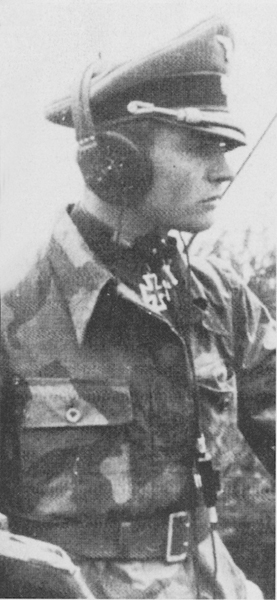
SS-Obersturmbannführer Max Wiinche.
5 and 7 Kompanies of II 12 SS Pz Regt were also to deploy to face the new threat. They took up positions on the ridge to the south west of Cheux. Thus a potent force of over twenty-five Mark IVs was moving into place, just in time to face the armour of 29 Armoured Brigade and 31 Tank Brigade.
At the first sight of the British armour, to the west of Cheux and le Haut du Bosq, SS-Hauptsturmführer Siegel ordered his tanks to halt:
‘We engaged these visible targets, and the enemy armour began to give off the well-known clouds of dark black smoke. Then, at top speed, taking advantage of the confusion our surprise intervention had caused, we raced across an open plain to the cover of a stand of trees at the bottom of a valley, and pushed on from there, firing all the time. Our own artillery began to bring down defensive fire to help us, we contacted our troops on the left flank who cheered our arrival, and spread out to the right, eastward to close the gap broken in our line. Finally, we were in position on the eastward, or enemy side, of le Haut du Bosq, facing towards Cheux. Ahead of us, a wide and slowly rising meadow lies wide open, leading to the enemy. Behind it – distance approximately 1,200 to 1,500 metres – the gabled roofs of Cheux. We stop here, the panzers ready to fire.’
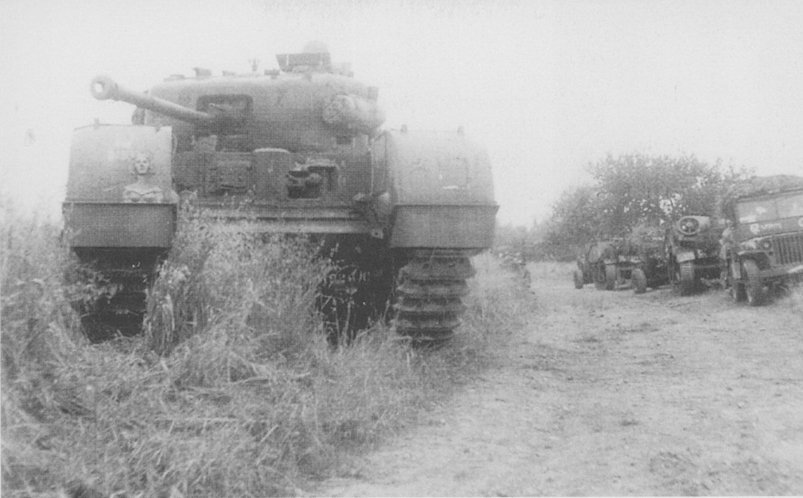
A Churchill and a section of anti-tank guns waiting to advance south on the afternoon of 26 June 1944.
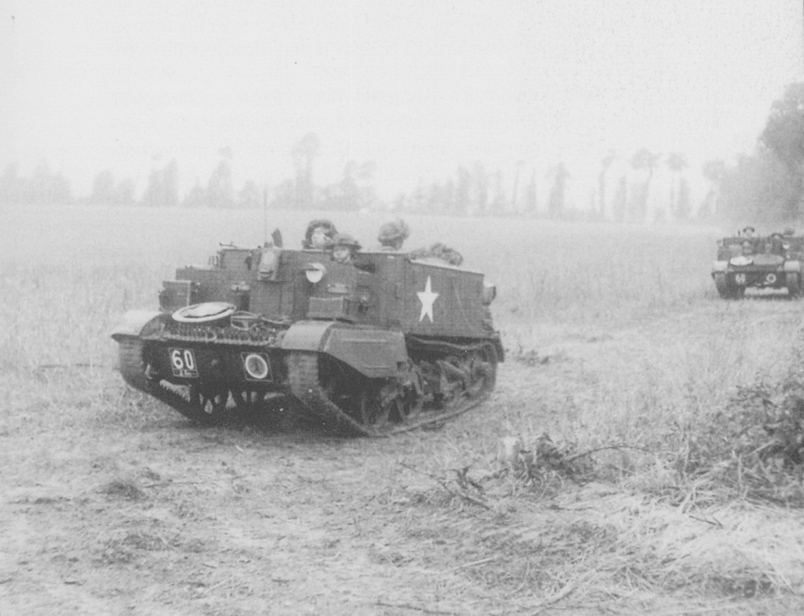
A Section of Bren gun carriers belonging to 2 Glasgow Highlanders. Photographed near Cheux.
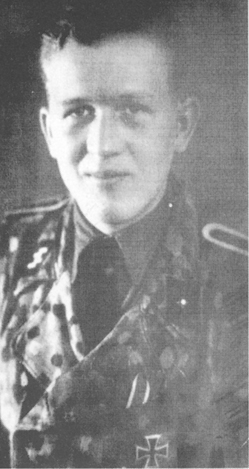
SS-Unterscharführer Otto Knot a tank commander in 5th Kompanie Hitlerjugend.
Siegler had re-occupied positions that he had been moved from to face Operation MARTLET. VIII Corps’s war diary described that:
‘There were many examples of enemy panzers being dug-in, and for each of these positions, there was an alternative position. These positions had been carefully chosen and prevent any close approach.’
As early as 1150 hours, VIII Corps approved orders for 2 N Yeo to dispatch A Squadron’s Cromwell tanks to seize the Toumauville Bridge. Moving along the boundary between 44 and 46 Brigades towards the northern end of Cheux, the Squadron encountered a minefield that prevented them approaching the village from the north. Eventually entering the village, which was still being cleared by 2 Glas H, they came under fire from small arms, grenades and panzerfausts. 2 N Yeo’s history describes the scene in Cheux:
‘… it took A Squadron a considerable time to find a way through or over the heaps of rubble, shell holes, and burning buildings. They were met by many determined snipers and “Bazooka-men” in the orchards and demolished buildings, behind chicken-houses, high banks and hedges. Several Germans were shot while trying to climb on to tanks with grenades and magnetic mines.’
Infantryman Roland Jefferson of 8 Rifle Brigade (8 RB), 11th Armoured’s Motor Battalion, accompanied the tanks into village:
‘We moved through the blasted ruins of Cheux and for the first time encountered being shelled ourselves. There was German sniper action and we had to seek them out and eliminate them. Perhaps for the first time, I realized that there was a vast difference between the text book soldiering when we were winning the battles on the Yorkshire Moors and the real thing we were now experiencing.’
Belatedly leaving the southern end of Cheux, shortly after 1300 hours, A Squadron 2 N Yeo had missed the supporting barrage, which was repeated at 1330 hours. Under cover of this fire, the four troops of Cromwells deployed astride the road ‘but soon came against anti-tank opposition, suffered casualties, and reported that they were unable to go on’. Reg Spittles was an A Squadron troop corporal:
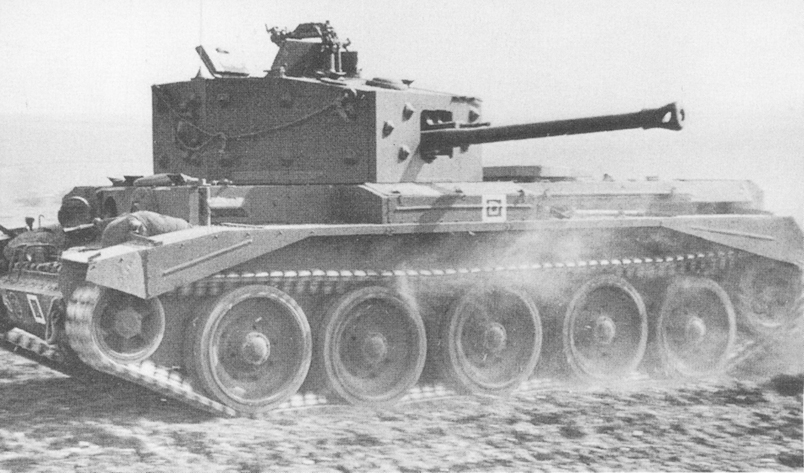
A British Cromwell tank of the type used 2 N Yeo in the recce role.
‘My troop [2 Troop] was sitting back in reserve. 4 Troop had gone on over the ridge to the left. 1 Troop and Squadron HQ’s advance was halted by a deep ditch, so the only tanks I could see moving were 3 Troop on the right. I was idly watching them motoring up the hill just as if they were on exercise. I wouldn’t have driven up so fast. Anyway, they went steaming up this slope. I suddenly looked back and two of the Cromwells were burning; knocked out. Major Peel came up on the radio and said you can see what has happened, get up there!
As troop corporal, I led the way in arrowhead formation. Going steadily, I went up between the two burning Cromwells, hoping that the smoke would cover me. I stood up in the turret to see, over the crest with my binos. I couldn’t see anything, so we trundled forward and I could then see these Mk IVs [Seigler’s Company mentioned above], with a few Panthers amongst them moving in the valley across my front. These were what had hit 3 Troop’s tanks. We sat up there firing and knocked out several Mk IVs. They fired back at us but as they were moving, they missed and they didn’t seem to want to seriously engage us, just get across our front.’
Supporting 2 N Yeo were the M 10 self propelled guns of 75 Anti-Tank Regiment RA. Sergeant Brettle recalled that he:
‘… spotted a Mk IV brewing up the Yeomanry’s Cromwells. It was lurking behind a house and I ordered the driver to start up and be ready to move. We fired but the muzzle smoke was a dead give-away. I saw a return AP cutting a path through the top of the corn crop and reversed smartly. My wireless operator could see through his periscope as the enemy AP sizzled past: “Curly – that was bloody close!” he calmly said.’
A Squadron, 2 N Yeo, Number 3 Troop was completely knocked out, as it attempted to cross the open ground and Reg Spittle’s troop, along with 1 Troop, was pinned down and unable to make any progress. However, 4 Troop, under command of Lieutenant Stock, benefited from a more covered axis of advance and reached the railway line at Grainville at 1500 hours and advanced far enough to radio back a report on the state of the Odon valley and crossings. Having done that ‘they spent a happy ten minutes shooting up a group of 20mm flak guns and their crews’. Despite this limited success, it was apparent that there was not going to be ‘an elegant armoured drive’ for the tanks to the Odon and beyond. According to the divisional war diary, ‘A Squadron 2 N Yeo were ordered to pull out’, as the Hitlerjugend’s panzers had established blocking positions.
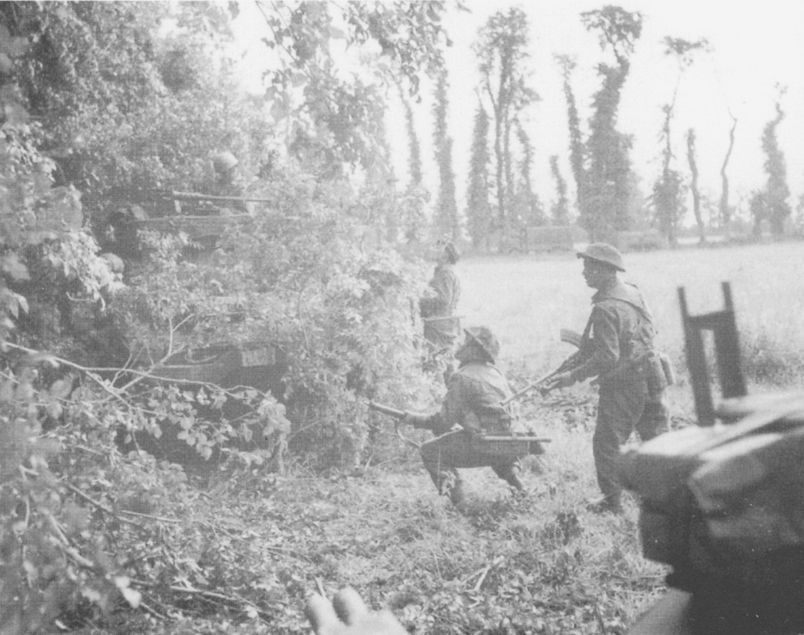
Tanks and soft skin vehicles of 23 Hussars are camouflaged in the hedgerow while the infantry flush out Hitlerjugend riflemen.
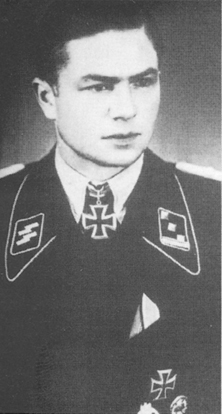
Hauptsturmführer Hans Siegel.
By mid afternoon, Hauptsturmführer Siegel’s panzers were not only facing 7 and 9 RTR’s Churchills, but also the Shermans of 29 Armoured Brigade. Major General ‘Pip’ Roberts, commanding 11th Armoured Division, who earlier had lost his own tank, at a crucial moment on a Canadian anti-tank mine, recalled:
‘About 1230 hours I got orders to send 2nd Northants Yeomanry on their dash for the Odon Bridges, to be followed by 23rd Hussars, 2nd Fife and Forfar Yeomanry and supported by 3 RTR. But unfortunately no close infantry/tank mutual support for which the Division had trained for many years was possible.’
On the right, to the west of Cheux, were 2 F&F Y and in the open country to the east of the village were 23 Hussars (23 H). Neither Regiment had been in action before and ‘The bocage country came as a great shock, it was all very different from the open country of our training areas in East Anglia’. Not least, because the Germans were making effective use of the cover afforded by hedges and sunken lanes.
Lieutenant Steel Brownlie of 2 Fife and Forfar Yeomanry (2 F&F Y) was to the west of Cheux and recalls his first advance:
‘The regiment formed up 1,000 yards short of Cheux alongside a regiment of Churchills of 31 Tank Brigade and an assault was made on the village. C Squadron went straight in. We went left but were stopped by tank ditches and sunken lanes, so were switched to the right. Don Hall took his troop round the edge of a wood, myself following. Two of his tanks went up in flames and he came roaring back, laying smoke from the burning tanks. Two APs [armour piercing shot] came just over my head so I too laid smoke and got out.’
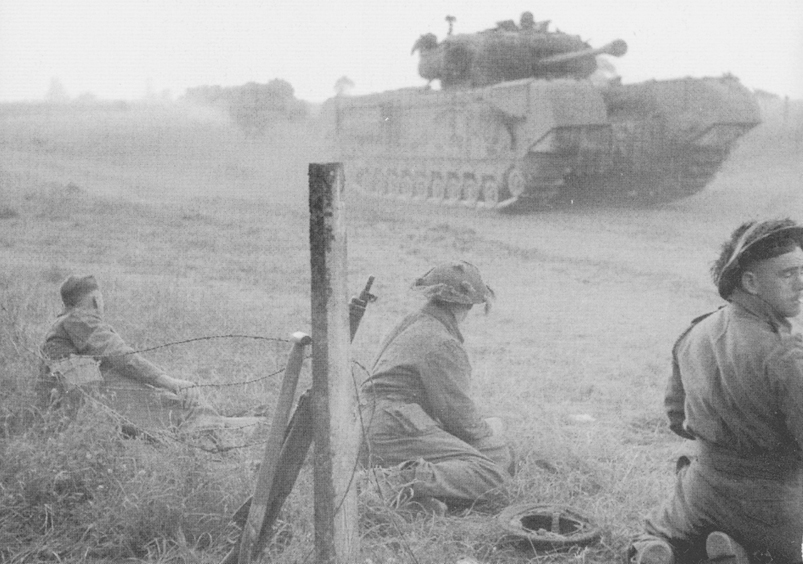
Waiting Infantry men look on as a Churchill tank moves forward.
Lieutenant Robson of A Squadron 23 H was not so lucky. Leading his troop forward onto a ridge south of Cheux, his Sherman was hit. The regimental historian recorded that:
‘Those who witnessed it will always remember the shock of seeing for the first time one of the Regiment’s tanks go up inflames. One moment an impregnable monster, … forging irresistibly towards the enemy; the next, a crack of a terrific impact, a sheet of flame – and then, where there had been a tank nothing but a helpless, roaring inferno.’
Deployed in good positions on the ridge between Rauray, Grainville and Colleville, the SS panzers had halted the British advance but the pressure exerted by three armoured regiments was telling on the Germans. SS-Untersturmführer Willi Kandler a platoon commander of 5 Kompanierecalled:
‘Even as we approached, numerous enemy tanks of various sizes [2F&F Y] could be seen on the hill to our left. They had come from le Mensil, in the direction of Cheux. Before we could turn into our old position by the hedge, we became involved in a violent duel of the tank guns, with successes and losses. Driving a few metres ahead of my Panzer, Untersturmführer Buchholz was standing in his turret. His panzer took a direct hit and Buchholz’s head was ripped off. Since a column of English tanks had already broken through, the Kompanie withdrew, fighting, for two or three hedge-bordered pasture squares to the south. We took up new positions on the route Cheux-Noyers. As I recall, Oberscharführer Junge encountered, on the way to the new positions, Sherman tanks that were advancing in a parallel direction. At very close range he knocked out five of them.’
The panzers were not the only Hitlerjugend troops moving back. SS Sturmbannführer Muller’s 12 SS Pz Arty Regt’s positions in Cheux and le Haut du Bosq had been overrun and as SS-Standartenführer Kurt Meyer recorded that: ‘The battalion was pulled back through the [centre] Sabley sector’. However, the Hitlerjugend still held positions dominating the routes south from Cheux.
To the east, beyond the blocking positions was the Hitlerjugend’s HQ Defence Kompanie. The divisional commander, SS-Standartenführer Kurt Meyer, wrote a colourful account of 23 H’s attack:
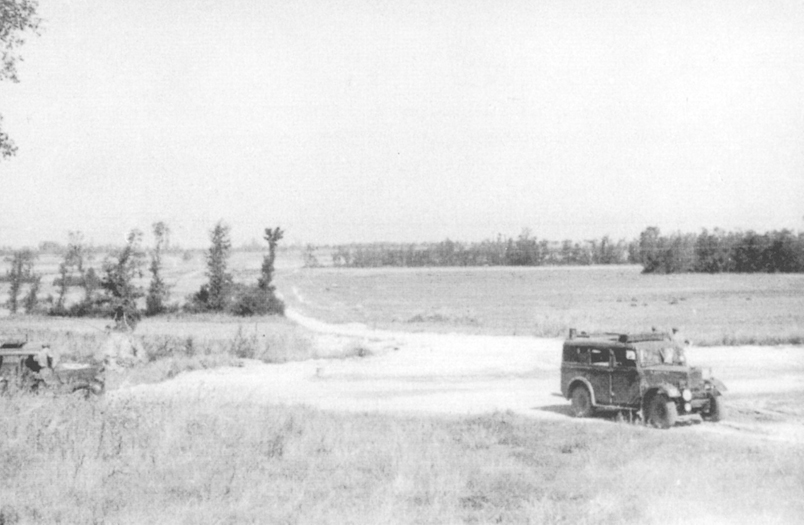
The crossroads north west of Cheux.
‘All command and control had become impossible. At that point, I could only be a soldier amongst soldiers. The eyes of the grenadiers lit up when they noticed me moving from section to section. These soldiers were unshakeable. They would not waiver or give way.
‘Soon there was no piece of ground where a round had not exploded. Enemy tank rounds exploded in our lines. Our defensive area was reinforced by two tanks and an anti-tank gun. We clasped the few remaining Panzerfausts tightly to our bodies.
‘A Panzer IV exploded and two Shermans were burning in front of us. The mass of enemy armour gave me the willies. Didn’t it border on madness to try to stop this army of steel with a handful of soldiers and a few rifles? It was too late to speculate; there was only one thing left to do – fight!
‘Two Shermans pushed closer down a defile. Some grenadiers lay in wait with their Panzerfausts behind blackberry bushes. I held my breath, and the exploding rounds had suddenly lost their terror. Spellbound we watched the soldiers as they got ready. The lead tank advanced further and further down the sunken road with covering tank rolling slowly behind him. It rolled past at that point; the second tank was as far as our soldiers. The barrels were pointed at Verson, but they would never fire again. A soldier rushed at the second tank. His Panzerfaust smashed into the Sherman’s side. The tank rolled on a few meters then stopped, smoking. The lead tank had also been halted; it lost its tracks on mines. Two survivors surrendered.
‘The Recce Company [15/25 Pz Gr Regt] fought for its life to my right. Wild artillery fire flung muddy earth high into the air. An anti-tank gun was still in position; it fired round after round into the British 11th Armoured Division’s column of tanks. A British artillery barrage reduced the gun into a heap of scrap metal. There were no more serviceable anti-tank weapons and tank rounds shredded the company.
‘I tried vainly to obtain artillery support. The spectre of “lack of ammunition” had been plaguing us for a long time. A couple of German artillery rounds were not enough to check the onslaught. The British tank attack continued. I knew every single one of these young soldiers, the oldest barely eighteen but they knew how to die!
‘A new sound suddenly mixed into a hellish concert. A lone Tiger was giving us support. Its 88mm rounds gave the Shermans an unmistakable command to halt. The British tanks turned away; they called off their attack.’
A handful of the powerful Tigers had arrived just in time to prevent a final breakthrough of the Hitlerjugend’s position. Just how close VIII Corps was to success on the afternoon of EPSOM’s first day is indicated by this paragraph written by Kurt Meyer:
‘We found two knocked-out British tanks on our return to the Divisional Headquarters; clerks had destroyed them with Panzerfausts. The wrecks were less than 200 meters from the Headquarters. The HQ staff had dug in for all round defence.’
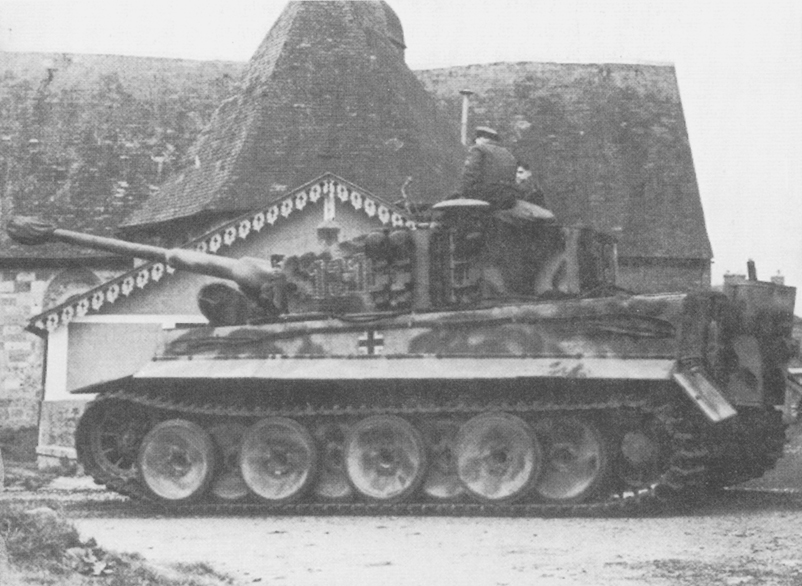
A Tiger of 101 Schwere SS Panzer Battalion.
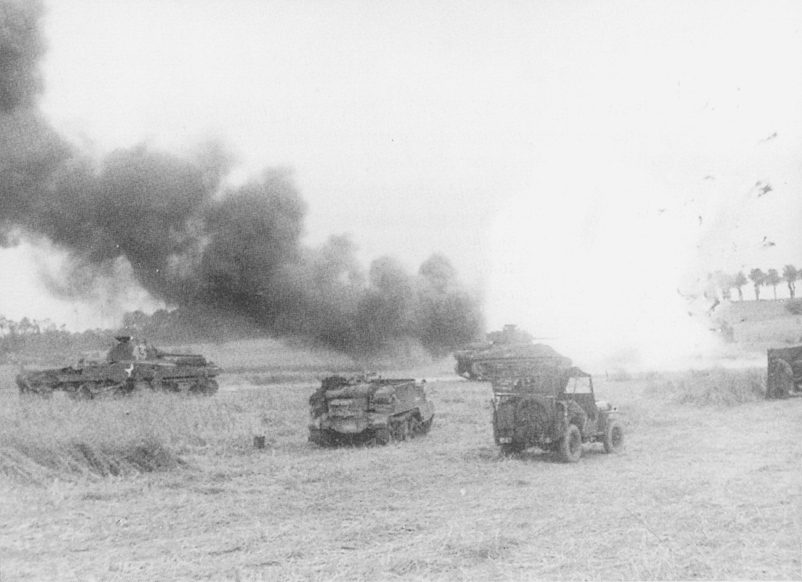
Mid-day north west of Cheux. A Sherman belonging to the Fife and Forfar Yeomanry (29 Armoured Brigade), explodes dramatically. The flail belongs to B Squadron 22 Dragoons.
Under pressure from the attack, ‘Panzermeyer’ recorded his feelings during the late afternoon of 26 June:
‘The danger of a breakthrough by enemy tanks existed mainly south east of Cheux in the direction of the Odon crossing near Verson, or south of Tour ville… The general command was constantly informed of the situation and was requested to send reinforcements. Initially, one company of the Korps Tiger Battalion was promised and moved to the area south of Cheux. Later SS-Brigadeführer Kraemer, chief of staff of I SS Panzerkorps advised that one company each of panzers and assault guns from 21st Panzer Division would be attached to the “HJ”.’
In addition, two battalions of 1st Leibstandarte SS Panzer Division’s infantry had been tasked to join the Hitlerjugend but they were still a long way from the battlefield. However, placing of six of the eighteen operational Tigers under the Hitlerjugend’scommand had produced immediate results. The 56-ton monsters, positioned on the ridge around Grainville and Mondrainville, using their 88mm guns’ 2,000 yard range, were able to cover routes south from Cheux and sweep Ring Contour 100, with both main armament and machine gun fire.
The Advance of 227 Highland Brigade
The armour having failed in the face of superior German firepower, it was the infantry who again were sent forward by Major General Macmillan. This time it was the Highlanders of 227 Brigade. The divisional historian recorded the Brigade’s first move forward, at 1800 hours:
‘From the forming up place, they set out southward through Cheux by two roads that lead to the Odon.
‘Cheux they found a heap of ruins – its streets flooded and cumbered with fallen masonry. In it was the most appalling traffic jam. Vehicles were trying vainly to go in every direction at once, and no one seemed to be in charge. Moreover, the place was in the grip of an intense sniper scare, and indiscriminate firing was going on up and down the streets.’
With tanks closed down because of friendly and enemy fire, according to 15th Scottish Division’s Military Police, ‘they were deaf to the entreaties of infantry transport trying to move through Cheux’. This is a classic example of the results of two formations attempting to operate on a single axis on a narrow front.
Having shaken free of the traffic chaos, shelling and snipping, 227 Brigade’s leading battalion, 10 Highland Light Infantry attempted to moved to its planned FUP south of le Haut du Bosq. However, they found it occupied by Siegle’s panzers. In addition, they had parted company with their transport, including their mortars and machine guns, as well as 7 RTR’s supporting Churchills. Sergeant Green describes 10 HLI’s move up and the attack from the infantryman’s point of view:
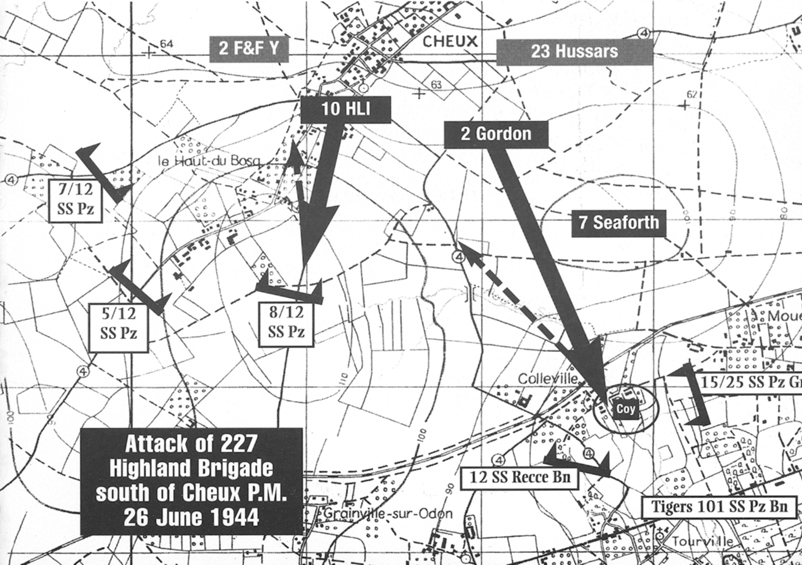
‘It was late afternoon when we were ordered forward in extended order across the Caen road towards Cheux, every man keyed up and searching each fold in the ground for snipers, though as yet not a shot had been fired at our leading troops. When within fifty yards of the road, a young German in a camouflaged uniform rose up from the long grass almost under the muzzle of a Sten gun which killed him instantly. This was purely a nervous reaction on the part of the owner, and the only case I was to see of a German being killed for no reason. But it started a sniper scare and a lot of indiscriminate firing took place in all directions. The rain now came down with teeming ferocity… The orchard area of le Haut du Bosq was reached and we passed through the forward troops of 46 Brigade, control was difficult, direction was lost in the orchards, and then we struck trouble. Machine guns opened up at the leading companies which, shocked by the suddenness of it, went to ground. Our supporting tanks replied, the tracer ricocheting in all directions, a source of fear to all and sundry, Scottish and German. Each time the leading companies tried to advance, they were met by heavy fire, and the advance petered out.’
The divisional historian wrote: ‘Finding that a further advance was impossible in such conditions, Lieutenant Colonel Young concentrated the HLI in the southern outskirts of Cheux preparatory to a renewed advance at daylight.’
Meanwhile, on 227 Brigade’s left, 2 Gordons, supported by C Squadron 9 RTR, formed up in the open to the east of Cheux, below the slopes of Ring Contour 100, held by 7 Seaforth. Although the Gordons had an easier time forming up than the HLI, they still suffered casualties from Nebelwerfers. Despite enemy fire, they advanced across the Sabley and up the ridge towards Colleville, with two companies forward covered by a creeping barrage. Sergeant Trevor Greenwood of C Squadron wrote in his diary:
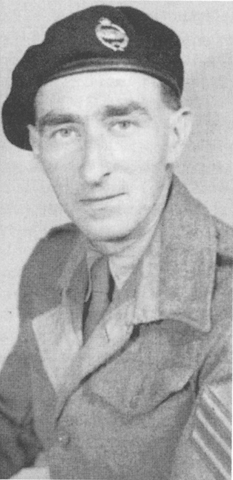
Sergeant Trevor Greenwood, 9 Royal Tank Regiment.
‘We took up our start position in a large field below the crest of a hill: 5.00 p.m. Our infantry were in position too, all smiling and cheerful. I think they were really glad to have our support. They asked us to swipe hell out of Jerry!
‘Close to zero-hour, word came that sixty Panthers were on the move [rumour! There were no more than twenty-five Mk IV from II/12 SS Pz Regt on the ridge, supported by six Tigers].… After about an hour, we commenced our delayed start at 6.15 p.m. Infantry ahead and rifles at the ready over the crest … towards the woods where we knew there would be trouble. By 7.00 p.m. the battle was on!
Infantryman Private Jim Fisk was advancing on the Gordons’s left flank:
‘We were in amongst some trees, or what was left of them, and suddenly there was fire coming at us from all directions, including our rear. There were yells and curses and we all dropped to the dirt and mud and started shooting, though we couldn’t see a thing, partly because of the mist, but also because the Jerries were so well hidden.’
Sergeant Hall, troop sergeant of 15 troop, came under fire at the same time in his Churchill called Ilkley.
‘It started to rain and as we were approaching the ridge. On the right flank [10 HLI and 7 RTR] we saw some tanks had been hit and set on fire. I saw green tracer coming towards us, one passed to the left and one to the right. The third was a direct hit on the turret. We fired back along the ridge at what was either a Tiger or a Panther [Tiger or Mk IV: probably the latter] and reversed to be able to come up in a different position. This we did and ended up three-quarters on to him. We came under fire straight away and received several more hits, mostly on the hull. Because we were at an angle none of the shots penetrated the armour but when we tried to reverse before coming up onto the ridge in another position, we had lost hydraulics. As we were still under fire, it was only a matter of time before they was knocked-out.
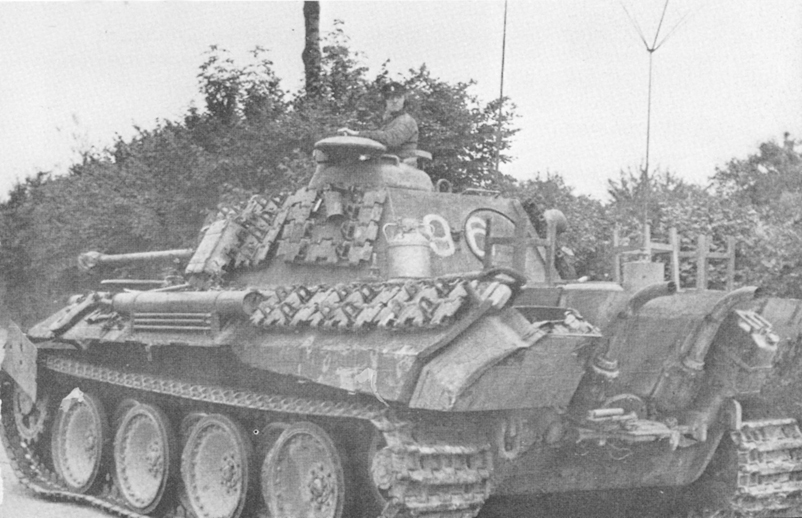
A commander’s Panther moves up during Operation EPSOM.
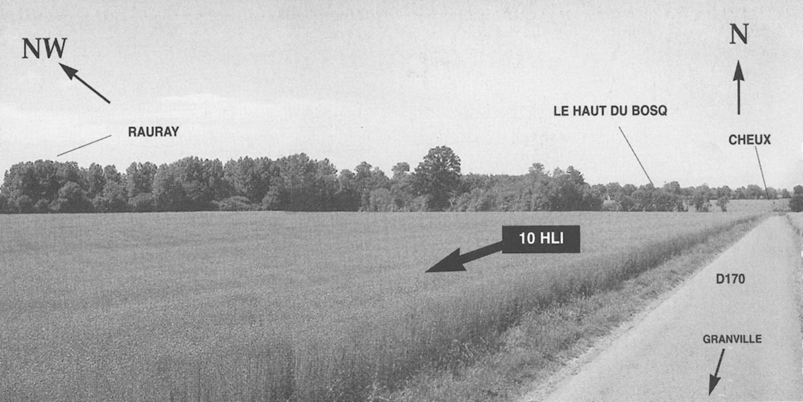
Panaroma showing the German view across the Ruisseau de Sabley from the ridge north of Granville.
‘I gave the order to get out and we all met up in a nearby shell hole. We came under mortar and sniper fire, but due to the wet ground no one was hit although mortars landed very close. We walked back through Cheux and reported to the B Echelon vehicles.’
Despite casualties amongst infantry and tanks, the Gordon’s battlegroup determinedly pressed on towards the railway line, which was held by the recently arrived troopers from Recce Kompanie 25 SS Pz Gr. The war diary of 9 RTR war recorded that:
‘Continuous rain made it difficult to locate targets and gradually one tank after another became a casualty. C Squadron deployed so that half engaged the enemy tanks, while the remainder pushed on to help the Gordons.’
11th Armoured Division’s war diary also recorded that,
‘29 Brigade report they are helping to shoot attack into Colleville, but enemy tanks and guns prevent 31 Tank Brigade getting up to their infantry.’
Meanwhile, the Gordons were having trouble with mortars and snipers as they approached Colleville. However, eventually they reached the village. Private Jim Fisk describes the fighting:
‘Then our Lieutenant got hit not far from us; he shouted at us to keep moving. So we did … Then we saw some ruined houses – it must have been almost an hour later. I know I looked at my mate’s watch and was surprised so much time had passed. We reached those houses with fire coming at us from all directions and blokes falling down and calling for medics. There was a high grey wall and I huddled up against it with my mate and waited. We had no orders and didn’t know which way to move. The battle got worse and we heard tanks and saw a Churchill moving along the street but it was hit and caught fire.’
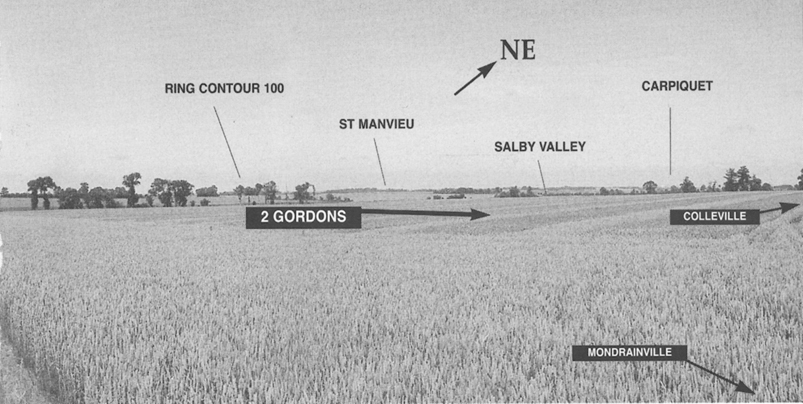
Having broken into Colleville, the Gordons lacked the strength to hold the village and were eventually forced to withdraw under persistent mortar fire.
During the fighting in Colleville, the left assault company had become separated from the remainder of the battalion and was surrounded. It was assumed to have been wiped-out. According to RTR Sergeant Greenwood ‘We were in action until it was too dark to see … must have been 10.30 p.m’. Trooper Jack Woods who was driving C Squadron’s Recce Officer’s armoured car witnessed the aftermath of the Gordon’s battle.
‘We passed some of 7 RTR’s Churchills being back loaded with ominous holes in their turrets – just to cheer us up. … finally getting up to the tanks later in the day, we witnessed a scene, which remains with me today. C Squadrons Churchills were on the skyline blazing merrily and pouring out dense clouds of black smoke, with their ammunition going off like a firework display. Their de-horsed crews were coming back through the corn, their faces registering the shock of what had just happened to them. The infantry, having been unable to reach [retain] their objective, were returning also and were regrouping prior to digging-in. What a shook us all was the fact that we had been encouraged to believe that our Churchill tanks were practically invincible and the truth was very sobering indeed.’
The Gordons withdrew north across the Sabley stream and dug in astride the Cheux to Collville Road. Their casualties for 26 June are difficult to calculate due to the declared ‘loss’ of the company in Colleville but they are estimated to have been in excess of one hundred. Also in action for the first time, C Squadron left eight of their seventeen Churchills burning on the battlefield. However, only three tank crew were killed, although fifteen men were wounded.
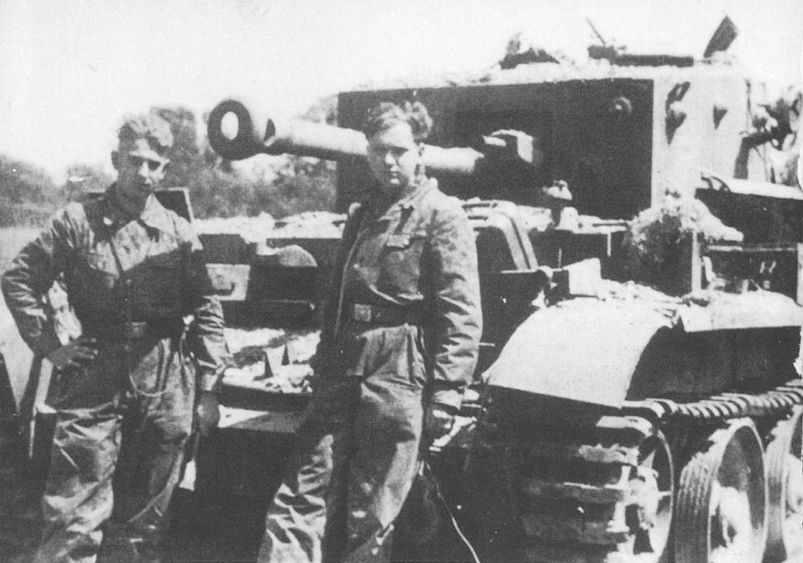
Hitlerjungend Panzer Grenadiers pose alongside a kill on 26 June 1944. A few Cromwells reached Tourville but not all returned.
The British attacks petered out as darkness fell. SS-Hauptsturmführer Hans Siegle summed up the situation at the end of the tank battle:
‘The enemy has withdrawn, probably to the southern fringe of Cheux. The breakthrough spot is closed, mission accomplished. It is getting dark.’
Overnight Siegler was tasked to tow back abandoned 105mm field artillery pieces to positions south of the railway line.
German Counter Attacks
Meanwhile, back in St Manvieu, the remnants of the Scots Fusiliers’ and 6 KOSB continued to clear the village. During the afternoon and evening, there were two counter-attacks by Hitlerjugend’s tanks and infantry, reinforced by the promised Panzer Kompaniefrom 21st Panzer Division. These attacks from the east were largely beaten off by intensive artillery fire. By this stage of the war, the British artillery had developed into a flexible organization, capable of quickly concentrating its massive firepower on a single target, under control of even junior Forward Observation Officers (FOO). However, 6 KOSB, with its companies half dug-in around buildings, paddocks and orchards, was prepared for the counter-attack. Lieutenant Woollcombe recalled:
‘The village was attacked, and C Company took the strain. Confusion seemed unending. In A Company, we sat tight. Again and again the British guns spoke, as afield regiment rained shells into the dusk for prolonged minutes in a wide protective line. Nobody budged until gradually the whole shapeless action petered out.’
Having been badly hit by artillery and repulsed by the Scotsmen amongst the ruins of St Manvieu, the German counter-attacks failed as night fell.
Relief in Place by 43 Wessex Division
Also moving on the battlefield as night fell on 26 June were the newly arrived Westcountry infantrymen, belonging to famous regiments such as the Dorsets, Somersets and Wiltshires. Their task was to follow up and take over positions secured by ‘the Jocks’; thus releasing 44 and 46 Brigades to move forward to take the northern slopes of the Odon Valley. As EPSOM developed, the Wessex were to expand the corridor to the east.
129 and 214 Brigades had spent most of the day moving up from Bracy, as 15th Scottish and 11th Armoured Divisions vacated the assembly areas and FUPs. 129 Brigade, following up behind 44 (Lowland) Brigade, was first into action. Wiltshireman, Sergeant Regt Romain recalled:
‘We moved off and the distant sounds of war became nearer and more intense – the lazy howling of the naval shells became cancelled out by the field artillery, both British and German, then the sharp cracks of 25-pounders and 88mm guns, superseded bySpandau and Bren gun firing as we moved into the battle area. We lost quite a few men to the carpet of mortar bombs that dropped around us and we were becoming excited with that atmosphere of battle.’
During this move forward, the Wessex infantry had finally abandoned as impractical the bicycles that had been issued, to ‘mobile companies’ for transport to the battlefield.
As recorded in 4 Wiltshire’s (4 Wilts) battalion war diary, its: ‘Recce party moved at 1100 hours under the CO to area St Manvieu. A German counter-attack was still in progress on arrival of the battalion’s Recce Party in the village. Main body of battalion was ready to move at 1200 hours’. Even thought they were ready to take over from the Scots as planned, 4 Wilts did not in fact move until 2030 hours. One Wiltshireman commented, that ‘That day we learnt the first lesson of war; there is an awful lot of waiting around in battle’. Approaching St Manvieu in the pouring rain, it was apparent that fighting was still going on in and around the village. ‘They found the village was distinctly not taken.’ It was a nightmare relief. Expecting to take over from 6 RSF, the Wiltshiremen found that St Manvieu was mainly held by 6 KOSB, which in the gathering gloom, added to the confusion. The battalion’s war diary stated dryly: ‘Take over took place in darkness and mortar fire was in progress during take-over’. A member of the Battalion explained that ‘Our second lesson was learnt in St Manvieu and that was that no amount of training prepares you for the reality of battle. Fear and confusion makes even the simplest task difficult to achieve.’ One factor that confused the Wiltshires was that the ‘Jocks were using captured Spandaus that, in the dark, with their high rate of fire sounded very different to our slower firing Bren guns’. Another factor was that the tanks were closed down, as their commanders justifiably feared the Hitlerjugend’sisolated riflemen who shot at any exposed head and shoulders. Consequently, the infantry found it difficult to communicate with the Churchills and to coordinate their activities. The result was ‘Total disorganization, as everybody fired at everybody else’. Nevertheless, 4 Wilts had relieved the Jocks by midnight.
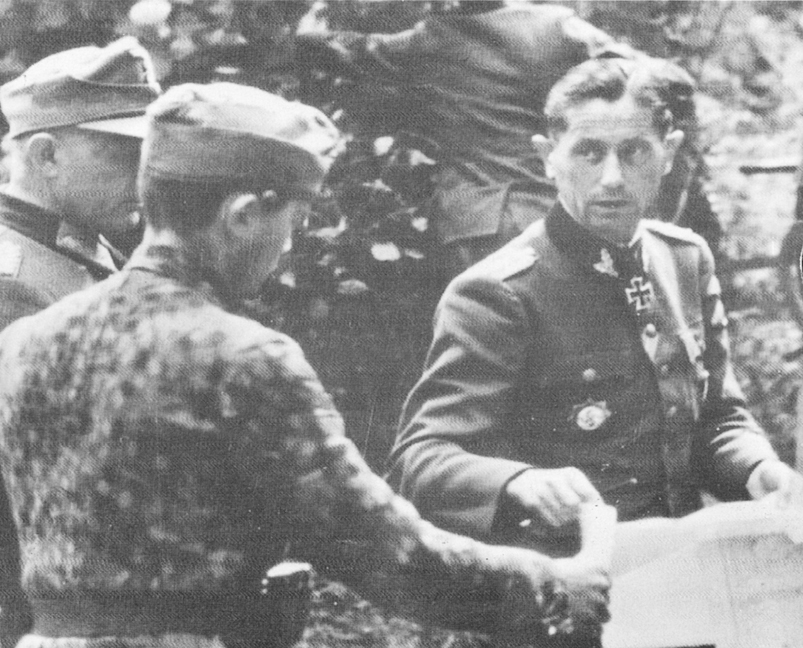
Staff officers at 1 SS Panzerkorps Headquarters brief commanders on the dangerous situation on the Odon front.
While 129 Brigade was taking over, SS-Sturmbannführer Krause ordered the remnants of I/26 SS Pz Grs around St Manvieu to break out. 1 and 3 Kompanies were, however to hold their current positions on the shoulder of the British breakthrough. SS-Unterscharführer Heinrich Bassenauer described the withdrawal:
‘After darkness we assembled for the breakout: in the lead, Papa Krause, a huge figure and a shining fatherly example, followed by the rest of his battalion, including our own wounded and prisoners. Unnoticed, we slipped through the English [sic] in a tall grain field, crossed the Caen – Fontenay Road, and reached the Marcelet – Verson road, where we were welcomed by our own units. During the following day, we moved into new positions at the southern slope of the Carpiquet airfield.’
Further west 5 Wilts was to take over positions from 8 RS in the le Gaule area. Sergeant Romain described how the battalion moved forward:
‘From Brecy we travelled through Norrey, then left the road to sweep across country to le Gaule. My first sickening sight of death in the fighting was to see two of the Royal Scots infantrymen straddling the barbed wire fence as we entered the village. … We hadn’t been there long before we were mortared and I dived into the nearest hole. It was a German latrine! I came out quicker than I went in – smelling – and fighting mad.’
5 Wilts’s relief in place at le Gaule, completed at 0300 hours, was the only part of the Wessex Division’s first operation that went to plan, all be it well behind schedule.
214 Brigade was to take over defence of Cheux and le Haut du Bosq from 46 (Highland) Brigade. On the main axis, mixed in with 11th Armoured Division and 46 Brigade’s transport, 5 Duke of Cornwall’s Light Infantry (5 DCLI) and 1 Worcesters spent most of the night in traffic jams that separated the marching infantry from their vehicles and support weapons. ‘It was an extremely unpleasant baptism, as we were wet through and being regularly shelled.’ wrote a Worcesters officer. The DCLI’s historian recorded that:
‘In such confusion, and in the dark, it was not practicable for the Fifth to take over until daybreak, and in this the Brigade commander concurred. It was a night of heavy rain and the battalion started to move forward at 2 a.m., partly across the field in which a mass of artillery was busily digging in.’
Because of the confusion, with too many troops using a single axis, with remnants of a determined enemy still active and with heavy mortaring impeding progress, by dawn 214 had failed to relief 46 Brigade.
Summary of the First Day’s Operations
A remarkably frank view of the fighting on 26 June 1944 is to be found in VIII Corps’s midnight situation report which, is recorded in their war diary:
‘All units (except 3 RTR) were in action for the first time and the majority of the officers and NCO gained their first battle experience. All reports indicate that the units were well led and that troops fought bravely, skilfully and daringly. They were facing an enemy who fought with fanatical determination, in terrain, which he knew well and had prepared for defence. The broken terrain and inaccurate maps made orientation difficult … causing first reports to indicate greater progress than had in reality been the case.
‘The broken terrain was advantageous to the defenders and the enemy made full use of this advantage. The fighting was mostly at short range.…
‘When there were indications of a breakthrough on a narrow front, both flanks were open and the broken ground again helped the enemy. He missed no opportunity to harass our flanks.’
Once through the enemy’s main position, the British were advancing across the grain of the country. For example, with most roads running east – west, the local road running south through Cheux was expected to bear hundreds of wheeled vehicles and with heavy rain, it and other cleared cross country routes were soon reduced to mud. As expected, a narrow salient was beginning to form that eventually became known as the ‘Scottish Corridor’. Meanwhile, the Germans still occupied dominating positions on the Rauray Spur. In addition, enemy artillery observers on the high ground at Carpiquet, had good views across EPSOM’s lower ground and German commanders had plenty of notice of renewed British attacks.
With enemy anti-tank and dual purpose 88mm guns surviving the bombardment and the Hitlerjugend’s Mark IVs of II/12 SS Pz Regt redeploying to face 15th Scottish Division, the British armour was fighting its own battle for survival. Consequently, the tanks and infantry were not combining their combat power to best effect. Referring to the first day’s fighting, Major General Pip Roberts said that ‘Co-operation between 15th Scottish and 11th Armoured was not very close; we rather went our separate ways’.
Even though a degree of tactical surprise was achieved, the Highland and Lowland Brigades were not able to smash their way through 26 SS Pz Gr Regt’s defensive positions, as quickly as envisaged. This gave the Hitlerjugend an opportunity to regain its balance and its midnight situation report recorded:
‘While strong enemy tank forces advanced in the area north east of Norrey until 2000 hours, the remains of 12 SS Pi Bn, 26 SS Pz Gr Regt and 12 SS Pz Recce Bn, and in particular 12 SS Pz Regt under SS Obersturmbannführer Wunsch, repelled all enemy attacks. After all these crises had been overcome, a new main line of defence has been formed, with the weak available forces.’
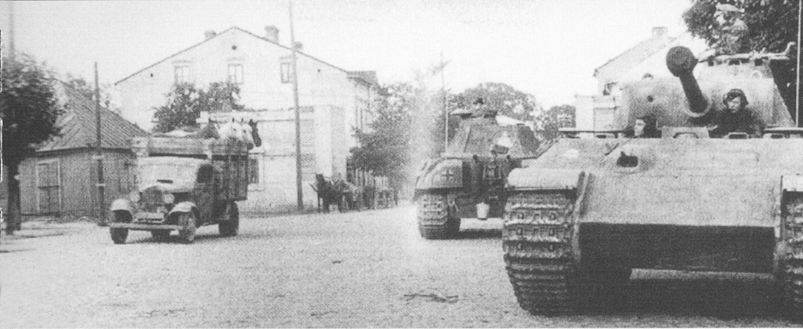
2nd Das Reich SS Panzer Division Panthers during their hurried drive east towards the ‘Scottish Corridor’.
These ‘weak available forces’ were supplemented over night by SS panzer grenadiers and pioneers who had been by-passed or had gone to ground during the day and made their way south under cover of darkness.
Despite VIII Corps failing to keep up with its planned rates of advance and the poor armour-infantry coordination, SS-Obergruppenführer Dietrich, at HQ I SS Panzerkorps, was clamouring for support from Seventh Armee, fearing an overnight British attack. He signalled:
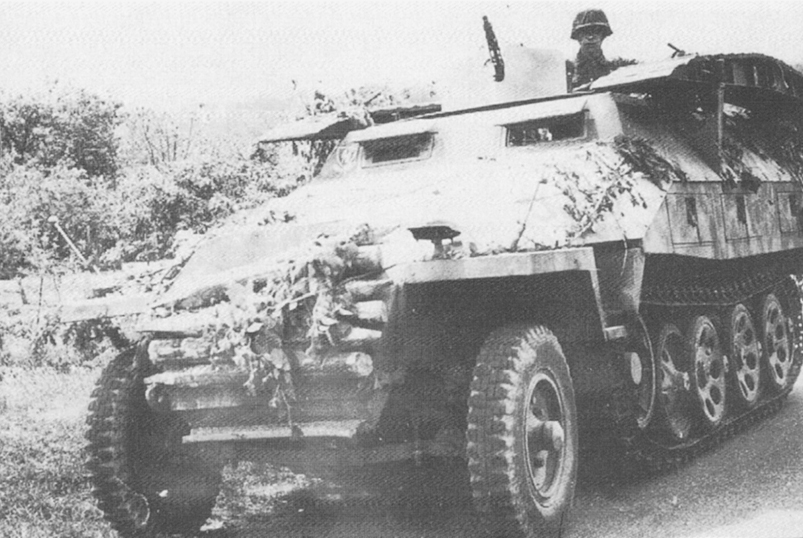
A halftrack belonging to the pioneer battalion of 12th Hitlerjungend SS Panzer Division during the fighting in June 1944.
‘If further reinforcements are not sent up to night, a break-through on both sides of Cheux cannot be prevented.’
According to Hubert Meyer:
‘The line consisted, especially in the central sector, of a chain of dispersed strongpoints without any depth. It could not withstand a renewed strong attack, in particular of strong tank forces.’
‘Panzermeyer’, recalled this period:
‘Time had lost meaning for us. We worked on a situation map by the glimmer of candlelight and prepared new defensive positions. I waited desperately for reinforcements’.
The Hitlerjugend’s report continued on similiar lines:
‘The Division expects that the enemy will renew his attack on 27.6.44 from Cheux – St Manvieu – Norrey area, despite his high losses, in order to capture Caen. The Division will defend its position using all available forces. Combat ready are: 30 Pz IVs, 17 Panthers, 233 armoured personnel carriers etc and 14 heavy anti-tank guns.’
Of the German reinforcements promised earlier in the day, the two Leibstandarte infantry battalions were still stranded at St Germain without fuel and were unlikely to arrive before dawn. However, nearer the front were elements of 2nd and 21st Panzer Divisions. These formations, following Rommel’s instruction at 2100 hours, that ‘everything which can be assembled must be thrown into the fight’, were each to provide a kampfgruppe based on a tank battalion. In addition, Kampfgruppe Weidinger, the leading element of 2nd Das Reich SS Panzer Division was driving east from St Lo. Also moving towards the EPSOM battle area, was another battalion of 7th Werferbrigade’s Nebelwerfers or multi-barrel rocket mortars.
As the evening and the night passed without a resumption of the British attack, the mood at HQ I SS Panzerkorps changed from desperation to optimism. A watchkeeper recorded SS-Oberstgruppenführer Dietrich’s view in Seventh Armee’s war diary that the day’s fighting ‘was a complete defensive success’. Shortly afterwards a further message recorded that Dietrich intended to mount a counter-attack based on the eighty panzers available or on the way to the battlefront. The scene was set for the largest set piece battle since D-Day to continue.
As a final note, Major Joscelyne’s words in A Squadron, 7 RTR’s war diary, summarize the impact of the day’s fighting on British units:
‘That day we lost five tanks knocked out and three on mines. We became a squadron of ten tanks and wiser and more sober men. We had lost some of our best officers, NCOs and men, in a few hours, after years of intensive training.’