
CHAPTER FOUR
While SS-Obergruppenführer Dietrich was optimistically planning a counter-attack to round off his ‘defensive victory’, Lieutenant General Sir Richard O’Connor was planing to renew battle at dawn on 27 June 1944. Headquarters 15th Scottish Division had issued the following radio orders, at 2300 hours the previous evening:
‘Enemy now reduced to last reserves on our front. Essential to secure crossings over R ODON as early as possible tomorrow 27 Jun. 227 Bde will secure GRAINVILLE SUR ODON, with 10 HLI attacking first light, with arty and tk sp as already arranged. 227 Bde will thereafter, push down to secure crossings north of GAVRUS 915623 and at 930630 [Toumauville] as quickly as possible supported by two regts 29 Armd Bde. 44 Bde on relief by 129 Bde will conc … in Div Res. 46 Bde on relief will take over COLLEVEILLE from 227 Bde and exploit towards MOUEN.’
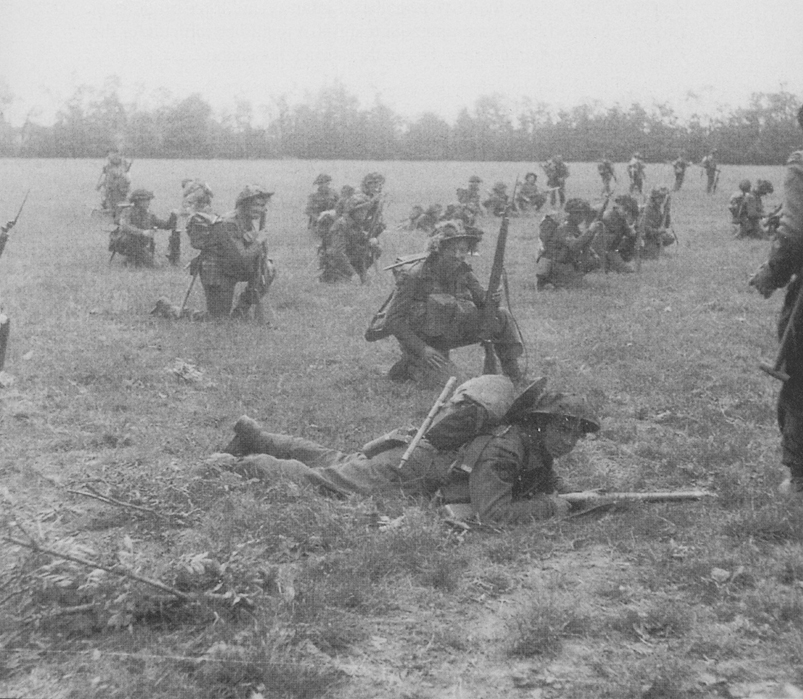
Soldiers of 227 Brigade shaking out into formation in their FUP.
The immediate objective was the capture of the Odon crossings by 15th Scottish Division. VIII Corps’s subsequent objective, to be taken by 11th Armoured Division, remained the River Orne and the open country beyond. West of VIII Corps’s boundary, 49th West Riding Division was to continue its attempt to clear the Rauray Spur, which uncaptured had done so much to undermine the previous day’s attack.
The plan was to continue with EPSOM, making only minor adjustments. To do anything else would have been impossible as, in the confusion of battle, it had taken most of the night to gain an accurate picture of exactly where units were, their strength and where the enemy were. Overnight, the divisional logistic units struggled forward through mud, rubble and traffic chaos with combat supplies. However, with the short June nights, many resupply vehicles were still forward at dawn and added to the difficulties, as the fighting echelons started moving again.
Major General ‘Pip’ Roberts, having seen his tanks stopped in their tracks the previous afternoon, was to wait for 15th Division to bludgeon its way through the enemy positions before unleashing his tanks again. However, with no less than five brigades of infantry and three brigades of armour crammed into about four square miles, it would be difficult for the attackers to gather momentum before they struck the enemy.
Rauray
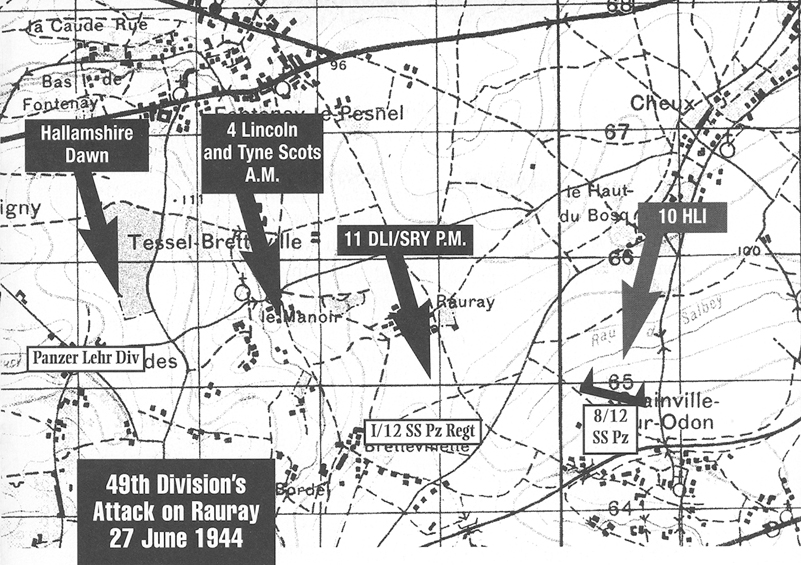
Before dawn, the Hallamshire Battalion advanced and established positions at the southern end of Tessel Wood, while 11 DLI held positions gained the previous evening. Advancing between these two salients 4 Lincoln and the Tyne Scots cleared the central area around la Grande Ferme. Now less exposed, 11 DLI advanced at midday to attack and eventually capture Rauray. However, dominating positions on the ridge further south including Grainville, were still in German hands.
49th West Riding Division
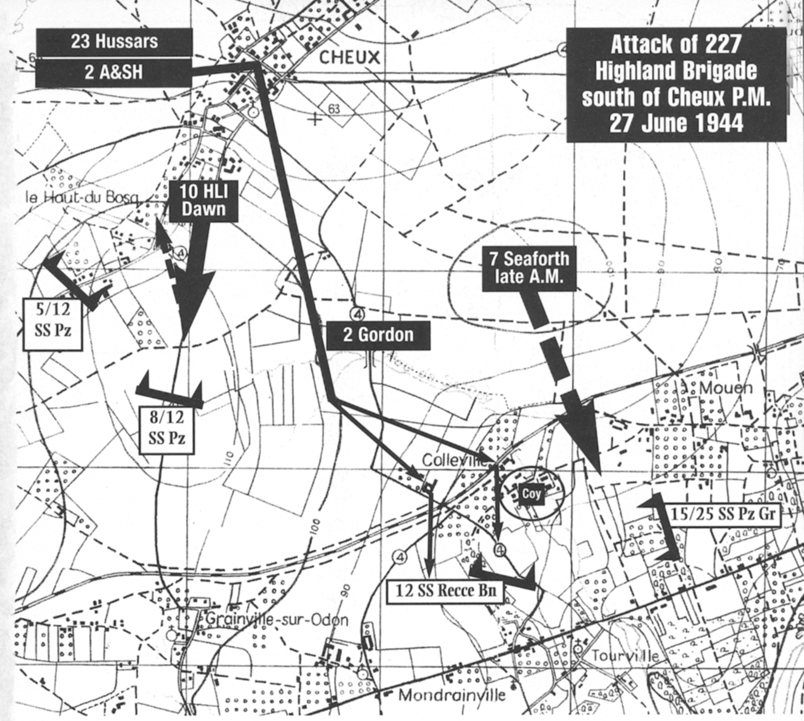
227 Highland Brigade’s renewed Attack
227 Highland Brigade’s plan to renew their advance is recorded in an entry in their war diary.
‘10 HLI will attack to the west of Cheux together with tanks of 31st Tank Brigade. They will capture the Odon crossing near Gavrus. H -Hour at 0445 hours.
‘2 A & S H [Argyll and Sutherland Highlanders] will attack east of Cheux, with tanks as previously scheduled, and will take the crossing south of Tourville [Toumauville Bridge]. H-Hour at 0530 hours.
[Delayed to 0730].
‘29 Armoured Brigade will be prepared to follow up success by 227 Brigade and 159 Infantry Brigade [11th Armoured] will advance via the Odon crossings and establish bridgeheads, as soon as the first tank units have crossed the R. Odon.’
10 HLI was the first unit of 227 Brigade to renew the attack shortly after dawn on 27 June. Lieutenant Robert Sherrin was not impressed:
‘…when we were ordered in again my heart sank. I’d seen so many lads go down, that I saw no chance whatever of success and it all seemed absolutely pointless. I thought, Christ, we’ve got so much artillery why not blast them to hell? It was sheer suicide to send men into an attack against prepared positions and frontally.’
Despite a heavy preliminary bombardment, SS-Hauptsturmführer Hans Siegel’s 8 Kompanie II/12 Pz Regt, still with only four serviceable Mark IVs, was ready and waiting. However, now they were supported by remnants from II/26 SS Pz Gr and 12 SS Pi Battalion. Siegel, writing in the third person, describes how he was away on a recce when the British bombardment started and, in his absence, the panzers pulled back:
‘The panzers are ordered back into their starting positions. They arrive just in time as an infantry attack begins from the heights south of Cheux, accompanied by tanks, which are, however, still holding back.
‘They let the attack approach them frontally. Fire only from machine guns, not from the panzer guns, so as not to betray the presence of panzers prematurely. Open fire only on the commander’s [Siegel’s] order. We let them come close and then hammer, at short distance, concentrated fire from four machine guns at the massed attackers who are anxiously firing bullets into the terrain, without aiming. Experience has shown that this tactic works, and the result here is that they run back in panic, under the salvos from our machine guns. We open fire from our panzer guns only on the tanks attacking with the second wave. Again, we achieved full success, without losses of our own. The enemy crews bail out in panic from burning and exploding tanks. The rest of them turn away and, with them, the infantry who disappear behind the hills.’
The Scot’s divisional historian wrote that:
‘By 8.30 AM 10 HLI were again held up… All day the HLI remained pinned under intense mortar-fire. Casualties were heavy, and no praise can be too great for the work of the stretcher-bearers.’
The four valiant but ill-fated attacks by 10 HLI on the second day of EPSOM, however, served to fix the enemy’s attention immediately south of Cheux. Thus thinning the German line elsewhere.
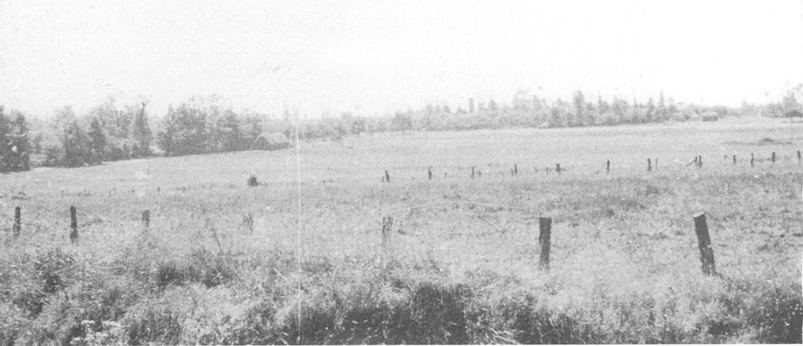
The area south of Je Haut du Bosq that 10 HLI tried to clear.
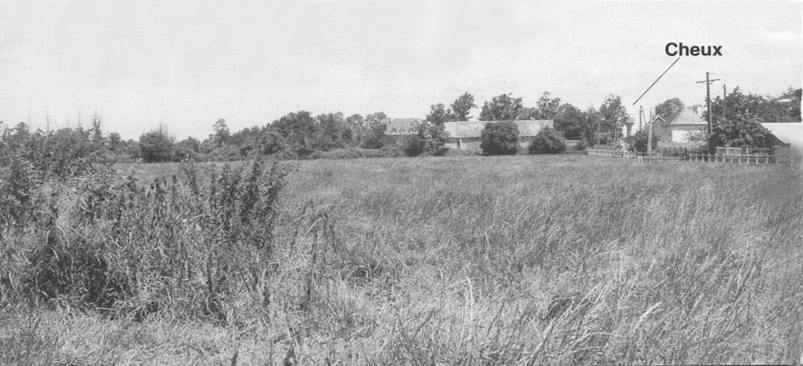
The area south of le Haut du Bosq where 10 HLI were halted by Seigel on the evening of 26 and agian on the morning of 27 July 1944.
The HLI’s CO was not a happy man. After the battle, he gathered his officers and senior NCOs together to address them. According to Sergeant Len Graves the CO stood on an ammunition box and said:
‘I am very disappointed with you all. You’ve shown me what you’re made of; you’re yellow, practically the whole bloody lot of you! I am ashamed of you. There will be some changes made and they won’t be very nice, I can tell you. I’ve never seen such a bloody awful performance, it really was stinking.’
‘We looked at each other and some blokes began muttering about what a fine example he was. One sergeant near me said, “If he thinks it’s f..…g well easy why the f..k doesn’t he get out and do it his bloody self?” I can tell you we all felt the same and our opinion of him went right down, we didn’t care a shit for him, with our pals lying out their dead and maimed while he stood there!’
Former Sergeant Major Bransen candidly spoke about the aftermath of the CO’s address:
‘I was made sergeant in late 1940 after seeing no action at all and spent the war in Britain, ending up with the HLI. I soon learnt in Normandy – too late – that I was not really cut out for it at all. I was not really the combat type and was happier in admin. But I had no choice but to try and set an example. When the shooting started I was terrified and flunked it: I just fell down in a faint and like the rest, ran back the way I’d come. After the CO gave us the bollocking the RSM took me outside with two more Senior NCOs and said “You men are hereby reduced to the ranks, you’re privates from now on. Get out of my bloody sight”.’
This type of incident was played out throughout the army, as men buckled under the searching rigours of combat, be they in action for the first time or in action on one occasion too many.
Nonetheless, 10 HLI in fixing the enemy’s attention had created opportunity for 2 A&SH, whose CO, Lieutenant Colonel Tweedie, was summoned to HQ 227 Brigade. He received his orders at 0530 hours. Supported by 23 Hussars (23 H), his battalion was to advance through 2 Gordons and seize the Tourmauville Bridge across the Odon. His H-Hour was to be 0730 hours. ‘Weary waiting north of Cheux gave place to a mad scramble – such is war. It says a lot for their battle procedure that the Argyles got off on time.’ With a start line north of Cheux, the battalion’s first problem was to get through the chaotic choke-point around the village. Having forced their way through, they passed through 2 Gordons and advanced towards Colleville. By taking this route, the Argyles avoided the exposed Ring Contour 100. Colonel Tweedie also ignored his open flanks and the battle between 10 HLI and Siegel’s panzers, a thousand yards to the west. Corporal Campbell was in charge of one of the Argyle’s 6-pounder anti-tank guns covering the move through Cheux:
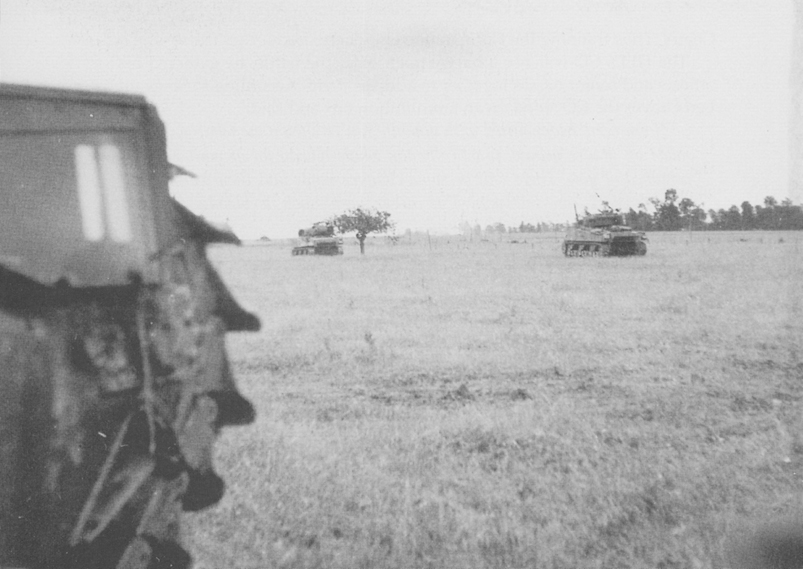
Morning 27 June 23rd Hussars follow 2 A&SH of 227 Brigade towards Colleville.
‘Suddenly 100 yards away a tank appeared side-on in a gateway; this was my first German. He hadn’t seen us and fired at something else. We fired one of the brand new 6-pounder discarding sabot rounds into its side. With the first shot nothing seemed to happen, so I grabbed a second and saw a spurt of flame come out from between the bogey wheels. Then I saw a bloke jumping from the turret – he was well alight. We fired a third shot and the whole thing blew up, knocking me over.’
The Argyles pressed on and the battalion reached the railway line, entered Colleville and ‘mopped it up after house to house fighting’. SS-Sturmbannführer Hubert Meyer, however, typically complained that 2 A&SH had:
‘… encountered a particularly weak spot in our defences. Only weak guards of the Recce Battalion, which had been moved from the operations area Rauray during the night in order to close a dangerous gap here as best they could, were located north of Colleville. The command post of the Battalion was in Mondrainville. 1 Battery of Flakregiment 53, part Flaksturmregiment was also there. Other than that, only members of supply units and stragglers had prepared the town for defence.’
However, this German force had anti-tank punch with 88mm flak guns in the ground defence role and a clear force multipliers in the form of stout stone buildings for the infantry to fight from. The resulting fighting in Colleville was a protracted affair that went on well into the afternoon.
SS-Oberscharführer August Zinssmeister, an armoured car commander in 12 SS Recce Battalion, wrote:
‘Dead and wounded Tommies are lying at the railway crossing. They are members of an assault squad caught by artillery fire. A heavy artillery barrage is raining on Mondrainville and our sector again. The whole area is full of smoke.
‘We encounter a section of our riflemen withdrawing along our path from the railway. A counter-attack with panzers and motorcycle riflemen fails and Tommy is able to get into the village to our flank. We fire everything we have, at close range, with devastating effect. The Tommies send up flares and hammer us with heavy shells.
‘We are reinforced and return for another counter attack along the northern edge of the town. The bushes and hedges are full of English infantry and the firefight continues without pause. The English infantry manage to advance further and now we are coming under anti-tank fire. I order let’s go and we run into a Sherman and I look into its muzzle!’
The SS had been forced out of Colleville and 15th Scottish had finally secured a foothold in the close country on the northern edge of the Odon Valley.
Cheux and the German Counter-Attacks
As has already been described, overnight 44 Brigade had been relieved in St Manvieu and le Gaule to become divisional reserve in the area of Le Mensil Patry. However, 214 Brigade had been unable to relieve 46 Highland Brigade in Cheux and le Haut du Bosq, thus preventing 46 Brigade, less 7 Seaforth, from being available for other tasks on the morning of 27 June.
However, at 0200 hours, 5 Duke of Cornwall’s Light Infantry (5 DCLI) started to move forward to take over from the Cameronians who were in the northern part of le Haut du Bosq. In the southern part of the hamlet, 10 HLI had taken up position following their failure to take Grainville the previous evening.
Major George Taylor, Second in Command of 1 Worcester, recalled that as Lieutenant Colonel Atherton led his battalion past, ‘I wished him luck. He replied sombrely: “I’ll need it George”.’ Private Denis Coulsen recalled 5 DCLI’s advance from the FUP:
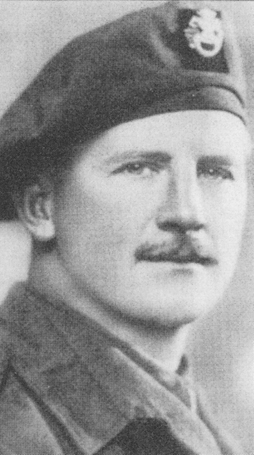
Major George Taylor. Afterwards CO 5 DCLI.
‘We formed up. It was not a bad morning but we were still wet from the soaking we got during the night. We’d had some breakfast but hardly felt like eating. Our battalion was crouched down and ready to go; we had some Churchills of the 7th Tanks. Then the whistles blew and off we went down a grassy slope and in no time, we began to get fire from two sides and we were pinned down. Our officer was hit at once and we heard no more from him. Our Sergeant tried to get us moving but as soon as he rose up he was hit in the arm and fell down moaning. We lay there quite unable to move; the bullets and shells were whizzing overhead and into the ground about us and some more men were hit. Then there were shells falling among us and some panic came so that first a few and then the lot of us were forced to run back the way we came. I had my head down and I could only see one of my mates and not many others of the 500 or so men who started out, but amazingly most of them got back sooner or later. As we crashed down again among the bushes and broken trees I saw our Colonel standing with his glasses by his scout car, and his face was a picture, a mix of anguish and fury.’
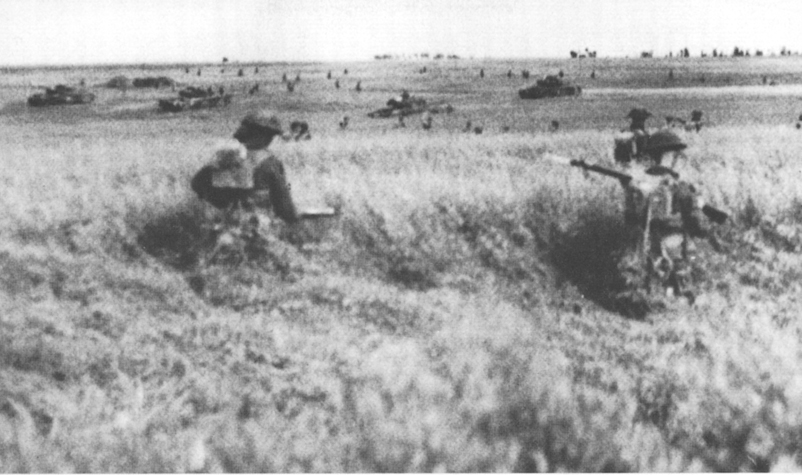
Infantry and supporting Churchills advancing through the waist high corn.
Also withdrawing was Private John Tilsen who explained:
‘I ran back in a hell of a sweat just behind Denis with all that stuff flying about us and was very surprised that we were in one piece. Yes, I saw our Colonel watching, and even before we’d got our breath back the reserve company was sent rushing forward down that hill, past the knocked out Churchills, and they went rushing down the slope waving white sheets and Red Cross armbands to get to the wounded, and some were hit. It was awful to see and I just buried my face in my arm. I’d seen enough and I cried. We’d had a bad introduction to battle – no mistake.’
It took all of Lieutenant Colonel Atherton’s leadership to get the shocked men moving forward to le Haut du Bosq behind the reserve companies who were now leading. They were being engaged from the Rauray Spur, to the DCLI’s right, which was not finally captured until later in the day. But, after a shaky start, the men who became one of the most effective Allied infantry battalions fighting in North West Europe, soon had an opportunity to show their true qualities.
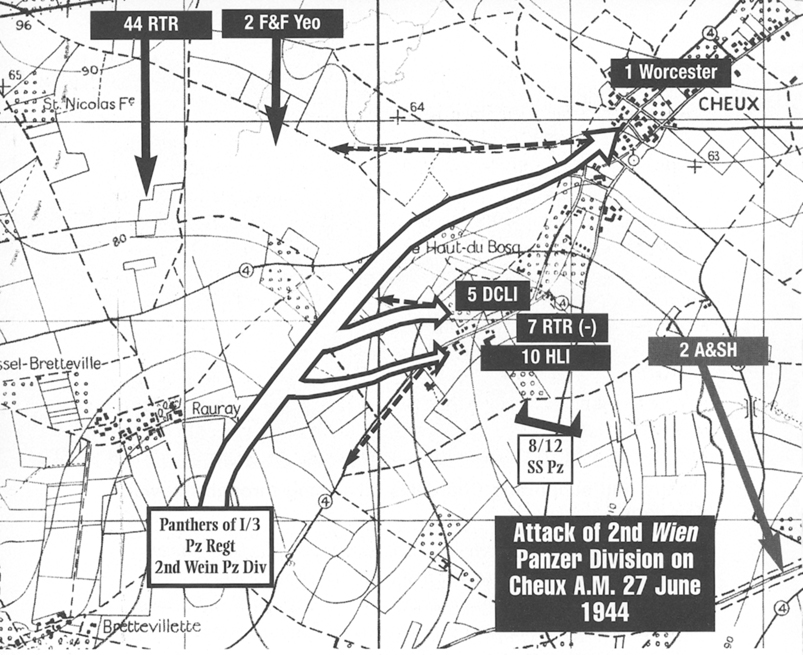
Reaching le Haut du Bosq, 5 DCLI found that the company of 9 Cameronians and their anti-tank guns, who they were to relieve, had already vacated their positions. To the Cornwall’s consternation, le Haut du Bosq was back in hands of enemy riflemen. According to the regimental history:
‘This unfortunate misunderstanding complicated matters for the Fifth, but they started to dig in amongst the orchards and at the same time carried out an active hunt for the snipers who abounded, many of them young SS fanatics who neither gave or received quarter. The chaos of battle was everywhere in evidence. Not far from the village to the north west could be seen part of 11th Armoured Division [44RTR and 2 F&F Yeo], their tanks grouping for action under a steady bombardment from the enemy artillery. On the other side of the village, some flame-thrower tanks were flushing the hedgerows for snipers. In front the crackle of small arms fire never ceased and periodically parties of wounded men and prisoners under escort made their way to the rear.’
As far as the Cornwalls were concerned, they were not in the front line but were to hold le Haut du Bosq in case the troops fighting in front of them were driven back by a counter-attack. Captain Jobson and Corporal Rohan were returning to D Company HQ following a successful ‘sniper’ hunt in the surrounding farm buildings, when:
‘About ten yards up the road we were surprised and glad to see six nice big tanks trundle up the road and turn into Company Headquarters’ Orchard. “Always nice to have armour in support – pretty decent guns on them – funny camouflage. My God! German crosses on their turrets!” This last observation was too awful to be ignored and violent evasive action was taken by the two of us,’
The arrival of six Panther tanks in the centre of a battalion position with out a shot being fired, on that battalion’s first day in action was a dangerous event. What had gone wrong and would a shaky battalion break and run?
Plenty had gone wrong, particularly for the Germans. Their normally smooth regrouping procedures had broken down under the pressure of the British attack. The Kampfgruppe sent from 2nd Wen Panzer Division in response to Rommel’s demands the previous evening, proved to be a battalion of Panthers (I/3 Pz Regt), without infantry. Initially, the battalion reported to Panzer Lehr’s Divisional Headquarters, which had contained 49th Division in its sector, and consequently dispatched the Panthers east to support the Hitlerjugend. SS-Sturmbannführer Meyer complained that I/3 Pz Regt had not reported to his headquarters and said:
‘… this attack was an obvious mistake. In this situation, not even a panzer battalion accompanied by infantry in battalion strength could have achieved lasting success. The enemy superiority was much too great. Instead, the Panthers could have extraordinarily contributed, from favourable positions, in the defence against the attack from Cheux. This is a case where despite best intentions, wrong actions had been ordered in ignorance of the real situation and local conditions. One of the reasons why the divisional command staff had remained in Verson was to be able to direct operations close to the quickly changing circumstances.’
At 0930 hours, the Panthers advanced from Rauray north east to Cheux. Some were engaged by 7 RTR, supporting the stalled 10 HLI, who claimed two kills. 10 HII’s war diary record that, on their western flank, at:
‘1000 hrs tanks [a part of I/3 Pz Regt] broke through into battalion area and were engaged by own anti-tank guns. Five enemy tanks were knocked out. Remainder withdrew and the position was restored by 1100 hrs. One signal truck burnt out after receiving direct hit.’
However, most of the Panthers bypassed the HLI and pressed on, with a reinforced platoon, advancing via a sunken road into le Haut du Bosq, while the main body continued towards Cheux. The six panzers heading for 5 DCLI drove past B Company’s position without being engaged. Captain Jobson continued his account:
‘The leading tank went on for fifty yards, and knocked out a whole troop of 17-pounder anti-tank guns just coming up.
‘Cpl Rohan and myself found ourselves in Sergeant Hicks’s mortar pit. After a brief pow-wow, it was decided that Sergeant Hicks, with his PIAT, should start shooting up the tanks from the back. I went off and organised the three PIAT teams from the three platoons. On returning, I had the pleasure of watching Major Fry and Ptes Jeffries and Parrish being chased all around the orchard. Each time a tank moved it was necessary for them to move also. Funny to watch but not for them. The rest of the Company Headquarters were in their slits, with the tanks actually on top or around them. Next, two German dispatch riders came down the road and Major Fry and I had the honour and pleasure of killing the first Germans in the battalion area. The German tanks then started to edge forward and knocked out the two 6-pounder guns in D Company’s area, wounding most of the crew. Battalion HQ was their next objective. It was a nice hull down shoot for them at about fifty yards range. Very soon there were soft vehicles and carriers brewing up and much activity was near the Battalion HQ ditch. Our 6-pounders replied despite the fact that they were under direct fire. Lieutenant Colonel Atherton was killed in a gallant attempt to keep one gun firing. He was acting as loader, as the rest of the crew was knocked out. At this time, I met the IO.
‘We lay in a shallow ditch in an orchard under the barrel of a 75mm gun with the tracks of the tank not two feet from us. Prayers were said amongst other things! Four PIATs were hitting the tanks up their backside and the Germans did not like it. One fled, hit three times by a 17 Platoon PIAT. …he got away badly hit and the crew well shaken. Sergeant Hicks knocked out another one at short range. Two more went round the corner and were worried by Captain Blackwell of C Company who led a PIAT party. He knocked one out and the other turned itself over in its excitement to escape. Sergeant Willison’s 6-pounder accounted for another when to his own surprise, and everyone else’s, the Panther brewed up at 100 yards range.
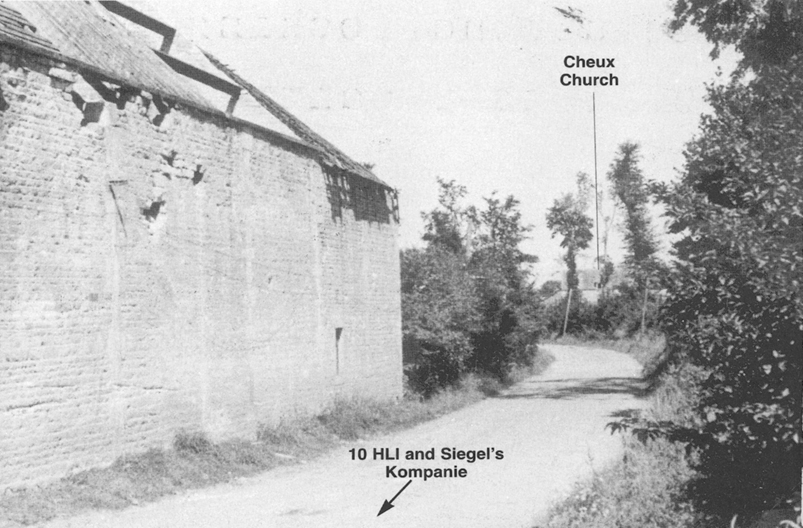
le Haut du Bosq where the Wessex Division’s 17-pounder guns were knocked out.
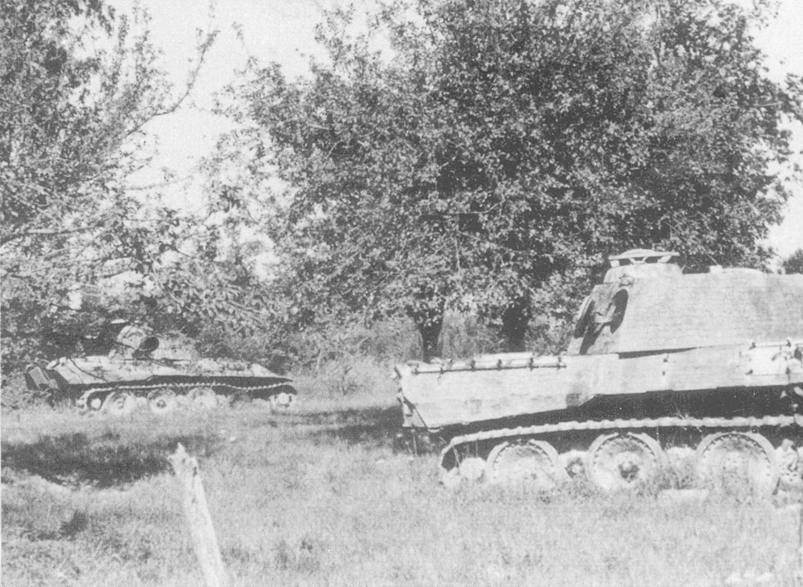
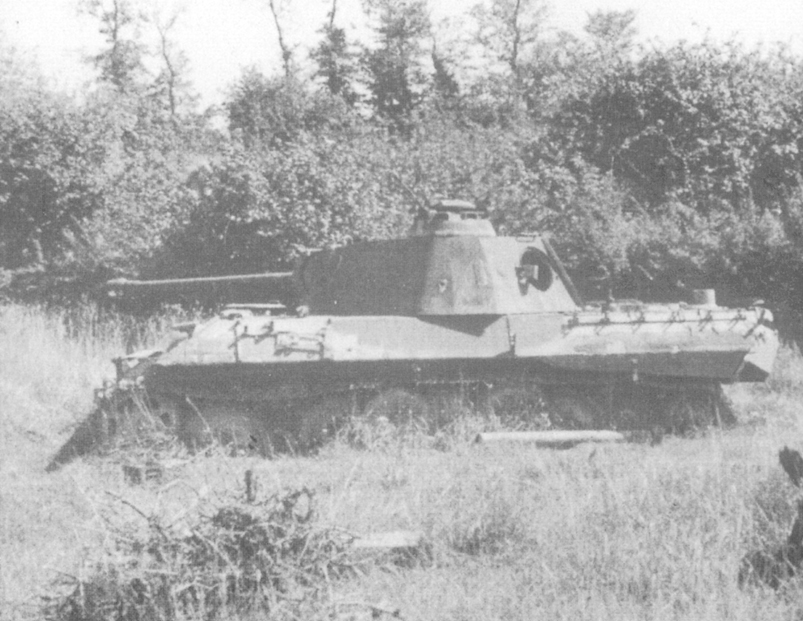
Sergeant Frank Grigg’s photographs of the Panthers in the orchard at Cheux knocked out by 5 DCLI.
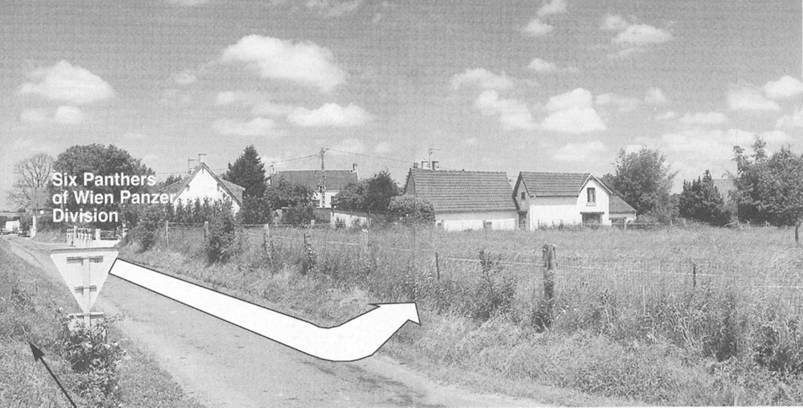
Panorama of the orchard where DCLI knocked out five Panthers.
Sergeant Grigg’s Trench
‘The hunting of the crews was the next phase and exciting sport it made. Four prisoners were captured and about nine Germans were killed.’
Having knocked out five Panthers in close quarter battle, 5 DCLI, a Territorial Army battalion, in action for the first time, with a shaky start two hours earlier, was now the talk of VIII Corps.
While the Cornwalls were in action at le Haut du Bosq, 1 Worcester was taking over the defence of Cheux from 2 Glasgow Highlanders.
‘Not a building was whole and most of them were knocked to pieces. The narrow roads were littered with equipment of all sorts including wreckage of our trucks and tanks, some still burning.’
However, with the Royal Artillery’s 17-pounders still in place, I/3 Pz Regt’s Panthers were unable to press home their attack in Cheux.
The Worcester’s companies had deployed into positions on the outskirts of the village to avoid the worst of the enemy shelling. As a fresh battalion, they found that there were too few slit trenches for them to occupy, so heavy had been the Highlander’s casualties in Cheux. Having taken over the defence of the village, Major Riddle held a Company Orders Group to co-ordinate the details of the defence and while doing so, a mortar bomb killed him and his four officers. Mortar bombs were not the only problem in Cheux. Almost twenty-four hours after the initial occupation individuals were still being shot by ‘snipers’ hiding in the ruins. Once the Battalion was in position, the Worcester’s Sniper Section was sent into the village, where these masters of field craft, observation and marksmanship ruthlessly hunted down the Hitlerjugend. The Germans were in fact not trained snipers at all but where what Brigadier Carver later insisted his Brigade referred to as ‘isolated riflemen’, who bravely fought on. No match for the handful of British marksmen most of the Hitlerjugend still hiding in Cheux, died from a single shot to the head or upper chest. With the final clearance of the enemy from the village, the order was gradually imposed on this battlefield choke point.
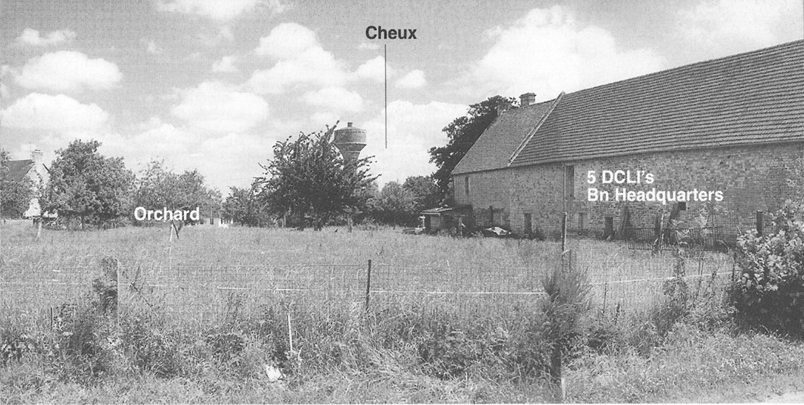
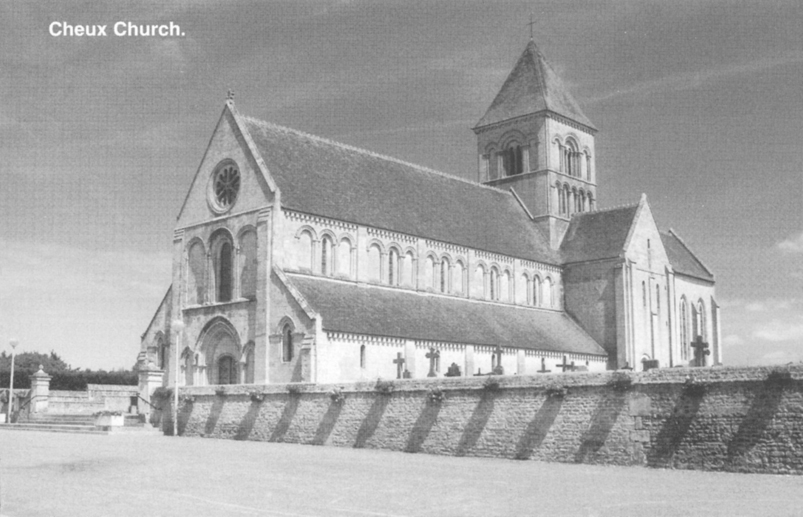
On outskirts of the village, the hedgerows still harboured young, determined SS troopers who were also prepared to die. 1 Worcester’s historian recorded an incident that demonstrated the fanaticism of the Hitlerjugend and the typical response they engendered.
‘On one occasion a German soldier was seen coming cautiously towards a platoon locality with his hands up above his head, but when he got close he suddenly threw a grenade, which luckily did not do any damage, and the only looser was the man himself, who was immediately shot. This soon got around and from then on, no one had the slightest compassion for the other side. Few or no prisoners were taken.’
Without a sniper section to counter the enemy shooting, 151 (Ayrshire Yeomanry) Field Regiment RA’s field newspaper The Yeoman recorded:
‘The tenacity of snipers was well demonstrated by the fact that two Boche were found in woods in the centre of the gun area 24 and 48 hours respectively after we entered the area. One of the above men who gave himself up to 125 Battery had remained hidden in the woods with a wound to his left leg. He belonged to the Engineer Battalion of 12 SS Pz Division. He was obviously frightened that he was going to be shot.’
South east of Cheux, 7 Seaforth, which had been unable to secure the crest of Ring Contour 100 the previous evening, cleared the feature at 1000 hours, having found that the enemy, outflanked by the Argyles, had withdrawn. In due course, the Seaforth took over positions previously occupied by 2 Gordons, who had followed the Argyles into Colleville.
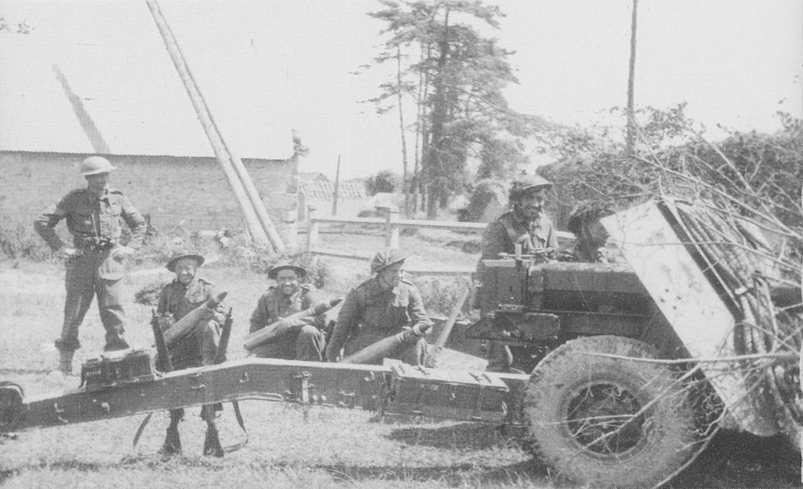
One of the anti-tank regiments’ 17-pounders that had just knocked out a Panther tank that belonged to 2nd Wien Panzer Division on the outskirts of Cheux.
However, on the ridge resolute defenders from SS-Hauptsturmführer Siegel’s 8 Kompanie received freshly repaired Mark IVs that maintained their strength, despite the inevitable losses suffered in a protracted battle. Siegel, himself, was badly burnt when his panzer was hit around midday but his Kompanie held its positions until later in the afternoon.
Despite his success, Siegel’s small force of panzers could not hold the whole front. Further east, 29 Armoured Brigade followed the infantry into Colleville, from where elements of the Brigade were able to advance south behind the Highlanders. At 0925 hours, 11th Armoured Division’s war diary recorded that the ‘Speed of advance increased, with 29 Armoured Brigade pushing on and 3 RTR going wide towards Mouen’. At this point 101 Schwere Panzer Battalion’s Tigers intervened. One kompanie engaged Shermans advancing across Ring Contour 100 towards their positions in the orchards around Mouen, while a second kompanie deployed on the Rauray spur to the west of Seigle’s position. However, faced with tanks from no less than one tank and two armoured brigades even the mighty Tigers were overwhelmed. A couple of entries from 11th Armoured Division’s war diary give a flavour of the fighting:
‘1050 3 RTR destroy one Tiger at 933658 [Mouen] and 942670 [Bas de Mouen]. 23 H destroys one Tiger and one 88mm gun and silence further guns [south of Colleville].
‘1055 owing to the fact that Right of 2 F&F Yeo is being threatened by Tigers from area 900656 [Rauray Spur], 44 RTR [from 4 Armoured Brigade] are ordered to move up and protect flank of 2 FF Yeo advancing south with them.’
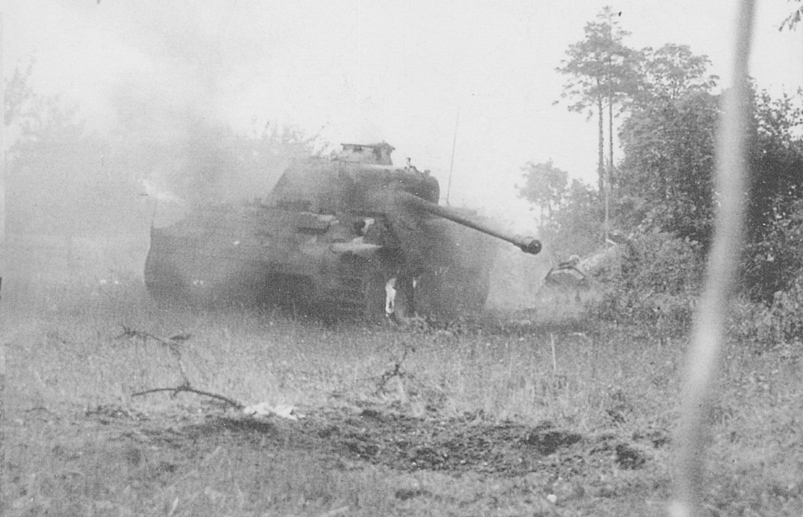
A wrecked Panther knocked out by the 17-pounder, pictured opposite.
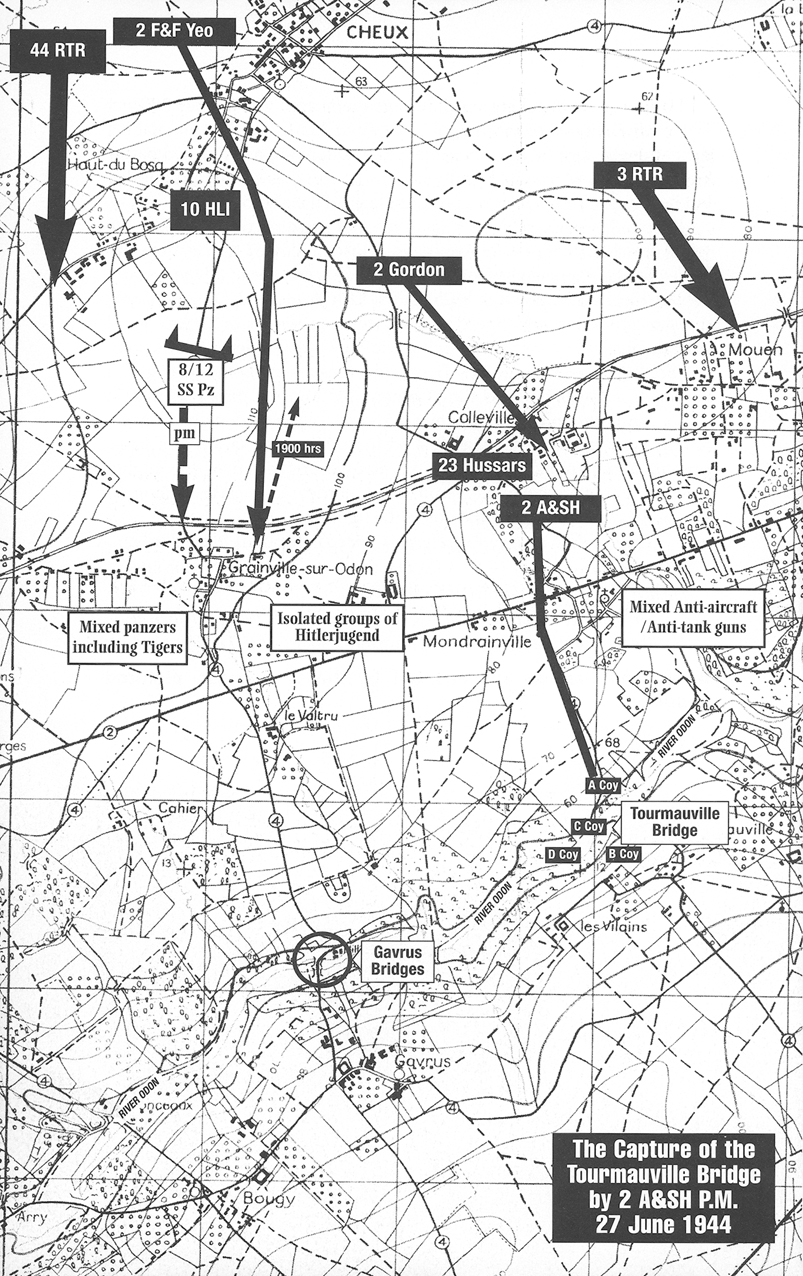
By 1130 hours, the advance was continuing towards the Caen – Villers Bocage Road. Both 227 and 29 Armoured Brigades claim the advance as their success. However, although co-ordination of the two brigade’s efforts was virtually impossible, they had a common aim and, more by accident than design, they effectively supported each other. 23 H following 2 A&SH through Colleville, made the most progress but at 1710 hours, ‘2 F&F Yeo [on the right flank] reported that they expect to reach Grainville shortly’. However, as recorded in 2 FF Yeo’s war diary, this was not to be a breakthrough, as:
‘The German thrust was continuous from the right all day and though A Squadron pushed on to the high ground N of Grainville, the close country on our immediate right, was never cleared’
At 1910 hours, the news that ‘2 F&F Yeo report that they are in Grainville and approaching the main road Caen – Villers Bocage’ was being passed up the chain of command. This good news was followed by word that they were unable to get across the road due to fire from their right flank and ahead of them. 2230 hours, 2 F&F Yeo were pulling back as darkness fell.
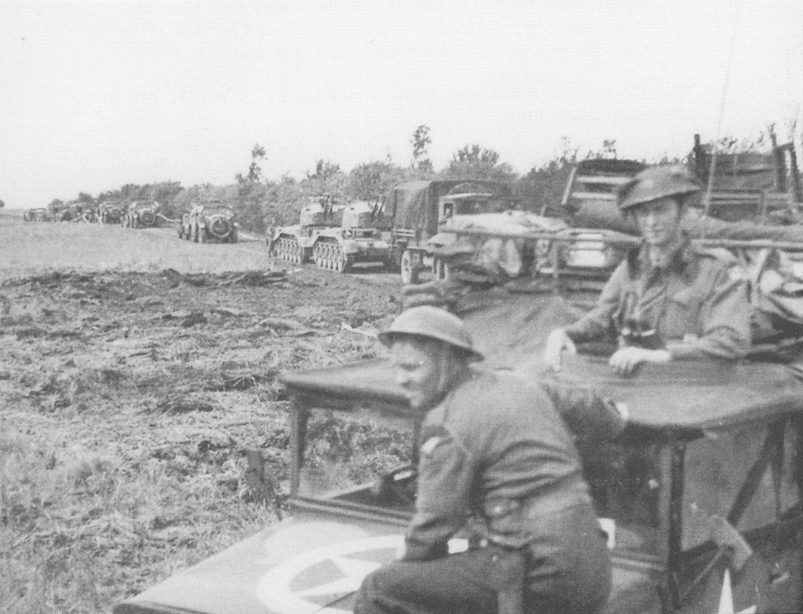
A traffic jam on route. Many logistic vehicles and towed anti-tank guns are protected by a pair of anti-aircraft tanks.
British tanks did not fight at night and habitually withdrew to a leaguer some distance to the rear. The day’s fighting had cost 29 Armoured Brigade nineteen ordinary Shermans and five 17-pounder Fireflies while 10 HLI, on the right flank, had lost a further 112 men; almost the equivalent of another whole company.
Capture of the Tourmauville Bridge
The Argyles and 23 H had taken a considerable time to fight through Colleville but by 1500 hours, seven hours after crossing their start line north of Cheux, they had reached the twin villages of Tourville and Mondrainville. These villages, standing on the Caen–Villers-Bocage Road, were covered by patrols from 12 SS Recce Battalion. The 15th’s historian wrote that opposition was ‘quickly mopped up, after driving off armoured cars which were patrolling the highway and knocking-out one of the two panzers that tried to intervene from eastward.’ These panzers summoned to help the recce troops, could not, without infantry support, hope to block the Argyles.
With two companies forming a firm base, 2 A&SH did not dally in the villages. Ignoring the fact that they were in danger of being cut-off Colonel Tweedie ordered an advanced into the Odon Valley. The divisional historian recorded that:
‘… the further advance by B and C Companies, covered by D Company, down the road to Tourmauville for another 1200 yards or so beyond the highway, culminated in the assault by C Company, led by Major Fyfe, to seize the Odon Bridge itself The whole affair was a tactical masterpiece. About 5 p.m. C Company took the [largely undefended] bridge intact.’
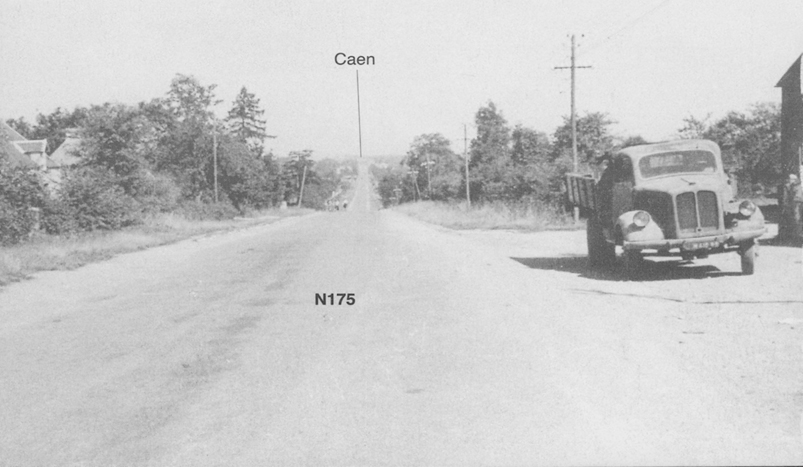
The Caen–Villers-Bocage Road reached by 2 A&SH on the afternoon of 27 June.
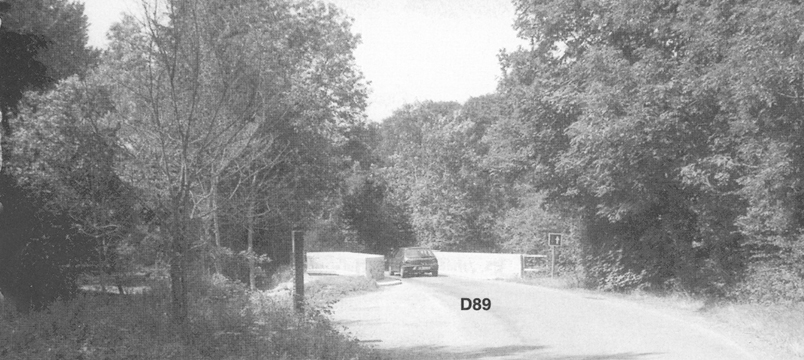
Road leading to the bridge.
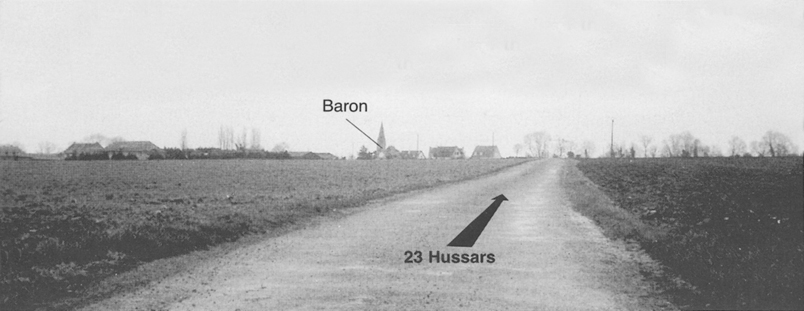
The road from the Tourmauville Bridge to Baron. Hill 112 lies almost directly beyond. 23rd Hussars thrust up this road was halted, forceing them to take a longer route to the east.
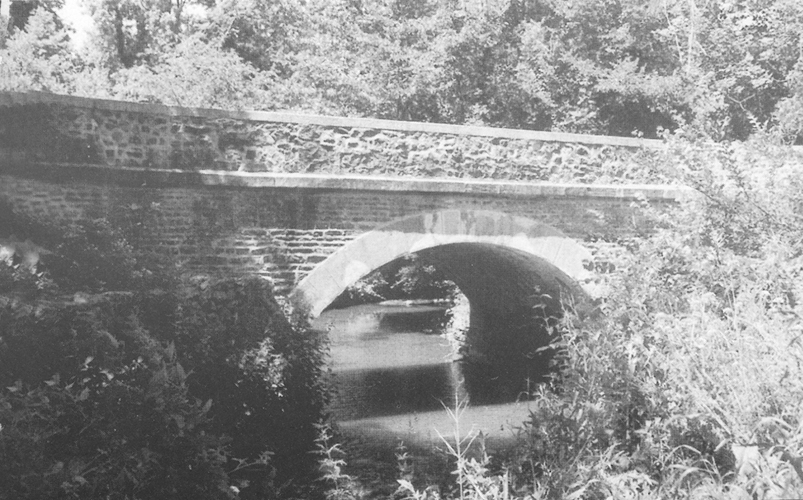
Tourmauviille Bridge.
Supporting C Company’s advance down into the valley was Corporal Campbell and his 6-pounder:
‘We came under machine gun fire. We unlimbered the gun and traced where we reckoned it was coming from; a house 3–400 yards away. This time we loaded with solid shot and we put a round through the top window and a round through a bottom window. End of machine gun fire! Then C Company charged down across open ground to the bridge. We limbered-up and went down to join the company commander.
‘I went across the bridge and with Major Fyfe went up the road towards Tourmauville. Reaching the open ground, he said “This is as far as we go”. I positioned the Company’s PIATs and brought the gun up.’
Lieutenant Colonel Tweedie sent both B and D companies across the Tourmauville Bridge to join C Company. Moving up the slope to where there were better fields of fire, the three companies formed a tight bridgehead about two hundred yards in diameter. A Company, which had hither too been in reserve, held the bridge itself and covered the steep approaches to the bridge down which they had just come. Commanders went around their positions coordinating up arcs of fire and started their men digging-in, before the Hitlerjugend could counter-attack. Meanwhile, signallers were fighting for radio communications. Deep in a narrow, wooded valley it needed all their skill to get the vital message out that ‘QUAGS’ (the code word for Tourmauville Bridge) had been taken.
During the evening, Colonel Tweedie sent two strong fighting patrols to the Gavrus Bridges, which were successfully occupied and the patrols radioed Battalion HQ with details of their success. In seizing the Odon Bridges, 2 A&SH has effectively completed, a day late, 15th Scottish Division’s original Operation EPSOM mission.
11th Armoured Division Reinforces the Bridgehead
Following behind the Argyles were the 23 Hussars Battlegroup, which included companies of 8 Rifle Brigade (8 RB) mounted in half-tracks. Heading south down the slope to the Odon, the tanks did not like the look of the ‘difficult’ or close terrain south of the Caen-Villers Bocage road. Consequently, Major Mackenzie’s H Company, 8 RB was ordered to debus and move ahead of the tanks towards the bridge. They ‘shot up’ remaining anti-tank guns and cleared away small groups of Hitlerjugend who, armed with Panzerfausts were a considerable threat to the tanks.
Half an hour after the Argyles reached the Tourmauville Bridge, H Company leading the Shermans of C Squadron, 23 Hussars, joined them. According to Corporal Campbell of the Argyles, who was only too aware how exposed his position was:
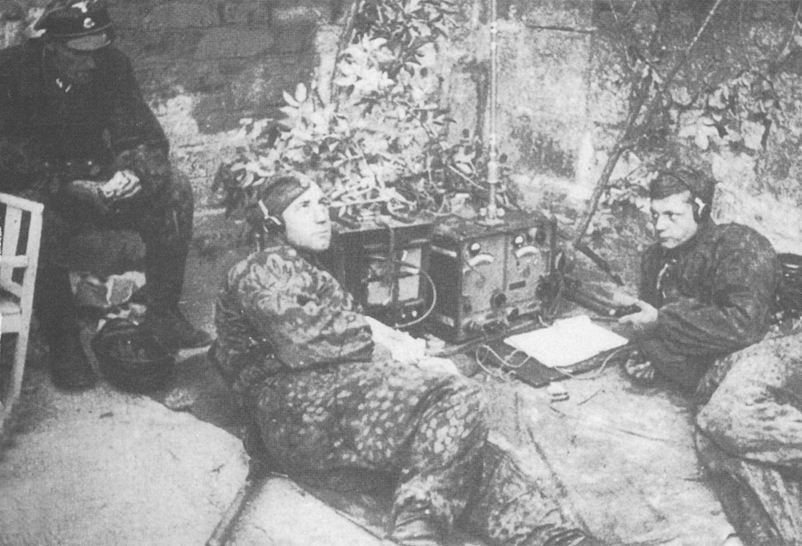
Signallers of the Hitlerjugend appear to be listening to the sound of aircraft overhead – which would have been Allied.
‘They were a wonderful sight to see; those tanks coming down the hill. There were cheers all around.’
Crossing the bridge, as described in 23 H’s regimental history, the tanks:
‘… ground along in low gear up a steep and twisting track through wooded and difficult country until they came out just south of the village of Tourmauville [south of the Odon], where, for the first time, they were able to fan out on ground that gave a good field of fire. Commanders and gunners strained their dust filled eyes. Were some of those bushes camouflaged tanks? One German experienced what was probably the greatest shock of his life. He appeared in a small civilian car from the direction of Esquay. Lance Corporal Evans put an armour piercing shot through the car at a range of twenty yards. Surprisingly the driver managed to get out and, though pursued by Corporal Hoggins with a Sten gun, he got away and was last seen going very fast in the direction of Esquay. This was followed almost at once by a short engagement with some guns and infantry in the area of Gavrus’
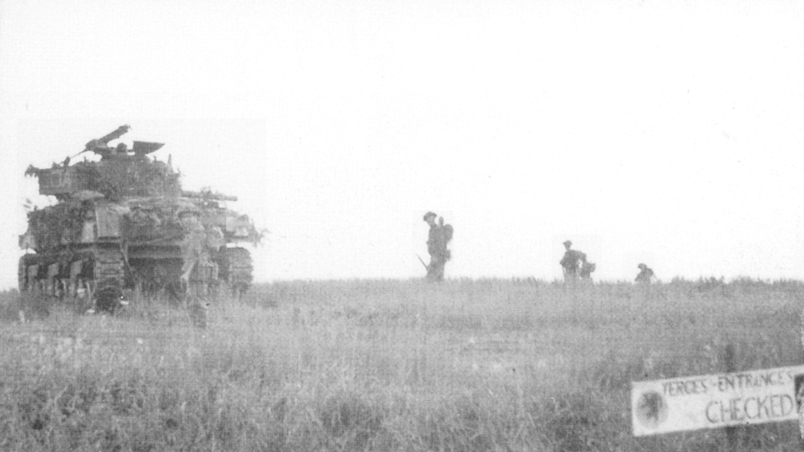
A Sherman belonging to 4th Armoured Brigade and infantry advance through an area, as advertised by the sign, cleared of mines by 279 Field Company RE.
Although 23 H’s leading company/squadron group had found a way down to the Tourmauville Bridge, the route was not fully clear of anti-tank guns that could engage the following squadrons. The Hussar’s regimental historian recorded with his usual understatement that:
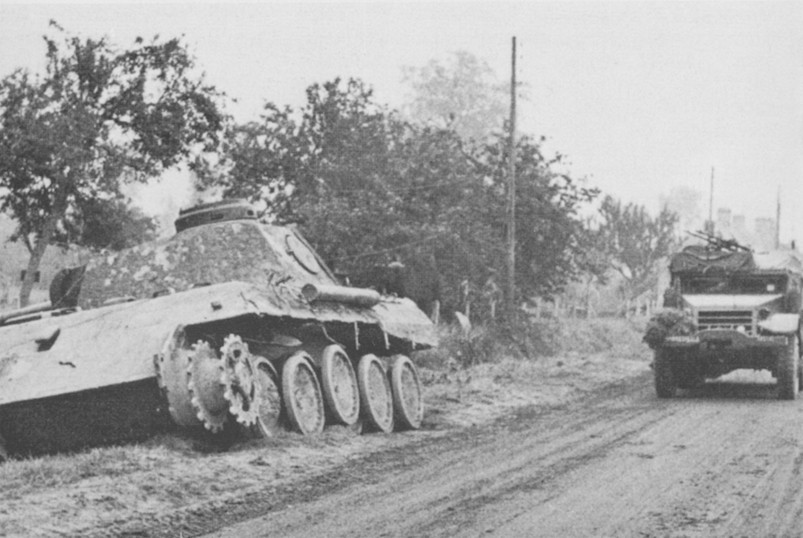
A Panther knocked out on the Tourville road.
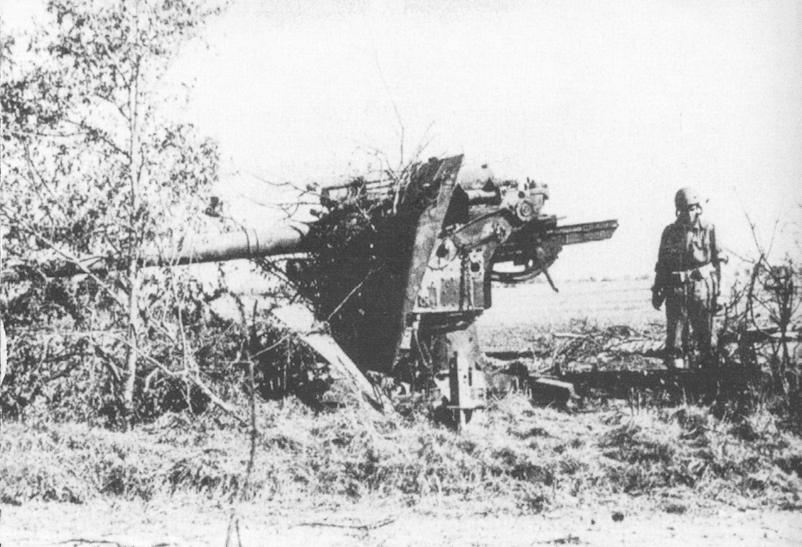
A British tank crew man from 29 Armoured Brigade inspects a knocked-out 88mm gun.
‘Even now, the journey through Mondrainville was not without its excitements. The road was not clear. Beside the tanks of B Squadron, which had been damaged or ditched, a Panther had been knocked out and lay with its long barrel stretching across the road. The result was a good deal of congestion. Two Honey tanks were hit and added to the mounting list of derelicts. … The CO’s tank itself had been taken on as a target by the German gunners, as it came through Mondrainville and to those listening on the Forward Link were amused to hear the Colonel come up on the air in the middle of the battle saying. “Get behind me, Sixteen Charlie, there’s some bastard shooting me up the dock!”’
By 1925 hours, both the depleted B and C Squadrons were across the bridge, having ‘by devious routes made our way down to the river’.
Following up, and trying to make their way through the rubble of Cheux and traffic jams of logistic vehicles, was 11th Armoured Division’s 159 Infantry Brigade.
‘At 2000 hours, accurate information was scarce. Had we taken the bridge? Where were the enemy? No one knew anything for sure, except that 159 Brigade had orders to cross the Odon before dusk.’
The commander, Brigadier Sandie, did not react well to the pressure of the situation and in ‘a chaotic orders group’ gave what his battalion commanders considered an unreasonable H-Hour for the advance. The tired and protesting commanding officers were ordered to be at the start line by 2130 hours. ‘An order is an order! Carry it out or take the consequences! Into battle!’ Major General Roberts was not impressed and the following morning, replaced Brigadier Sandie with Colonel Churcher of the Herefords. However, a VIII Corps staff officer wrote:
‘It is always desirable when a unit goes into battle for the first time for it to be introduced in such a way that the resultant shock is minimized as far as possible and there is time for a reasonably gradual adjustment to war conditions. …159 Infantry Brigade was, however, not so lucky in its battle inoculation, for with darkness falling, it had the unenviable task of enlarging the hard won bridgehead during the night, under constant harassing fire from enemy artillery and mortars, and conscious that by daybreak the position must be consolidated against attack so that the armour would have a firm base from which to operate on the morrow.’
In the gathering darkness, after a chaotic assembly, the leading battalions, 1 Hereford on the right and the 4 King’s Shropshire Light Infantry (KSLI) on the left, both managed to cross the Odon. In reserve, 3 Monmouths (3 Mons) were tasked to take up a defensive position on the north bank as brigade reserve.
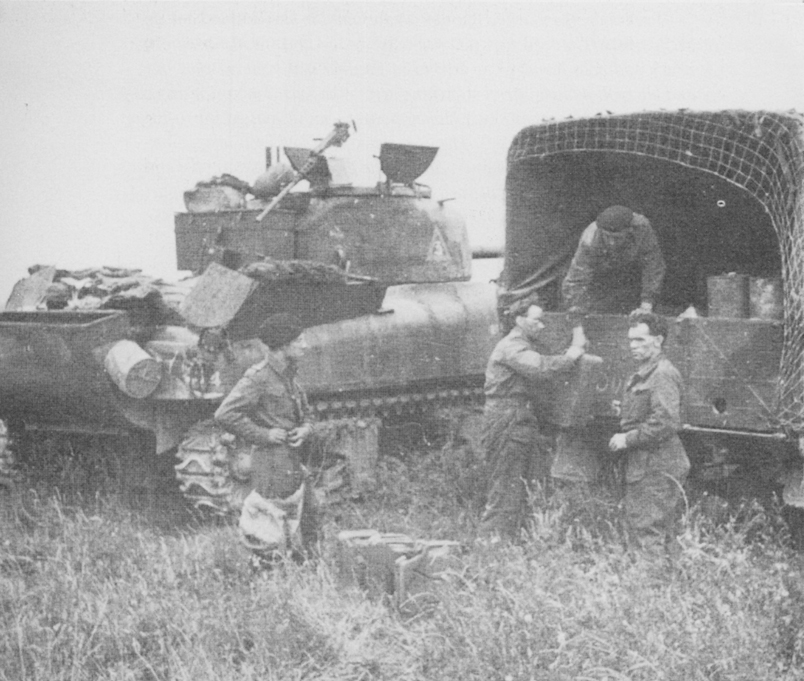
A Sherman of 44 RTR being refuelled during Operation EPSOM, prior to returning to action.
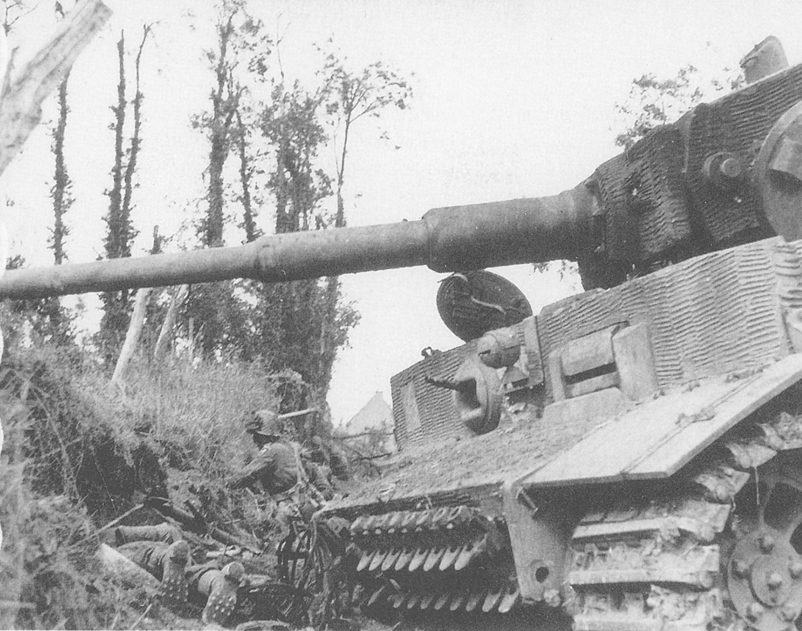
British infantry taking cover alongside a knocked out Tiger belonging to 101 SS Panzer Battalion at Rauray.
Major Ned Thornburn’s description of 4 KSLI’s advance to the Odon portrays the kind of problems the Brigade encountered:
‘We set out along this forest avenue at full light infantry pace, interspersed with stretches at the double. I ran from one platoon commander to the next explaining what the plan for the attack was. Mine was the second or third company in the order of march, so at least I didn’t have the responsibility of trying to achieve the impossible task of reaching the main [Caen – Villers-Bocage] road. I think we assumed that the enemy would be too alarmed by our numbers to show themselves (how naive one can bel). By 2115, I knew we had missed the artillery barrage … I got my two leading platoons lying down along the edge of the forest… I gave the word to commence the attack and we crossed the road. “Time spent in reconnaissance is never wasted”, the book says, but of course no one had done any reconnaissance on this start line and when we attempted to charge forward we found the thickest thorn hedge any of us had ever seen in our lives – utterly and completely unappeasable. I ran along the road for 100 yards or so until I found a gate, and we all walked through it very politely! Little did I think that D Company would deliver its first attack in single file with the company commander leading and reading his map! …we walked safely straight down to the river where, believe it or not we found straight in front of us an ornamental bridge …and we walked 400 yards up a steepish pathway to find ourselves at the gates of the Chateau de Baron. We were on our objective without a single casualty and there was not a soul to be seen anywhere. It was about 2245.’
The remainder of the Battalion followed on twenty minutes later.
The Herefords had less difficulty by simply following the road down to the Tourmauville Bridge and deployed beyond 2 A&SH at 2355 hours. Following behind was 3 Monmouths. However, moving across country from the Cheux area, in the dark, the Monmouths veered to far to the east and entered Mouen. Here they left C Company who took up positions in the houses and farm buildings. This isolated company was to play a significant roll during the following morning’s fighting. The remainder of the battalion moved down into the Odon Valley and dug in position on the north bank of the river.
By dawn, the bridgehead was firmly held by the infantry, supported by two of 29 Armoured Brigade’s regiments. An excellent platform for exploitation had been formed, from which 11th Armoured Division’s tanks should be able to advance to the Orne. An entry in C in C West’s war diary on the evening of 27 June timed 2330 hours, indicates that the Germans had come to the same conclusion:
‘Enemy have so extended their penetration in I SS Panzerkorps sector by the capture of Grainville [and Tourmauville] at 1800 hrs that a breakthrough eastwards to capture Caen is to be expected’.