
CHAPTER FIVE
On the night of 27 – 28 June 1944, Feldmarshalls von Rundstedt and Rommel, who had been summoned to the Eagle’s Nest at Berchesgaden by Hitler, were discussing the situation in Normandy and the massed panzer counter-stroke. However, in the absence of both senior commanders, Headquarters C in C West’s war diary recorded that:
‘Army Group B has instructed Seventh Armee to prevent this [the British breakout] and restore the situation by attacking with all available parts of II SS Panzerkorps, and 8 Werferbrigade.’
Consequently, General Dollman’s Seventh Armee Headquarters issued orders to SS-Obergruppenführer Hauser, directing II SS Panzerkorps to the Odon Front. This was contrary to Hitler’s intention, which was to use this Korps in the counter-stroke towards Bayeux. Under pressure, Dollman added the instruction that Hauser was ‘to attack immediately in order to clear the breach south of Cheux’. Hauser reported that he was unable to attack before 29 June and that he would prefer to fight a holding action. At this point, unable to cope with the situation, Dollman committed suicide. This precipitated confusion and paralysis in the German command. Orders were not reviewed, as newly appointed commanders struggled to get to grips with inherited plans.
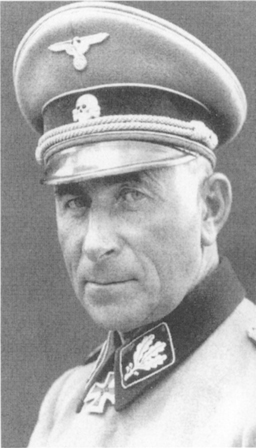
SS-Obergruppenführer Paul Hauser.
By mid afternoon, orders from Hitler were being circulated that SS-Obergruppenführer Hauser, was to assume command of Seventh Armee and, pending the return of von Rundstedt and Rommel, he was also to ‘command the invasion front.’ The resulting chain of moves saw SS-Gruppenführer Bittrich taking command of II SS Panzerkorps, while SS-Standartenführer Thomas Muller, left 20 Pz Gr Regt and took over 9th Frundsberg SS Panzer Division. At possibly the most crucial moment since D-Day, command arrangements in Germany’s remaining full strength elite formation, were in turmoil. This had a significant impact on the battle that II SS Panzerkorps was to fight over the following days. As a final change, General Geyr von Schweppenburg’s HQ PanzergruppeWest was inserted between Hauser at Seventh Armee and the field formations, taking command of the two SS Panzerkorps, XLVII Pz Korps and LXXXVI Infantrie Korps. General Geyr von Schweppenburg’s area of responsibility roughly coincided with that of Second British Army.
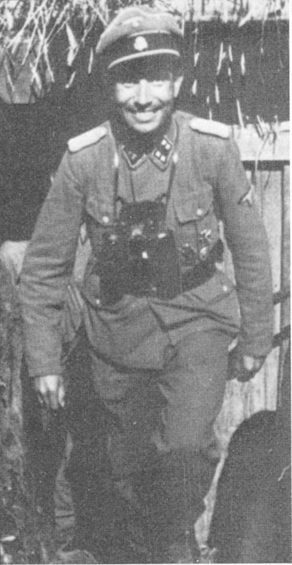
SS-Obersturmbannführer Otto Weidinger commanded the battlegroup Kampfgruppe Weidinger.
At the tactical level, the Hitlerjugend was to be reinforced by further kampfgruppen rushing to face the threat posed by EPSOM. In addition to the Panthers of 2nd Wien Panzer Division which had already arrived, two battalions of the 1st SS LeibstandartePanzer Division and KampfgruppeWeidinger, from 2nd Das Reich SS Panzer Division, were due to arrive on 28 June. Kurt Meyer intended to use these reinforcements to attack from east and west and cut the ‘Corridor’.
Rauray
At midnight on 27/28 June, a signal from XXX Corps to Second Army summarized:
‘Intentions for 28 June. 49th Division is to capture Brettevillette using one Brigade supported by elements of 8 Armoured Brigade and by Corps Artillery. The Brigade group will then reorganize in that area and patrol vigorously.’
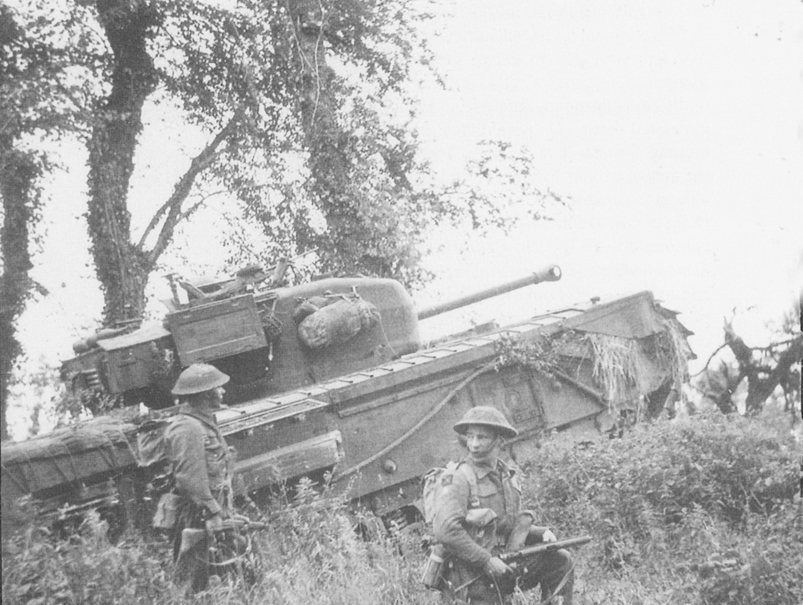
1 Tyneside Scottish, 49th Division.
At 0650 hours, the ‘Polar Bears’ artillery opened a ten minute barrage that preceded the attack by the Tyne Scots on Brettevillette. Opposition was brushed aside and, under cover of a creeping barrage, the battalion reached its initial objective of Bretteville in under an hour. Meanwhile, 11 DLI attacked south from Rauray to clear Point 110, which had been the source of so much trouble on 15th Scottish Division’s western flank the day before. The DLI seized and held Point 110 but the Tyne Scots, now holding their subsequent objective of Brettevillette, were subjected to counter-attacks. They beat of the tired and, by now, disorganized Hitlerjugend but an attack by the fresh Kampfgruppe Weidinger (2nd Das Reich SS Panzer Division) newly arrived from St Lo, ejected the Tynesiders. However, other battalions of 49th Division had closed up behind them and with Point 110 in British hands the significant German tactical advantage of positions on the Rauray Spur had been removed. It had taken four day’s of fighting.
Garvus
With a secure bridgehead over the Odon, VIII Corps confirmed that their intention for 28 June was:
‘… to complete Phase 1 [secure the Gavrus Bridges] and begin Phase 2 Operation EPSOM and secure the high ground north east of Bretteville sur Laize in order to cut roads leading south and south east from Caen.
Overnight, it will be recalled that 2 A&SH completed Phase 1 by dispatching platoon sized patrols to secure the bridges at Gavrus. On the morning of 28 June, with 159 Brigade now forming the bridgehead across the Orne, the remainder of the Argyles moved west to consolidate their hold on the two bridges. Corporal Campbell described the move up the Odon Valley as, ‘very difficult; through thick mud and hedges. It took us two hours to cover a mile to the bridges.’
The Argyles forward companies had not been in the village of Gavrus for long before the Germans probed their positions. Anti-tank gun commander, Corporal Campbell recalled:
‘We came under fire from armoured cars. Firing above us, we could feel the wind of their shot as they went over us and exploded above Battalion HQ in the village. We fired at the armoured car and he withdrew.
‘Half an hour later we were stood-to by a shout from the left “German Infantry.” I could see ten Germans coming through the wood towards us. We were told pull back, which we did under MG fire. We took up a well-camouflaged position to cover the bridge itself and Battalion HQ.’
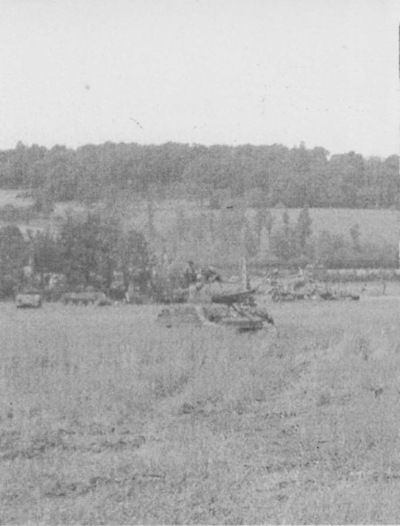
Hill 112
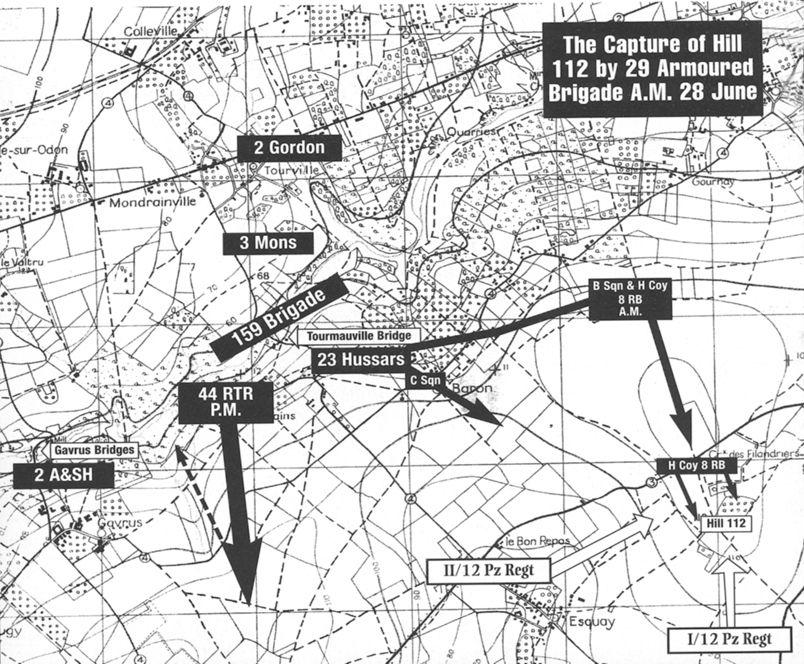
After a sleepless night in the Odon Bridgehead, shortly after dawn on 28 June 1944, 23 H spotted two enemy Mark IVs ‘on the high ground above Eaquay’. They engaged them at a range of 1,200 yards, resulting in ‘one tank being knocked-out and one being damaged’. These two tanks were a part of 5 Kompanie, 12 SS Pz Regt who had fought on the Rauray Spur during the previous three days. Now they were south of the Odon, leaguered, with their exhausted crews taking what rest they could. Otherwise, it was relatively quiet, as 4 KSLI’s history describes:
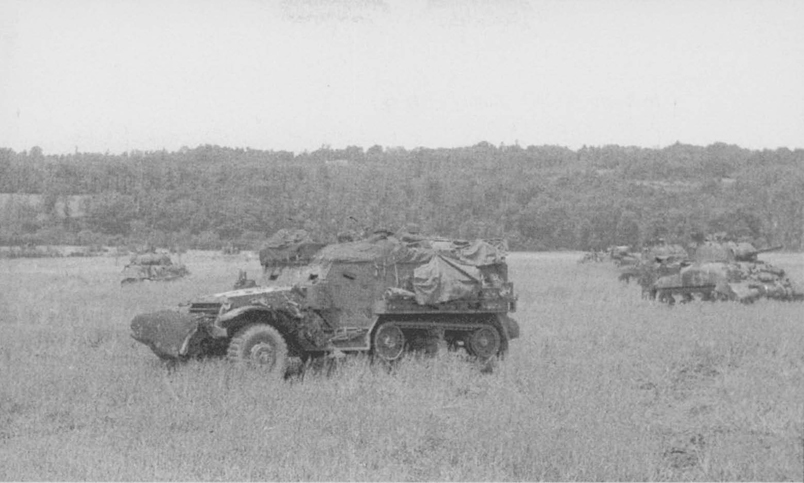
23 Hussars’ Shermans and M3 half-tracks of 8 RB at the foot of Hill 112 in the Baron area.
‘Although no attack came in, a number of the enemy infiltrated between the company positions and made a nuisance of themselves. They first crept up and attacked the RAP [Regimental Aid Post] at a range of about thirty yards, wounding two stretcher-bearers. The reaction of the battalion was fierce, resulting in the expenditure of large quantities of ammunition with little to show for it. These were early days and the battalion was still green. It was soon realized, however, that indiscriminate fire against stray Germans in close country was of little value, and later these men – they were called snipers although they were very ordinary German infantry with the most rudimentary ideas of musketry – were hunted by small parties of men with more success, about ten of them being killed or captured.’
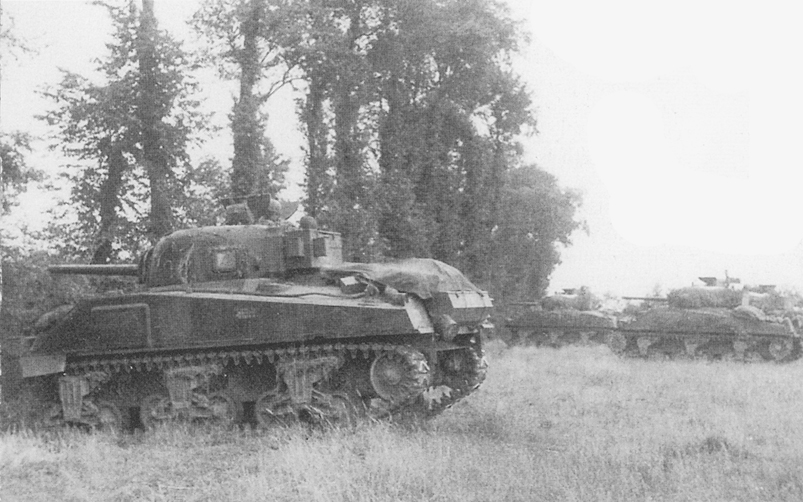
A squadron of 23 Hussars’ Shermans provide cover for the advance of the battlegroup towards Hill 112.
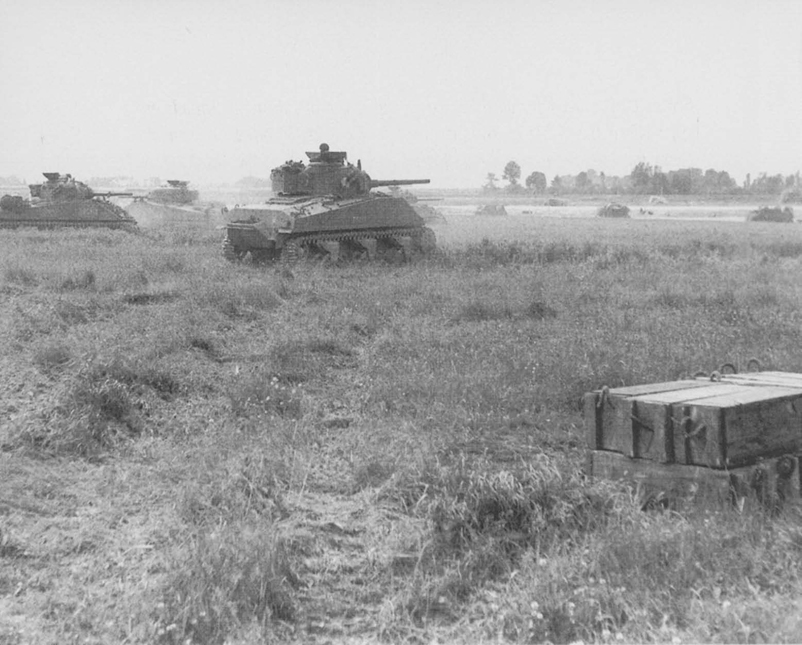
Having replenished their ammunition stocks, British Shermans deploy into their assault formation.
Meanwhile, leaving 159 Infantry Brigade to hold the Bridgehead, 29 Armoured Brigade advanced south towards Hills 112 and 113 and the Orne. 23 H’s Commanding Officer, taking advantage of the Germans’ relative inactivity, dispatched B Squadron to the top of Hill 112. However, a Luftwaffe motorised flak battery, I/53, was deployed around the feature, with its 88mm guns in the ground role. In addition, 11th Armoured Division’s war diary is littered with reports of tank v tank engagements, as 29 Brigade attempted to push south. It was already obvious that the Orne could only be reached after a serious fight. The Hussar’s historian wrote that:
‘C Squadron remained where they were to give B Squadron covering fire as they moved forward. Skirting the ruins of Baron, B Squadron approached the hill from the north as the lie of the ground gave most cover for an approach from that direction and most of the enemy fire seemed to be coming from the western slope of the hill. They went for some time over open, undulating country, which was good going for tanks, reminiscent of the Yorkshire Wolds. One tank was hit by a 50 millimetre shot, which broke its track, and Lieutenant. Cochrane’s tank was hit and destroyed. The crew got out and came under heavy fire from both sides… The Squadron had meanwhile, by moving round a little further to the east, had established itself on the northern part of the hill. The enemy opposition in the area consisted of dug-in tanks and infantry in positions in a small wood. Their tanks had alternative sites to move to under cover and were almost impossible to get at. An attempt was made to knock them out with some self-propelled anti-tank guns which were under our command and were sent forward with B Squadron. It was unsuccessful. Medium artillery was tried without effect. Finally, rocket firing Typhoons were called up but the Tigers [more probably Mark IVs and Panthers of 12 SS Pz Regt] were well camouflaged and the pilots were unable to locate them. The Gunners put down red smoke to indicate the target. One round fell amongst our own tanks and the hillside was immediately covered in yellow smoke, tins of which were issued to each tank so that it could signal to our aircraft and assure them that it was friendly. It often worked. On this occasion, the CO dropped the smoke in the turret of his tank to the great amusement of those who were near enough to see what happened and the discomfiture of his crew who found it rather overpowering.’
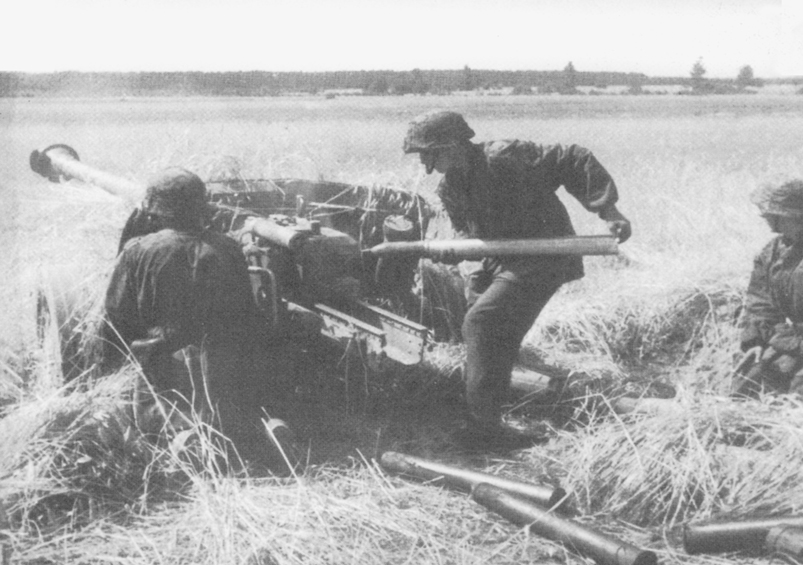
A 75mm anti-tank gun, crewed by SS gunners, in action against advancing enemy armour.
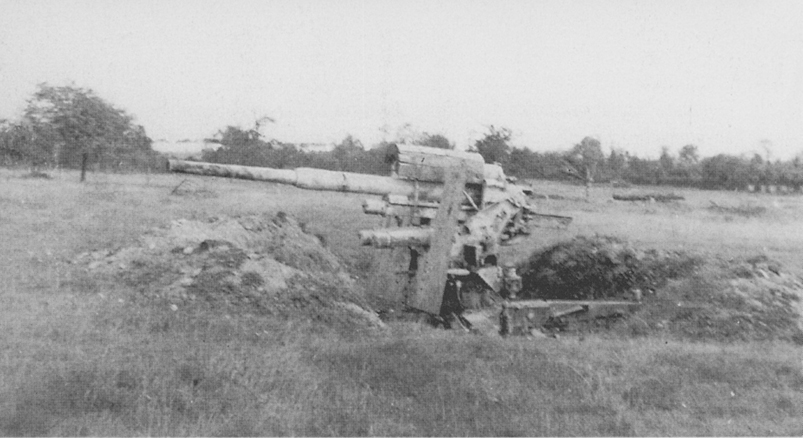
An abandoned German 88mm gun in the Hill 112 area.
C Squadron eventually joined B Squadron on the northern slope of Hill 112, along with Regimental HQ 23 H and H Company 8 RB. At 1235 hours, 29 Armoured Brigade were reporting that they were ‘almost entirely on Pt 112 feature except for western slope’. However, despite much manoeuvring and firing, the out-ranged Hussars could not overcome the interlocking arcs of the 88mm anti-tank guns and losses of Shermans mounted. Smoke from burning tanks, including the Commanding Officer’s tank, started to billow across the battlefield. H Company was sent forward to take the orchard on the top of the hill, which it did, despite taking casualties. Rifleman Roland Jefferson recalls,
‘Hill 112 will always be remembered as our initiation into the real hatefulness of war. We found ourselves in a cornfield protecting the [western] flanks overlooking the valley leading to Esquay.’
It would appear that the hilltop was held by the equivalent of a company of Hitlerjugend panzer grenadiers, who along with the anti-tank gunners fell back as the British infantry advanced on them.
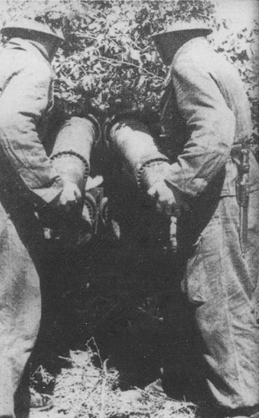
A Nebelwerfer being loaded with its 150mm projectiles.
The news of the British capture of Hill 112 was passed to 8 Werferbrigade by field telephone. Feldwebel Doom, who answered the telephone, ran to get 6 Battery’s commander, who received the following message:
‘Sir, the British are on top of the hill. A Sherman tank has stopped just five metres from one of our observation posts. For God’s sake don’t ring – they’ll hear it. We’ll try and get back somehow. I don’t know what has happened to Leutnant Wernike and Leutnant Nitschmann. I think they must have been overrun.’
‘In order to confirm what was happening, Feldwebel Doom was dispatched with a patrol up the open southern slopes of the hill but he was driven off loosing two men. His report to Hauptmann Gengl confirmed: ‘It’s not just a couple of tanks up there! Tommy’s got anti-tank guns and part of a machine gun unit.’
SS-Obersturmbannführer Max Wünsche planned a quick counter-attack to be delivered by his panzers. The Panthers of I/Battalion attacked from the south, while Mark IVs of II/Battalion advanced up the hill from the south west. SS-Oberscharführer Willy Kretzchmar, aged twenty, commanded one of the panzers climbing the slope from Esquay.
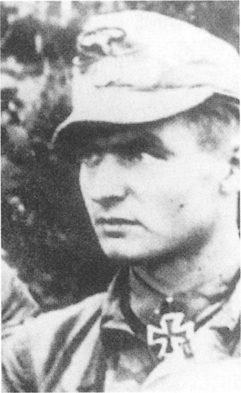
SS-Obersturmbannführer Max Wünsche
‘After a short assembly, we started the attack in a broad wedge formation on that wooded area. We worked our way forward, each panzer giving the other covering fire. Without obvious targets, we fired armour piercing and HE shells into the wood. The attack moved forward briskly. When we had approached to within 300 to 400 m, we spotted retreating English soldiers between the trees. We fired the turret and hull machine guns into the wood.
‘I was now the point panzer. Our advance was roughly north west …We cautiously made our way forward through the small wood. When we came to the end of the cover provided by the little wood, I had an observation halt. With my binoculars, I searched the country stretching away to our left, looking for tanks and anti-tank guns. Nothing suspicious! “Panzer advance!” I shouted. We had advanced ten or fifteen metres when there was a sudden crash. The sparks flew. We had been hit from the right. “Reverse” I shouted. SS-Sturmmann Schneider reacted with lightning speed. Back we shot at full speed. Back into cover of the wood. Not one second too soon! The Englander almost got us! A hairs-breadth in front of our panzer, armour-piercing solid shot was tearing ugly black furrows in the green grass.’
The Hitlerjugend’s counter-attack was beaten off but not before they knocked out further Shermans, some of whom had just arrived as battle-casualty replacements from the Armoured Delivery Squadron. Despite their failure to retake Hill 112, the ring of panzers and the remaining Luftwaffe 88mm guns, to the south of the feature, ‘roped-off the British advance’. In these circumstances, the 23 H battlegroup could not reach the Orne without further support. At 1445 hours, 44 RTR came under command of 29 Armoured Brigade and attempted to advance south to Hill 113 but mutually supporting anti-tank fire prevented a significant advance. However, I SS Panzerkorps, focusing on their vital ground, was not content with containing the British; they wanted Hill 112, ‘the cornerstone of our defences in Normandy’, back in their possession. The young soldiers of 12 SS Pz Regt were to counter-attack again. SS-Obersturmführer Kandier of 5 Kompanie was with them:
‘My gunner, Willi Schnittfinke, reported a defect in the electric firing mechanism. We had to halt, and after a quick repair, we were some distance behind the three panzers manoeuvring in front of us. SS Sturmbannführer Mueller was also hanging back behind Forsch and Kunze. Kunze, in the leading panzer, referring no doubt to those hanging back, shouted over the wireless: “It’s all the bloody same to me! Advance!” Two hundred yards from the little wood Kunze’s panzer was knocked out. Only the gunner and driver baled out. Groeter, the driver, was visibly shaken. He said the shell had gone clean between his legs.’
Another counter-attack had failed.
After almost twelve hours in action on Hill 112, the Hussars needed an ‘ammunition replen’ but in broad daylight, it was impossible to bring the trucks forward. Therefore, at about 1500 hours they were relieved by A Squadron 3 RTR. Major Bill Close described this as ‘A rather daunting proposition, as we moved through some of the burnt out tanks of the Hussars’. They had lost thirty-three troopers killed in action, thirty-three wounded and six missing. Taking a route through Baron, 3 RTR came under ‘intense tank fire’ that cost them their first tank loss of the campaign. Once on the Hill Lieutenant Langdon commented:
‘We remained in these rather negative positions for the remainder of the day. We were able to knock out several anti-tank guns but could make no impression on the dug-in Tiger tanks.’
Sergeant Caswell was with B Squadron 3 RTR on the eastern flank of Hill 112, and summed up why the Germans regarded Hill 112 as vital ground:
‘My tank had a wonderful position from which we could see Carpicjuet airfield, the whole of Caen and to the east the river Orne and the Borgubeus ridge six miles to the east.’
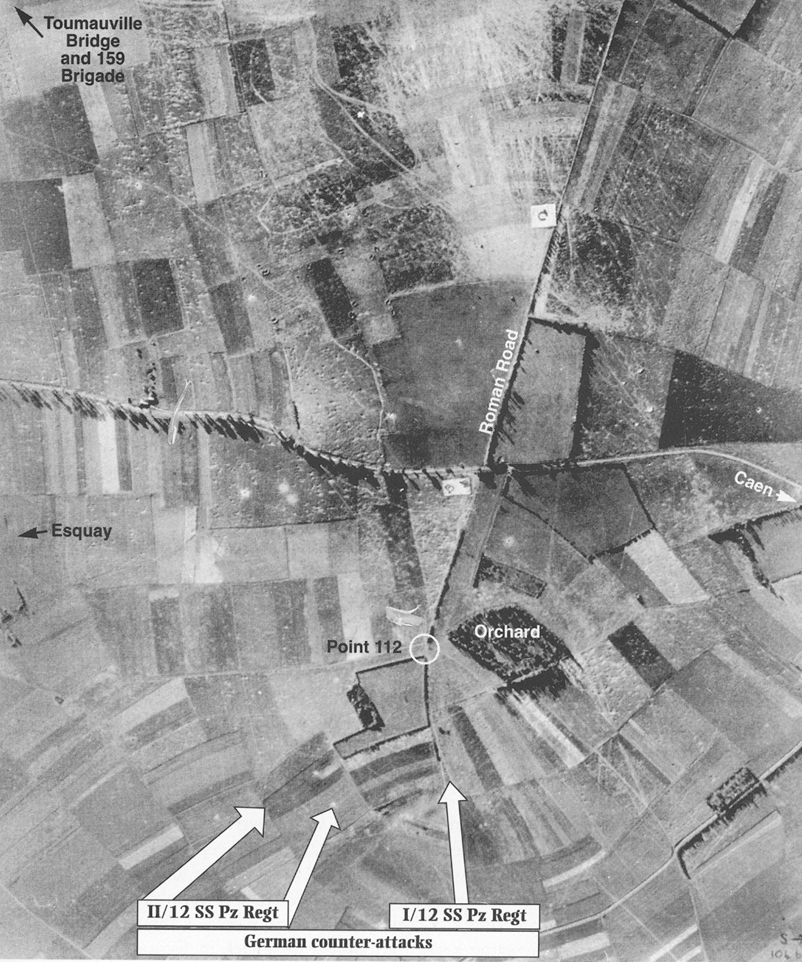
The shell scared Hill 112. Photographed during late June 1944.
G Company 8 RB joined 3 RTR on Hill 112. Rifleman Norman Habertin recalls that shortly after their arrival on the hilltop:
‘The storm broke. The enemy had been watching us settle down and before a single trench had been dug, down came those dreaded “moaning minnies”. There was nothing to do but lie down and bite the earth. A half-track a few yards away went up in flames and when the mortaring finally stopped, the complete battalion was in a state of utter chaos. All the company vehicles were mixed up, no one knew where their section or platoon was, wounded men were yelling for help and nobody in authority could get any orders carried out.’
8 RB were not the only occupants of Hill 112 and it was not long before the British infantry discovered that some enemy bunkers were still occupied.
‘Suddenly a scraggy-looking beggar in field grey appeared from a hedge hatless and with his hands in the air. He was rushed off at the point of a bayonet. He kept looking back, frightened or perhaps worried about what was happening to his companions. A moment later, two more, one an officer, were captured.’
These Wehrmacht officers, possibly Leutnant Wernike and Leutnant Nitschmann were 6 Werferbatterie’s forward observation officers, who had been overrun. Sheltering in their well-prepared dugouts, they had been able to call down fire on their own positions. However, failing to force the British off the hillside, they surrendered.
Despite losses of almost forty Shermans, the British position on the northern edge of Hill 112 seemed secure but 29 Armoured Brigade’s positions were surrounded on three sides. In addition, they were at the end of a very exposed corridor, which was in places, little more than a mile wide. Lieutenant General O’Connor, commander VIII Corps, and Montgomery himself, must have been acutely aware of this as they digested the flash signal from ULTRA: Rommel had authorized the release of the forty thousand men of II SS Panzerkorps. This powerful formation was to attack the British salient from the west and destroy VIII Corps. 11th Armoured Division’s positions in the Odon bridgehead and on Hill 112 were dangerously exposed.
At 1945 hours, with senior British commanders beginning to doubt the wisdom of holding their foothold on Hill 112, a watchkeeper recorded in 11th Armoured Division’s war diary that ‘29 Armoured Brigade report all quiet but 3 RTR heavily engaged if they move forward’. However, at 2150 hours, the Germans attacked again and it was recorded that ‘Royal Artillery report engaging tanks forming up for attack in Esquay’. The artillery failed to break up the attack and the enemy surrounding the Hill 112 closed in.
‘2200 hours. 29 Armoured Brigade report 3 Tigers have appeared on the Hill 112 feature. There is also sniper and machine gun fire coming from Esquay. We [Brigade Headquarters] are being engaged. The situation concerning 3 RTR is slightly confused.’
The accompanying panzer grenadiers advanced up onto Hill 112, forcing G Company, 8 RB to be withdrawn, leaving only a foothold on the northern edge of the plateau but the counter-attack was halted. Lieutenant Langdon of 12 Troop, 3 RTR, wrote that:
‘We remained in position on the hill for 36 hours. That first night was most unpleasant. We more or less stood to in our tanks as we were practically surrounded.’
Hill 112 was already littered with the wrecks of knocked-out armoured vehicles and the bodies of British and German soldiers. For both sides Hill 112 was to become the most notorious spot on the Normandy front. Hill 112 did not to finally fall to the British until 23 August.
The Leibstandarte’s Counter-Attack
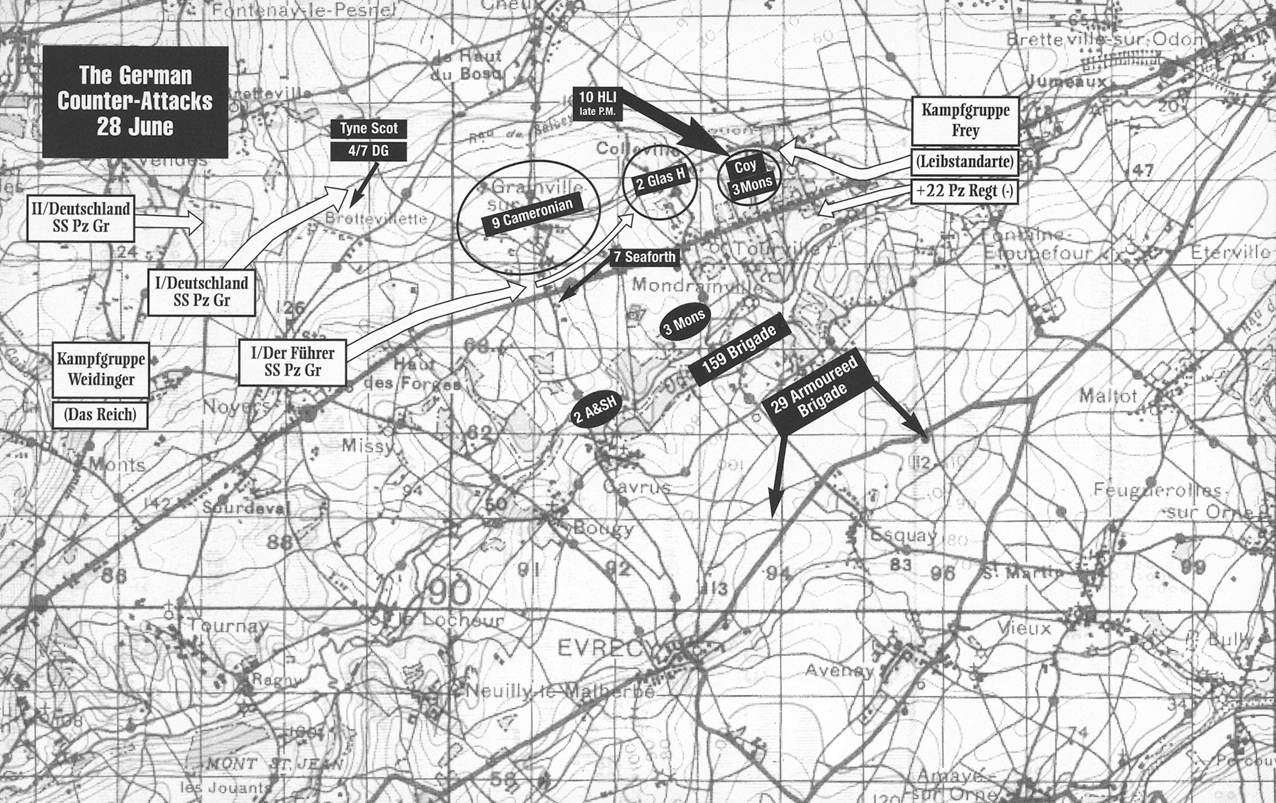
While 11th Armoured Division and the Hitlerjugend spent the day locked in battle on Hill 112, there were serious developments on the flanks of the Corridor. During the night of 27 – 28 June, welcome reinforcements came under command of the Hitlerjugend. SS-Standartenführer Kurt Meyer was not going to allow a repeat of the previous day’s debacle when the Panther’s of 2nd Wien Panzer Division attacked Cheux without infantry support. He planned properly coordinated and supported attacks from east and west along the Caen-Villers-Bocage road, designed to cut the Scottish Corridor and isolate 11th Armoured Division in the Odon Bridgehead, where II SS Panzerkorps would destroy them.
Approaching from the east, the two leading battalions of SS-Obersturmbannführer Albert Frey’s 1 SS Pz Gr Regt, were particularly welcome as the Hitlerjugend was critically short of infantry. However, starved of fuel and harried by Allied fighter bombers, it would take a week before the remainder of the Leibstandarte was complete on the Caen front. Joining Kampfgruppe Frey were the Wehrmacht Mark IVs of 4 Kompanie and five Panthers of 7 Kompanie 22 Pz Regt and three Tigers from 101 SS SchwerepanzerBattalion. This kampfgruppe was to attack from Verson westward towards Colleville.
Taking part in the attack on the western side of the Scottish Corridor was another SS kampfgruppe, under the command of SS-Standartenführer Weidinger. This kampfgruppe was made up from 2nd Das Reich SS Panzer Division’s leading units, which were arriving from south western France. Moving east under cover of night, they had assembled in Noyers in order to attack the Corridor from the west.
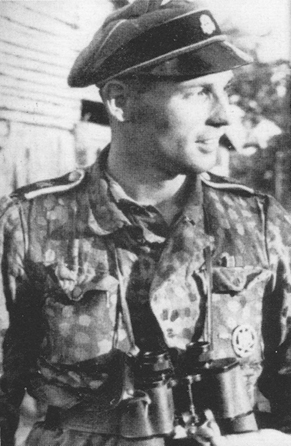
A Leibstandarte officer during the fighting in Normandy.
Positioned astride the Caen–Villers-Bocage Road were the fresh troops of Brigadier Carver’s 4 Armoured Brigade (less 44 RTR). Also in the area to face the German counter-attacks, were a mixture of units, from 11th Armoured and 15th Scottish Divisions, many of whom were fighting under command of an unfamiliar headquarters.
SS-Obersturmbannführer Frey was not, however, happy with the arrangements for what he considered to be a precipitate attack on the eastern side of the Corridor. He later wrote:
‘I received the attack order from SS-Standartenführer Kurt Meyer. I immediately made him aware that I could not execute the order without the support of heavy weapons. I therefore requested a delay until the Leibstandarte’s artillery could arrive. He answered my objection by saying that the artillery of 12th SS Pz Division would support my attack.’
The Leibstandarte’s attack began at 0600 hours, with the panzer grenadiers leading the tanks through the hedges and small fields of the Bocage country towards Mouen and Tourville. The railway and the road were used as the axis of advance. SS-Obersturmbannführer Frey complained:
‘I started the attack at the designated time but it was with a heavy heart that I gave the order. As I had feared, there was no artillery observation officer with me and 12th SS Artillery did not take any action of its own accord. The enemy offered immediate and heavy resistance. A remarkable feature of the resistance was the machine gun fire. It was very heavy and fell with intensity along the entire attack sector. It appeared that they were firing it from tanks.’
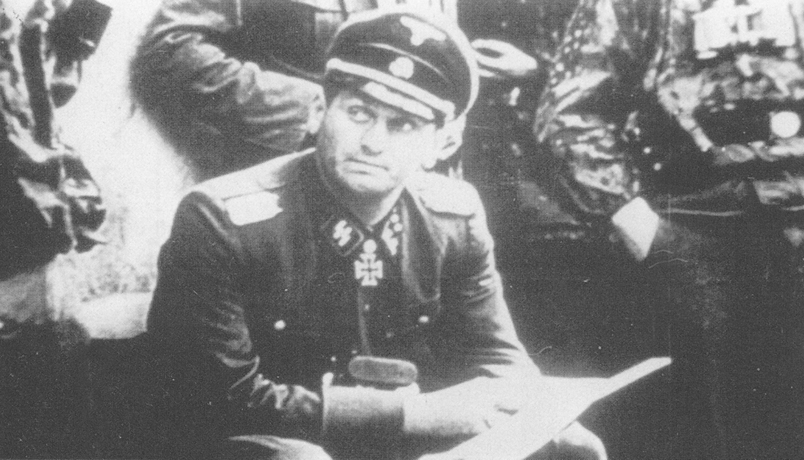
SS-Obersturmbannführer Albert Frey commanded the counter-attack by the Leibstandarte.
For a second time German battle procedure had fallen bellow expectation. However, the advance, despite initial surprise, made slow progress forward against the isolated C Company 3 Monmouths and tanks of 3 County of London Yeomanry (3 CLY). Lieutenant Kendall was a Mons platoon commander. He explained that:
‘We then started to consolidate according to orders and I gave a few directions before sitting down near a ruined house for some tea and consulting my map. A moment or so later some of our chaps at the end of the village ran up to say Jerries were coming. We barely had time to get to our feet before they were upon us, tanks and half-tracks and other stuff, all firing like mad. There was a wild scramble for cover with stuff flying everywhere and the buildings were being torn to pieces by shellbursts. In a matter of seconds, the Jerries were in amongst us and it was hell, pandemonium and a terrific, deafening noise. I tried to get behind a wall but was hit.’
Lieutenant Kendal played dead and had to endure the British bombardment, before he was found by counter-attacking Jocks. Three days later he was back in England, having had his leg amputated. Private Evans also fought with C Company:
‘We were not properly dug-in. Many were killed or wounded in the heavy bombardment. A light recce tank arrived – one of ours [3 CLY]. “Get back, they’ve got heavy tanks!’ we shouted. But it stayed and was soon hit and in flames.’
Commanding a Mark IV in the attack was Werner Kortenhaus of 4 Kompanie 22 Pz Regt, who recalled that:
‘We advanced in the morning, moving along the railway line with the grenadiers. The Panther tanks were further left. My Kompanie had five operational panzers in action. Almost immediately, we ran into fierce opposition. The SS grenadiers came and asked us to help them. They said that they had surrounded a company of British infantry in Mouen.’
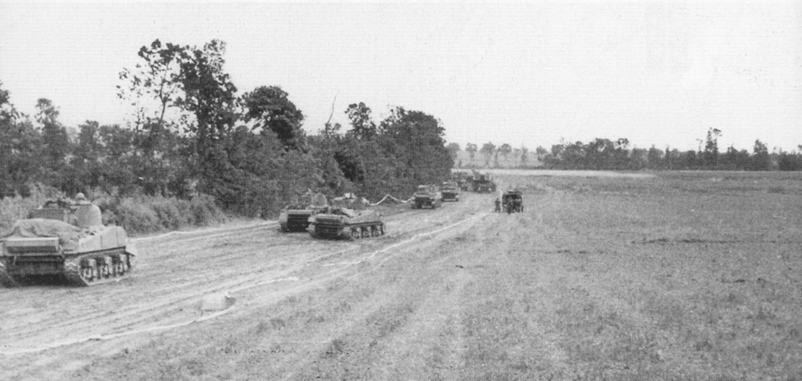
Shermans of 4th Armoured Brigade moving forward on the cleared route around Cheux. Note the mine tape.
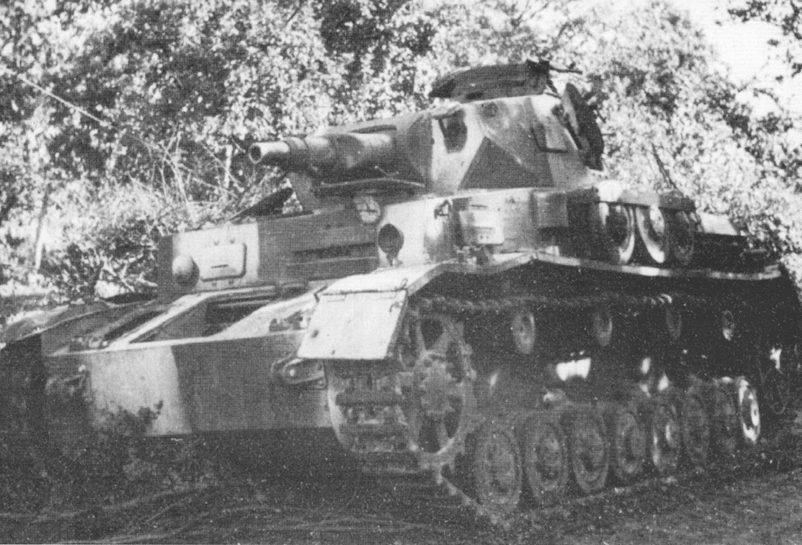
A MkIV belonging to II/22 Pz Regt knocked out while supporting the Leibstandarte. This obsolescent tank would probably have been issued as a replacement from a training unit; it has the short 75mm gun.
C Company 3 Mons fought on but were pushed back by superior numbers and a lack of support until they were overwhelmed. Major Richards and fourteen soldiers escaped, twenty-three were killed and the remainder or taken prisoner by the Leibstandarte. Amongst the prisoners was Private Evans who wrote that:
‘We looked after our wounded as best we could. We carried one on a door used as a stretcher. Later the SS general saw some of his soldiers taking our cigarettes. He was very angry. He pointed to our [11th Armoured Division] shoulder flashes, said something and made them give the cigarettes back. His name was Kurt something or other [Meyer?]. He was a gentleman.’
With C Company 3 Mons overwhelmed in Mouen, the Leibstandarte’s next objective was Colleville. 2 Glas H. were holding the village and the vital route south to the Tourmauville Bridge. The Leibstandarte attacked late in the morning from Mouen but despite securing footholds in Colleville, the SS were driven back by local counter-attacks during the afternoon. Despite failing to cut the Corridor, the Leibstandarte had dangerously narrowed the British salient. To clear up this situation 10 HLI put in an attack on Mouen at 1945 hours supported by a squadron of tanks.’
10 HLI advanced ‘in open formation’, with A Company left and D right, followed respectively by C and B Companies. The Shermans of the County of London Yeomanry moved on either side of the HLI. Private Arkwright, who was with the assault infantry, recalled:
‘They told us we could now get the SS buggers and take care of them. So we perked up a bit and got ready, and soon after that two sergeants led us off carrying Stens and soon we went into the fields. There was some corn and a few bushes and then we heard shouts and bangs and we dashed forward firing like mad and yelling our heads off.’
Advancing through the waist high corn from the area north of Cheux towards the railway line, the HLI came under heavy machine gun fire and the accompanying tanks were engaged by anti-tank guns. The Battalion’s war diary entry for 2015 hours recorded:
‘A-Tk gunfire aimed at tanks on left. One Sherman knocked-out. Heavy MG fire from houses and railway sweeping top of corn. A and B Coys & Bn HQ pinned down by MG fire & unable to advance. Five Panthers destroyed, three Shermans knocked-out.
‘On right: D & B advanced down right of railway towards wood. Before reaching wood came under heavy MG fire from Panther tank, dug-in in the orchard. OC Coy wounded, two subalterns killed. Unable to advance owing to the MG fire sweeping open ground. Withdrew to sunken lane.’
With the advance on the right flank was Private Arkwright, who continued his account:
‘It was fantastic but terrible, as we saw all these bodies of our own chaps and Jerries with brown camouflage jackets, some dead, some wounded, some firing or trying to get away. We showed no mercy at all; we fired in all directions and just wiped out the lot. We were so worked up into a rage.
‘When we got through their first position we soon came under fire from elsewhere, so we dug ourselves in. I felt completely worn out and all in a sweat, and I kept seeing all those poor Jocks lying dead and I felt sick and cried.’
Still in action at Mouen with Kampfgruppe Frey was Werner Kortenhaus of 4 Kompanie 22 Pz Regt, who recalled that:

‘We received a direct hit. The battle had suddenly flared up again. We couldn’t traverse the gun. The turret was jammed. As we pulled back, we were hit again, this time in the rear. Fortunately, the shot bounced off. An hour later, with the turret freed we were back in the thick of the action. One of our panzers was in flames. Another slowly backed out of the battle with the commander, Eichler, lying dead in the turret. He had been decapitated by a shell as he was looking over the top. A third was hit.’
After several further determined attempts to take Mouen from the west, 10 HLI was ordered to pull back at dusk. According to 227 Brigade’s war diary, the Battalion ‘dug-in for the night in a position a few hundred yards from their start line’. Both sides had lost heavily in the battle on the eastern flank on 28 June but above all, SS-Obersturmbannführer Frey’s attack had failed to cut the Corridor and the Leibstandarte were now struggling to hold their limited gains. At this point, 43rd Wessex Division was ordered to take responsibility for the eastern flank and improve the situation before the full weight of II SS Panzerkorp’s expected counter-attack fell on the Corridor.
Das Retch’s Counter-Attack
During the course of 28 June, Kampfgruppe Weidinger, with Mondrainville as its objective, mounted the second part of the counter-attack north of the Odon. With a Panther company in support, the panzer grenadiers of 1st Battalion Deutschland, on the left, attacked Brettevillet and the Rauray Spur, while 1st Battalion Der Führer, on the right, ran into British positions in Grainville.
At Brettevillet the Tyneside Scottish, supported by Shermans of B Squadron 4th/7th Dragoon Guards, who had been advancing south towards the hamlet, clashed with I/Deutschland in an encounter battle. Captain Whitehead wrote:
‘Ground was being made and by 1430 hours, all companies were on their objectives but were engaged in stiff fighting in Brettevillette where they were being counter-attacked in considerable strength by the 2nd SS Panzer Division infantry and tanks. Very confused fighting continued in the village. It was evident that it would not be possible to hold it and the CO ordered the companies back – D Company being only 300 yards from the built-up area.’
The Tyneside Scottish suffered one hundred and twenty-six casualties; however, I/Deutschland also suffered particularly heavy casualties during the battle for Brettevillet. As the British bombardment persisted, wounded SS were still being carried to the rear well into the evening. There was to be no further advance on Kampfgruppe Weidenger’s left flank on evening of 28 June.
On the Kampfgruppe’s right flank, advancing along the main road to Caen, I/Das Führer came under fire from Grainville, to the north of the road, which, unknown to Weidinger, was occupied by 9 Cameronians. Sometime later, to the south of the road, they encountered 7 Seaforth in a meeting engagement at le Valtru. Supporting 46 (Highland) Brigade’s infantry battalions were A and B Squadrons of 9 RTR. The country in which the battle took place was typical bocage, with small fields surrounded by hedged earth banks and sunken lanes.
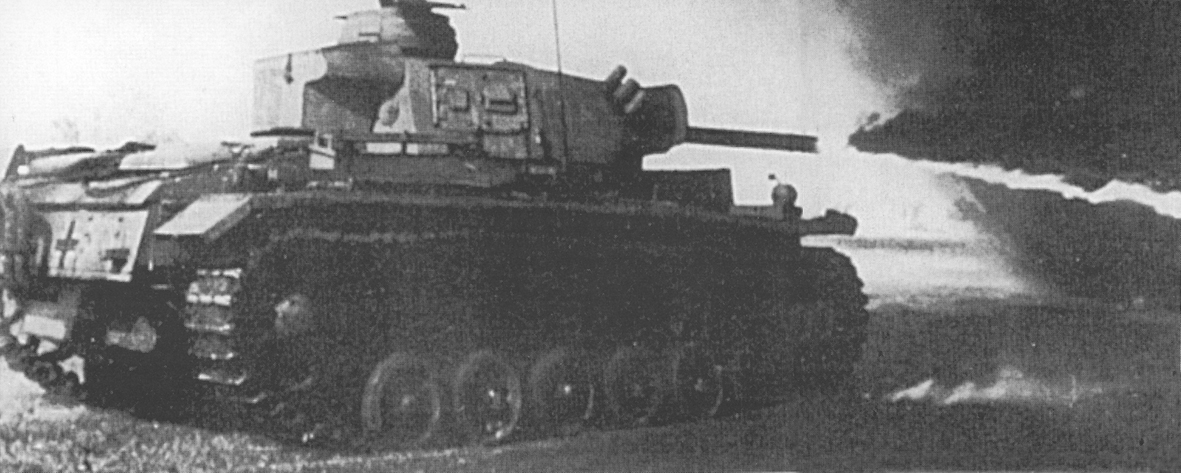
Flammenpanzer III. These older models were given a new lease of life by the conversion to flame projectors.
In this thick country, battle was a matter of infiltration and all round defence rather than bold speedy attacks. For the infantry, it was Nebelwerfers and rifle fire, resulting in heavy casualties. For the RTR’s Churchills, it was a difficult and deadly business. Lieutenant Peter Beal wrote:
‘Shortly after 8 and 10 Troops had reached Grainville, Teddy Mott’s 9 Troop was sent round to the south of the village to clear its southern flank. But in a hedgerow a German tank waited unseen until Teddy was 100 yards or so away and then opened fire. Teddy’s driver and gunner were both killed and the other two wounded. Teddy’s legs were smashed below the knee. He managed to get out of the tank but left one leg on the track guard and had the other amputated after he crawled back through the fields and had been taken by ambulance jeep to the medical services.’
Lieutenant Mott’s Troop Sergeant, George Rathke, recalled seeing his Troop Commander’s tank ‘Inspire’ being hit:
‘… there was a big flash and Inspire was hit, flames belching out of the turret. Then I heard a shell, presumably aimed at my tank, whistle overhead. I had by then told my wireless-op to send out smoke from the 2-inch mortar; I also directed my gunner on the spot where I thought the shots were coming from, and we fired two AP rounds and began to reverse having concealed ourselves in smoke.
‘Having reversed about 100 yards, I halted and looked for survivors. I spotted Jimmy Deem running towards some other tanks of the squadron among the orchards. Suddenly several German machine guns opened on him and he fell to the ground. We engaged the machine guns with Bessa and fired a couple of HE shells into the hedgerows concealing the German machine guns. All this happened in a matter of minutes – which seemed like hours.’
The infantry held their positions in the villages and in the surrounding orchards and hedgerows but, in a running short range duel, I/Der Führer and some Panthers penetrated between Grainville and le Valtru towards Collevile and Mondrainville. Sergeant Green was with 10 HLI near Colleville:
‘To all intents and purposes, we were out of the battle. Heavy fire from the direction of le Valtru caused havoc to the trucks of A1 Echelon, which carried the most urgently needed supplies, and when a heavy German attack developed against le Valtru itself we could see two German flame-throwing tanks in action and machine gun fire was incessant. Walking wounded came streaming back along the embankment, and our battalion stood by to seal off penetration, but gradually the position was restored and the fire slackened. A nasty situation had been developing but despite being over-run by enemy tanks, the infantry held firm and the Germans were driven out.’
Das Reich’s part of the attack had also failed. The ground was unfavourable and the volume of British artillery fire was, as ever, a significant factor but Kampfgruppe Weidinger had also lacked sufficient combat power to stand a realistic chance of breaking through to the Leibstandarte.
Hill 112
With the Corridor north of the Odon under pressure and II SS Panzerkorps approaching the Normandy front, Lieutenant General O’Connor permited the withdrawal of 29 Armoured Brigade from the crest of Hill 112. Major Noel Bell of 8 RB describes the operation:
‘There was much confusion. Nobody seemed to be sure what was happening or what the form was. Brian approached, supported under the arms by two of his section leaders. The parts of his face not covered with blood showed through deathly pale. We gave him a shot of brandy from a flask; he coughed. The trucks and carriers made their way back through the orchard. We saw a half-track burning, one of H Company’s. Ammunition was exploding and the burning tyres made vivid circles of flames. We made lagger, and attempted to find order out of chaos. A feeling of depression swept through us. There were only two officers left. The morning just a few hours behind us, seemed another age.’
In summary, 28 June had dawned with 11th Armoured Division having a real chance of reaching the Orne and the open country beyond but ended with the Division being contained in a bridgehead that included Hill 112’s northern slope. However, the timely and, as the Germans say, piecemeal arrival of reinforcing SS kampfgruppen, had not only threatened the Corridor but had allowed the Hitlerjugend to redeploy south of the Odon to contain 11th Armoured Division on Hill 112. The delay that the Germans had inflicted on the 49th Division and 15th Scottish bought time for the arrival of forces for their planned counter-stroke.
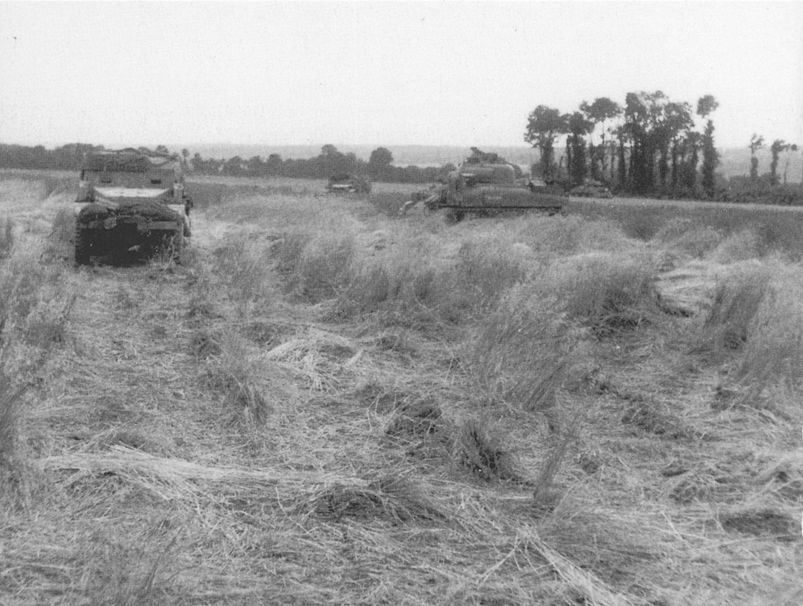
Armoured vehicles of 29 Armoured Brigade withdrawing from Hill 112 via Baron.