
CHAPTER SIX
The Second Army war diary records a message from General O’Connor at HQ VIII Corps, timed shortly after midnight:
‘Intention for 29 Jun 44. First. To enlarge bridgehead over the ODON. Second, 15 Div to clear general area COLLEVILLE-TOURVILLE-TOURMAUVILLE-GARVUS-BOUCY WOODS (901628). Third. 43 Div to clear area including BAS DE MOUEN-GOURNAY. Fourth. 11 Armd Div will as soon as 15 and 43 Divs’ tasks have been accomplished continue advance to R ORNE in accordance with original plan.
At dawn on 29 June, the ‘tidying-up’ of the centre and flanks of the Corridor was already under way by the Wessex Division on the eastern flank and by the Scots to the west
Mouen
The village of Mouen needed to be cleared, as the Corridor was only 3,000 yards wide and if VIII Corps was to survive the coming counter-attack, it would need additional depth to absorb the German attacks. Mouen, lying between the railway line and the Caen– Villers-Bocage Road, was a small hamlet in close country, bisected by three deep, hedged lanes. It will be recalled that the village had been occupied with out a fight by 3 Mons, as the result of a map reading error on the night of the 27/28 June. However, the following day it had been lost to the counter-attacking Leibstandarte and 10 HLI had been unable to retake it. At 2000 hours the previous evening, the Wessex Division’s 214 Brigade had been ordered forward to take the village but only two hours of daylight remained. Brigadier Essame recalled:
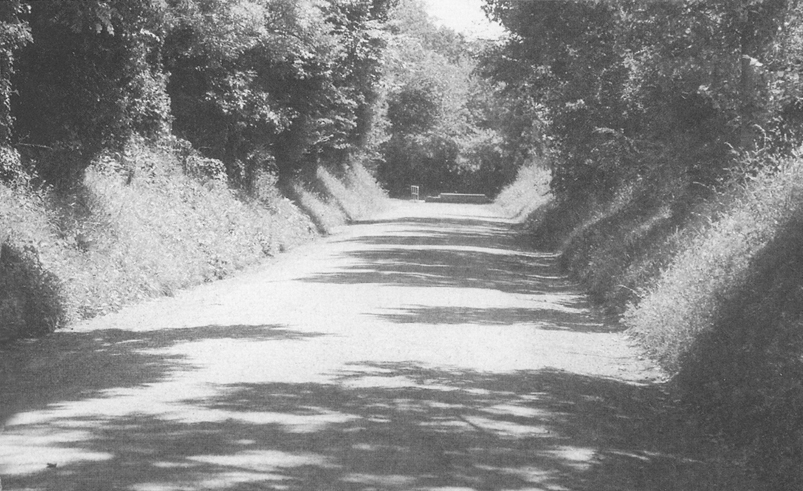
A lane in Mouen. Poor tank country.
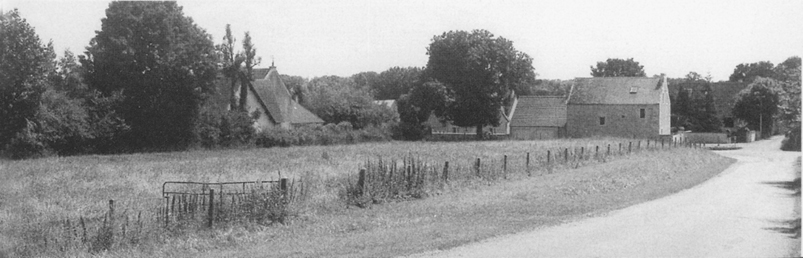
Mouen. The view south into the village from the railway line – today a duel carriageway.
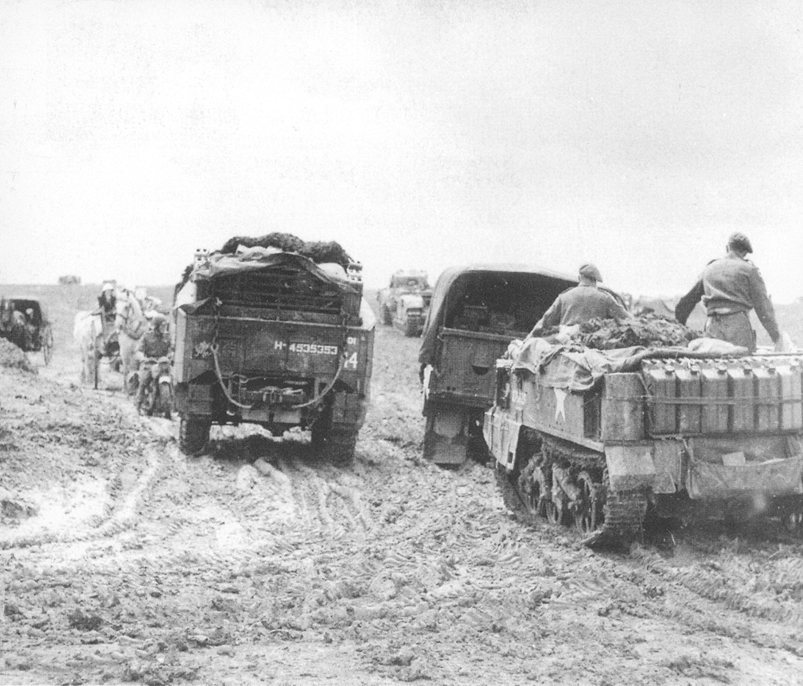
Transport belonging to 43rd Wessex Division, south of Cheux, moving up to the battle area.
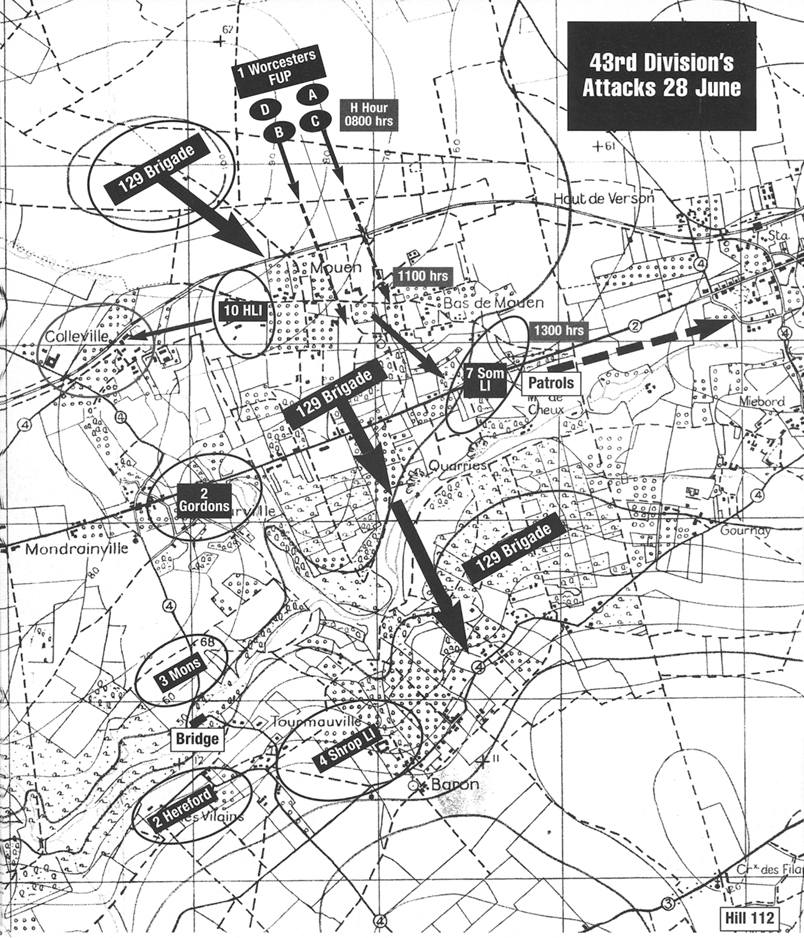
‘In hope of being able to exploit the [limited] success of the HLI by passing through them and carrying Mouen by a night assault, I moved 1 Worcester to an assembly area in the fields south of Cheux. Accompanied by the CO, Lt Col Harrison, and Major Alexander, his battery commander, I then went forward to reconnoitre, turned off the axis just north of Colleville and followed in the wake of 10 HLI. Amongst the high hedges and meadows we found the battalion grimly fighting its way forward inch by inch and at a heavy cost …
‘Back amongst the tightly packed traffic on the axis, I decided that a night advance through the HLI with the enemy still holding out in the narrow fields and orchards could only end in confusion and that an assault at first light from the north over the open fields would be more effective.
‘My Brigade O Group assembled at 3.30 a.m. by the light of a pressure lamp in a 160-lb tent near le Gaule. 1 Worcester were to seize Mouen by an attack from the open cornfields on the extreme east flank of the corridor and to exploit as far as the main road to Caen. No tanks were available but… 179 Field Regiment, in addition to the whole Divisional artillery who had secured the support of two medium regiments.’
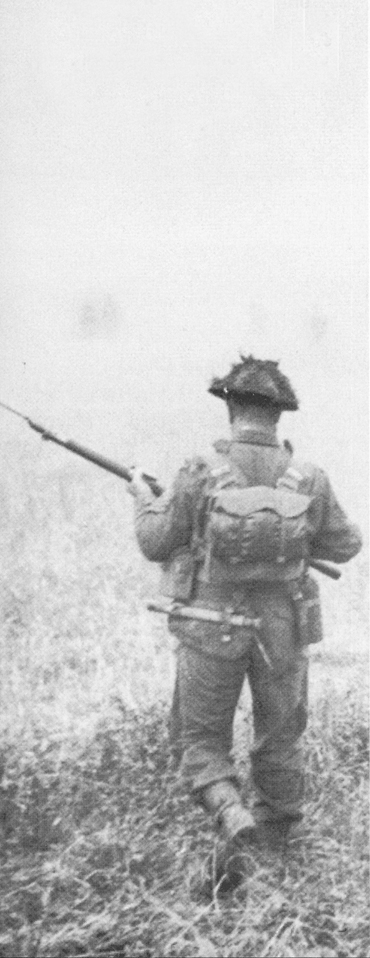
Into the morning mist. British infantry advance towards the German positions.
1 Worcester had been ordered to capture Mouen by 0900 hours. Time was short, so it was impossible for Lieutenant Colonel Harrison and Major Alexander to recce the ground, make a plan and be ready by the given H-hour of 0800. The plan, made from the map, required careful co-ordination with the artillery. According to the battalion history, the fire plan called:
‘…for a barrage of HE with smoke mixed, opening on the line of the railway short of the village of Mouen, dwelling there for thirty minutes (which was the estimated time for the advance across the open country), then moving forward at 100 yards in four minutes to the main Caen road. … The mortars of the Battalion were to take on opportunity targets and those of 7th Somerset Light Infantry to fire phosphorous smoke into the barrage both for blinding and lethal effect. 4.2 inch mortars were to fire smoke and HE on Bas-de-Mouen which appeared the obvious line of counter-attack and the medium machine guns were to fire on Carpiquet Aerodrome not only to neutralize but also a deception.’
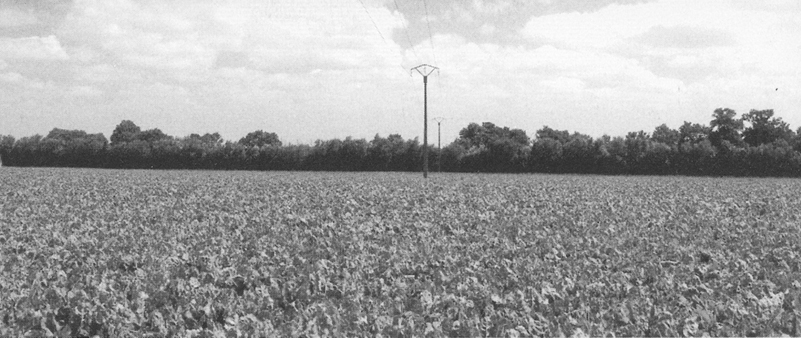
The pylon line used by 1 Worcesters as its axis during the attack on Mouen.
For simplicity Lieutenant Colonel Harrison planned to use obvious features; the advance was to be astride a line of pylons leading towards the church in Mouen which was the second landmark. B Company was on the right and C Company on the left. A Company was in support, moving on the left in order to cover the open flank and was, subsequently, to seize Bas-de-Mouen. D Company was the Battalion’s reserve. The well rehearsed battle procedure ‘went like clockwork’ and the attack began on time.
‘The battalion moved forward through the cornfield in copybook style. Not a man seemed out of place and never had the Battalion gone into attack so well in any training.’
However, the Worcesters suffered some shrapnel casualties from enemy airburst shells but officers and NCOs kept the men moving forward ‘in a very open formation’, which minimized casualties. Brigadier Essame also wrote that the Germans:
‘Deceived by the smoke as to the direction of the attack, the enemy put down his defensive fire not on the Worcesters but on the right flank, the direction from which it had been intended to assault the previous night.’
Regimental Sergeant Major Hurd was ‘well to the fore brandishing a shovel and calling on the troops to close with the enemy, advanced behind the barrage’. A reason for the Worcesters’ success in crossing the open ground was that they followed the barrage closely, as it moved into the German positions and being on top of the enemy when he emerged from his cover.
The Worcesters’ battle with the panzer grenadiers and tanks of Hitler’s Leibstandarte began at the edge of the village. According to Major Watson:
‘Some opposition from automatic fire was met with on coming to the railway line, but our artillery had opened very accurately on that line and neutralized most opposition there. However, directly we got over the line they found themselves in real close country, consisting of small fields with high hedges and sunken lanes. In these hedges, lanes and in the tops of trees, there was still a large number of Germans very much alive. Progress forward was slow, as each little orchard had to be dealt with separately before going on to the next if control was to be retained. In addition, there were some enemy tanks, which had been dug-in in the narrow lanes and were being used as pillboxes.’
Young Worcester soldiers armed with PIATs crept forward, uncertain how the ungainly spring propelled weapon would work against a real tank. Covered by the fire of the remainder of their platoon, they crawled into positions from where they could engage the SS panzers, including at least one Tiger, in their vulnerable flanks. They were greatly heartened to see the ‘steel monsters burst into flames’. The PIAT proved to be equally effective in blasting the determined SS defenders out of hedgerow positions and from buildings. However, progress through the village was much slower than the rate of advance of 100 yards in four minutes cited in the artillery fire plan. At 1100, hours the Battalion reached their limit of exploitation short of the Caen–Villers Road.
Mouen was not a pretty sight, being littered with knocked-out armour, dead Monmouths and bodies of the HLI, all the product of the previous day’s fighting. However, the Worcesters were extremely thorough in their clearing of the village. This resulted in the Battalion suffering relatively few casualties both during the attack and during the reorganization. In praising the attack, Montgomery described the Worcester’s attack as ‘The finest single action of the war’. 7 Som LI, moving through the village behind the Worcesters, was able to continue the attack towards the main road promptly, in good order and without significant casualties.
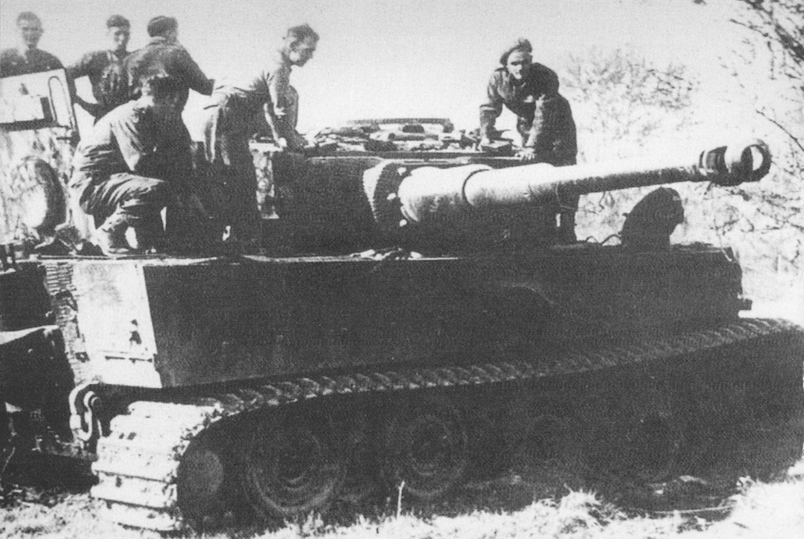
British soldiers inspect one of 101 SS Schwere Panzer Battalion’s Tigers knocked out in the Mouen area.
With the Worcester’s success, 129 Brigade advanced between Mouen and Colleville and down into the Odon Valley. Brigadier Essame recorded that:
‘Relieved of responsibility for St Mauvieu by 2 Guards Brigade, [129 Brigade] now advanced in the late morning with a squadron of Greys under command, with the task of clearing the woods and orchards astride the River Odon between Tourville and Baron on the Corps’ left flank. Deployed on a two battalion front, 5 Wiltshire on the right and 4 Somerset Light Infantry on the left, we advanced over the railway and past Colleville under heavy mortar fire until the ribbon of houses along the main road to Caen was reached. Here the battalions paused to reorganize and then thrust forward into the thick woods ahead. We reached the Odon and found it to be little more than a stream, but sufficient to hold up our carriers and anti-tank guns. On the right, the pioneers of 5 Wiltshire built a crossing of brushwood and earth. On the left 4 SLI found that the stream ran through a deep gorge and except for a narrow strip of grass either side was steep-sided, rocky and heavily wooded. This was to earn the name of ‘Death Valley’ in the days ahead.’
To the west of the Wessex, 44 (Lowland) Brigade was also ordered to improve the 15th’s tenuously held positions on the northern slopes of the Odon. In order to widen the Corridor, by 1040 hours 8 Royal Scots secured, with little opposition, positions on the railway to the west of Grainville. In the next phase of the plan 6 Royal Scots Fusiliers began an advanced towards the Caen– Villers-Bocage Road and onwards to link up with the isolated Argyles at Gavrus. Meanwhile, in the early afternoon, 8 RS, who were digging-in, came under heavy mortar fire and attack by SS troopers who infiltrated through the wooded country. 6 RSF, still short of Gavrus, were redirected back to deal with this new threat. Thus, 44 Brigade was to clear the enemy from the area between Grainville and Gavrus and therefore, could not form a coherent defensive flank. This left the Argyles still isolated at Gavrus.
44 RTR’s Advance on Hill 113
While the Wessex and Scottish Divisions were ‘tidying up the Odon Valley’, 11th Armoured Division started 29 June with the aim of reaching the Orne and an H-Hour of 0700 hours. From the western portion of the bridgehead, 44 RTR, under command of 29 Armoured Brigade, was againto advance south towards Hill 113 and Esquay. Accompanied by B Company 2 King’s Royal Rifle Corps, C Squadron was directed on Hill 113. B Squadron moved on Evrecy, while A Squadron shot up Esquay.
Preparing to attack over the same ground, were the leading elements of the newly arrived II SS Panzerkorps. SS-Obersturmführer Franz Riedel, commander of 7 Kompanie 10 SS Pz Regt, recalls his orders:
‘Attack Hill 113 at 0700 hours and following that Gavrus. Our forming-up zone was situated near Evrecy. My Kompanie should have been the point and 5 and 6 Kompanies were to be to the right and left rear. I was not informed of a postponement of the attack due to a delay in the arrival of the panzer grenadiers. Consequently, I launched my attack at the prescribed hour and my panzers rolled towards my objective. At the same time, an English armoured unit [44 RTR] with a great number of Shermans advanced across our front. In the blink of an eye, we fired and eleven of these Shermans burned on the hillside. My point tank commanded by Ewald Menzel destroyed five of the enemy tanks. We lost one tank… As the English were not able to reorganize after the shock of our surprise, we immediately advanced upon them and pursued by us, they rapidly retreated. Our pursuit would have been even more effective had the English not surrounded them selves by smoke. To follow them would have been fatal.
‘At this point, I saw a motorcycle sidecar coming towards my tank containing commander II/10 SS Pz Regt, SS-Sturmbannführer Leo Rehinhold, who loudly demanded “What was the meaning of this farting about?” Then, as the smoke cleared, he saw the burning Shermans and his face lit up at the significance of my success. Hill 113 had been saved from the enemy’
44 RTR claimed that C Squadron lost three tanks on Hill 113, with two more badly damaged. It is also recorded that the casualties would have been heavier but for the fire of 4 Regiment Royal Horse Artillery. However, 29 Armoured Brigade noted in their war diary that the ‘… regt [44 RTR], less one squadron attempted to outflank Esquay without success.’ Later a staff officer added:
‘44 RTR sustained some tk cas during the morning from A-tk fire from high ground between Bourgy and Evrecy making progress on that flank expensive and the advance was halted.’
Elements of the Hitlerjugend and 88mm guns, in position on the southern slope of Hill 112, also played a part in stopping 44 RTR’s advance. The RTR remained on the defensive in the western portion of the Odon Bridgehead for most of the day. The solo attack by the Frundsberg’s 7 Panzer Kompanie showed the potential combat power that II SS Panzerkorps could apply in offensive operations.
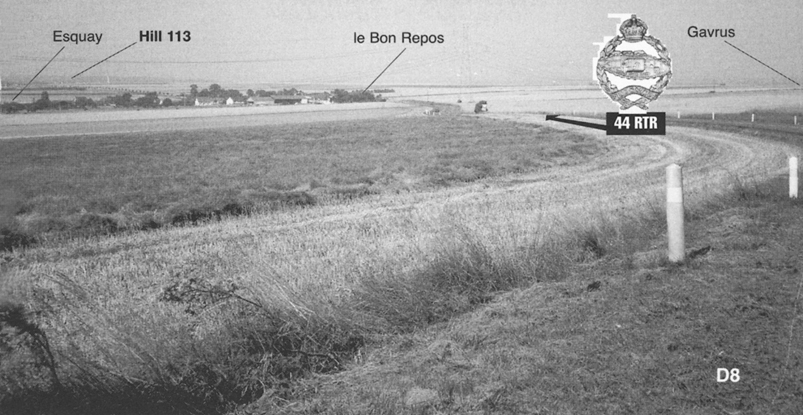
The view west from Hill 112 across le Bon Repos to the open country 44 RTR crossed en route to Hill 113.
Hill 112
Although the panzers had halted 29 Armoured Brigade’s advance short of Hill 113 and Esquay, II SS Panzerkorps’ delayed counter-attack gave the British an opportunity to reoccupy Hill 112. 3 RTR, supported by two companies of 8 RB was ordered back to up to the crest of the feature. The tanks set off full of misgivings, anticipating another day under a continuous and heavy fire from the surrounding Germans. SS-Standartenführer Kurt Meyer wrote:
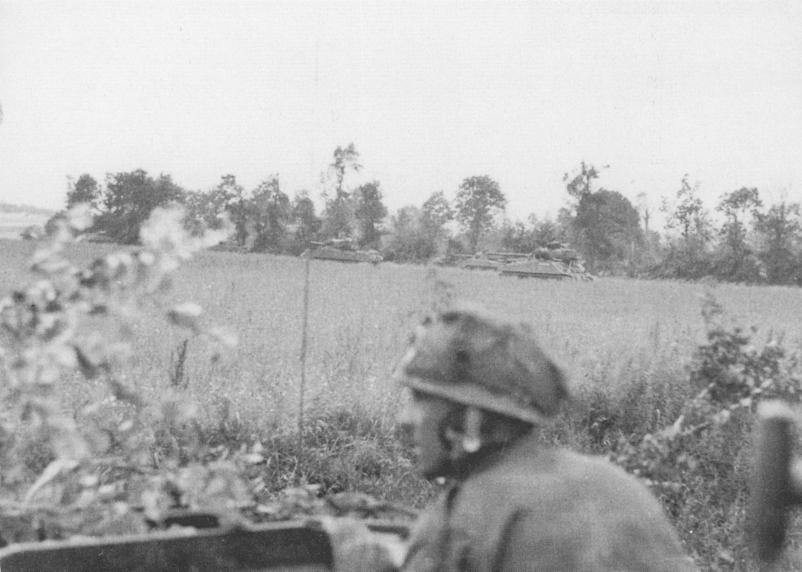
In the foreground a crewman belonging to 44 RTR surveys the ground ahead. In the background a troop of Shermans including a Firefly wait to advance.
‘Enemy artillery fire explored the ground around Verson. Shortly afterwards a massive barrage hit Hill 112. Would the British anticipate our plans and attack before we did? With an uncomfortable feeling, I watched tanks of 11th Armoured Division climb the slope south of the Odon and take Hill 112 in a pincer movement. The summit could no longer be identified. The impact of heavy gunfire was tossing the Norman soil around, metre by metre. There was no longer any doubt. The British had launched a pre-emptive attack. II SS Panzerkorps lost Hill 112.’
It appears that in anticipation of II SS Fanzerkorps’ attack from the south west, Kurt Meyer’s Hitlerjugend had erroniously relinquished responsibility for and its positions on Hill 112 shortly after dawn. However, with the delay in II SS Panzerkorps’ attack, 3 RTR, taking advantage of another German staff error, ‘surprisingly, reoccupied the hill with barely a shot being fired’. Hill 112 may have been occupied without loss but the Fife and Forfar Yeomanry were not so lucky. They were unable to make headway to the east of the feature, against 25 SS Pz Gr Regt who were well dug-in. On Hill 112, 3 RTR re-occupied its previous day’s positions, on the northern slopes and taking advantage of the lack of defenders, advanced to the crest and occupied the wood and orchard around the spot height. However, as Major Noel Bell recalled, all was not quiet for long:
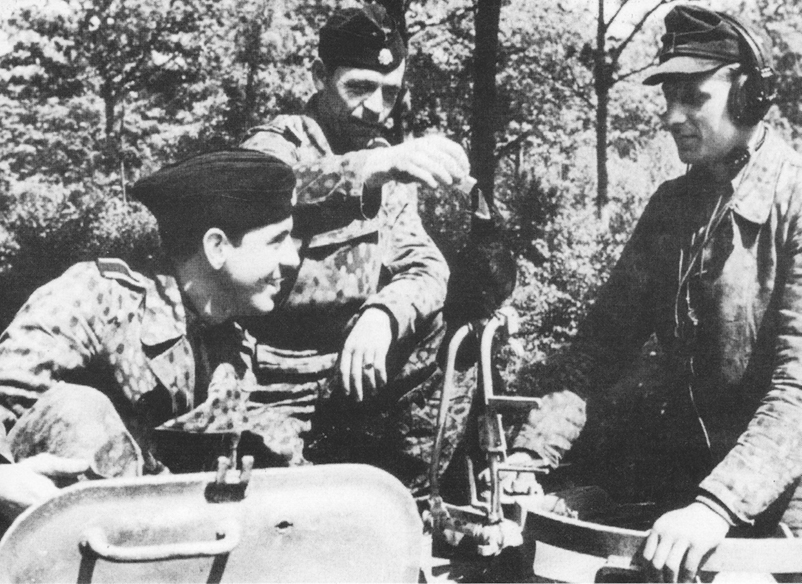
A panzer crew belonging to II Panzerkorps.
‘Shelling and mortaring commenced, varying in pitch from time to time. Bren carriers were blown bodily off the ground, but there were no direct hits. Our mortars, working with those of ‘H’ Company, put down a steady stream of fire. Sergeant Hollands continued to operate the mortars until wounded by shrapnel. Naish, leaning against a bank above his slit trench, was holding the wireless headphones in his hand, the better to hear any approaching shells, when there was an explosion nearby; shrapnel tore through the Bakelite, leaving in his hand only the metal band.’
Another description of the Nebelwerfer fire is recorded by Brigadier Essame:
‘A howling and wailing grew until it filled the sky, rising in pitch as it approached, and ending in a series of shattering explosions all round us … Then more squeals, the same horrible wail, and another batch of thirty-six bombs exploded astride us, so that the blast came first from one side, then from the other, then from both at once.’
Withdrawal
Later in the morning, with the crisis approaching as II SS Panzerkorps concentrated on the tanks of the Scottish Corridor, the British were under pressure. In Montgomery’s words:
‘In view of this it was decided that VIII Corps should concentrate for the time being on holding the ground won, and regrouping started with the object of withdrawing the armour into reserve ready for new thrusts.’
This decision in fact resulted, from confirmation of ULTRA interceptions and decryptions of German radio orders that had been in the hands of Generals Montgomery and Dempsey for several days. They knew that II SS Panzerkorps’ intentions were ‘to take the Baron, Mouen, Cheux area and to destroy the enemy who has advanced across the Caen – Villiers-Bocage road’.
Armed with this outline information, according to the VIII Corps’ History:
‘At 1000 hours General O’Connor held a conference at Headquarters 15 (Scottish) Division in which he announced that in view of the general situation any further advance to the Orne would be temporally stopped, and present positions maintained. A general consolidation would take place with particular stress on the co-ordination of anti-tank defence, and the positioning of the armoured brigades. Certain re-grouping too, on account… of intermingling of units. Areas of responsibility were re-assigned and every effort was made to ‘tidy up’ the sector in order to take the shock of what had every appearance of becoming the first major enemy offensive since the Allies had landed.’
On Hill 112, Trooper John Thorpe, of 3 RTR, recorded in his diary:
‘Warning Order received: Abandon tanks after destroying the gun. But no action until confirmed. New orders: Retreat, taking the tanks with us. Does anyone know what is going on?’
Despite the confusion, 29 Brigade was eventually ordered to abandon Hill 112. With two fresh SS panzer divisions approaching from the west, British commanders feared that its defenders, exposed at the end of the Scottish Corridor, could not hold the hill. In addition, the tanks of 11th Armoured Division, were urgently needed to hold the Corridor north of the Odon and 15th Scottish and 43rd Wessex Divisions were already fully committed to holding ground. With the gift of hindsight, it is clear that British commanders had failed to fully appreciated the operational value of Hill 112 and had overestimated the power of II SS Panzerkorps when faced with the overwhelming Allied air and artillery fire support. South of the Odon, British commanders were content to hold a shallow bridgehead and give up the firm hold they had on Hill 112. The battle resulting from, this decision was to have tragic consequences for many of the soldiers who were to fight on the slopes of Hill 112 over the following seven weeks.
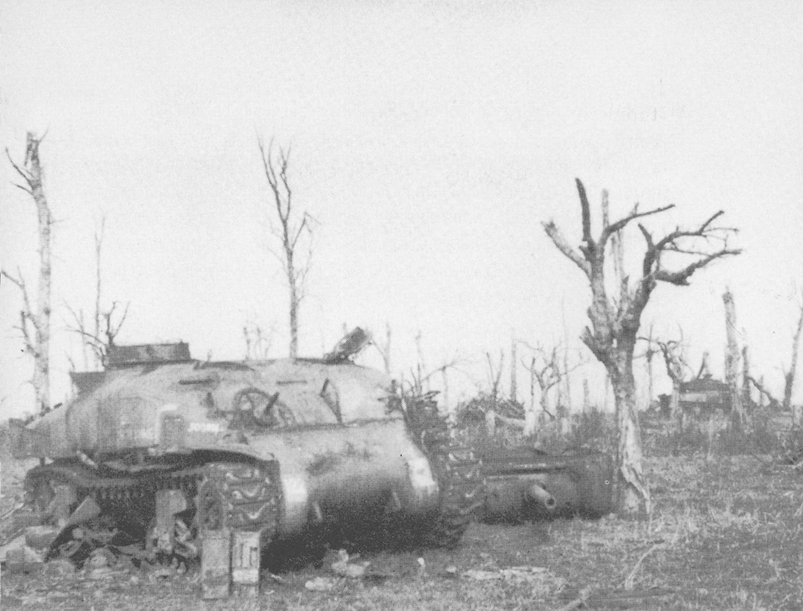
Knocked out Shermans on the slope of Hill 112.
II SS Panzerkorps’ Counter-Attack
With the traffic jams in the Scottish Corridor worse than ever and as the British regrouped, the Germans were facing a different problem. The sun had broken through the glowering skies of the previous days enabling the Allied airforces to be unleashed. From dawn onwards, air recce reports had been flowing into British Headquarters that there was large-scale eastward movement from Flers northwards to Argentan and Vire. Most of the traffic identified by the Allied airmen was the Germans’ tail of logistic vehicles, heading towards a triangle of ground between the villages of Evrecy, Noyers and Villers-Bocage. Armed with visual confirmation of II SS Panzerkorps’ concentration area, General Dempsey was able to act on the ULTRA information already in his hands.
In response to Germans preparations to mount their first significant counter-stroke since D-Day, the British concentrated their firepower to reduce the combat effectiveness of II SS Panzerkorps before it could come into contact. Allied fighter-bombers were promptly in action, claiming to have destroyed or damaged a hundred German transport vehicles and heavy artillery and naval gunfire also joined the deep battle. VIII Corps recorded:
‘Whilst the RAF was attacking the enemy moving up from the south, the Corps artillery, fed with unusually plentiful information from its Air OPs and counter battery sources, fired heavy concentrations on likely enemy assembly areas and forming up places, in addition to giving maximum aid to the forward troops in response to an increasingly large number of calls for direct support from them.’
Early casualties resulting from the Allied air and deep artillery strikes included seven precious fuel bowsers.
Veterans of the Eastern Front, 9th Hoenstaufen and 10th Frundsberg SS Panzer Divisions were used to artillery concentrations but nothing had prepared them for the neutralizing effect of the Allied firepower that they were now experiencing. A translation of an unfinished letter, written by an SS Rottenführer of 10th SS Panzer Division taken prisoner on 30 June, was published in a Second Army intelligence summary:
‘We are now 30 kilometres behind the front after a nightmare journey across France, which has taken a fortnight under the most frightening conditions on account of the enemy planes. For the last fortnight I have hardly slept at all and have forgotten how many times the enemy has straffed us. We have suffered many casualties in men and vehicles, but our so-called Luftwaffe has not ventured to put in an appearance. There was nothing like this in Russia, and we are all wondering whether life at the front will be as bad.’
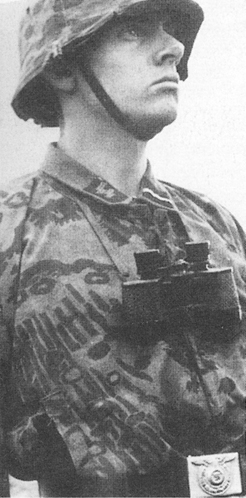
German troops had to be constantly on the alert for ‘Jabos’.
It was, and he went on to say:
‘Before dawn we took up sheltered positions in a wood and took some sleep. After only a short time, it was light and we were under fire of very heavy guns. We are now sheltering in our panzers, which are being shaken to pieces by blast and shell splinters.’
VIII Corps’ intelligence summary, under the air paragraph also describes how: ‘The fighter bomber pilots had a very happy time with a concentration of tanks discovered near Villers-Bocage’. Particularly badly hit by air strikes was a kampfgruppe consisting of III/20 SS Pz Gr Regt and the Panthers of I/9 SS Panzer Regt, who moving forward from Villers Bocage to their assembly area at Bas des Forges. Due to deliver a crushing assault on Cheux, they were attacked by an estimated one hundred Lancaster bombers. SS-Mann Wilhelm Tieke was on the receiving end:
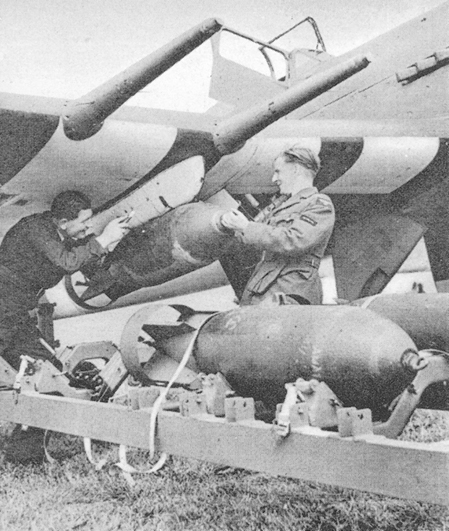
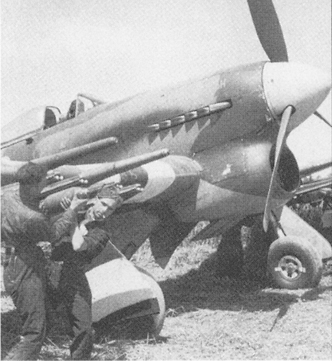
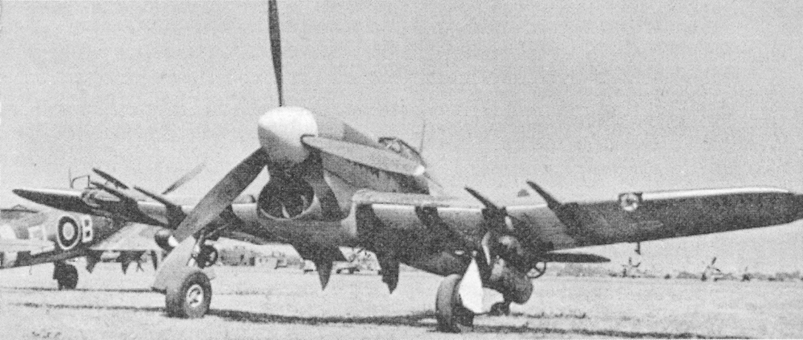
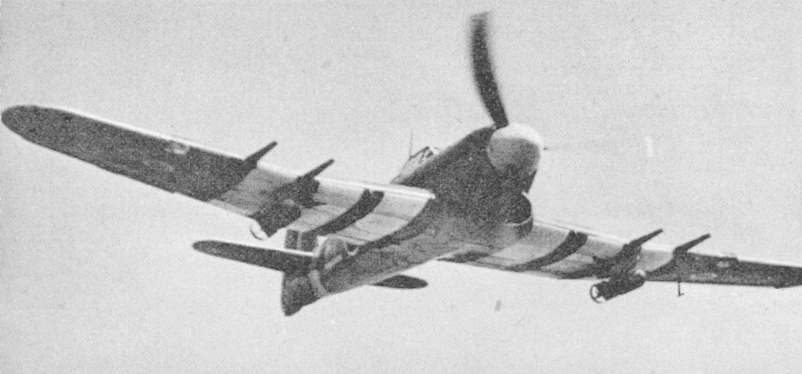
Typhoons loaded with bombs and rockets made movement by road and manoeuvre on the field of battle a highly risky business for the Germans. Luftwaffe fighters were absent from the skies over Normandy.
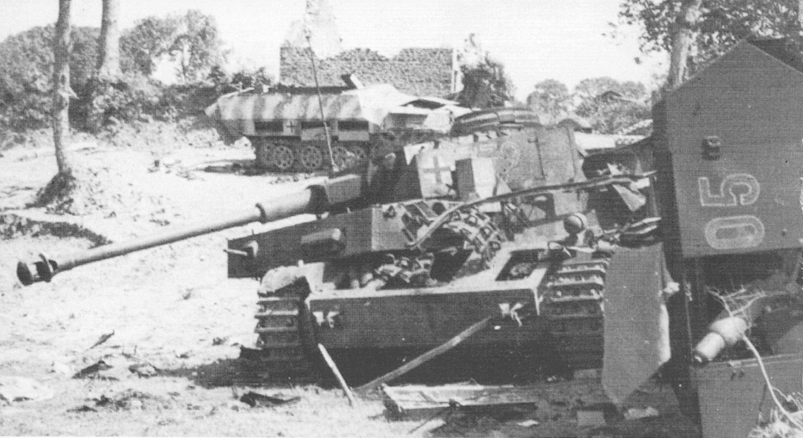
Armoured vehicles belonging to Das Reich, having been hit by concentrated Typhoon attack.
‘The bombs rained down. They tore at the earth. They snapped the tree trunks like matchsticks, threw armoured vehicles into the air, ripped off their tracks and even armour plate.’
In this Kampfgruppen twenty men were killed and forty wounded. Eighty percent of the armoured vehicles were damaged in some way. Also hit in the raids, was the Hohenstaufen’s tactical headquarters at les Nouillons.
H-Hour for II SS Panzerkorps’ attack, at 0700 hours, was initially delayed for two hours and later in the morning, SS-Gruppenführer Bittrich signalled where Tactical HQ, 9th SS Panzer Division was setting up during the early stage of their attack. SS-MannGeorg Essler, a Mark IV driver in 9 SS Pz Regt, recalled the opening stage of his first battle in the west:
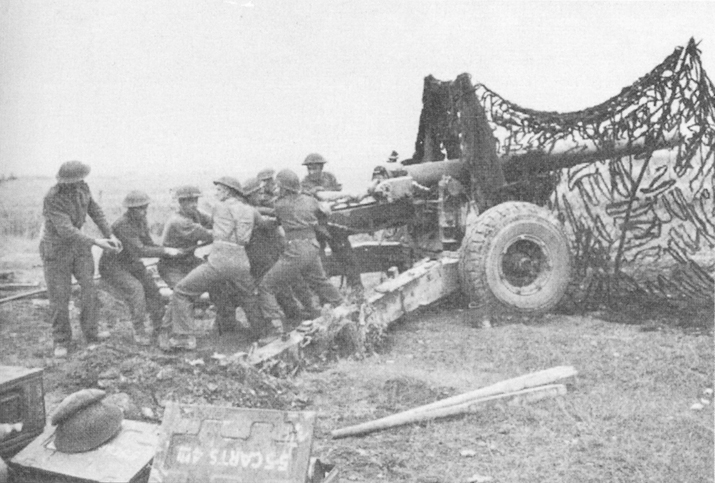
The main gun of the Army Group Royal Artillery was the 5.5 inch gun.
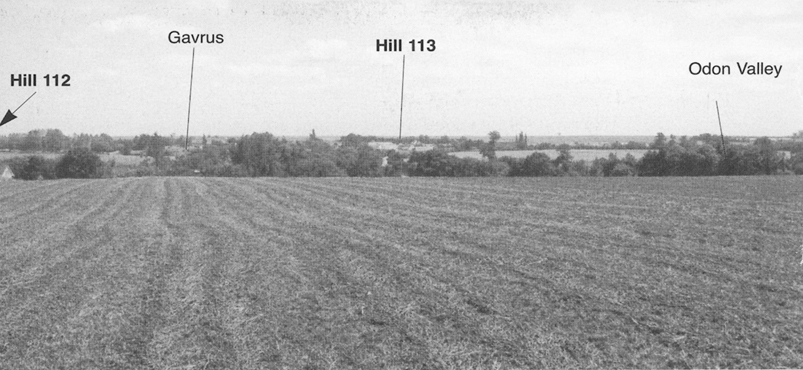
The view from Grainville looking south across the Odon to Gavrus and the open ground on Hill 113 beyond.
‘… we boarded our vehicles and followed a guide to a new attack point. A great battle was in progress, we saw a lot of smoke, and overhead the Allied planes were making constant attacks on our forces. Some of our comrades were already engaged elsewhere, and we received an order to go in and crush the British Salient. We went across the fields with our infantry and at once came under very heavy artillery fire, which disrupted everything.’
The Hohenstaufen’s attack was mounted from the Noyers/Haut des Forges/Vendes area, across the southern end of the Rauray Spur using the road Panzergruppen West that:
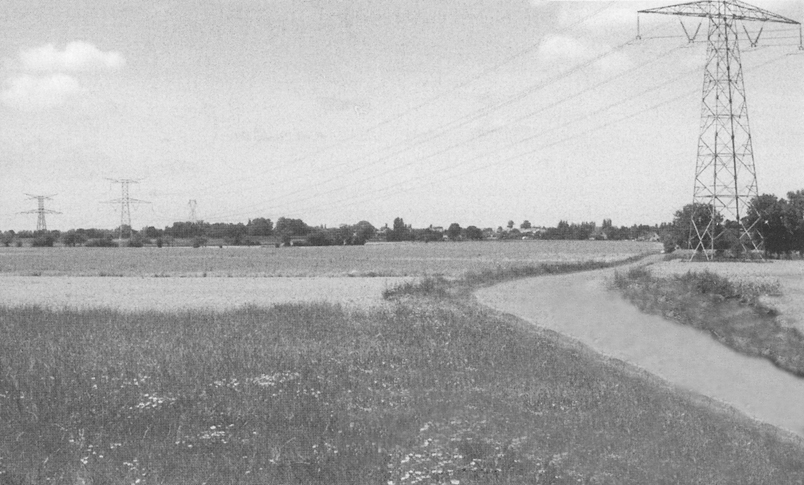
Looking north to Grainville and le Valtru.
A Scottish lance corporal firing from the cover of hedgerow.
‘The offensive can not begin until the afternoon. Our concentrations are under continual artillery and air bombardment’.
Another message at 1340 hours excused an even longer delay:
‘The enemy fighter bomber attacks are causing heavy loses… and the panzer divisions can not bring their tanks forward due to a lack of fuel.’
The attack, according to German war diaries, eventually started at between 1430 and 1530 hours. SS-Obergruppenführer Hauser also reported that: ‘This great artillery fire is taking its toll on morale’.
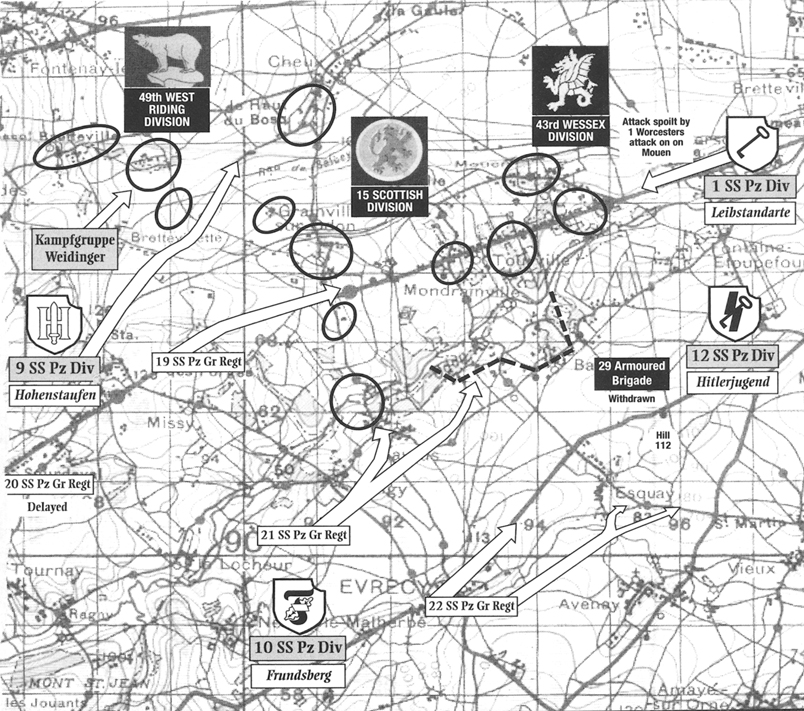
Most German commanders believe that II SS Panzerkorp’s counter-stroke had failed before it began. However, it is considered that the physical destruction caused by the British land, sea and air bombardment was greatly overstated, in order to excuse failure. Nevertheless, the British artillery and air strikes did neutralise the German attack for some hours, by causing damage, preventing essential preparations and orders being issued. Consequently, time was gained for units of VIII Corps to redeploy and improve their positions. The delay also permitted 43rd Wessex Division to attack the Mouen area, which effectively spoiled the supporting attack that the Leibstandarte was planned to deliver. Overall, the German attack was blunted by the air and artillery strikes but not stopped.
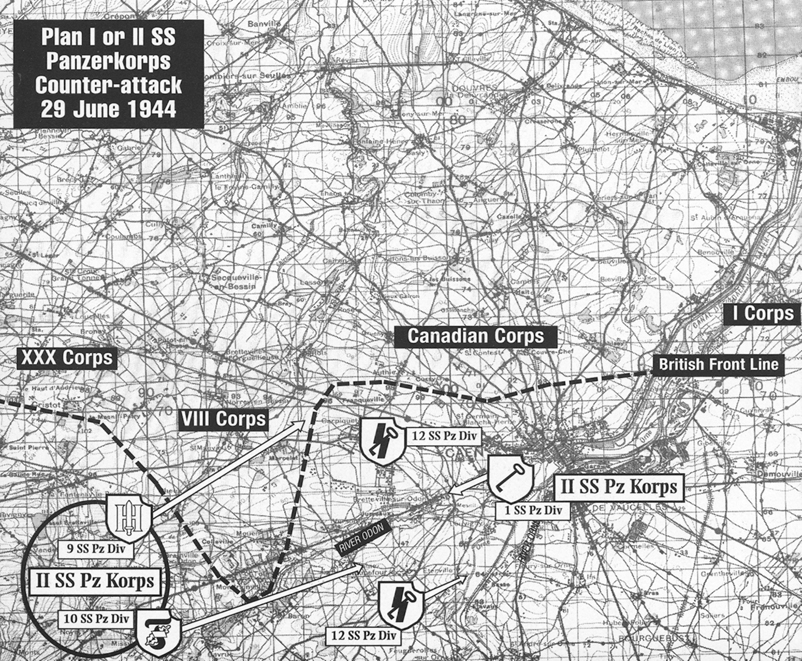
Despite the delays, SS-Obergruppenführer Bittrich’s plans for II SS Panzerkorps, with over four hundred panzers and sturmguschutz, were unchanged. He planned to attack with his two SS panzer divisions from the west, astride the Odon. 9th Hohenstaufenwere to attack to the north of the river valley and 10th Frundsberg to the south. The Hohenstaufen’s mission was to cut the Corridor (Korp’s main effort) and reach the Hitlerjugend’s positions on Carpiquet Airfield, while the Frundsberg was to destroy the enemy on Hill 112 and in the Tourmauville bridgehead south of the Odon. The Hitlerjugend were to support the Leibstandarte’s attack on the Allied salient from the south east but otherwise remain on the defensive.
See maps pages 155 and 161
The Hohenstaufen’s Attack North of the Odon
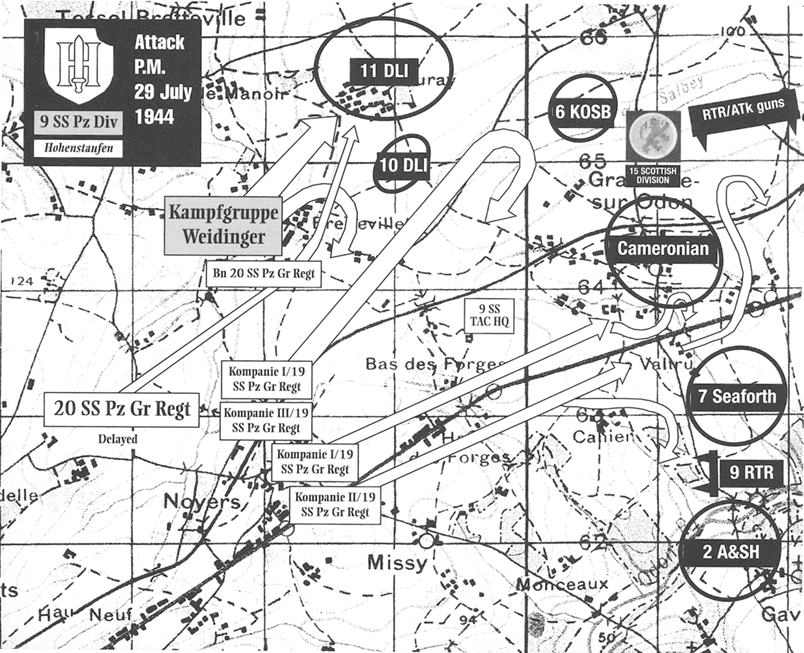
SS-Standartenführer Thomas Muller’s plan for 9th SS Panzer Division was to advance eastwards to their objective on a line between Cheux and Mouen. Kampfgruppe Weidinger, under command from 2nd Das Reich SS Panzer Division was to support the attack on the left flank. Cheux was identified as key terrain in the coming battle, because seizing the village would cut the salient that VIII Corps had driven into the German line.

The Hohenstaufen’s preparations for the attack were not only disrupted by air and artillery strikes but also by an attack by 8 Royal Scots, which was mounted to improve their positions in the woods around Chateau Grainville. In doing so, 8 RS engaged with direct fire and with artillery on likely enemy depth positions. These targets included les Nouillons Farm towards Cheux as the axis. However, the Germans concluded, as had VIII Corps, that the dominating Rauray Spur needed to be recaptured before an attack on Cheux could succeed. Therefore, the first objective was the village of Rauray, to the 1 ft of the axis, which Kampfgruppe Weidinger attacked from its existing positions around in Brettevillette.
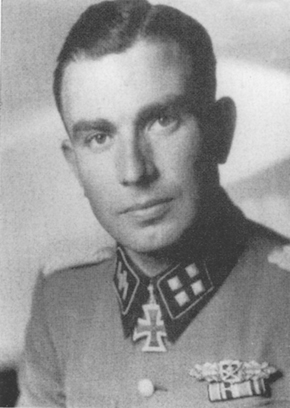
SS-Obersturmbannführer Otto Weidinger.
Facing Weidinger, whose attack started earlier than the main assault, was 70 Brigade of 49th Division. As has already been noted, Rauray had been taken by 11 DLI on 27 June and on 28 June, 10 DLI had occupied Point 110 on the crest of the Rauray Spur to the south of the village. Forewarned of the German attack, the 49th’s proposed attack on Brettvillette was postponed and the infantry set about improving their defences. Consequently, when their blow fell from the south west, Kampfgruppe Weidinger was repulsed.
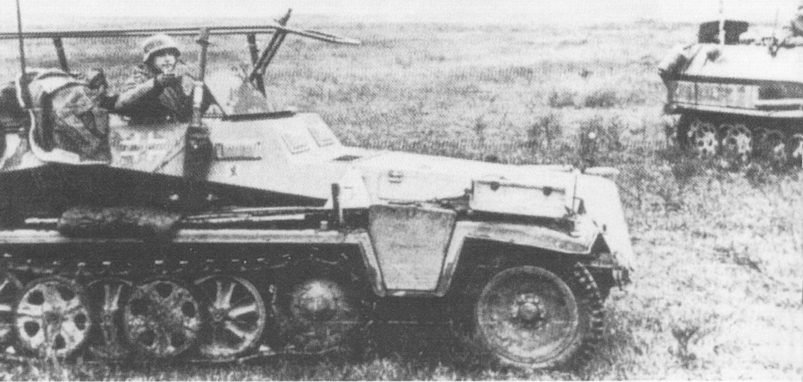
Armoured half tracks carried the 3rd Battalions of SS Panzer Grenadier Regiments into action. The vehicle on the left is a command variant.
The Hohenstaufen’s main effort was III/19 SS Pz Grs, mounted in half-tracks, they were to advance north east astride the Noyers - Cheux road. Supporting the panzer grenadier’s attack was a kompanie of Panthers from I/9 SS Pz Regt. The Kampfgruppe crossed the top of the Rauray Spur and started to descend into a shallow valley of small, thickly hedged fields. Now in full view of the dug-in British infantry, the Germans came under anti-tank fire from guns in well co-ordinated positions that covered all approaches. The SS infantry debussed from their half-tracks and took cover in the hedgerows, while the Panthers moved into covered fire positions, from where their superior, high velocity, 75mm guns knocked out counter-attacking British tanks.
Meanwhile in the ‘British salient’, 4 Dorsets were moving up to reinforce the Scottish Corridor. The Battalion’s Signal Platoon Sergeant recalled that at 1500 hours:
‘We were travelling through the gun areas when we were ordered to halt and disperse, everyone wondered what was happening, suddenly we were shaken by a thundering roar, every gun in the area opened up. What a barrage, red flames and puffs of smoke from cleverly concealed guns could be seen clearly, rapid fire seemed to work like clockwork. We couldn’t hear our selves speak. Officers and NCOs, including myself, shouted to the men, at the top of our voices; telling them to disperse and take up emergency positions, as we were informed that Jerry was putting in a strong counter attack.’
For the second time during the day, an artillery hammer blow struck II SS Panzerkorps. III/19 SS Pz Gr’s attack came to an abrupt halt, forming a small salient sandwiched between 44 (Lowland) Brigade in Grainville and the leading elements of 49th West Riding Division on the Rauray Spur. A thousand yards short of le Haut du Bosq, the Hohenstaufen’s main effort had failed. They would have to fight to clear their flanks if they were to resume their advance and take Cheux.
Facing the Hohenstaufen’s second southerly axis, 8 RS were reorganizing having taken Chateau Grainville, when they were attacked by I and II/19 SS Pz Gr Regt. According to the divisional historian ‘they were pushed out of it by an immediate counter-attack. Back they came again and retook the wood, thereafter they held their front despite severe enemy pressure.’
BBC corespondent Chester Wilmot, recorded a report describing the attack at Grainville.
‘The Germans attacked twice, first at two thirty in the afternoon, and for more than an hour there was a tank and infantry melee, concentrated mainly around the [Grainville] Chateau, where our troops were established in orchards and gardens. The Germans sent flame-throwers as well as tanks to support their infantry. The enemy infantry were pinned down in long grass, short of one company position. Two flame-throwers under covering fire from heavy German tanks that lay hidden in the hedges moved up. The flame-throwers got close enough to spray the very trenches from which the Scotsmen were fighting. Flames licked the hedges, and burnt up the grass around them, but the men kept their heads down and struck to their positions. …and while they held their ground, Churchill tanks, hidden in hedges behind them, drove off the flame-throwers and the tanks. The German attack petered out, but it cost them five Panthers which were knocked out by the Churchills and our anti-tank guns.’
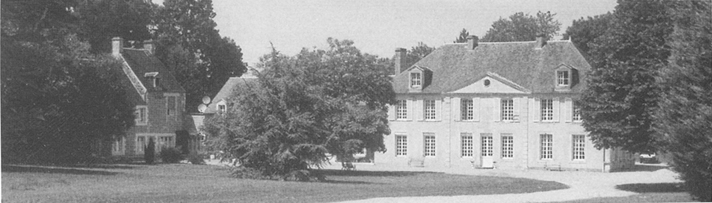
Chateau Granville.
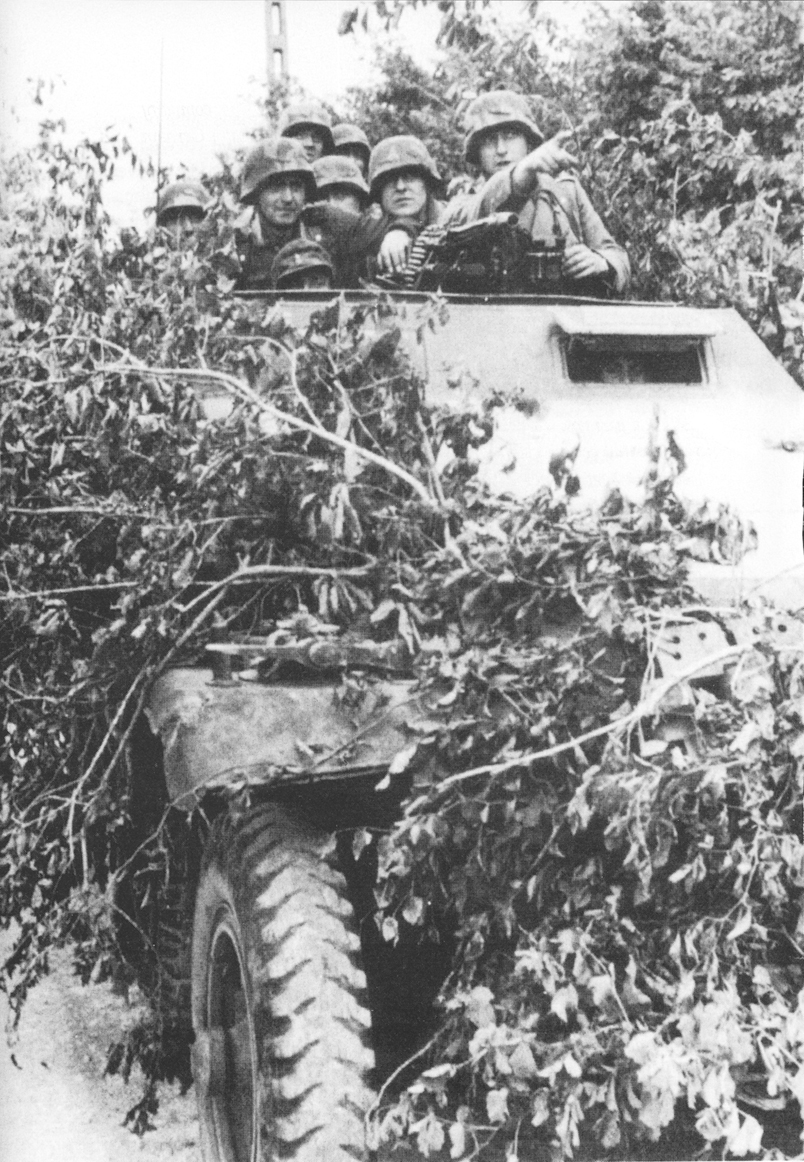
Armoured battalion panzer grenadiers in their well camouflaged half-tracks.
8 RS and 9 Cameronian, supported by 9 RTR holding the Grainville area, had also suffered heavily but a war corespondent of the day could not report this. Nor could he mention that panzer grenadiers had in fact, at one point, pushed the Cameronians back almost as far as the railway line.
At 1600 hours, 8 RS captured an officer from 19 SS Pz Gr Regt in the northern outskirts of Grainville, confirming that 9th SS Hohenstaufen was the formation attacking the Corridor north of the Odon. His marked map and note book confirmed the detail of II SS Panzerkorps’ aims that intelligence staffs had already developed. However, such information in a midst of a battle is difficult to exploit, as the troops were already locked in combat.
Meanwhile, 20 SS Pz Gr Regt struggled to free itself from the chaos in the assembly area and only took part in the closing stages of the attack. The three panzer grenadier battalions were thrown into battle piecemeal as they arrived, reinforcing 19 SS Pz Grs. One of the battalions succeeded in securing a foothold in Rauray and on the Spur, having attacked from the south. However, this hold on Rauray proved to be temporary, as only a small force had reach the village.
Back at Chateau Grainville, 8 RS, who had suffered heavy casualties holding their positions, were to be relieved by 6 Royal Scots Fusiliers at 1700 hours. However, at 1830 hours, according to the Scots’ divisional historian:
‘As this relief was in progress the enemy put in a particularly heavy counter-attack, which caught the forward companies on the wrong foot. First, enemy tanks lay off hull-down and picked off the Royal Scot’s forward A-Tk guns. Then two flame-throwing tanks charged home into the two forward company areas, where they milled round and killed a lot of men in a particularly unpleasant manner before they withdrew.
‘For a time there was great confusion. Profiting by this, a number of enemy tanks penetrated deeply into our forward positions. Enemy infantry was following. It was a very critical moment… Responding magnificently, our infantry counter-attacked in their turn and halted the enemy infantry thus depriving the enemy tanks of their infantry support.’
Now, unsupported by infantry, the Mark IVs of 7 Panzer Kompanie, taking a southerly route via le Valtru, broke through between Grainville and Collville. Advancing from the south towards Cheux, the panzers were halted by the 17-pounder M10s belonging to a battery from 91 Anti-Tank Regiment and the Shermans of 4 Armoured Brigade, deployed as a ‘back stop’ to 15th Scottish. Deep in the hull of one of the Mark IVs was SS-Mann Essler, who continued his account:
‘There was so much smoke I could hardly see, and I thought it very dangerous if we lost touch with our infantry. Then my commander, who was a Unterscharführer, told us there were enemy tanks ahead, so we opened fire at once. The bangs were continuous and I could hardly see a thing. Then I was ordered to stop while our gunner shot up some enemy tanks and other vehicles. And then we received a hit on the front of our panzer, which shook us up a bit, but did no real damage. We changed our position and I found I could see the enemy tanks ahead quite clearly in another field, and they were shooting at us. We found a little dip from where we could shoot many targets from a covered hull-down position. Then came a series of loud explosions around the panzer and we realized we were under artillery fire. So we withdrew, but we were on open ground and still under heavy fire, so I reversed again and saw one of our panzers burst into flames and two men jumping out. It was all very terrifying.
‘Our gunner found that he could no longer traverse the turret, so I turned the tank so he could lay the gun and we hit several more enemy tanks and vehicles.
‘Then something hit us very hard in the flank and we smelt burning. The Unterscharführer ordered us out quick, so I tried to unfasten my front hatch, but it was jammed. By the time I scrambled up into the turret, the whole panzer was on fire and my clothing was smoking. I just managed to jump onto the grass when it went up and the ammunition began to explode.’
As dusk approached, the Hohenstaufen was a spent force. They had been beaten back from Cheux and abandoning their footholds in and around Rauray and Grainville, they broke contact with the Scots and withdrew to their start lines.

The Frundsberg’s Attack South of the Odon
South of the Odon, 11th Armoured Division had started the day attempting to expand its bridged to the south and to the west, with 44 (Lowland) Brigade being tasked to ‘tidy up’ the western flank. They were unable to complete this task, leaving 2 A&SH almost isolated, at the Gavrus Bridges. However, 29 Armoured Brigade had sent infantry patrols from 8 Rifle Brigade, supported by a troop of Shermans to reoccupy Gavrus in order to bolster this exposed flank.
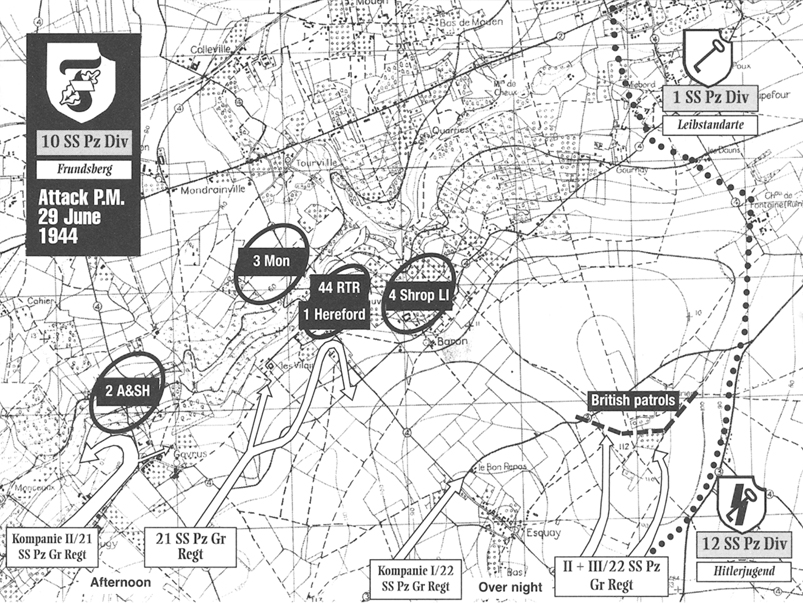
Meanwhile, having shaken themselves free of the chaos in their assembly area, 21 SS Pz Gr Regt prepared to lead the Frundsberg’s attack. Their mission was to destroy VIII Corps’ bridgehead and recapture the Odon Bridges at Gavrus and Tourmauville in order to establish lateral routes north to the Hohenstaufen. They formed up in the woods west of Bougy and in the first phase of the attack, they advanced eastwards. At 1550 hours, Headquarters 29 Armoured Brigade was reporting that ‘Gavrus is being attacked by tks and inf’. The panzer grenadiers described resulting fighting against 8 RB’s patrols as ‘fierce’. However, after almost two hours of combat, 21 SS Pz Gr Regt had fought through Gavrus pushing the British back into the valley. At 1740 hours, 11th Armoured Division’s war diary record ‘29 Armd Bde report having to pull out of Gavrus’, With the village clear, the Germans continued their advance. Almost immediately, the kampfgruppen heading north to the Odon, ran into 2 A&H, who was still dug-in in close defence of the bridges. The artillery again helped blunt the German attack, while the Argyles’ 6-pounder anti-tank guns, engaged targets at short range and the Royal Artillery 17-pounders, covered the open ground and longer fields of fire. Battalion anti-tank gunner Corporal Campbell recorded:
See map page 161
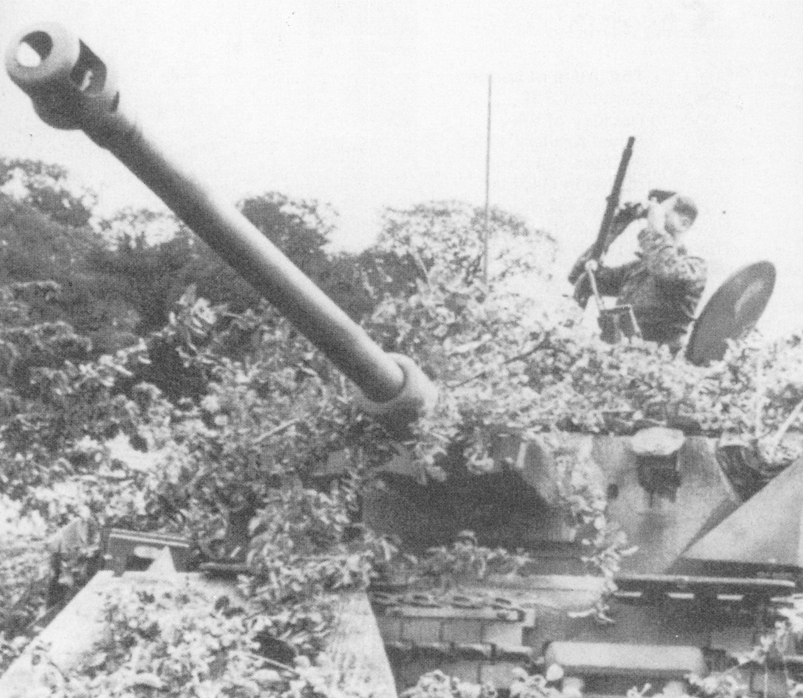
A well camouflaged Panzer MkIV hoping for concealment from both ground and air observers.
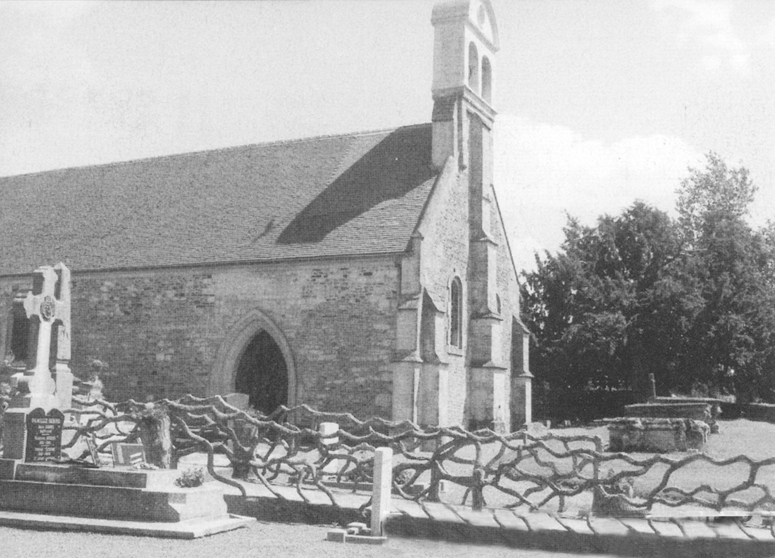
Chruch at Gavrus.
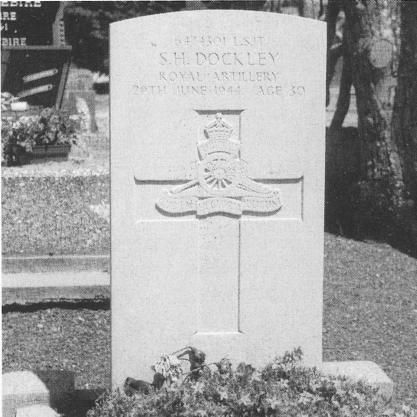
The grave of lance Sergeant S H Dockley of the Royal Artillery, killed 29 June 1944 and buried in Gavrus Graveyard.
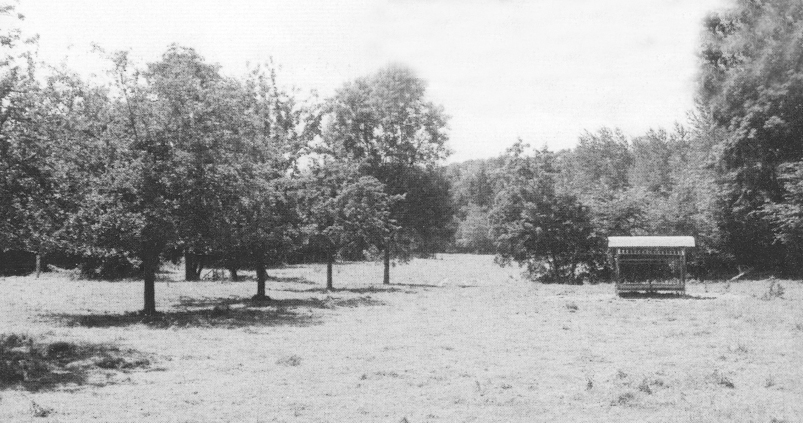
The narrow Odon valley at Gavrus.
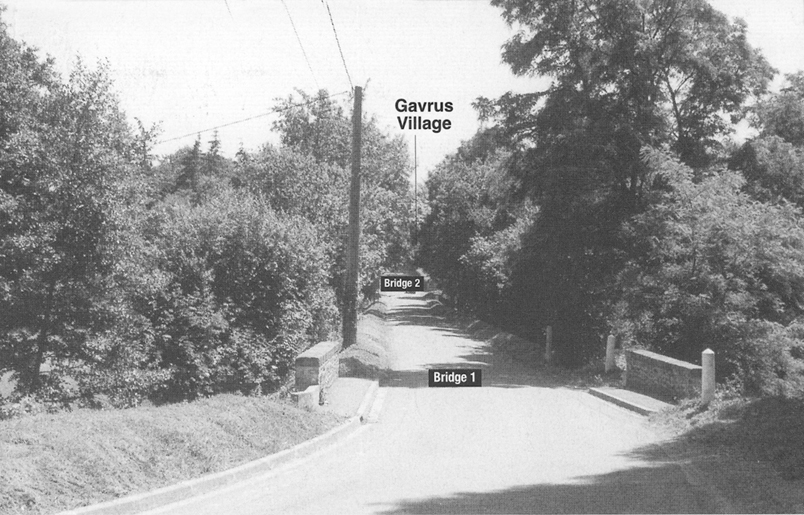
The double bridges at Gavrus held by 2 A&SH. Looking south on the D139.
‘All sort of reports were coming in about a big attack and we came under more and more fire. We were told by the CO to burn all our personal things except our pay books, as we were surrounded. It wasn’t a pleasant feeling to have tanks behind us. The Seaforth did a splendid job in stopping them totally cutting us of but we sent a day and a half with Germans all around us. At night time we were kept awake by German machine guns firing tracer on fixed lines.’
After four hours of determined attacks, the panzer grenadiers were beaten off and the Argyles stubornly held onto the important bridges.
Meanwhile, the remainder of 21 SS Pz Gr Regt, supported by the Sturmguschutz of 10 SS Panzerjäger Battalion, continued the advance east towards the Tourmauville Bridgehead. Here, at 1755 hours: 159 Brigade report enemy infiltrating into 1 HEREFORD posn’ and five minutes later ‘that the RIGHT Coy of 1 HEREFORD overrun’. However, the German attack was running out of steam, as illustrated by the following two entries in 11th Armoured Division’s war diary entries:
‘1815 hrs. Enemy attack on 1 HEREFORD held and enemy starting withdrawing. 29 Armd Bde report enemy having brought up some SP guns under cover of woods in area of Gavrus, which succeeded in inflicting hy cas on one sqn of 44 RTR.
‘1830 hrs. 159 Inf report spasmodic automatic fire in woods to the NORTH of the river. Situation well under control.’
The part played by the artillery in preventing the Frundsberg from pressing home their attack can not be over estimated. Major Steel Brownlie wrote of the Ayrshire Yeomanry Field Regiment:
‘Captain Walton with the Herefords reported a developing enemy attack, and a fire plan was arranged by Colonel Phillips and the commander of 159 Infantry Brigade. The entire artillery of 11th Armoured Division, 15th (Scottish) Division and 8th AGRA fired, the Yeomanry expending 90 rounds per gun in two hours. The attack was broken, and Captain Walton and Captain Garrett remained in observation to engage casual targets.’
Four hours after crossing its start line, 21 SS Pz Gr withdrew.
Night Attack 29/30 June 1944
As the German attack slackened, General O’Connor’s orders for the redeployment of his armour to north of the Odon were being completed.
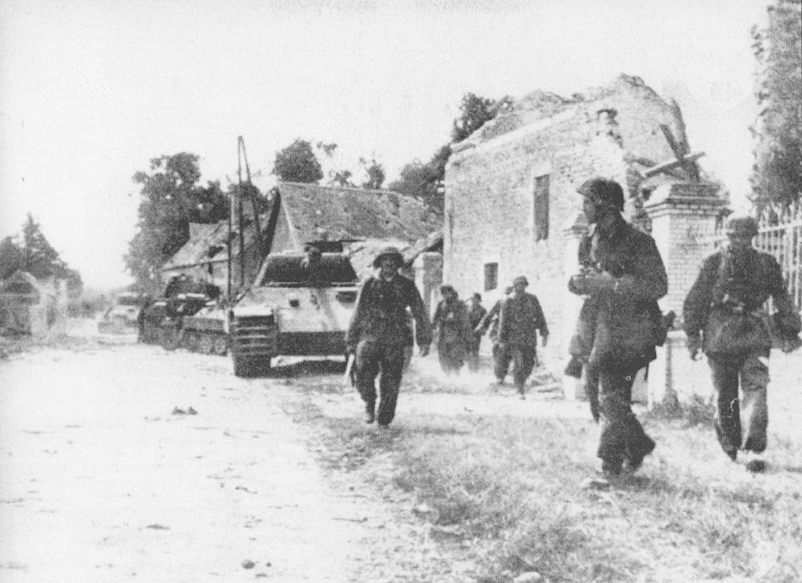
SS Panzer grenadiers supported by Panthers advance to contact through Brettvillette on the afternoon of 29 June 1944.
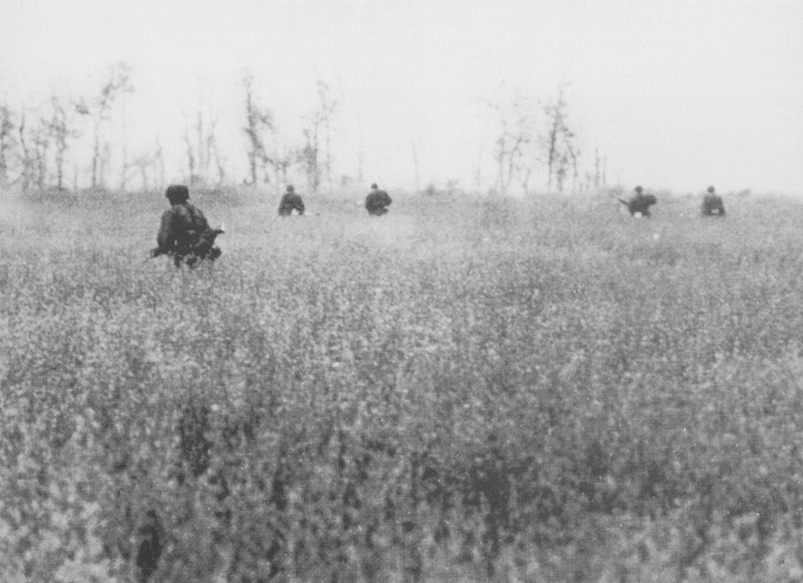
SS Panzer grenadiers advancing through waist high corn.
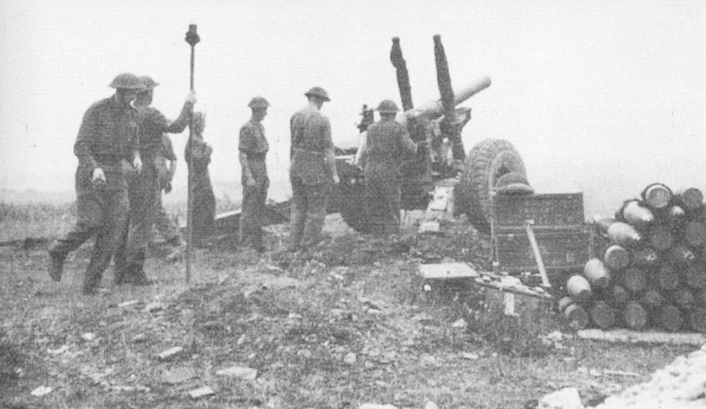
British artillery helped stop the attack by the Frundsberg.
In expectation of a renewed attack by II SS Panzerkorps, General O’Connor had positioned Churchills of 31 Tank Brigade in support the infantry and anti-tank guns in a screen in depth along the Corridor. 4 and 29 Armoured Brigades were concentrating in positions around Norrey-en-Bessin. From these assembly areas, they were to be prepared to counter-attack the flank of any German penetration of the infantry positions. However, for the armoured brigades, there followed a long and chaotic night of renewed traffic jams on the cleared routes back towards Norrey.
HQ Panzergruppe West was not, however, content to let the attacks peter out. II SS Panzerkorps was ordered to renew the attack under cover of darkness. It was reasoned that, at night, without being subject to air attack and with Allied artillery observation less than fully effective, the panzer grenadiers would not be under the same disadvantage as they had been during daylight. According to Panzergruppe West’s war diary, Rommel gave his thoughts to Bittrich over the telephone:
‘The II SS Panzerkorps counter-attack presents the big opportunity. The Schwerepunkt is to be kept on the left with Cheux as the main objective.’
Again, the Hohenstaufen were to be the main effort for the night attack. Their plan was almost exactly the same as it had been earlier in the day; an attack towards Cheux and the Carpiquet area beyond. The advancing panzers ran into a screen of recce Cromwells deployed by 2 Northamptonshire Yeomanry, who had been earlier sent forward to sweep the area of the afternoon’s attack. The Yeomanry’s screen having fallen back, the artillery and anti-tank guns engaged the panzers under the flickering light of star shells and again halted them.
To the south of the river, the Frundsberg’s advance progressed well and by 0400 hours, SS-Standartenführer Deisenhofer’s 21 SS Pz Gr Regt was closing in on the Tourmauville Bridge, still held by 1 Hereford, and had again virtually isolated the Argyles at the Gavrus Bridges. However, the attack was halted by artillery that produced ‘a wall of protective fire’ around the bridgehead. The British artillery tactics were pragmatic. Rather than attempting to strike individual German units moving somewhere in the darkness they resorted to firing protective barrages. Further south SS-Sturmbannführer Schulze’s 22 SS Pz Gr Regt, who had not been committed during the earlier attack, moved to secure the Hill 112 area to prevent its seizure if the British renewed their advance. I/Battalion advanced east on the Evrecy – Caen Road to le Bon Repos without opposition. Here it dug-in under artillery fire, which caused some casualties. To the south of Hill 112, II and III/Battalions pressed forward onto the slopes of the feature and took over the Hitlerjugend’s re-established but worn out and thinly spread defences. Even if General O’Connor could or had wished to resume the advance to the Orne, any chance had passed, now that 10th SS Panzer Division surrounded Hill 112 in strength.
Summary
After the war, SS-Obergruppenführer Hausser, commander II Panzerkorps, told his Intelligence Corps debriefer about the main features of the fighting on 29 June:
‘It was scheduled to begin at seven o’clock in the morning, but hardly had the tanks assembled when they were attacked by fighter-bombers. This disrupted the troops so much that the attack did not start again until two-thirty in the afternoon. But even then it could not get going. The murderous fire from naval guns in the Channel and the terrible British artillery destroyed the bulk of our attacking force in its assembly area. The few tanks that did manage to go forward were easily stopped by the British anti-tank gunners. In my opinion, the attack was prepared too quickly. I wanted to wait another two days but Hitler insisted that it be launched on 29 June.’
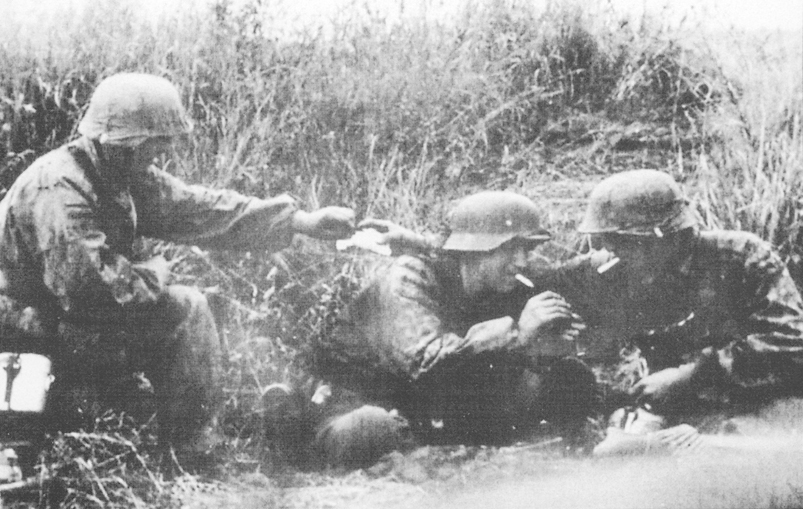
SS Panzer grenadiers take a smoking break.
Hausser was not to know that more time would have made little difference, as his intentions had been fully revealed by ULTRA decryptions of his radio traffic. The fully concentrated II SS Panzerkorps would still have been struck and badly written down by a massive Allied air and artillery attack.
Before the invasion Feldmarschall Rommel had predicted that the Germans would be unable to effectively concentrate panzer formations and launch them into battle under the gaze of Allied airmen. The firepower concentrated against II SS Panzerkorps on 29 June 1944, in the form of Allied bombers, fighters and fighter-bombers, coupled with British artillery and naval gunfire support arguably proved him to be correct.
The morale of II SS Panzerkorps, however, remained high. Surly, confident, SS soldiers taken prisoner:
‘…assured their captors that the boot would soon be on the other foot, as they had a “pep talk” in which they had been assured that London had been destroyed by V1s and twelve million Britons were dead.’
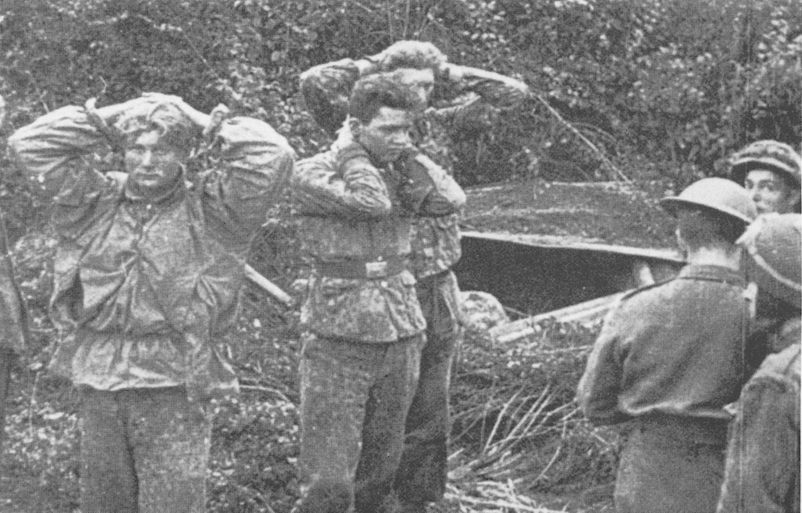
SS prisoners from II SS Panzerkorps. Most were confident that their captivity would be brief.