CHAPTER SEVEN
In response to the threat posed by II SS Panzerkorps, General Dempsey ordered extensive, operational level, regrouping, which came into effect at midnight 29/30 June. The following key formations and units were amongst those moving overnight to reinforce the Scottish Corridor: 53rd Welsh Division and 86 Anti-Tank Regiment, from XII Corps and 68 Medium Regiment RA from I Corps. The British offensive was at an end but German commanders harboured a desire to destroy the dangerous salient.
North of the Odon, with 29 and 4 Armoured Brigades’ traffic jams cleared, they completed their slow move to positions to the north and began the process of replenishing and repairing the tanks. Meanwhile commanders received orders and examined potential counter-attack options. In the front line, Scottish and Westcountry infantry endured rain and shelling. Brigadier Essame recalled that a:
‘… heavy and continuous mortar and artillery fire rained down on the track and the houses and orchards of Tourville, Mondrainville and Mouen. Around the bottleneck by the church in Tourville, buildings were in flames. The woods along the Odon and the main road remained under concentrated bombardment all day. Casualties began to pile up. Much of the fire came from a Werfer regiment to the south of Hill 112.’
However, the Brigadier continued to say that the shelling and mortaring was not all one way and that a considerable artillery duel was fought.
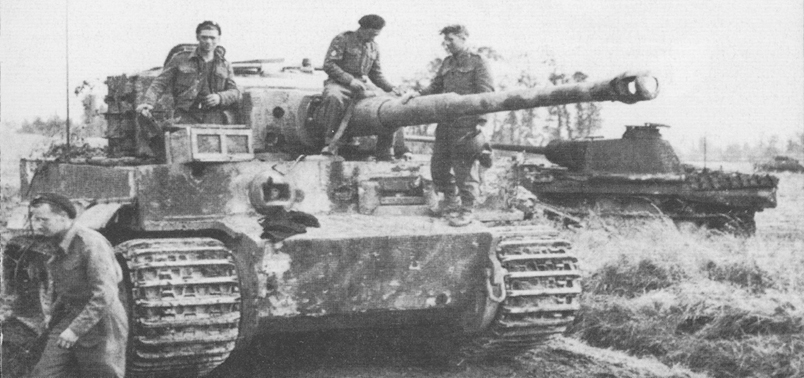
With the enemy pushed back, envious British tanks crews from British armoured regiments examine Tigers and Panthers – what chance against these.
‘Meanwhile, 94, 112 and 179 Field Regiments hit back, firing battery, regimental and even Corps targets all day. The 4.2s of 8 Middlesex came into action side by side with the infantry. The 3-in mortars of the forward battalions opened up. Even captured mortars were pressed into service.’
On top of the fire of the divisional artillery, Brigadier Churcher calculated that the guns of 8 AGRA fired approximately 38,000 rounds in the reporting period 30/31 June 1944. It is the use of quantities of ammunition such as this which contributed to the daily casualty rates in Normandy typically exceeding those of Passchendaele during the Great War.
It was not just an artillery duel that prompted this expenditure of ammunition but a series of German attacks. The corps historian recorded recorded:
‘The enemy was doubtless licking his wounds and regrouping his units after the terrible losses of the previous day. At all events no major effort was developed against 8 Corps during the whole of 30 June, though its opponents remained active and launched several probing attacks on a small scale. Thus at 1150 hours, 159 Infantry Brigade and 2 Argyles [in the western portion of the Odon Bridgehead] repulsed two companies of panzer grenadiers supported by tanks coming from the direction of Esquay, whilst in the middle of the afternoon the enemy tried again in a different sector – that held by 46 (Highland) Brigade [in the Grainville area], and for a short while succeeded in penetrating its southern positions. Within the hour, however, 7 Seaforth Highlanders had effectively dealt with this attempt.’
However, with the Argyles under sustained pressure Brigadier Makintosh-Walker ordered the abandonment of the positions that they had gallantly held for three days around the Gavrus Bridges. Having repelled successive counterattacks,
‘At 9.30 PM Major McElwee, now the Senior officer present, withdrew the three companies across both bridges without further loss and took them back by way of le Valtru – where the Seaforth were busy repelling a counter-attack – and Mondrainville to Colleville, where they found the headquarters of 227th Brigade.
‘Gavrus alone had been lost. For the rest, at the close of the fighting on 30 June the Division held all its positions firmly.’
The day ended with a controversial air raid by 250 Lancasters, who dropped 1,253 tons of bombs on the German transport bottleneck at Villers-Bocage. The town was largely destroyed and became a ‘no go area’ as the raid had included bombs with delay fuses set for up to thirty-six hours.
Over the period 31 June to 2 July, 53rd Welsh Division took over the western flank of the Scottish Corridor. To the east of the Odon Bridgehead, 43rd (Wessex) Division continued to fight along the valley from Baron towards Verson, overlooked during the succeeding days, by 10th Frundsberg SS Panzer Division who developed strong defensive positions on Hill 112. While not producing the same level of casualties as full offensive battle conditions, both sides suffered a steady stream of casualties. For the British, the Odon Valley became known as Death Valley, which subject to German harassing fire had to be negotiated in order to reach forward positions in the bridgehead. Eventually the Wessex Division cleared the Leibstandarte from the Odon Valley as far east as Verson.
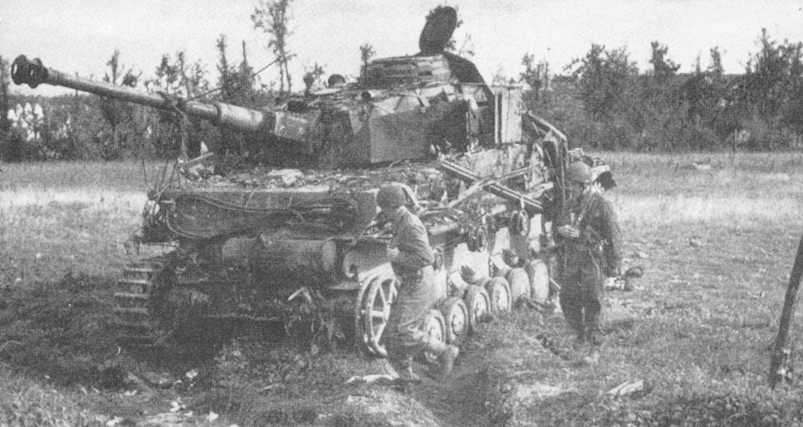
British soldiers inspect a Panzer MkIV. It appears to have lost a track whilst withdrawing; the turret has been turned to the rear.
Fighting continued over the next nine days, with the British divisions mounting a series of attacks so as to improve their positions astride the Odon Valley and the German mounting further battalion level counter-attacks. With VIII Corps concentrating on holding positions gained during EPSOM, Second Army’s main effort fell initially to the Canadians who eventually took the heavily defended Carpiquet Airfield from the Hitlerjugend. Following the clearance of the airfield on the high ground immediately west of the city, I Corps, with Bomber Command support, fought their way into Caen from the north and finally secured their D-Day objective on 9 July 1944.
Following the liberation of Caen there followed the epic battle fought by the Wessex Division to recapture Hill 112 in Operation JUPITER. The Westcountrymen captured the northern slopes of the hill and drove the Germans off the crest line. It became a no-man’s-land that held many characteristics of the Great War. The protracted battle for what is now quiet open farmland, went on until 23 August 1944 and is fully covered in the Battleground Europe title Hill 112.
The American General Omar Bradley summed up the strategic background to EPSOM and its aftermath:
‘The containment mission that had been assigned Monty was not calculated to burnish British pride in the accomplishment of their troops. For in the minds of most people, success in battle is measured in the rate and length of advance. They found it difficult to realize that the more successful Monty was in stirring up German resistance, the less likely he was to advance. By the end of June, Rommel had concentrated seven panzer divisions against Monty’s British Sector. One was all the enemy could spare for the US front.’