
Chapter 4
Megan Daniels
‘People of Rome! Caesar, who was reported but now to have sought a crown of bay at the cost of his life, comes home, victorious like Hercules from the Spanish shore.’1
Introduction
To study how the Roman emperors engaged with the imagery and symbolism of Hercules in matters of war requires engaging with the palimpsest of meanings associated with this god and his corresponding cultural manifestations over the long term. Throughout the first millennium BC, Hercules emerged amongst the varied cultural groups around the Mediterranean as a multifaceted deity representative of many themes pertinent to empire. As a mortal who obtained immortality and who wandered to the limits of the known world siring royal houses and conquering monstrous forces, he epitomized the ideals of imperium and virtus, and it is little wonder why dynasts from the Roman worlds adopted Herculean symbolism in their self-representations. Yet he was also an equivocal figure, who migrated between venerable warrior ancestor, maddened brute and exotic effete, making him an important counterpoint for ancient authors on the more ambivalent aspects of empire and conquest.
The clearest way to summarize Hercules’ military appeal to Roman emperors is his long history of mythical and dynastic prominence around the Mediterranean world, a history which went back to the Iron Age, and likely earlier. Hercules was a model for Rome’s rulers because he was a symbol of social power with a long history, recognized across numerous cultural groups who were incorporated into the Empire. His characteristic imagery, which included the lion-skin cap and club, was a widely shared symbolic language that could be employed in various cultural contexts, while the mythical tropes surrounding this god provided fodder for more erudite musings on the workings of power.
The Roman imperial engagement with Hercules thus involved a symbolic language that was much older than the Empire itself, but timelessly suitable and malleable to the purposes of empire. While this language was associated with bellicose endeavours like hunting and warfare, Hercules’ persona encompassed much more than brute force, channelling martial prowess into the grander civilizing missions of imperial rule. This lofty messaging can be read through the interrelation of a number of media – literary, numismatic, epigraphic and iconographic – that formed a dynamic and fluid ‘symbolic system’ of communication across the Empire, both official and unofficial.2 The first part of this chapter provides an overview of the warlike symbolism of Hercules from the Iron Age to the Republic, followed by case studies into the Roman imperial employment of Hercules as a war god.
The Mediterranean Backdrop
Hercules’ bellicose character is seen in relation to the ‘Master of Lions’ imagery that emerges on Cyprus at open-air sanctuaries around the Mesaoria plain in the early sixth century BC and takes the form of limestone figurines depicting a male in smiting pose (see Figure 4.1). There may be earlier iconographies of the Greek Héraclès, but all instances are conjectural: Hermary cites the Cypriot plate dating to the tenth century BC from Palaepaphos showing two hunters attacking a two-headed serpent as possible evidence for early versions of the Héraclès myth. Cypro-Phoenician-style silver cups from Kourion in Cyprus and Praeneste in Italy from the eighth and seventh centuries BC showing the same narrative scene of a hunter departing from a city, killing a deer in the mountains, making a sacrifice and attacking a monster with the help of a goddess may also suggest an early dissemination of the myth of Heracles across the Mediterranean.3
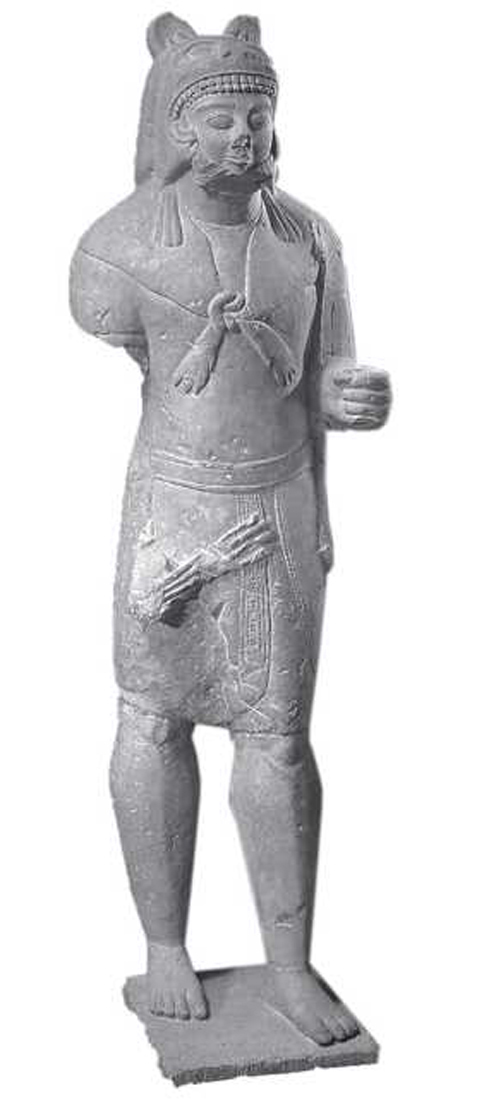
Figure 4.1: ‘Master of Lions’ figurine (c.530–520 BC) from Cyprus, heavily restored. (© The Metropolitan Museum of Art, 74.51.2455; public
In the ‘Master of Lions’ imagery, his raised right arm holds a club and his left hand grasps a lion by the tail, hind legs or neck. He wears a short belted chiton and lion skin draped over the head and shoulder, with the front legs knotted at the chest.4 The hunter in lion skin calls to mind the classic iconography of Heracles that appears in Greece and Italy in vase painting,5 while the smiting pose derives from Mesopotamian and Egyptian divine imagery, as does the general theme of hunting.6 There is some rightful scholarly hesitation to accept this Cypriot imagery wholesale as Heracles or Melqart,7 and it is perhaps most apt to see both the Master of Lions imagery and Heracles/Melqart as figures who evoked a venerable symbolic language of the king/hero/god who conquers chaotic forces like the lion and also assumes a leonine persona in the establishment of worldly order.8 Mario Attilio Levi argued that there were no common origins before the Hellenistic-Roman era between Heracles, Melqart and Hercules;9 this may be so as far as actual origins go, but interrelations between all of these figures were made well before the Hellenistic period in the context of the rampant cultural and commercial interactions within the Mediterranean.
With the expansion of numerous groups in the Archaic and Classical periods, for instance, the mythical and iconographic tropes of Heracles and Melqart played a clear role in dynastic and territorial claims.10 Bilingual inscriptions on twin cippi from Malta dating to the second century BC make the conflation of Heracles and Melqart as founder gods clear. In the Phoenician inscription, Melqart is invoked as b’l sr (‘Lord of Tyre’); Heracles is called archegetes (‘Founder’) in the Greek version.11 Engraved bronze razors from the necropolis of Saint Monica at Carthage, which date to the third century BC, combine Hellenizing imagery of Melqart (e.g., a standing male in lion skin holding a club) and more traditional Punic imagery (e.g., a bearded male in long skirt and pointed cap holding a fenestrated axe).12 In many ways, ‘Founder’ did not just denote a leader of colonists, but also, in Bonnet’s words, a process ‘d’appropriation culturelle du cosmos et d’espaces habitables par les communautés, tyriennes et diasporiques’ (‘of cultural appropriation of the cosmos and habitable spaces by communities, Tyrians and diasporas’).13 This appropriation extended to Heracles: the prince Dorieus of Sparta, from the line of Heracles, was advised to plant a colony, Heraclea, in western Sicily, ‘since Heracles himself had acquired it’.14 The mythical geographies of Heracles-Melqart reflected colonial endeavours, particularly in the western Mediterranean at Phoenician foundations such as Lixus and Gades. At Gades, mythical tradition had Heracles kill Geryon and affix two pillars into the earth, the ‘Pillars of Hercules’.15
As U. Huttner notes, ‘der militärische Bereich ursprünglich nur am Rande zu seinen Ressorts zahlte’ (‘the military aspect was originally only a small part of his portfolio’).16 Yet the employment of Heraclean imagery in the context of war and conquest comes into clearer focus with the Macedonian rulers – namely Philip and Alexander – and their successors, the Diadochoi, as the military duties of these kings were transferred to their patron. The Macedonian royal house claimed Heracles as its divine ancestor, and the exploits of Philip and Alexander were legitimized via recourse to their Heraclean ancestry.17 An inscription naming Herakles Patroos was found in the royal palace at Vergina.18 The association between Alexander and Heracles is witnessed clearly in the widely distributed tetradrachm showing Heracles in his lion skin on the obverse – possibly with Alexander’s features – and a seated Zeus on the reverse.19 Alexander besieged Tyre in 332 BC after the city refused to allow him to sacrifice to Heracles; he then honoured the god with yearly festivals.20
Alexander and the Diadochoi popularized the epithets Aniketos and Kallinikos, associated with the gods of the Macedonian dynasty, Heracles and Dionysus, both conquerors of the East, and Weinstock notes that Heracles was called Kallinikos and Aniketos much more frequently after Alexander, although he was addressed by these terms as early as the late seventh century BC.21 The links with the earlier first-millennium symbolism and ideology surrounding Heracles are evident: the late fourth-century Alexander Sarcophagus, commissioned by King Abdalonymous of Sidon,22 for instance, hearkens back to the Master of Lions imagery by depicting Alexander atop a horse in smiting pose in lion-skin cap on long side A, with a lion-hunt scene on long side B (see Figure 4.2).
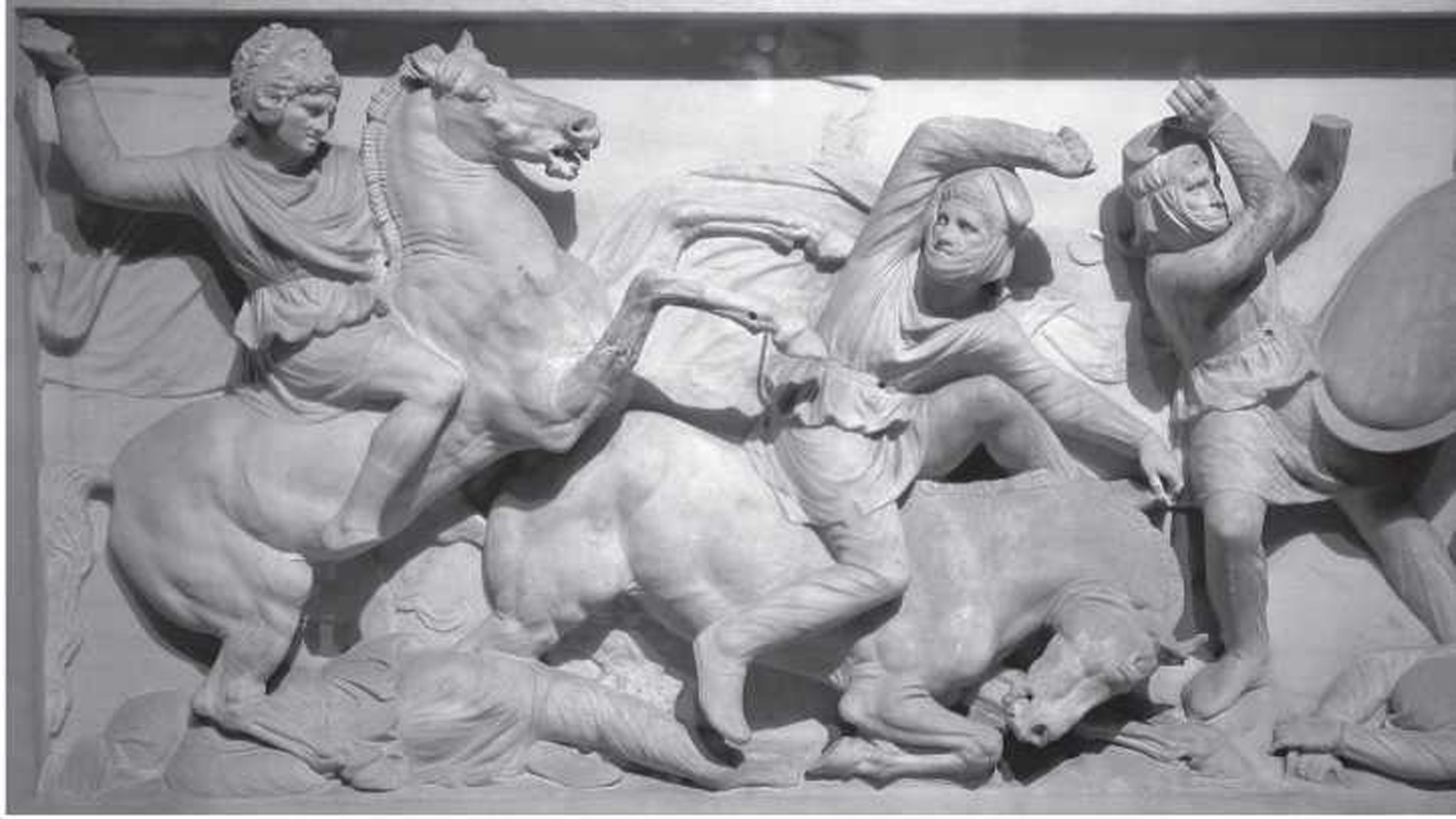
Figure 4.2: The Alexander Sarcophagus showing Alexander in lion-skin cap fighting Persians on long side A. (Photo by Ronald Slabke; CC BY-SA 3.0)
Alexander’s successors continued to capitalize on the symbolic language of Heracles through widely disseminated numismatic iconographies, in particular the Seleucids in the East. For instance, Seleucus I continued to produce the Alexandrine tetradrachm showing an unbearded Heracles in the lion skin on the obverse and an enthroned Zeus holding Nike or an eagle and sceptre on the reverse. Almost every mint that produced silver coinage issued these tetradrachms: Sardis, Tarsus, Antioch-on-the-Orontes, Antigonea-on-the-Orontes, Seleucia-in-Pieria, Laodicea-by-the-Sea, Carrhae, Babylon, Seleucia-on-the-Tigris, Susa, Ecbatana and several uncertain mints,23 while other dynasties also engaged with Heracles’ imagery and mythology – the Ptolemies, Antigonids and Attalids.24 This widespread use of Heracles continued under Seleucus’ successors, albeit with certain modifications of the Heracles type: for instance, Antiochus I issued coins in the western part of the empire showing Heracles resting after his labours – possibly symbolizing the security of the kingship – while the eastern part of the empire issued coins emphasizing the military aspects of Heracles, including images of his weapons, the club and bow.25
The appropriation of Heracles as victorious conqueror and divine ancestor took hold in the West as well, and incorporated the persona of Melqart.26 In Sicily, the Carthaginian and Sicilian leaders rapidly began minting coins at the end of the fourth century with the head of Heracles-Melqart in his lion-skin helmet, which alluded to the Alexander prototype and likely represented the appropriation by Siculo-Carthaginian leaders of the current dominant imagery of rulership via a widely recognized deity. Earlier Siculo-Punic coins from the fourth century depicted a bearded male head with earring and had the legend RšMLQRT, ‘Rosh Melqart’ or ‘head of Melqart’, referring to either a coastal location or a Carthaginian provincial institution.27 For the Carthaginians, this imagery seems to appear following their defeat of the Syracusans in 304 BC. But the tyrant of Syracuse, Agathocles, had also used the image of Heracles on his own wartime coin issues following his return from his campaigns in Africa.28 A few decades later, when Pyrrhus defeated the Punic forces of Eryx in 277 BC, he offered games and sacrifices to Heracles, just as Alexander had after his capture of Tyre.29
In the third century, the imagery of Heracles/Melqart appeared on coins from many of the Phoenician cities in Spain, utilized by the Barcid dynasty to legitimize their growing power in the Iberian Península.30 Coin issues showing a laureate Heracles/Melqart with club on the obverse and elephant on the reverse are likely quasi-portraits of the rulers, alluding to the Barcids’ wartime activities.31 Through these issues, the Barcids drew from the religious mentalities of the Punic cities in southern Spain, but also from broader ‘Heraclean’ ideologies associated with conquest and dynastic legitimacy. Finally, leaders going back to the Archaic period emulated Heracles, not only as a model founder god and royal ancestor, but also as the first victor of the Olympic Games: Milo of Croton is said to have led the army of his native city against Sybaris, clad in a lion skin and wielding a club;32 Polydamus of Scotoussa supposedly killed a lion with his bare hands in deliberate imitation of Heracles’ first labour.33
It is against this broader background that we must interpret Roman rulers’ employment of Hercules, as a syncretistic hero-god whose martial and royal symbolism translated across numerous cultural contexts. Indeed, the peoples of the Italian peninsula had formulated their own interactions with this peregrinating deity long before the Roman imperial period. From the excavations around the church of Sant’Omobono in the Forum Boarium in Rome in the mid-twentieth century came a two-thirds life-size terracotta statue, dating to the sixth century BC, of a god in a lion skin knotted at the chest and belted at the middle in the manner of Cypriot Master of Lions figurines, although the workmanship of the statue is reminiscent of types produced in eastern Greece (Ionia) (see Figure 4.3). He stands beside a female consort in Ionian helmet, generally interpreted as Minerva/Athena.34 Although her identity is disputed, Minerva/Athena would make sense, given Athena’s role as protector of Heracles during his labours, and bronze mirrors from Etruria show Hercle (Heracles) and Menrfa (Athena) together.35 While important in this early period for its strategic commercial and transhumant position on the fordable part of the Tiber and as a locale for trade in staples like salt,36 the Forum Boarium would, in the late Republic and early Empire, become an epicentre for Rome’s mytho-history, featuring Hercules in triumphal fashion (see below).37 Accounts claim that Hercules and Evander founded the Ara Maxima after Hercules arrived at the Forum Boarium from Gades with Geryon’s cattle and slew Cacus.38
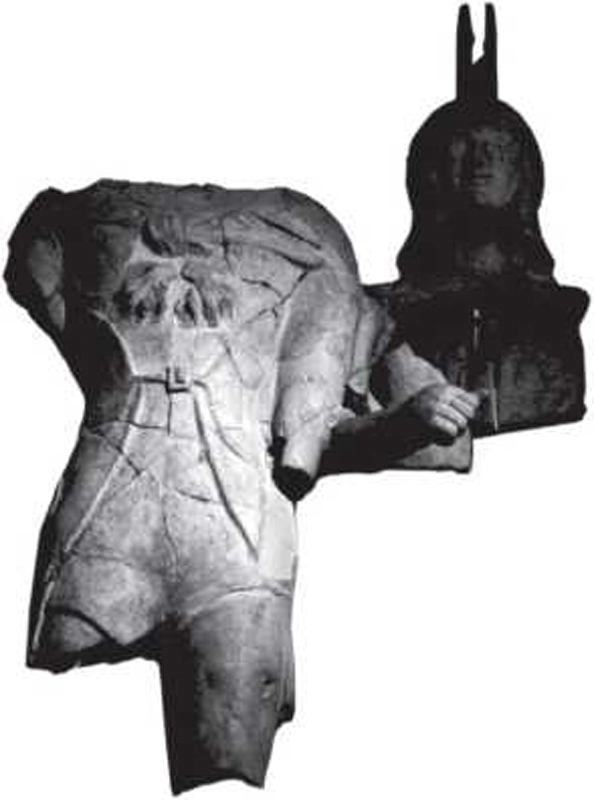
Figure 4.3: Hercules and Minerva terracotta statues from the archaic temple at Sant’Omobono, Rome, sixth century BC, now in the Capitoline Museum, Rome. (Photograph by author)
Hercules as a War God: The Republican Period
Some have suggested that Hercules’s persona in Rome, and in particular the Forum Boarium, underwent a transformation in the mid-Republican period, from a god associated with traders and commerce to a warrior deity as Roman rulers became increasingly engaged in Hellenistic martial and royal customs.39 Conversely, Levi argues that the original deity of the Ara Maxima – the Great Altar to Hercules in the Forum Boarium, built by Hercules and Evander according to mythical tradition – was a supreme ruler god who only became associated with the Greek hero in Mid-Republican times.40 The reality is clearly complex: the terracottas from Sant’Omobono mentioned above associate Hercules – in Cypro-Ionian style – with a warlike goddess, and Greek myths going back to the Archaic and Classical periods wrestled with the dual status of this god-hero. The use of a mortal-turned-god protected by a powerful goddess in Archaic Rome, atop a monumental temple, joins a number of other sites throughout Italy with this imagery,41 and, like the Master of Lions imagery, ties into a deeper history of regal employment across the Mediterranean and Near East.42
Nonetheless, while Hercules was long associated with royal and martial power, his focal point as a military deity associated with the Roman triumph does emerge in the Mid- to Late Republican period, alongside Rome’s expansion as an imperial power. Livy states that Roman generals were erecting statues to Hercules by 305 BC,43 and triumphal coinage depicts the hero with increasing frequency. An increasing number of temples and monuments were built to Hercules in this period – although it is important to note that the mid-Republican period in general saw an explosion of temple building in the capital.44 In the Campus Martius, the starting point for the triumphal procession, M. Fulvius Nobilior built the temple to Hercules Musarum (Hercules of the Muses) in the early second century.45 Another temple, that of Hercules Custos (‘Guardian’), is also mentioned in the ancient sources, but its location is unknown.46
In the Forum Boarium, M. Octavius Herennus built a temple to Hercules Victor in the second century BC after he escaped pirates.47 Scipio Africanus Aemilianus, the conqueror of Carthage in 146, built a round temple to Hercules, the aedes Aemiliana Herculis (an over-life-size bronze statue now in the Museo del Palazzo dei Conservatori in Rome – no. 1265 – may come from this temple),48 and rebuilt the precinct of the Ara Maxima. An inscription from the Caelian Hill records that Lucius Mummius, conqueror of Corinth in 146 BC, built a temple to Hercules Victor.49 Yet it was not just Hercules who was Victor and Invictus: Scipio Africanus was referred to as invictus,50 Pompey was called invictissimus51 and Caesar unus invictus.52
Most importantly, the Ara Maxima was located on the triumphal route, as was an ancient bronze statue of Hercules in triumphal clothes that dated to the time of Evander.53 Hercules’ cult at this altar took the epithet Invictus, and in 312 BC, the cult was transferred from the private management of the Pinarii and Potitii to the state under Appius Claudius Caecus.54 By the first century BC, generals customarily offered a tithe from their spoils of war to Hercules on the Ara Maxima, along with an extravagant public banquet. The tithe, or decuma, to Hercules had been customary amongst Italic traders,55 but in the first century BC, Sulla, Crassus, Licinius, Lucullus, Pompey and Caesar were all offering this tithe and/or providing the public feast.56 The banquet was located in the ‘hieron [shrine] of Hercules’,57 which Marzano argues signifies the Ara Maxima.58 Sulla also refurbished the shrine of Hercules Custos (‘Guardian’) near the Circus Flaminius, while Pompey refurbished a shrine to Hercules Invictus near the Circus Maximus (see below).59
The connection between Roman triumphs, the dedication of war spoils to Heracles and the provision of a banquet in Heracles’ precinct integrated this god’s persona as divine ancestor and victorious conqueror with the lavish public spectacles of wartime spoils drawn from eastern Hellenistic traditions.60 Marzano locates this increasing stress on Hercules and lavish banquets in Roman triumphs to the second century BC, specifically to Aemilius Paullus’ celebrations following his victory at Pydna (168 BC).61 The linking of Hercules to wartime victory was no doubt influenced by both the long-term martial persona of this deity as outlined above and Hercules’ more immediate historical contexts of exploitation by Alexander the Great, the Hellenistic kings and the Punic rulers in the western Mediterranean. Q. Fabius Maximus reportedly moved the Hercules temple ad Portam Collinam to the Capitoline hill, the culmination of the triumphal route, during the war with Hannibal.62 According to John Scheid, however, Hercules was not a commercial or military deity full stop, but a god of triumphal returns and civilizing qualities, particularly the Hercules of the Forum Boarium: ‘Hercules connects the two major qualities stressed by myth and celebration in the Forum Boarium area, namely a victorious return from strictly male activities, and civilising the first, barbaric inhabitants of the place.’63 Colette Jourdain-Annequin writes in a similar vein, that Hercules was ‘le modèle paradigmatique de la guerre conduit, au nom de la civilisation, contre les Barbares’ (‘the paradigmatic model of war conducted, in the name of civilization, against the barbarians’).64 Violence and civilization were two sides of the same coin.
This ideology extended to the expanding boundaries of Rome at the turn from Republic to Empire. Diodorus’ account of Hercules’ adventures in Gaul portrays the god pacifying untamed regions and protecting those who took possession of those regions.65 His syncretism with local gods drew on – and possibly shaped -his bellicose persona. For instance, in the Batavian region, Hercules was conflated with the local hero Magusanus, as demonstrated by inscriptions and cult sites.66 A sanctuary to Hercules Magusanus at Kessel/Lith on the south bank of the Meuse showed many kinds of weaponry deposited as votive objects, while the monumental sanctuary at Empel contained dedications by Batavian and Roman soldiers. Other sanctuaries at Xanten and Bonn also yielded dedications to Hercules by legionaries – a statue and votive altar respectively showing Hercules with club and lion skin.67 Tacitus, in his Germania, noted that the Germanic peoples invoked Hercules before heading into combat.68 For Romans pushing into frontier areas, Hercules’ bellicose and pacifying qualities alike may have furthered the syncretism between Hercules and local gods in regions that, to the Romans at least, were frontiers. In the contexts of imperial expansion, Hercules’ mythical exemplum thus provided a clear framework for empire: military conquest combined with a civilizing mission.69
The employment of Hercules in the civil war period shaped his subsequent use by the emperors. In particular, the ambiguous nature of Hercules – as a heroic civilizer yet also subject to the extremes of human emotions such as rage and fury – offered real fodder for writers characterizing larger-than-life figures like Caesar and Pompey, who could, almost in the same breath, be extolled for their magnificent accomplishments and maligned for their megalomania, hubris and lust for power.70 These later literary expositions were fuelled by the fact that these leaders actually likened themselves to Hercules. Like Hannibal before him (before Hannibal marched on Rome), Caesar visited the temple of Melqart in Gades. Upon seeing a statue of Alexander the Great in that temple, Caesar lamented at his own failure in similar accomplishments, and forthwith had a prescient dream symbolizing his conquest of the world.71 In the last weeks of his life, Caesar took the name Divus Iulius and was given a flamen (a priest of official Roman cults) and state temple to himself and his Clementia. Ovid ridiculed this act, including Liber and Hercules in his polemic against hubristic mortals conquering not only Earth and Ocean, but also Heaven.72 Furthermore, in the temple of Quirinus, the divinized Romulus, Cassius Dio tells us that there was a statue of Caesar inscribed with theo aniketo (= deo invicto), invoking Hercules’ title Invictus.73
Nonetheless, many of Caesar’s military accomplishments could be (and were) compared with Hercules’ feats. In the Pro Marcello, Cicero’s mention of the locations of Caesar’s victories – e.g., Oceanus (Ocean) – map onto Hercules’ accomplishments in these regions that won him immortality.74 The link between Hercules and Gaul, discussed above, also applies to Caesar’s military exploits in these regions. S.J. Harrison, interestingly, notes Cicero’s comparisons between Hercules and Caesar in the Pro Marcello as, conversely, emphasizing the clementia of Caesar in controlling the destructive passions of anger and revenge upon his victorious returns from civil war. Harrison notes that Hercules’ labours, from a philosophical standpoint, could actually be taken to represent the moral subjugation of passion and fury, in stark contrast to the mythical interpretations of this god-hero.75 Hercules’ persona was thus an exceptionally open palette upon which to construct one’s ideas of some of Rome’s most controversial characters.
Pompey, perhaps more so than Caesar, explicitly featured Hercules Invictus/Victor in his political ideology. He refurbished a temple to Hercules ad Circum Maximum, the aedes (temple) Pompeii Magni/aedes Herculis Pompeiani.76 His stone theatre was dedicated on 12 August 55 BC, the festival day of Hercules Invictus at the Ara Maxima (also tying in the theme of victory with the temple to VenusVictrix). These associations were likely connected to Pompey’s martial activities overseas, emphasizing Hercules as a god of victorious returns: he fought against Sertorius in Spain in the 70s BC, where the cult of Hercules-Melqart was prominent. His watchword used at the Battle of Pharsalus in 48 BC was Hercules Invictus.77 Furthermore, after returning from his campaigns in the East, his son-in-law Faustus Cornelius Sulla (son of Lucius Cornelius Sulla) struck a series of coins in 56 BC, one showing Venus on the obverse and three trophies on the reverse. Another showed the head of Hercules and the corona aurea received by Pompey in 63 BC,78 uniting these deities with Pompey’s selfrepresentation as invincible commander. Of course, Pompey’s portrait and adopted name (Magnus, ‘The Great’) also alluded to Alexander.
Mark Antony famously traced his lineage back to Hercules through his mythical ancestor, Anton, one of the sons of Hercules, and Plutarch also compared Antony’s physical appearance to the god.79 A set of aurei coins from 42 BC by Livineius Regulus shows this relationship: the obverses show heads of Antony, Lepidus and Octavian, while reverses depict their mythological ancestors: Hercules/Anton, the Vestal Aemilia and Aeneas carrying Anchises.80 An engraved stone ring from Pompeii shows Antony with the features of Hercules, alluding to actual statues of this type.81 Antony, like Alexander, associated himself not only with Hercules, but also Dionysus, both of whom symbolized Eastern conquests and ceremonial spectacle that formed a cornerstone of Hellenistic kingship.82 Coins struck for Antony in 43–42 BC in Gaul show a bust of Victory on the obverse and a lion on the reverse walking to the right – possibly symbolizing Hercules Victor and also alluding to Alexander.83 Plutarch, in his Comparison of Antony and Demetrius, suggested, however, that Antony preferred the effete version of Heracles, stripped of his weapons and dress by Omphale, thus mirroring Antony’s relationship with Cleopatra.84 This comparison may be an attempt – influenced by Augustan propaganda – to portray Antony as the soft, un-Roman ‘failed’ Hercules/Alexander.85 Nonetheless, the problematic nature of Hercules – an unconquerable hero, yet one associated with the extremes of madness and luxury – made him an equivocal character for the Roman emperors in their triumphal self-fashioning.
Augustus and First-Century Emperors
By the end of the Republic, therefore, Hercules offered a rich mosaic of associations with war and imperium, centred on triumphant returns to Rome of glorious and unconquerable military commanders, yet his portrayal in myth and propaganda evoked a certain ambivalence, as did Alexander’s. Weinstock notes an avoidance of the term invictus by Augustus (reigned 31 BC – AD 14) based on its association with Caesar and Pompey.86 Other studies suggested an avoidance of Hercules altogether by replacing him with Mars or Apollo,87 while the denigration of Antony-Cleopatra via Hercules-Omphale has already been noted. But the evidence once again presents a more complicated picture. Hercules and his martial endeavours emerge, on the contrary, as a crucial backdrop to Rome’s imperial trajectory under Augustus via a number of interrelated media: literary/rhetorical, symbolic and iconographic.88 Virgil, for instance, compared Augustus to Hercules in the Aeneid as the greater divine son and hero.89 Aeneas’ association with labor and persecution by Juno, not to mention his donning of the lion skin, position him as a reflection of Hercules,90 and all three characters – Augustus, Aeneas and Hercules – can be seen to oppose, respectively, Antony, Turnus and the monster Cacus.91
The tale told by Evander in Aeneid Book 8 of Hercules and Cacus in the Forum Boarium has been singled out as a seminal episode played upon by several Augustan authors, which located Hercules and his long association with this region as a focal point for Rome’s mytho-history fashioned under Augustus.92 The fact that Augustus celebrated his triple triumph on 13 August 29 BC, the festival day of Hercules Invictus at the Porta Trigemina, has not been ignored.93 Virgil alludes to this triple triumph in the description of Aeneas’ shield, and possibly also when Hercules is portrayed as returning to Rome triumphant with the spoils from ‘threefold Geryon’ (tergeminus).94 The ode composed by Horace, quoted at the beginning of this chapter, celebrated Augustus’ triumphant return from Spain as Hercules, mirroring Hercules’ own route taken to Rome from Spain following his Spanish conquests against Geryon. Virgil had Jupiter prophesize that Augustus would ‘circumscribe empire with ocean’,95 which was especially fitting for his conquests in Spain. Augustus played on Herculean themes through his coinage in Spain, minting coins at Gades showing the head of Hercules with lion skin and club with DIVI F (‘son of the divine’), and in other issues showing his portrait with DIVI F on the obverse and what may be the temple of Melqart on the reverse.96
A mythical road, the Via Herculea, also traced Hercules’ route from Spain to Italy.97 Furthermore, the allusions to the Gigantomachy in the Aeneid,98 and the Amazonomachy on the temple of Apollo Sosianus,99 associate Hercules not with Antony – who is better equated with the barbaric Giants and Amazons to be vanquished – but with Augustus. It may be that Augustus was in some way reclaiming Hercules from Antony,100 yet it is just as possible that Augustus simply employed Hercules as victorious conqueror in an iconic mythical narrative to reflect his own divinely sanctioned triumphs.101
Furthermore, rather than simply reclaiming Hercules from Antony, recent interpretations have instead favoured Augustus’ use of Hercules as establishing a clear link between the princeps and triumphant Republican predecessors activated within the ‘pre-Actian monumental landscape of Rome’, specifically the Forum Boarium.102 Matthew P. Loar notes how Virgil parallels Mummius – the likely raiser of the temple to Hercules Victor ad Portam Trigeminam in the second century BC -and his association with the illustrious past of Roman Republican triumphs with Augustus’ connection to this same past through Hercules. The figure of Hercules, by ‘activating a wide matrix of Republican resonances, telescopes centuries of Republican triumphs, offering a model for Augustus that reaches back not simply to Rome’s recently concluded civil wars, but to a point in history when Rome was ascendant, nearing hegemonic control over the Mediterranean’.103 It may be that Augustus chose the ‘proper Hercules’ associated with military victory and imperial glory over the luxurious, effete one. The reliefs from the temple to Apollo on the Palatine depicting Hercules and Apollo struggling over the Delphic Tripod may suggest a similar nuancing: it was in losing this struggle that Hercules was punished with servitude to Omphale. In David Quint’s words, ‘The real modern Hercules [of Aeneid Book 8] prevails at Actium over the dress-up one.’104
Yet Hercules still remains an equivocal character. Galinsky suggests that Virgil used Hercules as a foil for Aeneas (and Augustus) because he was a personal god, and thus could help meld Aeneas into a hero for the new Rome under Augustus.105 Yet Aeneas’ and Hercules’ uncontrollable – even monstrous – rage are evident in the Aeneid, for example the episode where Aeneas is compared to the hundred-handed giant Aegaeon as he rages across the battlefield after Pallas’ death.106 The ambivalence inherent in Virgil’s grand epic has certainly been acknowledged.107 Other Augustan authors, notably Propertius, also made it clear that experiences of empire could not be boiled down to a monolithic narrative.108 In Elegy 4.9, Propertius presents us both with Hercules the masculine hero and Hercules the transvestite who, more than any other mythical figure, parodies masculine Roman ideals, and also alludes to the Omphale episode. In considering Hercules as a war god for Rome’s first emperors, then, we cannot ignore these multiple aspects of his persona. Hercules was always an equivocal character: he was both hero and god, the champion of masculine power and yet readily subject to inhabiting both the detrimental extremes and the structural opposite of this ideal. Hercules – like Alexander – was all at once a focal point for emulation, for cautionary tales and for irony in the face of conquest and expansion.
Indeed, emperors could be derided for equating themselves wholesale with Hercules: Philo in his Embassy to Gaius attacked Caligula (ad 37–41) for overstepping the bounds of human nature to think himself a god, citing, among other grievances, the wearing of the lion skin and club to the theatre.109 Nero (ad 54–68), never an emperor that one wanted to emulate, also attempted to directly copy Hercules by (allegedly) having a lion trained in the circus so that he might kill it with a club as Hercules did the Nemean Lion, alluding to the widely disseminated iconography of Hercules (and king) as lion-slayer.110 Nero was supposedly hailed as Hercules upon returning from Greece as Olympic victor, and fashioned his cutting of the Isthmus of Corinth as a Herculean labour.111 What made Caligula’s and Nero’s usage of Hercules as an exemplum of bellicosity so disdainful? Beyond the many other well-known grievances against both emperors, Philo’s accusation against Caligula’s mimicry offers some clues that help us nuance the proper usage of Hercules. He demands of Caligula whether the emperor truly lived up to the ideals of the demi-gods like the Dioscuri, Dionysus and Hercules that he supposedly imitated: ‘Or did you also emulate Heracles in your unwearied labours, your tireless feats of courage? Did you fill continents and islands with legality and justice, with fertility and prosperity and a lavish supply of the other boons which peace deep-founded creates?’112
Hercules might be cast as triumphant conqueror, but the Hercules to emulate was the one who heralded progress and civilization alongside wartime victory, who exercised clementia in tandem with imperium. Conquest and domination legitimized by a civilizing mission is one of the clearest hallmarks of an empire’s self-fashioning;113 anything less, and we slide into the degenerate Hercules filled with uncontrollable rage or bested by luxury.
The ‘proper’ Hercules was evidently a concern also for the Flavians, and in particular Domitian. Nero and the subsequent emperors who revolted in the civil war of AD 68–69 possibly lent Hercules a bad flavour. Vindex, the governor of Gaul who rebelled in AD 68, is associated with anti-Neronian denarii showing Hercules and the legend Hercules Adsertor (‘Hercules the Liberator’).114 By the time Vespasian (ad 69–79) took the throne, Hercules may have seemed an unfavourable character, and Vespasian was said to have laughed when some Romans suggested that his family was descended from a comrade of Hercules.115 The Porticus of Herculaneum, however, contained a number of paintings of Hercules’ labours in prominent fashion, alongside the training and education of youth. This Porticus was repaired during Vespasian’s reign, and the patrons of Herculaneum replaced some of the Julio-Claudian sculptural groups with statues of Vespasian and his family. Statues of Theseus and Hercules flanked a statue of Vespasian in the central niche, highlighting the Flavians as bringers of peace to the Empire.116
Domitian (ad 81–96) attempted to fashion himself as a ‘greater Hercules’,117 with visual identifications made between the emperor and the god-hero on coins, medallions and statues: Martial, for instance, notes that a cult statue of Hercules along the Via Latina bore the features of the emperor.118 Domitianic literature compared the emperor to Hercules: military triumphs described in Statius’ Silvae make him equal to the greatest of heroes,119 and Silius Italicus’ Punica draws equation between Hercules, Domitian and Scipio.120 Statius’ Thebaid plays upon several Herculean themes as well. The beginning of this epic has Domitian helping his father against Vitellius in the Battle of the Capitol in AD 69, which is styled as bella Iovis – an allusion to the Gigantomachy, in which Hercules was the only mortal to take part.121 The Gigantomachy and Centauromachy, another important element in the Thebaid, both draw on earlier Greek themes, already put to use by previous Roman rulers, which positioned Hercules – and Domitian – as vanquisher of monstrous forces. The Thebaid also references similar Herculean themes in the Aeneid, notably the Hercules-Cacus episode through the Coroebus’ encounter with Apollo’s child-eating monster.122
With Domitian we also see the emperor’s virtus expressed through lion hunt imagery, a motif noted in earlier renditions of Hercules (see above), but largely absent from the Julio-Claudian associations with this god-hero. The fragmentary bronze equestrian statue of Domitian from Misenum, which was originally thought to show the emperor trampling a barbarian enemy in battle, has been reinterpreted as depicting the emperor spearing a lion (see Figure 4.4).123 Domitian’s cuirass on this statue shows Hercules strangling two serpents, alluding to the emperor’s superhuman strength against chaotic forces, destined for him at birth.124 The centre of his cuirass shows a winged gorgoneion over a Hercules knot, emphasizing Domitian’s link with Minerva, also Hercules’ patron goddess, and Martial compares Domitian’s cuirass to Minerva’s aegis with its Gorgon head.125
The overall composition of the statue follows Hellenistic models, both in Domitian’s dress and in the horse’s rearing posture and fear, which match Hellenistic lion hunt scenes, as well as such scenes on contemporary and later sarcophagi, and Cassius Dio alludes to the possibility that Domitian kept lions for hunting at his Alban estate.126 This imagery stems from earlier Hellenistic and Near Eastern royal imagery discussed above, and in the Roman context was associated especially with the virtus of the emperor.127 It is important to note that the Alexander sarcophagus also portrayed Alexander in lion-skin cap and civilian dress on rearing horse, with his right arm raised and holding a spear, but in this case he is about to spear a falling Persian warrior. Nonetheless, the Alexander sarcophagus draws clear links between military and hunting virtus via Herculean symbolism, and no doubt Domitian attempted to do the same through his imagery. He also allegedly placed a statue of himself with the attributes of Hercules into the lap of Jupiter’s cult statue on the Capitoline, fashioning himself as the ‘greater Hercules’ and son of Jupiter.128
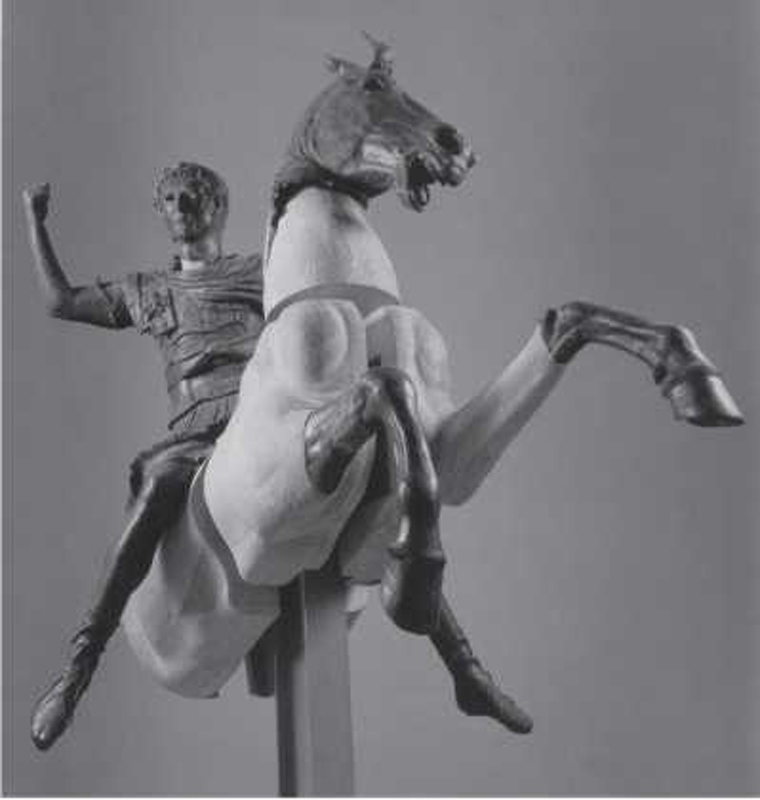
Figure 4.4: Bronze equestrian statue of Domitian from Misenum (Museo Archéologico dei Campi Flegrei nel Castello di Baia no. 155743). (Tuck, 2005: 224, Figure 2; photo by S. Tuck; used with permission)
Second-Century Emperors
Hercules as a conduit for virtus through pugnacious endeavours and an exemplum for civilizing imperium was given increased emphasis under Trajan (ad 98–117). Pliny the Younger called Trajan ‘imperator invictus’ (‘unconquered emperor’), and compared him to an unwearied Hercules after completing his labours. This characterization positioned the emperor as yet another new-and-improved Hercules after Domitian, now portrayed as the cruel Eurystheus.129 Dio Chrysostom (ad 40–120) emphasized this virtus in his First Discourse on Kingship,130 by alluding to the tale of Hercules’ choice between Virtus and Voluptas, in Dio’s tale portrayed as a choice between Kingship and Tyranny. Hercules’ adversity with Tyranny is akin to his struggles with monstrous forces – a likely reference to Trajan’s service under Domitian.131 Trajan’s association with Hercules also played upon Trajan’s birthplace, Italica in Hispania: Pliny noted how Trajan was called from Hispania to labour for a lesser king (Domitian). Once again, we see ‘good’ emperors like Trajan praised through Hercules not only for their excellence in war and conquest, but also (and especially) for their enlightened and pacifying rulership.
Nevertheless, under Trajan, Hercules’ military roles were augmented considerably.132 Trajan provided one of the new legions, Legion II Traiana Fortis, with the emblem of Hercules with club and lion skin. The close association between Hercules and Trajan
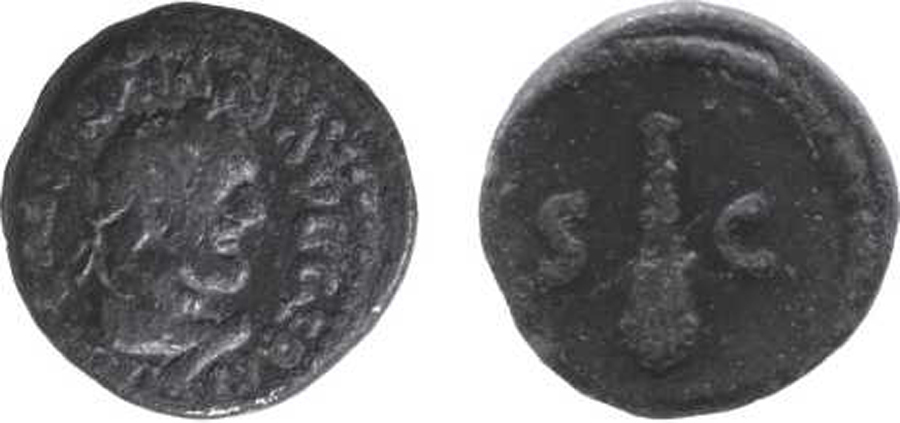
Figure 4.5: Bronze quadrans showing Hercules in the lion skin on the obverse, with IMP CAES TRAIAN AVG GERM and club on the reverse, from Trajan’s reign (ad 98–117); minted in Rome and found in Britain (RIC II, Trajan, no. 699; © Derby Museum Trust; CC BY 4.0). (Courtesy of the Portable Antiquities Scheme) is evident on coinage: a quadrans shows Trajan’s face on the obverse and a boar, a legionary symbol, on the reverse, while another shows the same boar on the reverse, but Hercules’ head on the obverse and the legend IMP CAES TRAIAN AVG GERM, drawing a direct association between Hercules, the emperor and the imperial legions: Hercules’ relation to the boar reflects his fourth labour, capturing the Erymanthian Boar.133 The reverse of an as coin displays Trajan’s Column, a triumphal record of the emperor’s Dacian campaigns, in the form of Hercules’ club set on a lion-skin pedestal with the legend SPQR OPTIMO PRINCIPI S C.134 Another series of quadrans displays Hercules’ bust on the obverse and his club on the reverse between the legend S C.135 While the emperor’s image is absent, the legend on the obverse reads IMP CAES TRAIAN AVG GERM (see Figure 4.5).136
Hercules under Trajan was thus a signifier of the emperor’s martial endeavours, particularly his Dacian campaigns. The Arval Brothers in AD 101 named, for the first time, Hercules Victor amongst the gods invoked for the emperor’s safety before his first Dacian campaign.137 The emperor departed Rome on 4 June for his second Dacian campaign, the feast day of Hercules Magnus Custos (‘Great Guardian’).138 Following his successful conquests in Dacia and Persia, Trajan inaugurated the Triumphal Games for Hercules (Ludi Herculei triumphales). Another coin type issued following Trajan’s Dacian victories (among other milestones in his reign) depicts, on the reverse, a statue of Hercules, naked except for the lion-skin cap and the rest of the skin hanging over his left arm. His right hand grasps his club, and his left hand sometimes holds an apple (see Figure 4.6).139 Coins with this imagery tended to be high-value aurei and silver denarii. Presumably this iconography was depicting a popular cult statue to Hercules, perhaps from one of the temples in the Forum Boarium, or even the precinct of the Ara Maxima. If so, the persistent appearance of this cult imagery on high-value coinage linked Trajan to earlier Augustan-era rhetoric that galvanized the illustrious history of expanding Roman hegemony through Hercules and the triumphal area of the Forum Boarium.140
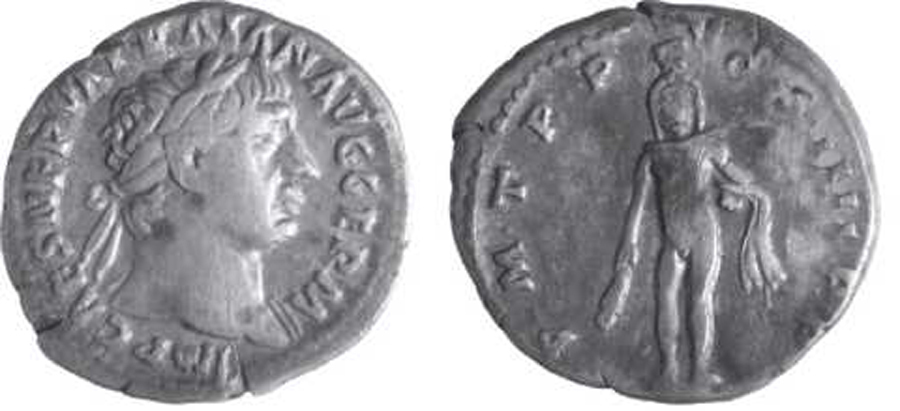
Figure 4.6: Silver denarius reverse showing Hercules on a pedestal with club and lion skin, with Trajan on the obverse (c.ad 101–102) (photo by Julie Shoemark; CC BY-SA 2.0). (Courtesy of the Portable Antiquities Scheme)
Hadrian (ad 117–138) cultivated a relationship with Hercules that further stressed the universal and civilizing reach of Roman imperium. Hadrian’s maternal family came from Gades, home to the famous temple of Melqart. Several Hadrianic aurei celebrate this relationship with both Gades and Hercules, showing the god-hero with club and the apples of the Hesperides (another feat that that took place at the ends of the known world), sometimes standing within the cella (inner area) of a temple. The details of each aureus diverge slightly, but one prominently displays the words HERC GADIT – Hercules Gaditanus – across the centre. The temple presumably is the famous one to Melqart in Gades, a longstanding source of wonder amongst Roman authors and one of the few temples allowed to receive inheritances under Trajan or Hadrian.141 Another element on this coinage is the presence of a reclining water god, Oceanus, and, in one case the head of the water god, which resembles images of Oceanus in Rome, most notably the Bocca della Verità in the Forum Boarium.142 The pairing of Hercules with Oceanus, while a far cry from wartime symbolism, nonetheless presents one of the most compelling portraits of a hero who conquered the furthest reaches of the oikoumene represented by Ocean, and whose civilizing persona fit nicely with Hadrian’s notability for being a widely travelled emperor. The very pomerium of Rome became extended to the known world, a sentiment captured in Aristides’ address to Hadrian’s successor, Antoninus Pius (ad 138–161).143 These achievements were celebrated near the end of Hadrian’s reign with a medallion portraying Hercules in the lion skin on the obverse and the goddess Tellus atop a globe on the reverse, with the legend TELLUS STABILIS (‘The earth established’).144
A distinctive type of Hercules, closely associated with military valour, was established under Trajan or Hadrian, the Hercules Invictus type, which depicts a youthful Hercules seated on a rock covered in his lion skin surrounded by cuirasses and shields. He holds his club downwards in his right hand and a statue of Victory in his left. This symbolism, of the victorious conqueror sitting atop enemy spoils, derives from Classical and Hellenistic prototypes.145 Denarii issued from AD 124128 following Hadrian’s tour, for instance, show Hercules Invictus seated upon a cuirass with a round shield and helmet on the ground behind. He holds his club in one hand and usually a statue of Victory, but also a distaff, apple or two arrows (see Figure 4.7).146 The Hadrianic hunting tondi (circular reliefs) preserved on the Arch of Constantine also follow the royal hunting themes brought back into vogue at the end of the first century ad. The tondi show Hadrian hunting bear, boar and lion; one shows a statue of Hercules Invictus, similar to imagery on Hadrianic denarii, to which Hadrian dedicates the skin of a lion killed in one of his expeditions.147 A series of medallions struck between AD 129 and 137 show Hadrian in similar hunting scenes to those on the tondi. The inscription on the medallions reads Virtuti Augusti, once again drawing a clear link between military and hunting prowess and virtus, and positioning Hercules as a persuasive medium for exemplifying these qualities. Similar medallions were struck under Antoninus Pius, Marcus Aurelius, Lucius Verus and Commodus.148
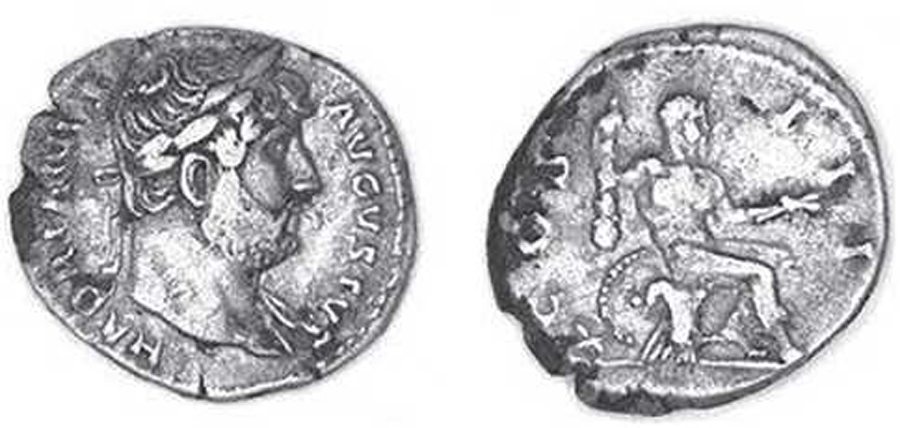
Figure 4.7: Silver denarius showing on the obverse a laureate bust of Hadrian, and Hercules sitting on arms and armour with club on the reverse, from Hadrian’s reign (ad 119) (RIC II, 149; © Leicestershire County Council; CC BY-SA 2.0). (Courtesy of the Portable Antiquities Scheme)
Antoninus Pius’ employment of Hercules departed from the far-flung travels of the hero and focused on more traditional bellicose aspects. A coin from his fourth year shows the Hercules Invictus type seated atop a cuirass and shields holding his club and arrows,149 and imagery of the victorious Hercules crowning himself appear in several Antonine media, from medallions to reliefs, once again deriving from Hellenistic models.150 Hercules was also centred more on Rome than abroad, with some coin types emphasizing his feats in Italy.151 A large bronze medallion now in the Bibliothèque Nationale in Paris, for instance, depicts Hercules standing over a deceased Cacus, stretched out before the mouth of his cave, hearkening back to Augustan ideology and the Forum Boarium. Four smaller individuals thank Hercules for his deed.152 Finally, coins from the 150s show Antoninus’ portrait on the obverse and a standing Heracles holding his club and bow and arrow on the reverse,153 once again, possibly signalling a well-recognized statue.154
Lucius Verus (ad 161–169) and Marcus Aurelius (ad 161–180) seem to have downplayed an association with Hercules,155 but Marcus Aurelius’ son and successor, Commodus (ad 177–192), fully embraced this deity, possibly as a way to legitimize his role as royal heir with little military or administrative experience.156 Emperors generally attracted criticism and disdain when they seriously blurred the distinction between themselves and Hercules, attempting to portray themselves as Hercules, rather than simply associated with or comparable to him.157 Such was the case with Caligula, Nero and Domitian, and was especially the case with Commodus.158 His assimilation to Hercules took place in several stages, with numerous coin issues over the 180s displaying Hercules on the reverse, first identifying Hercules as his comes (companion). In his final year, he proclaimed himself to be Hercules Romanus,159 with coins depict Hercules with club and lion skin crowning a trophy on the reverse with the legend HERVLI ROMANO A VG.160 Coins minted in AD 190–191 also contain the legend HERC COMMODIANO on the reverse, with images of Hercules.161 Cities in the East honoured the emperor by depicting him as various incarnations of Hercules: an Alexandrian coin, for instance, portrayed Commodus as Hercules Invictus, seated atop armour and holding a Victory.162
Further emphasis on Hercules Romanus can be seen in coin medallions and aurei that represent the emperor as Hercules the primeval ploughman, who founded a ‘new Rome’ following the fire of AD 191. Commodus in the lion skin appears on the obverse, and Hercules driving cattle is on the reverse with the legend HERC ROM COND (or CONDITORI).163 Commodus’ excesses in portraying himself as Hercules are captured in Cassius Dio’s account,164 and include renaming all the months of the year after himself and Hercules in AD 192 (e.g., Amazonius, Invictus and Herculeus).165 He engaged in gory gladiatorial feats dressed as Hercules, and was even known to shoot audience members in the amphitheatre in imitation of Hercules killing the Stymphalian birds.166 He allegedly had the head of Nero’s Colossus replaced with his own portrait, along with club and bronze lion.167 Commodus thus assumed the longstanding cross-cultural symbolism of Hercules to style himself as vanquisher of chaotic forces represented by the bronze lion and the many beasts slain in the amphitheatre. Or, in E. Meyer-Zwiffelhoffer’s words, ‘Die Arena war das Barbarenland, in dem er symbolisch die Wiederherstellung der Ordnung inszenierte’ (‘The arena was the land of barbarians, in which he [Commodus] symbolically staged the restoration of order’).168
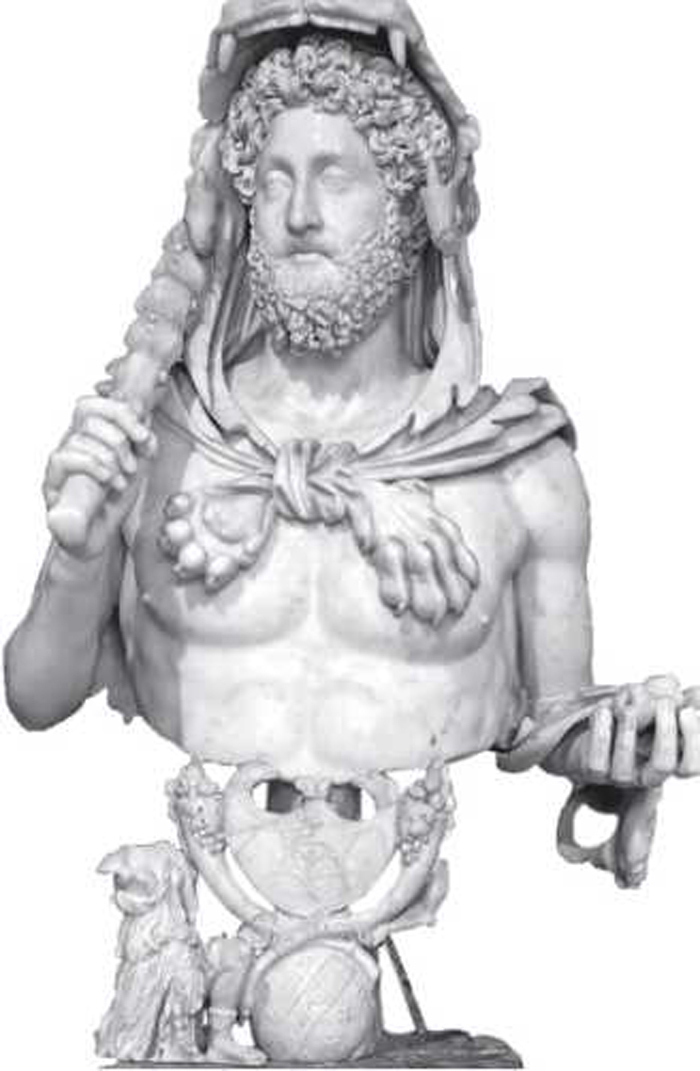
Figure 4.8: Marble bust of Commodus as Hercules, c.ad 191–192, now in the Palazzo dei Conservatori (MC1120). (Photo by Marie-Lan Nguyen, public domain)
Beyond Commodus’ gladiatorial excesses, Hercules played an important part in provincial military endeavours. The Augustan History of Commodus states that Commodus changed the name of his African fleet to Commodiana Herculea.169 An aureus depicts, on the reverse, Hercules resting his club on a tree trunk with a thunderbolt, while he places his foot on a prow and clasps hands with Africa.170 The marble bust found on the Esquiline now in the Palazzo dei Conservatori displays a decadent Commodus as Hercules, but also hearkens back to several important military moments (see Figure 4.8). Wearing the lion skin, he holds the club over his shoulder in his right hand and the apples of the Hesperides in his left hand to signify his apotheosis following the last labour. Amazons flank a globe and double cornucopia around a pelta below the bust. The globe is covered with zodiacal signs referencing important dates in Commodus’ life, signalling in particular the month of October, renamed Herculeus by the emperor. This month saw Commodus sharing in the Parthian triumph of Marcus Aurelius and Lucius Verus (12 October AD 166), taking the title Germanicus (15 October AD 172) and being acknowledged as emperor (22 October AD 180).171 Evidence from the provinces suggests that soldiers and civilians alike embraced Commodus as Hercules Invictus.172 An inscription found in 1860 in Carlisle is dedicated to Hercules Invictus Conservator, the saviour of Britain,173 likely referencing Commodus’s victory against the Caledonian rebels,174 even if it dated prior to the period of Commodus’ full assumption of Hercules’ identity.175
Hercules as a War God in the Third Century
Emperors in the third century continued to employ Hercules as a military model. Septimius Severus (ad 193–211), who hailed from Leptis Magna in Africa, combined the imagery of Liber Pater/Dionysus/Bacchus with Hercules on coin issues,176 and Hercules also appears on the arches of Severus in Rome and Leptis Magna. The employment of these deities, Liber Pater and Hercules alongside Severus’ North African background drew from longstanding Punic antecedents, namely the Phoenician gods Shadrapa (identified with the Roman Liber Pater/Dionyus/Bacchus) and Melqart.177 These deities received an important place in Severus’ Ludi Saeculares, and possibly represented his two sons, Geta and Caracalla, with the emperor as Jupiter.178 Severus built a huge temple to these two deities on the Quirinal.179 But Hercules also was portrayed alone on denarii with bow and lion skin in AD 196–197, with the legend HERVLI DEFENS.180 It was during this time that Severus’ war with Albinus occurred. Severus defeated Albinus at Lugdunum in AD 197, the year this coin type reached peak representation in hoards.181 Hercules was thus the defender of the Empire, and particularly the Western part, possibly with Liber/Dionysus as traditional defender of the East, whose imagery overtakes Hercules’ after AD 197.182 Clare Rowan argues that Hercules was an essential figure for Severus’ self-adoption into the Antonine family via Commodus’ explicit association with this deity. Severus portrayed himself with a lion-skin cap on a medallion from AD 202, and certain coin issues showed Severus with the lion skin around his shoulder.183 Caracalla continued his father’s tradition of striking coins with Hercules as one of the patron gods of Leptis Magna and in association with the Ludi Saeculares.184
Into the second half of the third century, Herculean imagery became a major source of virtus for the soldier-emperors, starting with Gordian III (ad 238–244). Hercules seemed particularly important to those ruling in the Gallic and Germanic provinces, where he was already a popular deity, via his longstanding identification with Germanic gods like Magusanus.185 Gallienus (ad 253–260) issued coins representing Hercules with attributes like the club, apples, branch, bow and lion skin, with the legend VIRTVS AVGVSTI or VIRT GALLIENI AVG.186 While many of these types came from Rome, several also came from mints at Mediolanum/Milan and Siscia, which serviced the imperial field armies and were possibly used to pay donatives to troops and advertise the emperor’s virtus via an already popular bellicose deity.187 Another coin, an aureus from Mediolanum, shows Gallienus himself in lion-skin cap on the obverse, with a personification of Fides on the reverse holding insignia, with the legend FIDES MILITVM,188 linking the Roman Army’s loyalty to the virtus of its heroic leader, possibly at a time when the Empire was threatened by the usurper Postumus.189
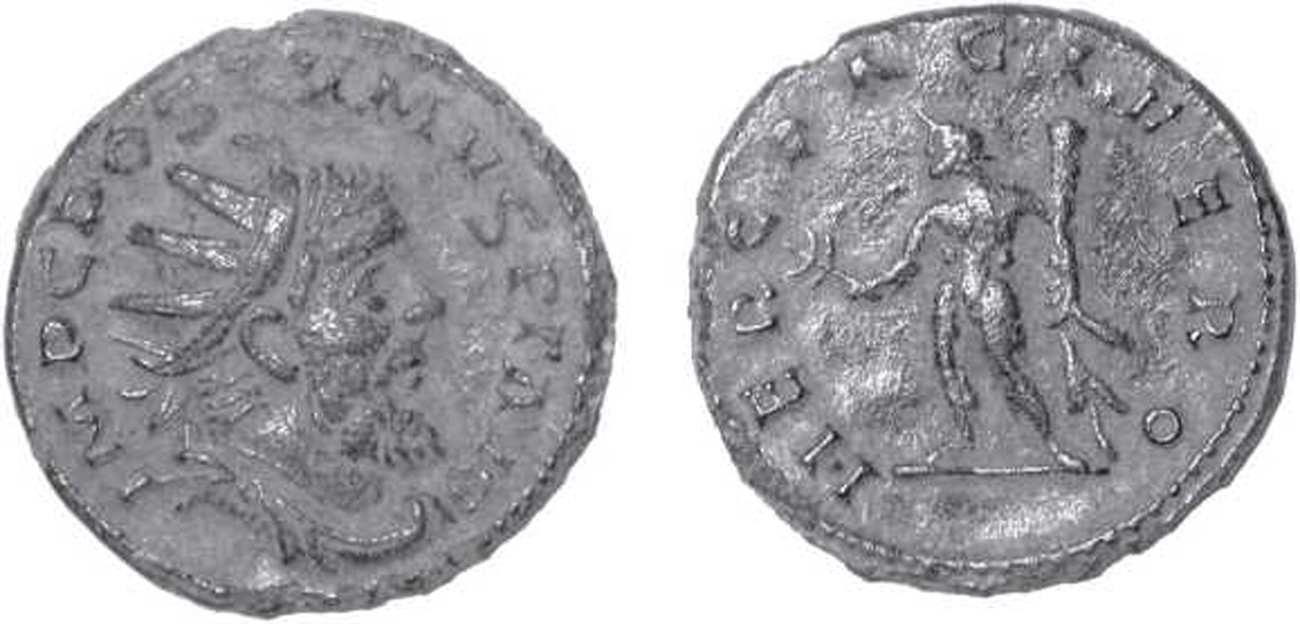
Figure 4.9: Bronze sestertius showing radiate bust of emperor on obverse and Hercules standing holding lion skin and olive branch with the legend HERC PACIFERO on the reverse; from Postumus’ reign (c.ad 260–269), found in central Bedfordshire. (Photo by Margaret Broomfield, Surrey County Council; CC BY-SA 2.0.) (Courtesy of the Portable Antiquities Scheme)
Both Gallienus and Postumus (ad 260–269) also portrayed themselves in Alexander’s fashion: a gold aureus from c.ad 263, for instance, depicts a three-quarter portrait of Postumus gazing upwards in the manner of Alexander’s portraits.190 This emperor associated himself closely with Hercules, likely as a way to compete with Gallienus: a number of coins show the laureate heads of Hercules and Postumus together on the obverse, with personifications such as Victory, Felicitas, Pax, Hilaritas, Sol, Luna, Mars, Apollo, Jupiter, Aesculapius and Castor on the reverse.191 Further coin issues with similar obverses recount a number of Hercules’ labours with legends including HERCVLI LIBVCO (strangling Antaeus), HERCVLI GADITANO (slaying Geryon) and HERCVLI INVICTO (triumphing over an Amazon, the Cretan Bull or the Nemean Lion).192 The association with the German warrior god, Magusanus (discussed above), is expressed in an antoninianus coin from Lugdunum,193 suggesting a longstanding identification of these deities with one another that played important roles in Rome’s diverse legions. This example, along with several other coin issues from Lugdunum with the legend HERC/HERCVLI DEVSONIENSI, suggests local versions of Hercules at Deutz and Mainz worshipped by soldiers.194 Another popular legend from this mint is HERC PACIFERO,l95 drawing on the other major aspect of Hercules’ exemplum beside his bellicose persona: that of civilizer (see Figure 4.9).196
Following Postumus, Probus (ad 276–282) continued to issue similar coin types in the western European provinces, possibly as a way to counter Postumus’ representation of Hercules, yet also presenting a sense of continuity and emphasizing, through Hercules Romanus, a connection to Rome and romanitas.197 Probus’ coins with Hercules also bear legends like COMITI PROBI AVG and HERCVLI ROMANO AVG and hearken back to Commodus’ early portrayals of Hercules (as comes, companion) and his final portrayal of Hercules, Hercules Romanus Augustus.198 He also portrayed Hercules as comes, expressing an intimate relationship between himself and this deity,199 a tradition that began with Commodus and continued into the reign of the Tetrarchy, the new system of government inaugurated by the emperor Diocletian in AD 293.200 Interestingly, most of these coins with Hercules’ imagery issued by the soldier emperors were on high-value media – issues such as medallions, aurei, antoniniani and quinarii – suggesting they were meant to appeal to a specific audience,201 possibly upper-class officials or members of the Army. None of these rulers had undisputed claims to the throne, and powerful and effective messaging was required.
Finally, Hercules was one of the major patrons of the Tetrarchs, the new, joint rulership of the Roman Empire. Their employment of Herculean symbolism was no doubt influenced by the later soldier-emperors’ stress on this deity as a conduit for virtus. In Erika Manders’ words, the ‘remarkable attention to Hercules from the Tetrarchs could be characterised as the last triumph of the Roman Hercules’.202 Diocletian (ad 284–305) assumed the signum ‘Iovius’, while his protégé, Maximian (ad 286–305), took ‘Herculius’, revealing these gods as imperial patrons, yet these adjectival terms could also be attached to military units.203 A number of the coin epithets from the Gallic provinces mentioned above were incorporated into the work of the Panegyric of 289 (from the XII Panegyrici Latini), possibly written by a native of Gaul, who promoted the Herculean qualifications of Maximian. Epithets borrowed include Invictus, Pacifer and Virtus alongside allusions to Hercules’ role in the Gigantomachy, all drawing from earlier imperial employments of this deity. Coin issues also associate Maximian with Hercules’ iconography, with legends like VIRTVS AVGG (see Figure 4.10).
These Herculean allusions may have been meant to centralize loyalties around Maximian rather than provincial leaders, as well as elevate Maximian’s status alongside Diocletian.204 Roger Rees notes that legends containing these signa, as with the soldier-emperors, were concentrated on medallions, possibly meant for the military.205 Olivier Hekster highlights, however, that, while legends with signa are lacking, there is no shortage of Jovian and Herculean imagery on coins administered by these two Tetrarchs, including images of Maximian in the lion scalp.206 Constantius Chlorus (ad 305–306) continued this symbolism: Eumenius’ Panegyric of 298 (another panegyric from the XII Panegyrici Latini) described him as a descendent of Hercules, and medallions show him also wearing the lion skin.207 Finally, Maxentius (ad 306–312) also depicted himself in the lion skin on his coins, and identified Hercules as his ally on aurei, with the legend HERCVLI COMITIAVG N and HERCVLI COMITI AVGG ET CAES N on the reverse.208 It is perhaps no surprise that his subjugator, Constantine (ad 306–337), subsequently avoided Herculean imagery, although Herculean symbolism would continue to be employed in Christian art.209
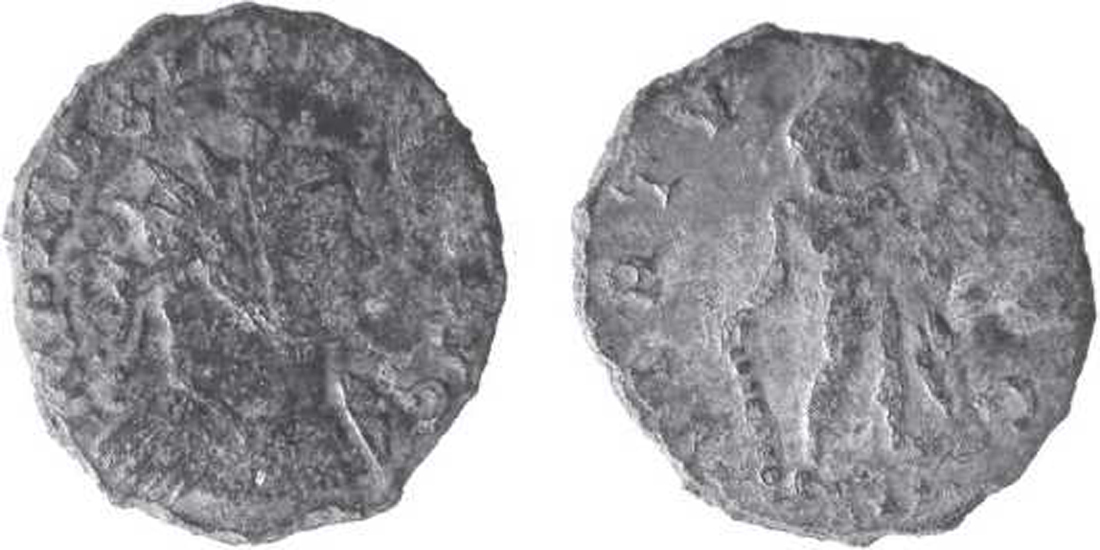
Figure 4.10: Silver-copper alloy antoninianus, showing radiate bust of Maximian on obverse and Hercules standing with club, bow, and lion skin on reverse, with the legend VIRTVS AVGG; from the reign of Maximian (c.ad 294), minted in Lugdunum (RIC V, Diocletian, no. 453; photo by Katie Hinds, Salisbury and South Wiltshire Museum; CC BY-SA 2.0). (Courtesy of the Portable Antiquities Scheme)
Conclusion
The second-century AD satirist Lucian, in his ‘Introduction to Heracles’, describes how he and a learned Celtic man observed a painting of the Celtic god, Ogmios, who was likened to Heracles. Ogmios was depicted as an old man, but dressed similarly to Heracles, with club, quiver and lion skin. Furthermore, Ogmios was dragging a crowd of more-than-eager followers by chains attached from their ears to his tongue. The Celtic man tells a bewildered Lucian, ‘In general, we consider that the real Heracles was a wise man who achieved everything by eloquence and applied persuasion as his principal force.’210 This short introduction condenses many of the apparent contradictions of Hercules discussed above into his role as an archetype for empire. The truest sense of conquest came not from brute force but from the flowering of speech and urbanity that was the intended outcome of – and justification for – the imperial mission, and demonstrated by elites like the Hellenized Syrian and his Celtic counterpart.211 Herfried Münkler writes, ‘All empires that have lasted any length of time have chosen as their self-justifying objective a world-historical task or mission that confers cosmological or redemptive meaning on their activity.’212
Few characters encapsulated both the activities (warfare and domination) and the justification for those activities (peace and civilization) as effectively as Hercules. Much of his success as a symbol for the Roman emperors lay in his long history of cross-cultural employment by Mediterranean rulers in their expansionist and martial endeavours, and the expert redirecting of these long-term processes towards the Roman imperial mission by the emperors and elites through ideological means. This mission centred on successful military conquest and its cosmological propensities found expression in triumphant spectacle, activities that were clearly reflected in both the mythical personas of the peregrinating hero and his widely disseminated symbolism. Over the several centuries of Roman engagement with Hercules, this god-hero mirrored an entire spectrum of features associated with imperial expansion: force, triumph, morality and decadence, yet the true ideal behind emperors invoking Hercules as a war god lay in a hoped-for aftermath of prosperity, stability and -ultimately – immortality. Montesquieu is famous for stating, ‘An empire founded by war has to maintain itself by war’ – the ideals of Herculean ideology offered rulers a pathway out of this conundrum. Hercules, perhaps even more than the emperors, was the ideal behind Jupiter’s prophecy for the Roman Empire in the Aeneid: Aspera tum positis mitescent saecula bellis.213
Notes
1. Hor. Od. 3.14.1–4, trans. Rudd (2004).
2. Noreña (2011), pp.199–200.
3. Hermary (1992), pp.133–34.
4. Hermary (1992), pp. 140–41, figs 2–4; Counts (2008), pp.7–8, 11–12; Yon (1992), p.151; Bonnet (1988), pp.412–14; Papantoniou (2012), pp.265–67. This ‘Master of Lions’ imagery appears on other media as well, notably metallic symposium bowls, scarabs and seals.
5. Schnapp-Gourbeillon (1998); Parisi Pressice (1998); Ulanowski (2015), p.265, n.108.
6. See Jourdain-Annequin & Bonnet (2001) on the personas of Heracles-Melqart in this imagery; cf. Counts (2008). See López Grande (2002) on the Egyptian origins for the smiting god and later relationships to Heracles; see also Bisi (1986). Statuettes of a striding/smiting god come from near Sancti Petri at Gades, where Melqart’s temple possibly stood: Celestino & López-Ruiz (2016), p.229; Aubet (2001), p.203; LIMC 6 Melqart no. 11.
7. Counts (2008).
8. Daniels (2021).
9. Levi (1997), p.120.
10. Malkin (2005); Malkin (2011).
11. KAI47; Louvre AO 4818; Amadasi Guzzo (2005), pp.47–48.
12. Bonnet (1986), pp.217–21; LIMC 6 Melqart no. 7.
13. Bonnet (2009), p.303; Bonnet & Bricault (2016), p.29.
14. Hdt. 5.43.
15. Hes. Theog. 289–94; la Genière (1999); Jourdain-Annequin (1989); Jourdain-Annequin (1992); Bonnet (1988).
16. Huttner (1997a), p.265.
17. E.g., Isoc. Philip. 76–77, 111–14; Plut. Alex. 2.1; Arr. Anab. 3.3.2.
18. Palagia (1986), p.139 n.23.
19. Palagia (1986), pp.140–41.
20. Arr. Anab. 2.15.7–16.8, 24.5–6; 3.6.1; Curt. 4.2.1–9. For more bibliography on coins issued by Alexander showing Heracles, see Anagnostou-Laoutides (2016), p.16 n.24.
21. Weinstock (1957), pp.214–15; e.g., Tyr. F11.1; Archil. F324 (West). On the pairing of Hercules and Dionysus in Hellenistic and Roman royal iconography, see Marzano (2009), pp.87–88; Erickson (2018).
22. Cf. Heckel (2006).
23. Erickson (2009), pp.84–85.
24. Palagia (1986), pp.142–43; Laubscher (1997); Huttner (1997a); Stafford (2012), pp.146–50; Anagnostou-Laoutides (2016), p.16 n.25 for bibliography. See Theocritus’ Idyll 17 on the link between Ptolemy I, Alexander and Heracles: Erickson (2018), p.254. On Ptolemy Philadelphus and Heracles: Laubscher (1997).
25. Erickson (2009), p.131; Anagnostou-Laoutides (2016), p.167.
26. Yarrow (2013).
27. Nitschke (2013); Yarrow (2013), pp.358–59.
28. Rawlings (2005), p.164, fig. 1; Yarrow (2013), p.354.
29. Plut. Pyrrh. 22.4–6; see Huttner (1997a), pp.153–62.
30. On Heracles/Melqart and imperial activities, see Nitschke (2013); Marti-Aguilar (2018).
31. Miles (2011); Alfaro Asins (1997); Chaves (1998).
32. Diod. 12.19.6.
33. Paus. 6.5.1–9.
34. Sommella Mura (1977); Ritter (1995), pp.21–22.
35. E.g., BM 1847, 1101.22; see LIMC 5 Hercle. But cf. Levi (1996); Levi (1997), who argues that Athena/Minerva was unknown in the region of Latium at this time: this divinity instead was the supreme goddess Diana.
36. Levi (1997).
37. Coarelli (1988); (1996), pp.15–17.
38. For Hercules’ cult in Italy: Mastrocinque (1993); Ritter (1995), pp.87–100; Bradley (2005); LIMC 5 Hercle. Note especially the temples at Pyrgi containing bilingual inscriptions in Etruscan and Phoenician mentioning the king’s worship of Astarte-Uni, and possibly Melqart: Mettinger (2001); Colonna (2002). Despite the mythical stress on the Greek origins of the Hercules’ cult – e.g., Dion. Hal. Rom. Ant. 1.40.3; Sutton (1977); Hartmann (2017); cf. Levi (1997) – in the Forum Boarium, Phoenician origins have also been suggested but never proven: Rebuffat (1966); van Berchem (1959–60); van Berchem (1967); Coarelli (1988), pp.129–30; Levi (1997), pp.43–44; Marcos Casquero (2002); Moret (2012), p.109. Levi (1997) instead argues for a sharp distinction between the Greek hero and the supreme god Hercules of the Ara Maxima, who was only replaced by Jupiter in the fourth century BC and then associated closely with the Greek Heracles.
39. This thesis is spelled out in Bayet (1926) and suggested by Weinstock (1957), p.223; Marzano (2009); cf. Scheid (2012), pp.296–97. Hercules had other cultic associations as well, for instance healing: Bolder-Boos (2017).
40. Levi (1996); Levi (1997).
41. Lulof (2000).
42. On eastern models for Roman kingship, see Grottanelli (1987). Lulof also draws associations between Roman kings and the Athenian tyrant Peisistratus, who associated himself with Hercules and Athena.
43. Livy 9.44.16.
44. See Padilla Peralta (2020).
45. For discussion of Nobilior and the temple of Hercules Musarum, see Russell (2016), p.139 n.30.
46. Ovid Fasti 6.209–12.
47. Macrob. Sat. 3.6.11.
48. Pliny Nat. Hist. 35.19; see Coarelli (1988), pp.164–204; Palagia (1990). Scipio may also have dedicated a cult statue to Hercules Epitrapezios, ‘At the Table’ – Coarelli (1988), p.129; Ritter (1995), pp.38–40). Another major aspect of this cult was the giant skyphos of Helios used by Hercules to cross the sea, and pictured in medallions of Antoninus Pius and Caracalla – van Berchem (1967), pp.336–38, pl. 16.1 – and in an unpublished mosaic from the Aventine: Palagia (1990), p.51; Berry (2011), p.21, fig. 31. See Macrob. Sat. 5.21.16; Serv. Aen. 8.278.
49. CIL 6.331 (ILS 20); Ziolkowski (1988), pp.92–103, argues that Mummius’ temple mentioned in the inscription is the round temple by the Tiber, contra Coarelli, who associated this temple with one built by M. Octavius Herennus. Cf. Richardson (1992), pp.185–89; Popkin (2016), pp.193–94; Loar (2017). Ziolkowski matches Mummius’ temple with the temple to Hercules Victor ad Portam Trigeminam mentioned in ancient sources, and possibly alluded to in Virgil Aen. 8.201–204 – Loar (2017), p.49. Servius Aen. 8.363 and Macrobius Sat. 3.6.10 both speak of two temples to Hercules Victor: one ad Portam Trigeminam and the other ad Forum Boarium. The temple of Hercules Victor ad Forum Boarium, within the Servian Wall, is identified as the one built by P. Cornelius Scipio Aemilianus, the aedes Aemiliana Herculis: Pliny Nat. Hist. 35.19; see Ziolkowski (1988), p.313, again, contra Coarelli (1988), pp.187–92. On the architectural importance of these Republican temples to Hercules, see Popkin (2016), pp.67–71.
50. Enn. Ann. 5.3.5.
51. Cic. Pis. 15.
52. Cic. Marcell. 12; Weinstock (1957), pp.221–28; Koortbojian (2013), p.87.
53. Pliny Nat. Hist. 34.16; Serv. Aen. 3.407, 8.288; see Coarelli (1988), pp.364–67.
54. Livy 9.29; Virg. Aen. 8.280–305; Weinstock (1957), p.223; Beard et al. (1998), p.18, 1.6c; Levi (1997), p.65; Mueller (2002).
55. On tithes offered by traders on the Ara Maxima: Dion. Hal. Rom. Ant. 1.40.6. Epigraphic attestations of the decuma: CIL 9.4672; 9.3569; 10.5708; 14.3541 – Marzano (2009), p.86, n.37. The tithe to Hercules was also known as the Herculana pars, and is mentioned in Plautus: Bacch. 665–66, Mostell. 984, Stich. 232–33. Some tie the decuma to Phoenician influence, e.g., Moret (2012), p.109 n.12. Hercules appeared to act as a certain guarantor over transaction mechanisms like weights and measures: CIL 6.282; Van Berchem (1967), p.324; Moret (2012), p.109.
56. Plut. Sull. 35, Crass. 12.2, Luc. 37.4, Pomp. 45, Mor. 267e-f (Roman Questions 18); Pliny Nat. Hist. 37.12–1; Diod. 4.21.4. See Marzano (2009), p.84 and n.12 for further bibliography.
57. Athen. Deip. 4.153c, 5.221–22f.
58. Marzano (2009), p.90; cf. d’Arms (1998); Beard (2007), pp.257–63. Note the fragment of Posidonius of Apameia dated to 146–143 BC in Athenaeus that mentions generals providing a public feast in the sanctuary of Hercules after the triumphal procession: Marzano (2009), p.90, n.78.
59. Santangelo (2007), p.229; Beard et al. (1998), p.232; cf. Beard (2007), p.381, n.11.
60. Bonfante Warren (1970), pp.64–65. See Erickson (2018) for the Dionysian elements woven into the ideology of these public spectacles.
61. Marzano (2009).
62. Livy 26.10.3; Richardson (1992), p.185. Interestingly, in Varro’s Menippean Satire, Heracles Invictus is equated with Mars: Macrob. Sat. 3.12.6.
63. Scheid (2002), p.297.
64. Jourdain-Annequin (1992), p.278.
65. Diod. 4.19; Roymans (2009), p.223; Favreau-Linder (2009); Lampinen (2015), pp. 13–14, n.13 for bibliography. The toponym Castra Herculis, on the Peutinger Map and situated along the Lower Rhine at Arnhem-Meinerswijk, may allude to a foundation myth associated with Hercules in Gaul. Castra Herculis was possibly built in connections to Germanicus’ campaign in this region in AD 14 and 16: Roymans (2009), p.224 n.28. Cf. Tac. Germ. 3.
66. On the etymology of Magusanus, see Toorians (2003).
67. Derks (1998), pp.112–13; Roymans (2009), p.228.
68. Tac. Germ. 3.1.
69. Lampinen (2015); Münkler (2007). See Dauge (1981), who encapsulated the use of Heracles to articulate the relationship between Romans and barbarians under the term and concept héracléisme.
70. E.g., Sen. Ben. 1.13.1–3, 7.3.1, Ep. 94.63; Fitch (1987), p.19; and see Fitch (1987) on Seneca’s Hercules Furens.
71. Suet. Caes. 7.1. For Hannibal: Livy 21.21.9; App. Iber. 28; Sil. Ital. Pun. 3.14–32; see Rawson (1970).
72. Dio 44.6.3–4; Ovid Am. 3.8.45–48; Fitch (1987), p.20; Wardle (2009), p.106.
73. Dio 43.45.3; Wardle (2009), p.106. Koortbojian (2013), pp.87–89, argues that this title referred to Quirinus, not Caesar.
74. Cic. Marcell. 28, cf. Cic. Tusc. 1.28; Diod. 4.8.1; Harrison (2018), p.340.
75. Harrison (2018); e.g., Heracl. Quaest. Hom. 33.3–8; Sen. Constant. 2.1, Ben. 1.13.3; cf. Huttner (1997a), pp.282–83.
76. Vitr. Arch. 3.3.5; Pliny Nat. Hist. 34.57; Santangelo (2007), p.228. A dedication day of 12 August is listed for Hercules Invictus AD Circum Maximum in the Fasti Allifani (InscrIt 13.2.181) and the Fasti Amiternini (InscrIt 13.2.191). Ziolkowski locates Pompey’s temple closer to the Circus Maximus, but Coarelli (1988), pp.187–92, identifies the aedes Pompei Magni with the Temple of Hercules Victor in Foro Boario.
77. App. Civ. 2.76.319.
78. RRC no. 426; Santangelo (2007), p.231.
79. Plut. Ant. 4.1–3; Palagia (1986), p.143; Zanker (1988), pp.44–45; Huttner (1995); Hekster (2004a), p.171.
80. RRC no. 494.2a.
81. Zanker (1988), pp.44–45.
82. Erikson (2018); Goyette (2010).
83. RRC no. 489.5. But cf. Hekster (2004a); Erickson (2018), p.261 notes, however, that an aureus (now lost) of Antony showing a lion walking to the left, holding a sword, with a star above, might mimic types struck by Alexander at Babylon.
84. Plut. Comp. Dem. Ant. 3; see Ovid Her. 9.
85. Spencer (2001), p.262; Barton (2007); Erickson (2018), p.264, but cf. Hekster (2004a).
86. Weinstock (1957), pp.231–32, n.127; although this phrase is not entirely avoided: Hercules is for example called invicte (unconquered) in Aeneid 8.293.
87. E.g., Schilling (1942).
88. See Ritter (1995), Ch.6. The dissemination of ideology in pre-industrial states has been characterized under several forms: literary and rhetorical, iconographic, symbolic and ceremonial: see Hekster (2005), p.216 n.32.
89. Virg.Aen. 6.801–805; Quint (2018), p.98; Secci (2013), p.224; Loar (2021); cf. Dio 56.36.4–5.
90. Virg.Aen. 2.721–23; Galinsky (1981), p.1006; Zarker (1972).
91. Galinsky (1966), p.22; Gransden (1976), p.107; Morgan (1998), p.176; Hekster (2004b). Gransden includes Romulus in this mythic genealogy. Cf. Quint (2018), pp.131–32 and n.33.
92. Virg. Aen. 184–305; Schnepf (1959); Galinsky (1966); Morgan (1998); Secci (2013), p.224; see also Marincic (2002) on Herculean mythmaking within the Aeneid and Eclogues. See Fratantuono & Smith (2018), pp.305–08, for more bibliography and discussion on the Hercules-Cacus episode. See also Loar (2021), who highlights the varying personas taken by Cacus in particular in Augustan prose and poetry. See Livy 1.7; Ovid Fasti 1.554; Virg. Aen. 7.190; Prop. El. 4.9; Dion. Hal. Rom. Ant. 1.39–44; Ps.-Aur. Vict. Orig. Gent. Rom. 6.
93. Galinsky (1972), p.41; Galinsky (1981), pp.1004–05; Galinsky (1996), p.223; Ritter (1995), p.131; Morgan (1998), p.176; Mueller (2002), pp.320–21.
94. Virg. Aen. 8.714, 8.200–04; but cf. Hekster (2004b), who tempers this argument somewhat.
95. Virg. Aen. 1.286–88.
96. Daniels (2017), pp.248–49.
97. Knapp (1986); Strabo 4.1.7; Diod. 4.19; [Arist.] Mir. Ausc. 85; Amm. Marc. 15.10.9. On the Vicarello Goblets and their representation of the mythical journey from Gades to Rome, see Schmidt (2011).
98. Hardie (1986).
99. La Rocca (1988), pp.123–24; Ritter (1995), pp.136–37; Quint (2018), p.134.
100. Galinsky (1972), pp.131–49.
101. Hekster (2004a); Hekster (2004b); Hekster (2015).
102. Loar (2017), p.46.
103. Loar (2017), p.60.
104. Quint (2018), p.135; Hekster (2004b) suggests that the Apollo temple on the Palatine may have been dictated more by mythological and religious considerations (e.g., its location close to the cave of Cacus and its role in housing the Sibylline oracles) than a blatant statement of Augustus’ and Apollo’s triumph at Actium.
105. Galinsky (1981).
106. Virg. Aen. 10.565–70.
107. Hardie (1986), p.2; Reed (2007), p.141. This ambivalence is noted specifically for Hercules: Quint (2018), p.136.
108. Spencer (2001), p.260; Welch (2004). See also Scheid (2012) on the structural oppositions between the Hercules’ cult and the cults to feminine deities in the Forum Boarium. On gendered readings of Propertius El. 4.9, see Fox (1988); Lindheim (1998); Janan (1998).
109. Philo Embassy to Gaius 75–92.
110. Suet. Ner. 53.
111. Dio 62.20.
112. Philo Embassy to Gaius 90, trans. Colson (1962).
113. Münkler (2007).
114. RIC 1.2 Civil Wars nos 49, 130–133; Rudich (2005), p.212.
115. Suet. Vesp. 286.
116. Najbjerg (2007), pp.67–69.
117. Mart. Ep. 9.101.
118. Mart. Ep. 9.64–65.
119. E.g., Statius Silvae 4.2.50–51; 3.155–57.
120. Hekster (2005), p.206; Rebeggianni (2018).
121. Laubscher (1997), p.162; Rebeggiani (2018); Mart. Ep. 9.101.
122. Ganiban (2007), pp.13–22.
123. Tuck (2005). The statue is in the Museo Archéologico dei Campi Flegrei nel Castello di Baia (no. 155743).
124. Laubscher (1997), pp.162–63; cf. Mart. Ep. 9.101. Tac. Ann. 11.11 and Suet. Ner. 6.4 report that Nero was protected by a snake as a child; see Laubscher (1997), p.164.
125. Mart. Ep. 7.1; see Soldevila et al. (2019), pp.399–400, for more bibliography on Domitian’s relationship to Minerva.
126. Dio 67.14. Note also the Alexander Sarcophagus discussed earlier, whose lion hunt scene seems to closely parallel the Misenum statue: Tuck (2005), p.244.
127. Medallions struck between AD 129 and 137 show Hadrian in similar hunting scenes to those on the Hadrianic tondi now on the Arch of Constantine. The inscription on the medallions reads Virtuti Augusti (see below).
128. Mart. Ep. 9.101; cf. 9.64; Tuck (2005), p.232.
129. Pliny Pan. 8.2, 14.5.
130. Dio Chrys. First Discourse on Kingship 94.
131. This tale is attributed to Prodicus, and appears in Xenophon (Mem. 2.1.21); Silius Italicus (Pun. 15.18–128); and Cicero (Off. 1.118). See Palagia (1986), p.146; Hekster (2005), p.205; Lampinen (2015), pp.14–15; Stafford (2017).
132. Jaczynowska (1981); Hekster (2005).
133. RIC 2 Trajan nos 695, 702. An unpublished mosaic from the Aventine shows attributes of Hercules, including a wagon drawn by two boars: Barry (2011), p.21, fig. 31.
134. RIC 2 Trajan no. 581. On the relationship between Hercules’ club-as-column and the later iconography on the Arch of Theodosius at Constantinople, see Lampinen (2015).
135. RIC 2 Trajan nos 699–702.
136. Trajan does not seem to have adopted an overt visual identification with Hercules – a Trajanic-era statue in the Palazzo Massimo alle Terme wearing a lion skin as a paludamentum has been taken to represent Trajan, but its identity remains in doubt: Palagia (1986), p.146.
137. CIL 6.530; Hekster (2005), p.207; Barry (2011), p.21.
138. Dušanic (2003).
139. See RIC 2 Trajan nos 37, 49–51, 689, 690.
140. Hill (1985), 82–83. See above for the over-life-size bronze statue of Hercules from the Forum Boarium, which is similar to the coin iconography, but without the lion skin.
141. Ulpian F22.6; see Mangas Mangarrés (1989).
142. See Barry (2011) on arguments concerning the placement of the Bocca dellaVerita on the Ara Maxima. A monumental bronze statue from Gades depicting either Hadrian or Trajan shows Oceanus in place of the usual gorgoneion on the cuirass (Museo Arqueologico, Cadiz, 4.584). A marble statue, likely of Trajan, from Terracina (now in the Museo Civico Pio Capponi) depicted. Oceanus on the cuirass above a Triton fighting two sea monsters: Barry (2011), p.22.
143. Aristid. Or. 26.62.
144. RIC 2.3 Hadrian no. 2897; see Barry (2011) for the interweaving of Hadrian’s artistic and architectural programme at his villa at Tivoli into this imperial ideology.
145. Palagia (1990), pp.59–60; see, for instance, the Roman copy of a statue with classicizing features in the Palazzo Altemps (60.316); a silver stater from Croton showing Hercules on the obverse in the Invictus style from c.420 BC; and an Apulian red-figure plate from the fourth century BC also showing a seated Hercules – all in Palagia (1990). Note also the Augustan-era cameo in the Louvre showing Venus Genetrix and Hercules standing facing one another with military tropaea between them. Hercules’ club is lowered onto the spoils: Ritter (1995), pp.137–38; Hekster (2004a), pp.173–74.
146. BMC 3380341; RIC 2.2 Hadrian nos 731–33, 786; Hill (1985), pl. 2.9–10.
147. Hill (1985), p.91.
148. Tuck (2005), pp.238–40.
149. RIC 3 no. 145, a quinarius.
150. Vermeule (1957).
151. Hekster (2005), p.208.
152. See Vermeule (1957), pl. iii.13. Another medallion, without the accompanying four figures, was issued under Marcus Aurelius; see Small (1982), p.122, n.1 for more bibliography.
153. RIC 3 Antoninus Pius nos 726, 922, 935.
154. Hercules appears as an archer in the Odyssey (12.599–608), and notably on the city gates of Thasos – Guide (1968), pp.185–91. Silver shekels from Tyre show Melqart with bow and arrow riding a seahorse: Nitschke (2013).
155. Hekster (2005), p.208, suggests that, unlike his predecessors, Marcus Aurelius’ position was indisputable: ‘Perhaps Marcus’ reign was sufficiently accepted not to have to hide behind someone else’s divine example.’ A number of coins minted under Lucius Verus and Marcus Aurelius reference their military victories and include imagery of Mars, Hercules and Victory, for instance RIC 3 M. Aurelius nos 510, 517, 519 (with obverse legend: L. VERVS A VC ARMENIACVS).
156. Hekster (2005), p.209.
157. Loar (2021); cf. Huttner (1997b).
158. As Palagia (1986), pp.146–47, notes, there are some suggestions that earlier second-century emperors portrayed themselves as Hercules – for instance, a rare bronze coin from AD 134–138 shows Hadrian with a lion skin knotted around his neck; another bronze medallion shows him wearing the lion-skin cap. A ringstone in the Cabinet des Medailles in Paris (no. 1759) may show the features of Lucius Verus. For an alternative take on Commodus’ assumption of Hercules’ persona, see Meyer-Zwiffelhoffer (2006).
159. Dio. 73.15; Hdn 1.14.8.
160. RIC 3 Commodus nos 254e, 640, 643; see Palagia (1986), p.147 and n.107 for bibliography; Meyer-Zwiffelhoffer (2006), pp.192–96. For Commodus as the infant Hercules strangling snakes in statue-form, see Laubscher (1997).
161. RIC 3 Commodus nos 581, 586, 591.
162. Palagia (1986), p.148, n.116.
163. BM R.5062; RIC 3 Commodus no. 247.
164. Dio 75.15–22.
165. On the possible meaning of Amazonius for Commodus-Hercules: Meyer-Zwiffelhoffer (2006), pp.197–98.
166. Dio. 73.20; Hdn 1.15; Aur. Vict. Caes. 17.4.
167. Dio 73.22.
168. Meyer-Zwiffelhoffer (2006), p.200.
169. SHA Comm. 8.5.
170. RIC 3 Commodus no. 259.
171. Hannah (1986), p.341.
172. Meyer-Zwiffelhoffer (2006), p.205.
173. CIL 7.924.
174. Dio 73.8.
175. Elsewhere the devotion by imperial soldiers to Commodus Invictus Hercules Romanus is noted – for instance, an inscription from Volubilis in Mauretania – Rostovtseff & Mattingly (1923), pp.98–99. Artefacts from a hoard from a private collection from Britain near Cambridge include a votive sceptre in the shape of a club with a figure trampling a barbarian enemy and symbols of the supreme Celtic god (often identified with Jupiter or Hercules), and an emperor’s head at the very summit, which had been broken off and restored. Rostovtseff & Mattingly identified this emperor with Commodus, but A. Aföldi (1949) suggested it was more likely Antoninus Pius and, furthermore, argued that the imperial bust and club could not have belonged together.
176. E.g., BM R.15814, an as coin.
177. Lichtenberger (2011), pp.27–99.
178. Rantala (2017), p.145.
179. Dio 77.16.3; Stafford (2012), p.155.
180. RIC 4.1 Septimius Severus nos 79, 97, 111, 488.
181. Rowan (2012), p.46.
182. Rowan (2012), pp.46–47; Hekster (2015), pp.257–58. Rowan (2012), p.48, argues that Hercules was an essential figure for Severus’ self-adoption into the Antonine family via Commodus’ explicit association with this deity. Severus portrayed himself with a lion-skin cap on a medallion from AD 202, and certain coin issues showed Severus with the lion skin around his shoulder. Caracalla continued his father’s tradition of striking coins with Hercules as one of the patron gods of Leptis Magna and in association with the Ludi Saeculares: Manders (2012), p.113.
183. Rowan (2012), p.48.
184. Manders (2012), p.113.
185. Moitreux (2002); Marsden (2007); Manders (2012), fig. 20; Lampinen (2015), p.15.
186. RIC 5 Gallienus nos 5, 6, 16, 91, 327, 328, 331, 537, 539, 595, 623, 624, 671–673, 678.
187. Marsden (2007), p.72.
188. RIC 5 Gallienus, no. 447.
189. Marsden (2007), p.69; Manders (2012), p.114.
190. BM 1864,1128.141; Marsden (2007), 66–67.
191. Several types of legends mark the reverses including: VIRTVTI AVG (RIC 5 Postumus nos 283, 333); CONSERVATORESAVG (RIC 5 Postumus nos 228, 263, 338); COMITIAVG (RIC 5 Postumus no. 261); and FELICITAS TEMP (RIC 5 Postumus nos 269, 301, 339).
192. HERCVLILIBVCO (RIC 5 Postumus, no. 273); HERCVLIGADITANO (RIC 5 Postumus, no. 346); HERCVLI INVICTO (RIC 5 Postumus nos 23, 24, 138, 305, 348). See also RIC 5 Claudius Gothicus no. 50, which bears the legend AVG INVICTO, linking this emperor to Hercules Invictus: Manders (2012), p.86.
193. RIC 5 Postumus no. 68.
194. Marsden (2007), pp.72–73; Moitrieux (2002). In some cases (e.g., RIC 5 Postumus 134) Hercules’ figure is placed within a temple holding the club and lion skin, possibly referencing his temple at Deutz.
195. RIC 5.2 Postumus nos 67, 135–36, 203–04.
196. On Hercules as paciferus: see Diod. 4.19.1–2; Amm. Marc. 15.9.3–6.
197. Manders (2012), pp.113–14.
198. Manders (2012), p.113, and n.87 for bibliography.
199. RIC 5.2 Probus nos 70–72.
200. See Hekster (2015), pp.156–57.
201. Manders (2012), pp.56–57, figs 7–8; pp.114–15.
202. Manders (2012), p.108; Jaczynowska (1981), p.641.
203. Aur. Vict. Caes. 39.18; Rees (2005).
204. Rees (2005), p.43; Bardill (2012), p.66; Lampinen (2015), p.16.
205. Rees (2005), pp.235–36.
206. Hekster (2015), pp.298–300; Palagia (1986), p.151.
207. E.g., BM 1928,0208.2.
208. RIC 6 Rome nos 171, 181; Varner (2014), p.50.
209. See Eppinger (2021).
210. Lucian Heracles 6, trans. Harmon (1913).
211. Favreau-Linder (2009).
212. Münkler (2007), p.84.
213. Virg. Aen. 1.291: ‘then wars shall cease and savage ages soften’, trans. Fairclough (1916).
Bibliography
Aföldi, A., ‘The Bronze Mace from Willingham Fen, Cambridgeshire’, JRS 39.1–2 (1949), pp.19–22. Alfaro Asins, C., ‘Las emisiones feno-púnicas’, in Alfaro Asins, C., Arévalo González, A. & Campo Diaz, M. (eds), Historia monetaria de Hispania antigua (Madrid, 1997), pp.50–115.
Álvarez Martí-Aguilar, M., ‘The Network of Melqart: Tyre, Gadir, Carthage and the Founding God’, in Ñaco del Hoyo, T. & López Sánchez, F. (eds), War, Warlords, and Interstate Relations in the Ancient Mediterranean (Leiden, 2018), pp.113–50.
Amadasi Guzzo, M.G., ‘Melqart nelle iscrizioni fenicie d’Occidente’, in Bernardini, P. & Zucca, R. (eds), Il Mediterraneo di Herakles. Studi e ricerche (Rome, 2005), pp.45–52. Anagnostou-Laoutides, E., In the Garden of the Gods: Models of Kingship from the Sumerians to the Seleucids (London, 2016).
Aubet, E., The Phoenicians and the West: Politics, Colonies and Trade, 2nd edn, trans. M. Turton (Cambridge, 2001).
Bardill, J., Constantine, Divine Emperor of the Christian Golden Age (Cambridge, 2012).
Barry, F., ‘The Mouth of Truth and the Forum Boarium: Oceanus, Hercules, and Hadrian’, The Art Bulletin XCIII.1 (2011), pp.7–37.
Barton. C., ‘Hercules in a Skirt, or the Feminization of Victory during the Roman Civil Wars and Early Empire’, in Britt, B. & Cuffel, A. (eds), Religion, Gender, and Culture in the Pre-Modern World (New York, 2007), pp.63–73.
Bayet, J., Les origins de l’Hercule romain (Paris, 1926).
Beard, M., The Roman Triumph (Cambridge MA, 2007).
Beard, M., North, J. & Price, S., Religions of Rome, Volume 2: A Sourcebook (Cambridge, 1998).
Bisi, A.M., ‘Le “Smiting God” dans les milieux phéniciens d’Occident: un réexamen de la question’, in Bonnet, C., Lipinski, E. & Marchetti, P. (eds), Religio Phoenicia (Namur, 1986), pp.69–87.
Bolder-Boos, M., ‘Der Tempel des Hercules in Ostia und die Bedeutung der republikanischen Kultstätte vor den Mauern des Castrums’, MDAI(R) 123 (2017), pp.47–72.
Bonfante Warren, L., ‘Roman Triumphs and Etruscan Kings: The Changing Face of the Triumph’, JRS 60 (1970), pp.49–66.
Bonnet, C., ‘Le cult de Melqart à Carthage. Un cas de conservatisme religieux’, in Bonnet, C., Lipinski, E. & Marchetti, P. (eds), Religio Phoenicia (Namur, 1986), pp.209–22.
Bonnet, C., Melqart: cultes et mythes de l’Héraclès tyrien en Méditerranée (Leuven, 1988).
Bonnet, C., ‘L’identité religieuse des Phéniciens dans la Diaspora. Le cas de Melqart, dieu ancestral des Tyriens’, in Belayche, N. & Momouni, S.C. (eds), Entre lignes de partage et territoires de passage. Les identités religieuses dans les mondes grec et romain. ‘Paganismes’, ‘judaïsmes’, ‘christianismes’ (Leuven, 2009), pp.295–308.
Bonnet, C. & Bricault, L., Quand les dieux voyagent: cultes et mythes en mouvement dans l’espace méditerranéen antique (Genève, 2016).
Bradley, G., ‘Aspects of the Cult of Hercules in Central Italy’, in Rawlings, L. & Bowden, H. (eds), Herakles and Hercules: Exploring a Graeco-Roman Divinity (London, 2005), pp.129–52.
Celestino, S. & López-Ruiz, C., Tartessos and the Phoenicians in Iberia (Oxford, 2016).
Chaves, F., ‘The Iberian and Early Roman Coinage of Hispania Ulterior Baetica’, in Keay, S. (ed.), The Archaeology of Early Roman Baetica (Portsmouth, 1988), pp.145–70.
Coarelli, F., Il Foro Boario: Dalle origini alla fine della repubblica (Rome, 1988).
Coarelli, F., ‘Hercules Invictus, Ara Maxima’, in Steinby E.M. (ed.), Lexicon Topographicum Urbis Romae, vol. 3 (Rome, 1996), pp.15–17.
Colonna, G., ‘Il santuario di Pyrgi dale origini mitistoriche agli altorilievi frontonali dei Sette e di Leucotea’, Scienze dell’Antichità 10 (2002), pp.251–336.
Colson, F.H. (trans.), Philo, On the Embassy to Gaius (Cambridge MA, 1962).
Counts, D.B., ‘Master of the Lion: Representation and Hybridity in Cypriote Sanctuaries’, AJA 112.1 (2008), pp.3–27.
Crawford, M., Roman Republican Coinage, vol. 1 (Cambridge, 1974).
d’Arms, J.H., ‘Between Public and Private: The epulum publicum and Caesar’s horti trans Tiberim’, in Cima, M. & La Rocca, E. (eds), Horti Romani (Rome, 1998), pp.33–44.
Daniels, M., ‘Annexing a Shared Past: Roman Appropriations of Hercules-Melqart in the Conquest of Hispania’, in Loar, M.C., MacDonald, C. & Padilla Peralta, D. (eds), Rome, Empire of Plunder: The Dynamics of Cultural Appropriation (Cambridge, 2017), pp.237–60.
Daniels, M. ‘Heracles and Melqart’, in Ogden, D. (ed.), The Oxford Handbook to Heracles (New York, 2021).
Dauge, Y.A., Le barbare: recherches sur la conception romain de la barbarie et de la civilisation (Brussels, 1981).
Derks, T, Gods, Temples and Ritual Practices. The Transformation of Religious Ideas and Values in Roman Gaul (Amsterdam, 1998).
Dušanic, S., ‘The Imperial Propaganda of Significant Day-States: Two Notes in Military History’, in BICS Suppl. 81: Documenting the Roman Army (Oxford, 2003), pp.89–100.
Eppinger, A., ‘The Early Christian Heracles’, in Ogden, D. (ed.), The Oxford Handbook to Heracles (New York, 2021).
Erickson, K., The Early Seleucids, Their Gods and Their Coins, PhD Diss. (Exeter, 2009).
Erickson, K., ‘Sons of Heracles: Antony and Alexander in the Late Republic’, in Moore, K.R. (ed.), Brill’s Companion to the Reception of Alexander the Great (Leiden, 2018), pp.254–74.
Fairclough, H.R. (trans.), Virgil, Aeneid: Books 1–6 (Cambridge MA, 1916).
Favreau-Linder, A.-M., ‘Lucien et le mythe d’ Ἡρακλῆς ὁ λόγος le pouvoir civilisateur de l’eloquence’, Pallas 81 (2009), pp.155–68.
Fitch, J.G., Seneca’s Hercules Furens (Ithaca, 1987).
Fox, M., ‘Transvestite Hercules at Rome’, in Cleminson, R. & Allison, M. (eds), In/visibility: Gender and Representation in a European Context (Bradford, 1988), pp.1–12.
Fratantuono, L.M. & Smith, R.A., Virgil, Aeneid 8 (Leiden, 2018).
Galinsky, K., ‘The Hercules-Cacus Episode in Aeneid VIII’, AJPh 87 (1966), pp.18–51.
Galinsky, K., The Herakles Theme (Oxford, 1972).
Galinsky, K., ‘Vergil’s Romanitas and his Adaptation of Greek Heroes’, ANRW 2.31.2 (1981), pp.985–1010.
Galinsky, K., Augustan Culture (Princeton, 1996).
Ganiban, R.T., Statius and Virgil: The Thebaid and the Reinterpretation of the Aeneid (Cambridge, 2007).
Goyette, M., ‘Ptolemy II Philadelphus and the Dionysiac Model of Political Authority’, Journal of Ancient Egyptian Interconnections 2.1 (2010), pp.1–13.
Gransden, K.W., Virgil: Aeneid Book VIII (Cambridge, 1976).
Grottanelli, C., ‘Servio Tullio, Fortuna e l’Oriente’, DialArch 3 (1987), pp.71–110.
Guide de Thasos, École française d’Athènes (Paris, 1968).
Hannah, R., ‘The Emperor’s Stars: The Conservatori Portrait of Commodus’, AJA 90.3 (1986), pp.337–42.
Hardie, P.R., Virgil’s Aeneid: Cosmos and Imperium (Oxford, 1986).
Harmon, A.M. (trans.), Lucian, Heracles (Cambridge MA, 1913).
Harrison, S.J., ‘HERCVLIS RITV: Caesar as Hercules in Cicero’s Pro Marcello’, CQ 68.1 (2018), pp.338–43.
Hartmann, A., ‘Between Greece and Rome: Forging a Primordial Identity for an Imperial Aristocracy’, in Vanacker, W. & Zuiderhoek, A. (eds), Imperial Identities in the Roman World (London, 2017), pp.16–35.
Heckel, W., ‘Mazaeus, Callisthenes and the Alexander Sarcophagus’, Historia 55.4 (2006), pp.85–396.
Hekster, O.J., ‘Hercules, Omphale, and Octavian’s “Counter-Propaganda”’, BABesch 79 (2004a), pp.171–78.
Hekster, O.J., ‘The Constraints of Tradition: Depictions of Hercules in Augustus’ Reign’, in Gazdac, C., Ruscu, L. & Roman, C. (eds), ORBIS ANTIQVVS (Cluz-Napoca, 2004b), pp.235–41.
Hekster, O.J., ‘Propagating Power: Hercules as a Model for Second-Century Emperors’, in Rawlings, L. & Bowden, H. (eds), Herakles and Hercules: Exploring a Graeco-Roman Divinity (London, 2005), pp.205–21.
Hekster, O.J., Emperors and Ancestors: Roman Rulers and the Constraints of Tradition (Oxford, 2015).
Hermary, A., ‘Quelques remarques sur les origins proche-orientales de l’iconographie d’Héraclès’, in Bonnet C. & Jourdain-Annequin, C. (eds), Héraclès: d’une rive a l’autre de la Mediterranee (Brussels, 1992), pp.129–43.
Hill, P.V., ‘Buildings and Monuments of Rome on the Coins of the Second Century (ad 96–192): Part 2’, NC 145 (1985), pp.82–101.
Huttner, U., ‘Marcus Antonius und Herakles’, in Schubert, Ch. & Brodersen, K. (eds), Rom und der Griechische Osten (Wiesbaden, 1995), pp.103–12.
Huttner, U., Die politische Rolle der Heraklesgestalt im griechischen Herrschertum (Stuttgart, 1997a).
Huttner, U., ‘Hercules und Augustus’, Chiron 27 (1997b), pp.369–91.
Jaczynowska, M., ‘Le culte de l’Hercule romain au temps de Haut-Empire’, ANRW 2.17.2 (1981), pp.631–61.
Janan, M.W., ‘Refashioning Hercules: Propertius 4.9’, Helios 25 (1998), pp.65–77.
Jourdain-Annequin, C., Héraclès aux portes du soir: Mythe et histoire (Paris, 1989).
Jourdain-Annequin, C., ‘Héraclès en Occident’, in Bonnet, C. & Jourdain-Annequin, C. (eds), Héraclès: d’une rive a l’autre de la Mediterranee (Brussels, 1992), pp.263–91.
Jourdain-Annequin, C. & Bonnet, C., ‘Images et fonctions d’Héraclès: les modeles orientaux et leurs interpretations’, in Ribichini, S., Rocchi, M. & Xella, P. (eds), La questione delle influenze vicino-orientali sulla religion greca (Rome, 2001), pp.195–223.
Knapp, R.C., ‘La via herculea en el occidente: mito, arqueologia, propaganda, historia’, Emerita 54.1 (1986), pp.104–22.
Koortbojian, M., The Divinization of Caesar and Augustus (Cambridge, 2013).
Lampinen, A., ‘A Helping Hand from the Divine. Notes on the Triumphalist Iconography of the Early Theodosians’, Acta Byzantina Fennica 4 (2015), pp.9–38.
la Genière, J. de, ‘Essai sur les vehicules de la légende d’Héraclès en Occident’, in Massa-Pairault, F.-H. (ed.), Le mythe grec dans l’Italie antique. Fonction et image (Rome, 1999), pp.11–27.
la Rocca E., ‘Der Apollo-Sosianus-Tempel’, in Kaiser Augustus und die verlorene Republik (Mainz am Rhein, 1988), pp.121–36.
Laubscher, H.P., ‘Der schlangenwürgende Herakles. Seine Bedeutung in der Herrscherikonologie’, JDAI 112 (1997), pp.159–66.
Levi, M.A., ‘L’Ercole romano’, DHA 22.1 (1996), pp.79–94.
Levi, M.A., Ercole e Roma (Rome, 1997).
Lichtenberger, A., Severus Pius Augustus: Studien zur sakralen Repräsentation und Rezeption der Herrschaft des Septimius Severus und seiner Familie (193–211 n. chr.) (Leiden, 2011).
Lindheim, S.H., ‘Hercules Cross-Dressed, Hercules Undressed: Unmasking the Construction of the Propertian Amator in Elegy 4.9’, AJPh 119 (1998), pp.43–66.
Loar, M.P., ‘Hercules, Mummius, and the Roman Triumph in Aeneid 8’, CPh 112.1 (2017), pp.45–62.
Loar, M.P., ‘Heracles, Caesar and the Roman Emperors’, in Ogden, D. (ed.), The Oxford Handbook to Heracles (New York, 2021).
López Grande, M.J., ‘Rashap en la tradición antigua de la equiparación Herakles-Melqart: Las fuentes egipcias’, in Ferrer, E. (ed.), Ex Oriente Lux: Las religiones orientales antiguas en la Península Ibérica (Seville, 2002), pp.77–86.
Lulof, P., ‘Archaic Terracottas Representing Athena and Heracles: Manifestations of Power in Central Italy’, JRA 13 (2000), pp.207–19.
Malkin, I., ‘Herakles and Melqart: Greeks and Phoenicians in the Middle Ground’, in Gruen, E. (ed.), Cultural Borrowings and Ethnic Appropriations in Antiquity (Stuttgart, 2005), pp.238–57.
Malkin, I., A Small Greek World: Networks in the Ancient Mediterranean (Oxford, 2011).
Manders, E., Coining Images of Power: Patterns in the Representation of Roman Emperors on Imperial Coinage, A.D. 193–284 (Leiden, 2012).
Mangas Mangarrés, J., ‘El culto de Hercules en la Bética’, in Blázquez, J.M. & Alvar J. (eds), La romanizacion en Occidente (Madrid, 1996), pp.279–98.
Marcos Casquero, M.-A., ‘El exótico culto a Hércules en el Ara Máxima’, Revista de Estudios Latinos 2 (2002), pp.65–105.
Marincic, M., ‘Roman Archaeology in Vergil’s Arcadia (Vergil Eclogue 4; Aeneid 8; Livy 1.7)’, in Levene, D.S. & Neils, D.P. (eds), Clio and the Poets: Augustan Poetry and the Traditions of Ancient Historiography (Leiden, 2002), pp.143–62.
Marsden, A.B., ‘“Some Sing of Alexander and Some of Hercules”: Artistic Echoes of Hercules and Alexander the Great on Coins and Medallions, AD 260–269’, in Gilmour, L. (ed.), Pagans and Christians – from Antiquity to the Middle Ages (Oxford, 2007), pp.65–74.
Marzano, A., ‘Hercules and the Triumphal Feast for the Roman People’, in Antela-Bernárdez, B. & Ñaco del Hoyo, T. (eds), Transforming Historical Landscapes In the Ancient Empires, BAR International Series 1986 (Oxford, 2009), pp.83–97.
Mastrocinque, A., ‘Eracle “iperboreo” in Etruria’, in Mastrocinque, A. (ed.), Ercole in occidente (Trento, 1993), pp.49–61.
Mettinger, T.N.D., The Riddle of Resurrection: ‘Dying and Rising Gods’ in the Ancient Near East (Stockholm, 2001).
Meyer-Zwiffelhoffer, E., ‘Ein Visionär auf dem Thron? Kaiser Commodus, Hercules Romanus’, Klio 88.1 (2006), pp.189–215.
Miles, R., ‘Hannibal and Propaganda’, in Hoyos, D. (ed.), A Companion to the Punic Wars (Cambridge, 2011), pp.260–79.
Moitrieux, G., Hercules in Gallia. Recherches sur la personnalité et le culte d’Hercule en Gaule (Paris, 2002).
Moret, J.-M., ‘Ostia, Roma, Tibur: Hercules Victor e il Pirati’, in Bocherens, C. (ed.), Nani in festa: iconografia, religione e politica a Ostia durante il secondo triumvirato (Bari, 2012), pp.109–25.
Morgan, L., ‘Assimilation and Civil War: Hercules and Cacus (Aen. 8.185–267)’, in Stahl, H.-P. (ed.), Vergil’s Aeneid: Augustan Epic and Political Context (London, 1998), pp.175–98.
Mueller, H.-F., ‘The Extinction of the Potitii and the Sacred History of Augustan Rome’, in Levene, D.S. & Neils, D.P. (eds), Clio and the Poets: Augustan Poetry and the Traditions of Ancient Historiography (Leiden, 2002), pp.313–29.
Münkler, H., Empires: The Logic of World Domination from Ancient Rome to the United States (trans. P. Camiller) (Cambridge, 2007).
Najbjerg, T, ‘From Art to Archaeology: Recontextualizing the Images from the Porticus of Herculaneum’, in Coates Gardner, V.C. & Seydl, J.L. (eds), Antiquity Recovered: The Legacy of Pompeii and Herculaneum (Los Angeles, 2007), pp.59–72.
Nitschke, J., ‘Interculturality in Image and Cult in the Hellenistic East: Tyrian Melqart Revisited’, in Stavrianopoulou, E. (ed.), Shifting Social Imaginaries in the Hellenistic Period (Leiden, 2013), pp.253–82.
Noreña, C., Imperial Ideals in the Roman West: Representation, Circulation, Power (Cambridge, 2011).
Padilla Peralta, D., Divine Institutions: Religions and Community in the Middle Roman Republic (Princeton, 2020).
Palagia, O., ‘Imitation of Herakles in Ruler Portraiture. A Survey, from Alexander to Maximus Daza’, Boreas 9 (1986), pp.137–51.
Palagia, O., ‘Two Statues of Hercules in the Forum Boarium in Rome’, OJA 9.1 (1990), pp.51–70.
Papantoniou, G., Religion and Social Transformations in Cyprus: From the Cypriot Basileis to the Hellenistic Strategos (Leiden, 2012).
Parisi Pressice, C., ‘Eracle e il leone: paradeigma andreias’, in Bonnet, C., Jourdain-Annequin, C. & Pirenne-Delforge, V. (eds), Le Bestiaire d’Héraclès: IIIe Rencontre héracléenne (Liège, 1998), pp.141–50.
Popkin, M., The Architecture of the Roman Triumph: Monuments, Memory, and Identity (Cambridge, 2016).
Quint, D., Virgil’s Double Cross: Design and Meaning in the Aeneid (Princeton, 2018).
Rantala, J., The Ludi Saeculares of Septimius Severus: The Ideologies of a New Roman Empire (London, 2017).
Rawlings, L., ‘Hannibal and Hercules’, in Rawlings, L. & Bowden, H. (eds), Herakles and Hercules: Exploring a Graeco-Roman Divinity (Swansea, 2005), pp.153–84.
Rawson, B., ‘Pompey and Hercules’, Antichthon 4 (1970), pp.30–37.
Rebeggiani, S., The Fragility of Power: Statius, Domitian and the Politics of the Thebaid (Oxford, 2018).
Rebuffat, R., ‘Les Phéniciens à Rome’, Mélanges d’archéologie et d’histoire 78 (1966), pp.7–48.
Reed, J.D., Virgil’s Gaze: Nation and Poetry in the Aeneid (Princeton, 2008).
Rees, R., ‘The Emperor’s New Names: Diocletian Jovius and Maximian Herculius’, in Rawlings, L. & Bowden, H. (eds), Herakles and Hercules: Exploring a Graeco-Roman Divinity (London, 2005), pp.205–21.
Richardson, L., A New Topographical Dictionary of Ancient Rome (Baltimore, 1992).
Ritter, S., Hercules in der römischen Kunst. Von den Anfängen bis Augustus (Heidelberg, 1995).
Rowan, C., Under Divine Auspices: Divine Ideology and the Visualisation of Imperial Power in the Severan Period (Cambridge, 2012).
Roymans, N., ‘Hercules and the Construction of a Batavian Identity in the Context of the Roman Empire’, in Derks, T. & Roymans, N. (eds), Ethnic Constructs in Antiquity (Amsterdam, 2009), pp.219–38.
Rudd, N. (trans.), Horace, Odes and Epodes (Cambridge MA, 2004).
Rudich, V., Political Dissidence Under Nero: The Price of Dissimulation (London, 2005).
Russell, A., The Politics of Public Space in Republican Rome (Cambridge, 2016).
Santangelo, F., ‘Pompey and Religion’, Hermes 135.2 (2007), pp.228–33.
Scheid, J., ‘Aspects religieux de la municipalisation. Quelques réflexions generals’, in Dondin-Payre, M. & Raepsaet-Charlier, M.-Th. (eds), Cités, municipes, colonies. Le processus de municipalisation en Gaule et en Germanie sous le Haut Empire romain (Paris, 1999), pp.381–423.
Scheid, J., ‘The Festivals of the Forum Boarium Area: Reflections on the Construction of Complex Representations of Roman Identity’, in Brandt, J.R. & Iddeng, J.W. (eds), Greek and Roman Festivals: Content, Meaning, and Practice (Oxford, 2012), pp.289–304.
Schilling, R., ‘L’Hercule romain en face de la réforme religieuse d’Auguste’, RevPhil 16 (1942), pp.31–57.
Schmidt, M., ‘A Gadibus Romam: Myth and Reality of an Ancient Route’, BICS 54.2 (2011), pp.71–86.
Schnapp-Gourbeillon, A., ‘Les lions d’Héraklès’, in Bonnet, C., Jourdain-Annequin, C. & Pirenne-Delforge, V. (eds), Le Bestiaire d’Héraclès: IIIe Rencontre héracléenne (Liège, 1998), pp.109–26.
Schnepf, H., ‘Das Herculesabenteuer in Virgil’s Aeneid’, Gymnasium 66 (1959), pp.250–68.
Secci, D.A., ‘Hercules, Cacus, and Evander’s Myth-Making in Aeneid 8’, HSCPh 107 (2013), pp.195–227.
Small, J.P., Cacus and Marsyas in Etrusco-Roman Legend (Princeton, 1982).
Soldevila, R.M., Castillo, A.M. &Valverde, J.F., A Prosopography to Martial’s Epigrams (Boston, 2019).
Sommella Mura, A., ‘La decorazione architettonica del tempio arcaico’, PP 32 (1977), pp.62–128.
Spencer, D., ‘Propertius, Hercules, and the Dynamics of Roman Mythic Space in Elegy 4.9’, Arethusa 34.3 (2001), pp.259–84.
Spencer, D., The Roman Alexander: Reading a Roman Myth (Exeter, 2002).
Stafford, E., Herakles (London, 2012).
Stafford, E., ‘Hercules’ Choice: Virtue, Vice and the Hero of the Twentieth-Century Screen’, in Almagor, E. & Maurice, L. (eds), The Reception of Ancient Virtues and Vices in Modern Popular Culture: Beauty, Bravery, Blood and Glory (Leiden, 2017), pp.140–66.
Sutton, D., ‘The Greek Origins of the Cacus Myth’, CQ 27.2 (1977), pp.391–93.
Toorians, L., ‘Magusanus and the “Old Lad”: A Case of Germanicised Celtic’, North-Western European Language Evolution 42.1 (2003), pp.13–28.
Tuck, S.L., ‘The Origins of Roman Imperial Hunting Imagery: Domitian and the Redefinition of Virtus under the Principate’, G&R 52.2 (2005), pp.221–45.
Ulanowski, K., ‘The Metaphor of the Lion in Mesopotamian and Greek Civilization’, in Rollinger, R. & van Dongen, E. (eds), Mesopotamia in the Ancient World: Impact, Continuities, Parallels (Munster, 2015), pp.255–84.
van Berchem, D., ‘Hercule Melqart a l’Ara Maxima’, RPAA 32 (1959–60), pp.61–68.
van Berchem, D., ‘Sanctuaires d’Hercule-Melqart: Contribution a l’étude de l’expansion Phénicienne en Méditerranée’, Syria 44 (1967), pp.73–109.
Varner, E.R., ‘Maxentius, Constantine, and Hadrian: Images and the Expropriation of Imperial Identity’, in Birk, S., Kristensen, T.M. & Poulsen, B. (eds), Using Images in Late Antiquity (Oxford, 2014), pp.48–77.
Vermeule, C.C., ‘Herakles Crowning Himself: New Greek Statuary Types and their Place in Hellenistic and Roman Art’, JHS 77.2 (1957), pp.283–99.
Wardle, D., ‘Caesar and Religion’, in Griffin, M. (ed.), A Companion to Julius Caesar (Malden, 2009), pp.100–11.
Weinstock, S., ‘Victor and Invictus’, HThR 50.3 (1957), pp.211–47.
Welch, T.S., ‘Masculinity and Monuments in Propertius 4.9’, AJPh 125.1 (2004), pp.61–90.
Yarrow, L.M., ‘Heracles, Coinage and the West: Three Hellenistic Case Studies’, in Prag, J.R.W. & Crawley Quinn, J. (eds), The Hellenistic West: Rethinking the Ancient Mediterranean (Cambridge,
2013), pp.348–66.
Yon, M., ‘Héraclès a Chypre’, in Bonnet, C. & Jourdain-Annequin, C. (eds), Héraclès: d’une rive a l’autre de la Méditerranée (Brussels, 1992), pp.145–63.
Zanker, P., The Power of Images in the Age of Augustus (Ann Arbor, 1988).
Zarker, J.W., ‘The Hercules Theme in the Aeneid’, Vergilius 18 (1972), pp.34–48.
Ziolkowski, A., ‘Mummius’ Temple of Hercules Victor and the Round Temple on the Tiber’, Phoenix 42.4 (1988), pp.309–33.