
Chapter 5
Darius is obviously overrated, especially by Herodotus. The intention of the latter must have been to glorify the success and the high moral standing of the Athenians who challenged his authority. Another motive may have been to be fair, if not agreeable to the Persians, who were in his day on friendly terms with the Athenians; the then Emperor, Artaxerxes, must have revered his grandfather Darius I but not his father Xerxes, who had jeopardized, with his palatial machinations and inadequacy, his own life, forfeited the lives of his siblings and undermined the empire.
Indeed, Darius fought and won many battles between 521 and 519 BC to safeguard his throne, but their size and nature should not be overrated. They were mostly counter-insurgency affairs in modern parlance. Then, the empire did expand to India, but there is no record of how, when and under whose leadership this expansion took place.
According to Herodotus, right after the resubmission of Babylon, Darius embarked on the Scythian adventure. This resubmission must have been the suppression campaign where Zopyrus (Her III.158) gained fame. Regarding the latter, the ‘right after’ is a little inaccurate; once the realm was pacified the new, satrapal administration should have been enforced, matrimonial measures were taken to solidify the new dynasty (Her III. 88), and the proper decorum would have been of the utmost importance and of the highest cost. It must have been at this point that the royal robe changed from Elamite to Persian (Sekunda & Chew 1992), while the person of the king was sanctified.
Darius I had been an Arstibara and to secure his throne he led his forces in person on many occasions, but once emperor, he only once acts as Karana, that is head of the hosts (Fields 2007): during the Scythian campaign – or at least this is the only occasion reported to us. In all the other cases he delegated authority, something advisable and with precedents aplenty, as was Harpagus’ mission of conquest in Ionia, ordered by Cyrus II himself (Her I.162,1). In any case, the ‘warrior’ aspect of the king is fading after Darius: he does lead and campaigns in person until he secures the throne, and then things change. The triple identity of the Persian King was Farmer, Warrior and Judge/High Priest. It differs from similar prerogatives, as among the Jews and Assyrians, where the motto was Shepherd, Warrior and High Priest/Judge (Llewellyn-Jones 2012) and means that the Persians were pastoralists to a lesser degree and settled farmers to a higher degree than usually believed.
The personal bravery issue remains steady in the Persian royal lore. Kings declare their mettle, as does Darius who considers himself ‘a good spearman/archer on horseback and on foot’ (Dnb 9). The king is a warrior chosen by warriors (Fields 2007), although the actual method and procedure of such choice is controversial in the dynastic context. But such prowess stands for their life and career before becoming kings, as is the case with Darius III (Diod XVII.6,1–2). In many cases a Spadapathis (general-in-chief), such as Artybius (Her V.112,2) or Mardonius (Her IX.63,1) may fight personally, although this is not a rule; Datis did no such thing. But once enthroned, Achaemenid kings may lead their armies, as does Xerxes, but do not fight themselves, despite the fighter status attributed to them by some modern scholars (Fields 2007). Xerxes might have fought when he was Arstibara or even when viceroy, but never engages when taking the field in Greece as Karana, and is not even present in the line; there are also no direct reports of Darius I, Cambyses and even Cyrus II engaging in the way Alexander III, Leonidas, Epaminondas, Themistocles, Callimachus and many Greek kings, generals and emperors did (Hanson 1999). Darius III is present in the battle line (Arr Anab II.8,11), in sharp contrast to Xerxes and similarly to Artaxerxes II, but his participation in an engagement is due to the failure of his entourage and army (Arr Anab III.14,3), not to his intention or choice. Cyrus the Younger and Artaxerxes II were to resolve a personal bitterness and once more, only the former actively engaged willfully (Xen Anab I.8,24–6).
More time was spent by Darius in purging the previous administration, as in the satrapies of Sardis (Her III.127–8) and Egypt (Her IV.166,2), and consolidating the new one. For the latter case, the example is the extermination of Idaphrenes (Her III.118), the maverick amongst the Seven; and even more time was perhaps spent on the Indian campaign, if it took place in this period and not later. All these must have taken at least a couple of years, which is hardly ‘right after’.
In any case, the lore has it that Queen Atossa, daughter of Cyrus II and mother of Xerxes I, persuaded Darius to choose Greece as his first target to the west. This was allegedly because she craved slaves from these places (Her III.134), but she might have taken a personal insult from the Spartan ultimatum to her father (Her I.152–3). Be that as it may, the spying mission of Democides (Her III.135) to Thrace, Greece and Italy was a total disaster in terms of public relations (Her III.137). As a result, the priorities changed: a massive host was brought across the Bosporus to invade Scythia from the west. In a time of no maps Herodotus thinks of Scythia as practically a square shape (Her IV.101), although he clearly considers the European Scythia, or, in modern terms, central Ukraine. There is no notion of the Scythian crescent and the eastern steppe people, as the Massagetae are considered different than the Scythians. This is not necessarily correct. The name Massagetae is a product of Getae, a Thracian tribe at the Ister (Her IV.93), and the comparison between Scythians and Massagetae rather implies a different federal/tribal system and not a national difference (Her I.201).
Darius mobilized a 600-strong Persian fleet, the standard ever since, and a 700,000 land force (Her IV.87). The latter figure creates questions much more severe than its size proper might have. In this expeditionary force, the Greeks are few but prominent: a Samian engineer bridged the Bosporus (Her IV.87–8), most probably by a pontoon bridge. The Samians were top engineers at the time, having completed back home three magnificent engineering feats: the aqueduct of Eupalinus, the temple of Hera (both mentioned earlier) and the great breakwater at the port of Samos (Her III.60). Furthermore, the imperial fleet is mostly Greek (Her IV.89). One commemorative inscription (Her IV.87), a specimen of the magnificent works Darius had been so fond of (i.e. the Behistun inscription), read clearly at the time of Herodotus that the king led contingents from all over the realm; but the navy, at least once in the Euxine, seems to have mustered Ionian, Hellespontine and Aeolian Greeks and perhaps Carians and Dorians by association (Her IV.138). It is of note that most areas furnishing ships to Xerxes in 480 BC (Her VII.91–95) are altogether absent from this campaign: Egypt, Phoenicia, Cyprus and Cilicia, Lycia, Pamphylia (the whole S/SE of the coast of Asia Minor).
The preponderance and special role of the Ionians might seem ill-advised, but the Persian system was based on personal reckoning and the truth is that it worked fine, with precious few exceptions for many years. Thus, the Greek part of the fleet, the only one with skill and experience in navigating the Euxine, passed through the Bosporus, reached the Ister and prepared another bridge for its crossing (Her IV.89), obviously smaller and less elaborate and, more importantly, modular (Her IV.139).
The Persian army arrived at the Bosporus by a route undisclosed by Herodotus but most probably by the road of Pteria and from there through Gordium to the Bosporus. Once in Europe, the advance must have been W-NW and then turned north (Map 5.1), subjugating Thrace with relevant ease (Her IV.93). The Thracian political disunity, though, meant that tribes not along the axis of advance did not surrender easily, and tribes near Greece really felt no reason to do so. Major cities remained independent very near the staging point of the invasion, as described later.
On the other hand, although some bits and pieces of NW Asia Minor may have had yet to succumb to the crown, like Sigeum, conquered by Peisistratus in the name of Athens (Her V.94–5), most of the straits passed safely to Persian hands. This cut off the Greek colonies of the Black Sea from the mainland, independent Metropoleis, resulting in no more corn trade or imports of Scythian archers, beyond the ones already recruited by Peisistratus and his sons once upon a time (EB Peisistratus 2018). Darius should have had detailed information of Greeks trading with Scythia, at least concerning the Ister, a vein of commerce. Detailed reconnaissance seems typical for the Persians, but especially for Darius as evident from the mission of Democides (III.135).
Crossing the Ister, Darius ordered the fleet to dismantle the bridge and support the advance of the land army (Her IV.97,1). Koes, a Greek captain from Lesbos, advised against dismantling the bridge and sailing (upriver?), for reasons of security and his advice was heeded (IV.97). In this deliberation and arguments, one may detect very interesting patterns and practices of the imperial Persian war machine.
i)Since the fleet was initially ordered to dismantle the bridge of the Ister and proceed, it must have been the Persian modus operandi. The vessels, once released from supporting the bridge, were to assist the invasion. The fleet going upriver would mean going away from the army. This might have been intentional, so Darius could level the Greek colonies of Pontus without any complications due to the national allegiance of his fleet. Still, there is no evidence of any lack of reliability by his Greek subjects. Perhaps the order was to come up along the coast of the Euxine, to assist the invasion as had been the case in Egypt, and not upriver; Herodotus’ reporting may be erroneous or corrupted but the actual orders and intentions of Darius might not have been.
ii)Thus, the bridge over the Bosporus should have been dismantled as well. Was it constructed by the Greek part of the fleet, which carried on in the Euxine, or by any other squadrons, which afterwards disappear from the narrative? Maybe the non-Greek part of the fleet was left in Propontis to survey the area and keep it secure, while the actual expeditionary fleet served both as an invasion arm and as a massive hostage camp to ensure the behaviour of the area. This sounds perfectly Persian but it is a patent misuse of resources. The possibility of a mainland Greek naval challenge is far-fetched, as the political organization of the mainland did not allow such ambitions, nor was there a state of war with the Empire – with the possible exception of the Spartan ultimatum to Cyrus (Her I.152–3).
iii)By the same token, the bridges of Xerxes in 480 BC should have been dismantled and their ships put to good use, and not destroyed by tempests. This would explain the safe-keeping of the cables of the bridges in Sestos (Her IX.115). It was the result of a fully organized and scheduled dismantling, not the salvaged remains after a catastrophic gale.
Darius was an experienced monarch. After his taxing ascendance, he must have taken notice of the character of the Greeks. Without them, he could not have attempted the expedition, as their ships were only a small part of their actual contribution: knowledge and intelligence regarding this area were their absolute prerogatives, as the Phoenicians had never ventured in the Euxine. Even more important had been their wholehearted participation in the expedition and the imperial ideal in general, as Darius had conceived it (DB 63). They guarded the Persian rear and did it dependably and efficiently. This support was actually a service against their folk in the Euxine colonies and was offered with precious little enticement. More of such services could be expected in any endeavour against their Metropoleis, provided that petty rewards would be offered by their master; in some cases simply spiting a fellow Greek neighbour or antagonist. The Samians, for example, had been massacred by Otanes, but they provided excellent services like the bridging of the Bosporus. Their traitorous, selfish behaviour during the Ionian Revolt does not suggest that such support was intended to keep the Persian threat away from the Metropolis and the Persian troops as far away as possible from their own cities. In short, their demeanour compares poorly with the valiant and concerted veto of the Phoenicians to Cambyses (Her III.19), which saved their colony, Carthage, and established them as privileged subjects (Holland 2005) and may, just may, be explained by some or other social/class struggle or upheaval within their island, with some strata having reaped rewards or just benefits from the Persian atrocities and subsequent overlordship.
The Scythian expedition was an uncompromised disaster (Grundy 1901). A highly mobile Scythian retreat and scorched earth strategy (Her IV.122), coupled with swift cavalry onslaughts (Her IV.128,2–3), harassed, demoralized and starved the Persian host and finally threw it back in full retreat if not outright flight (Her IV.135). Miltiades, an elected – actually selected – tyrant in the European part of the Hellespont, possibly a vassal and not a subject of Darius, proposed the demolition of the bridge of the Ister, kept and guarded by the Ionians alone, so as to trap the Persian army in Scythia and undermine the Empire then and there. Scythian messengers had infiltrated the Persian rear to request exactly what kind of action was required (Her IV.136). An imperial army with the bloodthirsty emperor and his top warriors would vanish without a drop of blood of his mutinous servants. No risk, innumerable gains. In retrospect, huge areas were ready to revolt given half a chance, from the belt of Greek colonies and the European shore of Thrace to Egypt and Babylon.
Too good to be true. The tyrant of Miletus, Histiaeus, reversed the commotion by appealing to the political instincts of survival of the assembled tyrants (Her IV.137). Thus, the bridge was kept intact from subversion by his fellow Greeks and safe from any Scythian incursion (Her IV.139). He literally saved the empire, and thus became an iconic figure throughout the ages for selfishness and self-interest; he also became Darius’ personal hero (Her V.11 & VI.30). Miltiades, on the other hand, became blacklisted; understandably so, since discretion has never been a Greek virtue.
To assess the result of this campaign one turns to the accomplishment of declared or inferred objectives. Darius wanted to subjugate the Thracians as there were Thracians under his rule in Asia, such as the Bithynians (Her VII.75), and free brethren of one’s subjects across the border always means trouble (Grundy 1901). Did he do so? He moved along the coast, to skirt Haemus and Rhodope ranges; so a wide swath must have succumbed directly. The point is, though, his westward progress (Map 5.1). The mountain ranges of Haemus and Rhodope are inaccessible and there is no hint of tribes residing on them having bent the knee; mountains were a constant vulnerability of the Achaemenid empire, as practically independent tribes could be found even in the Persian heartland, as were the Uxians, who were collecting tolls and presents from the King of Kings to provide ‘road security’ for the royal household through their mountains (Arr Anab III.17,1). The question is what happened with the wide plain inbetween the two mountain ranges, in modern-day Bulgaria, and then his proceedings in modern-day Romania. How much time did he spend subjugating these vast plains? It is possible that the tribes there sent proxies to pledge submission due to mere awe and terror.
Still, when Miltiades was kicked off his fief, he was able to seek refuge near Olorus, his father-in-law, a Thracian king (Her VI.39–40) lording over territories of unknown size. This suggests that the king was not aligned with the empire, since Miltiades was a wanted man (Her VI.133,1). Additionally, the campaign of Megabazus (Her IV.144), which is discussed later, seems to have been intended to secure some depth along the Aegean coast of Thrace. Whether additional campaigns were to follow is open to question. From the successful, or ‘successful’, completion of Megabazus’ campaign (Her V.16) the area remained relatively quiet for a decade (Her V.28). The sole exception was some mopping up by Otanes (Her V.26), which was focused on the geographical system of the Straits, from the offshore islands of Imbros and Lemnos to Byzantium (Maps 5.1 & 5.2). There is no indication of imperial occupation north of the Rhodope range at this time, nor after the operations of Mardonius in 492 BC and, according to the traditional interpretation, nor during Xerxes’ invasion. It was as if the empire was Greek, or Phoenician-minded and was seeking occupation of coastal areas.
As Darius flees with the remnants of his army, mutiny must have followed suit. Darius crosses from the Hellespont by ship (Her IV.143) and stays for a time at Sardis, to (over)see the containment of the mess of the Scythian expedition. Megabazus is left behind in Thrace, with 80,000 troops of the Persian host, to conquer the Hellespontine region (Her IV.144) and Thrace (Her V.2,2) due west, or to keep in check the Thracian areas subjugated previously, up north, or both.
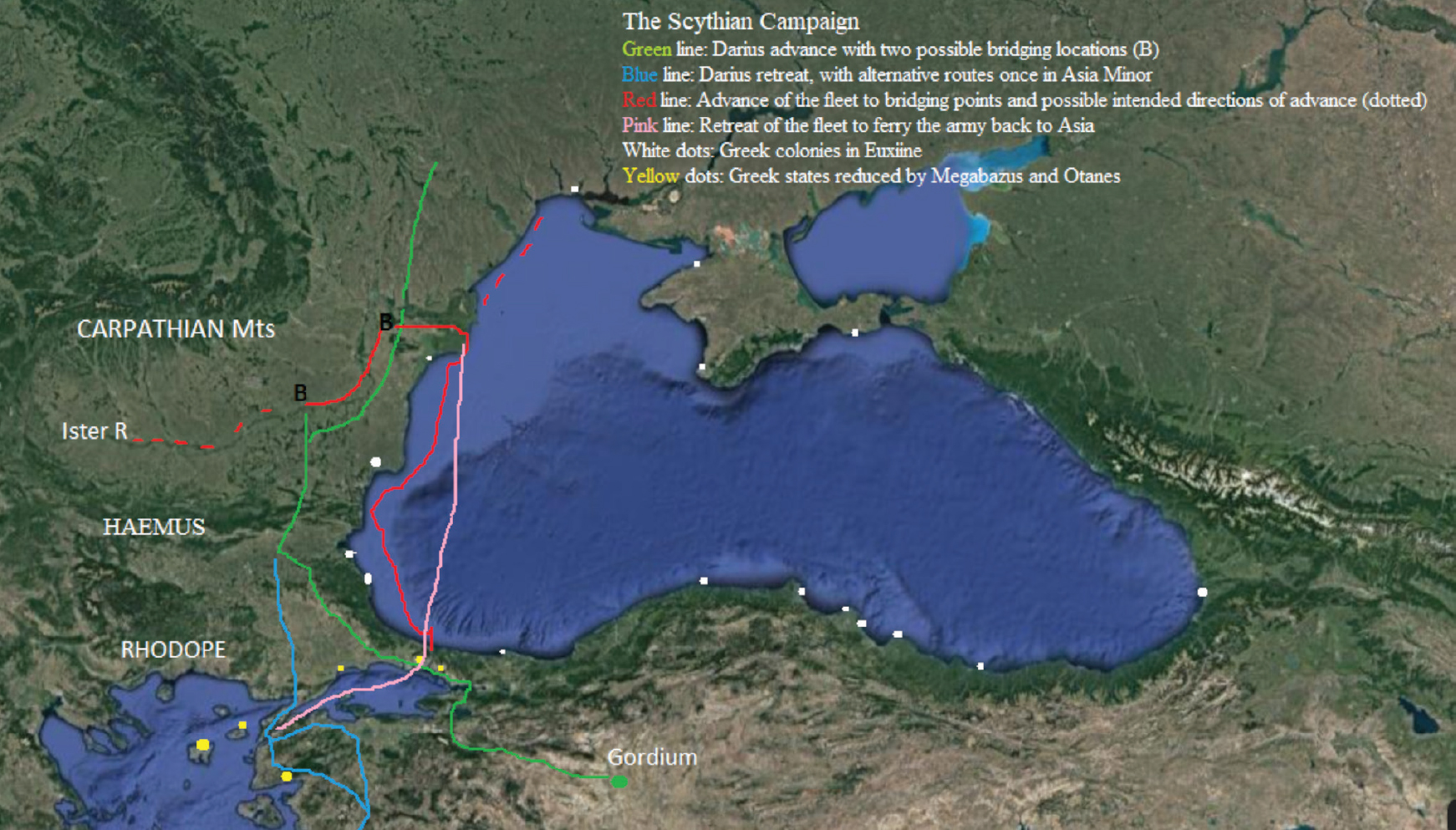
Map 5.1.
The army size becomes relevant at this point: Megabazus seems to command two army corps at standard expeditionary strength of two-thirds each; 40,000 out of 60,000, for an active force of 80,000 all told (Her IV.143,3). His first and major success is the reduction of Perinthus (Her V.2), sitting in the middle of the northern shoreline of Propontis, followed by an advance to the Thracian mainland to the west (Map 5.2). Megabazus thus rounds up the reduction of one of the Persian geopolitical loose ends. His advance reaches Paeonia up the Strymon valley, to stop north of Mount Pangeum and Lake Prasias (Her V.16). Although the coastal Greek cities were not reduced, the kingdom of Macedon under the House of Temenids now borders with the empire and perhaps becomes tributary (Her V.17–8). It is not governed by satrapal decrees, but the area of Myrcinus at the mouth of Strymon, near next-to-be Amphipolis, is Darius’ own to gift to Histiaeus as recognition for his good services at the Ister (Her IV.141).
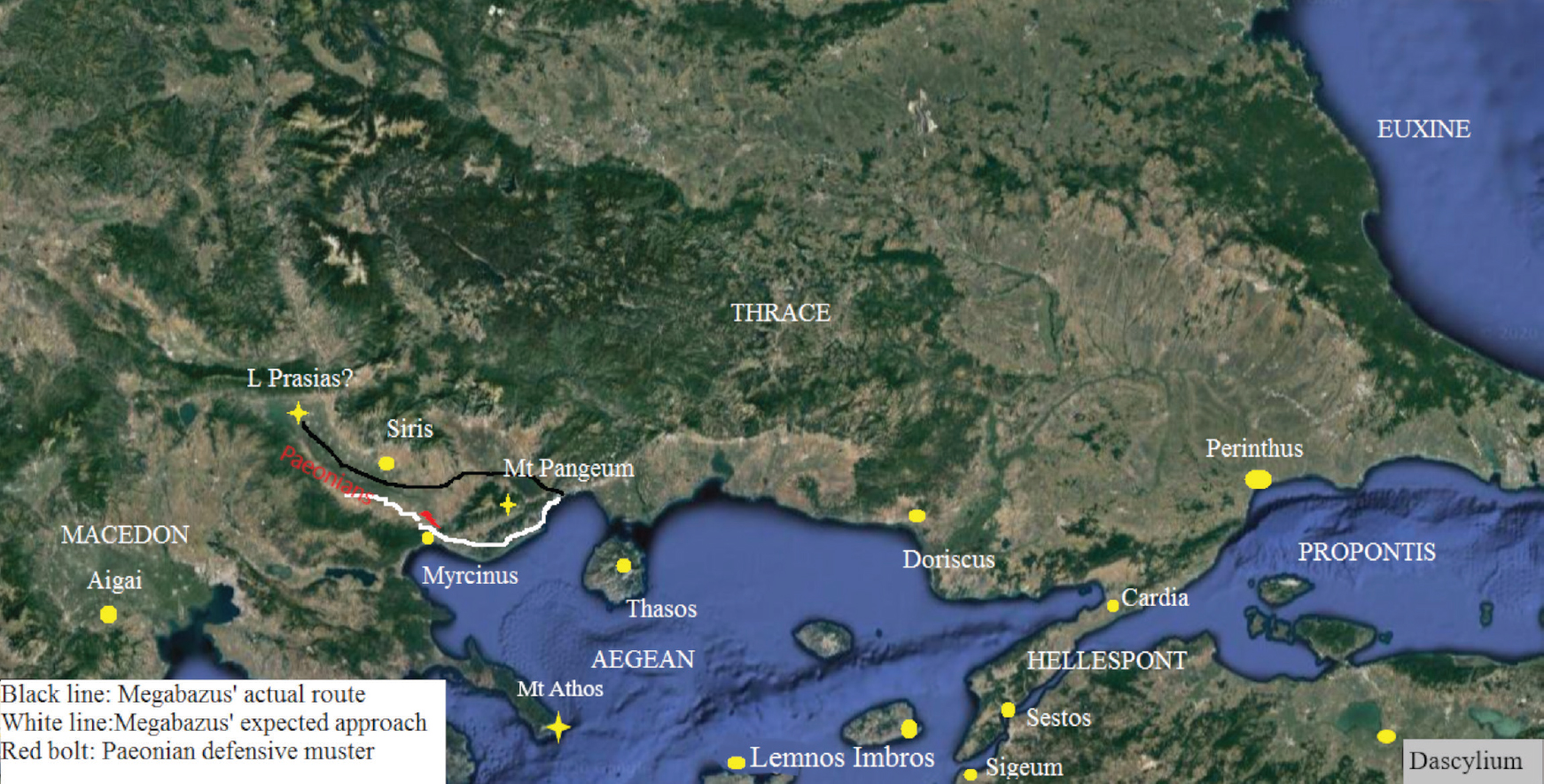
Map 5.2.
Megabazus declares his mission accomplished and returns to Sardis, bringing along the Paeonian tribe as prisoners, due to Darius’ whim for industrious slaves (Her V.13–4). Megabazus counsels Darius in Sardis to keep Histiaeus under surveillance (Her V.23) and Darius lures the latter from his new fief in Myrcinus to Sardis and includes him in his retinue as he moves the court to renovated Susa, his royal city and capital, where he retires once the western border is declared more or less secure and Thrace subjugated (Her V.24). In his stead, he leaves as general on the coast Otanes son of Sisamnes (Her V.25,1). The latter is a different and younger man than Otanes son of Pharnaspes, the general who subjugated Samos and was a member of the Seven (Her III.141). The seat at Sardis, once kept by the mutinous and murderous Oreites, who beguiled and murdered Polycrates and conquered Samos, is presented to Darius’ brother Artaphrenes (Her V.25). Otanes expediently brings some northwestern areas into Persian control with the help – especially in vessels – of the very loyal friend Koes (Her V.26) who is installed, after Darius’ return to Asia, as a tyrant in Lesbos. This seat was a recognition of his good services to the throne, mainly his advice not to dismantle the bridge at the Ister after crossing to Scythia, so as to maintain a ready point of retreat (Her IV.97). Thus, Imbros and Lemnos succumb, thanks to the lesbian fleet, as do some areas of lesbian overlordship in NW Asia Minor and, most importantly, the mutinous Byzantium (Her V.26). Only the Sigeum, a protectorate of Athens (Her V.94–5), remains outside the Persian border.
Megabazus is a person of interest for the developments of the next decades. Most probably he becomes satrap in Dascylium. After the fall of Miletus (circa 493 BC) the satrapy is in the hands of one Oebares, son of Megabazus (Her VI.33,3), and at 478 BC of a Megabates; the very one who campaigned against Naxos in 500 BC (Her V.32). This latter sired a Megabazus and thus, he was the son of one and, consequently, brother to Oebares. Thus, the line might have been Megabazus I – Oebares and Megabates – Megabazus II. The latter must be one of the four district admirals (Her VII.236) during the campaign of Xerxes, and probably last of his line, as the satrapy eventually came to the maverick Artabazus (Diod XI.44,4). In any case, the pompous title of Megabazus I, ‘General of Europe’ reported by Herodotus (Her IV.143,1) and the alternative one, ‘General of Thrace’ (Her V.14,1) may be two different free translations of the original Persian, which might refer to Skudra, the Persian lands in Europe. More complex analysis (i.e. as in Boteva 2011) might be needed on the subject of slightly different titles. Skudra was possibly under the surveillance of the Satrap of Dascylium or under a new, non-satrapal administrative unit based at Sestos (Her VII.33).
The sum of the western Scythian campaign was very different than the almost easy subjugations of eastern parts of Scythia (DB 74), some Indian territories (DB 6) and other late acquisitions. Of the four geopolitical threats, only one was efficiently dealt with – the Thracians; the Scythians had survived and were contemplating revenge (Her VI.84,2). Furthermore, an initial rounding-up of Greek territories would unmistakably lead to war eventually, as was the idea and the wish of the Queen (Her III.134) before the Scythian expedition.