

*Several Houston survivors have claimed that Captain Rooks wanted to steer the Houston toward Panjang Island in an effort to beach her, presumably to save his men and turn his ship into an unsinkable artillery emplacement. According to Quentin C. Madson, the captain’s last words were, “Head for the nearest land. We’ve got to give the men a chance.” William J. Weissinger Jr. recalled the PA announcement: “All hands stand-by for a ram. The Captain is going to try to beach. All hands stand-by! Belay abandon ship!” Seaman first class Seldon D. Reese told an interviewer, “Captain Rooks passed the word, ‘Don’t abandon ship! I’m going to beach it!’” Others, however, dispute the willingness of a top captain such as A. H. Rooks to risk turning his cruiser into a Japanese war prize. The longtime president of the USS Houston Survivors Association, Otto Schwarz, called the claim “a short-lived rumor” and “comic book propaganda.” Rear Adm. Robert B. Fulton observed that the Houston had no steering control once the after engine room was disabled, and regarded the idea that Captain Rooks was aiming to ground his ship as not only impracticable, but an insult to his reputation. “No capable and responsible commanding officer would ever beach his ship where it could pass into the hands of the enemy,” Fulton wrote to the author. “That would constitute a violation of the most basic rules in our Navy…. In the wardroom we had several discussions as to how we could best sink the ship if forced to that action to avoid capture…. The talk of beaching the ship is just nonsense. The originators of those stories, I think, were just trying to say something complimentary about their Captain, whom we all revered…. But those stories show a total lack of understanding of all that our Captain had to face.” In an August 28, 1945, letter to Edith Rooks, Ens. Herbert A. Levitt, the Houston’s signal officer, stated that the captain said to him, “We’ll beach her, man, and fight her from there” before he, “reluctant and with tremulous voice,” ordered Levitt to sound the abandon ship. In context, the remark, if it was actually made, seems more a fleeting and emotional exclamation than an order.
Part Three

War is hell, but that’s not the half of it, because war is also mystery and terror and adventure and courage and discovery and holiness and pity and despair and longing and love. War is nasty; war is fun. War is thrilling; war is drudgery. War makes you a man; war makes you dead.
—Tim O’Brien
The Things They Carried
CHAPTER 21
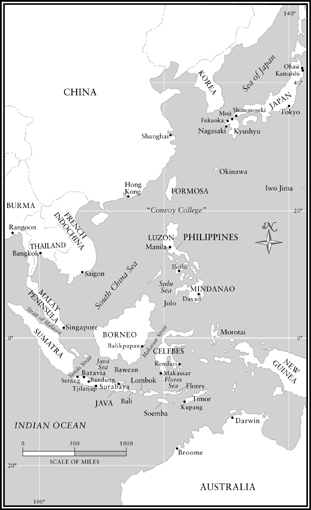
The Houston’s survivors were never far from shore. Their ship came to rest a few miles west of Panjang Island, and about the same distance east of St. Nicholas Point. The Perth settled several miles north of the Houston.
Despite the proximity to the coast, the obstacles to reaching land were formidable. Although 368 Houston survivors would finally be rounded up ashore—less than a third of the ship’s wartime complement—by all accounts many more than that survived the ship’s immediate trauma and loss. The final tally would take years to sort out. According to the ship’s action report, 150 men who made it into the water alive were never seen again. Lt. Harold Hamlin would write, “I saw hundreds of unwounded men go over the side there, whom I haven’t seen since.” So many men never reached the beach. With most of the lifeboats shattered by gunfire and torpedo blasts, and with any number of life rafts dropped prematurely on the first call to abandon ship, out of reach as the dying ship drifted to a halt, survivors clung to the handiest wreckage. The powerful surge draining out of the Java Sea through Sunda Strait took hold of them and whatever flotsam they were holding to—rafts, furniture, mattresses, spent shell cases—and pulled it toward a fathomless oblivion in the Indian Ocean.
From the moment the USS Houston and the HMAS Perth sank, hundreds of separate dramas set out on diverging paths. The currents feeding Sunda Strait saw to that. They spread the survivors far and wide. They dangled them within a hard swim of land all around St. Nicholas Point and near islands in the strait’s northern channel, and pulled them away on a natural whim. Survivors contended with predators under the sea and on land. They were set upon by native hillmen eager to settle scores with the white man and embrace the arriving Japanese. They were hauled aboard Imperial Army transports. They were shot in the water where they swam, never given a chance.
Sailors have earned places in legend for exploits less than what these men did up to the time of their sinking. Surely few naval personnel have ever performed more resolutely while running such a demanding gauntlet through enemy-controlled seaways. But when March 1, 1942, dawned, the eighty-fourth day of the Pacific war, their ordeal was in fact only beginning. No one could quite have guessed at the dimensions it would finally acquire.
The destruction of the Allied fleet in the Dutch East Indies was proof of Capt. Albert H. Rooks’s foresight. His “Estimate of the Situation” foretold the entire fiasco. “There is an adage at war colleges that he who wills the end must will the means,” he had written. “For this task the means are lacking.”
Just as he had predicted, the other ships of the ABDA naval force, used in scattered piecemeal defense, came to sad ends. Once the Houston and the Perth were gone, there was little hope left for the stragglers. The Dutch destroyer Evertsen got under way a few hours after the two cruisers departed on their final voyages, clearing Tanjung Priok’s minefield by 9:15 p.m. on February 28. Shortly thereafter her captain reported flashes of gunfire ahead. A surprised Admiral Helfrich relayed to Rooks and Waller a message from Admiral Glassford reporting the start of the battle: “EVERTSEN reports sea battle in progress off St. Nicholas Pt…. If any of addressees are engaged with enemy others render assistance as possible.” This was not news to anyone in the Houston or the Perth. But since the Evertsen herself was soon thereafter attacked and sunk by two Japanese destroyers, Helfrich’s message created the misunderstanding in the Navy Department that the Houston had been lost while going to the Evertsen’s aid.
On the morning of March 1, Helfrich received notice from his chief of staff, British Rear Adm. A. F. E. Palliser, that all Royal Navy ships would withdraw from the theater. Helfrich argued for a time but eventually relented, perhaps recognizing the intractable conflict of national interests within his own headquarters. He then instructed Admiral Glassford to send the remaining U.S. ships to Australia. The old destroyers Parrott and Whipple, three gunboats, and two minesweepers were the only ones to reach Fremantle. The new Brooklyn-class light cruiser USS Phoenix, released from convoy duty and speeding to reinforce Java, was ordered back to Exmouth Gulf, Australia. It is said that when sailors from the old Asiatic Fleet encountered Phoenix crewmen later in the war, they ascribed that necessary decision to a lack of nerve. Sharp words occasionally followed, and a fisticuff or two.
The HMS Exeter, hastily repaired at Surabaya after the Java Sea debacle, tried to escape the waters of the conquered archipelago. On the morning of March 1, she was hunted down south of Borneo by four Japanese cruisers and sunk with the destroyers USS Pope and HMS Encounter. That same day, the USS Edsall was caught south of Java by the battleships Hiei and Kirishima. With their fourteen-inch salvos the battleships blew the old destroyer’s keel literally out of the water. The saddest story may belong to the Edsall’s sister ship, the USS Stewart. She had capsized in dry dock at Tjilatjap and was scuttled by her crew as the Allies abandoned the port. The Japanese repaired, refitted, and commissioned her as their own Patrol Boat No. 102, making that destroyer the only U.S. surface warship in World War II to be salvaged and made operational by her enemy. Through the rest of the war American pilots, recognizing her lines despite the modified uptakes and mast, would be mystified by the idea of an American ship operating so deep in enemy territory.
In his “Estimate of the Situation,” Captain Rooks leveled no criticism at his superiors, though it was plain enough that he would have done things differently had the campaign been his to direct. Politics had trumped operational strategy at every turn. As Rooks suggested, a failure of foresight and a shortage of matériel sealed their doom. Adm. Ernest King was said to have called the campaign to defend the southwestern Pacific “a magnificent display of very bad strategy.” Samuel Eliot Morison saw little strategic use in ABDA’s ultimate martyrdom. Still, in the loss of the Houston and the other ships, and in the beyond-the-call gallantry of their officers and men, the U.S. Navy acquired an example by sacrifice that its future captains would ever remember.
“The United States Asiatic Fleet seldom tasted victory,” Morison wrote. “It drank the cup of defeat to the bitter dregs. Nevertheless, the fortitude of that Fleet in the face of almost certain disaster inspired the rest of the Navy in the forty months of war that followed, and its exploits will always be held in proud and affectionate remembrance.”
CHAPTER 22
For Otto Schwarz, after abandoning ship there had been no longing looks back at Old Glory whipping from the mainmast truck, just a deltoid-burning crawl stroke away from the gunfire and the explosions. Stopping to rest, he donned the life vest he had been dragging with him, then noticed the moonlit mountaintops in the indeterminate distance. Alone, he set out for them, arms chopping the sea all through the night.
Over the water Schwarz could hear shouts, the pop-pop of machine guns, faint screams, and silence. Then, startlingly closer, he heard the rumbling gurgle and swish of diesel engines, and sensed a small craft nearing him. He went motionless just as a searchlight beam grabbed at him. The boat came closer. He heard Japanese voices and tensed, waiting for bullets to come. A Japanese sailor prodded Schwarz with something long and sharp, a boathook perhaps. There was more jabbering discussion, then the searchlight switched off, the engines roared to life, and the boat was gone.
Word passed swiftly over the waters that the Japanese were shooting survivors where they swam. Jim Gee heard the reports—from stunned word of mouth and from the gun barrels themselves. The Marine could hear urgent advice passing between his shipmates: Swim that way. No, that way. Oil over here. Land’s that way. He settled for treading water. With no life vest or doughnut ring, he calmly kept his place afloat for about an hour as Japanese boats played yellow-white searchlights in all directions, looking for his like.
But in time Gee grew exhausted, deeply so. The consequence of rescue by the enemy was plain to the ear as gunshots ricocheted over the water. He thought of his shipmates killed in action. Well, a lot of them have already gone. There’s no need for me to do otherwise. What made him special? The existential vertigo became so unbearable that he despaired and finally just gave up. He quit the air and let himself slide under the water.
Gee stayed down long enough for a desperate reflex to kick in. “I took a deep drink of that sea water and I knew that wasn’t really where I wanted to be.” He kicked himself back to the surface and to his good leatherneck senses. A thought finally reached him that reoriented his thinking and told him that all was far from lost: “I had a round-trip ticket home…. I was going back home. From that point, I never wavered any one minute in believing that I wouldn’t make it.”
For some, the decision to survive was abrupt, coming in a flash. For others it was a function of staying on autopilot and letting the will regather its might. According to Charley Pryor, “You’re just completely beyond exhaustion but still you go. At a time like that you’ve got some reservoir of strength you never knew you had until you have to use it. Within ten minutes you feel, ‘Well, I can’t swim another stroke,’ but then eleven hours later you’re still going.”
Seaman second class Eugene Parham was on a lifeboat led by Lt. Cdr. Sidney Smith, the plotting room officer, when it drifted into a herd of Japanese troop transports anchored offshore. Soldiers and sailors lined the rails, jeering unintelligibly. When Commander Smith gave them permission to surrender if they so chose, Parham and some others climbed aboard a transport and submitted to their captors. Shortly afterward, a motorboat towing an empty Houston life raft puttered by and the next thing Parham and six other Americans on the transport knew, the Japanese were forcing them into the raft. A Japanese officer flashed his sword, the towline was severed, and they were cast loose again.
They drifted for the better part of the day, picking up a few more survivors before catching a current and losing sight of land. As the raft drifted along, Parham and two others decided their best chance at survival lay in jumping overboard and swimming toward the mountaintops visible on the horizon. Four hours of hard swimming paid an unexpected dividend: A mile from the Java beach, an outrigger canoe found them. Two natives were at the oars, but the hands that hauled them aboard were American. Ens. John B. Nelson was in charge of the craft, having leased it from natives for rescue work for the price of his U.S. Naval Academy ring. It bought Parham’s life, but no one on the lifeboat he had originally abandoned—not Commander Smith nor anyone else—was ever seen again.
At least one other native caught the entrepreneurial spirit, but this one overplayed his hand. A Javanese at the helm of a fishing boat motored up to a group of struggling Houston survivors, meaning to do some brisk business. “This jerk was picking up guys if they could pay him something of value,” seaman second class William M. Ingram Jr. said. “He kept picking up exhausted guys, more and more of them, and taking their wedding bands, money, and watches. All I had was a jackknife on a lanyard tied to my belt, and a cheap ring I’d picked up in Honolulu,” Ingram said. “The native wanted both of them. I gave him what he wanted because, hell, I had to get on that boat, and there wasn’t any time to bargain.” Eventually, outraged by the price gouging, a bunch of the Americans rose and, said Ingram, “threw his ass overboard.”
In their new boat, Ingram and his shipmates headed for land, fighting stiff currents all the way. As they passed close by a small island, several sailors got anxious and jumped for it, only to get swept away by the fast-moving water. Sometimes staying with a raft saved you. Other times it was a sure route to oblivion; by inference, more than a few rafts had to have been swept into the Indian Ocean. Ingram’s remaining group made it to the beach, but their lucky judgment did them no good. “We weren’t ashore five minutes when along came a bunch of Jap soldiers, who took us prisoner,” he recalled.

Exhausted from treading water, Jim Gee paddled in search of something buoyant to cling to, finally catching sight of a Seagull floatplane pontoon drifting loose. As he approached, he found a bunch of Houston survivors holding on to it, perhaps twenty of them, some badly burned. The ship’s chaplain, Cdr. George S. Rentz, was among them, doing what he had been put on the earth to do: minister to those in need.
Gee had little need of his chaplain’s services. The Marine private was not injured, merely tired. He clutched the side of the float, gathering strength and wind for another run toward shore. When he finally set out again, he discovered that no one, not even a strong-swimming Marine, could contend with the currents off Java. “I could feel myself being carried out to sea. There are certain things you can just tell. I could tell that I wasn’t going in a straight path.” He found just enough strength to return to the pontoon.
Gee got back in time to witness the making of a Navy legend. Chaplain Rentz, at fifty-nine, had been the oldest man on the ship, nine years senior to Captain Rooks and only about a year away from retirement when the Houston went down. The native of Lebanon, Pennsylvania, had been a pastor at churches in Pennsylvania and New Jersey before joining the Navy during World War I. That war was nearly over when Rentz, as a junior-grade lieutenant, was named acting chaplain to the Eleventh Marine Regiment, deployed to France in October 1918, just a month before the armistice. After the war, Rentz fulfilled a series of sea-duty assignments in the peacetime Navy, making commander in 1924. He needed nearly two decades more to find his ultimate calling as shepherd to the survivors of a U.S. Navy cruiser in extremis.
The surplus pontoon, taking on water through a hole in its top, was slowly losing its buoyancy. Several times during the night Rentz tried to swim away to keep it from sinking. “You men are young, with your lives ahead of you,” he said. “I am old and have had my fun.” Each time, a different sailor from the group ignored Rentz’s entreaty and retrieved him.
At one point Lloyd Willey saw Rentz huddled with a sailor on the float. The kid, seaman first class Walter L. Beeson, was hanging on, head down, apparently wounded, though it was hard to see where or how badly. He didn’t have a life jacket. According to Beeson, Rentz, unhurt himself, “told me his heart was failing him; told me he couldn’t last much longer.” Gasping for breath, the chaplain said a brief prayer for the men in the group, removed his life jacket, and offered it to the young sailor. Perhaps ashamed to take it, Beeson accepted it but declined to put it on, at least not until Rentz had kicked away from the float and submitted to the sea. According to Jim Gee, “No one realized what had happened. It’s just one of those things that one minute he’s there, and the next minute you look around and you take a head count, and sure enough, he wasn’t there.” Only when the finality of Rentz’s sacrifice had sunk in did Walter Beeson pull on the life jacket. The group stayed together and drifted the rest of that night, humbled by the spirit of their chaplain right to the end.
As dawn broke over Bantam Bay on March 1, the Houston’s survivors could at last see the full extent of the Japanese landing operation and their own incidental place in its midst. “The bay was as slick as glass, not a ripple anywhere except in the wake of the landing barges plying between the transports and the shore with their loads of supplies and troops,” wrote Bill Weissinger, floating with a group of Houston survivors led by Lt. Joseph F. Dalton. “The surface was dotted with all sorts of objects: boxes, crates, lumber, all types of containers, and life jackets—some empty…some occupied.” According to John Wisecup, on another raft, “Transports lined the beach as far as the eye could see, busily discharging troops and equipment with little visible resistance.” Too tired to swim for shore, the Americans drifted, watching the barges going back and forth, wondering if one might come for them. In time, a barge hauled out in their direction.
As the thirty-footer pulled alongside, Dalton urged his shipmates to remove any insignia that might identify their ship. The Japanese engineer in charge of the craft motioned them aboard, seated them on deck, then began making “strange guttural-snarling sounds which we found out later was the Japanese language,” Weissinger wrote. With the life raft towed behind it, the barge got under way and headed for one of the large transports. The Japanese engineer and his coxswain passed around cigarettes. Then the coxswain approached Lieutenant Dalton.
“Ingeris, ka?”
English? Dalton didn’t hesitate to correct him. “No. American,” he said.
The enemy sailor dismissed this out of hand. “No America. All America finis. Ingeris.” The two men disputed the question of nationality in pidgin for a few minutes until the barge reached the transport, then the Japanese sailor gave up.
The coxswain threw over a line, went up the gangway, and conferred with the troop carrier’s officer of the deck. Then without comment he came back down and released the line. The engineer throttled up again and steered the barge toward another vessel. They had no more luck with that one. In all, four different transports refused custody of the Dalton gang. “Nobody wanted us,” wrote Bill Weissinger. The engineer was finally left with no alternative but to cast them loose again. The coxswain cut the line towing the raft listlessly behind, and indicated that the survivors were to swim for it. As they went overboard again, three rifle-armed soldiers on the large transport walked along the rail. The troopship was moving just fast enough to keep the survivors on its beam. The Americans braced for gunfire. Reaching the raft and ducking behind its lee side, they cowered and drifted until they were out of range and their only enemy, once again, was the sea.
Some sailors drifted for days. Others were lucky enough to reach shore right away. Survivors who struggled ashore at the first opportunity were almost always rewarded with a quick capture. This was the fate of Frank Gillan, the lucky Perth lieutenant who appears to have been the last man off his ship.
Gillan rode a series of floating vehicles to survival, each one more seaworthy than the one before: a wooden plank, a Carley float, and finally a lifeboat, where he joined about seventy of his shipmates. An able sailor, Gillan got the mast and sails up, fashioned a tiller out of driftwood, and turned toward Sumatra before adverse headwinds forced him to shape a course back toward Java. Going slowly blind from the bunker oil clotting in his eyes, Gillan turned over the tiller to a sailor named McDonough. When the wind died at nightfall, they had to row. They were soon desperate with exhaustion. One sailor who started vomiting up oil was relieved of rowing but sat there for a time still pulling an invisible oar until someone eased him to the bottom boards, slick with the blood of the injured, to sleep. With a combination of “bullying and blarney and child psychology,” McDonough kept them bending to the oars. Two bodies were slid overboard as a chaplain named “Bish” Mathieson intoned the last rites. Finally, in the early hours of Monday, March 2, scarcely twenty-four hours since the Perth went down, they reached Java’s shore. They spread out the lifeboat’s sail on the beach like a tarp and arranged five wounded men on it. Then they slept.
At dawn Gillan awoke and the decision was made to split up their party, leaving the wounded on the beach while the healthy hiked north and south looking for help. Gillan paired up with Bill Hogman, a stoker, who, unasked, took his hand and served as his eyes, leading him after the others all that day and far into the night, guiding his steps, explaining what the country looked like. At the village of Labuhan, miles south of their original landfall, they met a Houston officer—this might have been Lt. Joseph Dalton or Lt. (jg) Leon Rogers, who both reached Labuhan and met Perth survivors. The American told them to wait while he went to another village where other Yanks were said to be. The Dutch, he said, would provide them with transportation. About an hour later a native policeman showed up and handed them a handwritten note from the same U.S. officer saying there were no vehicles after all and advising the Australians to head for the hills and attempt a rendezvous with Dutch ground forces.
Crossing the coastal paddies toward higher ground, the two Australians encountered Chinese shopkeepers who gave them food. The offerings of the natives were harsher: spitting and unintelligible threats. At a hillside village that night, they slept in a small hospital, where they met a Dutch officer. “Can you get us arms and medical supplies?” Gillan wanted to know. An encouraging promise was made, but it did not survive the night. In the morning the Dutchman was gone.
“We can fight in the hills,” Gillan said, still unable to see. He and his mates walked all day up-country through plantations and jungle, hoping to find Dutch soldiers. What they found instead were sarong-clad hillmen armed with gleaming parangs and knives. Though Gillan was enjoying the return of his eyesight—he could see if he pulled his lids open with his fingers—he could do little to resist. When the natives became preoccupied with arguing among themselves, he and Hogman scrabbled together some good rocks to throw. Gillan carried a heavy stick too, which he waved threateningly at an armed hillman who approached him. Though they were outnumbered and overmatched, the standoff held. It lasted, at least, until a truck motor shredded the jungle’s peace. A small Japanese flag flew from its hood. The natives scattered.
As the vehicle sped into view, the Australians saw the vehicle’s occupants and resigned themselves to capture. There were three of them, all Indonesians. All wore white armbands emblazoned with a red rising sun. One of them leaped out and, pointing imperatively at the truck, said, “You prisoner. You be well treated.” Gillan, exhausted and numb, complied. He and Hogman joined other prisoners in the truck as the driver got in, hit the gas, and began navigating the winding hillside roads. When they arrived at the town of Pandeglang, about twenty miles northeast of Labuhan, and parked near the town jail, crowds of natives filled the streets. They jeered, “English finish, English finish!”, spat at them, and smacked them with sticks.
Gillan, an engineer, was a machine-minded westerner. His dreams were of a familiar world he had learned to love: engine rooms, roaring burner fires, hissing boilers, screaming turbines, the smell of oil mixing with sweat. Now, like the rest of the sailors in captivity, he began adjusting to a different reality, an alien and primitive one. Somewhere along the way Gillan saw fit to speak a quick, quiet prayer: “Please, God, help us and deliver us all and look after our families at home.”
The men on John Wisecup’s life raft, whose senior man was a gravely wounded young lieutenant junior grade named Francis B. Weiler, fought Sunda Strait’s currents by using pieces of flotsam as oars and making fast a bowline that was towed by several of the stronger swimmers. Weiler had a gouge near his spine and a wound in his arm deep enough to show bone in the moonlight. After a day or two soaking in bunker oil, his arm festered and began to turn gangrenous. It swelled to twice its size. Drifting with the current, Weiler used his good arm to splash water on the parched, exhausted men who were doing the paddling. They worked doggedly, but thirst and fatigue pushed them toward madness. There were some outlandish conversations on that raft. Each time dawn came, Wisecup noticed, a few faces had gone missing.
Though morning on the third day revealed no land within sight, they knew enough to keep rowing, and somehow that afternoon the tide gave them a break, steering the currents back toward shore. With Weiler still lurching around the raft with one good arm, splashing water on folks and taking no notice of his wounds, John Wisecup looked toward the bowline and saw that the swimmers towing it had somehow changed their stroke. From the way their shoulders were moving above water, in fact, Wisecup was delighted to realize that they must be standing on the bottom. They hauled the raft toward the welcoming nearby beach. Two sailors carried Weiler ashore and sat him against a coconut tree. Then several elderly Javanese men appeared with machetes. They cut the tops off some green coconuts and let the sailors drink their fill.
Few of the Houston’s survivors had seen the need to keep their shoes when they left the ship. Faithful to regulations to the end, most had placed them neatly by the gunwales before going overboard. “The deck looked like a used shoe store display,” Wisecup recalled. As the survivors pulled themselves over coral and rocks and onto land, they realized their mistake. Much later some of them would dream of the abandoned footwear as they wrapped their bleeding feet in rags, leaves, and carvings from rubber tires. Sailors from the deck force got by the best going barefoot. Months of trudging the Houston’s hot decks with holystones and hoses in hand had toughened their soles as the yeomen and radio operators could only have wished.
Survivors washed ashore at any number of scattered points. They organized themselves and tried to round up their friends, to heal them or get them healed. Pursuing varied routes of evasion and escape, they acquired stories divergent and dramatic enough to keep a Hollywood producer busy making wartime epics for the rest of his career. In search of help, they hiked mountains and dirt roads, forded streams and hailed rickshaws. But as often as not, the help turned out to be in league with the newly arriving Japanese.
Several centuries of weighty colonial administration had not disposed Java’s nationalists to like the Americans any better than they did the Dutch. Some say the Japanese, perhaps not quite appreciating their new subjects’ readiness to collaborate with them, put a fifty-guilder reward on white men captured dead or alive. The cash might not have been necessary. Rhetoric of a “Greater East Asian Co-Prosperity Sphere” fueled nascent Javanese nationalism and paid dividends of loyalty in the early going, netting the Imperial Army scores of prisoners. Survivors who caught wind of the natives’ hostility hid out in the hills, subsisting on water, coconuts, and scraps from friendly Sundanese villagers. These acts of kindness and generosity—providing nourishment, concealment, shelter, and likely routes toward Allied army positions—were frequent enough to prevent the question of trusting the locals from ever becoming completely decided.
Ens. Charles D. Smith and coxswain Red Huffman, old hands from Turret Two, washed ashore on a small island about three hundred yards off St. Nicholas Point. Worn beyond hope, they slept until daylight on March 2 and woke to find that five others had joined them, Marine sergeant Joe Lusk and four sailors. The presence of Japanese ships and aircraft complicated the job of reaching the Java mainland, but in the morning a rainsquall passed through, providing sufficient medium-range concealment for them to swim ashore safely by daylight. They gathered themselves on the beach, slipped across the Japanese-patrolled coast road, then climbed to high ground and looked over the other side of the hill to the sea.
About five miles down the beach, they could see six or eight transports anchored off St. Nicholas Point. Beyond them, prowling the edge of Bantam Bay, was a light cruiser, three destroyers, and some patrol boats. No doubt the Japanese were still reeling from the sudden, spectral appearance of Allied cruisers in their midst. The price the two ships had extracted from the landing operation was plain to see. Swimming ashore, more than a few Houston survivors saw the hulks of three large Japanese merchant ships, sunken and lying on their sides, as well as a seaplane tender or some other kind of major auxiliary vessel with its flight deck mostly awash.
The problem with the survivors’ proto-heroic efforts at evasion and escape was that ultimately there was no way out. All Allied personnel who could manage it had fled to Tjilatjap and evacuated Java a week before. Now there were no ships or planes left to catch. Though there remained some ground battles yet to be fought for control of the island, the surviving sailors were stuck well behind Japanese lines, in a terrible position to link up with friendly troops. What the location and number of the few remaining Allied units might be, no one quite seemed to know.
CHAPTER 23
Before their ships were sunk together, the sailors of the Houston and the Perth had been no more than friendly strangers. With a wide ocean stretching between them, they waved from distant rails but seldom saw each other for the man beneath the uniform. The collective ordeal propelled them into a deeper alliance; many would end it as lifelong friends. “Those Aussies,” said Otto Schwarz. “If you ever have to get captured, get captured with Aussies.”
One of the traits the Americans seemed to have in common with the Australians was a boundless sense of the possible. Unlike the British, who struck many of the Americans as repressed by traditions and hierarchies, or the Dutch colonials, orderly and risk-averse like landed gentry, the Australians tended to be maverick optimists. While the Dutch were preparing themselves for surrender, the American and Australian sailors had fight left in them and showed it.
In fact, for some survivors of the Perth, it wasn’t enough merely to reach shore on Java or some barren island in Sunda Strait. There were a couple of well-led groups that hatched plans to travel like castaways all the way home to Australia. They built boats and jury-rigged them for sea. They set sail and felt their way home, navigating by starlight, convinced that their war had only begun. Going home was an option unavailable to all but the most fantasy-prone Americans. But if the Aussies had their way, they might yet fulfill Admiral Glassford’s February 28 order sending them to Tjilatjap in preparation for a run down under.
Leading seaman Keith Gosden—who had flown suddenly and exuberantly off the Perth when the torpedo hit near Y turret’s lobby—refused to be rescued when he had his chance. Alongside his raft came an Imperial Navy destroyer. Already holding Perthsurvivors in custody, its crew threw down lines. One of them called, “Come aboard,” but Gosden and his shipmates saw rescue as a synonym for surrender and pushed off from the warship. A Perth man shouted, “You know where to stick it, mug—we’d rather drown!” The Japanese replied, “So, you say Nippon no bloody good. You wait till tomorrow.” The ship vanished.
Soon afterward the tables were turned. Gosden felt someone pulling at his legs. Startled, he looked down and saw his assailant: a swimming Japanese soldier with a rifle and in full battle gear trying to get aboard his raft. The survivors of the Houston and the Perth were not the only victims of the Battle of Sunda Strait to contend with the violent sea. All around Gosden and his fellow survivors imperial troops floundered, some facedown, dead and drowned, others struggling toward the raft, holding their rifles “like periscopes.” When the soldier grabbing at Gosden tried to say something, the sailor replied with a sharp kick to the face. The soldier reached again for the Australian sailor’s boots—he had kept them in anticipation of getting ashore, but they made fair weapons too. Gosden kicked at the face again and again until it was no longer there to be kicked. His resistance spurred his shipmates to a rather frenzied defense of the raft. Soon the only Japanese visible nearby were facedown and inert. They were Gosden’s enemy, and he would neither accept rescue by them nor do them that favor. He was going home. As he would remind himself on the difficult journey ahead: There’s a plan for every man, and when that plan is completed that is the end. This is not my time. My death is not determined yet. I will get home.
By first light on March 1, the southerly flow through Sunda Strait was carrying Keith Gosden and his float full of survivors into the wedge of sea separating Toppers and Sangiang Islands. Gosden’s shipmate, Lieutenant Gillan, and his boys, like the Americans Hamlin and Huffman and Harris and Schwarz and so many others, were able to scramble ashore. Gosden and his mates went for a ride.
Toppers Island, near the up-current northeastern end of Sunda Strait, was a small lump of rock that sported an important lighthouse. Survivors of both the Houston and the Perth found refuge on its compact shore. Sangiang Island, larger and more verdant, was visible as a low line of rocks, fringed by bushes and taller palm trees that enclosed a narrow inner plain full of broad-leafed swordgrass and younger banana palms. Watching the islands as they appeared to slide north along the distant mainland coast, Gosden could see that he might be missing his only chance to reach land before the current expelled him remorselessly into the Indian Ocean. He told his shipmates he was going to swim for Sangiang. They scoffed. He persisted. The argument was not settled until Gosden slid off the raft and began swimming, along with a persuadable Royal Australian Air Force corporal, Ronald Bradshaw. The waters near Sangiang’s shore whorled and ripped, sometimes bubbling like rapids. Fifty yards from the beach Gosden and Bradshaw got caught in this watery revolving door and were spun out farther from the island.
Many others had fought these currents and lost. From Lt. Joseph Dalton’s group, two American sailors, seaman first class Isaac A. Black and signalman first class Edward T. Carlyle, set out for the Java shore. They dived off the raft and rode a shore-bound current for a time, but Lieutenant Dalton could soon see that they were moving faster down-current than toward shore. Black, about a half mile south of Dalton and his men, seemed to be in trouble. He began waving and shouting, but the wind and waves erased his words. Carlyle was farther away but apparently having better luck. Somehow he had gotten on board a banca boat, which he began rowing in Dalton’s direction. But when another boat, a native fishing craft, was spotted heading in their direction, the men in Dalton’s raft took their attention away from their two distant shipmates. Pursuing their own survival, they piled from the raft into the small craft, nearly swamping it, giddily showering their rescuers with the cash they had in the pockets of their khakis. When they finally settled in, they realized they had lost sight of Black and Carlyle. “They had both disappeared,” wrote Bill Weissinger. “It is a mystery we could never find an answer for.”
Keith Gosden had better outcomes in mind for himself. Moving again toward Sangiang, he treaded water for a while to catch his breath, and as he did the current brought a body his way. The body was on its back, arms outstretched. As it drew nearer, the Australian recognized it as a Perth telegraphist, Peter Nelson. As Nelson drifted nearer still, Gosden was startled to realize that he was alive—asleep in fact, and snoring robustly. When Gosden yelled and splashed water on him, the telegraphist awoke and, sleepily incensed, asked, “What’s biting you?” But the risks were apparent: they were drifting so fast that they stood to miss the island altogether. Gosden waved at Nelson and Bradshaw, indicating he was going to swim for Sangiang’s beach. Again the currents seized him, but this time he was pulled toward the island’s sheltered lee side, where the waters relaxed and purposeful swimming became possible. The Adelaide native chose a wave with the shape and strength to take him in. Hitting the shallows in an avalanche of foam, he felt the redemptive stinging scrape of live coral against his belly.
Twenty-two Australians gathered at Sangiang, eventually congregating under the leadership of Lt. Cdr. P. O. L. “Polo” Owen, the Perth’s paymaster. Owen took charge and split them into groups and they went right to work. Ducking the odd Japanese aircraft, they gathered corn, green papaws, tomatoes, native tobacco, and coconuts. They found some tins of kerosene and used it to dissolve the corrosive coat of bunker oil that clung to them. They scoured the beach for useful treasures, prominent among them a wooden lifeboat well stocked with provisions, oars, sails, and flares. They found three sheep shut up in a hut, slaughtered them, and made a fine pink stew. And they slept. Hard.
They rose the next day to find four of their number missing, along with the lifeboat. Someone said, “If that’s the sort they are, we’re better without them.” What was there to do but accept the frail criminality of human nature? All agreed it would be a death sentence to stay where they were.
Seeing Japanese air activity in the east, Commander Owen guessed that Batavia was an enemy hive. There was no point trying to reach it. But he felt if the men could get from Sangiang to the Java mainland, they might find transportation there to Tjilatjap and rejoin Allied forces. On Wednesday, March 4, having gorged on as much stew as they could manage with bare hands, shells, or palm leaves as spoons, they overloaded a twenty-five-man boat with food and forty-one souls and shoved off for the last battlefield in the Dutch East Indies.
Once on Java, Owen wanted to go to Labuhan by land. Keith Gosden and some others preferred to travel by sea. The seafarers, who found a leader in Lt. John A. Thode, felt they could get all the way to Australia on their own. Owen and Thode agreed to disagree as to means, but they settled on an interim rendezvous at Labuhan. Owen and one group would walk there. Thode and his group would go by sea, hugging the coast.
Owen’s journey turned quickly into a deadly misadventure. Four of his fellow travelers, unable to keep his aggressive pace after a few miles, decided to head for Batavia instead of Labuhan. Their reward for breaking ranks was an ambush by Javanese hillmen that left three dead and the survivor badly slashed but able to tell the story. Owen and the others continued south and their line straggled out before they reached a small village. Coming to a rise in the road, they glimpsed the sea. Owen saw a lifeboat out there, oars dipping and pulling, up and down, and the sight of Thode’s crew reenergized his steps through the paddies and coconut plantations. He headed a line that stretched out now for miles.
Just before sundown, Owen came to another village and met a young man, well dressed in a linen coat and a black and orange sarong, who pointed the way to Labuhan. The man said he had worked as a schoolmaster in Batavia before the Japanese came. He warned them of armed bands of Javanese who had looted and burned Labuhan’s Chinese-owned shops. They could be relied upon to do worse to white men, he said, adding that there had not been any Dutchmen in Labuhan for some time, and that transportation to Tjilatjap was unavailable.
Marching into a sparsely developed fishing outpost, Commander Owen’s party saw out in its bay a modest fleet of small gondolas painted green and scarlet and yellow. One boat among them looked decidedly out of place. It was the lifeboat carrying Lieutenant Thode’s party. Owen called out and waved to them. As he led his men toward the beach, a score of parang-armed natives picked up their stride and started trailing them. The Australians began running. They passed through a coconut grove and reached the water. They sloshed quickly through the coral-bottomed shallows until the water was deep enough to swim. Reaching Thode’s lifeboat, they were pulled aboard and were reunited with their shipmates from Sangiang.
Discouraging though Owen’s experience ashore might have been, he held on to his wish to go over land to Tjilatjap. He pressed the issue again with Thode, and the lieutenant finally had no choice but to stand firm. The disagreement endured. Thode returned his superior to land with some two dozen others. As Owen’s men vanished among the huts of Labuhan, Thode and his nine castaways, including Gosden, rowed their lifeboat back to sea. It was then that their mini-epic adventure truly began.
They ran south with the currents, rowing mostly and taking whatever help the light winds could blow into the split canvas bag they used for a sail. Always within view of Krakatoa’s cone, looming in the northwest, they made the thirty-five-mile run from Labuhan to Princes Island in the southwestern end of Sunda Strait in one day. On that rocky beach they found five dozen crates that had been shoved around and scattered by the tides. Dreaming of canned asparagus, steak, beans, and beer, they tore into them but found only two types of loot, and lots of it: ammonia and bundle upon bundle of paper currency. Since the latter proved to be Japanese occupation money, and since the sailors aimed to avoid that jurisdiction altogether, they cursed the treasure and tossed the bundles into the surf. But one last box of the trove had not been opened yet. One of the sailors found it wedged in some rocks where the beach ended. He smashed it open with a pair of rocks and was dumbfounded to find what they needed even more than food: sails, a full set of them—mainsail, foresail, and jib. “Boys,” said Lieutenant Thode as the group surrounded the find, “this definitely means we’ll get home.”
Before departing they used a piece of iron binding from one of the boxes to saw down a coconut tree and feasted on its eight fruits, garnished with some periwinkles pulled from the rocks. The next morning, Friday, March 6, they set course for Tjilatjap. They would need twelve days to cover the three hundred miles to the friendly port. From there, the optimists calculated, reaching Australia would mean five more weeks at sea.
They rowed all day in shifts. The absence of wind caused their muscles to burn as surely as the sun did their oil-stained skin. When the heat became oppressive, the castaways could dip themselves in the sea, but only briefly and only so long as a shipmate could stand by, oar at the ready, to fend off the trailing sharks. The nights were clear, the moon bright between dusk and nine o’clock. On some nights the stars stayed visible longer than that, providing a fix to navigate by. But usually it rained, forcing them to sail blind. More than once they discovered that they had wasted the night rowing in a big circle.
When morning broke on the twelfth day past Princes Island, Thode said, “If we’re lucky we’ll see a monolith at the entrance to Tjilatjap some time today.” The announcement was met skeptically—out of food, the men were growing suspicious of cheap gambits to boost morale. But early that afternoon land appeared, and as they drew closer they could see, in a gap between hills, the monolith.
The inlet to Tjilatjap harbor was a narrow passage between the mainland and the coastal island of Kanbangan. Entering it, the Aussies could see on one side of the harbor, on a faraway shore, hundreds of soldiers dressed in khaki. Were they Japanese? Weak from exhaustion and perhaps reluctant to consider the worst, Thode steered on, heading the opposite way. He tied up on a wharf next to a patrol boat flying the Dutch flag. Two Dutch officers in green uniforms met them. One carried a pistol, the other a light machine gun. “Who are you?” the latter demanded, speaking first in Dutch, then in English. Thode approached the Dutchmen, identified himself, then described their ordeal and their ambition going forward. He requested food for the journey ahead. The officer with the pistol shook his head. “Nippon is your friend. You must give up your plan to reach Australia and go to him for protection.”
Thode returned to consult with his men. “You heard what he said. What’s it to be? Surrender, or shall we have a crack at them?” The strength left in their bodies did not match the anger in their veins. Certainly they were powerless against a submachine gun and a pistol. One of them muttered, “You bastards. You yellow, fifth-column bastards.” And so at friendly gunpoint the heroes of the HMAS Perth surrendered the fight. Stunned as they were by the turn of events, they were more shocked still to find that their actual mortal enemy—the Japanese—was more inclined to show them kindness than their putative friends. The Dutch officers marched the captives to a makeshift Japanese headquarters in town. As imperial troops beat looters with rifle butts outside, the Dutchmen, speaking in Japanese, called out to the headquarters’ occupants. A Japanese colonel appeared. When Thode identified his band as survivors of the Perth, the Imperial Army officer said in clean English, “You sank our ships in Sunda Strait. Look at me. I’m still covered in oil. I can’t get the stuff off.”
The Australians were taken to a place where they could wash. When the oil residue did not come off, Japanese soldiers helped them scrub down, and at this point it struck Gosden that the unexpected generosity had to have a catch. The Japanese were known to be brutes. Yet who could deny this charity: The Aussies were fed, given tea with milk, cigarettes, and matches. They slept for a bit, then were awakened and given clothes and more cigarettes. In light of the dark rumors circulating about the Japanese, they could scarcely believe their luck.
The colonel interrogated Thode that afternoon, took down the names of his party, then made the lieutenant a surprising offer. He would be allowed to choose his prison camp. That day Thode, escorted by the colonel’s sergeant major, inspected several of them and settled on a camp outside of Tjilatjap. At the time, there was no way anyone might guess that this would be the last act of enemy-sanctioned free will that most of them would exercise for more than three years.
CHAPTER 24
For a time, the Australians who reached Tjilatjap were permitted to think that their gallantry would win them some type of preferred treatment. The rest of the survivors, and certainly most of the Americans, had less encouraging introductions to prisoner life.
The morning after his ship was destroyed, after two weeks at battle stations and thirteen hours fighting Sunda’s currents, Otto Schwarz was retrieved by a Japanese landing boat and deposited on the beach. So tired he could scarcely stand, the eighteen-year-old from Newark, New Jersey, joined a group of about nineteen other Houston sailors. He cast off his life vest, leaving himself wearing only his khaki pants, and tried to seat himself on a crate. Almost immediately a Japanese guard ran up to him and bashed him to the ground. An officer took him behind some palm trees, leveled a pistol at his head, and asked, “Do you want to see your family again?” He demanded to know how many airplanes the Americans had, and how many battleships. A seaman second class never knew much, but any Allied sailor in the theater would have laughed at the idea that battleships or aircraft had a prominent place in early-1942 Allied orders of battle. Schwarz said as much. The officer grew belligerent but shoved Schwarz back to his group, where they all became stevedores for Gen. Hitoshi Imamura’s beachmasters.
Prodded at bayonet point and bashed by rifle butts, the group of twenty Americans, including Schwarz, Lt. Cdr. William Galbraith, Ens. John Nelson, and Marines Charley Pryor and Howard Charles, spent three days and four nights hauling pony carts full of food, supplies, and ammunition from barges to depots ashore. A Japanese officer who could manage a little English said, “You are prisoners of war. Your lives will be spared.” But reassurance wasn’t what Pryor, for one, needed. “I had no fear of these people. It didn’t worry me from one minute to another whether or not they wanted to line me up and shoot me.”
As it happened, the beasts that had been earmarked to pull those carts had gone down with one of the merchantmen sunk the night before. So the Americans worked in their stead late into the night. The asphalt road ground their bare feet raw. Schwarz developed a huge single blister running from toe to heel. Taken to a local schoolhouse, he was allowed to rest a bit, then a Japanese soldier approached him with a pair of tweezers and tore off the blister and doused the wound with iodine. “All my life I was the kind of person who just went from one event to another. I never worried about the door closing behind me,” he would say. “I always took everything day by day. I realized life was not going to be pleasant after that. I found out in quick order what it was going to be like to be a prisoner of war.”
Capture was an anticlimactic end to grandiose plans to evade and escape. When Ens. Charles D. Smith, Red Huffman, and Sergeant Lusk came ashore, they had tried to avoid the well-patrolled coast road, cross the mountains, and reach Dutch lines. But at midday on March 3, after two and a half days of subsisting on rainwater and growing weak from the deprivation, they encountered a native whose wary hospitality got them a meal of fish heads and rice but not much more. As they were eating, he evidently hailed a Japanese army patrol nearby. They scarcely had time to duck into the bushes before they were rounded up without a fight. Shackled as a chain gang and marched through a village, they realized they might be better off with the Japanese than with the natives. In the village, the locals were waving small flags emblazoned with imperial rising suns. The Japanese officer in charge of the prisoners assigned a guard to protect them.
Thoughts of escape gave way to the reality of their physical limitations, to exhaustion and the absence of routes to Allied lines. All roads led to prison. Taken to the nearest villages, they were packed into local jails emptied for use as POW pens. Into Pandeglang came Lt. (jg) Leon Rogers and Lt. Joseph Dalton, similarly betrayed by natives, Otto Schwarz and the beachside work party, and John Wisecup and the rest of the men from Lieutenant Weiler’s raft. Most of the prisoners were finally force-marched or packed in trucks and driven to Serang, the largest town west of Batavia. Except for the preponderance of olive-green Japanese army vehicles shuttling soldiers and equipment hither and yon, the trading center’s bustling streets reminded some Americans of good old Manila. General Imamura had established his temporary Sixteenth Army headquarters in the municipal building there until sturdier facilities were found in a southern suburb of Batavia. Imamura liked what he heard of local cooperation with his invasion forces. His army was received as the Asian liberator foretold in Indonesian prophecy since the 1700s. The general told a village elder, “You and the Japanese are brothers. We are fighting the Dutch so that you can recover your freedom.”
Pandeglang, Rangkasbitung, Serang. To Western ears, the names were alien. But for three weeks in March these places were home to most of the U.S. and Australian survivors who straggled in from the surrounding jungles and beaches of Java. It was strange territory to them, but even to those familiar with it, the contours of this corner of the universe were in flux. The Japanese troops were on the move, consolidating a foothold in western Java and jousting with Allied forces in the east.
Amid the confusion, reunions with other shipmates had an aspect of excitement. Lieutenant Thode’s men rejoined Commander Owen and his group. The senior officer had worked his way from village to village, pleading with the village wadanas (or chieftains) to help his men until the inevitable betrayal. The Houston survivors compared notes on their last sea battle (“How many do you think we lost?”) and on who got off the ship, where, and when (“Did so-and-so make it? Have you seen him?”). One sailor reported having seen Sergeant Standish, the grizzled Marine who was thought to have fired those last bursts from the Houston’s toppling foremast, cleaning his .45 pistol on the beach and then vanishing into the bush. Few of the others thought that could be possible.
The municipal jail was cleared of its local felons and jammed on March 8 with as many Allied prisoners as would fit. Most of the Houston’s officers were imprisoned there. They compiled a muster roll of all of the known survivors from the ship. By authoritative tallies, 368 men from the Houston’s complement of 1,168, and 324 of the Perth’s 681, survived to become prisoners of war. At Serang, there was a total of about 1,500 prisoners, an odd rabble of captives that included sailors of four nations, Royal Air Force personnel, British troops evacuated from Singapore, and local Dutch, including women and children. Dressed in whatever they happened to wash ashore with—oil-stained khaki shorts or perhaps just a loincloth—they slept on hard floors in square fourteen-foot cells. The officers had a tub for a latrine, which was emptied once a day into an open drain running through the cell and outside into a small creek. The rest of the men were crammed into an abandoned movie theater, where the seats had been stripped out, leaving a sloping concrete floor as a POW campground.
Frightened as they were, the prisoners in the Serang theater had to laugh at their captors’ futile attempts to count them. During the roll calls, which the Japanese would teach them to call tenkos, the men were forced to sit erect and cross-legged while the guards took a count. “On the first nine occasions their counts varied between 1,620 and 1,483,” wrote Rohan Rivett, an Australian radio journalist who had escaped Singapore only to be captured on Java. “They’ve now decided after several more counts on some intermediate figure, but their system of counting is so weird and wonderful that I doubt if they really know to the nearest fifty just how many of us they’ve got jammed into this [bloody] hellhole.” But the prisoners’ laughter welled in the shadow of death. In the balcony above them, a tripod-mounted machine gun pointed out over the stage like a lethal spotlight.
Bearding and filthy, their injuries untreated, the sailors were “packed together,” Rivett wrote, “like penguins or seals on one of those rocky beaches which the publishers of natural history books love to photograph.” Under strict orders to neither speak nor move, the men pressed bones to concrete for hours on end. Only a few had serious wounds. The swift ocean currents, by killing the weak, had largely prescreened survivors for a minimum level of health. Any number of the severely injured who got off the ship never made it ashore. William Stewart, burned while escaping the shell deck beneath the inferno of Turret Two, didn’t appear to have very good prospects. Lieutenant Burroughs, the Houston’s junior medical officer, figured Stewart wouldn’t last two days. The ragged burns on his back and chest prevented him from lying down, so he had to sit. A Houston pharmacist’s mate wrapped the sailor’s charred body in a large swatch of canvas theater curtain, keeping it moist with water cajoled from the Japanese guards and changing and remoistening the dressing with religious regularity each morning after peeling away the dead skin. An Australian doctor saved his left arm by deft application of cod liver oil.
Those with high fevers were sent outside to lie on the bamboo platform that covered the latrine. At night they reclined and slept as sardines in a can, arranged tightly with chests against spines across the full length of the theater. One man’s attempt to roll over required a whole row of his fellows to do the same. Food was available only in starvation rations: bare spoonfuls of nearly raw rice. Native cooks mixed it in a concrete bin with a shovel. The result stuck fast to a plate turned upside down. Sufficient water rations went only to those willing to risk execution by slipping outside near the pit latrine during a rain and drinking what fell through the downspouts from the gutters.
The Houston’s officers were taken aside in turns for interrogation by the Japanese secret military police, or Kempeitai, in a private residence in Serang that bustled with the comings and goings of Imperial Army jeeps and motorcycles. The small but resounding professional kindnesses the Perth’s men experienced in Tjilatjap were not to be found here. Rank brought no privileges. The interrogators worked them over severely. The Americans could hear the tortured screams of a kid from the Royal Australian Air Force. “We thought we were dead pigeons more than once,” Lieutenant Barrett wrote.
The Japanese had declared the Houston sunk so many times that the flesh-and-blood presence of her survivors fresh from battle might well have struck them as a mass apparition. “They just didn’t want to believe we were off the Houston,” said Charley Pryor. Lieutenant Hamlin, captured and taken to a Japanese merchant ship, was questioned extensively about American attitudes toward the war and whether or not he thought America could win. The information the Americans received or inferred from the interrogators might have given them confidence that victory could be had. Lt. Tommy Payne was told that seven Japanese warships had been sunk on the night of February 28, including heavy and light cruisers, destroyers, and a seaplane tender. Like Otto Schwarz, he was pressed to reveal how many battleships had been in the Allied force that night. Ens. Herbert Levitt was told that three Japanese cruisers were sunk, along with nine destroyers, a seaplane tender, two transports, and a hospital ship. The extravagant falsity of these claims was matched by odd reports at Serang, supposedly originating with senior Dutch officials, that the American Pacific Fleet was off Java, bombarding Japanese forces near its principal cities, that Allied troops had landed on Timor, Bali, and Java itself, and that, farther afield, four million American, British, and Canadian soldiers had invaded the Bordeaux region of France. Flirtations with fantasy kept morale up, but the news would get worse before it would get better. On the evening of March 24, the stragglers in the contingent of Houston survivors, including ship’s doctor William Epstein, arrived at Serang and were locked up in the town jail. Two days later, word reached them that the first of their captured shipmates had passed away. On March 26, Lieutenant Weiler, who had tried so gallantly to rally the men of his raft despite his own severe wounds, died at the small Dutch hospital in Pandeglang. A Japanese army officer pocketed his Naval Academy ring as a souvenir.
At first, they put great hopes in the idea that friendlies were just around the next coconut palm. “For the first four or five days at Serang,” Lanson Harris said, “we were very up. We thought any minute now the Marines were going to come crashing through the door and rescue us. I didn’t know where the Marines were going to come from. All I knew is that Marines were pretty good at this kind of stuff.” Others were less sure, although the confidence certainly was contagious.
Months before, the Marines had turned in a performance in defense of Wake Island that was as inspirational to home morale as the Houston’s exploits might have been had full details reached the mainland. But those Marines were Japanese prisoners now. Their brothers in the Corps were still several months away from settling on Guadalcanal as their first major objective. It took only a few weeks for the mood to darken. “We began to mellow out and to think, Boy, we’re a thousand miles from home and nobody’s going to come get us out,” Harris said.
Their world contracted around the here and now. Food was the top priority in that world, and the Japanese did little to satisfy it. “We were hungry to the point of it being actual torture,” said Charley Pryor, held at the Serang jail. They learned that the feeling of extreme hunger was both mental and physical, a transition phase from relative abundance to a crisis of want. They would grow accustomed to far worse. The sign of trouble would be when their hunger pangs disappeared altogether.
“After about two weeks, things began to get very uptight,” Lanson Harris said. “We began to hear a lot of stupid arguments. There were a lot of fights. I remember a fellow named Blackie Strickland who was arguing with another fellow over how many pancakes he could eat. I can eat twenty-six pancakes. You’re a damn liar! You can’t eat twenty-six pancakes. Next thing you know they’re down on the deck punching holes in each other.”
Six weeks in Serang were a short education in the utility of discipline, leadership, and unit integrity. The Japanese, apparently seeing the risks inherent in those same things, undertook to erode them. The first week of April, they ordered most of the Houston’s officers to board trucks. Eight of them—Al Maher, William Galbraith, Joseph Dalton, Bob Fulton, Frank Gallagher, Harlan Kirkpatrick, Tommy Payne, and Walter Winslow—were taken from the camp to the docks of Tanjung Priok and put on a prison ship destined for Japan. Three line officers stayed behind, Lt. Russell R. Ross, buckled with dysentery, Lieutenant Hamlin, and Ensign Smith, as well as the two ship’s doctors, Cdr. William Epstein and Lt. Clement Burroughs. The departing officers would arrive at Shimonoseki, Japan, on May 4, beginning a journey entirely distinct from the one that would engulf the men left behind on Java.
The scattering of the Houston’s men to the far corners of Asia achieved something that the Japanese never quite could with guns and torpedoes. Tokyo Rose wouldn’t be crowing about it, but the dispersal of the survivors ensured that one of the fleet’s best-drilled fighting crews, the officers and bluejackets who had given life to a presidential flagship, ceased finally to exist. They would forge their identities afresh in the crucible of captivity.
CHAPTER 25
On February 28, 1942, the Navy Department had issued to the press Communiqué No. 48, making vague reference to a “major action” fought by an Allied fleet against a much larger Japanese force trying to land troops on Java. “From fragmentary reports received in the Navy Department,” it read, “American naval forces participating in this action consisted of one heavy cruiser and five destroyers.” Two weeks later, on March 14, the Navy put out Communiqué No. 54, recounting in more detail the great battle the Houston had fought on February 27. The report stated she had survived this encounter and, having refueled, continued west on February 28 in the company of an Australian cruiser. That night the Allied ships met the enemy again, entering battle at about 11:30 p.m. “Nothing, however, has been heard from the HMAS Perth or the USS Houston since that time,” the communiqué read. “The next of kin of the USS Houston are being informed accordingly.”
Communiqué No. 54 became the basis for an Associated Press report that led the front page of the March 15, 1942, Los Angeles Examiner. Jane Harris, who lived in Los Angeles, saw it. The eighty-point sans-serif headline declared, “12 Allied Warships Lost in Java Battle—U.S. Cruiser Houston, Destroyer Pope Among Japanese Victims—13th Vessel Beached; 8 Nipponese Craft Sunk in Fight.” But since the piece didn’t mention her husband, as far as Jane Harris cared, it might as well not have run.
The ambiguity grew worse five days later. On March 20, the Navy delivered a telegram to 16011⁄2 North Broadway Street in Santa Ana, regretting to inform Lanson Harris’s parents of their son’s MIA status. “Santa Ana Flyer Listed as Missing,” announced the hometown paper. Newspapers around the country reported the various local reverberations of the Navy’s communiqués and casualty lists. “Kin of Missing Sad but Proud, Some Hopeful,” reported the New York Herald Tribune. In April, a wire report detailed the exploits of Houston crewmen who fought an inferno ignited by an aerial bomb that hit the cruiser’s after gun turret. That was the last certain knowledge to be had of their worldly acts. “Heroes of Cruiser Fire Now Missing,” the Los Angeles Times reported on April 15.
A United Press dispatch published in some U.S. papers on April 24 opened the possibility of hope. It reported a Japanese propaganda announcement that gloatingly claimed that the Houston’s gunnery officer, Cdr. Arthur Maher, was in captivity in “the southern regions.” According to the Domei News Agency, which broadcast the dispatch, Maher had told his interrogators that only a few of the Houston’s complement had been rescued after “the Battle of Java.”
The potential enormousness of the ship’s loss was itemized on May 14, when the Navy published “Casualty List No. 3,” naming the 2,495 officers and enlisted men missing in action from the Pearl Harbor attack through the middle of April, as well as 2,995 more killed in action during that period. The entire crew of the Houston appeared on the MIA list. What fate had befallen any one of them was unknown.
People received news in approximate proportion to their mental and emotional wherewithal to collate scattered and fragmentary dispatches. They had to read the right newspaper at the right time, or have friends or family in other cities to keep track of out-of-town sources. For some people, the uncertain grief of a missing loved one eroded the concentration needed to scan and absorb relevant information from the stream of world developments, just as it intensified the need to do so. With four theaters of war in full furious swing—a struggle that Franklin D. Roosevelt had described in a fireside chat as “a new kind of war…different from all other wars of the past. Not only in its methods and weapons but also in its geography”—it was easy to miss the smallest report that could unlock a mystery.
The telegram from the Postal Telegraph Co. reached 705 McGilvra Boulevard in Seattle on March 4, about ten days before she would learn that anything had happened to her husband’s ship. The local receiving station had date-stamped it 12:44 p.m. Though it was printed with any number of alphanumeric codes, the space reserved for the point of origin simply said, “Sans Origine.” But its message seemed to establish an essential fact that Edith Rooks would cling to in the difficult months ahead. It was simply this: “Everybody well. Love, Harold Rooks.”
If that was so as of the date it was stamped, it did not matter to the captain’s wife where the telegram had originated. She told a reporter, “That means he and the ship are okay. When he meant himself in cablegrams to me, he said, ‘All well.’ If he meant himself and the ship, he said, ‘Everybody well.’” From the signature line itself, the telegram might well have come from her son Harold R. Rooks, then a junior at Harvard University. Ten days later, however, she heard from him too. He sent a Western Union dispatch from Cambridge, saying, “Just heard that Houston was sunk. Have you heard anything? Will stay in if you want to phone Eliot 1546. Love, Harold.”
Edith had indeed heard something. But as word of the sinking of the Houston began to make headlines, the March 4 message from her husband was her talisman against the dark reality pressing down around her. It was a miracle of miracles. He was alive. When the Navy Department’s “We regret to inform you” notice arrived on March 14, the day of her son’s inquiry, informing her that her husband was missing following action against the enemy, she could dismiss it as a mistake, a bureaucrat being overzealous with the boilerplate.
The Houston was lost but her husband was fine, and she was so very proud of her older son. Nineteen-year-old Harold was busy with a naval reserve officer curriculum that would propel him in his father’s path. Edith applauded his ambition. Her March 18 letter to Admiral Hart was, as Hart told her in reply, “characteristic of you in having no hesitation about your son carrying on in his father’s footsteps.” The Rooks family was fully vested in this war. And Hart was not giving up on the skipper of the Houston. He wrote Edith on March 25, “I, myself, am by no means without hope of seeing Rooks in the flesh again. It is quite true that we may not hear from him for a long time, since he may be a prisoner of war. But the experiences of ships sinking in action in that warm water is that there are many survivors in most of the cases. You see, water is warm, not rough, and men can endure until they are picked up.”
A few weeks later, the Secretary of the Navy put a sharp dent in Edith’s hopes, elaborating on the Western Union telegram.
It is with deep regret that I confirm the Navy Department’s dispatch informing you that your husband, Captain Albert Harold Rooks, United States Navy, is missing following action in the service of his country.
The meager report received shows that the vessel to which he was attached has been reported missing and must be presumed to be lost. As you know, battle conditions delay communications, and it may be months before we have definite information. However, as soon as further details as to his status are received, you will be notified.…
As a recent law has been passed providing for continuing payment of salary and certain allotments for missing officers, it is suggested that you communicate with the Navy Department concerning allotments that may lapse.
I desire to express to you my deepest sympathy in your anxiety.
For a few months her only source of news, and the only theater for her despair, was private correspondence. In late April, Edith received a letter from a Navy captain named J. W. Woodruff saying that the mother of Houston aviator Lt. John B. Stivers “had word from a most responsible source” that Captain Rooks was a prisoner of war in Formosa. No vague blandishment from the Secretary of the Navy could wash away the hope that grew from these heartening nuggets.
In a May 21 encomium to her husband, Admiral Glassford described him as “a tower of strength in getting our scattered forces together, providing safe conduct for hundreds of merchant ships escaping to the southward out of the fighting area to the north, and in planning not only our operations…but for our operations against the enemy…. It would be difficult for me to tell you how I relied on your husband’s advice to me during those days. So much so that I had determined quite definitely after I relieved Admiral Hart to get Captain Rooks out of his ship at the first opportunity and attach him to my staff as the Deputy Chief of Staff. He never knew of this…. I needed just such a man.”
Years of activism by William A. Bernrieder and other Houston civic leaders to name CA-30 after their city reflected a level of pride that wartime only strengthened. If the launching of the Houston had been cause for front-page headlines and champagne celebrations, her loss was, for Bernrieder, akin to the loss of a loved one.
He was visiting the Navy Department on that sad day in early March when he heard that the Houston had been sunk. “There was a bell in the naval office which tolled every time a ship was lost,” Bernrieder said. “I’m not a crying man; I’ve probably cried twelve times in my life. But when I saw that dispatch and heard the toll, I went down the hall into a bathroom and cried.” The emotional resonance of the name Houston was no longer exclusive to Texas. In short order following the news of the cruiser’s loss, Navy secretary Frank Knox announced that a sleek new Cleveland-class light cruiser under construction at Newport News and slated to be christened the Vicksburg would be renamed Houston. The new Houston (CL-81) was scheduled for a June 1943 launching. And the people of the city of Houston were preparing an even more resounding salute to the lost ship.
“There’s never been anything like it, before or since,” a city magazine would write four decades later of Memorial Day 1942 in Houston. More than ten thousand Houstonians jammed Main Street between McKinney and Lamar to ensure that the memory of their late namesake cruiser would never be lost. They had read with the rest of America the Navy dispatches and scant news reports sketching the events of her demise. They hungered for news that at least some of the crew might have survived. If it would fall to the Navy to build a new Houston, the city itself would take the job of finding the men to replace the human toll.
The old heavy cruiser embarked 1,168 men. The goal of the “Houston Volunteers” recruitment drive was to find a thousand more to replace them. The throng in downtown Houston that day had come to witness the swearing in of a group chosen from the more than three thousand who answered the call. Few of the eager volunteers were likely aware that according to Navy superstition, it was powerfully bad luck for a ship to have its name changed after the keel was laid. There was a war to be won and a campaign of boosterism to sustain. The volunteers included ranch hands and cowboys, college kids and middle-aged men. “I’m ready to fight,” one of them told a recruiter after the word went out just two weeks before Memorial Day. “I want to join the Houston Volunteers and get a chance to avenge the boys of the cruiser Houston.” The volunteers would indeed later become known as the “Houston Avengers.”
Though a Navy edict would block family members from serving on the same ship, there was no shortage of familial pledges. Brothers volunteered with brothers; fathers showed up with their sons. A fifty-three-year-old logger named William Harrison Watson tried to sign up but was turned away because of his age and poor eyesight. His four boys took the oath instead. The Junior Chamber of Commerce commissioned a sixty-foot model of the old Houston and displayed it outside the naval recruiting office. The keynote speaker that day was the last admiral to fly his flag from Houston’s truck, Admiral Glassford, extracted from the doomed Asiatic theater.
Like Glassford, William Bernrieder must have marveled at how times had changed. When the executive secretary of the Cruiser Houston Committee was a naval reservist in the twenties, he had walked down this very same thoroughfare in uniform and been jeered at by pacifists. Now it seemed people couldn’t jam themselves tightly enough into the downtown intersection to join this street festival of patriotism. After Glassford finished the swearing-in ceremony, Houston’s mayor, Neal Pickett, read a letter from President Roosevelt over the loudspeakers:
On this Memorial Day, all America joins with you who are gathered in proud tribute to a great ship and a gallant company of American officers and men. That fighting ship and those fighting Americans shall live forever in our hearts.
I knew that ship and loved her. Her officers and men were my friends.
When ship and men went down, still fighting, they did not go down to defeat. They had helped remove at least two cruisers and probably other vessels from the active list of the enemy’s rank.…
The officers and men of the USS Houston drove a hard bargain. They sold their liberty and their lives most dearly.
The spirit of these officers and men is still alive. That is being proved today in all Houston, in all Texas, in all America.
Not one of us doubts that the thousand recruits sworn in today will carry on with the same determined spirit shown by the gallant men who have gone before them.…
Our enemies have given us the chance to prove that there will be another USS Houston, and yet another USS Houston if that becomes necessary, and still another USS Houston as long as American ideals are in jeopardy.…
The officers and men of the USS Houston have placed us all in their debt by winning a part of the victory which is our common goal. Reverently, and with all humility, we acknowledge this debt.
To those officers and men, wherever they may be, we give our solemn pledge that the debt will be repaid in full.
At the close of the ceremony, the new boots marched down to the railway station, where five trains would take them to west coast training centers. Ultimately, only one of the Avengers would actually come out of the personnel pool assigned to the new Houston: a reservist named William A. Kirkland, who worked as a banker in town. The rest were given to the Navy’s general personnel pool, which Secretary Knox called “an unparalled gift of manpower.”
The fate of those they were replacing remained a vexing open question when an AP wire dispatch published on July 2 cited a Japanese announcement that a thousand survivors of the USS Houston and HMAS Perth were being held at Batavia. No doubt mindful that the Japanese had been announcing the sinking of the Houston just about every other week since the start of the war, the AP discounted the news, referring to the essential untrustworthiness of enemy pronouncements.
The avenging impulse carried on. Later that year the city would organize a fund-raising campaign to pay for the new ship. By the time it closed on December 21, 1942, Houston residents rich and poor would pledge $85 million to cover the construction costs of the new Houston, delivered by check from FDR’s secretary of commerce, Jesse H. Jones, to Secretary Knox. And there was enough money to fund not only a new Houston but an aircraft carrier as well. In January 1943, a light carrier already under construction at New York Shipbuilding in Camden, New Jersey, was christened the San Jacinto (CVL-30) after Texas’s signature victory in its war for independence. That ship would slingshot a sometime Houstonian and future American president into desperate air battles in the far western Pacific. George H. W. Bush’s aircraft carrier would join a fleet that the survivors languishing on Java could only have fantasized about.
CHAPTER 26
Serang would be a way station to larger prisons. Consolidating the unexpected mob of prisoners—what imperial officer worth his sake could ever have imagined so many men surrendering?—the Japanese determined that more spacious accommodations were needed. On April 13 Imperial Army trucks arrived and the prisoners were mustered and told to prepare to move out. A Japanese officer ordered the Americans to line up against the jail’s wall. “Officer? Any officer?” he demanded to know. An American stepped forward. “Yes, I’m a naval officer.” It was Lieutenant Hamlin.
The Japanese, in broken English, elicited some basic biographical information from Hamlin. He was none too pleased to learn his prisoner was from the Houston. The Japanese officer alluded to a hospital ship sunk in Bantam Bay—“No good. No good,” he said—then he turned to weightier questions of honor. He asked Hamlin, “Who is the better man, Tojo or Roosevelt?”
“Roosevelt,” answered the lieutenant.
The Japanese officer turned and hollered at his troops, who jumped away from the American as machine gunners swiveled their weapons and trained them on the prisoners.
There was a weighty silence, then the officer stepped forward again. “Who is the better man, Tojo or Roosevelt?” Again Hamlin responded in favor of his commander in chief.
The machine gun barrels converged on Hamlin now. The Japanese officer repeated the question, “Who’s the better man? Tojo or Roosevelt?”
Though he might have had special reason to know, given FDR’s famous affection for his old ship, Hamlin simply said this time, “Roosevelt is my leader.” This seemed to satisfy the Japanese officer. He barked at his troops and they began breaking down their machine guns. When they were finished, they began herding the Americans into trucks for a journey to God knew where.
It wasn’t a long trip. The trucks drove them some sixty miles to Java’s capital city, Batavia. A Dutch installation there, known as “Bicycle Camp,” had been the headquarters of the colonial army’s Tenth Battalion, a unit of bicycle troops, before General Imamura’s troops seized it and turned it into a prison. The trucks passed through the gate and unloaded the prisoners along the long macadam road running straight through the camp. On either side of the entrance road, long barracks stretched a hundred yards or more, separate ones for the Dutch, Australian, British, and Americans. Constructed from concrete blocks, the barracks had smart red tile roofs and porches running the length of them on both sides. The sleeping quarters inside had no bunks as such. Prisoners slept on bamboo platforms that lined either wall. The barracks were subdivided into cubicles, each holding five or six men. Though the compound was ringed with concertina wire, it was full of relative luxuries such as running water and sewers. After the squalor of Serang, Lloyd Willey thought Bicycle Camp “looked like the Hilton.” About five thousand Allied prisoners of war would call it home in the summer of 1942.
For the Houston’s seasoned crew, it was boot camp all over again. Whenever a guard walked into the camp area, which they did day and night, the first man to see him shouted “Kiotsuke”—attention! “The whole camp froze,” said Jim Gee. “You stood like statues. Rank didn’t make a bit of difference. As long as you were a prisoner, you froze. And if the Japs saw you move, if you were a hundred yards away and you moved, you kicked something, or you picked up something, boy he’d walk directly to you and knock you right down with the butt of his rifle or do whatever he wanted to.”
Several times a day, whenever a Japanese officer saw fit, muster was called. Whenever tenkos were ordered, the prisoners counted off—“Ichi, ni, san, shi, go…” If a guard came within forty feet, a crisp, forty-five-degree bow was required, arms straight at the sides. The slightest failure—of posture, of appearance, of obedience to the babel of commands—brought a swift blow to the head by open hand, fist, stick, or rifle butt. The prisoners adopted the British term for this abuse, “bashings.”
It was no special form of torture. It was standard treatment in the Imperial Army, which routinely enforced discipline through physical abuse, humiliation, and corporal punishment. Though the Japanese had little regard for an enemy who surrendered—the Japanese army’s interpretation of the code of Bushido gave no such option to the emperor’s troops—the bashings were little different from what they gave their own troops. In the Imperial Army pecking order, the beatings flowed downhill from the sergeants to corporals to the several levels of privates, to the Korean conscripts, and finally to the prisoners. “When a guy got out of line, they didn’t bawl him out. He had to stand at attention, and they belted the piss out of him,” said John Wisecup. “Officers did it to one another, so they did it to us, only more so.”
Many of the Japanese noncoms initially at Bicycle Camp were first-team combat veterans with years of experience in Manchuria and China. Though their odd split-toed tabi sneakers and oversized uniforms struck the Americans as comical, their prowess was evident enough. “They were hard cases,” said Wisecup. The front-line troops, who temporarily administered the camps until combat operations ended, were tough, disciplined, occasionally brutal, and every so often surprisingly humane. “They were looking for a soft billet,” said Houston sailor George Detre. “They just wouldn’t bother you unless they had to.” Later, when rear-echelon support troops arrived and Korean conscripts were given charge over the prisoners, the treatment would grow much worse.
The only reliable way to avoid a bashing was to will yourself into the woodwork. Taller guys had a hard time being inconspicuous, and because the Japanese and later Korean guards seemed sensitive to the racial height disparity, taller prisoners were often made to stand in pits or sink to their knees so the guards could knock them around. The Marines, chosen for Asiatic Fleet service in part for their stature, paid a price for their genetic blessings. John Wisecup was an imposing specimen, long and lean, with a squint of New Orleans character in his looks. Jim Gee stood six foot three, one of the better boxers in the fleet, nicknamed “Caribou” for the size of his frame. According to Gee, “Some of them were so short that when they’d start to hit you with their fists you could sort of straighten up and miss it. And that would make them mad! Oh, they’d get mad when you’d do that! And so once, being a tall person, one of them was so little that I could miss his slap every time he’d try it. So he marched me over to a building, and he stood upon the porch, and I stood down on the ground, and he literally slapped me back and forth until I decided, ‘I really shouldn’t do that anymore. I’ll just let him hit me once or twice next time and miss the rest of it.’”
The worst thing a prisoner could do while under assault, short of retaliating, was to fall down. “You did your damnedest to hold your feet, and you did your damnedest to hold in any kind of a groan or anything like that,” said Seldon Reese. They learned to stand and take it. “After a while, hell, a bashing didn’t mean nothing to you,” said Wisecup. “Christ, it was a way of life.”
Amid the daily grind at Bicycle Camp, local Dutch women appeared outside the barbed wire from time to time, riding by on bikes, flashing the prisoners a V for victory, cheering them on, sometimes offering them food, soap, sugar, or news. This incensed the Japanese, who more than once knocked the women off their bikes and beat them on the ground. The prisoners learned to dread the women’s friendly gestures, knowing the likely reaction from the guards. But their courage was inspiring. “I must say that if they were fighting the war, it might have turned out differently,” said Jim Gee. “The women and the kids had more intestinal fortitude than any group of people that I have ever seen or know of.”
The guards’ conduct confirmed the basest Western stereotypes of the Japanese even as it shocked them with its brutality. “The Japanese soldier placed great emphasis on his masculinity, lowering his voice several notches by force to make it sound deeper, meaner, and harsher,” Howard Charles would write. “He strutted, pulling the corners of his mouth down like an actor in a Kabuki play. He appeared to engineer his anger, starting at one level and building his rage to the point of explosion. If you never hated before, you did now. But you could not let it show, if you wanted to live.”
Other guards showed kindness and generosity to their captives. A three-star private nicknamed Smiley professed to be a Christian and said that he had a brother who lived in the Sacramento Valley in California. “I’ll always thank some good Christian missionary, I guess, for his work with this individual,” said Charley Pryor. “This old boy had a mouthful of gold teeth. He opened his mouth, and it looked like the sun coming up.” His time in the States seemed to dispose him kindly to his prisoners. “At nighttime you’d hear some noise around your cell door, and there’d be a little tin of water he slid under the door or maybe a tin of rice that he had taken from the natives’ kitchen,” Pryor said. But such behavior was exceptional. Once in a while, a prisoner would start to feel his oats a little too fully, bringing a reprisal that reasserted powerfully who was in charge.
One day at Bicycle Camp a guard was hollering at a big Australian kid, who couldn’t understand what was being demanded of him. The guard slapped him. The Australian reared back and struck the guard right in the jaw, knocking him back several steps. “All these other Jap guards rushed out immediately, and they started beating on this Australian,” Lloyd Willey said. “They beat him all afternoon. They made him stand at attention, and anytime that he dropped down, they’d go out and beat him some more. That lasted almost three days, until he just laid on the ground. He was practically dead, and then they started kicking him until he was dead. Then they tied a rope around his ankles, and they pulled him up and down every street in Bicycle Camp.” They called the Allied officers over. “‘This man died an easy death compared to what the next man will get who hits a Japanese guard.’”
CHAPTER 27
In the deprived conditions at Bicycle Camp, hygiene was difficult to practice. An outbreak of dysentery at Serang had left hundreds of men unable to crawl to the latrine. A few days after the officers’ departure to Japan on April 8, Marine Pvt. Donald W. Hill, removed to the courtyard outside the Serang theater, died of the disease. He couldn’t stomach the food the Japanese were serving. According to Marvin Robinson, Hill “willed himself to die” by repeating these words as his dysentery drained him: “This is not the way my mother made bread.…”
The Houston sailors had long ago adjusted their constitutions to resist the contagions of Asiatic Fleet service. Sudden sicknesses were liable to wash over the crew at any moment. Once, before war broke out, the ship’s sick bay became so overcrowded that the Marines had to be evicted from their berthing area to make room for the ill. They got savvy to the ways sickness spread, controlling contagions by careful hygiene, requiring coffee be drunk from disposable paper cups.
Though an enterprising Marine sergeant had procured a showerhead down at the Batavia docks and converted the rudimentary plumbing in the Navy barracks into showers, dysentery and malaria were rife. To combat them, the Japanese gave prisoners access to the camp hospital, where medical officers and pharmacist’s mates worked as staff. The Houston’s entire medical department, including its two doctors, Commander Epstein and Lieutenant Burroughs, and pharmacist’s mates Al Kopp, Eugene Orth, Raymond Day, Griff Douglas, and Lowell W. Swartz, worked there. Proper medicine was unavailable. They had lab dyes, slides, and cover glasses but no microscope. One day, Burroughs cajoled a Japanese optometrist into finding them a new microscope. In the morning he smuggled in a 1920 vintage Himmler model.
But when disease came, their defenses were unprepared. John Wisecup fell ill with bacillary dysentery and then its amoebic cousin. He came close to death. Passing blood and growing anemic, he dropped thirty pounds from his normal weight of 175. “This stuff is just like a knife in your guts,” he said. “The smell of any kind of chow made me sick.” Not treatment by charcoal solution nor rice soup or salts cured him. “I was a walking wreck. People wouldn’t even come near me…. I could see them looking at me: ‘Jesus! This son-of-a-bitch is going to die!’ You know, I looked that bad.”
The worst case belonged to the senior surviving line officer from the Houston, Lt. Russell R. Ross. They called him “Rosie.” He had contracted a case of bacillary dysentery that defied the best work of the men at Bicycle Camp’s hospital. Hamlin repeatedly asked the camp commander, a lieutenant named Suzuki, to allow him to go to Batavia to buy medicine, where there was known to be an ample supply. The Japanese refused. According to Hamlin, “Finally a British colonel interceded and told the Japs it would be plain murder if they did not permit the purchase of medicine for Lt. Ross and an Australian soldier who was also critically ill.” The medicine was delivered, but it arrived too late. Ross died on May 5, the Australian a day or two later.
According to John Wisecup, Ross could not seem to summon the will to live in captivity. “He gave up a long time ago,” Wisecup said. “This guy was an overaged lieutenant. He was in his thirties and was a very moody type of guy.” Senior officers, who usually had the best access to information and were well suited to evaluate it, could be the most despondent prisoners in the camp. Commander Epstein succumbed to the despair that education and knowledge sometimes brought. According to Al Kopp, where others with more hopeful outlooks managed to work their way through the most difficult days on naive faith, Epstein, though well loved by the sailors, who could be his sons, became mired in pessimism. Thus, when Lieutenant Ross died, it was another lieutenant, a Naval Academy man and a line officer, who ascended to lead the Houston contingent. Having shown his mettle trying to save Ross from contagion, the man who helped bury him, Lt. Harold S. Hamlin, took over as commander of the Navy company.
With the Houston’s other senior officers pulled away and shipped to Japan, and with the officers left in camp housed in separate quarters, Hamlin feared the enlisted men would dissociate without the officers there to lead them. He thought they might conclude that they were “all in this together on an equal footing.” Such egalitarianism was unacceptable to Hamlin. He worried that small acts of rebellion unconscionable on a Navy ship were becoming everyday occurrences. Enlisted men stole from the waterfront. Some dispensed with saluting and used first names or nicknames with officers. John Wisecup, a gifted cartoonist who was as ruthless with the sketch pad as he was with mouth and fists, lampooned one and all with his illustrated satires of camp life. He resisted the temptation to spoof the camp guards only at the behest of shipmates with a surer sense of self-preservation. As useful as this leveling idea might have been from a survivalist’s perspective—and as useful as it would occasionally prove later, when life got worse—there was value in hierarchy and internal accountability. Prison morale grew from the sense of order and structure that the captives built independent of that which the Japanese imposed upon them. It helped them keep their dignity and thus built a foundation for survival.
Lieutenant Hamlin called several meetings of his men and, quoting Navy regulations from memory, reminded them that the authority of officers extended beyond the hull of the ship. “Generally speaking,” he wrote, “petty officers behaved splendidly in this respect and after I had held ‘Captain’s Mast’ and assigned extra duties as punishment, discipline returned to normal.”
According to Hamlin, “Organization was kept in every way as similar to normal Naval organization as the circumstances would permit.” The group was subdivided into divisions commanded by an officer assisted by a chief petty officer. Lt. (jg) Leon W. Rogers was appointed executive officer. The supply officer, Ens. Preston R. Clark, assisted in the preparation and distribution of food. The third senior officer, Ens. J. M. Hamill, was appointed first lieutenant and, assisted by the carpenter, was in charge of the upkeep and cleanliness of the barracks. The medical department was under Commander Epstein. Hamlin arranged for a rotating schedule of daily watches and installed two yeomen, John C. Reas and John A. Harrell, in a Japanese-equipped office to compile personal records. They kept one copy for their captors and another, secretly, for themselves.
The officers and NCOs cobbled together battle reports for the actions in the Java Sea and Sunda Strait. Lt. Leon Rogers interviewed survivors and began to keep a log of their movements, disciplinary offenses, and so on. “We were professional sailors,” said George Detre, “and this was the only way we went.” Throughout the ordeal, the enlisted men would benefit from the strength and station of their officers. “If you got your brass, you got a chance. If you don’t, you’re strictly on your own,” said John Wisecup.
The hyperactive machismo of a guy such as Wisecup, reined in over time by the likes of senior sergeants including Walter Standish and Harley Dupler, bred the Marines’ reputation for aggressive efficiency that led so many prisoners to vest their hopes in rescue. When would it finally come? Despite a mounting impression that no one was riding to their aid, the prisoners kept an eager ear on the news.
News was a gold-standard commodity, as valuable to the mind as food was to the body. It was power. It was strength, the key to withstanding the psychic assaults of the guards at tenko. Somewhere along the line at Bicycle Camp, Charley Pryor found a Malay-English dictionary. He studied it like a Bible in catechism. Three weeks of cramming enabled him to talk with natives and get the scoop on the outside world. “They would tell us about great naval battles and what the Allied forces had destroyed and that they were on Ambon, or they’d landed to the north in the Celebes or on Borneo, and they were on Sumatra. Oh, it was just a matter of a few days, you know, and they’d be on Java.”
There were plenty of reasons to question the sunny outlook. On a work party out at the Dunlop tire factory one afternoon, Paul Papish was stacking tires, cussing a blue streak. “What’s the matter, sailor?” a voice behind him asked. Papish replied, “These damned Japs don’t know where they want this stuff.” Reaching for another tire, he saw out of the corner of his eye a split-toed tabi belonging to a Japanese sergeant.
Turning, Papish stood and looked around for the speaker. “I don’t know where this voice is coming from, speaking just as good English as I am,” Papish said. As he realized it must have been the Japanese, shock spread across the American’s face, and the sergeant grinned and said, “That’s all right.” Papish could not have guessed how all right it was. As it happened, this soldier had more in common with a New York cabbie than with one of Tojo’s finest. He told Papish that before the war started he had in fact been a taxi driver in Manhattan. On December 8, the date of the Pearl Harbor attack in Japan, he was home visiting his aging parents. Stuck thereafter in Nippon, he was conscripted into the army and there was no looking back.
“Listen, I want to tell you something,” the sergeant said. “There’s a lot of Japanese who speak good English. They won’t be like me. Remember that.” The sergeant gave Papish a cigarette later that day, as well as some canned beef to mix with his rice. Papish asked him, “Look, tell me something. What do you think of this war?”
“Well, sailor, I’ll tell you this. You and I both know who’s going to win, but it’s going to be a long one. Yes, it’s going to be a long one.”
Paul Papish had persuaded himself that liberation was just around the corner. If denial morphed into fantasy, and the result bucked up the spirits, why not cling to it? The Japanese might have the upper hand at the moment, but it wouldn’t be for long, he consoled himself. Yet the English-speaking sergeant’s candor eroded his confidence that the war would go well. “That just kind of took the wind out of my sails,” Papish said. A Catholic, he sought out a Dutch priest and asked if he had anything he could pray with. The priest gave him a rosary.
The frightful possibilities had a few weeks to gain a foothold in the sailors’ minds before, as expected, United States troops finally appeared, marching on the gates of Bicycle Camp. But it was not the U.S. Marines who came for the Houston men. The Army did the honors instead.
CHAPTER 28
The four-hundred-odd soldiers who appeared at Bicycle Camp on May 14, 1942, belonged to the Second Battalion of the 131st Field Artillery Regiment of the Thirty-sixth Infantry Division, Texas National Guard. Reaching Bicycle Camp under the command of Col. Blucher S. Tharp, the soldiers, in full dress, marched in hauling duffles and all manner of diverse equipment. The sudden commotion was a pleasant surprise to the Navy prisoners. “They sure looked good,” said Donald Brain. “They looked awfully good coming in there.” Otto Schwarz and Gus Forsman felt their hearts swell at the sharp appearance of their countrymen.
The Texans, a world away from their headquarters at Camp Mabry in Austin, had become orphans on the Army’s organizational chart shortly after their unit was placed under federal control on November 25, 1940. After conducting maneuvers in the Louisiana swamps and pine forests in the summer of 1941, the Texans were “surplused”—detached from the Thirty-sixth Division and sent to the Pacific, earmarked for a secret location named “PLUM.” They left San Francisco on board the SS Republic just two weeks before the Pearl Harbor raid. PLUM turned out to be the Philippines. Their mission was to support Allied forces under General MacArthur.
For the Houston survivors, the arrival of this sharply uniformed, well-supplied battalion of ostensible liberators was the long-awaited moment of deliverance, the restoration of the natural order of an America-centered universe. At least it was all of these things for a few minutes. Like their dream fantasies about roast beef and fresh bread and sweet pork and beans vanishing at the end of hungry slumbers, the idea that the Army had come to free them shimmered briefly and gave way to scraping reality. It dawned quickly on the Houston men that the Texans were not rescuers. Herded into Bicycle Camp, they were coming to kneel alongside the Navy company in submission to Imperial Japan. Back home, their fate unknown, the unit would acquire a nickname that had the ring of legend: “The Lost Battalion.”
As the fleet-wide assignment of the Houston Volunteers showed, the Navy Department forbade its ships from having the kind of provincial identity that characterized the Lost Battalion. Each of its batteries was drawn from a single Texas town—D Battery from Wichita Falls, E Battery from Abilene, F Battery from Jacksboro, Headquarters Battery from Decatur, and so on. Though the Houston’s crew hailed from all across America, it had a number of Lone Star Staters, including Marvin Robinson, Charley Pryor, Jim Gee, Frank “Pinky” King, and Bert Page. A few of them actually had friends in common with the Guardsmen. It highlighted the clannish nature of the Texans—and also their greatest strength. By virtue of their selection as Asiatic Fleet flagship and the president’s private fishing yacht, the Houston men had developed a special sense of identity that became the basis for everything they did. But the Texans of the 131st were born with it. The Alamo spirit grew out of small-town friendships, rooted in local pride. As it happened, more than a few of the Houston sailors could relate to them on that level. Pinky King’s older sisters had gone to school with 2nd Lt. Clyde Fillmore’s wife back in Wheeler County. They had to meet halfway around the world in an enemy prison camp to discover it.
The first asset the artillerymen brought to camp was their number. With the arrival of the 534 Texans, there were a total of 902 Americans at Bicycle Camp. “We felt very good because we felt that in numbers there was strength. We needed that,” said Jim Gee. If some of the Houston Marines wondered what kind of soldiers these Guardsmen were, others had seen some of their handiwork earlier, on the long march to Serang. Charley Pryor had seen Japanese trucks burning by the roadside, trees denuded of foliage, and the odd corpse of an Imperial Army soldier in khaki and split-toed boots. Who was doing the fighting they could hardly have known. Swift though the Japanese conquest had been, it was not a complete walkover.
The Texans, appalled by the ragged condition of the Navy “gobs,” responded with generosity that brought the sailors a step back toward humanity. Their extra clothing and gear was distributed among the bedraggled Houston men until everyone had gotten something. They passed around blankets, pants, shirts, smokes, cans of Spam, spoons, plates, cups, razors, and tools. “Whatever you needed, they seemed to come up with it,” said Gus Forsman. Rumors floated that the battalion’s officers had brought a considerable sum of cash into the camp. With the arrival of the 131st came, somehow, money that was used to buy supplies. The men were paid by their rank and took all opportunities to buy food from locals. The 131st brought a full field kitchen with them. Once it was set up, the Americans had the best in the camp.
Like the Houston survivors, the Lost Battalion had tangled with the Japanese and come away monstrously frustrated. Sailing westward during the countdown to war, embarked on the SS Republic and escorted by the heavy cruiser Pensacola, even the experienced troops among them had wondered, “How could there be so much water in the world?” Under way for the Philippines, they were redirected to Brisbane, arriving three days before Christmas 1941. There they ran into some locals who greeted them boisterously, “Hey, Yanks!” The artillerymen responded, “Hey, ANZACs!”* When the protest came, “We’re not ANZACs, we’re Australians,” the Guardsmen replied, “Well, we’re not Yanks, we’re Texans.”
On January 11, 1942, they landed at Surabaya, Java, eventually to deploy around Camp Singosari, an airstrip amid the muddy tapioca fields outside nearby Malang. The artillerymen worked as the Nineteenth Bombardment Group’s ground support unit, as their mess, their equipment maintenance, communications, and air defense staff. They rigged their World War I–vintage seventy-five-millimeter field guns for antiaircraft duty, planting them in pits to improve their firing angles. They sprang into action whenever they heard the drum signals of native spotters along the coast warning them of inbound Japanese planes.
Like their naval counterparts within ABDA, they had been poorly employed under multinational command. Perhaps no one invested any great hope in them. On January 18, Field Marshal Wavell himself inspected them and did not seem impressed. There was little they could do to protect the home of the overmatched, overworked B-17 Flying Fortress crews at Singosari. On February 27, what was left of the Nineteenth Bombardment Group, ravaged by Japanese air attacks, withdrew from Java. The Second Battalion was released, too. “We were still in an Alice in Wonderland world,” said Jess Stanbrough, a technical sergeant and radio specialist with the unit. “It was just another Louisiana maneuver. Nobody was frightened of the situation. We certainly didn’t realize how bad it was. We thought there were a lot of other people around to help.” Like the sailors on the Houston, they idled and wondered when the Japanese amphibious assault would finally come.
The commander of ABDA’s ground forces needed artillery. Dutch Lt. Gen. Hein ter Poorten had two Australian infantry battalions, the 2/3 Machine Gun and 2/2 Pioneers (combat engineers) under Brigadier Arthur S. Blackburn; twenty-five British light tanks of the Third Hussars; and 25,000 Dutch troops, the majority of them ethnic Indonesians with a low level of readiness and training. What he lacked was artillery. The Americans filled the bill. When the fight for Java was joined on the ground, the 131st’s E Battery was assigned to clean up the battalion’s equipment and then withdraw to Surabaya. The rest of the battalion went west to fight alongside the Australians.
As they departed, the Americans drove their trucks in circles to convince Japanese observers there were more of them than the four hundred or so there actually were. “We would pass through a village, make a wide sweep, rearrange our vehicles and enter that village from another direction,” remembered Kyle Thompson, a sergeant with Headquarters Battery. “It all seemed useless to me, but then the idea was to make the people think they had tons of support from the United States Army.”
The 131st dug in new positions in a rubber plantation outside the Dutch governor’s grounds at Buitenzorg (now Bogor). Soon they withdrew to Bandung. The plan was for Brigadier Blackburn’s Australians, combat-hardened veterans of fighting in North Africa, Greece, and Crete, to hold the Japanese from prepared positions in western Java while the Dutch troops counterattacked on the flanks. If the worst happened, the artillerymen knew they could count on the Navy to retrieve them from the beach and carry them to safety. The British had done it at Dunkirk.
Japanese troops came ashore on March 1 and before long they seemed to be everywhere. They were too many and too swift. With Japanese aircraft controlling the skies—soldiers from the 131st were dismayed to find American fighter planes at Bandung still in crates stacked on flatcars—the Aussies and the Dutch were left fighting a piecemeal defense that never congealed into a force capable of a counteroffensive.
On March 4, near Buitenzorg, the 131st, two and a half miles behind the Australian front lines, went into action supporting friendly infantry, firing till dark. During the next couple of days the artillerymen played hide-and-seek as Japanese patrols sought to locate them. Maj. Winthrop H. (“Windy”) Rogers, the battery’s commander, told Sergeant Thompson, “There’s only a few hundred of them over there. We’ll have them wiped out by tomorrow noon, and within a week there won’t be a Jap left on Java.”
On March 5, scouts from D Battery came across a large, modern hotel, the Savoy, and parked their command car by the entry. Dozens of Dutch officers in dress uniform milled about, escorting women in fine formal wear. A good orchestra was playing, a seven-course dinner in progress. “We entered right off the road, dressed in our fatigues, dirty and bearded, and carrying our .45 pistols. We were utterly amazed to see this big party going on with bright lights blazing with a full-scale war going on just down the road,” said Jess Stanbrough. The Americans sat down and gorged themselves.
Two days later a courier arrived from the front with a message for Colonel Tharp: “The Australian Brigadier says it’s getting pretty hot up there. He advises an immediate withdrawal. The first line of Japs already have crossed the river. We can’t possibly stop them—we’re outnumbered at least 100 to 1.”
Tharp ordered his batteries to retreat and join him in Buitenzorg as Dutch engineers blew up bridges over Java’s western rivers. “The impact of this hit us like a ton of bricks,” wrote Kyle Thompson. “At last we fully realized that the war had caught up with us.” One moonless night, the Texans began pulling out. Because Thompson’s command car had radio equipment that needed to stay hooked up to the command post, he was the last one out. With Japanese forces advancing directly behind him, he raced through the night, headlights blazing in violation of blackout orders.
At his command post, Colonel Tharp gathered his men on the morning of March 8 and said, “Well, men, it’s quite obvious that we aren’t running the Japs off the island and we aren’t likely to. It looks like this whole thing will fall through. We are under the direct command of the Dutch, and what they say, we have to do. I think they will surrender by the tenth at the latest. We have one chance left. There may be a ship down on the south coast. We’ll try to make it through to it.”
With Japanese bombers controlling the skies, the Imperial Second Army took Batavia and Tjilatjap, overcame light resistance outside Surabaya, and was converging on the old ABDA headquarters at Bandung from two sides. At nine a.m. on March 8, as Tharp’s men were still aiming to escape, General ter Poorten announced that the Dutch fight for Java was at an end. Two hours later, a Dutch messenger reached the 131st’s headquarters on a motorcycle. He was carrying a message: “We are forced to surrender. It is useless to try to hold out any longer. You are ordered to surrender immediately with your men and equipment, unconditionally, to the Imperial Japanese Army. You are to wait with your men and equipment at Goerett.”
“On whose orders?” Colonel Tharp asked.
“The Governor General’s office, Batavia, sir. I am also instructed to tell you that it’s useless to attempt an escape. There is no way out.”
Allied leadership would be as fractious in surrender as it had been in battle. “We were stunned, speechless,” wrote Kyle Thompson. “Some of us were crying out of fear of an uncertain future.” A few slipped out of camp against orders and headed for the coast in hopes of escape. But there was none. Instructed by the Dutch to surrender their equipment in good order, the battalion rebelled. The Texans depressurized the recoil mechanisms on their artillery pieces, buried their small arms, rolled hundred-dollar bills into cigars and smoked them. They drained the oil pans of their trucks and held a morbid competition to see which make lasted longest without engine lubrication. The Ford died first, then the Dodge, then the Chevy.
Word came that some Americans had been able to evacuate at Tjilatjap. The soldiers had heard rumors that the Houston and perhaps other ships were standing by to take them off the island. “We still had this eternal hope, prayer for the Houston,” Sgt. Wade H. Webb of the 131st said. “We lived on that, and actually we lived on that right up until they capitulated. Even a few days after, there was talk of breaking to the coast on the south…We clung to that possibility that we would get on the Houston and get off Java.” They knew nothing of the Battle of Sunda Strait, the heroism of Captain Rooks, or the stoutness of Sergeant Standish’s heart. They could go south and take their chances there, or surrender and roll the dice with the enemy.
Though some newspaper reports back home would describe the capture of the Lost Battalion as if it had been a repeat of the Alamo, the reality was far less dramatic. For the duration of the war it would burn the Texans that they had been cashed out by the Dutch and forced to submit with scarcely a fight. Rounded up at Goerett, they were taken to a train station and presented to a Japanese officer who made a welcoming speech. “I guess that was the first time I’d seen a Jap or heard them speaking,” said Staff Sgt. Roy M. Offerle. “He would scream and holler and yell, and then the interpreter would say, ‘The commander says he is very happy to see you.’ Then he would scream and holler like he was threatening to kill us, and then they would say, ‘You will soon go to a camp.’” On April 1, they were imprisoned at Batavia’s port district, Tanjung Priok.
Six weeks later, the artillerymen were marched to Bicycle Camp, where they came face-to-face with the sailors who were supposed to have been their rescuers. The sailors stared back, reciprocal expectations evident in many eyes. Through no fault of their own, each had let down the other. All were disappointed, if not altogether surprised, to find that they were not the only Americans who had failed to turn back an ambitious emperor’s bid for control of the Asian world.
*ANZAC is an acronym for Australia and New Zealand Army Corps, dating to 1915.
CHAPTER 29
Capture was a crucible that turned the dynamics of success upside down. Strengths became weaknesses, weaknesses strength. Where at the Naval Academy a well-developed aura of entitlement and patrician self-esteem could propel one to success, now those traits were potential paths to ruin. A disdainful look in the eye or a failure to submit, so carefully inculcated in children of privilege, got you beaten. A harder upbringing, on the other hand—a lifestyle of rural labor, of daily brinksmanship with an abusive stepfather—could produce a psychological carapace that enabled survival amid horrible adversity. Such improbable strength was not uncommon among the hardscrabble kids who enlisted in the military in the late 1930s and early 1940s. The trick to living in Japanese captivity was to navigate the divide separating subservience and defiance. Independent-minded boots who once thought the world revolved around their own tough selves might have wondered at the calculated brutality of their drill instructors. They would learn soon enough the higher purpose behind it all.
Otto Schwarz had left Newark at sixteen in the summer of 1940, joined the Civilian Conservation Corps, and worked on road construction crews in the Sierra Nevadas. After a Navy recruiter visited his work site one day, Schwarz asked his mother to sign his enlistment papers. She seemed to know that the military offered him a chance for a better life. Howard R. Charles grew up in Kansas fantasizing about killing his abusively tyrannical stepfather. Ultimately his method of coping was to run away. By the time he reached Bicycle Camp, he knew how to take a punch. “That’s the way I handled myself with my stepfather. ‘Howard,’ he would say, ‘I’m gonna fix you, you little sonuvabitch.’ And then he would beat me, always in private, sometime with fists, sometimes with that blacksnake whip, promising to kill me if I ever so much as breathed a word about it to my mother particularly, or anyone else…. I reacted to the guards who beat the prisoners as I did to my stepfather. I would never deliberately antagonize them. I would let them get their kicks from beating me, and I would wait, and one day…”
There were times when the Japanese seemed vulnerable to a surprisingly effective group countermeasure devised by the prisoners. It worked like this: when one of their number was taking a bashing, rather than cower, they gathered as an audience. They would call each other’s attention to the victim and point and laugh at him. “Hey, old Joe’s really getting a pounding…!” In effect it turned the offending guard into a performer on the prisoners’ stage. This psychological aikido could have striking results. “That really embarrassed the Japanese,” said Seldon Reese. “It had a hell of a psychological effect on them…. They got to where they didn’t really hound the Americans and Australians and Scots nearly as much as the English and the Dutch…. They got far worse bashings than us guys that laughed.” It was a bit like slowing the progress of a forest fire by burning down the woods in its path. But it paid dividends, at least initially, at Bicycle Camp.
Every morning at daybreak, after tenko, the Japanese sent the prisoners down to the dockyards at Tanjung Priok and to other military and industrial sites to salvage useful things from the rubble of war. At the Dunlop tire factory, they stacked tires and loaded them onto ships. Out at an airfield, they moved gasoline and oil drums. At the partially scuttled Shell Oil Company refinery, they used hand pumps to move gasoline from the few storage tanks that the Dutch hadn’t ruined with sugar into fifty-five-gallon drums, then rolled them onto trucks for transport to a makeshift storage area out on a golf course. There were plenty of smaller drums of grease and oil to queue up on the docks. Autos were cannibalized for their carburetors and spark plugs and sheet metal. Industrial machinery—large gears, small nuts and bolts, generators, refrigerators—was crated up and shipped to the home islands. What furniture and other treasures could be looted from Java’s Dutch mansions and villas were likewise jammed onto cargo ships and taken to Japan.
A barge sunk in the harbor was found to be full of gin, whiskey, and spirits. Japanese divers retrieved much of it, selling bottles in camp for two guilders. Prisoners could usually flip such delicacies for a profit, though if a guy got caught doing arbitrage the penalty was severe. “In Bicycle Camp, you tried to get out on a working party rather than get out of work,” Paul Papish said. “It was survival. You had a chance to get something to eat.” Prisoners assigned to stack sacks of sugar learned to tear open a sack and leak some into their boot. A ship’s cook used the contraband to make candy with coconut and peanuts.
The Batavia waterfront was a scavenger’s paradise, and the prisoners benefited from it as surely as their masters did. They snatched anything at hand that offered some potential use in captivity: nails, paint, medicine, Vaseline, kerosene, gasoline, gin. Service in a warship’s closed universe made Navy men resourceful. John Wisecup fashioned a prison mess kit out of some old peach cans. Bamboo stalks became spoons or chopsticks. He could take a beer bottle, tie string around the middle, and set the string on fire. When it burned through, he would tap the bottle on concrete and break it around the middle, then sand down the edges to make a serviceable drinking glass. Two sailors, Blackie Strickland and Manuel Castro, found some timbers and built a four-sided vat. Mixing sugar, available from locals for a price, and a sweet fruit that looked like a long peanut, they brewed beer. Amassing a stash of several dozen bottles, they were loath to sell right away, at least until a sailor named Jack Burge arranged a change in their market outlook.
Burge occupied a cubicle across from Strickland and Castro’s, affording him a clear and tempting view of the fermented treasure trove. Apparently the temptation got to him. One day Burge said to George Detre, “Well, I think we’re going to have a big sale on beer tonight.” Detre didn’t think so. He didn’t sense the brewers were eager to sell just yet. “I think they will tonight,” Burge offered. “Why?” “Because I just started a rumor that the Japs are going to raid the place.” When he knew word had gotten around, Detre approached Strickland and Castro and asked how much they wanted for the beer. A bargain was struck and Detre took the whole supply. He tipped off Burge, and the two sailors spread a blanket under the fruit tree that night and drank until the sun came up.
Marine Sgt. James McCone’s nickname was “Gunner” before his creativity and resourcefulness in Bicycle Camp earned him a new moniker. As Howard Charles wrote, “He’d see a tin can—‘Oh my God, this is a container. This is not a tin can. This is a container. This can hold things, house things.’ He’d see a bit of twine: ‘We’ll sew somebody up with this someday. This can be very, very vital.’” He was intense about it, became focused every waking moment, it seemed, on gathering useful things for himself and his fellow prisoners. His buddies started calling him “Pack Rat.”
The Japanese were leery of McCone’s eccentricities. “They’d look at him and kind of shake their heads a little bit and just leave him alone,” wrote Charles. Pack Rat was hard to intimidate. He maintained a vacant, vaguely bemused posture somewhere between spaciness and menace. He walked with a bouncing lope that Charles suspected was phony and affected. “I don’t know what there was in that man,” Charles said. “I don’t know what got him that way. He’d been a loner all his life. He grew up on this huge Montana ranch. His dad wasn’t there. The Japs were scared of him. They were afraid of anybody who was crazy. And they thought he wasn’t of sound mind.” If the Japanese didn’t know what to make of McCone, most of his shipmates didn’t either when they learned he was the son of a prominent Montana politician, the late state senator George J. McCone, who had gotten a whole county named after him. They wondered: The kid could have gotten his card punched through family influence, and he joined the China Marines? In captivity, McCone was one of the most resourceful of survivors. He quietly assembled a crew he called “the Forty Thieves,” whose ingenuity and generosity would keep many a man alive through the worst of the ordeal.
One day a Houston machinist’s mate named Jack Feliz was thinking how much he’d like a mirror to help him shave when his wish wheeled right into camp. A Japanese soldier drove past the gate to deliver a load of rice. He parked his truck in the middle of the American compound before going in search of a work party, or kumi, to unload the rice. Feliz saw the truck’s rearview mirror and recognized an opportunity. Pack Rat McCone saw a larger windfall at hand. He said, “Hey, Jack, you’ve got a real treasure there. Wait until I get my Forty Thieves, and we can work on that thing.” McCone’s buddies set upon the vehicle like a pit crew. Well equipped with tools, ever handy, and impeccably organized, they got right to work, lifting the truck and inserting concrete blocks under each axle, removing tires (for boots), the hood (for trays and plates), and the windshield (a card table). They stripped it for every piece that had a secondary use: metal, rubber, plastic, glass. In time only its chassis was left, picked like a buffalo carcass on a Cherokee plain. When they were through stripping the vehicle, Pack Rat called “Timber!” and the men pushed the chassis off the blocks and rolled it over to where some other junked vehicles sat. They got rid of the concrete blocks, used brush and bamboo to whisk away the vehicle’s tire tracks, then hid in a nearby bamboo thicket.
When the Japanese driver returned, the sailors were rewarded first by the epithets the horrified soldier hurled at himself—translated loosely: “You dumb bastard! Where’s your truck?”—then by the reaction of his superior, a sergeant, who received the missing vehicle report. A festival of brutality ensued as first a private and then a corporal appeared. Each heard the sergeant’s story and each beat the driver in turn. When they looked around and failed to find the truck, the sergeant was forced to tell the camp commandant, Lieutenant Suzuki, who came over, lined the four of them up—driver, private, corporal, and sergeant—and hammered his doubled-up fists over the top of each head. Suzuki searched for the vehicle himself, at one point pausing and resting a hand on the bed of the very vehicle he was seeking, so thoroughly stripped as to be unrecognizable. Watching from the bamboo, Feliz, McCone, and the other Americans were “just choking ourselves to keep from laughing,” Jack Feliz said. They were relieved the officer hadn’t touched the hot radiator.
As audacious as he was, McCone was bound to get caught every now and then. Once he was collared borrowing a quart of Scotch from the docks. The guards knocked him to the ground and beat him with a bamboo stick, then made him kneel in the gravel with a thick bamboo pole wedged in the pit of his knees. He knelt in that gravel for some six hours with a sign around his neck that said: “This man stole many things.” For about three days afterward, he could hardly walk. “He was the type of guy that could actually get you in trouble because somewhere, built in with him, Pack Rat had to steal something,” said Marvin Robinson. “And I think he honestly stole it with the intentions of getting caught.” Maybe he had something to prove. The Japanese worked on Pack Rat, then and on other occasions, but they never seemed to get to him. His resourcefulness and guile existed on a plane far removed from the one where beatings mattered.
CHAPTER 30
You took your chances challenging a system as rigidly hierarchical and ruthless as the Japanese Army. Most of the Americans found the courage on occasion to try. A successful challenge, either public or covert, could inspire. A failed one often stood as a morale-crushing cautionary fable.
In their dual accountability to the Japanese on one hand and to their own men on the other, the Allied officers occasionally walked the edge of a razor blade. The Japanese officers communicated only through them, holding them responsible for discipline, for cleanliness, and for turning out the kumis that labored at the docks. Their men, quite inadvertently, frequently put them in a difficult position by waging a low-level campaign of petty sabotage against their captors.
Lanson Harris, the Houston’s enlisted pilot, was not the type to submit meekly to the prisoner’s life. Though quiet and studious, he was unlikely to make, or to want to become, an officer because, as Red Huffman put it, he didn’t have the capacity to swallow baloney. One day the guards sent Harris and some others into Batavia to fill trenches in a city park. Four or five hours on a shovel gave him some painful blisters. When the pilot complained to a guard, he instructed Harris to hold out his hands. Out came the scissors, off came the top of his blisters, and back to work went Harris.
“Now when you get in a situation like that,” Harris said, “you have to have something to think about. Most of the time we spent thinking about how in some small way we could get back at the guards…. Shortly after the blister-cutting episode some of us were assigned to a detail where we had to fill several fifty-gallon drums with water, build a fire underneath them, heat it, and then the guards would come in in the evening and use it for their hot bath. What they didn’t know was that as we filled them up, all six or eight of us stood around and urinated in the water. When they got in the damn tub it was really nice to stand back and watch them splash this water all over themselves. It really gave you a lift to see something like that.”
They put water into carburetors and generators, stole sugar not only to eat but to pour into oil drums or the gas tanks of vehicles. They loosened the caps on the drums and stacked them so they would leak. “If you had a chance to sabotage, this was uppermost in your mind,” said Paul Papish. “Here again was an opportunity to—what you might say—keep your self-respect.” Among the more dangerous acts of subversion were the efforts by several of the technically minded prisoners to build and operate radios. The twenty-three-year-old radio section chief in the 131st, Jess Stanbrough, had been collecting parts. Like Pack Rat McCone, he was adept at scavenging useful things, always on the lookout for copper wire down by the docks. Since copper’s principal applications included radio construction, it was dangerous contraband to handle.
During the early weeks of captivity, a GE portable AM radio about the size of a small breadbox was smuggled into camp by a Lost Battalion sergeant named Jack Karney. He gave the radio, in a small leatherette case, to Stanbrough, who was proficient with a ham radio, a field transmitter, and Morse code. Stanbrough went right to work repairing the radio, rewinding its oscillator coil for shortwave reception. Before Java capitulated, he had noticed while riding in a command car that the island had no AM reception, so he looked farther afield and at 1,200 megahertz found a signal. On KGEI San Francisco, he heard the voice of William Winters, and Dinah Shore singing. The station, established by General Electric in 1939 for the Treasure Island World’s Fair, would become the model for the Armed Forces Radio Service. It was a principal news source for U.S. troops in the Philippines, who rebroadcast the signal throughout the region with their thousand-watt transmitter at Bataan until its fall. Before long, Stanbrough was getting BBC newscasts from India and even London.
Soon another radio turned up in camp, a small Zenith, which Stanbrough rewired and concealed in a wooden Velveeta cheese box. Though it had good reception, it was voltage-sensitive and prone to noisy static—much more than a mere annoyance under these circumstances—and so he gave it to the Navy boys. Radioman first class Jerry J. Bunch Jr. kept it running, helped by his old department chief, Harmon P. Alderman.
Stanbrough hid his radio inside the corner post of his bunk and powered it by running a wire into the electric light socket overhead. Knowing the danger the radio would pose were it discovered, he replaced the speaker with some earphones scavenged from the docks and stashed an aerial antenna in the attic of the barracks. His dispatches were given to a POW who worked inside the Japanese camp headquarters and thus had access to typewriters. He typed up the news and circulated a clandestine bulletin that was sneaked into the barracks, read aloud, and burned.
As the Japanese guards grew suspicious of the prisoners’ improved mood, Stanbrough became increasingly careful about sharing news. When the news was bad, he paid a price from his own men too. They often asked him how long he expected them to be in camp. Having heard a broadcast that disclosed the disastrous final tally of the Pearl Harbor attack, Stanbrough told them, “Oh, it looks to me at least six months. We won’t be home by Christmas.” But the result was that “some of the boys would not even speak to me with that much bad news.” Spirits rose when word came of the Battle of the Coral Sea. The Japanese had been only too happy to describe the sinking of the USS Lexington in that battle. But the radio brought them the rest of the story: that a Japanese carrier too had gone down in the great fight that saved New Guinea’s Port Moresby from invasion and blunted the Japanese drive to isolate Australia.
The prisoners bucked up their morale however they could. No one knew what the future held, but the structure of the here and now could be made to stand on a foundation of optimism and bracing military routine. One day a Houston NCO brought a bit too much gusto to these efforts, pushing things a step too far. Perhaps unsurprisingly, he was a U.S. Marine: 1st Sgt. Harley H. Dupler.
Dupler was intense and robust, filling his space like a steel beam anchored in the ground. Feared and respected in equal measure, he had always taken his rank and role seriously. Yet he could relate to his men too. He would share tales about his adventures during the Nicaraguan intervention, and in such idle moments he would allow his men to call him by his first name. He was always full of encouragement. “Hang in there,” he would say. “We’ll make it.” He knew something about team play, having starred on the Marine Corps football squad in the thirties. But when he was on the parade grounds leading them in close order drill, he was only ever Sergeant Dupler. Because the officers were kept in separate barracks and lived apart from their men, his was a crucial leadership role. The two Marine officers were no longer with the men. Lieutenant Gallagher was in Japan, and Lieutenant Barrett was with the Navy officers.
One morning after tenko, in the dusty clearing between the barracks used by the Navy enlisted men and the one used by the Texas artillerymen of the 131st, Sergeant Dupler called his Marines to attention. He had decided to lead them in close order drill. It was a bid to buck up sagging morale at a time when the liberation he had long exhorted them to believe in was increasingly unlikely. On the dusty parade ground the Houston’s Marine detachment assembled, wearing a hodgepodge of U.S. Army fatigues and green Dutch army uniforms. Then Dupler began marching the men back and forth—“right face, forward march”—building a cloud of dust. “Had anyone else tried to instigate such a thing,” Howard Charles said, “we would have told him to forget it. But we were eager to please Dupler.”
The Japanese guards took immediate notice, but they were amused more than anything else. They laughed too at the 131st Field Artillery’s commander, Colonel Tharp, who was said to carry a single-shot .22-caliber gun concealed in his walking stick. “The Japanese knew he had it and laughed at the fact that he had it,” Seldon Reese said. Any of them who heard Dupler tell his Marines to stay fit and encourage them with empty promises—“Any day, now, our guys’ll hit that beach out there”—surely laughed too. But if they did, it meant only that they didn’t appreciate Dupler’s deadly seriousness about keeping the proper frame of mind.
The other prisoners—the Texas artillerymen, the Brits, the Dutch, and the Australians, each in their separate barracks—noticed the commotion the Marines were causing. They were not amused at all. They were galvanized. They decided to follow suit.
As Howard Charles relates it, the British soldiers imprisoned on the other side of a fence were the first to line up and start their own close order drills. Then the men of the 131st Field Artillery came out, followed by the Dutch and the Australians. Confronted with a mass movement, the Japanese posture changed altogether. They feared losing control over the camp. “The guards poured out on the grounds to stop it then,” said Charles. The immediate object of their wrath was the instigator of the exercise, Harley Dupler.
Two Japanese guards ran to Dupler and brought rifle butts down on his torso and head. He reeled and faltered and kept trying to rise, but the guards bore down and worked him over. It was a beating the likes of which the prisoners hadn’t yet seen, certainly not to anyone who had survived. They beat Dupler until he couldn’t stand, and then they battered him some more. The drill-field gathering dispersed. Quiet returned to the camp.
Dupler never led close order drill again. Afterward, something seemed to go out of him. The old lesson was driven home: tempting as it was, you didn’t trifle with the guards. “There were times you’d just say, ‘Well, I don’t give a darn how it’s going to turn out, but I’m going to take one good healthy poke and then let the chips fall where they may,’” Paul Papish said. “But then I guess you think real fast, and you say, ‘There’s really no reason for doing it. You’re only going to bring nothing but grief on yourself.’ The Japanese believe very strongly in force punishment.” Most prisoners understood that their reckless pride might mean the death of a friend.
The idea that they could retaliate but chose not to in order to protect their friends was therapeutic in a way. “I never admitted that we were whipped,” Gus Forsman said. “I think that was one of the things, too, that helped us—not admitting to ourselves that we were beaten.”
At Bicycle Camp, suspicions flourished—along with budding resentment—that the officers of the 131st were keeping a stash of money for their own benefit. The rumors were correct. The officers had a bankroll of $150,000 intended for supplies and payroll. The Japanese never confiscated it. They allowed the artillery officers to buy food in native markets outside camp, supplementing the modest pay the Japanese gave the soldiers for working: 25 sen per day for officers, 15 for noncoms, and 10 for enlisted men.*The men seized the opportunity to buy tins of corned beef, pinto beans, meats, fruits, sweetened condensed milk—especially prized for its concentrated calorie content—coffee, tea, and sugar. The twice-daily main course of rice got a little more interesting with some spicing up.
The inequality led to grumbling, and an every-man-for-himself attitude was festering. The resentment grew intense enough that the 131st’s noncoms designated Master Sgt. E. E. Shaw to take the complaint to the officers. When Shaw threatened to pursue the issue after the war, he was summarily court-martialed and busted to private for thirty days. Maj. Windy Rogers intervened to keep his punishment from being worse. But the confrontation had its intended effect. Thereafter the funds were used to benefit all Americans in Bicycle Camp. They ate well for the duration of their stay there. And despite the near rebellion, a number of officers—most notably Major Rogers, Capt. Samuel H. Lumpkin, Capt. Ira Fowler, and Lt. Jimmy Lattimore—won the wholehearted respect of the enlisted men. Prisoners of other nationalities noticed the Americans’ inexplicable wealth and took to selling their own hoarded provisions to them. The Australians were usually able to charge a considerable premium and in this way the lifesaving wealth trickled down.
The source of the money was an officer who remained something of a mystery to the men in the camp, 2nd Lt. Roy E. Stensland. He was a Los Angeles native and a West Point man, a member of a team of carefully selected junior officers dispatched to the Dutch East Indies by General MacArthur’s headquarters to buy food and charter vessels to supply the Philippines through the Japanese blockade. Stensland went to Makassar with an 800,000-guilder letter of credit, but once the Japanese encroachment made it impossible to requisition ships to break the blockade, the mission dissolved and Stensland fell in with the 131st.
A well-funded liaison role was unusual for a second lieutenant, but Stensland was no usual officer. He rated in the top one percent on the Army’s scale for resourcefulness. More than a little hairy, with a thick frame and long arms, he was fearless and intimidating. “He’d remind you of a damn gorilla walking down the road,” said Marvin Robinson. “I mean, that’s his appearance. But he was all man.” The Japanese called him “King Kong.” His fellows in the 131st called him “Mr. Bear.”
More intriguing than Stensland’s physical stature was the fact that he seemed to live in an alternative dimension where the usual rules of offense and consequence did not apply. He liked the booze, but his drinking took nothing from him. He took from it. It seemed to give him strength and superabundant willpower. When a guard came down on a prisoner it was often Stensland who stepped in and took the beating. He was good at staying on his feet. Reportedly the Japanese guards even invited Stensland to drink with them on occasion. Once they allowed him to hunt pigs with them, although that time, reportedly, Stensland himself became the target of a few rifle shots. But nothing ever touched him while he was out front spotting artillery fire against the Japanese on Java. Why would a rifle shot from a drunken guard perform any better?
One day as he was heading to work on a dockyard kumi—he was one of the few officers regularly to do so—Stensland witnessed a Japanese guard beating a Dutch woman. She had ridden her bicycle to the camp that afternoon, stopping by the fence and holding high some bananas as an offering. Seeing this, the guard rushed her from behind and struck her. She toppled off the bicycle and hit the ground. “Lieutenant Stensland, before you knew what was happening, was over there, and he knocked that Jap down,” Lester Rasbury of the 131st said. “The Jap went one way, and the rifle the other. The lieutenant helped the lady up, and, boy, that Jap picked up his rifle and ran. He got out of there, and he didn’t do anything about it. It scared him, I think.”
“I thought he was a dead man,” said the Lost Battalion’s Houston “Slug” Wright. “He came out of it because that Japanese was afraid to go to his superiors and say that an American beat him up. He was lucky as the dickens, and that wasn’t the only time that he walked right into a situation and told the Japanese what they could do and walked away from it. If it would have been me, they would have killed me, but old Stensland was the type of man that had more courage and guts than anybody that I have ever seen.”
What seemed to distinguish Lieutenant Stensland from Sergeant Dupler—at least what may begin to explain the diverging reactions the Japanese had to the two courageous leaders—may have been that Stensland had a little of Pack Rat McCone in him: a raging mind, mercury in the blood, and a visible unconcern with the personal consequences of rebellion.
*A sen, no longer used in Japanese currency, is 1/100th of a yen.
CHAPTER 31
In June, the spirit of the Japanese darkened, and Jess Stanbrough, Jerry Bunch, and others in the secret radio news circle were first to figure out why. There had been a terrible collision between the American and Japanese aircraft carrier fleets. From the sound of it, the battle—fought near Midway Island, alarmingly close to Honolulu—dwarfed the Battle of the Coral Sea fought thirty days earlier. Something big had happened. A decisive battle had been won. But one didn’t need a radio to know that something had displeased and disturbed the guards.
A prisoner had to keep his optimism closely guarded, like a secret straight flush. Their heightened energies seemed to draw directly from the reserves of their captors. Ens. John Nelson let his exuberance get the better of him when a Japanese guard tried to taunt him about the progress of the war. “This one day we were on a working party,” said Lloyd Willey, “and Ensign Nelson was with us. This one Jap guard was sitting down with a stick in the dirt. He said, ‘San Francisco—boom boom boom boom! New York—boom boom boom boom!’” Nelson, who was plugged in to the latest news courtesy of KGEI and had heard of Jimmy Doolittle’s April raid on Japan, wasn’t buying it. Willey said, “Nelson listened for a while, and then he said, ‘Tokyo—boom boom boom boom!’ That made the guard suspicious. He said. ‘Radio? You have radio?’” There were innocent denials all around. The Japanese searched the barracks but did not turn up the radio.
If your ego got the better of you, if you gave in to the urge to fight back, you could get yourself—or worse, somebody else—killed. The Japanese said they would execute ten men for every man who tried to escape. That was at the heart of the moral dilemma that plagued the prisoners. U.S. military regulation imposed a duty to attempt to escape, and the Geneva Convention recognized that duty. Yet they were held by an enemy who believed in mass reprisals and punishment by proxy. Because only the seniormost officers appreciated these legalities, the enlisted POWs were often bewildered to find their officers variously encouraging and forbidding escape. On June 14, the Japanese solved the ambiguity for their Bicycle Camp guests when they gave the officers a legal document to sign.
It was a pledge not to escape. It read in part, “I will obey all orders from the Japanese.” According to Ensign Smith, “We refused to sign this document and nothing more was heard of it for a short time.” Lieutenant Hamlin tried to negotiate the language of the pledge to eliminate its conflict with American military law, which required prisoners to attempt escape. To the phrase “I will obey all orders from the Japanese” he proposed adding, “insofar as they are not contrary to my oath of allegiance to the United States.” If it was a labor negotiation, management held all the cards. The Japanese were going to have things their way.
Shortly after the no-escape pledge was foisted upon the prisoners, they got the opportunity to take their subversive radio arts to new levels, not merely to receive news but to make it, to go international, to broadcast word of their survival to a nation that still wondered at their fate. One day the Japanese invited Allied officers to write letters and read them over Batavia’s Japanese-controlled shortwave radio. Ever suspicious of propaganda, they refused, at least until cooler heads realized it might be a way to send word home and reassure family that there had been plenty of survivors of Java’s collapse.
It fell to the Australian broadcast veteran Rohan Rivett to go to the Batavia studio each day to read a letter over the air. The first was written by an Australian army captain. The second correspondent, another Australian captain, described Bicycle Camp’s conditions as “comparable to those of Dudley Flats.” The Japanese, believing the reference to Melbourne’s slum was a compliment, permitted the broadcast to go out. Quickly enough Rivett realized the value of the tool he had been given. On June 20 his own turn came and he sent the following broadcast, intended not to detail the fates of the Perth and the Houston but to offer the first indication of the damage they had inflicted and to narrate the path the ships’ survivors had taken through Serang to the Batavia compound.
At Serang were nearly all the survivors from the gallant Australian cruiser Perth and the American cruiser Houston, sunk in a terrific battle against superior Nippon forces at the entrance to Sunda Straits on the early morning of 1 March. I have heard the Nippon sailors on a destroyer which picked up some of the 300-odd Perth survivors pay a generous tribute to the wonderful fight put up by the two vessels, surrounded by great numbers of Nippon cruisers, destroyers, submarines and transports. Nippon officers themselves paid generous tribute to the deadly efficiency of Perth’s gunners, both in that last action and in the action on 26 February [sic] in the Battle of the Java Sea.
According to Rivett, “From first to last perhaps a hundred men of all ranks and nationalities had letters broadcast, while at the same time the Japanese were also transmitting the names of all those in the camp at a rate of twenty-five names every two days. It was a painfully slow business, but it was better than nothing, and those of us whose names were sent home were much luckier than tens of thousands of others in Japanese hands, whose people did not hear that they were prisoners until late in 1943.”
The broadcasts soon rippled on American shores. In early July, the mystery of Captain Rooks’s fate became what in 1942 must have passed for a minor media event. Japanese-controlled Batavia radio broadcast Rivett’s first message, stating that a thousand survivors of the Houston and Perth were at a former army barracks at Batavia. The media began focusing on the question of the survivors of the USS Houston and its captain. Edith Rooks seemed able to withstand it. Speaking with reporters, she never sank into despair or pity. She only ever spoke of her admiration for her husband and her pride that her son was following in the bright wake of the Rooks family naval tradition. She would circulate widely in wartime Seattle, sponsoring the launchings of new warships out at the shipyard, working with Navy Relief, and staying current with the traumas and bereavements in the network of Navy women around her. She was direct and brutally frank in discussing with her fellow war wives the pain that attended the long absences and occasional losses, confronting things no one wanted to talk about, and cleansing dark thoughts by exposing them to the light and air of forthright discussion. She was like a latter-day Unsinkable Molly Brown, steady and stalwart in the face of tragedy, headstrong as her ship began to sink. She had a rare ability to confront the worst in life without flinching and wrestle it to the ground. It was, after a fashion, a way of coping.
The War Department had duly notified the parents of soldiers in the 131st Field Artillery that their sons were missing. Drawn tight as a community in grief, they began meeting for mutual support. The battalion’s five batteries were pulled from tiny towns throughout north-central Texas. Their sons might be lost, but the families had found each other.
Sgt. Crayton Gordon’s mother wrote the Ft. Worth Star-Telegram, “I know many of the boys who are now in Java and particularly do I remember Sergeants Billy Joe Mallard and Wade H. Webb, both of Hillsboro. I was closely associated with these young men of the ‘Lost Battalion.’ I know the ability of those boys and know that they can meet whatever faces them like men. I am proud of the boys and of their brave parents.” Reportedly it was a Star-Telegram writer who coined the nickname “the Lost Battalion.” It stuck fast enough and became nearly official.
Until they became un-lost, the families would make do. The mother of Frank Fujita, a sergeant with the Lost Battalion who happened to be Japanese American, bucked up her courage and wrote a letter to the Abilene Reporter News, published in October 1942.
I am proud of my two boys and their volunteer service for our wonderful USA. I am not regretting their enlistment, and since it has come to war, and of course that means fighting, I only wish I had two more to go. I have three girls—Naomi, Freda and Patricia, and myself—all to give freely in whatever way we can serve. And also Mr. Fujita, who is an alien, but through no fault of his own. He has tried several times to be naturalized, but the law, of course, [says] no. But he is 100% American at heart, and has been so ever since coming to this country in 1914. He is willing to be used in whatever way Uncle Sam can use him. He renounced all relations to Japan when coming to this country—even to writing to his mother. He would not teach his children the Japanese language, as he wanted them to always speak American. We are both proud to have two boys to give in defense of our country; and if they should lose their lives, it would be for a glorious cause. We would gladly do the same.
If any of the Navy company or the Texans of the Lost Battalion ever took their families for granted, if they ever assumed that the good meals they had enjoyed and the hopes they had nourished had been the natural result of their industry, foresight, and clean living, Bicycle Camp was there to set them straight. They escaped by talking about the convertibles they were going to buy, the college degrees they were going to pursue, the farms they would inherit and run. There was little talk of girlfriends. As hunger and disease got to them, thoughts of the fairer sex faded from the picture. When they slept, aromas from imaginary kitchens seasoned their dreams. Awake, they brainstormed menus, recited lists of ice cream flavors, made a competition of waxing eloquent on hamburgers they had known. They remembered the little things about home, once so familiar as to be unremarkable but like revelations now that they were impossibly out of reach. The hopeful among them learned to revalue their gifts and aspirations.
On July 4, Ensign Smith returned to Bicycle Camp with his dockyard working party. As they entered the gate and passed the guardhouse, Smith noticed that all of the camp’s prisoners were lined up at the Japanese commandant’s office. “As I marched my troops up and halted in front of the guardhouse the officers were called out separately and a note stuck under my face which said, ‘If you do not sign the oath, your life will not be guaranteed.’” The prisoners’ refusal stood. Smith wrote:
I was then taken by the Japanese guard into the rear room of the guardhouse and put in a room where I found the senior officers and hut commanders all ready [sic] there. We were not allowed to talk or smoke and we stood there at rigid attention for about forty-five minutes. At the end of this period we were lined up outside and marched under guard across over into the Japanese side of the camp and into a garage where we all found the officers from the camp waiting. The Japanese made a great show of loading their rifles and cocking their pieces as if they thought that they could bully us into doing things by force.
A guard held up a sign restating the ultimatum of a few weeks before: “If you do not sign the oath, we do not guarantee your lives.” That the Japanese imposed written legalities on their prisoners was rather rich in view of their government’s own refusal to ratify the Geneva Convention. It may seem absurd that the Japanese expected a duress-induced promise to trump a man’s wartime instinct for survival. And it certainly seems quaint that the prisoners risked torture by refusing to sign a contractual nullity. But that is just what they did. After several weeks of reduced rations, restricted access to cooking facilities, and confinement of officers and senior NCOs, not to mention threats of death, the responsible officers of the various POW factions finally advised their men to sign the agreement. Extracted under duress, it would be void in any event.
There were just three holdouts. Two Australian army captains and Lt. Frank Gillan, the Perth’s engineering officer, refused to sign the oath. “You can always be sure that some Australians will go out of their way to aggravate the Japanese,” said Jess Stanbrough. That morning the guards took the three protesters to the guardhouse, produced thick bamboo sticks and forced each to kneel on the gravel walkway with the bamboo behind his knees. They were kept in that agonizing position for six hours while half a dozen guards, including Lieutenant Suzuki, did Joe DiMaggio impersonations on them with their rifle stocks. Three or four times Suzuki unsheathed his saber and struck them with its flat side. The three men stayed conscious throughout.
Finally the senior officer in the camp, Australian Brig. A. C. Blackburn, together with Col. Albert C. Searle, the senior U.S. Army officer on Java, prevailed upon the men to sign the oath and the beatings ceased. “The three men were in obvious pain,” observed Lieutenant Hamlin, “but bore the torture with great fortitude. The men were black and blue all over, and so remained for several days.”
Signing that piece of paper meant something to the men. It hurt. “There ain’t a one of us who didn’t think we were traitors,” said John Wisecup. “All during the war, I thought of that…. We believed actually that we were selling our country down the road.”
According to Jess Stanbrough, the dustup over the oath marked the beginning of the war. “After the Fourth of July, all hell broke loose,” he said.
In mid-August, Lieutenant Suzuki and his contingent of Japanese guards left Batavia and were replaced by a company of Koreans under a Lieutenant Sonai. Abused by the Japanese, they vented their frustrations downstream on the prisoners. “The Brown Bomber was our first infamous one,” Stanbrough said. “He’d go pick out somebody, and usually the taller you were the worse you’d get it.”
As the prisoners would soon well understand, the Koreans’ position in the Imperial Army pecking order was but a half notch above the captives themselves. Nicknames made it possible to discuss them in a common shorthand. The guard nicknamed “Snake Eyes” had a beady look. “Pock Face” was fighting eczema. “Hollywood” was busy with his hair all the time. His fastidious dress did not keep him from being one of the nastiest guards in Bicycle Camp. The “Brown Bomber” bore a certain resemblance to Joe Louis. The Korean named “Liver Lips” because of his heavy facial features was “the worst one that we ever ran into,” said Charley Pryor. “He just went through there from one end to the other bashing and hammering and clubbing with his silly rifle…. I think he was just about the meanest and orneriest rascal that we’d ever run into. You didn’t have to provoke him. He’d just see you, and he was provoked.”
For a variety of reasons there was never serious talk of escape from Bicycle Camp. They could have managed it, could have scurried over the concertina wire, made it back into the jungle. But then what? As the crow flew it was five hundred miles to Australia. Java was Japanese-held, as were its skies and surrounding seas. The jungles were alive with unfriendly natives. The well-traveled men of the Navy company had a better handle on these realities than artillerymen of the Lost Battalion. “A soldier might tell you, ‘Yeah, we’ll get a boat and go,’” said George Detre, “but…not the sailors, no, we never seriously entertained escaping.”
CHAPTER 32
In early October, seven months into the prisoners’ tenure as guests of the Imperial Empire, an uneasy order had settled over Bicycle Camp. That was about to change. Rumors began surfacing that a move was afoot. The Japanese guards, in their guttural pidgin, spoke of vacations in a green, mountainous land full of sunshine.
On October 8, the first of several groups of prisoners was marched out of Bicycle Camp, taken down to the Tanjung Priok waterfront, and mustered in the shadow of an old freighter, a coal-burning five-thousand-tonner named the Kenkon Maru. Sprayed with disinfectant, the men were herded up the gangway and led to their stowage, hundreds upon hundreds packed in each hold.
Pack Rat McCone’s reputation was well established by then. Having honed his talent at dockside requisition, he was, according to historian Gavan Daws, “the only man who could make five-gallon cans invisible to the Japanese.” Up the gangway he strode, hauling a beggar’s ransom in surplus: two tires, a gang of pipe, containers useful for capturing water, and several sacks of other valuables slung over his back. “Man, he had some gear,” said John Wisecup. “The ‘Gunner’ was really loaded.” The Japanese guards laughed out loud at the sight of it. “They seldom laughed,” said Wisecup, “but they did this time.” “He became a sort of hero, or whatever you want to name him, but he was the one who controlled an awful lot of water aboard that trip,” Howard Charles said.
This first group, known as the “Black Force” after its senior officer, Australian Lt. Col. C. M. Black, consisted of 191 Americans and 600 Australian soldiers and sailors. Its senior U.S. officer was Capt. Arch L. Fitzsimmons, the commander of the Lost Battalion’s Headquarters Battery, leading most of the Americans to call Black Force the Fitzsimmons Group. It included three of the 131st’s superb second lieutenants, James Lattimore, David Hiner, and Roy Stensland, as well as nineteen members of the Houston’s Marine detachment, including Howard Charles, Jim Gee, Pinky King, Pack Rat McCone, Freddie Quick, Robbie Robinson, and John Wisecup. Houston sailors in this group included Gus Forsman, Otto Schwarz, and forty-one others.
The remaining Americans, including all of the Navy company officers and medical staff, and a few Marines who had been overlooked in the hasty first selection, including sergeants Harley Dupler and Charley Pryor, stayed behind as the Kenkon Maru departed on October 8. Nominally commanded by the Lost Battalion’s leader, Lt. Col. Blucher S. Tharp, a second group of Americans, 477 strong, piled into the holds of the four-thousand-ton merchantman Dai Nichi Maru, fetid with the smell of animal waste. Joining hundreds of Dutch and Australians, under the overall command of Australian Brig. Arthur L. Varley, they left Batavia on October 11. Beginning with these two departures in the first half of October, at least five merchantmen made the run from Batavia northward by the end of 1942, largely emptying Bicycle Camp of Allied prisoners.
The saga of the so-called hell ships would become a grim chapter in the story of Japan’s treatment of its POWs. Ens. Charles D. Smith wrote, “The Japanese method of shipping troops is one man per ton, so on a two thousand ton ship, they transport 2,000 troops or prisoners.” There were three tiers of wooden platforms built all around the bulkheads of the hold. When the holds were jammed full, “the Japs made space,” said Julius B. Heinen of the 131st. “They just took a rifle butt and jammed it at the guy who was closest. Well, his reaction was to try to get away from the rifle butt that was coming at him, so he moved backwards with as much force as he could generate. That left another space where another man could get in.” They were packed in like farm animals, clothes soaked with their sweat and little liquid intake available to replace it. The crowding was so bad that the Japanese merchant captain protested to Army authorities but was summarily overruled. When the rusty old Dai Nichi Maru departed Batavia, it was stuffed with three thousand POWs.
The act of transporting prisoners in unmarked ships carrying war matériel was against the Geneva Convention. As Rohan Rivett was herded by screaming guards into a hold on the Kenkon Maru, he saw that it was full of armored reconnaissance vehicles. Conditions on the ship were unfit for humans. “There had been cattle hauled in that ship, as I recall, and there was straw in the bilge,” said Howard Charles. The ship reeked of its earlier cargo. Down in the hold, the temperatures approached 120 degrees. There was no circulation, no air to breathe, nowhere for a dysentery patient to run ten times an hour. If you opened a porthole, you got as much seawater as air. Enterprising sailors got fresh water by bleeding steam from the engines of the ship’s cargo crane. They had to duck and cover whenever a perplexed engineer came looking to see why his steam pressure had fallen.
The journey out of Batavia was a short one, just three days. Fortunately for the prisoners, the Allied submarine offensive against Japanese merchantmen had yet to reach full fiery bloom. When subs roamed without hindrance later in the war, they would exact a terrible toll on these uniquely vulnerable human cargoes. By day the men roasted inside the stinking enclosure of a hull heated by the unblinking equatorial sun. At night they thrashed through haunted dreams. Those prisoners who had compasses said the ship was headed north and speculated that their destination could be Singapore or maybe even Japan itself. Because the Dai Nichi Maru’s skipper didn’t have charts of the waters north of Java, he sailed only by day. Each sunset he dropped anchor. Perth survivor Ray Parkin wrote, “It was a night of darkness and heat and drugged stupor; of entangled bodies which flung unconscious arms and legs athwart each other so that, on awakening, it was hard to tell which limbs were your own. You were conscious of having far too many arms and legs.” Men with the slightest sense of claustrophobia had raging breakdowns.
On the third morning, those few who got topside to relieve themselves could see all around them a rabble of islands and scattered islets whose rocky shores were garnished with scraggy foliage. The steep red slopes of the mainland lay ahead. The Japanese guards didn’t let them gawk for long. They chased them back down into the hold. But the curious prisoners kept pushing topside, “like froth from a boiling saucepan,” Ray Parkin wrote.
For the men on both ships, the common mystery of their destination ended when the chunking rumble of the coal-fired steam engines stopped, the hatches opened to sky, and the men stretched their legs and climbed on deck. As the breeze caressed them, they saw they had entered a large harbor. Descending the gangway under guard, they set their sore feet, at last, on land. They were the newest tenants of proud Singapore.
CHAPTER 33
The harbor was a ruin, littered with hulks of bombed-out British ships. All along the wharf lay huge piles of scrap iron—steel plates from dismantled oil tanks, automobile chassis squashed flat. “Once again,” Rohan Rivett observed, “as in Batavia, one felt as if a blight were hanging over the city.”
Both of the main groups had the same experience on arriving. Loaded on trucks near the dock, they were convoyed through Singapore’s central city and then out into the countryside. Soon a fortresslike stone structure was visible, situated on scenic heights overlooking the city from the northeast. Known as Changi, this district of the island was the onetime home of a Royal Army garrison. The turreted gray stone edifice, the Changi Jail, was its signature structure. It was the most forbidding prison Charley Pryor had ever seen. When the trucks stopped in front of it, he asked himself, “Oh my God, what in the world have I done to deserve this?” But a mistake had been made. Before Pryor knew it, the Japanese were loading their prisoners back onto the trucks and taking them to the garrison barracks. These long barracks and smaller administrative buildings in the landscaped district were pleasant, picturesque even, with trees arranged in a neat layout. The barracks were mostly stripped bare, but there were a few bed frames and even some mattresses. The exhausted prisoners flopped down and sacked out.
Singapore was known as Great Britain’s Gibraltar of the East before it collapsed and capitulated like the Batavia of the North. Now the Japanese, rudely ignoring propaganda about Singapore’s invincibility, had imprisoned the British in their own fortress.
A total of about fifty thousand Allied prisoners were in Singapore, including thirteen thousand Australians and a small minority of about eight hundred Americans. Among them was a young British private named James Clavell, whose eventual novel King Ratwould be based on his experience as a Singapore POW. “Changi was a school for survivors,” he would write. “It gave me a strength most people don’t have…. Changi became my university instead of my prison.” Observing the landscaped idyll of their surroundings and the cock-of-the-walk sureness of the British officer corps nominally administering it, the Houston sailors could never quite fathom Changi. “It was the strangest thing I’ve ever seen in my life,” said Otto Schwarz. “These guys acted as if they were on regimental maneuvers.”
The British had had eight months since February 15, 1942, to acclimate themselves to captivity. Though their pride was wounded, they were on the surface still in charge, brightly so and with bucked-up spirits. Save for the daily tenkos and the occasional presence of Sikh soldiers who had turned coat and served the emperor, scarcely a Japanese soldier or guard was in sight. Howard Charles asked himself, “Why don’t they make a run for the wall? They could make it; just by sheer numbers they could overwhelm these guards and go somewhere…. I remember asking a few of them that, and they just looked at me with a cold stare, like, ‘You’ve got to be out of your head.’” Everyday life as prisoners at Singapore had the aura of an absurd dream: the posturing of the British, pretending at command; the Japanese, lurking unseen like puppeteers; the manicured enclave turning dingy under occupation; creeping hunger blanching any illusion of order and civilization; the future, clouded in doubt.
At Changi the Allied prisoners would learn to count their blessings. Contrary to myth, Changi was no death camp. There was time for leisure when the light work of clearing the district’s rubber plantation and stevedoring at the docks was finished. There were some robust baseball games. Though John Wisecup, buckled by a knife-in-the-belly bout of dysentery, was unavailable to pitch, the Americans stood their ground against a formidable Australian team that boasted several cricketers whose talents readily crossed over to the chalk diamond. Charley Pryor put on a show, hitting seven home runs in the four games they played, making an indelible impression on the slap-hitting Aussies and winning them over thoroughly—“Lay on one, Yank!” Lieutenant Hamlin gave several lectures to the Brits on the late, great USS Houston and her wartime exploits. At a musical revue at the Changi parade ground, Marine Pvt. Freddie Quick, a practiced baritone, caused jaws to drop when he stood before thousands and delivered an a cappella solo of an Irving Berlin peace song that Kate Smith had turned into a sensation in November 1938. Though “God Bless America” had graced both the Democratic and Republican national conventions in 1940, it was still fresh to the ears of this audience. Quick nailed it. As Howard Charles recalled, “Everybody just sat there spellbound because he was a great singer, and he belted this thing out like you had never heard it sung before. The Japs standing along the wall had rather frightened expressions, because they were afraid that this was going to rally the men to some kind of action.” Quick left the parade ground silent.
Mostly, though, the prisoners of different nationalities entertained themselves by comparing their grievances. They debated who had the more powerful claim to having been sold out. There was resentment to go around. The Americans noticed that the British fed their dogs better than their enlisted men. Australians were allied with the Americans in their dislike of the imperious British brass. According to Otto Schwarz, some Scottish Gordon Highlanders told the Americans that if any trouble started, “they’ll be right at our sides.” In the absence of the Japanese, the British were seen by default as the hand of the enemy.
Stealing from the British became a way of life. “They had their own stuff cached away…and we made it our business to find out where they were hiding it,” said Howard Charles. The absence of good rations forced them to get creative with their menus. Stray cats—or “alley rabbits”—filled the bill. Some Australians took to ribbing the Yanks by slyly squeaking “meow, meow” whenever they walked by. Outside the perimeter of the Changi Barracks, beyond the coils of concertina wire, were some sprawling groves of coconut trees. Marine Cpl. Hugh Faulk was particularly adept at shimmying up the trees and knocking the fruits from their high perches, careful not to unleash a deluge lest it alert the guards. Once a British military policeman stopped some tree-climbing American thieves and informed them, “Those are the King’s coconuts.” The officiousness of his tone approached self-satire, though it had to be taken seriously: the penalty for stealing the King’s coconuts was a jail sentence.
As John Bartz tells the story, one time some Americans raided a British general’s chicken pen. The culprit, caught, was put in irons. Lieutenant Hamlin went to the jail and confronted the colonel in charge. “You have got to take that man out,” Hamlin said. “We do not put our people in irons. At no time do we put our people in irons.” Hamlin got his man back.
Lieutenant Hamlin was never shy about standing up to the British. One day he failed to salute a British colonel, who took umbrage at the disrespect shown by a Yank who was dressed in the ragged fashion of Serang and Bicycle Camp. The Brit declared, “Well, my man! Don’t you know you should salute?” Hamlin just stared at him. “Don’t you know who I am?” the colonel thundered. He announced his senior rank and station, whereupon Hamlin said, “Pleased to meet you. I’m Harold S. Hamlin, Acting Admiral for the American Pacific Fleet, Changi Area.”
Strictly speaking, Hamlin was within his rights to claim temporary flag rank. He was the senior U.S. naval officer at the new Changi Station and thus its acting commander. On an empty chessboard, a pawn can be king, just as a king’s royal coconuts, commandeered by an imperial emperor, can become fodder for slaves.
CHAPTER 34
The Japanese aroused suspicions when they sent around a questionnaire asking the prisoners about their technical backgrounds. Leery of disclosing anything their enemy might find useful, some of the Americans professed to be students or farmers or certified “peach-fuzz inspectors.” Those who did disclose actual technical or mechanical aptitude were called to the Changi commandant’s office and told how fortunate they were. They were going to be taken to Japan.
Most of the men in the Houston’s engineering department, as well as technically minded Lost Battalioners such as Jess Stanbrough, joined this “technical party” on the same miserable ship that had brought them to Singapore. On October 27 the Dai Nichi Marugot under way north. Stopping over in Formosa, the ship arrived at Moji in northern Kyushu on November 25. A few days later, on November 28, another group left Singapore for Japan. This party included Frank Fujita, the Japanese American whose mother had written with such pride of his service in the 131st.
Fujita had plenty to lose in his dealings with the Japanese. His father’s countrymen, his captors, had no idea of his true heritage. Fujita didn’t quite know why. He assumed they took him for a Filipino or a Mexican. Though his name was as Japanese as could be, no one paid him much attention. But his buddies did. “Hell, they are going to kill you,” they would tell him. “Change your name. For God’s sake, don’t tell them you’re half Japanese.” Fujita was scared. He had no doubt they were right. Yet he could not quite pull the trigger on adopting a racial disguise. “If I change my name to Joe Martinez or something, well, when they kill me anyhow they might have me listed as Joe Martinez, and then my folks will never know what happened to me. So I figured hell, I was born with this name, and I might as well die with it.”
On November 28 he found himself jammed with 2,200 other men aboard the Kamakura Maru, a 17,500-ton Japanese passenger ship. Each man had a single canteen to last him the ten-day voyage. The ship left Singapore and stopped at Formosa, where some POWs debarked. Continuing north, the ship reached Japan on December 7, 1942, and docked at Nagasaki, the home Fujita’s father had left in 1914. The northern winds were cold on his face.
The POW camp known as Fukuoka #2 was situated about a mile from the port city’s great Mitsubishi shipyard. The inland dry dock there was massive enough to hold four ten-thousand-ton ships simultaneously. The Japanese workforce was far less impressive. Whereas American shipbuilders at Newport News, Mare Island, Puget Sound, Seattle-Tacoma, Quincy Fore River, and elsewhere relied on professionals, the Japanese at Nagasaki employed children, the mentally ill, and starving and sick prisoners for its labor. Spread among the various yard crews, the Americans worked alongside Japanese civilian riveters, welders, and stage builders. Fujita’s job was to build scaffoldings on the angle-iron frameworks that cradled the infant hulls of new ships. The yard’s noise level was monstrous. The clangor of its overdriven riveters made speech communication impossible. Yard foremen used colored chalk to mark hull plates for different types of processes, such as bracketing, riveting, or cutting with a blowtorch. Fujita’s work took him all over the yard. He soon understood that if he was discreet enough, he could get away with murder as a saboteur. He carried a piece of chalk tied to a long stick. Whenever he felt he could get away with it, he would furtively change the foreman’s markings on randomly chosen plates and beams. “We carried on our own little war there,” he said.
They were in this war whether they wanted it or not. An average of six prisoners a day died on the job in the Nagasaki shipyard, a dangerous gauntlet of high-voltage wires, high-pressure hoses, and toxic industrial substances. Heavy steel objects were hoisted with fraying cables, equipment was poorly maintained, and workers labored prone on high platforms, vulnerable to lethal human mischief. One day Fujita got hit in the head with a large rivet. It smarted badly and could have killed him. He looked upward in the direction of where it had fallen and saw a Japanese worker two stages above him, smiling nastily, fiercely pleased with his aim. Fujita took a long look at him, marking his features.
A few days later his opportunity for payback came when his task put him about six levels above where the rivet dropper happened to be working. Calmly Fujita found a big shipfitter’s bolt, slipped a couple of heavy industrial washers over it, and twisted on two or three large nuts. It was about fifteen pounds of metal. Hefting his handmade iron bomb, Fujita aimed by eye, made a minute adjustment for the brisk wind, and let go. The blow to the top of the Japanese worker’s head was direct and, according to Fujita, instantly fatal. “He never even kicked,” recalled the artilleryman, who within sixty seconds had shuffled and quickstepped around the platforms and scaffolding to the other side of the yard. He was on his own, feeling his way in a brutal new world.
Japan had scores of POW camps, most located in major urban centers near shipyards, or in the mountains adjacent to mines. The senior Houston officers under Cdr. Arthur L. Maher, who had arrived at Shimonoseki on May 4 and moved to the camp at Ohuna, had long since acclimated themselves to the frigid climate. The hard work in the mines, the rough treatment by the guards, and the sparse rations “took us all down,” Maher wrote. When dysentery and beriberi struck in the summer, the guards eased up on exercise, though no more food came. Meanwhile, every day brought more Japanese officers from Tokyo to pick out prisoners to interrogate. The Houston’s senior surviving officer faced questioning from as many as a dozen Japanese at a time.
“They were anxious to find out almost anything they could regarding our Navy,” Maher wrote, “the operations of the ships, the officers in command, the number of men on board, the modern installations, radar and so forth.” Because the barracks at the small Ohuna camp were within earshot of the guardhouse, prisoners spoke loudly so as to let the others overhear the questions and plan their answers. It was wise to keep one’s evasions consistent. Inadequate answers brought a summons to the courtyard, where the offender was hauled before the POW company and beaten with clubs at the direction of a Japanese warrant officer.
On January 7, 1943, the Houston’s remaining officers at Singapore were loaded into trucks and driven to a train station, where they said farewell to the Allies’ bastion of disgrace. This group included Colonel Tharp, Lieutenant Hamlin, and Ensigns John Nelson and Charles Smith, as well as 1st Sgt. Harley Dupler, Lanson Harris, Red Huffman, and Charley Pryor. Marching out of camp, they were led by a unit of Gordon Highlanders who groaned a haunting melody on their bagpipes as their lone drummer beat the cadence. “It was an honor, we understand, to be piped out, an old Scottish custom the Japs didn’t like,” pharmacist’s mate Raymond Day wrote. “For the sound of the pipes, they say, were devils and was against civilization for such savage music. So we had the Pipers play all the more.” Along the way, natives lined the city’s thoroughfares shouting encouragement and tossing them food and cigarettes. The officers boarded filthy boxcars, found patches of personal space, and began a squealing crawl north.
Two days later, they arrived at the Malayan coastal city of Georgetown, also known as Penang, and two days after that were herded to the docks to board another merchant vessel. The Japanese, inveterate busybodies when it came to moving prisoners around, were economical with information. Their native language seemed to be hyperbole, allegory, and propaganda. “You’re going to a health camp,” the guards told them. “You’re going to go to a nice place where the food is plentiful and the sun is shining.” Where they went first was back into the steel confines of another hell ship. When Colonel Tharp’s group boarded the decrepit Dai Moji Maru about fifty Americans stayed behind at Changi. John Wisecup, Paul Papish, and Robbie Robinson were among those kept behind for reasons of ill health and placed under the nominal command of the lone American officer left with them, Marine 2nd Lt. Edward Miles Barrett. On January 11, the rest of them headed for sea. A second ship, the Nichimei Maru, embarked fifteen hundred Dutchmen and five hundred Japanese engineers whose services were needed somewhere in the north. The two freighters were escorted by a small corvette that looked like a large pleasure craft with a three-inch gun mounted astern. The little convoy settled on a northwesterly course through the Straits of Malacca.
At daybreak on January 15, 1943, the ships neared the Gulf of Martaban near Rangoon. Up on the main deck, Sgt. Luther Prunty was bulling around with two other Lost Battalion sergeants, trying to figure out where they were headed. Rumors had it they were just a day or so from making port. Having judged that they were well clear of Malayan waters, Prunty said, “Well, we ought to be out of the danger zone.” Sgt. Julius B. Heinen Jr. figured the exact opposite. The closer they got to India, he said, the closer they would be to Japanese airfields. Then Heinen said, “Just incidentally, if you’ll look up in the sky right over there right now, you’re going to see three planes, and I’m going to bet you that they’re ours. Prunty, those damn planes are going to make a run on these ships!”
As the aircraft approached, Charley Pryor was in the Dai Moji Maru’s after cargo hold, directly below the open topside hatch, watching some guys play a card game they called “Stateside Poker.” It was a variation common among prisoners. Bidding was vigorous but debts were deferred—kept careful track of, but not paid—until they returned to the States after the war. Under the circumstances it might as well have been called “Bright Side Poker.” A series of deep, muffled explosions shook the ship, putting an end to the card game. “We heard this tremendous whomp whomp whomp and couldn’t imagine what the Sam Hill it was,” Pryor said, “but I just looked up through there, and I see this great silver airplane with four motors.”
There were three of them. As the big B-24 Liberator bombers vectored in at about twelve thousand feet to make their bomb runs, hysteria gripped the Dai Moji Maru. Japanese soldiers up on deck fired their rifles at the planes and struggled to unlimber the two French-built, wooden-wheeled seventy-five-millimeter field guns tied down on wooden platforms fore and aft. Sergeant Heinen ordered all prisoners on deck to return to the hold. He told them to take off their shoes, tie them together and hang on. “Just don’t panic. Don’t get in an uproar,” he said. He yelled down to Ens. Charles D. Smith and swapped places with him. Tracking these bombers from a ship called for a naval officer’s talents. Heinen took charge of the men in the hold and Smith climbed topside.
The aircraft that found them early that morning were part of a flight of six B-24D Liberators operating from an Indian airdrome called Pandaveswar, well hidden in the countryside about a hundred miles northwest of Calcutta. Fanning out over the Gulf of Martaban hunting Japanese shipping, three of those planes found the POW convoy about fifty miles off the Burma coast, near Tavoy.
The Dai Moji Maru was an underpowered old bucket, saddled with a full load of coal and capable of only about six knots. With their limited elevation, her two field guns, one mounted fore and the other aft, were poorly suited to antiaircraft defense. But as the B-24s lumbered in, the Japanese gun crews untied their deck cables, tracked the planes, and opened fire. The old marus made difficult targets. Their captains began circling on contact with the bombers.
A Liberator nicknamed “Captain and the Kids,” piloted by Capt. William A. Delahay, droned overhead and dropped four bombs on the first run, missing the Dai Moji Maru by about a quarter mile astern. Another B-24 targeted the lead prison ship, the Nichimei Maru. Its bombardier’s aim was true. A stick of bombs walked right across the ship’s fantail, killing most of the men in the after hold. She heaved up out of the sea and settled back again, broken at the keel. As fate would have it, the Nichimei Maru’s after hold was full of Japanese engineers. The men in the forward hold—Dutch POWs—suffered far fewer casualties.
Belowdecks on the Dai Moji Maru, Julius Heinen found Capt. Hugh Lumpkin, a medical officer, and two other Lost Battalion officers absorbed in a game of bridge. “What’s the bid?” he asked. One of the officers said he’d bid four spades. Heinen took his own cards, looked at everyone’s hands, and said, “If you play that hand correctly, you could make five spades, but I don’t think you’ve got time to finish it. They’re making a run over us with three bombers, and they’ve already sunk the ship ahead of us.”
Cards flew. As the bombers headed for them, Ensign Smith stood at the edge of the hatch above, calling down ranges and angles of elevation: “Thirty degrees, forty, forty-five…” Zero degrees was a line to the horizon, ninety was straight overhead. The soldiers from the Lost Battalion were hazy on what all the Navy’s aerial geometry meant, but understood well enough when Ensign Smith announced, “I can see them! Jesus, these are close!” The planes homed in on them again, approaching the drop point of fifty-five degrees. As the American bombers bore in high on the starboard hand of the undamaged Dai Moji Maru, gunners on the ship’s forward mount tracked one of the twin-tailed bombers and carelessly closed their firing key just as the plane flew behind the ship’s superstructure. The projectile slammed into the bridge, blowing its starboard portion clean away and raining shrapnel over the bridge and the forward deck. Still tracking the plane, the crew fired again. This projectile struck a guide wire directly in front of them and exploded, killing them all. Five bombs came whistling down and landed right across the Dai Moji Maru’s beam, straddling the ship, three to starboard and two to port.
Observing his target from twelve thousand feet through his Norden bombsight, the bombardier of the plane, 2nd Lt. Thomas B. Sledge, could see flames raging amidships on the vessel. Then he watched as his bombs splashed close aboard, the nearest barely twenty feet alongside. The blasts ruptured hull plates, lifted the ship’s bow clear of the water, and turned her about fifteen degrees off her previous heading. As Sledge completed his run, he saw that the ship was stopped and the fire was out. He cursed, thinking that his hits had caused the fires and the towering spouts of his near-misses had quenched them. But the fires were from an altogether different cause: the incompetent zeal of the Japanese field gun crews on the Dai Moji Maru.
Charley Pryor figured it was the dense mass of coal filling the ship’s hull that had kept it from collapsing below the waterline. “Up above the water line,” Pryor said, “and above the coal bunkers, it just caved the whole side of the ship in. If we’d been an oil burner, it’d have torn all the seams loose and we’d have been sunk right there.” The Japanese gun crew on the fantail seemed just as intent on scuttling the ship with their flak barrage. On one of their first volleys at the Liberators, they failed to lock the breech of their field gun properly and produced a back blast that set the gun’s wooden platform and after magazine afire. At least thirty Japanese were killed. Flames engulfed the stern of the ship, threatening the aft hold, full of Australians. As those sailors fought the fire, the medical people on board, including Dr. Lumpkin, Staff Sgt. Jack Rogers of the 131st’s medical detachment, the Houston ship’s doctor Cdr. William Epstein, and pharmacist’s mate second class Raymond Day, tended to more than a hundred wounded and dead on deck.
The B-24s turned and came around yet again. Spotting them at a distance, the Americans cursed, and asked the Japanese skipper to grant the Houston’s chief signalman, Kenneth S. Blair, permission to alert the planes that they were a POW ship. An Australian major, as it happened, just went and did it, blinking a message to the pilots with a flashlight. One of the planes returned the signal and, to everyone’s relief, departed to the west.
The Dai Moji Maru stopped to rescue survivors from the Nichimei Maru, lingering until after dark to get the work done. There were 960 in all, the majority of them Dutch. Ensign Smith, who had seen the whole show while spotting the aircraft topside, wrote, “I will give credit to the Japanese merchant captain of the Moji Maru, who conducted himself in a thoroughly seamanlike manner and after the planes left he refused to leave the vicinity until all survivors from the other ship were picked up.” It wouldn’t occur to Charley Pryor till much later that what may have compelled the Japanese captain to save them was not mercy but necessity: The prisoners jamming his miserable holds were needed alive for a reason.
One Houston sailor who had traveled this path with the Fitzsimmons Group, Donald Brain, heard en route to the docks that they were headed for Burma. Uncommon among the Houston’s working-class enlisted men, Brain knew the remote country well from his father’s prewar work in foreign oil fields. His dad’s job had taken him all over the world: Kirkuk, northern Pakistan, Shanghai, Rangoon. From the age of twelve to seventeen Brain had lived in the last of these cities, Burma’s great southern port. He learned the local commoners’ language, knew the gentleness of the Buddhist mind, the communal style of child rearing, the quiet spirit of industriousness. And he knew the fractious country well enough to weigh its possibilities and risks as a home in captivity. He thought of the mines in the north, the oil fields in the Irrawaddy River Valley, and the rubber plantations in the south. If Burma was indeed the destination, all of these would be likely places to put prisoners to work.
In Singapore, there had been talk of a railway in jungles far to the north. They had seen the groups of British and Australian prisoners shipping out, to where nobody knew. Brain doubted the experience would live up to the guards’ sunny billing. But what was this talk about a railroad? Don Brain wondered. The hearsay was never very specific. He knew enough about Burma to ask this: If that was indeed their destination, where in its godforsaken jungles was there a railroad to work on?
CHAPTER 35
The men on the Dai Moji Maru—dozens of them, mostly Dutch, were horribly wounded in the attack by the U.S. bombers—spotted land again on January 16. The coastline was broken by a wide sweeping delta where a powerful river dissipated into the sea. Mangrove forests and rice paddies surrounded them as the ship navigated the winding river channels and estuaries. Forty miles into the delta system, they came upon a city. Speculation flew about its identity. It was well familiar to at least one sailor. “Hell, I know where we are now,” said Donald Brain. “This is Rangoon, Burma.” He caught some flak for being a know-it-all, but he was right.
The Japanese Fifteenth Army invaded that country on January 16, 1942, rolling over two weak divisions of Burmese and Indian irregulars in less than two weeks and putting the imperial sword against Rangoon, the threshold to Great Britain’s south Asian empire. When Japanese troops landed on March 7, taking the port city as the Dutch were surrendering on Java, the rout acquired epic proportions. Nearly a million Burmese became refugees, fleeing for their lives as the Japanese advanced northward. The British Army commander who yielded the city, Lt. Gen. Sir Harold Alexander, had already built a reputation as a steward of hopeless causes. Less than two years earlier, he had directed the British evacuation of Dunkirk. U.S. Gen. Joseph W. Stilwell’s forces escaped into India in a withdrawal that would make “Vinegar Joe” too a hero for his exploits in retreat. By the end of April 1942, the Japanese had pushed north and seized Lashio, the western terminus of the Burma Road. When that supply link was severed, China was once again left to its own starved devices. The enemy’s success provoked fear in Allied military councils that the Japanese might link up with the Germans in the Middle East, bringing the immediate collapse not just of China but of India too.
Almost immediately on arrival in Rangoon, the prisoners were transferred to smaller vessels and sent to sea again. Departing, they headed east, traveling all that afternoon and through the following day. At dusk they approached the shore again. From within the Salween River delta, a smaller town could be seen near the coast: Moulmein.
The name held vague meaning for them. Those who knew the Rudyard Kipling poem “Mandalay,” popularized by the Robbie Williams song “The Road to Mandalay,” had heard of the Moulmein Pagoda already. Before them now such a structure stood, an angular temple towering over the village like an ornamented gateway between jungle and sea. “We were still young and adventurous,” said Jim Gee, who had arrived with the Fitzsimmons Group earlier, in October, “and at this time still had a lot of strength. We looked at things from the eyes of an adventurer.” Scattered lights of settlements peeked through the palm-topped overgrowth. A red moon “lit the ground almost as though the sun was shining,” he said. “And I shall never forget the beauty that surrounded us as we made our way by these small boats into the landing.”
Unloaded at gunpoint, the healthy prisoners were taken up a narrow cobblestone street to a wooden building that seemed to date to the early 1800s. It was a jail. Its denizens—Burmese political prisoners and British army personnel—were moved out to make room for the newcomers, and they inspected the jail like curious ants. From conversation with natives—Donald Brain could still get by in the Burmese language—and from a few telling details, such as a mortician’s slab in the midst of the prison, the Americans learned that the facility had been used to impound lepers. For a few panicked moments, some of them envisioned a disfiguring contagion overtaking them. Then they claimed real estate and ate a meal of hardtack and stew. From a Burmese prisoner they verified a lingering rumor: They had been brought there to build a railroad into the jungle.
Al Kopp, a Houston pharmacist’s mate who landed in January with Colonel Tharp’s newcomers, volunteered to stay behind at Moulmein as medical caregiver to forty-two Dutch prisoners gravely wounded in the air attack on their convoy. With no medicine or instruments to work with, Kopp would be forced to watch every last one of his patients die. Meanwhile, the rest of the prisoners milled through Moulmein’s streets, where local people tossed fruits and vegetables to them, as well as a type of cheroot that was potent enough to knock you silly if you smoked it. Taken to an open field with a railway siding, they were loaded into cattle cars. The locomotive at the head of the train chuffed to life and was soon enough pulling them south.
Their journey to this point happened to be a virtual reverse tour of Amelia Earhart’s itinerary five years before. The legendary aviator had flown her Lockheed Electra 10E from Rangoon to Bangkok, Singapore, and Bandung—fighting dysentery en route to an undocumented fate somewhere in the central Pacific. These locales, whose names were more or less familiar to some of them from their time in the Asiatic Fleet, were well-established way stations on the road to oblivion.
Their final destination—and the first stop in the new odyssey to follow—was the Burmese town of Thanbyuzayat. After unloading, they were taken to an open field ringed with guards who were busy burning brush. In the field, standing on a crate of some kind, was a stocky Japanese colonel, his sharp army uniform festooned with ribbons. The Americans would never forget the man’s stagecraft: Col. Yoshitada Nagatomo, peacock proud, chest puffed up and the brim of his cap cocked low. Notwithstanding his Napoleonic stature, he had a well-cultivated air of pomposity—“very cocky, a king-of-the-walk type,” recalled Howard Charles on witnessing the same performance when the Fitzsimmons Group arrived. Nagatomo’s outfit was dominated by his tall brown leather boots, flashy and oversized, so much so that one Houston sailor thought “he could run and jump and land inside of them.” Nagatomo stood before them on a sweltering field surrounded by an entourage of guards, and gathered himself to speak. With an interpreter turning his guttural roar into something they could understand, he instructed the prisoners to listen intently. They did. They would never forget his words.
It is a great pleasure to us to see you at this place as I am appointed chief of war prisoners camp obedient to the Imperial command issued by His Majesty the Emperor. The great East Asiatic War has broken out, due to the rising of the East Asiatic nations whose hearts were burned with the desire to live and preserve their nations on account of the intrusion of the British and Americans for the past many years. There is, therefore, no other reason for Japan to drive out the anti-Axis power of the arrogant and insolent British and Americans from East Asia in co-operation with our neighbors of China and other East Asiatic nations, and to establish the Greater East Asia Co-Prosperity Sphere for the benefit of all human beings and establish everlasting peace in the world.
During the past few centuries, Nippon has made great sacrifices and extreme endeavors to become the leader of the East Asiatic nations, who were mercilessly and pitifully treated by the outside forces of the Americans and British, and Nippon without disgracing anybody has been doing her best up till now for fostering Nippon’s real power.
You are all only a few remaining skeletons after the invasion of East Asia for the past few centuries and are pitiful victims. It is not your fault, but till your government do not wake up from the dreams and discontinue their resistance, all of you will not be released. However, I shall not treat you badly for the sake of humanity as you have no fighting power at all. His Majesty the Emperor has been deeply anxious about all war prisoners and has ordered us to enable opening war prisoner camps at almost all the places in the Southern countries. The Imperial Thoughts are inestimable and the Imperial favors are infinite and as such you should weep with gratitude at the greatness of them, and should correct or mend the misleading and improper anti-Japanese ideas.
He asked them to look around them and see the sorry state of the world. Its endemic poverty and filth, not the depredations of the Japanese slave keepers, were the reasons they lacked medicine, food, and supplies. Women and children could not eat; why should prisoners or soldiers have other expectations? Nagatomo declared that they would live according to Japanese military law, that their possessions would be limited, and that anyone attempting escape would meet “the extreme penalty.”
“If there is one foolish man who is trying to escape, he shall see big jungles toward the East which are impossible for communication. Toward the West he shall see boundless ocean.” To the north and south lay the Japanese Army. Then Nagatomo referred to the “ill-omened matters which happened in Singapore,” perhaps referring to the executions of prisoners who tried to escape, or to the thousands of Chinese who had been butchered on the beaches shortly after the Japanese seized control.
Then he got to the point.
By the hand of the Nippon Army Railway Construction Corps to connect Thailand and Burma, the work has started to the great interest of the world. There are deep jungles where no man ever came to clear them by cutting the trees. There are also countless difficulties and sufferings, but we shall have the honor of joining in this great work which was never done before, and you shall do your best efforts.
We will build the railroad if we have to build it over the white man’s body. It gives me great pleasure to have a fast-moving defeated nation in my power. You are merely rubble but I will not feel bad because it is your rulers. If you want anything you will have to come through me for same and there will be many of you who will not see your homes again. Work cheerfully at my command.
Nagatomo’s basic ethos was already emblazoned far more succinctly in German over the gates to concentration camps throughout central and eastern Europe: “Arbeit macht frei,” work brings freedom. Over the backs of the white man the Burma-Siam Express shall ride.
“Thanbyuzayat turned out to be the beginning of a real nightmare,” Jim Gee said. It was the northwestern terminus of one of the most notorious engineering projects in history. The prisoners did not know what awaited them, but they were quick to grasp their isolation. “At that point we learned that life was going to be pretty rugged,” Gee said. “It didn’t take a very educated man to see that conditions in this part of the world were going to be very bad. We knew something about the climate. We knew it had a rainy season, and we knew it had a dry season. We knew that both were severe. And just the thought that we were going to be in the jungles, wearing as few clothes as we had, working under the conditions that we knew and could see the natives work, we knew that we were in for a spell of pretty rough living.”
Howard Charles, who had to this point never really feared the Japanese, heard Nagatomo’s words and felt a chill in his bones. “I knew this guy meant business…. I just had this sinking feeling that this was going to be a bad show, and if we lived through it, we were going to be very lucky.”