
CHAPTER TWO
Allied Combined Operations: the Second Front
The intelligence preparations for the Second Front had actually commenced in 1941 as part of a general analysis of occupied Europe. In October of that year, Prime Minister Winston Churchill had summoned Lord Louis Mountbatten back from the Fleet to take command of Combined Operations Headquarters. The direction that he received from the Prime Minister was truly inspiring given that British fortunes were at their lowest ebb. Churchill issued him with the following order:
‘I now want you to start the preparations for our great counter-invasion of Europe. Unless we can land overwhelming forces and beat the Nazis in battle in France, Hitler will never be defeated. So this must be your prime task. I want you to work out the philosophy of invasion, to land and advance against the enemy. You must collect the most brilliant planners in the three services to help you. You must devise and design new landing craft, appurtenances and appliances and train the three services to act together as a single force in combined operation. All other headquarters in England are engaged on defensive measures; your Headquarters must think only of offense.’
Having taken up the appointment, Mountbatten established a philosophy that would assist both him and his successors in designing the campaign plan for the Second Front. He recognized that the Allies must:
‘Firstly be certain of obtaining a firm lodgment at the desired place on the enemy-held coast against all known defences.
‘Secondly, to break out of the beachheads while reinforcements of men, vehicles, munitions, and stores continued ceaselessly to follow up the spearhead no matter what the weather conditions during the following weeks.
‘And thirdly, at the same time to keep the main enemy forces as far from the landing area by deception and prevent them, when they discovered the deception, from moving reinforcements to the landing area faster than the build-up of the invasion force, by bombing all road and rail communications over a wide area for several months beforehand.’
In comparison to the gloating German response, Lord Louis Mountbatten’s rapidly growing staff at Combined Operations Command drew very different lessons from OPERATION JUBILEE. The British produced a remarkably forthright and very constructive Combined Report on the Dieppe Raid that was signed by Mountbatten himself in October 1942. Lieutenant General Morgan and his staff certainly benefited from the report and its associated lessons learnt. The report stated most significantly:
‘The Lesson of Greatest Importance is the need for overwhelming fire support, including close support, during the initial stages of the attack. It is not too much to say that, at present, no standard naval vessel or craft has the necessary qualities or equipment to provide close inshore support. Without such support any assault on the enemy-occupied coast of Europe is more and more likely to fail as the enemy’s defenses are extended and improved.’
Ultimately, although the cost was terrible, the experience gained at Dieppe, and then subsequently in North Africa and Sicily would prove essential to Eisenhower’s ‘Great Crusade.’ Mountbatten later assessed that for every casualty suffered at Dieppe the Allies had saved ten men in Normandy.
In April 1943 Lieutenant General Morgan, Chief of Staff to the as yet un-named Supreme Allied Commander (COSSAC), had warned his team, ‘the term planning staff has come to have a sinister meaning. It implies the production of nothing but paper. What we must contrive to do somehow is to produce not only paper but action.’
The following month in Washington, Roosevelt and Churchill together with their military advisors agreed to launch an offensive against the Atlantic Wall in 1944. Over the next month COSSAC and the Combined Operations Command completed a highly detailed military appreciation. They concluded at a conference, codenamed RATTLE, that Normandy was the optimal target for the invasion. Roosevelt and Churchill endorsed this at the Quebec Conference (QUADRANT) in August 1943. A provisional date of 1st May 1944 was identified for D-Day under the codename OVERLORD.
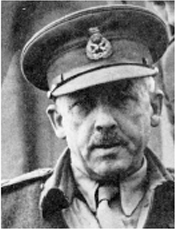
Lieutenant General Morgan. Architect of OVERLORD.
One of the foremost deductions in the COSSAC appreciation was that the Allies could not launch the invasion head-on against a fortified port, nor could they count on capturing such a facility during the critical build-up phase. It was inevitable that once the Allies had shown their hand the Germans would be rushing reinforcements up to the lodgment area to first contain and then destroy the forces in the beachhead. As General Bradley said in his address to the Press on board USS Augusta on Saturday evening 3 June 1944:
‘You’ve got to remember that just as soon as we land, this business becomes primarily a business of build-up. For you can almost always force an invasion – but you can’t always make it stick.’
The outcome of this decisive race to achieve numerical and materiel superiority would depend on the Allies ability to land, deploy and subsequently supply the combat forces designated for Operation OVERLORD. A port facility would therefore be critical. German intelligence had as yet no knowledge of the artificial, prefabricated Mulberry harbour concept, so in the absence of an alternative, Hitler’s fortress-port policy made considerable sense. By denying the Anglo-American forces any substantial dock facilities, Hitler hoped to starve any second front of the necessary logistic resources required to achieve a decisive build-up and concentration of force for a breakout towards the Reich.
In isolation Hitler may have been right. However, Operation NEPTUNE-OVERLORD was the opening stage of a much larger, combined and joint campaign. That campaign would be supported by a remarkable and highly effective deception plan codenamed BODYGUARD designed to tie down many of Hitler’s reserves away from the Norman coastline.
Once ashore the Allied armies would be sustained by vast stocks of materiel and while they would be struggling to build-up their combat power in the lodgment area, the combined naval fleets and air forces of Britain and the United States would be supporting and protecting them. The Allied air forces would prove to be particularly effective in disrupting German road, rail and air communications, thereby hampering or delaying the arrival of German reinforcements in the battle area. Rommel had recognized that by 1944 the very nature of war had changed and that even the veteran units from the East were in for a shock. Fritz Bayerlain, the commander of Panzer Lehr, recalled Rommel’s prophetic words:
‘Our friends from the East cannot imagine what they’re in for here. It’s not a matter of fanatical hordes to be driven forward in masses against our line, with no regard for casualties and little recourse to tactical craft; here we are facing an enemy who applies all his native intelligence to the use of his many technical resources, who spares no expenditure of material and whose every operation goes its course as it had been subject of repeated rehearsal. Dash and doggedness no longer make a soldier...’
The Allied Joint and Combined Campaign Plans Evolve
After many debates Churchill and Roosevelt agreed that General Dwight D. Eisenhower should be the Supreme Allied Commander for OVERLORD. Eisenhower was notified on 7 December 1943. Ironically, only five days later in Germany, Hitler appointed Erwin Rommel to establish a new command for the defense of the Atlantic Wall. At the very time that Rommel was making his presence felt along the northwest European coastline, the Allied command team was being appointed and gathered just across the channel on Christmas Eve 1943:
SUPREME COMMADER, ALLIED EXPEDITIONARY FORCES:
General Eisenhower
DEPUTY SUPREME COMMANDER:
Air Chief Marshal, Sir Christian Tedder
COMMANDER IN CHIEF ALLIED NAVAL EXPEDITIONARY FORCES:
Admiral Sir Bertram Ramsay
COMMANDER 21ST ARMY GROUP:
General Sir Bernard Montgomery
Shortly after being appointed, Montgomery analyzed the plan proposed by COSSAC. He quickly identified critical flaws in the concept of operations. General Morgan had designed his plan based on the resources he had been allocated for this mission. Morgan had been working on the assumption that only three divisions could be used in the first assault wave. Montgomery rightly considered this to be too small a force deployed over too narrow a frontage. He recommended, and obtained Eisenhower’s support that the assault should be expanded to a five-division operation with four divisions in the follow-up wave. He reasoned that this would increase the chances of success by stretching the German response over a wider area, providing greater security to the lodgment, and facilitating the capture of key objectives, namely the Port of Cherbourg and the road and rail communications hub at Caen.
On 21 January these changes were implemented along with a new target date of 31 May 1944. This delay would be essential if the necessary resources for a substantially larger operation were to be built both in Northern America and Britain and then gathered in the United Kingdom in time for D-Day. The changes were then integrated into the Initial Joint Plan (IJP) dated 2 February 1944.

Air Chief Marshal Tedder, General Eisenhower and General Sir Bernard Law Montegomery seated, with General Bradley, Admiral Ramsay, Air Chief Marshal Sir Trafford Leigh-Mallory and General Walter Bedell Smith.
The decision to expand the scale of NEPTUNE-OVERLORD by extending the landing area to include the Cotentin (Utah Beach) and the Orne (Sword Beach between Lion-sur-Mer and Ouistreham) had a major impact on 3rd Division’s plan. To date all 1st Corps and divisional planning and training had been conducted on the assumption that the 3rd Division would assault with two brigades astride in the first wave. The IJP stated otherwise; due to shortfalls in appropriate assault landing craft, and terrain constraints, the 3rd Division was now ordered to prepare for an echeloned assault. General Dempsey, Commander of 2nd Army, is on record that it was done to provide more depth to the attack. But on the basis of the IJP there was no alternative. 2nd Army would be landing with five brigades in the initial assault.
It is true that Sword Beach was only half the width of those beaches used at Bernieres-sur-Mer (Juno) and Le Hamel (Gold). This was because of the constraints imposed by the small cliffs that lie at the western end of Sword Beach and the offshore rock shelves running out to sea that would have prevented landing craft from approaching that section of the beach. At the eastern end of Sword Beach the estuary of the River Orne has created an extensive, shallow fan of sand and silt that further impeded landing craft from closing with and then extracting from this section of the beach.
The IJP also declared that three airborne divisions would be used to secure the flanks and fix German forces in place during the critical and highly vulnerable amphibious landing phase.
The final assault plan divided the land operation into two sectors. In the West the First US Army, under General Omar N. Bradley, would land three infantry divisions on the beaches codenamed Utah and Omaha. Two American airborne divisions (the 82nd and 101st Airborne) would be dropped or landed in gliders on the western flank to dislocate the German response and thereby assist the amphibious forces ashore. In the east, the 2nd British Army under General Miles Dempsey would land on three beaches, codenamed Gold, Juno and Sword with an infantry division on each. On the eastern flank the British 6th Airborne Division would land by parachute and glider and seize the critical bridges over the River Orne and its canal. This division would also secure the high ground east of the river as a bridgehead for subsequent operations. It was also hoped that these operations would hamper and generally disrupt German deployments from around Caen against the eastern beaches (Sword and Juno) during the first critical hours of the invasion. The plan was that the five beaches would then be linked-up by midnight on D-Day. By setting his initial objectives deep, Montgomery wanted to encourage dash and élan amongst his formation commanders. The greater the depth achieved, the less likely the invasion would be stalled on the beaches as had happened at Gallipoli in 1915 and Anzio in 1943.

General Sir Miles Dempsey. 2nd British Army.
The final date for mounting the operation and the time for the assault to begin were also critical command decisions for Eisenhower. The land component wanted to land in darkness in the hope of gaining tactical surprise – particularly across the exposed beaches. The navy and air component commanders preferred to mount daylight operations in order to ensure more accurate bombardments of enemy targets. The navy was also concerned that in poor sea conditions the already complex task of controlling the vast fleet of assault craft would be all the more hazardous and difficult in darkness.
As a result of Rommel’s deployment of defensive obstacles on the Norman foreshore, Ramsey and Eisenhower agreed on 1st May 1944 that the assault would have to take place three to four hours before high tide, and about ten minutes after sunrise. The night before the landing would require good moonlight to support the accurate drop of the airborne divisions and the bombing strikes. All these conditions could only be met on about three days in each lunar month. The final factor would be the weather itself, and this could not be forecast with any real degree of accuracy too far ahead. As a result of all these complex factors the actual date and time for D-Day could not be decided until nearer the window of opportunity in late May-early June. But if the invasion was not launched then, it would have to be delayed for several weeks before the correct conditions of Moon and tide recurred.
The Joint Campaign: Allied Air Power
By 1944 the Allies had developed an ever-improving joint force capability (the art of operating and exploiting the synergy between separate military services) within a combined (the operations of multinational forces in a coalition or an alliance) environment. On 14 April 1944 the overall direction of Allied strategic forces passed to General Eisenhower. He promptly instructed his British deputy, Air Chief Marshal Arthur Tedder, to act as an intermediary between the various interests of the Allied air commanders in order to create an overall operational plan in support of the forthcoming invasion.
Tedder assisted the Allied effort by shaping, designing and activating a devastating air campaign that would support the expeditionary phase and subsequent land battle in Normandy. With the Allied Expeditionary Air Force under the overall command of Air Chief Marshal Sir Trafford Leigh-Mallory, air forces were assigned to conduct both defensive (force protection) and offensive tasks. To ensure that these were properly integrated within the Neptune Overlord phases, Leigh-Mallory considered that:
‘The air operations in immediate and direct support of the land battle should be specially co-ordinated and directed. I, therefore, decided to establish a small operational organisation to be known as Advanced Allied Expeditionary Air Force [AEAF]. Under my general direction, the Commander Advanced AEAF was given the task of directing and coordinating the planning for and operations of such forces of the Ninth Air Force and Second Tactical Air Force as were allotted to him from time to time.’
Amidst fierce argument and bitterness, Tedder and Leigh-Mallory succeeded in achieving a concentration of effort from the Allied air forces that would make a significant contribution to the overall campaign. The Allied air plan for NEPTUNE-OVERLORD stated that the general aim of the Allied air forces would be:
‘To attain and maintain an air situation which would assure freedom of action for our Forces without effective interference by enemy air forces and to render air support to our Land and Naval Forces in the achievement of this objective.’
To achieve this aim the following tasks were to be fulfilled in a four-phase air campaign:
Phase 1. The first phase of air operations consisted of air interdiction of enemy naval and air assets in the Channel area, in addition to extensive air reconnaissance operations.
Phase 2. This phase commenced in March 1944 and was known as the preparatory phase. As D-Day approached the combined weight of air operations would fall on targets associated with the invasion. This included the use of heavy bombers to attack fortresses, naval facilities and lines of communication (rail, road and surveillance assets such as coastal radar stations). During this phase two out of three raids were still being conducted away from Normandy to maintain the deception plan.
Phases 3 and 4. These last two phases were designed to support the actual invasion and the subsequent battle for Normandy. The scale of effort was remarkable: fifty-four fighter squadrons were designated to provide beach cover, while another fifteen squadrons protected the fleet. An additional thirty-three fighter squadrons were tasked for escort duties with the bombers and airborne forces. Thirty-six bomber squadrons were to provide direct support to the land battle with seven additional squadrons of Spitfires and Mustangs providing fire control.
In total some 5,000 fighters were operating over the invasion area in addition to the medium and heavy bombers. Between 6 and 30 June this Allied air fleet would conduct a total of 163,403 air sorties.
Using this vast air capability at the Allies disposal, Tedder directed Bomber Command to attack targets throughout France by night while the U.S. Eighth Air Force along with fleets of Allied fighter bombers attacked other selected targets by day.

Typhoons en-masse, by D-Day the Allies had won total domination of the skies.
The outcome of this air campaign was dramatic. From January 1944 to D-Day the French rail system was strangled as a result of the thorough execution of the Transportation Plan. German controlled French rail traffic dropped to a mere thirty percent of its 1943 totals. Essential bridges leading to the Normandy battle area were destroyed and all major roads and railways severely damaged. From 1 April to 5 June, the allied air force made 200,00 offensive and defensive sorties. Montgomery described this effort as ‘brilliant.’ To support the BODYGUARD deception plans for D-Day these attacks were not confined to Normandy alone. Raids were conducted across northern France and Belgium. The Seine and Loire River bridges were particularly singled out for methodical destruction in May 1944, thereby impeding the movement of the critical panzer and panzergrenadier divisions into Normandy after D-Day. Innovation was the spirit of this time. Allied air force commanders initiated new tactics such as shuttle bombing, improved radar equipment, and developed fuel drop tanks in order to extend aircraft ranges. This was a magnificent effort. As J. Flagg stated in his work on the United States Army Air Force in World War II, ‘the Anglo-American Air Forces did more than facilitate the historical invasion of 6 June 1944, they made it possible.’
Because of the very thorough and integrated Allied planning involved in every aspect of Operation OVERLORD the Germans were unable to assess this bombing campaign and deduce with any certainty as to where the expected invasion would take place. This confusion was reinforced by the Allied air targeting policy: for every raid inside Normandy two were conducted elsewhere. The effects of the bombing operations were severe and felt throughout the West. In 1946 Lieutenant General Friedrich Dihm, former Special Assistant to Erwin Rommel, stated in an interrogation conducted by the US Army:
‘Except for this air supremacy, it would have been possible, in my opinion, to prevent a successful invasion during the first days after the initial assault. These were the most critical days for the Allies. Later, the constant and increasing reinforcement of the Allies could be less and less equalized by the arrival of German reinforcements, hindered by the destruction of important traffic routes.’
The air plan combined the strengths of both the bomber force and tactical air assets with devastating results. Part of Tedder’s overall strategy was to draw out the enemy air force and destroy it in combat. The effects of this policy were dramatic. By June 1944 the Allies dominated the skies above the Neptune-Overlord area. From January to June 1944 a total of 2,262 German fighter pilots had been killed out of a force averaging 2,283 at any one time. In May 1944 alone, twenty-five percent of the total fighter pilot force had died during a relentless Anglo-American campaign to rid the skies over France of enemy aircraft. From April 1944 waves of air attacks were mounted against enemy airfields within a 130-mile radius of the invasion beaches.
It is hardly surprising that the Luftwaffe would be notably ineffective on D-Day. Only two German fighters would strafe the beaches during the daytime.
Beyond the lodgment area Allied air power would be a major contributor to the disruption and delay of German troop and equipment movements. At the St Paul’s briefing Montgomery had stated: ‘Air must hold the ring...and make very difficult the movement of enemy reserves by train or road towards the lodgment area.’ After 6 June one mobile Kampfgruppen ordered to move from Brittany to Normandy took ten days to reach the invasion front as a result of sustained Allied air attacks.
Unfortunately, at the tactical level, even the might of the Allied air forces would fall short of expectations at Sword and Omaha Beaches on D-Day. At 0600 hours some 480 B-24 Liberator bombers of the US 8th Air Force were to attack thirteen targets along the coast. In limited visibility many of those raids were initiated late or abandoned for fear of bombing the convoys or landing craft already heading in to the shore. As a result, the bombs fell harmlessly inland leaving the defenses intact and the flat open beaches un-cratered and thus devoid of cover for the approaching waves of assault troops. In Colleville near Ouistreham, strongpoint Hillman, which was one of the strongest depth fortifications in Normandy and sited directly inland from Sword Beach, was left unscathed. The planned air raid had been aborted because of low cloud cover over the target.
The Joint Campaign: Naval Forces
While Allied air forces could shape the battlefield, provide force protection and isolate the invasion area it would inevitably fall to the combined fleet of the Allied navies to get the expeditionary armies to their objectives. Allied naval forces were under the overall command of Admiral Sir Bertram Ramsay. His tasks included the design and preparation of Operation NEPTUNE the maritime element of the OVERLORD invasion plan. Some 4,100 ships and craft of all types would be involved in the initial assault, each vessel choreographed into the grand design, the object of which – as Ramsay stated in his orders — was to ‘secure a lodgment on the continent from which further offensive operations can be developed.’

Admiral Sir Bertram Home Ramsay
Ramsay’s responsibilities included the carriage and sustainment of the invasion forces in Normandy. In addition naval gunfire would form a vital, devastating component in the overall fire support provided to the ground forces during their assault and into the follow-on phase when the lodgment would be secured. Naval gunfire would also prove to be a decisive component in offensive and defensive fire missions during the Battle of Normandy. This intimate tactical support would continue while the front line remained within range of the ship guns sited off the beaches. Naval assets would also play a major role in the FORTITUDE deception operations by supporting a feint towards the Pas de Calais.
The Eastern Naval Task Group was responsible for Gold, Juno, and Sword Beaches. The British Commonwealth assault area extended from the eastern boundary of Omaha Beach just west of Port-en-Bessin to the river Orne at Ouistreham, a distance of some twenty-five miles. The Eastern Task Group had to contend with the threat of coastal shore batteries, the heavy guns of Le Havre and the threat of Schnellboots or ‘S’ Boats from the flotilla stationed in Le Havre.
The Task Group was under the overall command of Rear Admiral Sir Philip Vian RN. Lieutenant General Sir Miles C. Dempsey would accompany him on his flagship HMS Scylla, a Dido-class cruiser. Vian was responsible for supporting Dempsey’s 2nd Army with over 200 vessels of all types. His command was divided into subordinate Forces: Force ‘G’ under Commodore Cyril E. Douglas-Pennant RN would support 50th (Northumbrian) Division at Gold Beach. Force ‘J’ under Commodore Geoffrey N. Oliver RN would land and then support 3rd Canadian Division ashore at Juno Beach. Force ‘S’ under Rear Admiral Arthur G. Talbot RN would support 3rd British Division ashore. A Follow-up Force ‘L’ under Rear Admiral William E. Parry RN would be responsible for landing various follow-on elements on all three beaches.
An additional protective task involved the defense of the invasion fleet from enemy naval action. On D-Day the Allied naval commanders were acutely aware of the threat posed by German ‘S’ (motor torpedo boats or E-Boats as they were known by the Allies) stationed in the fortified ports of Le Havre and Cherbourg.
Just over five weeks earlier, on 28 April 1944, the American convoy T4 had been attacked by E-Boats in Lyme Bay off the Dorset coast while taking part in Exercise TIGER. This exercise was an invasion dress rehearsal for the US VIIth Corps. The convoy was carrying men from the 4th Infantry Division destined for the operation against Utah Beach on D-Day. The three-mile long convoy consisted of eight LCTs under the escort of HMS Azalea. Shortly after 0200 hours the convoy was attacked by nine E-Boats from the 5th and 9th Flotillas in Cherbourg. The results were devastating. Three LCTs were struck in less than twenty-five minutes. US personnel commented afterwards that the Germans had them ‘trapped and hemmed-in like a bunch of wolves circling a wounded dog.’ A total of 749 men were killed. One unit, the 3206th Quartermaster Company was annihilated.
At dawn the following day rescue ships approached the area. Aboard HMS Obedient Julien Perkin recalled:
‘We arrived in the area at daybreak and the sight was appalling. There were hundreds of bodies of American servicemen in full battle gear, floating in the sea. Many had their limbs and even their heads blown off... Of all those we took on board there were only nine survivors.’
Fortunately on D-Day the combined fleet would prove highly effective in deterring further German forays from the ports on the flanks of the invasion area. Sword, the eastern most assault area, provided the only example of German surface operations against the NEPTUNE fleet. Once confusing reports in the early hours of 6 June had alerted Admiral Krancke’s naval command that something was afoot, he ordered units from his Western Defense Force to conduct patrols. At 0430 hours three torpedo boats (T-28, Jaguar and Mowe) from 5. Torpedobootsflotille sailed from Le Havre to sweep the Baie de la Seine under command of Korvettenkapitan Heinrich Hoffmann. At approximately 0530 hours they exited from an air delivered smoke screen and found themselves approaching the flank of the Eastern Task Force. Eighteen torpedoes were launched. Remarkably, given the concentration of targets, only one ship would be lost in this German naval action on D-Day and that was the Royal Norwegian Navy’s destroyer, the Svenner, supporting Force ‘S’ off Ouistreham. Svenner was hit amidships, breaking its back and sinking with great loss. Another torpedo narrowly missed Admiral Talbot’s flagship HMS Largs that had to take evasive action to avoid damage. Two further torpedoes passed between Ramilles and Warspite. Admiral Talbot subsequently described the British response:
‘The Warspite followed the enemy in [to Le Havre] by radar and opened fire at 14,000 yards; she reported one torpedo boat sunk.’
Hoffmann received the Knight’s Cross as an award for his exploits.
In general it is clear that the Kriegsmarine had ignored Admiral Donitz speech on 17 April 1944 when he demanded of his units:
‘Throw yourselves recklessly into the fight...any man who fails to do so will be destroyed in shame and ignominy.’

HMS Warspite in action supporting the D-Day landings.
The Allied navies also performed a vital fire support function bombarding German shore positions. Because of tidal variations the H-Hour for Sword Beach was 0725 hours, nearly an hour later than the landings at Omaha and Utah. The bombardment force used this time to great effect delivering additional observed and predicted fires onto coastal targets. During this essential process HMS Warspite, veteran of the battle of Jutland, was straddled by fire from the Seine batteries but soon changed station to avoid further harassment and then continued the delivery of devastating high-calibre shells to selected German strongpoints. This vital service to the land component would continue well into July as the land campaign remained within range of the offshore ships guns.
The Bombarding Force D mission was ‘to assist in ensuring the safe and timely of our forces by the engagement of hostile coastal defenses.’ Force D was dedicated to support 3rd Division and Force ‘S’. Rear Admiral W. R. Patterson was the senior officer of Bombarding Force D. In total, his Force consisted of the battleships HMS Warspite and HMS Ramilles, the Monitor HMS Roberts and the cruisers HMS Mauritius, Arethusa, Frobisher, Danae and Dragon (Polish Navy). In addition a squadron of thirteen destroyers provided additional security and firepower (including the ill-fated Svenner). Patterson’s most powerful battleship was HMS Ramilles with her eight 15-inch guns each capable of firing a 1,938 lbs shell over 32,000 yards (some eighteen miles). Each gun had 110 rounds aboard. Her twelve 6-inch guns provided additional firepower with 130x112 lbs shells for each gun.
While there was a particular threat to Sword sector posed by the heavy coastal batteries located astride the Seine estuary, additional batteries further west at Villerville, Mount Canisy and Houlgate were also identified and designated as priority targets for each of the two battleships and the monitor in Force D. The bombardment and suppression of these shore batteries commenced at 0545 hours. The attacks on the closer range batteries and coastal defenses would also be a task for the cruiser force and the destroyers. Meanwhile the Seine batteries would be engaged and then blinded by flanking smoke screens laid by Allied aircraft. In total, five naval bombardment groups were organized to engage the twenty-three German shore based batteries located in Normandy. In addition, each ship in every group was given one battery as its primary target. Reconnaissance and intelligence gathering operations prior to D-Day had identified and mapped these battery positions in great detail.
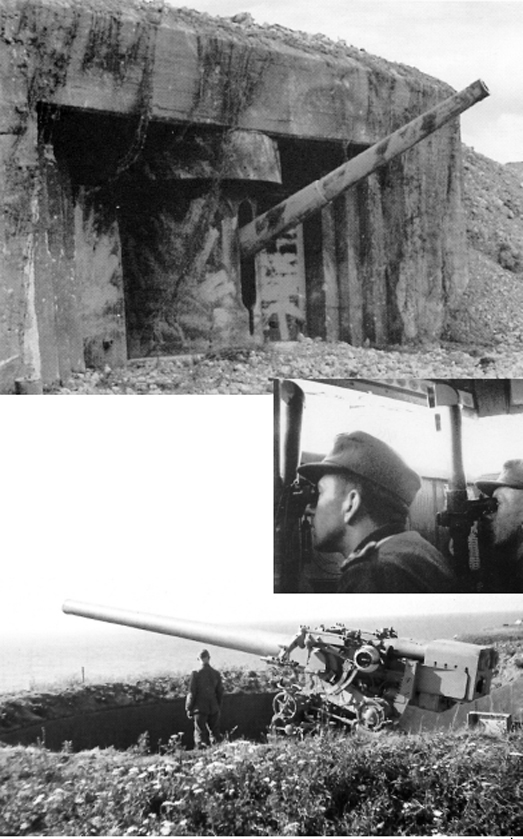
Types of German batteries that would oppose the landings: Concrete casemates housing the largest calibre pieces and more vulnerable open emplacements.
Initially Force D’s main effort was focussed on German coastal gun batteries, fortifications on the beaches, and on-call interdiction missions against possible reserves deploying to the lodgment area. But once the land component commenced the assault at 0725 hours, the navy would provide on-call fire support. The destroyer force would then move to the flanks of each assault sector and continue bombarding identified targets.
To provide accurate targeting the NEPTUNE bombardment forces were supported by 104 spotter planes and thirty-nine Forward Observer Bombardment (FOB) parties. The FOB parties consisted of naval personnel equipped with radio communications back to the ships and trained to operate with the ground forces ashore. The air spotters were equipped with slow moving Piper aircraft, ideal for loitering and observing over the battlefield. The air spotters made a vital contribution to the effectiveness of naval gunfire support during the landing phase. As a result of their target indication and adjustment of fire, targets were actually engaged up to seventeen miles inland. This was endorsed in the privately published history of the 21st Panzer Division that stated,
‘The enemy dominated important road junctions and supply routes with recce aircraft. He bombed or fired at central points, sometimes also with heavy naval guns at long range.’
The preliminary bombardment at Sword Beach would prove sufficient to disrupt or damage many of the inland defenses threatening 3rd Division’s advance. However, where beach defenses had been sited to fire along the beach in enfilade (fire applied to a target from the flank rather than head on) such as strongpoint Cod, many bunkers and gun emplacements were hard to see from offshore and these remained unscathed and combat effective. Indeed, once the initial bombardment had finished, many of the German defenders from the 736th Coastal Defense Regiment were able to pull themselves together and man their positions against the incoming landing craft.
During his subsequent and increasingly desperate attempts to contain and eliminate the bridgehead, Rommel reported,
‘Our operations in Normandy are tremendously hampered ...by...the superiority of the enemy air force [and] the effect of the heavy naval guns.’
After the war other German generals would also praise the naval gunfire support provided in Normandy. Field Marshal von Rundstedt said, ‘The fire from your battleships was a main factor in hampering our counter-attacks. This was a big surprise...’
The British Ground Force Component
Second British Army
Under command of Lieutenant General Miles ‘Bimbo’ Dempsey the Second (2nd) British Army issued its final Operation Order No.1 on 21st April 1944. The Army would be landing with 30th Corps right (West) and 1st Corps left (East) with three divisions up and five assault brigades in the first echelon. The inter-Corps boundary was exclusive to 1st Corps: La Riviere, Tierceville, Fresnay le Crotteur, and inclusive Putot en Bessin. The stated Second Army intention was to:
(a) Assault between PORT EN BESSIN 7587 and the R ORNE.
(b) Secure and develop a bridgehead South of the line CAUMONT 7059-CAEN 0368-and SE of CAEN in order to secure airfield sites and to protect the flank of First US Army while the latter captures CHERBOURG and the BRITTANY Ports.’
The Army concept of operations was broken down in to four detailed phases. This extract only covers 1st Corps of which, 3rd Division was a critical component and the specific subject of this study:
‘Phase I
On D Day 1 Corps will:
1. Assault the beaches between 940865 (incl) – R ORNE (incl).
2. Capture CAEN.
3. Secure a firm base on the general line PUTOT EN BESSIN 9072 (incl)-CAEN (incl).
4. Seize the coastal defences FRANCEVILLE 1578-CABOURG 2179 from the rear and dominate OUISTREHAM 1079-CABOURG 2179-TROARN 1667-CAEN in order to secure the left flank and prevent interference with the beaches immediately West of OUISTREHAM.
5. Operate in front of the firm base with an armoured force with the objective of securing EVRECY 9259.’
Additional tasks included the capture and guarding of Wasserman, Wurtzburg, and Freya radars within boundaries.
In Phase II the Corps was tasked to pivot on Caen and maintain contact with 30th Corps on its right. This would then lead into Phase III when the Corps would secure high ground between Caen and Falaise around Bretteville sur Laize and Argence in order to allow airfields to be built southeast of Caen. Unfortunately this area would not be taken until August 1944 and then not without enormous cost to the Commonwealth and Polish forces engaged there (Operation TOTALISE). In Phase IV the Corps was to gain contact with First US Army at VIRE.

Lieutenant General Sir John Crocker.
1st British Corps
Lieutenant General Sir John Crocker commanded 1st British Corps. Crocker was an experienced veteran from World War I when he had won a DSO, MC, and Croix de Guerre. He had a sharp incisive mind, an honest character and a tendency to be a strict disciplinarian. In 1944 his Corps consisted of three infantry divisions (3rd British, 3rd Canadian, and 51st Highland) two of which were reinforced with supporting armoured brigades. An additional armoured brigade (33rd) was retained under Corps command. The 80th Anti-Aircraft Brigade and the normal component of support assets were also in place to support the Corps.
The 1st Corps Operation Order No. 1 was issued on 5th May 1944. Dealing only with operations ashore it stated the intention and tasks for the Army, flanking formations and the specific divisions under General Crocker’s command. It stated:
The Assault
1 Corps will assault, 3rd Canadian Infantry Division RIGHT, two brigades up; 3rd British Infantry Division LEFT, one brigade up.
It will be the task of these divisions to secure the covering position on the general line PUTOT EN BESSIN 9072 – CAEN – thence River ORNE to the sea on D-Day.
The tasks of the assaulting divisions is to break through the coastal defences and advance some ten miles inland on D day.
Great speed and boldness will be required to achieve this. It will be necessary to forestall the action of the enemy’s local reserves quickly, overcome minor resistance met during the advance, to get set before the arrival of reserve formations, and be ready to meet the enemy’s first counter attacks, which must be expected to develop by the evening of D-Day.
As soon as the beach defences have been penetrated therefore, not a moment must be lost in beginning the advance inland. Armour should be used boldly from the start. Such an action will forestall the enemy’s reaction, confuse him, magnify his fears and enable ground to be made quickly.
All available artillery must be ready to support the advance. If opposition is met which cannot be overcome by these strong advance guards, simple plans embodying the full resources of artillery and armour must be employed to dislodge the enemy quickly and certainly. Hastily staged, ill-supported infantry attacks are unlikely to succeed and are likely to be slow and costly in the long run.’
What is crucial to note here is the emphasis on speed and momentum.
The 3rd British Division: Order of Battle
The War Establishment was set at about 17,000 men but this excluded those special attachments that would join the division specifically for the assault phase of the invasion. Of those 17,000 men, less than half were actually infantrymen in the infantry brigades. About one quarter, or 4,500 personnel, were the officers and men of the rifle companies – the fighting edge of the division. With that in mind it is worth recording here that over the ten month period from June 1944 to the fall of Germany, the division suffered 11,084 battle casualties (the vast majority from the combat arms) and a further 6,000 non-battle casualties – all men lost from the division. The reality was that very few of those men in the rifle companies taking part in Operation Overlord on that cold grim morning on 6 June 1944 were likely to see the Normandy campaign through to the end unscathed.
Two of the three subordinate formations of the division were 8 and 9 Infantry Brigades. These brigades had fought together under the then Major General Bernard Montgomery’s command in France in May-June 1940 and successfully withdrawn, in comparatively good order, from France through Dunkirk under his strong leadership. In 1942 the 185 Infantry Brigade joined the division.

3rd Division badge.
Each of the three infantry brigades consisted of three infantry battalions. Each of those nine infantry battalions in the division consisted of a support company with four platoons: mortar platoon with six 3-inch mortars, a carrier platoon with thirteen Bren Carriers and an anti-tank platoon equipped with six of the ubiquitous 6-Pounder guns, and the assault pioneer platoon. The four rifle companies each had three platoons, each of three ten-man sections, with one light machinegun in each section. The rifle companies also held three Projector Infantry Anti-Tanks or PIATs. These were inferior man-portable, spring loaded, and short-range antitank projectors with a maximum effective range of about 50 yards. Total battalion manpower strength would number 821 all ranks.
An additional infantry battalion, the 2nd Middlesex Regiment, also featured in the divisional Order of Battle for OVERLORD and subsequent operations up to the end of the War. The Middlesex Regiment was a key component in the division’s combat organization, providing each of the three brigades with ‘Support Groups’. Each Support Group consisted of twelve Vickers medium machine guns and four 4.2-inch mortars; a substantial addition to the combat power available to brigade commanders.
The division also had an armoured reconnaissance regiment (Royal Armoured Corps) that was one of only two Territorial Army units in the division. The armoured reconnaissance regiment had been formed from the 8th Battalion, The Royal Northumberland Fusiliers. It consisted of a Headquarters (HQ) Squadron and three Reconnaissance (recce) Squadrons. The HQ Squadron had an anti-tank battery of eight 6-pounders, a mortar troop with six 3-inch mortars and signal and administration troops.
The recce squadrons each consisted of one HQ and three recce troops equipped with Humber armoured cars, Bren Carriers and an assault troop of infantry mounted in half-tracks. The total armoured fighting vehicle strength in this regiment was twenty-eight half tracks, twenty-four light recce Humbers, and sixty-three Bren Carriers with a total manpower strength of 41 officers and 755 other ranks.
The division’s artillery was divided up and ‘tied’ to each infantry brigade. The 76th Highland Field Regiment (TA) was in support of 8 Brigade. 33rd Field Regiment was in support of 9 Brigade, while 7th Field was supporting 185 Brigade. Field regiments had a total of 24 guns and carried 144 rounds of high explosive at ‘first line’ (immediately available within the forward battle area), in addition to sixteen smoke and twelve armoured piercing (AP) rounds per gun.
A battery from each field regiment supported its own designated battalion of infantry. Each battery was equipped with eight American manufactured self-propelled M7 ‘Priests’ carrying the 105-mm howitzer mounted on an adapted Sherman tank chassis. The priest was capable of providing fire support to the assault forces as they moved onto the beach by shooting from the open decks of their LCTs and LCAs. By D-Day this had become a well-practiced drill developed during the ‘live’ firing rehearsals conducted in Scotland at the Divisional Battle School, during the training and build up phase prior to D-Day.
This technique allowed the guns to fire over the bows on the run-in from 11,000 yards down to 4,000 yards, at which point they prepared for beaching. During the ‘run-in shoot’ as it was called, they would fire off about 100 rounds per gun. The ammunition would be stacked on the open decks around the Priests. Unfortunately, the Priests were soon withdrawn from British service and replaced by towed 25-pounders because the Americans could not provide sufficient 105 mm ammunition to their own artillery units in addition to British artillery units. Similarly the four batteries of 20th Anti-tank Regiment (RA) were ‘brigaded’ in the same way as the field regiments. To a lesser extent so were the batteries of the 92nd Light Anti-Aircraft Regiment (RA). This regiment had been formed from the 7th Battalion The Loyal Regiment. The 92nd Light Anti-Aircraft Regiment was organised into three batteries each of three troops, each of six 40-mm guns giving a total of fifty-four air defence guns.
The 20th Anti-tank Regiment had a total of forty-eight guns and was equipped with one troop of American self-propelled M10s that carried a 3-inch gun on a Sherman chassis. This was a fine anti-tank weapon with only slightly less penetrating power than the 17-pounder. The other two troops in each battery were using towed 17-pounders that would require greater handling over the sands of Sword Beach.
3rd Division Units
The division’s engineers consisted of three field companies and a field park company under command of HQ Royal Engineers (HQRE). 246 Field Company was under command of 8 Infantry Brigade. The Company’s task was to carry out assault demolitions, hand mine clearance tasks and the opening of one wheeled route forward to the Brigade objective at Periers-sur-le-Dan. Field Park Companies contained a workshop and a stores platoon, their tasks being to act as a base for the field companies and hold specialist and bulky equipment including bulldozers. Field companies had 257 all ranks. The divisional bridging troop held 80-feet of Bailey bridging capable of carrying 40-ton loads. 253 Field Company, less one platoon, were to open and maintain safe lanes consisting of one single and one double-way route for 185 Infantry Brigade close behind the advance. The other platoon under command of 9 Infantry brigade was to provide assault demolition and mine clearance teams.
7 Field Company, with 71 Field Company and detachments of 106 Bridging Company Royal Army Service Corps were attached from Army and GHQ Engineers. Their task was to clear a wheeled route to Benouville and then construct and operate Class 5 ferry and Class 40 bridges over the Caen canal and river Orne at Benouville and Ranville. 15 Field Park Company was to provide bulldozer teams for the field companies, take over local stores dumps, and establish Engineer RVs to reload returned empty bridging company vehicles.
For the assault task, the division took under command the 27 Armoured Brigade with 190 Shermans and 33 Stuart light tanks. One unit, the 13/18th Hussars would deploy from their LCTs 5,000 yards offshore and strike out for the beach in their unseaworthy Duplex Drive (DD) ‘amphibious’ Sherman tanks. The two other armoured regiments of 27 Armoured Brigade were the Staffordshire Yeomanry and the East Ridings Yeomanry both equipped with Shermans and Stuarts. The brigade numbered 3,400 all ranks and 1,200 vehicles; a sizable addition to the division.
There were of course additional attachments for D-Day. The 4th Royal Marine (RM) Commando and the bulk of 1st Special Service (unfortunately abbreviated to SS) Brigade was placed under command until the landing was made. Once ashore they were to pass through the leading brigade positions and move on to join up with 6th Airborne Division at Benouville and beyond the east bank of the river Orne. In addition, the 53rd Medium Regiment (RA), 5th Independent RM Armoured Support Battery and two detachments of RM frogmen, who were to clear beach obstacles, were also under command. A slice of the 5th Assault Regiment RE and detachments of the 22nd and the Westminster Dragoons equipped with flail tanks and an assortment of ‘funnies’ from Hobart’s 79th Armoured Division were also provided. Additional engineer resources from the Army Group were to assist the assault groups to clear four zones of beach obstacles, clear routes and glider landing sites for the follow up waves of 6th Airborne Division, and to bridge the river Orne and its canal.
The great majority of these attachments were present to help the assault division over the first physical and psychological obstacle of the open beach and through the initial crust of German defences. The major exception would be the 101st Beach Sub Area which would be responsible for the landing of all men, vehicles and stores for the division (along with those belonging to 6th Airborne Division and a slice of supplies for the 1st Corps troops) right up to D + 55.

A Joint and Combined Force
It is important to note that the 3rd Infantry Division, its brigades, or even its proud regiments, cannot be thought of in isolation. The success of the division depended on a close co-operation between all Arms and Services that comprised the total force. Battalions and brigades all relied on the support provided by the Royal Artillery (RA), the Royal Engineers (RE), the Royal Signals (RSignals), the Royal Army Service Corps (RASC), the Royal Army Medical Corps (RAMC), the Royal Electrical & Mechanical Engineers (REME) and the Corps of Military Police (CMP).
NEPTUNE-OVERLORD was to be the greatest amphibious operation of the war. The division was carried and supported by Naval Force ‘S’ or Sword, commanded by Rear Admiral A. G. Talbot. His flagship for Neptune would be HMS Largs, a former French passenger liner, the Charles Plumier. Under command he also had Bombardment Force ‘D’ and three assault groups and associated ‘Build-Up Squadrons.’ HMS Largs would be the nerve centre from which the NEPTUNE plan for Sword Beach would be controlled and directed. Once the General Officer Commanding 3rd Division established himself ashore, command of land operations would be switched from the sea-based headquarters to Rennie’s forward command post, initially in Hermanville.
As early as December 1943, the 3rd Division had started to concentrate around Inverness and the Moray Firth for a series of amphibious exercises with the maritime component of Force Sword under Talbot. A unique and intimate sense of team spirit rapidly developed between the naval force and its designated division. To his credit Talbot established his HQ alongside Divisional HQ in Cameron Barracks, Inverness. He also saw to it that every assault vessel under his command bore the 3rd Division’s glorious and unmistakable triangular badge.
Through December 1943 Talbot’s small armada of landing craft and ships were harboured from Invergordan to Fort George on the south side of the Moray Firth. From here a series of grueling exercises were conducted in harsh sea states through the winter and early spring. After the invasion Rear Admiral Talbot would report that the hard school in which the Force had trained in the Moray Firth was a blessing in disguise. Soldiers and sailors of Force ‘S’ had been well prepared for the rigors of expeditionary operations by the time D-Day was upon them.
Above the invasion fleet would be the 5,000 fighters and the medium and heavy bomber armadas of the British and American tactical air forces. With proper coordination, leadership, courage and thorough planning this joint and combined force would be able to punch a hole through the Atlantic Wall and liberate France, occupied Western Europe and then ultimately defeat Nazi Germany.
But let us not forget that for all this apparent invincibility, the close-contact battle on the beaches and inland could still be lost against the German Army. This was not a foe that could be brushed aside or in any way underestimated. Events at Omaha Beach certainly demonstrated this, as did the brilliantly executed actions conducted at the tactical level by Waffen-SS and panzer grenadier units, frequently with little sound strategic or operational direction, adequate air support, or any real hope of decisive victory.