
CHAPTER FOUR
Stand A
“The game’s a foot, follow your spirit”
Shakespeare King Henry V
Route to Stand A
From Caen proceed north on the D515 following directions to Ouistreham Car Ferry. This fast road follows the west bank of the Canal de Caen, also known as the Orne Canal. Note the exit to Benouville and Pegasus Bridge. Proceed towards Ouistreham Car Ferry at the first roundabout by taking the right fork on the D84. At the next roundabout note the Comite du Debarquement Monument on the roundabout. Again follow signs to the car ferry terminal by driving along the slower canal road. Note the Ouistreham lock gates and beyond, on the far bank, the island promontory of the Pointe du Siege. Identify the dark brown Maginot turret opposite the ferry terminal building. You may wish to park in the terminal car park and cross the lock gates, noting that that these gates and the defenses, including the turret, had to be secured by troops landing on Sword Beach on D-Day.
Directly opposite the terminal building main entrance is a memorial to the British Royal Navy and Royal Marine crews who manned over 4,000 landing craft, ships and barges transporting the Allied soldiers and their equipment to Normandy ‘or supported them with their guns and rockets, from D-Day, 6 June 1944 until the end of the Second World War in Europe on 8 May 1945.’
Rejoin your transportation and exit the port to the north past the hotels and restaurants until the road turns west and follows the sand dunes and coastline towards Riva Bella, Colleville Montgomery Plage and Hermanville sur Mer. Five blocks from the ferry terminal on the left will be the Museum of the Atlantic Wall (Le Grand Bunker) identifiable by its 52-foot-high concrete artillery observation tower. The fully restored fortification is the only significant component of the Atlantic Wall remaining in Ouistreham.
Continue on along the coast road through Riva Bella noting the post war Casino and Tourist Office (Tel: 02 31 97 18 63) on the right. At the roundabout keep right in order to remain on the coast road. After the Casino park and identify the Musee du No 4 Commando on the south side of the road, and on the dunes a memorial to No 4 Commando and Commandant Philippe Kieffer. The memorial is a symbolic flame surmounting a German blockhouse cupola. It was erected in 1984. The Museum opposite contains memorabilia and details of German defenses in the area.
Proceed along the shore road and observe how Sword Beach opens out in a wide sweeping crescent. After several hundred meters Riva Bella blends into Colleville Montgomery Plage. Note the German blockhouse on the left hand side and the NTL post. The blockhouse has been integrated into the flat-roofed three story dark slate fronted house next to it. Note its protected gun port facing along the beach to the west. On the dunes there is a further memorial to the 177 French Commandoes under Kieffer who landed with No. 4 Commando, and No. 3 and 6 Commando and 45 Commando, all units of Lord Lovat’s 1st Special Service Brigade.
Turn left at the blockhouse and go to the junction with D514 and turn right (west). At the junction with the D60a note the bronze statue of Montgomery set back from the road in a square and garden. The statue, sculpted by Vivian Mallock, was unveiled 6 June 1996 by Prince Michael of Kent. The statue was presented to Colleville Montgomery by the Normandy Veterans Association (NVA) and the D-Day Normandy Fellowship and matches the statue in Portsmouth that stands outside the D-Day Museum adjacent to Southsea Castle.
Walk across the D514 at the pedestrian crossing and enter Avenue du No 4 Commando and identify two memorials. One marks the site of the first British burials of 6 June 1944 and one to Kieffer’s French commandos. Rejoin your transportation and proceed west along the D514.
Two blocks before the junction with D60b there will be a obvious change of direction to what has been a very straight road. Note the AVRE Churchill tank with its Petard Mortar and turn off to the right before passing the tank and park your vehicle in the allocated spaces. Having read the dedication plaque accompanying the tank, a Churchill AVRE of Hobart’s 79th Armoured Division placed in La Breche in 1987 by 3rd Armoured Division, and the NTL post, please walk along Rue du Docteur Turgis to the small square adjacent to the Hotel de la Mer. Turn right and walk towards the beach and note the memorials to the 3rd Division, Royal Navy midget submarines and Royal Artillery.
In the adjacent Syndicat d’Initiative Hermanville sur Mer there is an Exposition Historique de Sword Beach. Having looked at the displayed documents and diorama here please proceed to the beach, sit on the bench to the left of the exit and consider the events that took place around you in the middle part of the last century.

AVRE Churchill tank serving as a present-day memorial at La Breche.
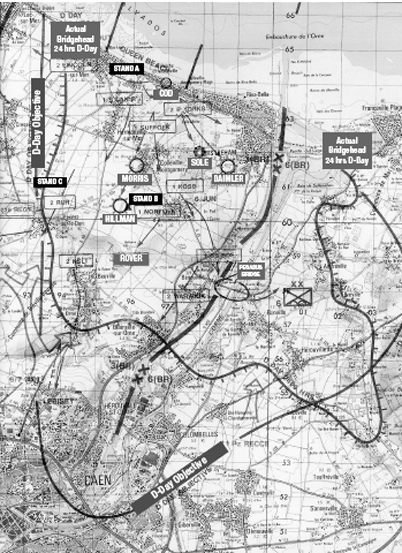
This guide is concerned with the actions centered around the Stands indicated (A, B and C). German strongpoints are indicated under their Allied codenames COD, SOLE, DAIMLER, MORRIS, HILLMAN.
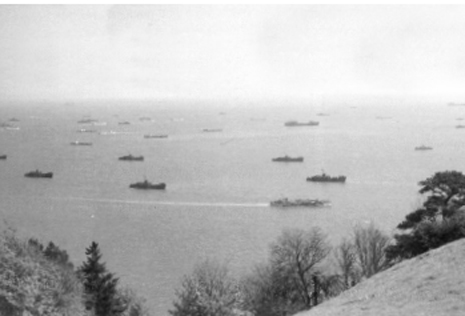
The invasion fleet off the southern coast of England.
The Sea Passage
On 5 June, as the first groups of the NEPTUNE assault force sailed from their sheltered ports in Britain, the assembling Allied fleet learned that Rome had been liberated. Before the day was far advanced, a steady stream of 1,213 warships and 4,126 landing craft was proceeding to sea. As one reporter wrote of this spectacle ‘They came, rank after relentless rank, ten lanes wide, twenty miles across, five thousand ships of every description.’ For many young men going in to battle for the first time it must have been a rousing and emotional time as their view of home and safety receded with each mile sailed to the south. Officers on board each craft now broke open the sealed map packs and detailed orders for the invasion. Most now learned for the first time that their objective was Normandy. Maps and final orders were issued to commanders and soldiers alike, and weapons cleaned and oiled in final preparation for a cold and fearful landing on a very hostile shore.
By the evening of 5 June the minesweepers had cleared the way through the German sea mine barriers, in spite of heavy seas and strong tides making exact navigation difficult. In mid-Channel a mine-cleared rendezvous had been prepared codenamed ‘Piccadilly Circus.’ From there, the five landing groups, Forces Utah, Omaha, Gold, Juno, and Sword proceeded towards their objectives. As the early morning progressed the assault troops left the comparative comfort and security of the transports and loaded into their appointed assault craft that were bouncing like corks in a bottle. Many of the soldiers were already weakened by seasickness. Lieutenant IC Dickinson MC of 77 Assault Squadron RE recalled:
We were up early the next morning, and I for one went straight to the gunwales! The approach was just like the approach on Exercise LEAPYEAR in the Moray Firth. Everything seemed quiet, but soon we could discern the shore, and then it became more and more visible. A destroyer [the Svenner] went down on our port beam. Then we saw flashes on the coast and began to slacken speed.
With a heavy swell and four foot waves the assault troops now faced a long, wet, uncomfortable, and potentially dangerous run-in to the beach. As many soldiers and sailors witnessed (following the sinking of the Svenner) with horror during the approach to the hostile shore, the navy crews had been forbidden to stop and pick up survivors if their craft were carrying military personnel (assault troops) or vehicles. Only the designated US Coast Guard Cutters attached to the Allied convoys could be spared to rescue drowning personnel. This was no exercise. Some soldiers struggled and controlled their innermost fears. Major
HG Jones MC of the 2nd Battalion King’s Shropshire Light Infantry (KSLI) wrote in his personal account:
My feelings at this point were that first and foremost I wanted to get off the ship and feel terra firma beneath my feet again. I had no conscious fears about the inevitable battle to come my main fear was that the Germans may have poured oil onto the sea and would set it alight. The thought that I might end up like so many fighter pilots with badly burned, scared faces really did worry me.
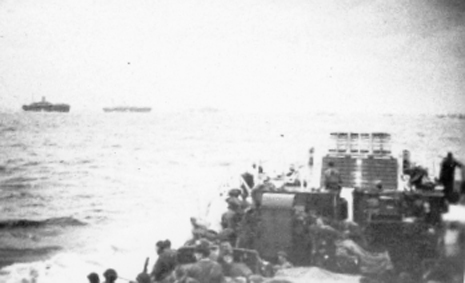
Approaching the Normandy coast.
At 0550 hours just before dawn on the 6 June gigantic flashes and flickering tongues of flame on the horizon told the assault troops that the bombardment force had commenced the task of engaging the enemy coastal defenses in the Sword sector. Brief duels occurred as German batteries responded. Overhead a great air armada was similarly engaged with its vital air and airborne tasks. The fleet had watched in silence as thousands of aircraft passed overhead throughout the night. No shots were fired. The fleet had been forbidden to engage aircraft during this approach to the continent after the disastrous friendly fire incidents in Sicily the year before. As the naval orders emphatically stated in capital letters:
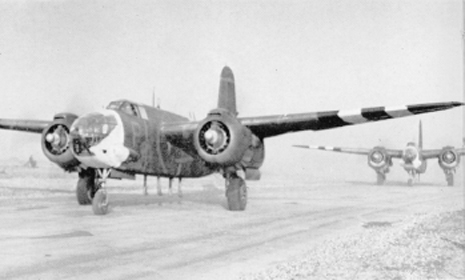
Bostons of 88 Squadron, 2nd TAF taking off for a sorte over the Normandy beaches.
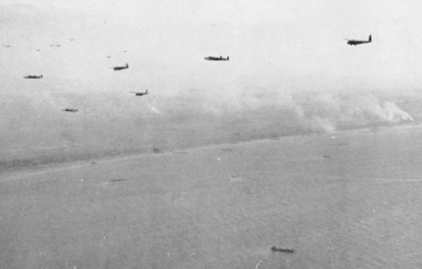
RAF gliders and their tugs passing over Sword Beach on D-Day.
I HOLD COMMANDING OFFICERS RESPONSIBLE THAT OFFICERS OR RATINGS IN CHARGE OF THE ANTI-AIRCRAFT DEFENCE OF THEIR SHIP, OR OF GUNS, FULLY UNDERSTAND THE ORDERS.
Just as well. As Harry Jones of 2 KSLI recalled: ‘Overhead were hundreds of aircraft all heading for the French coast American Flying Fortress bombers, Lightning and Typhoon fighters.’
It was an impressive and encouraging sight. In the final minutes before beaching the assault troops would witness one final air attack by Allied fighter-bombers on the shore defenses and coastal villas that were already shrouded in smoke and the concussion of explosions.
The German concrete emplacements had not been badly damaged by preliminary bombardment and perhaps fortuitously no craters had been blown either in the roads leading off the beaches, or on the roads immediately inland. Surprisingly there were few mines buried on the beach itself. Damage to craft coming in was being caused mainly by mines and shells fixed to the hedgehog obstacles. Thickly sown mines were soon found on the roads immediately behind the dunes, on the roads leading away from the beaches to the main lateral road, and in the narrow lanes between the beachfront houses. Beyond the main lateral road, all minefields were marked and wired, but were found to be mainly dummies consisting of flat metal plates manufactured specially for this purpose in Holland. The mines found around the exits from the beaches were chiefly Teller mines, S-mines, and French light anti-tank mines. Picric mines were also found at Luc-sur-Mer. No wooden mines were found at this stage. Electrically controlled ‘Beetles’ (remote control caterpillar-tracked bombs) had been dug in behind the dunes, but no recorded instance of their use has been found. After being disarmed, they were popular with the sappers as beach runabouts.

Incredible German photograph showing the invasion fleet off the French coast at Lion-sur-Mer, Sword Beach, taken from Merville Plage.
Waiting to meet the forces landing at Queen beach were members of 736th Regiment of 716th Coastal Defence Division. It was imperative that 3rd Division, with its supporting tanks from 27 Armoured Brigade, should secure a sizeable bridgehead before the panzers of the 21st Panzer Division, which was positioned at Caen, could intervene. The rapid enlargement of the bridgehead depended on the speed with which troops could be landed and cleared from the beaches, and the clearance of both beach obstacles and beach exits was fundamental to the success of the landing programme.
3rd Division had the capability and engineer resources to make eight gaps in the coastal defences, and the modern beach exit marks one such gap called Lane 8 or Exit E. The gaps made in the sea wall, wire and obstacles were to be made by assault engineers from 77 and 79 Assault Squadrons. The gaps were then to be exploited by vehicles supporting the two assault battalions: 1 South Lancashires on your immediate right as you face out to sea on Queen White, and 2 East Yorks on Queen Red about 500-800 meters further to your east. To achieve this initial task each infantry assault company would be directly supported by an engineer assault demolition team from 16 Field Engineer Company to clear further gaps and obstacles.
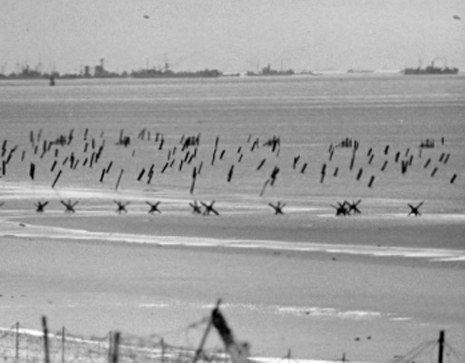
With all the confusion of battle, the division’s assault frontage was about 3,000 metres wide reaching from the yellow faced coastal villa on your left (west) and the modern gray slate roofed house to your right (east). This is emphasised so that the reader can appreciate how congested the assault sector could become given the limited exits. A rising tide, abnormally high due to the unseasonable channel storms, would also reduce the beach from a normal thirty metre width at high tide, to a mere ten metres of congested fire-raked sand as the morning progressed.
The Battle for the Beach
By 0530 hours the soldiers were grouped on the boat decks of their LSIs, hove-to at the lowering position. A and B Companies of the 2nd East Yorkshires in addition to A and C Companies of the South Lancashires climbed into their LCAs and were lowered into the heaving sea. Reserve companies and battalion headquarters followed them, and as they headed for the shore past HMS Largs a bugler of the East Yorkshires sounded the General Salute, which was acknowledged by the Divisional Commander, Tom Rennie, and Admiral Talbot. Ahead of them, in an LCA carrying A Company headquarters of the East Yorkshires was the legendary second in command of the battalion, Major C K King DSO, known throughout the division as ‘Banger.’ He held the attention of his men by reading the most inspiring extracts from Shakespeare’s King Henry V over the craft’s tannoy system. He would be one of the leading infantry across the beach followed by his batman and the assault companies. This inspiring officer was to be killed in action 18 April 1945.
While the infantry could only wait, huddled in their LCAs until the moment of beaching, the gunners following behind were able to fire the 3rd Division’s first shells at the enemy since May 1940. Major Hendrie Bruce, battery captain of 9th (Irish) Field Battery, 7th Field Regiment, describes his role and view of the landing:
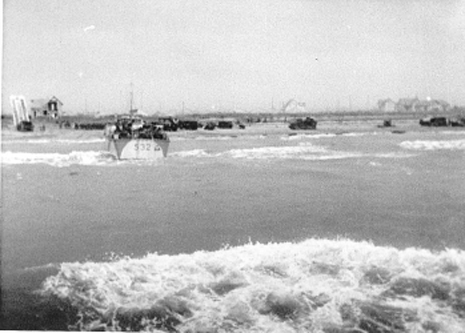
Run-in to Queen Beach. Note the bridge layer on the left
By this time the big LSIs had hove-to at the lowering position and had launched the 30-odd LCAs carrying the assault companies of the East Yorkshires and south Lancashires. These small craft were making their way, pitching and rolling, towards the distant shore, which was now clearly visible in the light of a gray stormy day and appeared absolutely deserted. We could see the long row of villas and boarding houses on the sea front and identified the mouth of the River Orne by the lighthouse at Ouistreham but had not positively identified strong point ‘Cod’ as yet.
Meanwhile the LCTs carrying the DD Tanks of the 13th/18th Royal Hussars and the AVREs of 5th Assault Regt RE kept steaming steadily on. It was planned that the former should heave-to at 7,000 yards and launch the DDs but owing to the heavy sea running they closed to 5,000 yards. We were quite close when some time after 0600 hrs we saw them swing round with their bows down wind and lower their ramps, allowing the extraordinary amphibious tanks with high, inflated bulwarks to crawl down into the water and set off for the shore looking like a lot of rubber dinghies. We were content to cruise along in their wake, scanning the coastline constantly with our special-issue naval binoculars until we were satisfied that we had identified ‘Cod.’
We had now closed the shore to about 3,000 yards. Further out to sea came the group of 18 LCTs carrying the divisional artillery and at about 06.3ohrs, when they were about 15,000 yards from the shore, they began to change formation in readiness for the ‘run-in-shoot’, as it was called. Led by LCT 331 (a troop, 7th Field Regt aboard), the craft adopted an arrowhead formation in three groups of six each with 7th Field Regt in arrowhead formation in three groups of six each with 7th Field Regt in the centre and 33rd and 76th(Highland) Field Regts slightly to left and right rear respectively in close attendance was a motor launch (ML) equipped with radar to calculate the opening range. The radio links were working perfectly and all was now ready for ranging to being at H-42 at 0644 hours (1 min late) the first ranging rounds were fired by A Troop, 7th Field Regiment a section salvo of white-correction was given and the range, confirmed by the radar ML, passed to the three adjutants at the control sets of the leading craft of their regiments. Monitors, cruisers and destroyers had already begun promptly at H-35 (0650 hours) the seventy-two 105mm and self propelled guns of 3rd Division Artillery opened fire at just over 10,000 yards, firing HE, Rate 3. The field artillery was now playing a unique naval role in the softening-up of the defences by firing from the decks of their LCTs, which maintained a steady speed and course with their bows aimed at the target. The guns had been embarked side by side in sections with 2 guns forward, 2 right aft, and other vehicles in between. Over 100 rounds per gun had been stacked on the tank decks to be expended solely on the run-in: mostly HE but some smoke also, if required. At Rate 3, over 200 rounds per minute were arriving on the target which was seen to be well covered with burst both on the foreshore and among the buildings behind, and by the end of the bombardment some 6,500 rounds, all HE; had been fired. The steady rate of decrease in range was calculated by an instrument called the Coventry Clock with which each GPO, (Gun Position Officer) standing on the bridge of his craft, was equipped, a stream of range corrections, dropping 100 yards at a time, was given out over the tannoy loudspeakers.
The din down in the tank decks was deafening and not only the gunners, but all personneldrivers, signalers, cooks etc were kept busy passing the ammunition and throwing the empty cartridge cases overboard. The 105mm ammunition came packed in large cardboard cylinders and these, floating in their thousands in the wake of the LCTs, laid a clear trail to the beach for those who followed.
The LCTs closed with the shore and his account continues:
The enemy had now wakened up with a vengeance and the sea around the leading craft was peppered with splashes. Several LCTs took evasive action, causing confusion in general and some casualties among the DDs in particular and although many of the splashes could be attributed to enemy fire, some of our own rounds appeared to be falling short. We were particularly concerned at the fact that the pitching of the divisional artillery LCTs in the unusually rough sea might be lengthening the zone of the guns so, as the first assault wave was nearing the beach, I gave a correction of ‘add 600’. The trouble persisted on the right of the target so I stopped the 76th to try and sort things out it was immediately apparent that the culprit was an LCT(R) whose salvoes of rockets were falling short so I immediately gave ‘go on’ and the 76th resumed at an increased rate to catch up. It was now H-5 when all the guns lifted 400 yards; the assault then went in at 0725 hours, on time. The run-in-shoot terminated, and my first task of the day was over.’
Once the run-in-shoot was completed the LCTs carrying the Priests turned away from the beach to await their appointed landing time at about H+195 minutes. As they made their turn they witnessed the first moments of the assault. Acting Major Robin Dunn (aged 24) was the commander of 16th Battery, 7th Field Regiment. His memoirs of D-Day provide a valuable account of events in Normandy:
‘We could just see the turrets of the DD tanks above the waves, with tracer flying inland from them, and the AVREs crawling up the beach and little figures running among them, and the hundreds of little twinkling lights as the air force bombed the various strongpoints.
‘We turned away to sea after our shoot, passing bobbing assault landing craft full of steel-helmeted infantry and infantry landing craft with waving green bereted commandos on board.’
Amongst the DD tanks was Lance Corporal Hennessey of A Squadron 13th/18th Royal Hussars. He provided a dramatic description of the DD tank assault on Sword Beach. He was one of the lucky DD crews that made it to the beach unscathed. Twenty-four DD tanks were successfully launched at 5,000 yards. Of those two would be rammed and drowned by oncoming LCTs, five would be swamped in the surf including Hennessey’s tank, and a further four damaged by enemy fire on landing. This would leave thirteen tanks mobile to support the troops on the beach until the remaining armour could arrive dry-shod in follow-on waves:
‘We were roused long before dawn on the morning of 6 June. The sea was still rough and there was a strong wind blowing. We heard and watched the airborne force pass over us, hosts of gliders following their tugs, preceded by the aircraft carrying the parachutists and the busy fighter escorts above them. As daylight slowly appeared we could see ships of every description stretching away to the horizon on both sides of us and to the rear. It was a stupendous sight, which must remain in the memory of all who saw it. We marveled that such a gigantic force could assemble over a period of five days and move across the English Channel undetected.
At last the order came to board the tanks. We climbed on, stowed away bedding rolls and made sure that everything was in its place, and we took post to inflate the screen. The air bottle was turned on and the screen began to rise. We took particular care, this time to make sure that the struts were secure because we could feel the effect those large waves were having on the LCT and we were under no illusions as to what they would do to a puny DD tank once we got into the water.
‘The bombardment started with a tremendous roar of gunfire. On our left we heard a terrifying “whooshing” noise and saw a veritable fire-work display as the rocket firing ship, LCT(R) went into action. The burning projectiles carved an arc through the sky as they sped towards the shore. Beyond her stood HMS Warspite, adding a loud contribution from her large guns. We had been warned that it would be very noisy, but this still took us by surprise.
‘We heard the order over the ship’s tannoy, “down door, no 1”, and we knew this was our cue. The ramp on the bow of our LCT was lowered into the sea, the ship hove to, tank engines started, and Sergeant Rattle’s tank moved forward down the ramp and nosed into the waves. We followed, and as we righted in the water I could just see the shore line some 5,000 yards away; it seemed a very long distance and in a DD Tank, in that sea, it certainly was!
‘Slowly, we began to make headway. The crew were all on deck apart from Harry Bone who was crouched in the driving compartment, intent on keeping the engine running because, as we all knew, if that stopped we stood no chance of survival. The noise seemed to increase and the sea appeared even rougher from this low point of view, with only a flimsy canvas screen between us and the waves. We shipped a certain amount of water over the top of the screen from time to time, so Trooper Joe Gallagher, the co-driver, whose task it was to man the bilge pump, was kept hard at work.
‘Each side of us other DD Tanks were launching. To my right and behind me I saw Captain Noel Denny’s tank as it came down the ramp and into the sea. It straightened up and began to make way, but behind it I could see the large bulk of its LCT creeping forward. The distance between them closed, and in a very few minutes the inevitable happened. The bows of the LCT struck the DD Tank and forced it under the water. The tank disappeared beneath the LCT and was never seen again. Captain Denny managed to escape and was picked up, the tank was sunk [it sank in 25 feet of water and ended-up upside down] and the rest of the crew was lost. There was nothing anybody could do. It was our first casualty.
‘We battled on towards the shore through the rough sea. We were buffeted about unmercifully, plunging into the troughs of the waves and somehow wallowing up again to the crests. The wind, fortunately, was behind us, and this helped a little. The noise continued and by now the shells and rockets were passing over our heads, also, we were aware that we were under fire from the shore. The Germans had woken up to the fact that they were under attack and had brought their own guns into action. It was a struggle to keep the tank on course, but gradually the shoreline became more distinct and before long we could see the line of houses, which were our targets. Seasickness was now forgotten. It took over an hour of hard work to reach the beach and it was a miracle that most of us did. As we approached, we felt the tracks meet the shelving sand of the shore, and slowly we began to rise out of the water. We took post to deflate the screen, one man standing to each strut. When the base of the screen was clear of the water, the struts were broken, the air released and the screen collapsed. We leapt into the tank and were ready for action.
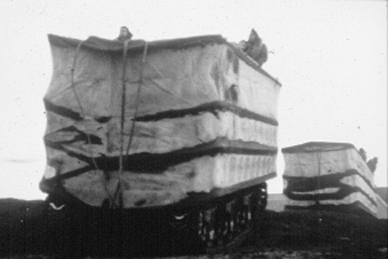
Shermans with floatation skirts inflated – not recommended for use in a heavy sea swell!
‘“75, HE, action-traverse right, steady, on. 300 white fronted house first floor window, centre”. “On”. “Fire!” within a minute of dropping our screen we had fired our first shot in anger. There was a puff of smoke and brick dust from the house we had aimed at, and we continued to engage our targets. Other DD Tanks were coming in on both sides of us and by now we were under enemy fire from several positions, which we identified and to which we replied with 75mm and Browning machine gun fire. The beach, which had been practically deserted when we had arrived, was beginning to fill up fast. The infantry were wading through the surf and advancing against a hail of small arms fire and mortar bombs. We gave covering fire wherever we could, and all the time the build-up of men and vehicles continued.
‘Harry Bone’s voice came over the intercom “lets move up the beach a bit I’m getting bloody wet down here!” We had landed on a fast incoming tide, so the longer we stood still the deeper the water became. As we had dropped our screen, the sea was beginning to come in over the top of the driver’s hatch and by now he was sitting in a pool of water. The problem was that the promised mine clearance had not yet taken place so we had to decide whether to press on through a known mine field, or wait until a path had been cleared and marked.
‘Suddenly, the problem was solved for us. One particularly large wave broke over the stern of the tank and swamped the engine, which spluttered to a halt. Now, with power gone, we could not move, even if we wanted to. Harry Bone and Joe Gallagher emerged from the driving compartment, soaking wet and swearing.
‘More infantry were coming ashore, their small landing craft driving past us and up to the edge of the beach. There was quite a heavy firefight in progress so we kept our guns going for as long as possible, but the water in the tank was getting deeper and we were becoming flooded. At last we had to give up. We took out the browning machine guns and several cases of .3 inch belted ammunition, inflated the rubber dinghy and, using the map boards as paddles, began to make our way to the beach. We had not gone far when a burst of machine gun fire hit us. Gallagher received a bullet in the ankle, the dinghy collapsed and turned over, and we were all tumbled into the sea, losing our guns and ammunition.
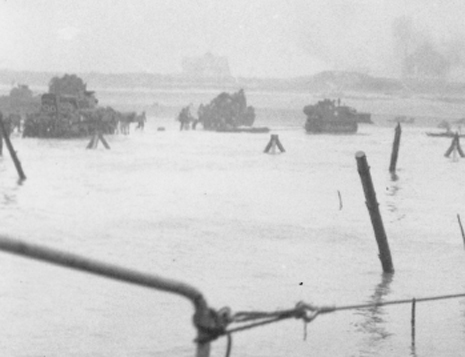
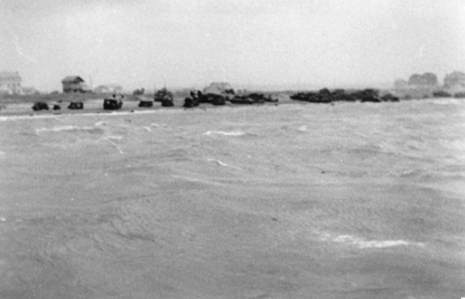
Approaching Queen Red. The two houses on the right help identify the exact spot today.
‘Somehow, we managed to drag Gallagher and ourselves ashore. We got clear of the water and collapsed onto the sand, soaking wet cold and shivering. A DD tank drove up and stopped beside with Sergeant Hepper grinning at us out of the turret “can’t stop!” he said, and threw us a tin can. It was a self-heating tin of soup, one of the emergency rations with which we had been issued. One pulled a ring on top of the tin, and miraculously it started to heat itself up. We were very grateful for this, and as we lay there on the sand, in the middle of the battle taking turns to swig down the hot soup, we were approached by an irate captain of Royal Engineers who said to me: “get up, corporal – that is no way to win the second front!” he was absolutely right of course. Rather shame-facedly we got up, moved further up the beach and found some medical orderlies into whose care we delivered Joe Gallagher who cheered up considerably when someone told him he would be returning to Blighty as a wounded “D-Day hero”. We left him at the field dressing station and moved on. We had only our pistols with us, but we found a discarded Sten gun and some magazines. Attaching ourselves to a section of the South Lancashire’s, we made our way in-land. The beach, by now, was a very unhealthy place to be, it was under intensive small arms and mortar fire, mines were exploding and being detonated by our own mine clearance services, and all the time the build-up of troops and vehicles continued, making it a very crowded area. Clearly, we were not of much use to the infantry in our un-armed state, so I found the Royal Navy beach master and reported our presence to him. He was a very busy man at the time, and advised me to: “get off my bloody beach!” We made our way to the road which ran parallel to the sea, some four of five hundred yards inland, and there we met up with some other un-horsed tank crews.
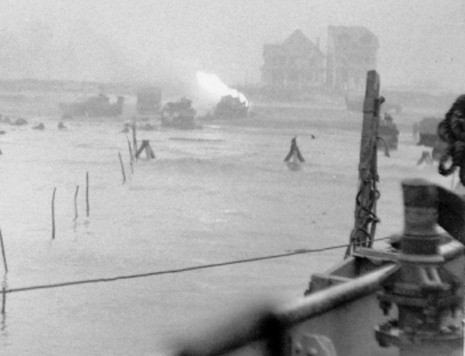
‘We could not help feeling a bit unwanted at that stage. There was plenty of action taking place, but there was not a lot that we could do to influence the course of the battle and nobody seemed keen to invite us to join in. of course, we had already played our part, and we could look back with some satisfaction. We had done what most people had thought was impossible, we had swum a thirty-two ton tank through 5,000 yards of savagely rough sea and had given that vital support to the infantry to enable them now to have the chance to do their job of clearing the beach. On reflection, I had learned a valuable lesson from the events of that morning. Sergeant Hepper, for instance, had clearly not been deterred by the prospect of mines on the beach and had driven his tank shore, accepting the risk. If I had used initiative and done the same, our tank would not now be standing submerged some 150 yards out in the sea. The RE Captain too, had the right idea of “press on, regardless”. In the heat of battle it really does not pay to sit back and weigh up the pros and cons of a situation, it is quick decision and immediate action which brings results. I mentioned these thoughts to Harry Bone, whose only comment was: “Bugger that! If we had hit a mine, I would have been sitting right on top of it.”
The beach was still a scene of frantic activity. Landing craft were coming in, depositing their loads of men and vehicles, then backing out to sea again. The area was swept by machine gun and mortar fire and snipers were busy from the windows of the houses. Shells and mortars were kicking up clouds of sand, the noise level remained very high, and the infantry were taking a lot of casualties. I saw death for the first time that day, and also for the first time I came face to face with the German Army. About two dozen prisoners were being marched to the beach, hands held aloft some were wounded, all looked shocked and frightened. They were a scruffy crowd, not at all the ‘supermen’ we had been led to believe were opposing us. Most professed to be white Russians or Poles, but there were a few who were arrogantly German. Eventually, we were found by Major Wormald who directed us to make our way to the village of Hermanville. We were delighted to see him and to know that he had survived the landings. As he drove off in his tank, we felt a return of confidence as we started the three-mile trek to Hermanville.’
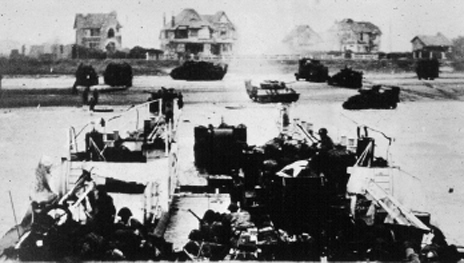
DD and Engineer tanks on the beach.
The carefully choreographed plan was to being affected by the sea state; this meant that the DD tanks, assault engineers and leading infantry companies of the East Yorkshires and South Lancashires were now sweeping towards the shore together. Major AR Rouse, of the South Lancashires (in 8 Brigade’s first wave) described the first desperate minutes of the 3rd Division’s landing:
‘The boat crews had been ordered to go in at four knots and hit the beach hard. During the last 100 yards of the run-in everything seemed to happen at once. Out of the haze of smoke the underwater obstacles loomed up. We had studied them on air photographs and knew exactly what to expect but somehow we had never realised the vertical height of them, and as we weaved in between iron rails and ramps and pickets with teller mines on top, like gigantic mushrooms we seemed to be groping through a grotesque petrified forest the noise was so continuous that it seemed almost like a siren. The seamanship was magnificent. The LCAs weaved in and out of the obstacles and we almost had a dry landing. I have very little recollection of wading ashore; there was too much going on above and around to notice it. It was, however, apparent from the beginning that it was by no means an unopposed landing. Mortar fire was coming down on the sands, an 88 mm gun was firing along in the line of the beach and there was continuous machine gun and rifle fire. Immediately ahead of us a DD Tank, its rear end enveloped in flames, unable to get off the beach, continued to fire its guns.’
In planning his battalion’s assault the commanding officer of the South Lancashires, Lieutenant Colonel Richard Burbury, had tried to visualise some of the difficulties of command and control during the first chaotic moments of the initial assault. To ease his task he had a hand flag made in the battalion colours to help his men identify him. The idea was that this would be a rallying symbol and he could be easily identified. He carried this in his hand as he landed. Unfortunately it made him far too conspicuous and one of the enemy defenders killed him as he reached the beach wire. The second in command, Major Jack Stone, took over command – but not the flag.
Because of the heavy swell A and C Companies had actually landed almost simultaneously with the leading DD Tanks. This mixed force immediately came under heavy fire. Major Harwood, commanding A Company was fatally wounded. One of his platoon commanders was also killed while crossing the beach. Lieutenant Pierce took command of the company and moved off to the west clearing a series of fortified houses. He was later wounded and before their task had been completed the company was left with only one officer.
The men of C Company were more fortunate, they crossed the beach with only light casualties and Major Eric Johnson directed them to the east towards strong point Cod also known to the assault troops as Strongpoint 0880 after its map square grid reference. The follow up second echelon companies were to have landed exactly behind the lead companies but in the confusion of smoke and battle they hit the beach well to the east with battalion headquarters almost exactly opposite the western end of Cod. Major Harrison, B company commander was killed immediately and one of his subalterns, Lieutenant Bell-Walker took command. He moved a platoon to the left to attack a concrete pillbox, which was firing from an defilade position with devastating effect along the beach. Bell-Walker’s actions were witnessed as he attacked the bunker, in what was described later as classic battle school fashion. He crept round behind the position threw a grenade through a gun slit and then gave the interior a burst of Sten gun fire. He was killed instantly by a burst of machine-gun fire from one of Strongpoint Cod’s depth positions. By his action he had, however, opened a way for the rest of his company to get off the beach. They had landed almost exactly opposite the strongest fortifications of Cod itself, and rather like the Americans to the west on Omaha Beach, these troops were immediately committed in a frontal attack.
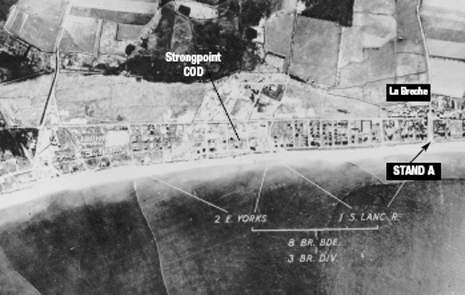
The Assault area:
Queen Red, 2 E.Yorks; Queen White, 1 S. Lanc Reg.
Lieutenant KP Baxter of the 2nd Battalion the Middlesex Regiment landed on Sword Beach with responsibility for the coordinated development of beach exits in his area. His account is rich in detailed observations:
‘We could see nothing beyond a horizon of water. Many of us found ourselves mentally checking that the sky was lightening on the port side, showing that we were indeed running south and not back on to an English beach on yet another exercise. The run-in was long, and gradually, in dispersing gloom, we found ourselves joined by more and more craft whilst from the shore started a crescendo of explosions as the air bombardment carpeted the defences.
‘It was now getting quite light and we suddenly came upon the midget submarine X.23, a complete surprise to us as it should have been, and we knew nothing of the long vigil that it had kept awaiting our arrival.
‘The shoreline became more distinct, but detailed recognition was still impossible due to the heavy pall of smoke and dust still obscuring the buildings. Stabbing orange flames showed the strike of both artillery and the naval bombardment that had now joined in and then suddenly the air was torn with an ear-splitting roar as the rocket ships loose their projectiles. Then we saw the first setback: a returning LCT with her ramp seemingly jammed in the half-lowered position. These craft, four to each beach, carried the specially equipped AVRE. Tanks that were to work in groups of three, the centre tank being armed with a ‘snake’, a 60-foot long heavy tube of explosive to be pushed through the beach defences and detonated.
Not only would this breach the wire but the explosion was calculated to set off any mines in the near vicinity it would then be the job of the exit teams to clear and widen the corridors by hand and then to signal in following craft as the exits became operative. That one of these AVRE carrying craft had been unable to land its tanks meant that at least one of the beach teams would have to make its exit the hard way.
Steadily the flotilla of LCAs pressed onwards towards the beach. Four hundred yards from the shoreline and the royal marine frogmen slipped over the side to start the job of clearing underwater obstacles. This would be sufficiently hazardous at the best of times, but add to it the risk from all those churning propellers with many more following and their task became most unenviable.
‘Closing to the shore rapidly, eyes scanned the clearing haze for familiar landmarks. There were none. A burst of machine-gun fire uncomfortably close overhead brought curses up on those in following craft for their enthusiastic “covering fire”. Suddenly a burst ricocheted off the front of the craft, telling us that this was no covering fire. The opposition was very much alive and well.
‘We had still been unable to identify our position but we were by now right on top of the beach. The protective steel doors in the bows were opened and everyone waited, tensed for the soft lurching bump. “Ramp down!” and out into knee-deep water.
Baxter then described the assault on Strongpoint Cod. Cod was located at the junction of two beach areas and extended for 400 meters into Queen Red and about 100 meters into Queen White. It actually consisted of twenty separate strongpoints within wire obstacles and interconnecting trenches. This defensive hedgehog comprised of a 75-mm gun; two 50-mm anti-tank guns; three 81-mm mortars; a 37-mm gun and five other machine gun posts each in turn equipped with two or three guns. Forward observation posts and shelters completed a formidable defensive area that would take over three hours to clear and cost the assaulting battalions dearly. It would take the combined efforts of the East Yorks and South Lancashires and supporting tanks and infantry from the No.5 Beach Group (5th Battalion Kings Regiment) and No.4 Commando to overwhelm German resistance.
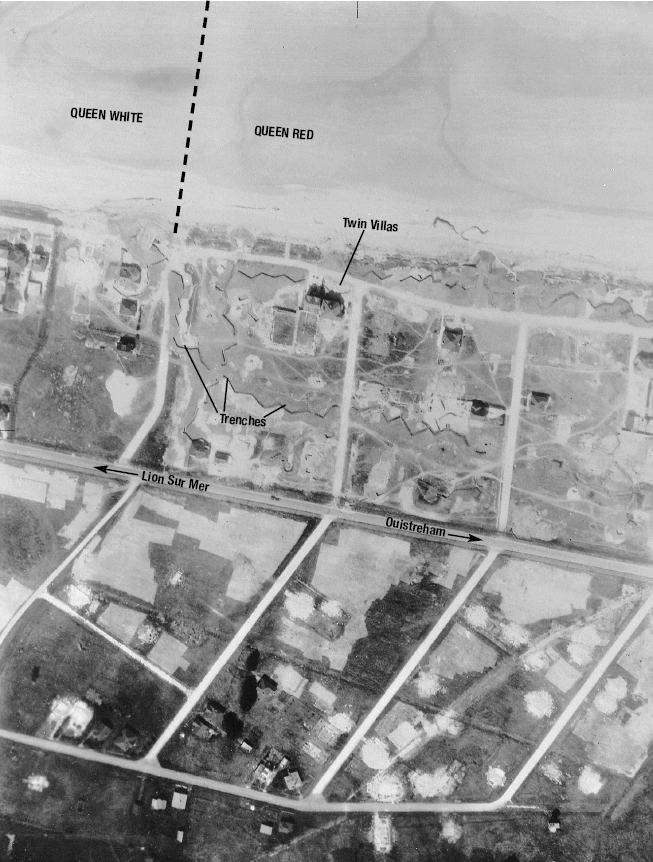
Strongpoint Cod. Note zig zag pattern of trenches and evidence of aerial bombing.
‘Ahead, a line of prone figures just above the water’s edge and some 200 yards beyond a tank was nosed up against the small strip of dunes at the head of the beach. The first impression was – that the tank had got in ahead of the first wave and they, following the same instructions as given to the beach exit teams, were holding back until the explosive charges had been detonated.
‘I had not gone far when I was tripped by some underwater wire and, with no hope of retaining balance with the heavy assault jacket and pack that had been issued to us, went flat on my face. Attempting to rise, I was struck a heavy blow on the back, which flattened me again. Then suddenly the machine gun opened up on us once again. The fire came from dead ahead and we could now make out the shape of a heavy embrasure in the low silhouette of some concrete fortifications at the top of the beach. We then realized that, by the narrowest of margins, we had landed immediately in front of: strong point 0880, codeword Cod.
‘Both mortar and light artillery defensive fire was being brought down by the enemy in front of the strong point which now intensified, and a still unspotted machine-gun made an instant target of anything that moved. The prone figures that had first been seen just above the water’s edge, we found to be casualties from the leading craft. Our wireless communication had been lost when the corporal operator, corporal Roulier, had been hit on leaving our craft, but on White Beach to our right, troops could be seen crossing the beach and reaching the top. There was a brief lull in the firing and we immediately took this opportunity to make a dash for the top of the beach. Briefly seeking cover behind the motionless tank to count heads, it was found that only the signalman of our group had managed to come through unscathed.
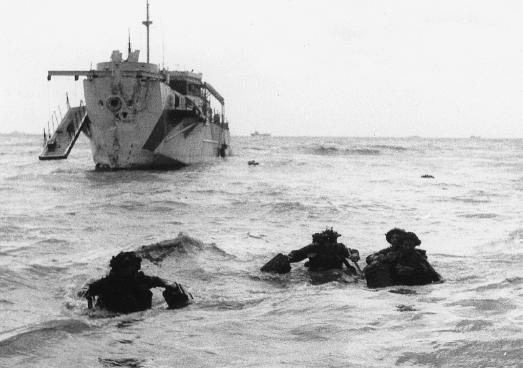
Men belonging to Intermediate Brigade HQ Staff wade ashore from their LSI.
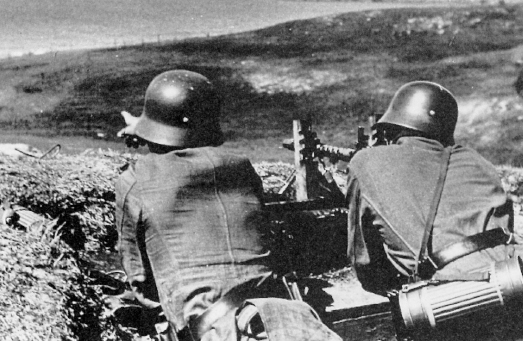
German machine-gunners in defensive positions on the French coast.
‘We had hardly jettisoned our heavy equipment when the strong point above our heads sprang to life once more. German stick grenades somersaulted through the air, their effects being greatly reduced in the soft sand, whilst we in turn desperately sought grenades from amongst the remnants of other detachments now grouping with us. However, further action was promptly eclipsed by the arrival of lieutenant Tony Milne with his machine-gun platoon of the 2nd Battalion Middlesex Regiment. The platoon was equipped with universal carriers, having the heavy Vickers mounted above the engine casing, and were the first infantry fighting vehicles to land.
‘Without a moment’s hesitation, waterproofing shields were ripped away, gun clamps freed and the leading carrier drove straight at the trench line above our heads with a long swinging traverse from the Vickers, depressing into the trench as they closed. a brief pause silence then at the end of the trench system some fifteen survivors appeared in hasty surrender. Strong point Cod had been taken.
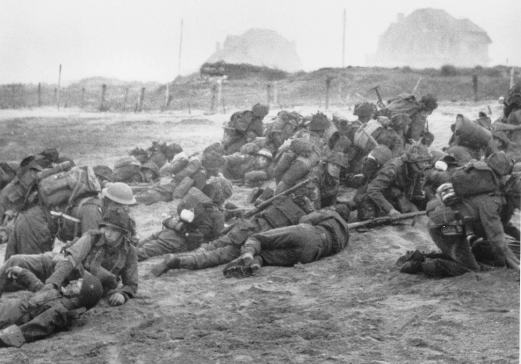
Sheltering from fire on Sword Beach while regrouping after landing.
‘A first-aid post was quickly established in the concrete emplacement of the strong point, and then every hand was turned to helping vehicles through the soft sand above the high-water mark. The self-propelled guns of the 76th and 23rd Field Regiments, together with the Royal Marine artillery would be coming in at about 0900 hours[1000 hours after local variations] and were indeed to establish their first gun line on the water’s edge. Already it seemed that we had been there all day.’
A part from the depth positions at strongpoint Cod that were still resisting (finally secured at about 1000 hours), 8 Brigade had cleared the immediate beach area of enemy as early as 0810-0830 hours. Within another half an hour elements of the South Lancashires had pushed south and secured Hermanville, while A Company had turned west towards Lion sur Mer to take on strongpoint Trout at the western end of Queen Green. Meanwhile infantry from the East Yorks had started to move east towards strongpoint Sole. As this was taking place the Suffolks were landing in good order and were striking south to their battalion assembly area before enlarging the beachhead; all this within the first hours of landing. Richard Harris was a young infantryman coming ashore with the Suffolks. He recalled:
‘Nearer and nearer we drew to the shore...Trembling, my rifle tightly clenched, I crouched awaiting the dreaded shout, “Ramps down!” We seemed to inch in, in between craft already beached, some of which were burning. The diesels went into reverse, the bows ground into the sand and pebbles and we came to a standstill. “Ramps down!” This was it, I was determined to present myself for the minimum time as a target at the top of the ramp and being one of the first to go I had a clear run.’
The relief of reaching terra firma was quickly overwhelmed by other emotions as the reality of war struck these young men most forcibly. Harris remembered:
‘A complete shambles... Against a backdrop of smoke, gutted blazing buildings were several burning knocked out DD tanks and strewn about from the water’s edge to the seawall were sodden khaki bundles staining red the sand where they lay. The thought that for them the day was already done appalled me.’
While his assault troops were fighting there way ashore, General Tom Rennie was observing operations from HMS Largs and assessing the proper moment at which to land and follow the assault brigades ashore. Captain AC Duckworth RN was at the time Staff Officer (Plans) to Admiral Talbot. He remembered that the GOC was a great inspiration to them all, and recalled that at the time of the landing Rennie and Talbot were on the bridge, and were engaged in a heated argument as to when the General should be allowed to land: Rennie insisted that he should embark in a landing craft forthwith, while Talbot stated firmly that he was in command and the general would land at his discretion. Meanwhile, the Norwegian destroyer Svenner had been sunk on the port bow by a German E-Boat, and the spread of the incoming torpedoes had narrowly missed sinking HMS Largs while this frustrating argument continued. Fortunately, the Captain of HMS Largs had taken the necessary avoiding action and Rennie was allowed to land shortly afterwards at 1030 hours. Thus Headquarters 3rd Infantry Division re-established itself in France. Once ashore Rennie was to spend much of the day racing from one critical point to another encouraging and cajoling commanders at every level to ‘Drive On.’
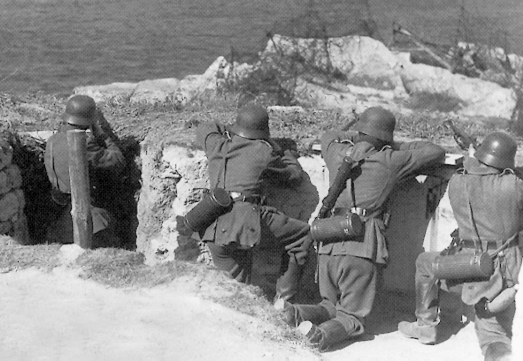
Infantry holding strongpoints along the invasion front put up a strong resistance against the invaders.
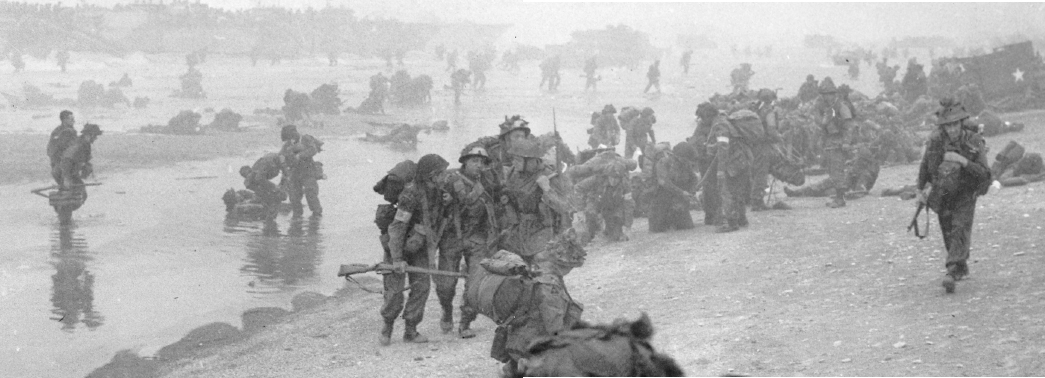
Queen White looking East. No.84 Field Company ashore at 0815 hrs.
Royal Engineer Operations on D-Day
While the infantry and DD Tanks had been overcoming the enemy beach defences the tide, much increased in height by the strong wind, was rapidly covering the sand and beach obstacles behind them and it was now time for the engineer gapping parties to clear gaps and exits from the beach area. The sappers had already suffered heavily from enemy fire; several had been drowned while working on the half submerged beach obstacles. The Commanding Officer of the 5th Assault Regiment, Lieutenant Colonel ABDB Cocks attached from 79th Armoured Division, had also been killed while disembarking from a LCT, but the work went ahead. On D-Day 5 ARRE would suffer 117 casualties while 22nd Dragoons would have forty-two casualties. Fifteen of their twenty-six Sherman flails alone were knocked out or damaged that day.
For the engineer clearance teams the first priority was the removal or destruction of explosive charges on top of the beach obstacles to create cleared lanes for the follow up waves. Army engineers were tasked to clear these obstacles above and below the high water mark. As Lieutenant IC Dickinson MC explained:
‘Obstacles from a depth of ten feet to four feet six inches were the responsibility of the Landing Craft Obstacle Clearance Units of the Royal Navy, and those from four feet six inches to 0 feet were a sapper responsibility. Each Beach White and Red, was allotted five AVREs for obstacle clearance. Our latest information before leaving was that the obstacles were laid in four rows in the following order from the dunes to the sea: two rows of Hedgehogs, Stakes, and Ramped Stakes.
‘The intention was to land with the tide lapping the bottom of the ramped stakes. We were to through these, drop our porpoises (waterproofed steel sledges carrying ammunition and explosives) on the beach, and then return, remove such mines as we found on the ramped stakes and then either run them down or tow them away. Having completed row c we were to go to b, and so on.’
The sappers had devised and practiced various methods to complete their tasks including the use of fitted slings on their vehicles for towing away the stakes, and waterproofed explosive charges for blowing more difficult obstacles. Unfortunately their well-practiced drills were hampered by the un-seasonal tide, heavy swell and sapper casualties caused by enemy action. Sappers were witnessed swimming out to the obstacles in order to cut away the lethal mines and shells and drop them into the deepening water. Others used a flail tank as a platform to drive between stakes and cut away Tellermines. Many brave men drowned trying to complete their allotted tasks. The conditions for the beach gapping teams were just as grim. Captain A Low of No.2 Troop commanded a beach gapping team and he recalled the effects of enemy small arms fire on the LCT bridge, making it a very unhealthy place for crew and engineer officers alike. On landing, he witnessed one of his tank crews using their flail to pulverise a particularly active German gun position. Tank crews used their vehicle weapons and even small arms to engage, suppress or kill German defenders who exposed themselves in their haste to engaged the men struggling ashore. After supervising the creation of gaps off the beach, Low realised that a knocked-out Sherman tank was blocking one of the vital exits so he used his tank to clear the obstacle in the desperate race against tide and landing schedules.
Meanwhile 246 Field Company had cleared an exit on the right but on the left, where roads were blocked by damaged tanks, it took nearly two hours to open up further exits. To get clear of the beach, vehicles had to move laterally to the west before meeting the road to Hermanville that formed the nearest causeway over the flooded and now marshy land immediately behind the dunes. As the morning progressed, queues at the exits built up, while more and more vehicles were landing on the ever-decreasing strip of sand. The congestion was extremely serious and would ultimately impact on the mission to reach Caen on D-Day. In addition to vehicles waiting to move forward there were now some fifty SP guns (the Priests) firing from the beachand eventually these were standing in the surf. At midday it was decided to suspend beaching for half an hour to allow the congestion to subside.
The armoured engineers of 5th Assault Regiment reinforced the divisional engineers. The engineers were organised into eight gapping teams with additional dismounted sappers from 629 Field Squadron and support teams for the assaulting infantry battalions, consisting of assault demolition teams and mine clearance teams with each of the assault companies. The gapping teams all succeeded in disembarking with the exception of one LCT carrying the left hand gapping team for Queen White beach. This craft came under close anti-tank gunfire and only the leading flail was beached. The second flail was hit and jammed at the ramp door whilst a hit on a Bangalore torpedo caused an explosion on board. It was at this point that CRE 5th Assault Regiment, in command of all beach clearance and gapping teams, was killed on this craft. Despite heavy casualties to tanks, the gapping teams succeeded in opening four exits within an hour on Queen White beach and in interconnecting them inland, on Queen Red further to the east, teams suffered from heavy enemy fire and to a great extent were reduced to clearance by hand. Damaged tanks blocked their first two exits. One gap with lateral communications was open at H+90 minutes followed by two more within a quarter of an hour.
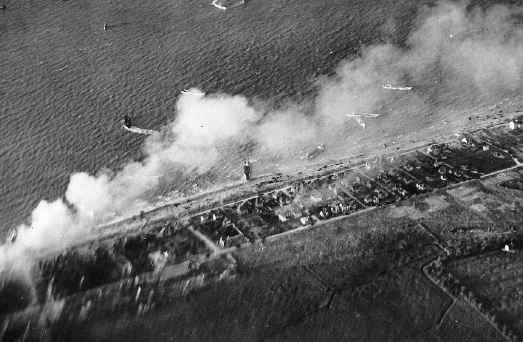
Queen White Beach during the landings – Lanes have been cleared by 77th Assault Squadron RE.
This notable account is from Sergeant T R Kilvert (a relative of the author) who landed on Queen White beach commanding his AVRE in 1 Troop, 77 Assault Squadron:
‘We stood to at dawn on board the LCT 100A at 0500 hours. Breakfast was on but nobody really wanted it, being more or less seasick. I had AVRE 1c started up, all guns loaded and a last minute check over the tank. It was now about 0610 hours and the coastline stood out in the haze; we were coming in fast. About half a mile out everyone mounted their tanks. Almost in, 400 yards to go when 1c had a violent shake, we had been hit. Damage not known because the LCT had also sustained damage a bit forward and we had to get off at once.
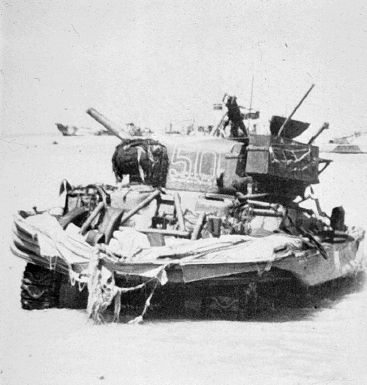
A drowned DD Sherman on Sword Beach.
‘The LCT stopped:.. going down the ramp now and the water was almost up to our cupola. Again we were hit but on our Bobbin, it being at a crazy angle. Coming up out of the water, hit again and at last dry and following 1a up to sand. Hit a mine, one bogie gone, but, following on in 1a’s track, we were ordered to put up a windsock, 1a having lost his. Struck a second mine, two bogies and left track gone.
‘L/Corporal Fairlie and Sapper Vaughan jumped out to put up a windsock. L/Corporal Fairlie was blown up by a mine as he came round the tank. I ordered abandon tank, take all arms, and jumped out myself, destroyed ‘slidex and code papers’. We were all out now petrol was pouring out of 1c and filling the mine crater. Everyone lay down whilst I looked for the L/Corporal’s remains. None found so I returned and organised the crew into a fighting patrol. Just then L/Sergeant Freer from 3 Troop joined us; he had swum ashore from his tank which had been on our LCT. Moving up the beach we passed Captain McLennan in 1a, stood on the gap top. I ordered a defensive position and to consolidate in front of 1a on the crossroads.
‘Asking the troop leader to cover us, we moved forward behind the leading flail, until he reported no more mines in the road ahead. Again we consolidated. I went back to the beach to bring up the troop. Captain McLennan had now advanced through the gap and was followed by 1b, who stood at the exit a little to one side. I collected L/Sergeant Freer’s crew and a couple of infantrymen and brought them forward to our advanced position.
‘Again we moved forward (we thought) until a bend in the road cut them, by 1a and 1b from view.
‘We advanced in short bounds to the high wall of the large farm. Here we split into three parties, one covering the main road or killing zone, another as rear protection and another as house clearance.
‘It was then that fire came at us from three sides, but bursts from our two Brens brought a lull. Shooting open the garden door, I advanced covered by my L/Sergeant and Sappers Lewis and Hand, up the two paths and raked the whole front of the house and part of the farm with fire killing, we later found eleven of the enemy.
‘We rushed the house with hand grenades, and searched it from top to bottom. Going out into the yard we found the air raid shelter and the civilian occupants of the farm.
‘Sapper Hand, who spoke the lingo, obtained the information that the big house (on the corner of Hermanville itself) housed about 200 of the enemy I then reorganised the party, sending two runners back to Captain McLennan. Using the road ditch and the garden wall as vantage points we advanced about sixty yards when Sapper Vaughan opened fire with a Sten gun on an enemy party coming down the road towards us. Immediately everyone of us opened fire, and with the two Sergeants with 100 round magazines with their Bren guns this scattered the enemy. An SP gun then came up, followed shortly after by the infantry and Lieutenant Tennent on foot. We then handed over to a RA major, and moved to our RV in a field opposite. On Captain McLennan’s instructions we used a detector and tested for mines.
Sergeant Kilvert survived the war. Sadly Captain McLennan was killed on the afternoon of D-Day leading three AVREs in support of No.41 RM Commando in the clearance of German defenses in Lion sur Mer. A German 50mm gun destroyed each of the tanks in turn. A grenade killed McLennan while he was attempting to evacuate his men under cover of a smoke screen and commando supporting fire. He was one of the ten men from 77 Assault Squadron killed on D-Day a further twelve men were wounded. Of the Squadron’s armour, three AVREs were destroyed, three were damaged and five were still operational. Two flails had also been lost on the Squadron front. For their work on D-Day, 77 and 79 Assault Squadron personnel were awarded two DSOs, four MCs, and three MMs.
253 Field Company one of 3rd Division’s integral sapper companies, was landing with 185 Infantry Brigade and this account gives a clear image of the state of the beaches by the time the Intermediate Brigade started to come ashore:
‘Soon I could pick out the silhouette of houses on the low flat skyline and I tried to identify the house with a tower which showed on my panorama this was Lion sur Mer. It was my responsibility to get all these men and their vehicles clear of the beaches, but from where I was standing on the bridge of this LCT emblazoned with the red and black triangle of 3rd Division. I could not see enough room on the beach for a dinghy to pull in. However, to my intense relief our skipper touched down perfectly full marks to the Royal Navy as he dropped his ramp without mishap just at this moment a shell landed forward on our immediate neighbour and removed his ramp before he reached the beach, and I saw a sapper jump for it and swim loaded like a Christmas tree with assault jerkin and mine detector.
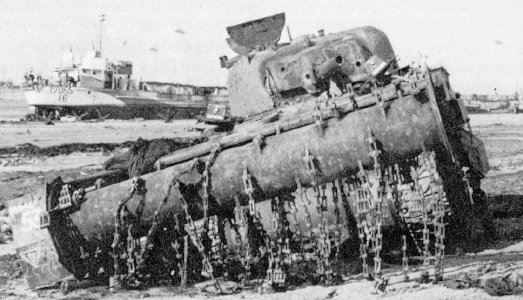
A Sherman Flail knocked out on the beach.
‘Now I began to get very impatient because although our ramp was down there was so much traffic in front of the mouth of our craft that none of our vehicles could move. Visions of another shell hitting us amidships and cooking our goose! So I walked off the craft and trudged along the beach to see what the hold up was.
‘I never found the cause of this stoppages, but slowly things began to move, terribly slowly it seemed to me; occasionally over the din of the shelling I heard the unmistakable ‘woomph’ of a mine going off and a stretcher passed me with a badly wounded man with his face knocked about and I realised with a jolt that this was the real thing again. When I had walked as far as the road behind the beach, I saw that mines in the verges had already taken their toll and went back along the column warning every driver including my own, to stick to the crown of the road; then I got aboard and we drove off the beach in a column that was still bonnet to tail.
‘This movement was very short lived, for soon there was another inexplicable hold up and again I got out and walked forward to try to clear the block this time I got as far as the crossroads which lead to Hermanville and as I walked back one of my hussar friends shouted “your truck’s had it, sir”. It had two rear wheels blown clean away and the centre of the truck ripped up like so much paper-there were seven men aboard but only one was wounded and that not serious, and the track marks of dozens of trucks had crossed this mine before us.
The contents of the truck were vital and included two wireless sets the company control and the rear link to the CRE. We all got busy and unloaded the essentials on to the dusty road in a matter of minutes. How to get all this to our RV was my next problem!’
By nightfall the specialised armour attached to Rennie’s division from the 79th Armoured Division and the other engineers from 5th Assault Regiment had helped establish the beachhead.
Expanding the Beachhead
Meanwhile offshore the principal concern for Rear Admiral Talbot remained threat posed by the massive Le Havre battery that could fire directly into the Sword landing area. Heavy smoke screens were laid all morning to prevent the Germans ranging. Instead the battery seemed to be content with shelling the warships. Led by HMS Warspite, the warships fired heavy salvos back and kept the Germans occupied.
The pre-assault bombardment by the twenty-two ships of the Bombarding Force and the Allied air forces suffered from the inevitable lack of visibility once the battle started. According to one official report, not all the bombs landed on target. As one officer wrote later he thought that the air bombardment was placed rather too far to the westward, but it was difficult to judge through the smoke and dust as approaching craft reported that they could not recognize the beaches from a distance once the bombardment had commenced.
‘The early waves, however, saw all they needed and all spoke highly of the value of the models and photographs, which they were shown in the Commercial Buildings, Portsmouth, prior to sailing. I was surprised to see several houses on the front in Queen sector undamaged and with windows still intact in spite of the bombardment.’
The assault started off with some style. Brigadier the Lord Lovat led his commandos in with the now legendary Piper Bill Millin playing highland reels on the fo’c’sle of his landing craft. The men needed to keep their morale high; many had been on the point of physical and nervous exhaustion after the rough crossing. As one naval officer wryly commented, ‘the military were mostly sea-sick.’ According to at least one report this was not a universal experience:
‘At 0635 I was lowered in LCA 796 from LSI SS Empire Broadsword with thirty men and a captain of the Suffolk regiment. We formed up and left the lowering position at approximately 0645, commencing the run in to White Beach, Sword area, to touch down at H plus 60. The sea was fairly rough but the soldiers, with one or two exceptions, enjoyed the run in.
‘At just over 1,000 yards, I signaled all craft to increase to maximum revolutions, and, regardless of our own barrage, some of which fell in our midst, the flotilla hit the beach at full speed, LCT 947 touching down at 0726. Just after the first tank had got ashore from LCT 947, we were hit forward by mortar fire, which exploded the bangalore torpedoes. The second tank (flail) was put out of action, also the tank astern of it. Three army personnel were killed, including the colonel, and seven others wounded.
In spite of some heavy losses of armour, enough flails, DD and AVREs crawled up from the sea to support the individual infantry assaults that would overwhelm the seafront strong points and machine-gun positions. The men of the 8 Infantry Brigade slowly fought their way up onto the promenade and began a series of vicious little close quarter battles for the control of the coastal road and the beachfront villas. Dennis Glover commanded one of the craft carrying Lovat’s Commandos. He later reproduced this very personal and vivid account of the assault:
‘Now eyes for everything eyes for nothing. The beach looms close, maybe a mile. There are people running up and down it. There are fires, and the bursting of shells down it. Yes, and wrecked landing craft everywhere, a flurry of propellers in the savage surf among the wicked obstructions. Beach clearance parties I expect bloody heroes, every one. Craft stooging quietly in, some of them on fire though. Diesel fuel burns black. That vicious destroyer is irritating me, but the colonel doesn’t seem to mind. He’s cool, but I’ll bet he’s worried. Curious how all these soldiers dislike assault by water. I’d hate to dash out of foxholes at machine-guns. Damn him, I can pretend I’m cool too. Starboard ten! It’s the noisiest gun in the navy that 4.7-midships cox’n. What a cool disinterested reply he makes. Colonel, you make me grin. I like your nerve.
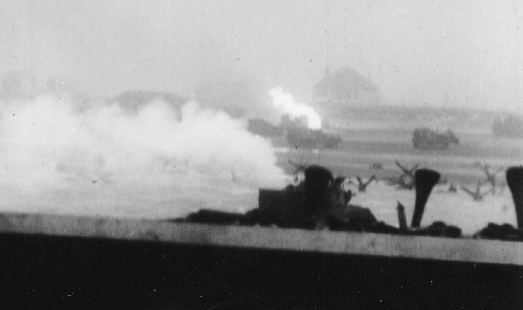
1st Special Service Brigade (Commandos) approaching Queen Red Beach at 0845.
‘We are on those bristling stakes. They stretch before us in rows. The mines on them look as big as planets. And those gray nose shells pointing towards us on some of them look like beer bottles. Oh God, I would be blown up on a mine like a beer bottle. Whang here it comes those whizzing ones will be mortars and the stuff is falling all round us. Can’t avoid them, but the mines and collisions I can avoid.
Speed, more speed. Put them off by speed, weave in and out of those bloody spikes, avoid the mines, avoid our friends, avoid wrecked craft and vehicles in the rising water and get those troops ashore. Everything is working as we’ve exercised it for so long. Oh hell, this new tin hat is far too big for me I’ll shake it off my head with fright, if I’m not careful.
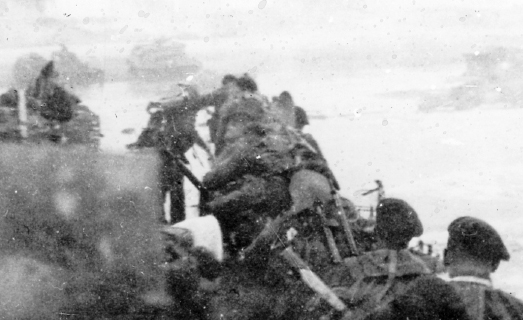
1st Special Service Brigade (Commandos) ramp going down...
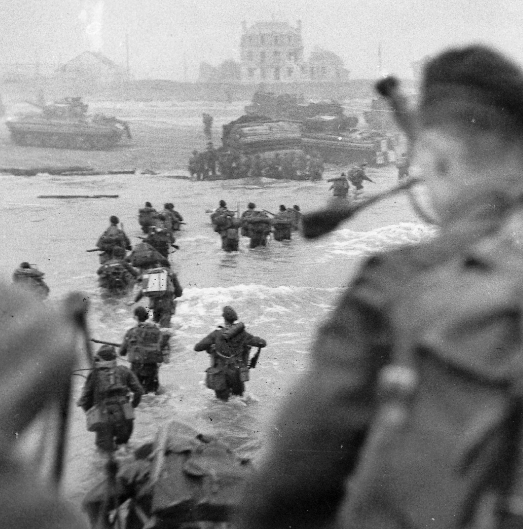
1st Special Service Brigade (Commandos): Piper Bill Millin is close-up and the commander, Lord Lovatt, is the detached figure on the right wading ashore (close to Millin’s left arm). Time: H+1.
‘Slow ahead together.’ slow down to steady the ship, point her as you want her, then half ahead together and on to the beach with a gathering rush. Put her ashore and be damned! She’s touched down. One more good shove ahead to wedge her firm. Smooth work! “Now off you go! Good luck, commandos, go like hell! Next meeting Brighton!” how efficiently, how quickly they run down the accustomed ramps, not a man hit that I can see, and there they go, splashing through a hundred yards of water, up over more of the flat beach than that and out of sight among the deadly dunes. The colonel turns to wave and is gone with them. They ignore the beach fire. They have their objective and they are going for it.’
This was part of the landing of No.6 Commando, its objective, Ouistreham. Meanwhile No.4 Commando had landed earlier than the rest of the brigade, its vital mission being to push inland rapidly and link up with the hard-pressed men of the 6th Airborne Division holding the bridges over the Orne. The rest of the brigade had the difficult task of prizing the Germans out of their heavily fortified positions at Riva Bella and Ouistreham. The port marked the entrance to the river Orne and the lock gates controlling the Caen ship canal. In an ironic twist of history the local inhabitants had set up a monument to their successful repulse of a British attempted landing on 12 July, 1792. Now they were waiting to welcome the British as liberators and, to the great joy of the French inhabitants of Ouistreham and Riva Bella, the new liberators included a Free-French Commando Company under Commandant Kieffer. Villa by villa the commandos shot it out with the Germans until the guns of the Riva Bella casino strongpoint halted them. Kieffer obtained the support of a single DD Tank and by 0930 he had stormed and cleared the casino.
Captain J H Patterson RAMC was attached to No.4 Commando. Lovat quoted his memories of D-Day in his book March Past. Again, this account steps back from the ‘glory’ of D-Day and describes the reality of opposed amphibious assaults where the invader must face not only a prepared enemy in defence but also the hazards of the environment:
‘There was thick smoke over the beach, and the tide low but flooding. There were many bodies in the water; one was hanging round one of the tripod obstacles. The shoals were churned with bursting shells. I saw wounded men among the dead, pined down by the weight of their equipment.
‘The first I came to was little Sapper Mullen, the artist. He was submerged to his chin and quite helpless. Somehow I got my scissors out and with my numb hands, which felt weak and useless, I began to cut away his rucksack...
‘The Commando were up at the wire and clearly having trouble getting through. I went back to the wounded in the water. I noticed how fast the tide was rising, and wounded men began to shout and scream as they saw they must soon drown. We worked desperately; I don’t know how many we pulled clear, though it wasn’t more than two or three.’
In one of the vulnerable LCIs (509) carrying the men from No.3 Commando, it was found in an after the battle study that fifty-four out of sixty-three commandos had been killed on the run-in by enemy fire and the inevitable secondary explosions caused by ammunition and fuel. This was no ‘cakewalk’.
Yet by mid-morning the accurate German shelling and mortaring of Sword beach had been dramatically reduced. The beach commanders had realized that in the absence of their forward observers (now dead, prisoners or in flight to the rear) the German artillery was ranging on the barrage balloons flying over the area to provide cover against low-flying air attacks. When these had been cut adrift or lowered, the intensity and accuracy of the German gunnery declined. Following the battle a detailed technical analysis showed that the most effective weapon against the assault battalions was the ubiquitous 81 mm mortar much favoured by the Wehrmacht. With an effective range of 2,500 meters it inflicted 6.5% casualties for every 5.7 bombs fired.
The commandos supported by armoured engineers and gun tanks continued their drive into the town and by midday German resistance had spluttered out. Ouistreham was liberated and Frenchmen had played an important role. The population was overwhelmed; Kieffer recalled hearing a young French boy say how delighted he was that the English had been so thoughtful as to bring along soldiers who spoke French.
With Kieffer and the Commandos securing the beach front at Ouistreham and Riva Bella in the east, 8 Infantry Brigade were now pressing south to the Periers ridge leaving a dangerous gap between Sword and Juno sectors and with the follow up waves of 185 and 9 Brigades coming ashore into the now crowded and battle scarred beachhead amongst them was Harry Jones and his platoon from the KSLI. Having escaped from the fire soaked sands on the beach he lead his platoon inland:
‘We passed through the village of La Breche and after an advance of about a mile, were soon in the town of Hermanville. As we marched in single file, with a gap of five yards between each man, French people came out doors to welcome us, some shouting “Vive les Anglais”, to which I replied in my best Churchillian French “C’est la Liberation”. One sight I will never forget was that of the town’s chief fireman in full regalia, wearing his large bright brass helmet, rushing down the road to give me a great big hug!