
9

WHEN HIS INAUGURAL CEREMONIES ENDED AND HIS PRESIDENCY officially began, Abraham Lincoln found waiting for him on the desk in his White House office a series of desperate messages from the commander of a beleaguered federal garrison in Charleston Harbor: Fort Sumter. Robert Anderson, a native Kentuckian who wished above all else that North and South could separate without violence, had bad news to report. His 127 men were fast running out of provisions. They could not last much longer without fresh supplies. Hostile forces surrounded the five-sided fort, which presented impregnably thick walls east to the sea but stood at the center of newly erected batteries to the north, south, and west. Built to withstand foreign attack in the large harbor’s main channel, the fort was more vulnerable to assault from domestic foes.
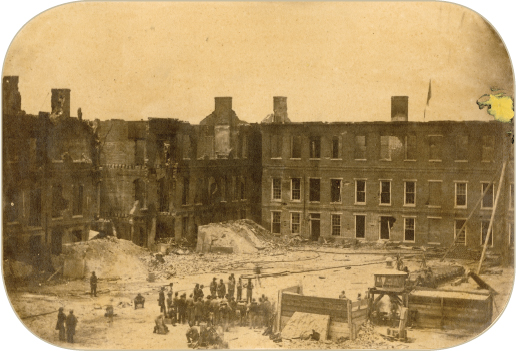
PLATE 9–1
The Lincoln administration thus faced a critical series of fundamental decisions virtually from its first moments in power. Above all was the question of to whom all the Charleston forts rightfully belonged. South Carolina insisted that since Sumter sat on a man-made island within its sovereign territory, it could rightfully claim ownership. But even Lincoln’s predecessor, the Democrat James Buchanan, had insisted that since it had been built with federal funds, it belonged to the entire nation. Buchanan had even ordered a ship to supply it in January 1861, but the Star of the West quickly turned back when it came under fire from batteries on the shoreline. Now the choice fell to Lincoln: abandon the installation and withdraw the men, averting or postponing a showdown; or draw a line in the sand at Sumter and insist on the right to maintain a federal presence there. The very future of the Union might depend on his decision.
In communications to General-in-Chief Winfield Scott even before he took office, Lincoln had made his views abundantly clear. Scott should be “as well prepared as he can,” Lincoln advised him, “to either hold, or retake, the forts, as the case may require, at and after the inauguration.” Though he had toned down the equally bellicose language he originally drafted for his inaugural address, Lincoln left little doubt where he stood when he rose to deliver his most important speech to date on March 4, 1861: “All the power at my disposal will be used to hold, occupy, and possess the property and places belonging to the Government.”
The unresolved subject dominated the new president’s initial Cabinet meetings, but if Lincoln thought his newly appointed ministers would rally around his inclination to maintain Fort Sumter, he was mistaken. Secretary of State William H. Seward initially believed that Anderson should withdraw his men and that the government should make its stand at the nearby, more easily defended Fort Pickens off the coast of Florida. General Scott, too, endorsed the idea of abandoning Sumter. Earlier, the politician whom Lincoln had defeated for the presidency, the still-respected Democratic senator from Illinois, Stephen A. Douglas, had introduced a congressional resolution calling for withdrawal of all the garrisons in the seceded states north of Florida. Only the West Point graduate Postmaster General Montgomery Blair argued for holding the Charleston fort. None of the other secretaries seemed inclined to risk the government’s reputation by fighting for Sumter—a battle, everyone agreed, the vastly outnumbered garrison was unlikely to win. By April 8, Anderson, whose total loyalty to the Union Lincoln still doubted, confided anxiously to Adjutant General Lorenzo Thomas: “We have not oil enough to keep a light in the lantern for one night.…We shall strive to do our duty, though I frankly say that my heart is not in this war, which I see is to be thus commenced. That God will still avert it, and cause us to resort to pacific means to maintain our rights, is my ardent prayer.”
Jefferson Davis, now president of the Confederate States of America, had a similar choice to make. He knew that Fort Sumter posed no real military threat to Charleston, since most of its guns pointed toward the ocean, while its other weapons were incapable of doing much damage onshore. In a letter to South Carolina’s new governor, Francis W. Pickens, he argued: “The little garrison in its present position presses on nothing but a point of pride.” But pride was more than enough to move the two sides inexorably toward conflict. South Carolinians, Pickens included, believed the fact that Anderson had moved his garrison from the vulnerable Fort Moultrie to Sumter amounted to an act of outright aggression. Insisting that “there was obviously no other course to be pursued,” the governor authorized batteries to be installed around the shoreline and aimed at the federal fort.
For a time, Lincoln bowed to his advisers’ caution and opted for delay. Meanwhile, continuing to cling to the fantasy that secessionists constituted only a well-organized minority throughout the South, he sent emissaries to South Carolina to take the measure of the state’s alienation from the Union. But the president’s trusted friend Ward Hill Lamon reported back that Union sentiment there no longer existed. The only exception was a cantankerous old judge named James Petigru, who had insisted that South Carolina was too small to be a nation and too large to be an insane asylum. His neighbors dismissed him as a crank and ignored him.
After Lamon’s return to Washington, Lincoln decided to reprovision Fort Sumter with food and other essentials, but not guns or ammunition, and ordered a naval squadron to proceed to Charleston. But in a stroke of political genius he announced his intentions in advance to Governor Pickens, throwing what the historian Craig L. Symonds has called “the burden of decision making” to Jefferson Davis. If Davis decided to allow the fort to take on new provisions, he would be perceived as backing down. If the Confederate president opted to interrupt the expedition with an act of overt hostility, he would be seen as the aggressor. The historian James McPherson has aptly described Lincoln’s game-changing strategy as “heads I win, tails you lose.” Pressed to the wall, Davis chose to attack, and on the Confederacy fell the burden of starting the Civil War.
At 3:20 a.m. on April 12, Anderson received and rejected a final demand that he surrender and abandon Fort Sumter. A little more than an hour later, as civilians ringed the shore and crowded the rooftops of the mansions on the Battery to watch the spectacle, Confederate batteries commanded by the flamboyant brigadier general Pierre Gustave Toutant Beauregard opened fire, commencing a bombardment that lasted some thirty-four hours. By the time the Union supply ships appeared over the horizon, delayed by a gale wind, the shelling had become so fierce they were forced to remain outside the harbor. Inside the city, meanwhile, the diarist Mary Boykin Chesnut heard the first guns and excitedly scribbled this entry: “The heavy booming of a cannon—I sprang out of bed, and on my knees, prostrate, I prayed as I have never prayed before.” The secessionist firebrand Edmund Ruffin, given the “highly appreciated compliment” of unleashing the first shot, seemed irritated when the Union garrison did not offer a “hostile defense,” worrying that if the fort fell without fighting back, it “would have cheapened our conquest.”
Anderson’s defenders had ample reason to offer only token resistance; some of their guns were unmounted or facing the wrong direction, and they had precious little ammunition left on hand. In addition, Anderson wanted to ensure that the full onus for initiating hostilities fell on the secessionists, and he waited until full light before returning fire. For several hours the garrison in the fort simply hunkered down. The soldiers huddled outdoors on the parade grounds, ordered there for fear that a shell might ignite what was left in the powder magazines. Not until 7:00 a.m., two and a half hours after the bombardment began, did Fort Sumter begin to return fire. Fires broke out during the barrage, and the men began to experience trouble breathing. During a lull in the bombardment shortly after noon on April 13, a Confederate emissary rowed back out to the fort under a flag of truce, finding Sumter now shrouded in smoke like a smoldering volcano and capable of offering only sporadic return fire toward the shore. Again the Confederates asked for surrender, and this time Anderson capitulated. The next day, after a formal flag-lowering ceremony during which a weapon exploded amid a hundred-gun salute, resulting in the only human casualty of the entire siege, the Union defenders left to board the supply ships now waiting to transport them north.
Once a bulwark against possible enemy invasion, Fort Sumter evolved literally overnight into an icon of Confederate independence and resistance. Even as the city began mobilizing for the further defense of South Carolina, pleasure boats thronged the harbor to get a closer look at the prize, while photographers rushed to the island to make visual records of the place where the rebellion had started—certain that the results would become treasured, and profitable, keepsakes. Among the most vivid, and probably the very first, was the work of a man named Alma A. Pelot, a camera operator employed by one of Charleston’s most prominent photographers, Jesse H. Bolles. Authorized to set up his cameras inside the fort by General Beauregard himself, Pelot took this amazing view of Confederates huddling inside the grounds of the battered installation on the very first day of its occupation. Scrawled beneath this historic image is the handwritten inscription “South-western angle of Fort Sumter, showing portion of officers Quarters on the gorge, and soldiers barracks on the west side of Parade [ground], with part of flag staff. Charleston Harbor, S.C. April 15 1861. Approved G. T. Beauregard Brig. Genl.”
The following day, the Charleston Mercury proudly announced that a “young native Artist” had “taken full and perfect representations of the internal appearance of Fort Sumter, on the morning after the surrender.” The newspaper, which had earlier rallied the state toward secession, made it clear from the outset that the images were treated as more than ephemeral illustrations, noting: “These pictures for the time will afford appropriate ornament for our Drawing Rooms, Scrap Books and Albums, and a most acceptable present to distant and anxious friends. Well our citizens could see them, and especially our patriotic ladies, who may now have a hand in taking Fort Sumter.” Within days the Bolles studio had increased its advertising buy after announcing the project with the following notice on April 17:
FORT SUMTER.
PHOTOGRAPHIC REPRESENTATIONS
OF THE
Internal Appearance of Fort Sumter,
TAKEN ON THE MORNING
AFTER THE SURRENDER,
EXHIBITING FIVE DIFFERENT VIEWS.
WILL BE READY FOR DELIVERY
THIS AFTERNOON, 17TH INST.,
AT BOLLES TEMPLE OF ART,
CORNER OF KING AND LIBERTY STREETS
For the next four years, America would be consumed by a war of armies, a war of words, and a war of images—with pictures like this often providing the home front not just with newsworthy depictions of distant battlegrounds but with talismans capable of stimulating assurance, indignation, and fortitude. These photographs did more than merely illustrate; they inspired, helping to build national pride on each side of the war and serving to steel both Northern and Southern families for unforeseeable confrontations yet to come.