
8

DURING THE SO-CALLED GREAT SECESSION WINTER BETWEEN ELECTION Day 1860 and Inauguration Day 1861, the Southern states were not the only territories whose leaders seemed determined to reevaluate their relationship in and loyalty to the American Union. As these extraordinary documents attest, so did a place many people—now, and even then—considered the quintessential city of the North: New York.
Few realized at the time how deeply interconnected the city’s economy had become with the institution of slavery and the export of cotton. City leaders looked on nervously as seven Southern states—and commercial partners—seceded from the Union even before Abraham Lincoln departed his Springfield hometown for his inauguration as president. Before Lincoln ever reached Washington, or uttered a word of official policy, the seceded states had formed a provisional government, ratified a new pro-slavery Constitution, and sworn in a president of their own—Jefferson Davis of Mississippi.
Lincoln’s eleven-day inaugural journey to Washington beginning February 11, 1861, nonetheless proved a sensation with the public, attracting hundreds of thousands of onlookers to see and hear the virtually unknown leader in town squares and train depots across the North—more people than had ever cast eyes on any American president. But contemporaries also understood that it was not the only such spectacle unfolding in the country: it was playing out against the threatening backdrop of a rival inaugural trip in the South, and along his “meandering” journey Lincoln was often greeted with partisan hostility in Northern newspapers loyal to the defeated Democratic Party.
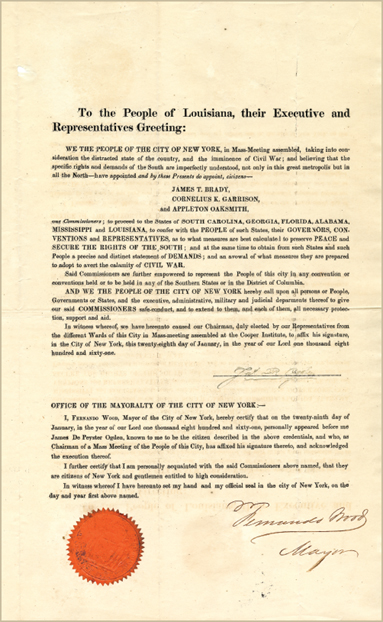
PLATE 8–1
No doubt the weary president-elect looked forward with especially keen anticipation to his arrival in New York City on February 19, 1861. Here, almost exactly one year earlier, he had made his triumphant East Coast oratorical debut at Cooper Union, then a newly opened college in Manhattan. That speech, he later commented appreciatively, together with a flattering photograph made earlier the same day by Mathew Brady at his handsome new Broadway gallery, helped elect him. Perhaps Lincoln had forgotten that despite the enthusiastic reception he had generated among local Republicans and antislavery newspapermen in February 1860, the city ended up voting against him for president that November by a margin of more than two to one. In fact, the smoldering sectional crisis notwithstanding, New York remained hostile to Republicans in general and the president-elect in particular. If Lincoln needed a reminder of the challenges he still faced in (and from) the nation’s leading commercial city, he got a jolting wake-up call soon after his arrival.
The procession of carriages that took him and his family to the Astor House, a sumptuous hotel opposite City Hall, was as impressive as any the metropolis had witnessed, comparable even to the parade the Prince of Wales had enjoyed when he came through town not long before. But spectators along Lincoln’s route offered little of the same fervor. Frank Leslie’s Illustrated Newspaper was not the only one of the city’s many periodicals to report “much respect” but “little enthusiasm” for the president-elect. Riding in an open coach drawn by six black horses (the same carriage, many noticed, that had been used by the future Edward VII), Lincoln could observe flags “flung to the breeze” and a few banners here and there conveying messages of welcome and good luck. But the crowds south of Twenty-third Street thinned out noticeably, and when Lincoln arrived at the Astor House, a large throng may have been on hand to witness his arrival but offered more in the way of stares than cheers. Among the locals trapped in the traffic jam that day, perched on the top deck of a horse-drawn omnibus and thus ideally positioned to observe the scene, was Walt Whitman, who remembered: “There were no speeches, no compliments, no welcome.” The poet found the absence of excitement chilling—and vaguely threatening:
All was comparative and ominous silence. The new comer look’d with curiosity upon that immense sea of faces, and the sea of faces return’d the look with similar curiosity. In both there was a dash of something almost comical. Yet there was much anxiety in certain quarters. Cautious persons had fear’d that there would be some outbreak, some mark’d indignity or insult to the President elect on his passage through the city, for he possess’d no personal popularity in New York, and not much political. No such outbreak or insult, however, occurr’d. Only the silence of the crowd was very significant to those who were accustom’d to the usual demonstrations of New York in wild, tumultuous hurrahs.
Added Whitman: “I ha[d] no doubt (so frenzied were the ferments of the time) many an assassin’s knife and pistol lurk’d in hip or breast-pocket there—ready, soon as break and riot came.”
From there, at least politically, things for Lincoln went from bad to worse. After a rest and a welcoming levee at his hotel, he ventured across Broadway the next morning for an awkward public reception hosted at City Hall by the mayor of New York, Fernando Wood—out of the frying pan, as it turned out, and directly into the fire.
The mayor, an ardently pro-South Democrat, had already decided, as Lincoln well knew, that the best way for New York to maintain preeminence during the sectional crisis and prevent any potential threat to its lucrative trade with the slaveholding South was to secede from the Union, too, and form some sort of independent republic. On January 7, 1861, some seven weeks before Lincoln’s visit, Wood had formally asked the city’s Common Council why the municipality should not “disrupt the bands which bind her to a venal and corrupt master—to a people and a party that have plundered her revenues, attempted to ruin her commerce, taken away the power of self-government, and destroyed the Confederacy of which she was the proud Empire City?”
“As a free city,” Wood suggested, New York “would have the whole and united support of the Southern States, as well as all the other States to whose interests and rights under the Constitution she has always been true.” The breathtaking proposal offered an unimaginable alternative to loyalty: “Amid the gloom which the present and prospective condition of things must cast over the country, New York, as a Free City, may shed the only light and hope of a future reconstruction of our once blessed Confederacy.” After all, Wood argued, if “the Government is dissolved…it behooves every distinct community, as well as every individual, to take care of themselves.” Wood was careful to avoid recommending “the violence implied in these views.” But he provocatively reminded the Common Council of an old rallying cry: “freedom, ‘peaceably, if we can; forcibly, if we must.’” Reading the proclamation, the New York lawyer George Templeton Strong called the mayor “a cunning scoundrel,” noting that Wood “sees which way the cat is jumping and puts himself right on the record…giving the best possible offence to his allies of the Southern Democracy.”
A careful reading of the twenty-page Communication from His Honor the Mayor, Fernando Wood, an original pamphlet copy of which resides in the New-York Historical Society collection, points out a major backstory behind the initiative. Wood was not only fearful of losing trade rights with the South; he also saw secession as an opportunity to separate the city from the rest of New York State, whose legislature had imposed objectionable taxes and exerted unwelcome control over municipal construction projects. In short, the mayor wanted to be as free from Albany as from Washington. Naturally enough, his promise of tax relief and open trade intrigued the worried merchant class and in the bargain appealed to workers, many foreign-born, who had no desire to fight against slavery and see free African Americans competing with them for unskilled jobs. Hundreds of businesses in the city, as the writers Anne Farrow, Joel Lang, and Jenifer Frank accurately pointed out, “were connected to, or dependent upon, cotton…merchants, shippers, auctioneers, bankers, brokers, insurers, and thousands of others.” Whatever the complex nature of the local politics animating Wood’s message, it was interpreted at the time principally as an audacious salvo against the incoming Lincoln administration—and one that came close to outright treason.
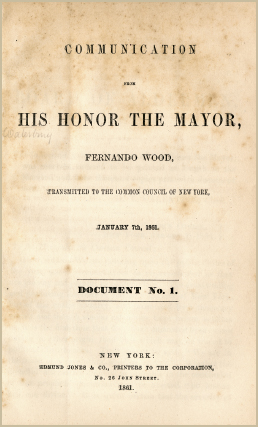
PLATE 8–2
Communication from His Honor the Mayor, Fernando Wood, January 7th, 1861
Three weeks later, Wood outdid himself with an even more extraordinary document—an original copy of which is also at the New-York Historical Society: an official communication, stamped with the city seal, addressed to the governors, senators, and representatives of all the seceded states. The message announced the appointment of three New York “commissioners” instructed to proceed to South Carolina, Georgia, Florida, Alabama, Mississippi, and Louisiana to discuss ways to “preserve PEACE and SECURE THE RIGHTS OF THE SOUTH.” In other words, Wood planned to assume the status of a chief of state designating ambassadors to negotiate concessions to states in rebellion against the federal government. While the emissaries were in the Southern capitals, of course, they could remind officials of New York’s willingness to maintain commercial ties. Not long thereafter, Wood went further still, earning condemnation in some quarters for unashamedly approving the shipment of arms through the city bound for the South.
Wood’s “communication” naturally struck a responsive chord among those of his constituents who were skeptical of Lincoln. New York was bitterly divided, increasingly populated by immigrants with little natural allegiance to American institutions and openly contemptuous of people of color. A tireless organization man from the beginning of his political career with a knack for working the city’s feuding clubhouses to his own benefit, Wood had won election to the House of Representatives as a Democrat before the age of thirty. From 1855 to 1858, he served his first term as mayor, a tenure characterized by bitter disputes with the state legislature over management of the corrupt and fractured police force. After narrowly losing a bid for reelection in 1857, Wood earned a second term in 1859 and was midway through his new, equally fractious administration when President-elect Lincoln passed through town. The writer John Bigelow, who was well acquainted with the mayor, called Wood “the handsomest man I ever saw, and the most corrupt man that ever sat in the Mayor’s chair.”
Now, on February 20, 1861, he formally, almost defiantly welcomed the president-elect from behind the symbolic safety of George Washington’s old desk, which adorned City Hall’s splendid second-floor Governor’s Suite. As Lincoln stood impassively before him, Wood ostentatiously lectured him with a statement urging him to use his “exalted powers” to make certain the country returned to “its former harmonious, consolidated, and prosperous condition.” Wood made no secret in his remarks of his concern that New York’s “commercial greatness” was being “endangered” by the crisis that, the mayor strongly implied, Lincoln had done too little to avert.
In his careful response, Lincoln calmly deflected the assault—and in the process let much of the air out of New York’s secession trial balloon. Repeating a message he had offered in several predominantly Democratic towns along his tour, he thanked Wood and the city for welcoming him even though they “do not by a majority agree with me in political sentiments.”
Then he got to the main point. “There is nothing,” he declared, “that can ever bring me willingly to consent to the destruction of this Union, under which not only the commercial city of New York, but the whole country, has acquired its greatness.” Responding indirectly to the city’s overt secession initiatives, he coolly added: “I understand a ship to be made for the carrying and preservation of the cargo, and so long as the ship can be saved, with the cargo, it should never be disbanded.” The language was oblique, to be sure, but the message was inescapable. Privately, Lincoln was even clearer and more self-confident—adapting a different but unmistakably firm metaphor: “I reckon that it will be some time before the front door sets up housekeeping on its own terms.” If Wood really expected that Lincoln would offer him the concessions and conciliation he had thus far refused to offer the South, he was disappointed. The mayor, a local newspaper reported, “got nothing.”
Lincoln would never appear in public in New York again. But the city’s brief and potentially devastating flirtation with secession ended. Lincoln’s New York troubles would continue, but the idea that the nation’s principal port could declare its independence died aborning. Two months later, once Fort Sumter came under attack, Fernando Wood pledged allegiance to the Union, and his recent and highly questionable initiatives faded from memory. The surviving evidence of New York’s bizarre effort to establish its independence as a free city serves as a reminder of a crucial and fearful interregnum during which a political misstep or rhetorical overreaction might have threatened what was left of the Union and changed the course of history. Asked by the London Times,“What would New York be without slavery?” a Southern editor is said to have replied: “The ships would rot at her docks; grass would grow in Wall Street and Broadway, and the glory of New York, like that of Babylon and Rome, would be numbered with the things of the past.”
That dire prediction was about to be put to the test.