
11

ONE OF THE MORE UNLIKELY RELICS IN THE NEW-YORK HISTORICAL Society’s Civil War collection is this handkerchief-sized cotton flag. Less than a foot square in overall dimensions and somewhat tattered, it retains evidence of the vivid blue with which its unknown creator painted it in 1861, around the same time South Carolina declared its independence from the Union and joined the Confederacy.
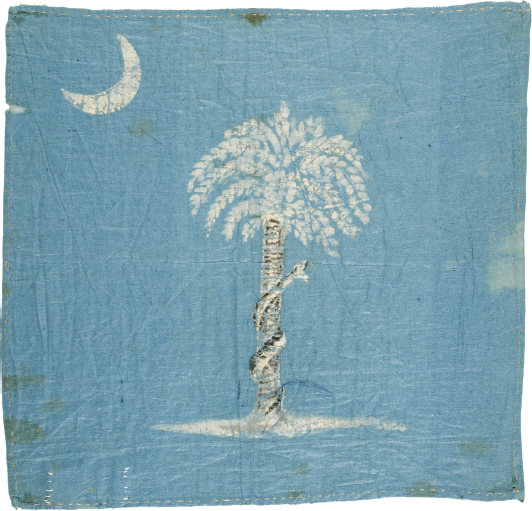
PLATE 11–1
According to the donor who presented the banner to the Society at war’s end, this state flag flew proudly in Charleston during the Confederate bombardment of Fort Sumter—waving in that day’s strong winds as a testament to Southern defiance during the opening hours of the Civil War.
The design for South Carolina’s new state flag, featuring a white palmetto tree set against an azure field, with a white crescent moon tucked into its upper hoist corner, had been formally adopted only three months earlier. But its inspiration could be traced all the way back to 1765, when foes of the British Stamp Act angrily toted blue flags in their protest parades, most of them featuring an emblem pattern composed of three crescent moons—increasingly interpreted as a defiant symbol of liberty. Just such a flag flew from Charleston’s Sullivan’s Island when it came under attack by the British fleet in June 1776. It was said that the city’s defender, the patriot colonel William Moultrie, credited an impenetrable wall of palmetto tree logs at the site of the fort subsequently named for him with saving the island from destruction by enemy shells. In tribute, South Carolina added an upright palmetto tree to the state flag in 1861, as if to serve notice to Union forces that it would again, and always, be prepared to resist what it regarded as invasion.
The flag’s other dominant symbol, the coiled snake, dated to the Colonial period. Benjamin Franklin had issued his famous woodcut, “Join, or Die,” in 1754, showing a snake sliced into pieces, each representing a different disconnected colony. The image was meant to call to mind an ancient legend that held that if a snake was cut into sections, it would return to life if joined back together before the sun went down. By adapting and visualizing this myth, Franklin meant to inspire the squabbling colonies to make themselves stronger through national unity. The coiled-snake motif eventually appeared on American currency, on military uniforms, and of course on flags—the generic snake eventually replaced by an indigenous American rattlesnake, the pieces restored and inseparable, and a new slogan in place to ward off aggressors: “Don’t tread on me.”
By the outbreak of the Civil War, the combination of all these potent emblems in South Carolina iconography served to vivify the assertion of the seceded states that they were fighting a noble battle for their independence and liberty little different from the struggles of the founders against Great Britain during the Revolutionary War era. As the historian Reid Mitchell has pointed out, “The flag itself was the emblem of the community that sent companies and regiments into the field.…Their flags linked them to their homes.” Since flags were usually made by women, they required protection much as the soldiers’ wives and mothers needed protection. “The flag was the physical tie between the homelife they had left and fought for and the war into which they were plunged.” Yet the fact that South Carolina felt compelled to maintain its own flag at a moment of emerging Southern nationalism testified as well to the challenges facing a new Confederate nation founded on states’ rights: some of its own component parts still considered themselves independent republics. Not for a while longer did the Stars and Bars come into general use in all areas of the Confederacy. The problem with the Stars and Bars motif was that it so closely resembled the Stars and Stripes, especially on the battlefield. For that reason the Confederate general P. G. T. Beauregard designed a separate “battle flag” based on the St. Andrew’s cross.
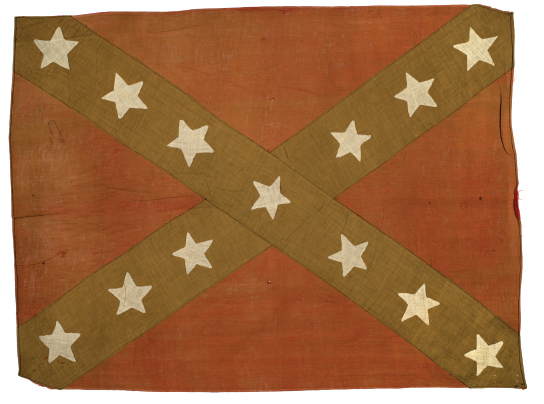
PLATE 11–2
Confederate Navy Jack, or “Southern Cross,” 1861–1865
Nevertheless, artists on both sides returned frequently to the palmetto-and-snake motifs throughout the Civil War—both to further sanctify the idea of Southern independence and, from the other side, to brand it as outright treason.
It would be unfair to conclude that Confederate nationalism waned over the course of the Civil War simply because patriotic emblems grew scarcer or, conversely, that emblems grew scarcer because nationalism waned. The truth has little to do with demand or patriotism. In fact, so much of Southern industry began focusing on war production, so many artists and artisans took up arms, that neither the time nor the manpower remained on hand to supply a full panoply of civilian goods. Imports, meanwhile, declined precipitously as a result of the Union blockade. Through all the deprivation, flags retained their special romance, and it was not unusual for an engraver assigned to “official” work in the Confederate Treasury or Post Office departments to place a flag prominently on currency or stamps. And when Lost Cause artists reinvigorated Confederate memory after 1865, flags and flag bearers resumed their dominant place retrospectively. Artists like William L. Sheppard and Allen C. Redwood made flag bearers objects of special attention and reverence, illustrating the legend that those bearing the colors almost always fell picturesquely and passed their banners to an eager comrade before either soldier or flag hit the ground. The reality was more complicated, but one story that has the ring of truth involved an enlisting officer who told a potential recruit that he would be especially proud to carry the regimental flag because it bore the words “Victory or Death.”
The enlistee replied, “I object to the motto.”
“Why so?” inquired the officer. “How shall it be changed?”
The recruit answered: “Make it victory or pretty damned badly wounded, and I’m your huckleberry.”
If enthusiasm varied, so did the use of enthusiasm-generating symbols. Toward the end of the war, the snake symbol that had begun appearing frequently in American cartoons created in the North was no longer the coiled rattler symbolizing American defiance but the equally venomous new symbol of Northern Democratic opposition to the war: the copperhead. New York, Boston, and Philadelphia artists might depict Jefferson Davis strung up from a symbolic palmetto or hanging from the proverbial sour apple tree of derisive song. In one end-of-war print titled “Young America,” the nation was symbolized by the cherubic infant Hercules, seen choking the life out of the two serpents dispatched by a jealous Hera, according to Greek myth, but redeployed now to remind Northerners that national survival had been threatened by the reptilian offenses of sedition and rebellion. The palmetto and snake, once used to represent liberty and endurance, came in the end to reference treason.
That makes it doubly ironic that in June 1865, E. C. Estes, the business manager and secretary of the executive committee for the National Freedman’s Relief Association, sent this flag to George H. Moore, librarian of the New-York Historical Society, accompanied by the following affidavit: “Herewith is a small Palmetto Flag which was in use by the Rebels during the attack on Fort Sumter. Mr. Chs. C. Leigh obtained it in that vicinity some years ago. He is certain of its genuineness, and when about to leave home a month ago, at my suggestion deemed it best to send it to you.”
At the time, the association was busy collecting clothing and cash not for unrepentant white advocates of the Lost Cause but for ex-slaves uprooted and impoverished by the war. Perhaps Estes and Leigh meant this only as a prize of war. It did not seem to occur to the generous donor that the flag had once represented the last defense against the freedom of the once-enslaved people his organization was now endeavoring to sustain.