
12

ON APRIL 15, 1861, PRESIDENT LINCOLN OFFICIALLY ACKNOWLEDGED the existence of a rebellion against the U.S. government. Based on a 1795 law giving him the power to arm the states’ militias in an emergency, he issued a proclamation calling for seventy-five thousand volunteers to “re-possess the forts, places, and property which have been seized from the Union” by “combinations too powerful to be suppressed by the ordinary course of judicial proceedings, or by the powers vested in the Marshals by law.” Four days later he ordered a blockade of Southern ports. The aggressive response masked a desperate situation. The South housed the majority of federal arsenals, now falling like dominoes into Confederate hands. And in 1861 the American standing army boasted a paltry sixteen thousand men, most of them assigned to duty at remote western forts guarding settlers against Indians.
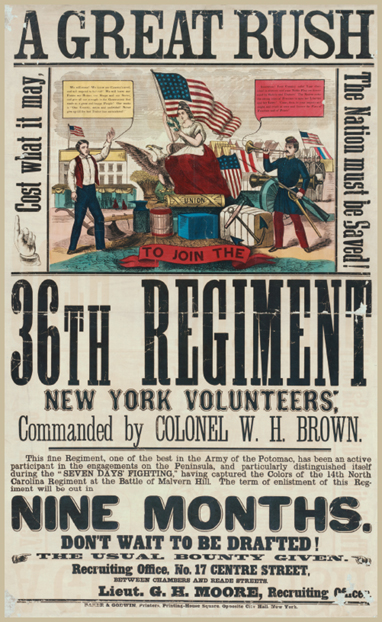
PLATE 12–1
Northern states responded to the proclamation with alacrity, but within weeks four more Southern states forced now to choose between secession and suppression of their sister states not only formally refused to raise regiments for Lincoln but abandoned the Union entirely: Tennessee, Arkansas, North Carolina, and Virginia joined the Confederacy. Border slave states like Kentucky and Maryland resisted the call for volunteers and teetered on the brink of secession as well. In July, Lincoln asked a special session of Congress for “the legal means for making this contest, a short, and a decisive one.” After this, no one doubted that a real civil war had begun, even though confident Northerners continued to believe it would be brief.
Because the Militia Act that authorized Lincoln to call for volunteers specifically limited their service to ninety days, many idealistic Northerners rushed into service expecting to endure no more than a three-month duty characterized by more glory than danger. Only later did the administration turn to three-year recruitment and eventually resort to military conscription to fill increasingly demanding state quotas for more men.
The first volunteers had a difficult—and dangerous—time reaching the national capital. On April 19, the day Lincoln ordered the blockade, a mob of pro-secessionist Marylanders attacked troops from the 6th Massachusetts Volunteers as they attempted to change railroad lines in Baltimore—along the same perilous route Lincoln himself had originally planned to take when he passed through that city en route to Washington for his inauguration six weeks earlier. Lincoln had altered his plans, but the soldiers could not. Waiting for them as horses pulled their railroad cars across town, angry onlookers jeered, waved Confederate flags, and threw stones before gunfire rang out. As many as four civilians and nine soldiers died in the riot. Fears mounted that Washington itself was now vulnerable to attack.
When the governor of Maryland, Thomas Hicks, reacted to the outbreak of violence by requesting that federal troops stop using his state as a passageway to the defense of Washington (further insulting the president by proposing that the British ambassador serve as mediator between North and South), Lincoln summoned Hicks and the mayor of Baltimore, George W. Brown, for an emergency meeting. It proved more a confrontation than a conference. The president used the occasion to issue a blunt statement that left little doubt that he expected volunteers not only to continue coming forward but to come forward through Maryland:
You, gentlemen, come here to me and ask for peace on any terms, and yet have no word of condemnation for those who are making war on us. You express great horror of bloodshed, and yet would not lay a straw in the way of those who are organizing in Virginia and elsewhere to capture this city. The rebels attack Fort Sumter, and your citizens attack troops sent to the defense of the Government, and the lives and property in Washington, and yet you would have me break my oath and surrender the Government without a blow. There is no Washington in that—no Jackson in that—no manhood nor honor in that. I have no desire to invade the South; but I must have troops to defend this Capital. Geographically it lies surrounded by the soil of Maryland; and mathematically the necessity exists that they should come over her territory. Our men are not moles, and can’t dig under the earth; they are not birds, and can’t fly through the air. There is no way but to march across, and that they must do. But in doing this there is no need of collision. Keep your rowdies in Baltimore, and there will be no bloodshed. Go home and tell your people that if they will not attack us, we will not attack them; but if they do attack us, we will return it, and that severely.
The president hoped he had secured the right of passage through Maryland, but when troops still had not appeared in Washington by the night of April 23, Lincoln’s aides found him standing “alone and silent” before the huge windows on the second floor of the White House, gazing “long and wistfully…down the Potomac in the direction of the expected ships; and, unconscious of other presence in the room, at length broke out with irrepressible anguish in the repeated exclamation, ‘Why don’t they come! Why don’t they come!’” Two days later he authorized Lieutenant General Winfield Scott to arrest the members of the Maryland legislature, if necessary, to prevent their assembling at Annapolis with the avowed purpose of instituting secession proceedings. When the first battered volunteers of the 6th Massachusetts finally limped into Washington, Lincoln greeted them personally, saying: “I begin to believe that there is no North. The Seventh Regiment is a myth. Rhode Island is another. You are the only real thing.” But then New York’s 7th at last made its way into town, covering the final twenty miles from Annapolis on foot, prepared to fight secessionists all along the way if necessary. Finally, Washington was secured.
New York responded to the first call for volunteers—its initial quota was seventeen regiments—with a rush of patriotic fervor and an unprecedented commitment to service. “Cost what it may,” thundered one recruiting poster, “the Nation must be Saved!” On Sunday, April 21, George Templeton Strong attended Sabbath services at New York City’s Trinity Church and was electrified by the divine coincidence of the epistle of the day from the book of Joel: “Prepare War; wake up the mighty men: let all the men of war draw near.…Beat your plowshares into swords.…Multitudes, multitudes in the Valley of Decision…because they have shed innocent blood in their land.” By the following evening, prominent New Yorkers, Strong among them, had organized a volunteers’ association to manage recruitment efforts. New York’s 7th Regiment marched down Broadway and off to the defense of Washington “through a tempest of cheers two miles long,” while a parade of the 69th Irish Brigade attracted a large crowd of what the incurable blue-blooded snob Strong called “Biddies…sobbing and sighing.” According to Strong, too old to fight but sufficiently imbued with war fever to agree to train recruits in rifle marksmanship: “Both regiments looked as well as one has a right to expect of levies raised on such short notice. The uniformed companies looked and marched well.”
In May, the stakes increased when Lincoln asked for another forty-two thousand volunteers, this time for a term of three years, and added a call for eighteen thousand sailors for the navy. Individuals eager to claim command of a new company or regiment conducted most of this recruiting. Absent any government recruiting offices—at least initially—these ambitious would-be captains and colonels competed with one another to organize units for the war. The New-York Historical Society boasts a number of posters that were once displayed in shopwindows, on fences, and on trees to attract volunteers. “Pension! Bounty! Extra Pay!” promised one. Another, promoting the Harris Light Cavalry, touted its “beautiful camp at Scarsdale, near New Rochelle, New York” as if it were a vacation retreat, adding that “6 Sergeants and 8 corporals to each company will be selected from the best privates in the ranks.”
Yet another such poster heralded “75 More Recruits Wanted for the Anthon Battalion of Light Artillery Now Quartered at Camp Green, Mount St. Vincent, Central Park, N.Y.,” adding the alluring promise of “$50 cash bounty immediately upon enlistment and $100 at the end of the war!”
The New York print publisher Baker & Godwin, which had issued a Lincoln campaign lithograph just a few months earlier, now produced a large notice asking for volunteers for the Twelfth New York Artillery, which breathlessly announced: “The conscription will soon commence! Avoid it and secure the Bounties and help to man the forts! Awake! The Enemy Are Upon Us.” The offer included a $402 bounty from the federal government and $75 more from the state, and the poster provided the useful detail that recruiters were ready to accept volunteers at offices on both Broadway and South Street. Baker & Godwin contributed other stellar examples of the genre, including a magnificent hand-colored, two-by-three-foot “Recruits Wanted” broadside offering Brooklyn recruits a $75 bounty and a month’s pay in advance to serve three years under Colonel Anthony Conk’s “Senatorial Regiment.” The appeal to patriotism was visual as well as mercenary. The woodcut featured a barefoot and appealingly buxom goddess of liberty sitting atop a cannon beside a large American eagle, holding the national shield and a ribbonlike banner declaring: “Respond to Your Country’s Call!” In the background sat a paddle-wheel ship and a lighthouse to suggest unthreatened commerce and by contrast the now-iconic walls of Fort Sumter, its tattered flag flying. Surmounting all was a liberty cap illuminated by a sunburst indicating that the war had become as much about freedom as reunion and revenge.
The resulting early rush of patriotism nationwide was compromised by confusion, disorganization, and corruption, but somehow the Union came close to meeting its manpower quotas. The North was ready to make the war a short one as advertised, though the South had other ideas. New York exceeded its original quota many times over, organizing sixty-six regiments by the end of 1861.
One of the gaudiest among all the Society’s recruitment posters is the richly illustrated “A Great Rush / Cost what it may,” a poster issued in 1862 to attract recruits for the 36th Regiment, New York Volunteers, a unit commanded by a colonel named W. H. Brown. Though this handsome example of the Union’s insatiable appetite for manpower dates to the year after recruiting officially commenced, it beautifully represents the ongoing push for volunteers.
By the time this poster appeared, Lincoln had asked for yet another 500,000 men, and there was no going back. By the end of the war, by one estimate, more than 2.7 million had served in the federal armed forces and over a million in the Confederate.