
13

INTACT SURVIVING CIVIL WAR UNIFORMS IN FINE CONDITION ARE RARE and precious enough, but the gorgeous, impeccably preserved Zouave costume that has resided in the New-York Historical Society collection since 1948 may be unique. The exotic woolen outfit—boasting additional elements made of linen, cotton, metal, bone, and even wood—was worn by Private David P. Davis of the 5th New York Volunteer Infantry, a unit known as Duryee’s Zouaves or the “Red-Legged Devils,” through some of the bloodiest engagements of the eastern theater. Davis was one of thousands of early Union recruits who went into action at the most terrifyingly modern battles in world history incongruously dressed like Algerian soldiers from previous generations. Anachronisms or not, by the end of the war some seventy-five Zouave regiments had fought on the Union side and about twenty-five regiments on the Confederate. All of them enlisted and fought in flamboyant attire like this as long as their costumes held out. They proved hard to maintain and virtually impossible to replace.
In their baggy red pantaloons, short cape-like jackets, white puttees, gold-trimmed wraparound sashes, and fez-style tasseled hats of distinctly Middle Eastern inspiration (they even wore turbans for dress occasions!), Zouaves turned out to be easy marks—their uniforms’ vivid hues made them targets. But for a while, fey and affected as their apparel may look to modern eyes, Zouaves were widely considered the roughest and toughest men in Union service. Eventually, most Zouave regiments shed the distinctive costumes, if only because it grew increasingly difficult to find materials to repair them. But a few units did stubbornly cling to the uniform (the 114th Pennsylvania, also known as Collis’s Zouaves d’Afrique, served in full dress from 1862 until the end of the war because, it was explained, they were “men of pride and culture”). The gradual disappearance of these colorful Zouave fighters, as the historian Mark E. Neely Jr. and I have written, constituted what amounted to “a reversal of the caterpillar’s progress toward butterfly.”

PLATE 13–1
The French had first brought the Zouave “look” home from their wars in North Africa in the 1830s (the name derived from a colorfully attired Berber tribe from Algeria’s Jurjura Mountains known as the Zouaoua) and adapted it for their own elite units in the Crimea. Observing them there, the future Civil War general George B. McClellan praised the French Zouaves as “the most reckless, self-reliant, and complete infantry that Europe can produce,” adding admiringly: “With his graceful dress, soldierly bearing, and vigilant attitude, the Zouave at an outpost is the beau-ideal of a soldier.” There was no denying that though to modern eyes they made soldiers look not unlike harem dancers, the uniforms came to convey unrivaled fearlessness. “Nobody knows anything about these men who has not seen them in battle,” wrote Thomas Wentworth Higginson, a white abolitionist who later became an officer in an all-black Union regiment. “There is a fierce energy about them beyond anything of which I have ever read, unless it be the French Zouaves. It requires the strictest discipline to hold them in hand.” Not everyone concurred. The artist Winslow Homer created several famous canvases of Zouaves smoking pipes or pitching quoits in camp, but even an art critic of the day who lauded the works as “remarkably fine” could not help speculating about the inutility of Zouave uniforms in combat, deriding the “flaming scarlet and blue…with which some departmental lunacy has clothed a large portion of our heroes.”
In fact, one of the war’s first Union heroes had helped introduce and popularize the Zouave style in America, and his early death cemented the Zouaves’ reputation for manhood and courage. Ephraim Elmer Ellsworth, who hailed from upstate New York, won prewar fame as the drillmaster of an elite and gaudily uniformed outfit called the U.S. Zouave Cadets, by some accounts the first Americans to dress in this distinctive style. Ellsworth may have had a hand in designing the uniforms himself, but it was one of his cadets who described their attire with all the deadpan earnestness of a twenty-first-century fashion writer: “A bright red chasseur cap with gold braid; light blue shirt with moire antique facings; dark blue jacket with orange and red trimmings; brass bell buttons, placed as close together as possible; a red sash and loose red trousers; russet leather leggings, buttoned over the trousers, reaching from ankle halfway to knee; and white waistbelt.” When the Ellsworth unit made an appearance at the New York Academy of Music for a “grand dress” demonstration of its gymnastic drill routines, the New York Times rapturously declared, “The name Zouave is just now a household word.”
Ellsworth’s elite unit went on to win a national drill team championship and then toured the West performing its acrobatic routines to the accompaniment of a brass band. Later Ellsworth headed to Illinois, where he fell under the thrall of Abraham Lincoln, studying for a time in Lincoln’s Springfield law office before joining a handpicked cadre of military officers and civilians who accompanied the president-elect as bodyguards on his inaugural journey to Washington. The spruce, diminutive Ellsworth, who became a huge favorite with the entire Lincoln family, initially hoped for appointment to a desk job in the War Department, but when it stalled, he impatiently returned to New York and organized a company of local firemen into an eleven-hundred-man Zouave regiment, deploying them to the defense of Washington in the spring of 1861. Lincoln personally swore them in on May 5.
That month, itching for action, Ellsworth grew increasingly offended by the sight of a mammoth Confederate flag constantly flying from atop the Marshall House, an undistinguished hotel in Alexandria, Virginia, just across the Potomac River from the White House—technically Confederate territory since Virginia had seceded in April. On May 24, Ellsworth defiantly marched a company of soldiers into the city and climbed up to the hotel rooftop himself, where he tore down the flag and headed downstairs clutching it as a trophy of war. But the hotel’s indignant proprietor, James W. Jackson, met Ellsworth as he descended the staircase and fired at him at close range with a double-barreled shotgun, killing him instantly. The little colonel, the first Union officer to die in the war, was only twenty-four years old. Reflecting widespread outrage at the news, George Templeton Strong predicted that his “murder will stir the fire in every northern state.” In Strong’s opinion, Ellsworth “could hardly have done such service as his assassin has rendered the country.”
Recognizing similar propaganda value in the tragedy, and no doubt deeply mourning his death as well, Lincoln consecrated Ellsworth’s sacrifice and helped elevate him to the status of national martyr by hosting his funeral in the East Room of the White House. He also sent a magnificent condolence letter to the young man’s bereaved parents, lamenting in part:
In the untimely loss of your noble son, our affliction here, is scarcely less than your own. So much of promised usefulness to one’s country, and of bright hopes for one’s self and friends, have rarely been so suddenly dashed, as in his fall. In size, in years, and in youthful appearance, a boy only, his power to command men, was surpassingly great. This power, combined with a fine intellect, an indomitable energy, and a taste altogether military, constituted in him, as seemed to me, the best natural talent, in that department, I ever knew.
Amid the Ellsworth mania it was forgotten by most Northerners that the colonel’s so-called avenger, the innkeeper Jackson, was himself shot dead on the spot by a Union corporal. Jackson, too, became a martyr, no less celebrated for his sacrifice in the Confederacy as was “the gallant Ellsworth,” the quintessential Zouave hero, in the Union. But with significantly greater publishing power, and a public blessed with much more disposable income to spend on decorative pictures, the Northern hero emerged the more famous by far. More than four dozen prints of Ellsworth flooded the marketplace in 1861.
Following Ellsworth’s virtual canonization, so many Zouave regiments organized in tribute, imitation, or both that one French-language newspaper proudly commented: “Il pleut des Zouaves” (“It is raining Zouaves”). Like all regiments, they varied in ability, but their extravagant uniforms always made them stand out. New York uniquely combined ethnic pride and fashion appeal when it organized one such unit, the Phoenix Regiment of Corcoran Zouaves, which its commanders described as a “splendid Regiment of Irish volunteers” composed of “as fine a lot of fellows as ever followed the Green Flag to Battle.” In the words of a verse accompanying its original recruitment poster: “Oh, come and wear a green cockade / And learn the soldier’s glorious trade; / ’Tis of such stuff a hero’s made— / Then come and join the Bold Brigade.”
Unfortunately, far less is known about Private David P. Davis, whose son donated his intact uniform to the New-York Historical Society more than eighty years after the end of the war. But according to archival records, Davis enlisted at the age of twenty-six on May 9, 1861—only two weeks before Ellsworth died so spectacularly in Alexandria—mustering into service at Fort Schuyler in the Bronx before heading south to the front. Before the end of his two-year service, Davis saw action in the Peninsula Campaign, the Second Battle of Bull Run, Antietam, Fredericksburg, and Chancellorsville. He survived them all—flamboyantly dressed like this.
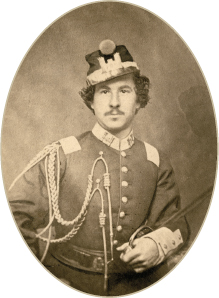
Ephraim Elmer Ellsworth (1837–1861),
photographic print, ca. 1861
PLATE 13–2