
14

NOT EVERY NEW YORKER VOLUNTEERED TO FIGHT FOR THE UNION, or even support the Union cause, even in the wake of such patriotism-generating events as the attack on the Stars and Stripes at Fort Sumter, the flag-suffused rally at Union Square, and the martyrdom of the local celebrity Colonel Ellsworth. For some, what was often called “the Southern way of life” proved irresistibly alluring.
One such New Yorker was Howard Cushing Wright, whose coolheaded letter to his mother declaring his unwavering allegiance to the Confederacy appears on these pages. Wright was born in the city around 1837; his father was a banknote engraver from Maine, and his mother was a well-known educator who hailed from Charleston. No doubt the Sumter episode alone inspired fascinating table conversation in the Wright household in April 1861. One wonders what Mrs. Wright said of the action at her onetime hometown—or what her son made of it. A war many historians have described as brother against brother may have seemed to the Wrights more like a mother-against-father dispute. In fact, most of their children sided with the Union. But the Wrights had apparently taken or sent their promising son on several trips to the South during his boyhood, and these sojourns clearly influenced him.
He was precocious from the start and an abundantly gifted writer. By the time war broke out, according to an account written many years later by his niece, young Howard had already established a small weekly literary journal in New York, developing a skill, a contemporary reported, for “composing serial sketches and romances.” To help support himself, he sent additional contributions to a number of Louisiana newspapers and established a reputation there as well. Wright had already spent considerable time in the region and was devoted to Southern literature. When war broke out, he left for New Orleans.
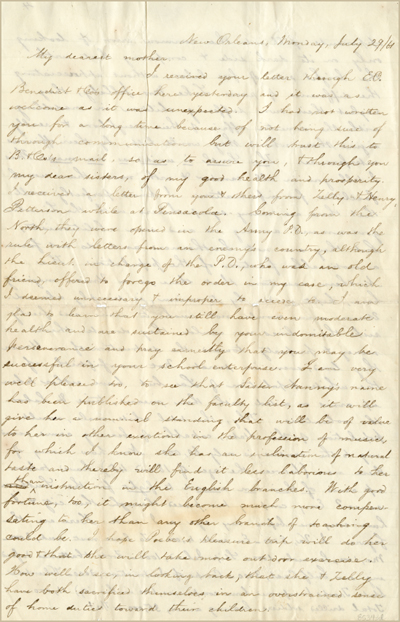
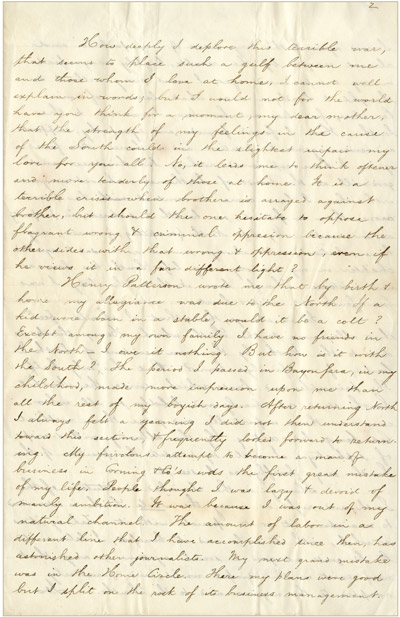
PLATE 14–1
On July 29, 1861, his spirits lifted by the unexpected Confederate victory at the First Battle of Bull Run (Manassas), Wright wrote home to his Southern-born mother to explain his decision to renounce the Union—probably to an audience of one who did not need much convincing, considering her origins. But as Wright’s long letter shows, he certainly knew he was likely to lose the affection of other family members by pledging allegiance to the Confederacy. His letter reads more like a manifesto. Its calm formality suggests that he rather hoped his relatives could steer it into print.
After dispensing with family matters, Wright got right to the point, arguing passionately for states’ rights, Southern independence, and the righteousness of slavery in what must rank as one of the most impassioned defenses of the Confederate cause ever composed. Though still largely unknown, it is eloquent enough to require a transcript rather than a summary:
How deeply I deplore this terrible war, that seems to place such a gulf between me and those whom I love at home. I cannot well explain in words, but I would not for the world have you think for a moment, my dear mother, that the strength of my feelings in the cause of the South could in the slightest impair my love for you all. No, it leads me to think oftener and more tenderly of those at home. It is a terrible crisis when brother is arrayed against brother, but should the one hesitate to oppose flagrant wrong & criminal oppression because the other sides with that wrong & oppression, even if he views it in a far different light?
Henry Patterson wrote me that by birth & home my allegiance was due to the North. If a kid were born in a stable, would it be a colt? Except among my own family, I have no friends in the North—I owe it nothing. But how is it with the South? The period I passed in Bayou Sara, in my childhood, made more impression upon me than all the rest of my boyish days. After returning North I always felt a yearning I did not then understand toward this section, & frequently looked forward to returning. My frivolous attempts to become a man of business in Corning & Co’s was the first grand mistake of my life. People thought I was lazy & devoid of manly ambition. It was because I was out of my natural channel….
Northern papers boast of the unparalleled “rush to arms” of their people but what do the figures show? No deduction need be made from Northern population for slaves. Now if the North had “rushed to arms” as Louisianans have, [General Winfield] Scott would per force have 1,300,000 men at the seat of war and over 2,000,000 under arms and drilling, ready to respond to the first call of danger. And La. has not ceased sending troops to the field. Nearly every day companies are arriving from county parishes and others are getting up all over the city. Yes, my dear mother, I tell you with the solemn earnestness of truth, the people of the South are resolved, now that their stand of independence is taken, to maintain it to the bitter end. Thousands after thousands of their bravest men may be slaughtered in battle, they may be driven inch by inch from their homes on the border, but before they are conquered every courageous Southerner must be killed, every Southern dollar expended and there will be no longer a South—it will be but a worthless wreck. We are ready at any moment to put the torch to our entire cotton crop, destroy all our stored provisions, yes, to burn down our cities as the Russians did at Moscow, if necessary. But such sacrifices will not be required. Manassas has told us so….
Now, then the South being determined to uphold the institution of slavery, in the belief that it was right, natural to their country, and God-ordained (vide the Sacred Scriptures), the best informed and most thoughtful have seen for years that the “irrepressible conflict” [the New Yorker William H. Seward’s controversial prewar phrase for the inevitability of war] was a stern reality. The abolitionists did not boldly proclaim their real intentions in 1856 and 1860 because it would not have been politic, but they knew that by laboring with perseverance they could drive the South from one point to another until at length it would awake to its danger only to find itself helpless in the net which had been so slowly but surely drawn around it.…The Republican party gained control of the North and the Abolitionists gained control of the Republican party.
Southern statesmen saw the precipice to which their section was being so noiselessly drawn and they endeavored to awake the slumbering South. Many opened their eyes and myself among the number. I was not an earnest secessionist, on principle, from 1859, but a great many slept in their fancied security and indignantly protested against the cry of wolf because its fangs were not fastened in their throat.
But those who saw the danger resolved to save their country if possible. They knew that Lincoln would be elected and his administration could cripple the South in six months by removing our material to northern arsenals, by gaining unprincipled partizans among us through the disposal of office and federal patronage. Trusting to the ultimate vindication of his constituents, [John] Floyd [former president Buchanan’s secretary of war] sent all the war material South that he could remove without arousing suspicion, that we might not be defenceless when we had to fight for our independence. Lincoln was elected & the news fell like a thunderbolt on those who had thought a majority at the North could never be deluded into hostility against them. Now spoke forth secession. “The irrepressible conflict is upon us—the South must choose at once between the abolition of slavery or independence—a year hence will be too late to take a stand—we will then be in chains!”
…Patriotism slept for awhile with some and the greed for gain and cowardly love of ease and safety kept others from coming forward. But the rapid succession of events that followed dashed the veil from before the eyes of the dim-seeing and awakened the latent patriotism of the luxuriant. Now we are eleven bonded States, Missouri is anxious to join us and poor outraged Maryland would, if she could. In Western Va & Eastern Tenn. there are plenty of abolitionists but our principle of government gives them the right to go where they please—to cast their lot with whichever government they desire. The South needs and wishes no unsympathizing hearts, no unwilling hands.
And now for the deduction—If slavery is right in the estimation of the South, she is right in upholding it. Consequently she is right in taking every necessary measure for defending it. Who but the individual menaced can be the judge of his danger? The South believed her institutions would be gradually destroyed by remaining in the Union & that the only way of preserving them was to set up an independent government, she had the right to do so precisely as the colonies had to declare their independence in 1776, when their cause of complaint was not the threatened destruction of their social system but simply a question of the pocket—taxes.
The North says that in seceding the South wanted to rob her. What baseless assertion! Has the South ever refused to arrange a friendly and equitable settlement of the national accounts? Why the North has never thought of letting her do it. The South, I believe, would gladly have consented at one time, even to get the worst of the bargain, than to be dragged into conflict with their brothers to maintain their rights. No, the Lincoln government thought it was able to rush out slavery, even if the South were destroyed with it, by arraying the host of the Northern States under that shallow but delusive cry of “the Union.” This cry is but thoughtless sentiment—the stern and terrible facts of the times require men to go deeper down than buncombe….
There seem to be three principle [sic] motives which bind together the North in this bloody, fratricidal war of extermination. First, the abolitionists think they see in it the eventual freedom of the slaves, whose alteration of social condition is to them dearer than the lives of millions of their own brothers. Second, the spirit of revenge arouses among the masses, and their desire to retrieve the mortification caused at first by the fall of Sumter & latterly by the rout of their great army at Manassas. Third, the love of ambition and gold, the war furnishing such a large number of military titles and “fat contracts.” Thus, the Northern motive—springs of this war resolve themselves into four vices—fanaticism, revenge, vanity and avarice. These lead to crimes on a much larger scale that are inseparable from war—murder, arson, robbery and lying. Would it not have been better and more Christian to let the Southern Confederacy go out of the Union, right or wrong, with a fair settlement of the national accounts and an amicable treaty of commerce and friendship?
Who is there so stupid or even so prejudiced as to really and honestly believe that the South can now be forced back into the Union? What would a Union be worth, maintained by fire and sword? If a wife thinks she is wronged by her husband, and believing that he intends to ill-use her, leaves him, is there any honorable or chivalrous man who would advocate beating her and putting her in chains to prevent her running away? I am in no mood for boasting; because we have won such a signal victory at Manassas I do not look forward to a constant succession of triumphs; but this I do say, and leave its vindication to time & history—the South cannot be conquered….
As my brothers-in-law, and perhaps my sisters, look upon me with deep sorrow for having espoused the cause of the South I have often longed to sit down and write them why I am heart and hand a secessionist, not that I expected to abate their Northern feelings a jot, (for a drop of rain can affect nothing falling in the midst of a desert of sand) but that they might understand and perhaps appreciate my feelings, should it become necessary for me to confront upon the battle field the man of that section in which I happened to be born. It is well that they should know that if I am not already in the ranks of Gen. Beauregard’s army, it is not because I am unwilling to go or hesitate to wield a sword or bayonet against Northern men. [T]he South has plenty of men in the field to defend her soil and there are plenty more “eager for the fray.” If these are not enough she will find plenty more, myself among the number. I pray God that in such an event I may not be confronted by one I love or esteem, but my duty to my country is my duty to God and to him I pray, as you pray, to bring this horrible war to an end.
The “horrible war” of course continued, and true to his word Wright enlisted as an officer in the 30th Louisiana Infantry and saw action at the Battle of Baton Rouge in 1862 and in the Confederate defense the following year of Port Hudson, a stronghold along the Mississippi River. From there he was captured, imprisoned, paroled, and joined up to fight yet again.
Wright died in action on the battlefield on April 14, 1865—according to the date supplied by his niece to the Historical Society decades later. Although Lee had surrendered the Army of Northern Virginia five days earlier, effectively ending the war, skirmishes had continued to break out in North Carolina, Alabama, and several states in the West. Wright was reported to have “received a shot wound in the breast which caused instant death” during an artillery exchange at West Point, Georgia. Joseph Johnston surrendered the last standing Confederate army to William T. Sherman just twelve days later on the twenty-sixth.
Another casualty the very same day Howard Wright died was Abraham Lincoln, fatally shot at Ford’s Theatre shortly after 10:00 p.m. Earlier on that same April 14, Major Robert Anderson, the commander who had lowered the U.S. flag in surrender at Fort Sumter four years earlier to the day, raised it anew in triumph at ceremonies there marking the end of the Civil War. By now, Sumter was a ruin, its walls battered by months of relentless shelling not by South Carolinians but by Union gunboats. Fireworks illuminated the harbor that night. Onlookers in Charleston no doubt recalled the beginning of the conflict, still not aware that Lincoln would soon become its final casualty and certainly unaware that a little-known New York writer named Howard Cushing Wright had fought against his section and his family, in his niece’s words, showing himself “true to his convictions…a brave and loyal soldier who gave his life for the cause in which he believed.” Wrote another eulogist: “The soil that he loved so well can not but lie tenderly on his faithful breast.”