
15

ASIDE FROM A FEW SURVIVING GIGANTIC CYCLORAMAS AND PETER Rothermel’s mural-sized paintings of the fighting at Gettysburg commissioned by the state of Pennsylvania for its spacious capitol building, here is perhaps the largest-scale Civil War painting of them all. And it is a true New York anomaly—a masterpiece of nineteenth-century public relations designed, in a phrase so often used by modern marketers, to make lemons into lemonade.
Triumphal as the scene appears to the modern eye, the painting actually commemorates not the battle at which the men depicted in it had fought but the safe return home to lower Manhattan of its survivors. And these Irish Americans are veterans not of a resounding victory but of a humbling defeat. Perhaps only in New York could ethnic pride swell so grandly as to inspire a mammoth canvas more than seven by eleven feet in size to honor a regiment that had achieved its greatest success supervising a retreat. Recently restored to the full magnificence that once dazzled both critics and viewers following years of deterioration in storage, the panoramic picture now holds pride of place atop the museum staircase in the second-floor galleries opposite the New-York Historical Society library—repository of some of the surviving archives of the very battle in which these soldiers fought.
To comprehend the onetime power of Louis Lang’s Return of the 69th (Irish) Regiment, N.Y.S.M. from the Seat of War requires an understanding of who these men were—and how they got to and from the war in the first place. On April 23, 1861, just nine days after the surrender of Fort Sumter, the ten-year-old 69th Regiment of the New York State Militia responded to President Lincoln’s call for volunteers and headed off to defend Washington under the command of the thirty-three-year-old colonel Michael Corcoran. Like most of his troops, Corcoran hailed from Ireland—in his case Carrowkeel in County Sligo. He had assumed command of New York’s 69th in 1859.
A member of the influential Fenian Brotherhood in America as well as an active Democratic ward politician who held significant power as a school inspector and served on an influential committee overseeing judicial nominations, Corcoran had been highly successful in recruiting Irish Americans into the army. The Lincoln administration had made it clear that in order to promote loyalty among the North’s diverse population—some of which, like the overwhelmingly Democratic Irish, opposed Lincoln politically—it wanted ethnic regiments formed and men we now call “hyphenated Americans” named to command them. By 1861, colonels and generals with foreign-sounding names like Schimmelfennig and Corcoran could be found leading Union soldiers into battle. Few proved very adept, but that is another story.
Corcoran’s 69th, already widely known as the Irish Brigade, headed off by ship to Annapolis, then by rail to Washington, arriving at the capital on May 9, 1861, and making camp above the city at Arlington Heights. Assigned to join other units building up the defenses around Washington, the crack New York militia regiment needed only a week to construct its own 650-by-450-foot fortification, which the troops named in honor of their commander: Fort Corcoran. The grateful colonel asked the regimental chaplain, a Catholic priest named Thomas Mooney, to baptize its newly installed cannon with holy water. Father Mooney captured the mood of the hour by declaring, “Parents look forward to the first words of their children. I look forward to the first roar from the mouth of this babe.” The archbishop recalled him.
On July 21, the Irish Regiment was ordered into the Battle of Bull Run in Northern Virginia as part of a brigade commanded by Colonel William T. Sherman. The 69th held its position manfully in the midst of a humiliating rout, losing forty-one men, then helped safeguard the Army of the Potomac’s exposed rear flank during its hasty retreat back to Washington. But Michael Corcoran fell into enemy hands and became a prisoner of the Confederates. From captivity, he sent out the stirring message: “One half of my heart is Erin’s, and the other half is America’s. God bless America, and ever preserve her the asylum of all the oppressed of the earth, is the sincere prayer of my heart.”
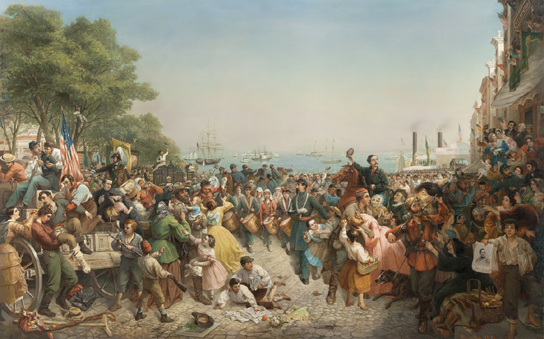
PLATE 15–1
Though Corcoran continued to languish in confinement for more than a year, the twelve hundred volunteers of the Irish Brigade officially concluded their ninety-day enlistments once they returned to Washington from Manassas and then shipped back to New York under the command of Thomas Francis Meagher. They had served well in the midst of a demoralizing Union catastrophe, but even the most unflappable of these returning Bull Run veterans could not have expected the joyous reception the city offered them when they stepped off the steamer John Potter at Pier One at Battery Park in Manhattan on the morning of July 27. It was this jubilant scene that the artist Louis Lang painted in such monumental scale: a bravura depiction of a triumphant return that lacked nothing except the underpinning of a triumph. In a city where Irish pride trumped military accomplishment—and where sustaining morale remained a high priority—the boisterous reception seemed the most natural thing in the world. A critic of the day recognized that the picture emphasized not martial combat but “touching episodes that diversify the scene when the soldier becomes again the citizen.”
Following their exuberant shoreline welcome, the ninety-day veterans of the 69th marched up Broadway to Union Square, then back down Fourth Avenue all the way to Grand Street to deposit their weapons at the Essex Market Armory. By August 3, the militia regiment had officially disbanded. It was left to Lang to immortalize a unique moment in early Civil War history: the glory of service for the sake of service.
He proved more than up to the challenge. Lang (1814–1893) was the son of a history painter and came to America from Germany as a young man after studying art in Stuttgart and Paris. By the early 1850s, he was an established artist in New York and a member of the prestigious National Academy. No one is precisely sure who commissioned him to paint the large picture of the return of the 69th, but the regiment itself is the likeliest patron. It had an armory to decorate and a memory to preserve.
When completed in 1863, Lang’s monumental canvas debuted on public display at the Knoedler Gallery (formerly Goupil’s) on Ninth Street. It was an instant hit. A critic for the New York Times commented favorably, noting that the incident it portrayed “gave scope to the artist; allowing him to introduce the magnificent Bay of New-York as seen from Bowling-green.”
The influential periodical Fine Arts concurred: “The entrance of the 69th Regiment of N.Y. State Militia into this City…on its return from its first brief and bloody campaign, was a popular ovation, especially among the Irish residents of New York. The steady bearing and resolute gallantry of the Sixty-ninth, in circumstances over which we have always passed lightly and which we would not willingly recall, fixed the Sixty-ninth in the hearts of the people. The return, we say therefore, of its shattered and hard-worn remains was regarded as a fete; and Mr. Louis Lang, a very skilful and estimable artist here resident, has been happy enough to select the most striking moment of their reception as the subject of a large commemorative painting, now on exhibition at Goupil’s.” For its part, the gallery wisely directed its exhibition publicity at the Irish community. As its own advertising broadside proclaimed: “Well may our adopted citizens be proud of a regiment that has nobly sustained the glory and heroism of their native land, while defending the flag of their adoption.” As the art historian Barbara Dayer Gallati has asserted, the picture broke no new ground in heroic art—how could it, with its focus instead on portraying identifiable local civilian celebrities?—but with its “brilliant accretion of detail” it provided “a complete impression of an actual urban event” on a “scale…unmatched in nineteenth-century American art.”
Lang’s highly romanticized scene—after all, it is very unlikely that children and beautifully dressed girls lolled about in the street as men and horses approached—was so well received that it seemed not to matter that the man shown doffing his cap to the cheering crowd sandwiched between Castle Garden and the Washington Hotel was not the regimental hero. Michael Corcoran remained jailed in the South, and it had fallen to his replacement, Captain Thomas Francis Meagher, to get his enlistees home—and to receive the ovation of the welcoming crowd. “Col. Corcoran in Irons!” the Albany Evening Journal reported as late as September 5. “The traitors have special animosity against the gallant Colonel. He has, from the first, spurned every proposition to give his parole, or in any way to recognize the authority of the Rebel Government.…The announcement that their heroic Colonel is subjected to these indignities and humiliations will stir the warm blood of his friends.” Lang cleverly included Corcoran in his scene in a detail in the lower right-hand corner of the canvas, where a newsboy can be seen hawking lithographs of the captured commander. As for the carefully delineated spectators shown cheering from nearby buildings and on the streets, Lang provided a useful “key” to their identities: many were portraits of the actual community leaders who had welcomed the regiment home. As the key reveals, the chaplain who had blessed Fort Corcoran a few months earlier was not among them. When New York’s archbishop, John Hughes, learned that Father Mooney had “baptized” a cannon, he replaced him with Father Bernard O’Reilly, and it is O’Reilly who makes an appearance in the Lang canvas, tending to a Bull Run widow clutching her orphaned child.
Michael Corcoran finally gained his liberty in an August 1862 prisoner exchange. President Lincoln honored him and a few other newly liberated officers with a White House dinner on the eighteenth. The hero of the 69th eventually returned to New York and formed a new outfit, the Corcoran Legion, which subsequently saw action in a number of minor battles. Corcoran died young but not gloriously. Returning to the defense of Washington, he was riding alone three days before Christmas 1863 when he suffered a fatal accident, fracturing his skull when his horse fell on top of him.
As for the 69th, it reorganized with three-year recruits and returned to action later in 1861. Over the next few years, the Irish Brigade saw action on the Virginia Peninsula and at Second Bull Run and Antietam. According to legend, the Confederate general Robert E. Lee was so impressed by its stubborn valor at another costly Union defeat at Fredericksburg that he dubbed the regiment “the Fighting 69th.” True or not, the name stuck.
The painting, however, became an artistic curiosity of local interest to only those who recognized the represented figures. In addition, the depiction of the regiment’s triumphal homecoming remained relevant just a short while, for not only did the soldiers return to the battlefront, but anti-Irish backlash following the 1863 draft riots further diminished the work’s enduring attraction. In 1886, Lang donated the canvas to the Historical Society, where it remained on view until sometime after World War II. When curators rediscovered it in storage in 1977, it was in several pieces, which is how it remained until the beginning of the twenty-first century. The Williamstown Art Conservation Center reassembled the tattered fragments in time for the Society’s grand reopening, after a three-year renovation, on November 11, 2011—fittingly, Veterans Day.