
16

ABRAHAM LINCOLN’S ELDEST SON, ROBERT, SPENT MUCH OF HIS father’s presidency away at school in New England—he was enrolled at Harvard Law by the year Lincoln was assassinated—and his younger brother Willie died just eleven months into his father’s term. In a way, it comes as little surprise that no surviving photographs show the Lincolns together before tragedy struck one, then another of them down.
Yet in another sense, the absence of such period pictures is astonishing. The briefly united family could easily have visited a photographer’s studio together in that first wartime summer of 1861, when Robert arrived in Washington on school vacation and both younger boys were alive and well. The national mania for photographs was at its peak that year. The new carte-de-visite process made pictures far easier, and cheaper, to make and reproduce. The public collected images not only of their own families but of celebrities as well, filling their new leather albums with portraits of parents, children, and politicians alike. Yet no such sitting was ever arranged for or by the Lincolns. The family—principally Mary Lincoln, who generally hated the way she looked in photographs—never felt the need to commission a group picture, even though Mary enthusiastically collected family and celebrity cartes herself. For a time, the public appeared to have little interest of its own in seeing, much less owning, images of the president, his wife, and their three sons. The modern cult of the first family had not yet come into existence, and never would the Lincolns have another chance to immortalize themselves together. Robert, who came to regard the White House as a “gilded prison,” spent most of his time away.
As for First Lady Mary Lincoln, who reacted to Willie’s death by lapsing into protracted mourning, she later admitted she was fortunate if her busy husband could find time to visit her bedroom late at night merely to talk over the events of the day. The presidency was never conducive to family togetherness, and in the crucible of civil war it divided the Lincolns as much as it fractured families who sent fathers, brothers, husbands, and sons into battle—and often never saw them again.
Nonetheless, when the president himself died at the hands of an assassin in April 1865, Americans suddenly expressed a longing for retrospective visual assurances—however fanciful—that Lincoln had indeed enjoyed comfort in the bosom of his family while he lived. One particular New York–based artist was perfectly situated to capitalize on this demand. The man who deserved—but never truly received—full credit for brilliantly responding to this cultural yearning was the Homer, New York–born painter Francis Bicknell Carpenter (1830–1900). In 1864, armed with introductions from leading Republican politicians and further aided by a lifelong friendship with one of Lincoln’s clerks, Carpenter talked his way into the White House and spent six months working there to create a heroic canvas of Lincoln reading the first draft of his Emancipation Proclamation to his Cabinet back in July 1862. The artist enjoyed life sittings with the president and his Cabinet officers and made many sketches of Lincoln’s office. Ultimately, he painted the group gathered around a table there, in the spot they had first discussed Lincoln’s most famous official act. Lincoln greatly admired the result. The huge canvas subsequently went on a national tour, earning critical raves and no small amount of fame for Francis Carpenter.
While laboring on his ambitious picture, which today hangs in the U.S. Capitol, Carpenter also got to observe Lincoln in loving exchanges with his surviving little boy, Tad. He believed that if “the worst of his adversaries” could only see the burdened president behind the scenes, it “would have melted their hearts.” To Carpenter, “The President never seemed grander in my sight than when, stealing upon him in the evening, I would find him with a book open before him…with Little Tad beside him.” In response, he so painted the two together for a tiny cameo picture he probably created expressly as a family keepsake. It remained unknown to the public for a century.
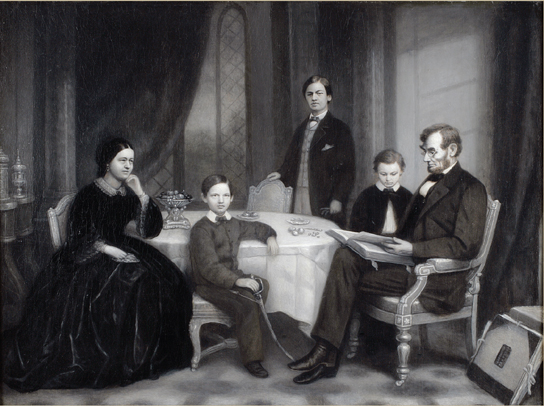
PLATE 16–1
More important, Carpenter also accompanied Lincoln and Tad to Mathew Brady’s photography studio in February 1864 principally to pose the president for a series of pictures meant to serve as models for his emancipation project. During the visit, he persuaded the president to sit for one photograph together with Tad, examining the photographer’s oversized sample photograph album as if it were one of those books he often saw Lincoln reading to the boy. The resulting warm portrait of father and son might have served then and there to ameliorate the prevailing image of Lincoln (at least to his opponents) as a brutal warrior and harsh abrogator of constitutional liberties. But inexplicably it remained unpublished during the entire Civil War. Only after Lincoln’s murder did Mathew Brady release the photograph to the public. It became an immediate bestseller, after which engravers and lithographers outdid themselves in a race to adapt the pose into imaginary composite group portraits of the entire, ill-fated family. None of these 1865 prints credited Carpenter for first posing the source model, and many of them took the liberty of converting the Brady prop album into a Bible in an effort to further sanctify the scene.
That left Carpenter to create the definitive, if no longer the first, pictorial statement about the private Lincoln. The usually enterprising artist was uncharacteristically lethargic in responding to the commercial appeal of such pictures. He did not take his idea for a Lincoln family portrait to the New York publisher John C. Derby until well after Lincoln’s death. Nonetheless, Derby offered Carpenter the handsome sum of five hundred dollars to create a group portrait and hired the accomplished New York engraver John Chester Buttre to adapt it into a mezzotint. But Buttre had to wait.
Even as competitors rushed their cheap imitations to the market, Carpenter patiently wrote to Mary Lincoln to ask which photographic models he might consult to achieve the most accurate results. Mary recommended “the best likeness” of Robert taken “at [John] Goldin’s” Washington studio the previous spring, apologizing that she had “none, unframed,” to send him. She did share one relic from the Lincoln family album: a photograph of Willie and Tad together, taken in 1861. “Even in that likeness, of Willie,” she lamented, “justice, is not done him, he was a very beautiful boy, with a most spiritual expression of face.” Mary refused Carpenter’s entreaties that she pose for a new photograph herself. It would be “utterly impossible,” the grieving widow insisted, “in my present nervous state.” Asked to propose an alternative, the ever-vain Mrs. Lincoln recommended “an excellent painted likeness of me, at Brady’s in N.Y. taken in 1861.…I am sure you will like it.” It is easy to see why Mary urged this particular model on the artist. The heavily retouched Brady image had miraculously carved inches from her ample posterior. Carpenter followed all of the widow’s suggestions.
Using these models, Carpenter accomplished a handsome painting, but only “in black and white,” he explained, “with the expressed purpose of facilitating the engraving. When that was completed, I fully intended to finish…the painting by adding color to theflesh…as well as to the draperies.” He never did. Yet what the picture lacked in color, it more than made up for in skillful portraiture and the canny arrangement of figures and props: the composition showed the Lincolns seated around a modest, draped table bearing food as if set for an afternoon tea. Carpenter did not believe in “imaginary curtain or column, gorgeous furniture, or allegorical statue.” Obviously pleased with the result, the print publisher, Derby, spent another $1,164 to get the chiaroscuro original engraved. It was finally issued in 1867. By then, unfortunately, many print buyers had already purchased group portraits of the Lincoln family, however inferior. The once-robust demand had faded. The Carpenter project had consumed so much time that the engraver, Buttre, was compelled to impose a mustache on the portrait of Robert Lincoln in recognition of the fact that the so-called Prince of Rails had in the intervening years grown from boy to man. Though titled The Lincoln Family in 1861, the composite in fact depicted its subjects as they appeared over a three-year period. Some copies of the engraving—including an example in the New-York Historical Society—featured the very tinting and highlighted the very draperies that Carpenter had eschewed for his painting.
Francis Carpenter never got the credit he deserved for originating a powerful idea: sympathetically showing a quintessential public man—the president of the United States—in a private sphere alongside his wife and children. Until then, the genre had allowed for only a single famous example: the iconic domestic glimpse at George Washington and his family by Edward Savage. Carpenter did nothing less than launch an artistic revolution in how Americans perceive their elected leaders.
Carpenter’s oil on canvas may look to modern observers like a colorless boilerplate—merely a family gathered woodenly around the proverbial dining room table. But the inspirational model for the composition—Lincoln reading a book to Tad—was in fact Carpenter’s original invention, and only the painter’s chronic insistence on perfection denied him the approbation he deserved for so brilliantly inventing a private life for the fallen Civil War president.
For a time, an appreciative Mary Lincoln lavished praise and attention on Francis Carpenter. When he arranged publication of an engraved portrait of the late president, she provided a rare and enthusiastic endorsement, calling it “the most perfect likeness of my beloved husband that I have ever seen.” She felt betrayed, however, when Carpenter assembled his firsthand impressions of Lincoln—along with stories from contemporaries—into what turned out to be an enormously successful book called Six Months at the White House. Mary’s chagrin escalated into fury when subsequent editions of the memoir were retitled The Inner Life of Abraham Lincoln. The woman who had once expressed “great pride” in “the success” of Carpenter’s work now denounced him as a “silly adventurer…with whom my husband had scarcely the least acquaintance,” scathingly adding: “This man…never had a dozen interviews with the late President and the latter complained more than once to me, that C[arpenter] presumed upon the privilege he had given C. to have the use of the State dining room, for a short time, whilst he was executing his painting. This was done in consequence of the rumor we had heard of his indigent circumstances.”
In 1895, the sixty-five-year-old painter learned to his distress that his original Lincoln family painting had been sold to a New York collector for just fifty dollars by one George Probst, who had inherited Buttre’s business when the veteran engraver died two years earlier. Probst insensitively boasted that he had rescued the long-discarded original “from a rubbish pile where it had lain for twenty-five to thirty years…forgotten by everybody.” The proud new owner, Warren C. Crane, wasted no time in showing his acquisition to Carpenter. The artist admitted that he, too, had “forgotten all about the picture” but bristled that he had never actually sold it to Buttre, merely consigned it to be engraved. Despite his insistence that he had relinquished “only the copyright of this picture…and not the painting,” and that the “incredible” fifty-dollar purchase price was “humiliating” to someone who had in his heyday commanded a thousand dollars and more for his portraits, Carpenter never regained ownership of his work.
Instead, Crane kept the black-and-white oil painting, preserved it, and ultimately donated this unique relic of the Civil War White House to the New-York Historical Society in 1909, the centennial year of Lincoln’s birth. Certainly not the first, and probably not the most popular, domestic Lincoln image published after the president’s death, it remains the most authentic behind-the-scenes study ever created of the Lincolns—a family shattered in life but evocatively reconceived by one New York artist’s uncanny vision.