
17

AMONG THE MILITARY ARTIFACTS AT THE NEW-YORK HISTORICAL Society is this magnificent double-headed tubular snare drum, its wooden cylinder lavishly decorated with an expertly painted American eagle whose outstretched wings are surrounded by a border of stars, a red-white-and-blue shield of liberty at its feet. The animal-hide instrument is two-sided, indicating it was made to be used in battle, where, like all such drums, it was employed to convey orders to troops. Even in the confusing smoke and noise of combat, alert soldiers were trained to rally around specific drumrolls that signaled either attack or retreat.
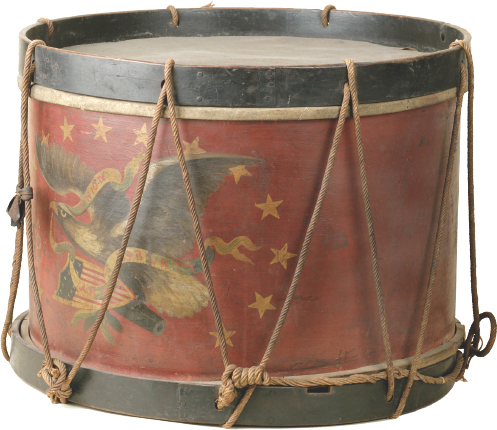
PLATE 17–1
That this method of communication was effective was confirmed by one Confederate general who appreciatively recalled a Union advance at Antietam so brilliant it could have been inspired only by its regimental band. He remembered that “this magnificent array moved to the charge, every step keeping time to the tap of the deep-sounding drum.” In this sense, drums became something approaching the category of weapons for their power to inspire precision. It is no surprise that the choicest surviving examples boast patriotic inscriptions, and this particularly fine relic is emblazoned with the motto “Union and Liberty.” Its red color indicates it was made for an artillery unit (blue drums signified infantry).
According to the museum’s files, the Society’s drum was used during the Civil War by one Philip Corell (1847–1935). Like many (but not all) drummers, Corell enlisted as a mere fourteen-year-old. He initially joined the 99th New York Volunteer Infantry in 1861 and later served in Hancock’s Veteran Corps, which contained regiments from New York, Pennsylvania, Maine, and Wisconsin. General Winfield Scott Hancock led his troops through the 1862 Peninsula and Maryland campaigns and fought with distinction at Fredericksburg, Chancellorsville, and Gettysburg. We do not know for sure whether Corell was on hand for all these engagements, but we can surmise that Hancock made ample use of musicians and drummers: any commander who acquired the nickname “The Magnificent” no doubt expected to be accompanied by marching bands.
At least Corell made it safely through all four years of the war and more, mustering out in 1866 and living almost seventy more years. Though plenty of camp musicians were adults, the romance attached to heroic “little drummer boys” resonated with the public. Corell was hardly the youngest drummer boy in the Union service. Traditionally, that distinction belongs to the Ohioan Johnny Clem, the famous “drummer boy of Shiloh,” who joined up when he was only nine. Another source gives the youngest recorded drummer boy’s age as seven. According to that unrivaled chronicler of Civil War statistics, E. B. Long, some thirty-eight hundred soldiers aged sixteen or younger actually served in the ranks of the federal army. The historian Bell I. Wiley calculated that 5 percent of Confederate soldiers were under eighteen. But that number surely did not include drummer boys, whose numbers were undoubtedly far larger, for each regiment needed one and the Union alone boasted more than thirty-five hundred regiments. According to one record, the U.S. Army placed orders for no fewer than thirty-two thousand drums between 1861 and 1865. A surviving roster for the regimental band of the 72nd Volunteer New York Infantry, a unit probably very much like Corell’s 99th, boasted four separate musicians assigned, variously, to side and bass drums. Drummer boys almost always marched at the front—of both the band and the regiment itself.
Some regiments organized fife-and-drum bands that emphasized percussion over melody. A veteran of the 17th Maine remembered many a sunrise reveille promptly followed by the unforgettable sound of the drumrolls. “The drums of one regiment commence their noisy rataplan, which is taken up by the ‘Ear piercing fife and spirit stirring drum’ of another, which is in turn echoed by another, till every drum corps of the brigade, with accompanying bugles and fifes, join in the din, and the morning air is resonant with the rattle of drums.”
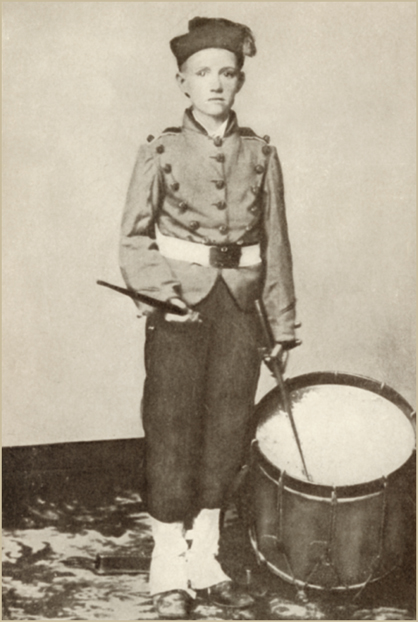
Charles F. Mosby, Age 13. Confederate Drummer Boy,
Served Throughout the War, photographic print, ca. 1865
PLATE 17–2
A powerful mystique thus grew up about drummer boys, nurtured along in large measure by poetry (Whitman extolled the “pride and joy” of “the stretch’d tympanum”), juvenile literature, and sentimental artists. The painter William Morris Hunt (1824–1879), for example, idealized one such young serviceman as a long-haired, open-shirted ragamuffin who appeared to have come right out of the barricades of the French Revolution. Hunt was not subtle: he symbolically positioned his drummer boy on a pedestal in acknowledgment of all such children’s bravery. But despite its pretensions, the picture was surprisingly well received. Hunt followed this effort with a more realistic depiction titled The Wounded Drummer Boy, showing a child—perhaps the same drummer as he had depicted previously—now lying prostrate before his discarded instrument. Hunt’s contemporary Eastman Johnson (1824–1906), who actually witnessed the Battle of Antietam, painted another unlikely scene he claimed to have observed firsthand there. He described his creation as “a drummer boy…disabled by a shot in the leg. As he lay upon the field,” Johnson maintained, “he called to his comrades, ‘Carry me and I’ll drum her through.’ They tied up his wound, a big soldier took him, upon his shoulders, and he drummed through the fight.”
Such events probably never occurred, since drummer boys did not in fact “drum through the fight” during battles. They issued their rat-a-tat signals to announce attacks, after which they promptly headed to the rear to perform the other job to which they were assigned in combat: the grisly task of serving as stretcher bearers to remove the dead and the maimed. Another artist who left a singularly realistic portrait of this aspect of a drummer boy’s life—at least in words—was Edwin Forbes, who observed in his memoirThirty Years After: An Artist’s Story of the Great War, published in 1890: “Painters of military pictures are fond of placing a broken drum in the fore-ground of their battle-scenes; but no representation could be more incorrect, for during a battle musicians anddrummers are detailed to the rear for hospital service, and may often be found behind some fence enjoying a quiet cup of coffee.”
Between engagements, drummer boys functioned in camp practically as servants, cleaning up campsites, barbering soldiers’ hair, and drawing heavy pails of water from the nearest wells. During lulls in the action—and there were many more lulls than actions—they also served as part of the rhythm sections of their camps’ military bands, pounding away during parades and drills, performing at impromptu evening concerts, and of course helping to rouse the soldiers before the crack of dawn. Thus they slept little themselves. The kindest soldiers collected funds to pay drummer boys something on the side and got small-sized uniforms made for them. The most brutal adults treated them abusively; what soldier, after all, enjoys being roused for reveille?
One painter who truly understood and acknowledged the stark life of the drummer boy in wartime was the New Englander Julian Scott, who in 1861 lied about his age to enlist at fifteen as a fifer in the 3rd Vermont Infantry. Scott went on to earn a Congressional Medal of Honor for valor under enemy fire, and when he began depicting scenes of the Civil War, he often showed drums and drummer boys on the sidelines of his pictures—where in fact they belonged. No one ever doubted their bravery, but the life of the drummer boy was far less glamorous than the one that most artistic observers mythicized. Scott’s 1891 canvas, Civil War Drummer Boys Playing Cards, pointedly reminded viewers that the Civil War had exposed children to what one company musician described in a letter home as the “demoralizing influence the vices of army life have upon the minds of a great many.” Where drummer boys were concerned, as Scott was pointing out, the war robbed a generation of its innocence.
We have no way of knowing where and under what circumstances Philip Corell played his drum during the Civil War—or how close he came to the kind of danger many artists vivified. But we do have his spectacularly preserved instrument, on which Corell’s handwritten ink inscription is still visible, testifying to pride of ownership and faithfulness to duty: “Philip Corell / Co. F 5. Regt U.S. Vet. Vols. / 2nd BRIG. 1st DIV. 1st A, C. / Washington/D.C.” As a handful of drummer boy photographs in the collection also show—all of them portraying young men proudly clutching oversized instruments like this one—their wartime experiences were likely the most exciting of their lives.
It surely surprised none of these veterans that Walt Whitman gave a particularly evocative title to his first collection of poems dedicated to the Civil War: Drum-Taps. And in one of the poems he described the power of the drum to stir a storm—this time of patriotism—right out of King Lear:
Beat! beat! drums!—blow! bugles! blow!
Through the windows—through doors—burst like a ruthless force,
Into the solemn church, and scatter the congregation,
Into the school where the scholar is studying;
Leave not the bridegroom quiet—no happiness must he have now with his bride,
Nor the peaceful farmer any peace, ploughing his field or gathering his grain,
So fierce you whirr and pound you drums—so shrill you bugles blow.
Beat! beat! drums!—blow! bugles! blow!
Over the traffic of cities—over the rumble of wheels in the streets;
Are beds prepared for sleepers at night in the houses? no sleepers must sleep in those beds,
No bargainers’ bargains by day—no brokers or speculators—would they continue?
Would the talkers be talking? would the singer attempt to sing?
Would the lawyer rise in the court to state his case before the judge?
Then rattle quicker, heavier drums—you bugles wilder blow.