
18

AMONG THE MANY AMBIGUOUS DEPICTIONS OF AFRICAN AMERICANS that exist in the Society’s—and nearly every—major collection of Civil War art and archives, Edwin White’s powerful oil portrait remains one of the most intriguing. Massachusetts-born White (1817–1877), a self-taught genre painter with a fine reputation, had trained in Europe under Jacques-Louis David, exhibited at the National Academy, and earned distinction for a number of historical subjects (most prominently his 1859 Washington Resigning His Commission, for which he earned six thousand dollars) when he tackled the theme of freedom in this 1861 image. He did so not with a complex group composition in the manner of Eastman Johnson but with a haunting depiction of a solitary black working man—well dressed but, judging by his bare and deteriorating surroundings, impoverished even in freedom—reading the news of the day and perhaps pondering a better future outside the United States.
A poster marked “Hayti” can be seen tacked to a door in the background, suggesting specific aspirations to migrate to the black-led republic in the Caribbean. The man consults a newspaper, indicating that he is literate and fully capable of grasping his surroundings and aspiring to something better overseas. In other words, this is a colonization picture—meant to assure white people that black people wanted to leave America, even if such was never the case for any but a tiny minority. White’s magisterial canvas has been on permanent loan from the New York Public Library since 1944.
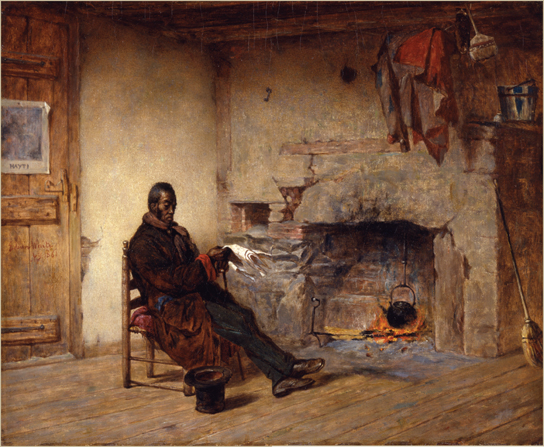
PLATE 18–1
For years, Frederick Douglass had tried to disabuse white Americans—even those like Henry Clay and, for a time, Abraham Lincoln, who believed in colonization as a philanthropic endeavor—of the notion that it was noble or even rational. In Douglass’s contrary view, “the destiny of the colored American” was inexorably intertwined with “the destiny of America” and had to remain so.
Nonetheless, for years conflicted slave owners like Clay, who was known as the Great Compromiser, argued that the only way safely to end slavery in America was to facilitate the deportation of free blacks so that whites did not have to fear violent reprisals and would not have to live among free black citizens. With this supposedly eleemosynary purpose in mind, many moderates flocked to join the American Colonization Society, a group dedicated to this purpose. In a eulogy to Clay delivered in 1852, the former congressman Lincoln made no secret of his admiration for the man or his goal. He unapologetically endorsed words Clay had once employed to advance the idea of colonization: “There is a moral fitness in the idea of returning to Africa her children, whose ancestors have been torn from her by the ruthless hand of fraud and violence. Transplanted in a foreign land, they will carry back to their native soil the rich fruits of religion, civilization, law and liberty.”
Not everyone agreed. “An attempt to remove” African Americans from the country, Frederick Douglass insisted, “would be as vain as to bail out the ocean. The whole naval power of the United States could not remove the natural increase of our part of this population. Every fact in our circumstances here marks us as a permanent element of the American people.…We shall never leave you.” As Douglass put it: “We are Americans…and shall rise or fall with Americans.”
White’s rather opaque response to this unresolved debate was widely praised when it first went on view in New York in late 1861 at a sale organized to raise money for some sort of “Patriotic Fund.” Commending the artist for eschewing “ridicule and obloquy” in his canvas, a critic for the antislavery weekly the Independent lauded as “magnanimous” White’s sensitive “portrait of the janitor of the studio-building; a high, thoughtful brow, covered with a black skin, pondering a newspaper.” As the critic interpreted the scene: “The black philosopher is reading the war news, and wondering what the future has in store for his race. The figure is full of feeling, and commands an involuntary respect for the dignified old serving man.”
It appears impossible to pinpoint when the canvas acquired the name by which most people have identified it—Thoughts of Liberia, Emancipation—but it must have been later, since, for one thing, emancipation was not yet at the forefront of the national struggle to restore the Union when it was painted in 1861 and, for another, the background poster labeled “Hayti” clearly indicates that the painter intended the viewer to conclude that the subject of this portrait is pondering a future much closer to home than Africa. Certainly we are meant to infer from the poster tacked to the door in the background—itself a symbol of potentially dramatic exit and entrance—that the sitter is at least giving careful consideration to the thought of emigration nearby. Douglass, who called Haiti a “modern land of Canaan, where so many of our people are journeying from the rigorous bondage and oppression of our modern Egypt,” abruptly canceled a trip of his own there when war broke out in the spring of 1861, saying: “This is no time for us to leave the country.” Since Douglass declared himself—and other people of color—“ready to lend a hand in any way we can be of service,” it is clear that from that day forward he was ruling out the Caribbean as an alternative even for those who had been “looking to that country for a home.”
Over the years, this rugged portrait has inspired as many far-fetched interpretations as the dark-hued, nearly silhouetted masterpiece it most closely resembles—Whistler’s Mother. One modern critic even attempted to tie White’s picture directly to Lincoln himself, suggesting that in his lean, lank frame and haggard face, not to mention the stovepipe hat that can be seen in the foreground on the floor, the African American here bears more than accidental resemblance to the Emancipator. This interpreter went so far as to suggest that White intended “slyly” to probe the black “Lincoln” here “for what his response would be were he the one asked to establish a colony far from his home and the land of his birth.” This may be overreaching, but in any case in the following year, 1862, Lincoln gave two unmistakable indications that his own “thoughts” had not strayed very far from those espoused by his lifetime hero, Clay.
In July 1862, Lincoln drafted an emancipation proclamation, and then, at the advice of his Cabinet, tabled it until its announcement could be sustained by a Union military victory. Throughout the summer, Lincoln impatiently waited for a success that did not come. In fact, the Army of the Potomac instead suffered another staggering setback at the Second Battle of Bull Run. To hasten the process of freedom, Lincoln meanwhile signed the Washington, D.C., compensated emancipation bill and two congressional confiscation acts and began intensive negotiations with Border State representatives to encourage these loyal slaveholding areas to agree to compensated emancipation on their own. But the Border State congressmen rejected the initiative, and with no other alternative Lincoln waited in frustration for the army to give him a victory so he could act alone on slavery in his capacity as commander in chief.
He had firmly made up his mind to do so, but over the next few weeks he gave every indication that he cared not a whit for the fate of the African American himself—a massive public relations feint that the beleaguered president believed crucial to guarantee that the majority of racist Northern whites accepted the proclamation when he finally published it.
In one such initiative, on August 14, Lincoln welcomed a delegation of free African Americans to the White House to discuss “emigration,” marking the first time a president had hosted an official group composed of people of color. But the president hardly played the perfect host that day. Accompanied by an Associated Press reporter he had apparently instructed to record his remarks, Lincoln asked his visitors to be seated and then informed them that Congress had “appropriated…and placed at his disposition” money “for the purpose of aiding the colonization in some country of the people, or a portion of them, of African descent, thereby making it his duty, as it had for a long time been his inclination, to favor that cause.”
“Your race are suffering,” Lincoln bluntly told them, “the greatest wrong inflicted on any people. But even when you cease to be slaves, you are yet far removed from being placed on an equality with the white race.” Without slavery, Lincoln continued in an astonishing exclamation, “the war could not have an existence.” Then he got specific—and even more blunt:
It is better for us both, therefore, to be separated.…The place I am thinking about having for a colony is in Central America. It is nearer to us than Liberia—not much more than one-fourth as far as Liberia, and within seven days’ run by steamers. Unlike Liberia it is on a great line of travel—it is a highway. The country is a very excellent one for any people, and with great natural resources and advantages, and especially because of the similarity of climate with your native land—thus being suited to your physical condition.
As the stunned delegation sat in silence, Lincoln rambled on awkwardly, concluding by asking them to give a month’s consideration of his proposals “for the good of mankind.” The group withdrew and two days later sent a polite letter both commending the president for so “ably” making known his views and asking for more time to consult “with leading colored men in Phila New York and Boston upon the movement of emigration, to the point recommended in your address.” The AP reporter dutifully wired an account of Lincoln’s remarks, and the dispatch was widely published in the press; that is how Douglass learned of them.
Frederick Douglass, however, did not wait to consult with anyone. Only a few months after writing sympathetically that a “blind man can see where the President’s heart is,” the enraged abolitionist leader published a highly critical editorial in Douglass’ Monthlycondemning Lincoln for assuming “the language and arguments of an itinerant Colonization lecturer, showing all his inconsistencies, his pride of race and blood, his contempt for Negroes and his canting hypocrisy.”
Douglass continued: “Illogical and unfair as Mr. Lincoln’s statements are, they are nevertheless quite in keeping with his whole course from the beginning of his administration up to this day, and confirm the painful conviction that though elected as an anti-slavery man by Republican and Abolition voters, Mr. Lincoln is quite a genuine representative of American prejudice and Negro hatred and far more concerned for the preservation of slavery, and the favor of the Border Slave States, than for any sentiment of magnanimity or principle of justice and humanity.”
There was some truth to Douglass’s harsh judgment. Lincoln was indeed fearful that his imminent announcement of emancipation had the potential of frightening Kentucky and Missouri out of the Union, and he did believe that without their continued loyalty he must surrender the government and abandon the war to preserve the Union. But Douglass’s reaction shows that Lincoln’s speech to the delegation of free blacks had real sting and perhaps went too far. Though calculated to assure white voters that anything he did with regard to emancipation would be motivated by military necessity, not philanthropy, the comments obviously caused deep pain to many in the African American community.
Lincoln relieved some of that despair when he issued the preliminary proclamation on September 22, causing even the dubious Douglass to rejoice. But it would be a mistake to conclude that Lincoln’s map to freedom thereafter followed a consistent path and included no more references to colonization. As late as December, in his annual message to Congress, he revealed that his administration was in the midst of negotiating a consular treaty with “Hayti.” His message also included a proposed constitutional amendment authorizing Congress to appropriate funds “for colonizing free colored persons, with their own consent, at any place or places without the United States.” That month, 453 African Americans sailed for Cow Island off Haiti to establish a new colony there under a dubious for-profit scheme Lincoln endorsed. The expedition proved a calamity, and Lincoln ordered a vessel to return 368 survivors to the mainland in 1864.
In the end, Lincoln actually spent only $38,000 of the $600,000 Congress appropriated for colonization, but there is no question that he actively pursued the idea of voluntary emigration of free blacks until at least mid-1863. Only when African Americans began fighting in the ranks for their own freedom did he conclude that they were fully entitled to coexist with whites in a biracial future society. The revolution in Lincoln’s own mind portended a revolution in American society.