
19

IN MID-1861, THE CONFEDERATE NAVY LIFTED THE SUBMERGED HULL OF the wooden ship Merrimack from the shallow waters of the Portsmouth Naval Base, where it had been scuttled by evacuating Union forces. After that, Confederate authorities completely redesigned it, building a wooden casemate atop the hull and covering it with two layers of two-inch iron plates. The resulting vessel was too big, and the metal sheathing too heavy, for the hybrid failed to achieve much stability or speed: it steamed to a maximum of only six knots. But once launched, the renamed CSS Virginia managed to cause more devastation in one morning and afternoon than at any one-day battle in American naval history until the attack on Pearl Harbor on December 7, 1941—and survived its destructive debut unscathed to fight another day. Many worried observers of the time believed the Virginia might next have steamed up the Potomac and caused unanswerable destruction to Washington itself—ending the entire fight to save the Union, Secretary of War Edwin M. Stanton feared—had it not been for the technological marvel fortuitously en route to Virginia at that precise moment to engage it.
The Union’s response was the truly revolutionary USS Monitor, made entirely in New York, whose original “plating” half model survives to this day in the Historical Society collection, the gift of the ship’s highly efficient and well-paid builder, Thomas Fitch Rowland (1831–1907).
It was a model very much like this one that the Connecticut industrialist Cornelius Bushnell had lugged to Washington to show to Abraham Lincoln at the White House in early September 1861. Bushnell was convinced that a Swedish-born inventor working in Brooklyn, John Ericsson, had hit upon a brilliant advance in naval technology: what Ericsson described as “a floating battery absolutely impregnable to the heaviest shot or shell.” Most daringly of all, the novel design featured a revolving gun turret, the first of its kind ever proposed and a direct forerunner of the rotating guns on modern warships.
Lincoln was certainly open to new shipbuilding ideas; he had once crafted his own wooden model of a vessel designed to lift itself buoyantly over river shoals—for which he became the only president before or after to receive a U.S. patent. But it is fair to say he had never seen anything quite like what Bushnell brought to him, a vessel designed to ride extremely low in the water while keeping afloat its heavy-gauge gun capable of firing in any direction it chose without altering the course of the ship. Lincoln examined the curious wood-and-metal scale model with intense interest and, suitably impressed, promised to accompany Bushnell to the Navy Department the very next morning to discuss the proposal further with the military professionals. There, Lincoln typically issued no direct orders to proceed with the scheme. But in his best frontier manner, he conveyed his undisguised interest by drawling: “All I can say is what the girl said when she put her foot into the stocking. It strikes me there’s something in it.”
Even with that prodding, the fusty naval board took its time mulling over the innovative proposal before ultimately awarding Ericsson a contract to create a test vessel. Work then commenced quickly at Rowland’s shed-like Continental Iron Works in Greenpoint, Brooklyn, using metal from upstate Troy. Employees of the shipbuilding yard were required to take an oath of allegiance, and some initially balked, thinking it was a ruse to conscript them into the armed forces. In an interview with the New York Times in 1890, Rowland remembered that he had insisted on an unheard-of price to bring the plan to full realization, arguing that the construction schedule was so demanding that workers would be required to labor day and night, plus weekends, to speed production, increasing costs. Ericsson had no choice but to agree to Rowland’s terms. It was the inventor who proposed the name for the “floating battery at Greenpoint” in a letter to Assistant Secretary of the Navy Gustavus Vasa Fox. Desiring a title that would convey “the impregnable and aggressive nature of this structure,” he noted that his “iron-clad intruder will…prove a severe monitor” to “the leaders of the Southern Rebellion.” On these grounds, he wrote, “I propose to name the new battery Monitor.” The word ultimately evolved into a generic term for a whole series of similar vessels.
Because of the original bureaucratic delay, however, what became the original USS Monitor was not launched until the end of February 1862, when the Times reported (newspapers never quite understood that printing such news might alert the enemy) that “the iron-clad steamer Monitor” had been “put into commission…at the Brooklyn Navy-yard,” adding: “Great exertions are being made to get the Monitor off at once, and she will doubtless sail in a day or two.” Secretary of the Navy Gideon Welles wisely ordered it to be rushed to the vicinity of Hampton Roads, Virginia, where he presciently expected the refitted Merrimack to emerge at any moment from the Confederate naval yards at Norfolk and menace the wooden American fleet there. Just as feared, before theMonitor could be towed to Virginia—in fact, the ironclad almost capsized in choppy seas along the journey—the Confederate ironclad Virginia appeared on March 8 off Newport News and within hours rammed and sank the stately but antiquated USSCumberland, shelled the majestic USS Congress into a smoldering ruin, and drove the USS Minnesota aground. Some 250 federal sailors died in the attacks, which all but spelled the approaching end of the wooden navy.
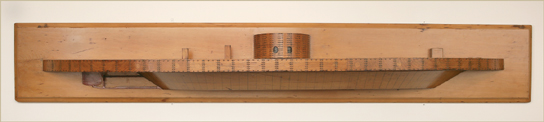
PLATE 19–1
Shifting tides compelled the Virginia to withdraw for the day before it could finish off what was left of the federal armada, but when it appeared the next morning to continue the unchecked devastation, civilian onlookers watching breathlessly from the shoreline noticed a smaller, sleeker vessel steaming toward it from the opposite direction. From a distance, it appeared to be no bigger than an elongated lifeboat of some sort; it looked harmless enough to elicit the derisive nickname “Yankee cheese box on a raft.” In truth, it was low-lying but formidable: 172 feet long by more than 41 feet wide. Moreover, it carried two eleven-inch Dahlgren smoothbore guns.
Over the next several hours, often with less than a hundred yards separating them, the USS Monitor held off the CSS Virginia in what became the most dramatic and unforgettable naval duel of the Civil War. The contest ended in a virtual draw. Shells from theVirginia could not penetrate the Monitor (one officer on the Confederate ironclad commented during the battle, “It is quite a waste of ammunition to fire at her. Our powder is precious…and I find I can do the Monitor as much damage by snapping my finger at her every five minutes”). But the Monitor’s guns proved equally incapable of penetrating the Virginia. Actually, the Monitor’s much-heralded turret malfunctioned during the engagement, rotating uncontrollably, so that the crew was able to fire at the Virginiaonly when the guns swung around fully 360 degrees and the target came back briefly into view. No one died in the duel, and both sides claimed victory. But the arrival of the Monitor neutralized the offensive potential of the Virginia and allowed the Union navy to retain possession of Hampton Roads, which allowed McClellan’s local campaign on the Peninsula to continue. (It subsequently ended in failure anyway.)
Despite all this, the so-called Battle of Hampton Roads proved the inspiration for the kind of art and poetry that seemed almost counterintuitive, since the battle between iron warships whose crews operated unseen from belowdecks rather than waving hats or climbing masts as at classic sea engagements of the past clearly heralded the end of romanticism in naval warfare. Inspecting the vessel for himself some time later, Nathaniel Hawthorne, for example, contended that the Monitor “could not be called a vessel at all; it was a machine.” After seeing the ironclad, he wrote almost regretfully, “All the pomp and splendor of naval warfare are gone by. Henceforth there must come up a race of enginemen and smoke-blackened cannoneers.”
“Hail to victory without the gaud,” echoed Herman Melville in a similarly morose, almost sarcastic, vein. Here was “zeal that needs no fans / Of banners; plain mechanic power / Plied cogently in War now placed— / Where War belongs— / Among the trades and artisans.” Lincoln, of course, saw nothing depressing in the Monitor’s achievement—quite the contrary. Irresistibly drawn to new technology, he visited Ericsson in early April, boarded the Monitor for a personal tour in early May while visiting nearby troops, and subsequently approved production of a fleet of similar ships. Naval warfare would never be the same again. As the Monitor’s chief engineer wrote to Ericsson after the battle: “Thousands have this day blessed you.…Every man feels that you have saved this place to the nation by furnishing us with the means to whip an ironclad frigate that was, until our arrival, having it all her own way with our most powerful vessels.” Credit, even the exhausted crew agreed, went to the inventor and his invention.
In reality, the guns of both vessels fell silent after Hampton Roads. The Virginia never fired another shot in battle. The Navy Department meanwhile ordered the Monitor not to risk another engagement with its Confederate rival unless it posed a new threat to the federal fleet at Hampton Roads. The Monitor’s paymaster likened the orders to the manner in which “an over careful house wife regards her ancient china set—too valuable to use, too useful to keep as a relic, yet anxious that all should know what she owns & that she can use it when the occasion demands.” The occasion never did. When Union forces later took Norfolk, Confederates determined their prize vessel could neither ascend the James River to Richmond nor survive in deep water, and they destroyed theVirginiabefore the enemy could capture it, in much the same way they often burned their own cotton rather than allow approaching Northern armies to seize crops. By New Year’s Eve 1862, the Monitor, too, was no more. On the last day of its only year in active service, the legendary craft went to the bottom in a gale off Cape Hatteras.
Perhaps the quintessential artistic tribute to the pioneer ironclad Monitor is the Society’s lithograph The First Naval Conflict Between Iron Clad Vessels, In Hampton Roads, March 9th 1862, the work of Endicott & Company of New York (plate 19–2). The central image in the composition, like most of the art inspired by the engagement, predictably depicted the one-on-one duel between the two ships at close range, the Virginia belching black smoke, the Monitor spewing white smoke (a pointed good-versus-evil contrast, though apparently their respective engines indeed generated just such contrasting flumes) at certain points of the battle. (The burning of coal produced black smoke on both ships; the firing of guns produced white smoke—again on both ships. It was up to the artist to decide what to emphasize.) Otherwise the Endicott print represented an important departure. It did not even include a portrait of Captain John Worden, the Monitor’s heroic commander, who was temporarily blinded and disabled during the battle. (In acknowledgment, Lincoln paid a courtesy call on the captain as well.) Moreover, it totally ignored the heroic crew who struggled in furnace-hot conditions to stabilize the turret and fire its guns. Instead, the picture focused on the inventor Ericsson, and in additional vignettes along the left and right borders detailed the ship’s unique technological features. Next to Ericsson’s portrait is a depiction of the Monitor’s “caloric engine.” It was as if Herman Melville’s predictions had come to life: honor was bestowed on the machine and its inventor rather than on the sailors.
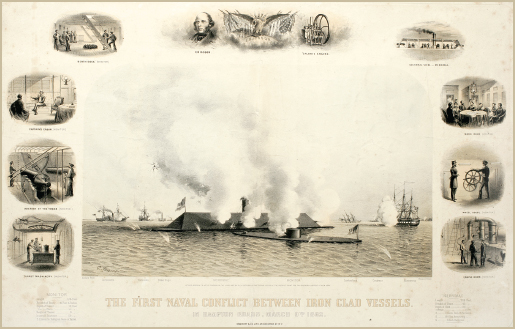
PLATE 19–2
The First Naval Conflict Between Iron Clad Vessels, lithograph by C[harles]. Parsons, 1862
The Union navy triumphed in the end but, just as Melville had noted, “without the gaud.” When the New York Times marked John Ericsson’s death in 1889 by dispatching a reporter to visit the builder Thomas Fitch Rowland at his Manhattan home, the correspondent could not help noticing there, still on proud display, a “model of the Monitor, handsomely finished, and with heads of Ericsson and others set in the frame.”
But that was another model altogether. As the paper scrupulously noted: “The model by which the vessel was built hangs on the walls of the New-York Historical Society, to which it was presented by her builder.” And there it has remained ever since.