
20

ALEXANDER ROBERT CHISOLM (1834–1910) MAY HAVE DIED IN CIVILIAN luxury in New York after a long career as a stockbroker, merchant, and railroad investor. But in his rather more glamorous youth, he had served in the Civil War—on the Confederate side, no less—and most astonishingly of all as a personal aide and, in his own words, “confidential friend” to the flamboyant Louisiana-born Pierre Gustave Toutant Beauregard (1818–1893). Captain Chisolm was in fact serving at the general’s side in Charleston, South Carolina, when Beauregard launched the April 1861 reduction of Fort Sumter. Chisolm’s eventual role was quite specific: he had charge of sending and receiving coded messages, and plate 20–1 depicts the very deciphering key he used for that purpose—by Chisolm’s own description, a “cipher code…in book form.”
Chisolm was born on the large Coosaw Plantation in Beaufort, South Carolina, but when he was left fatherless at the age of two, his mother took him to stay with relatives in New York. After his mother, too, died in a carriage accident, Chisolm and his sister remained in the city, where they were raised by an aunt and uncle. When he came of age, he inherited the family plantation and its 250 enslaved people and returned south to grow rice and cotton on its 3,321 acres. After secession, the governor of South Carolina asked Chisolm to assign some of those slaves to the construction of batteries to be aimed at Fort Sumter from nearby Morris Island. Chisolm requested an army commission in return and became a lieutenant colonel.
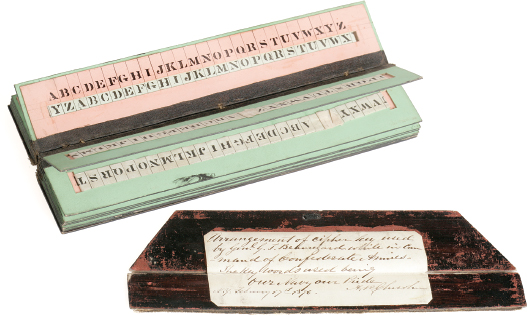
PLATE 20–1
During the worsening Sumter crisis, Chisolm estimated that he took “five different communications” from the Charleston shoreline out to Major Robert Anderson, demanding his surrender. When he finally rowed out to report to the Union commander that Confederate batteries would shortly begin shelling the fort, he recalled that “Anderson was much affected stating that he would await our fire. He accompanied us to my boat cordially shaking our hands remarking ‘If we never meet in this world again God grant that we meet in the next.’” Chisolm later observed that even after the bombardment “the exterior of the fort showed” nothing more than “slight indentations from our artillery fire,” while “not a gun of its three tiers was dismounted.” As he watched the departing federal garrison board ships to head north, Chisolm suddenly realized that it would have been “an impossibility to take” Sumter “by assault,” adding: “That Anderson with his officers should have surrendered is still more to be wondered at, the only excuse for their action appears to be that they had become demoralized by the burning of the barracks, which did not explode the magazine or in any way effect the exterior of the fort.” In one of the most interesting sections of his memoir, Chisolm expressed the belief that had Anderson “agreed to such a disgraceful giving up a Fort two years later, during the war, I believe they would all have been Court marshalled.”
Chisolm saw subsequent action under Beauregard at the First Battle of Bull Run and reputedly led a successful cavalry charge at Cub Run Bridge. Confederate success in this first major engagement of the war was due to the timely arrival of rebel reinforcements from the Shenandoah valley. According to tradition—which may well be as much myth as history—Jefferson Davis was inspired to order those reinforcements to Manassas because of a secret message sent by the Confederate spy Rose O’Neal Greenhow. If so, that message may have been decoded on a contraption much like this one—or perhaps this very relic. Chisolm subsequently accompanied Beauregard west and served as an aide-de-camp, mostly as a scribe and confidential messenger, at Shiloh and other fronts before heading back to Charleston with the general for the long Confederate defense of the city against Union assault in 1862 and 1863, by which time, he noted, Sumter was a “great mass of ruins”—reduced, ironically, not by Confederate fire but by Union. Chisolm saw further action under Beauregard at such places as Battery Wagner, Drewry’s Bluff, Savannah, and Petersburg.
After the war, he sought a pardon from President Andrew Johnson—reputedly the first Confederate officer to go to Washington for that purpose—and then sold his plantation and returned to New York, where he became a shipping merchant.
When Chisolm died at age seventy-five, the war had been over for nearly half a century. But he clearly still treasured his experience in Confederate military service. He had retained all his papers, which included scrapbooks, letters, notes, newspaper clippings, the manuscript of an unpublished, illustrated autobiography, and something more: the curious, fan-shaped cipher key that Chisolm had used in Beauregard’s behalf to send, receive, and unscramble coded messages during the war. In 1912, Chisolm’s son donated the entire lot to the New-York Historical Society, where he trusted it would be “more safely preserved than in my possession.” Included in the trove was the battered cipher key.
Historians are not absolutely certain who adapted the ancient innovation of coded messages for modern war. In one form or another, armies had been using codes for centuries. We do know that a U.S. Army surgeon and cryptographer named Albert Myer, later chief signal officer, introduced a system of flag telegraphy known as “wigwag” that came into widespread use after 1861. The system used rapidly waving flags by day and substituted a system of shifting torches to send messages by night. Both iterations of course required recipients of the signals to have a dictionary, or key, at the ready to translate the coded signals into decipherable words and sentences. Myer later patented a cipher disk that aligned numbers and words in prearranged sequences so that signalmen could also rapidly and securely speak to each other in code by telegraph. Where cipher was concerned, the challenge was always to scramble messages in such a way that the enemy would have difficulty decoding them. But ciphering also required a system that the intended recipients of intelligence could unravel promptly enough to do some good during battle. It was an elusive goal, seldom completely met. But as a veteran of the corps named J. Willard Brown pointed out: “It does not do away with the utility of ciphers that they may be sometimes deciphered, for we must often use them, conscious that, with sufficient time and appliances, they can be interpreted; but knowing, also, that the time interpretation will require will render the message useless to the enemy.” President Lincoln himself often requested that his messages to generals in the field be sent in code. At the top of such messages he characteristically scribbled—often misspelling the instruction—“Cypher.”
Most military historians contend that Union cipher technology far outdistanced Confederate, perhaps because much of the latter remained faithful to the outdated sixteenth-century Blaise de Vigenère method. According to the best source on the complex subject, a study titled Codes and Ciphers, the Confederate general Albert Sidney Johnston employed a different system of shifting letters, known as “Caesar substitution,” to communicate with General Beauregard during the Battle of Shiloh. Again, Chisolm’s very cipher key may have been used to receive and decode that intelligence—which turned out to be insufficient to prevent a Union victory there in April 1862. True to the mystery and complexity that have always surrounded the story of coded messaging during the Civil War, the truth is hard to decipher.
The most Chisolm would explain about the system he used was scrawled in a note written on this relic in 1876: “Arrangement of cipher key used by Genl. G. T. Beauregard while in Command of Confederate Armies—the key words used being Our Navy our Pride.” The veteran did usefully provide an example of how the system functioned, the sample being the coded cryptogram “XIERS.BMSN.J.DLBKXC.HZTHO.” Unscrambled on Chisolm’s key, the information translated into “Jones goes South to night.” Presumably, there were always agents like Captain Chisolm at the other end of the telegraph lines to decode such alerts before the enemy did. All we know for certain is that few of these instruments of secret communication survive.
Chisolm, however, did survive. He married a general’s daughter, thrived in business, and established a home in Manhattan and summer residences in Morristown, New Jersey, and Southampton, Long Island, where he helped found the Shinnecock Hills Golf Club. The only clues to his Civil War experience could be found in the occasional letters he wrote to the New York Times in 1893, 1894, and 1901, loyally defending Beauregard. Far kinder to his flawed old commander than history has been, Chisolm also contributed to the establishment of the Beauregard Monument Fund. Chisolm ended up a commander, too—of the New York camp of the Confederate Veterans.