
21

ON MARCH 9, 1862, A SMALL DETACHMENT COMPOSED OF FOURTEEN dragoons from Company H of the 1st New York Cavalry launched a valiant charge against a 150-man element of General Joseph Johnston’s Confederate infantry in Northern Virginia. The Union men were under the command of a youthful, well-connected New York City–born lieutenant named Henry B. Hidden.
By one account, the rebels were at the time menacing the site of a bridge that Union soldiers were attempting to build at the Sangster railroad depot near Fairfax Station, Virginia. According to other descriptions, the Confederates were merely attempting an orderly withdrawal toward the Rappahannock River from Centreville and Manassas. Whatever the impulse for the charge, Hidden’s surprise thrust initially scattered the much larger enemy force, and the mounted New Yorkers reportedly took thirteen Confederate prisoners. But at the peak of the brief and furious action, a bullet struck Hidden in the neck, killing him. He was only twenty-three years old. The vastly outnumbered members of the New York cavalry unit quickly fell into enemy hands.
Hidden and his cavalrymen might have been entirely forgotten, and the Battle of Sangster’s Station, as it came to be known by veterans of the tiny engagement, might have languished even deeper in the shadows of Civil War history had it not been for the large, churning canvas that the painter Victor Nehlig (1830–1909) first exhibited at the National Academy of Design in 1863. Gallant Charge of Lieut. Harry B. Hidden, at Sangster’s Station, Virginia, as it was called when it went on view at New York’s Metropolitan Fair the following year, has understandably remained a favorite of museumgoers since Hidden’s brother-in-law William H. Webb donated it to the Historical Society in 1875. Almost ever since, it has been known under a title that tends undeservedly to mute the high drama it portrays: An Episode of the War—the Cavalry Charge of Lt. Henry B. Hidden. Both the painting and the “episode” were of course much more.
That the canvas was created at all is remarkable enough. The obscurity of the event it celebrates was all but guaranteed when the action unfolded on the very same day the ironclads Monitor and Virginia fought their historic duel at Hampton Roads, and just one day after the crucial Battle of Pea Ridge in Arkansas, a Union victory that came at a cost of twenty-six hundred total casualties. Newspaper accounts understandably focused on the more important engagements that week on both land and sea. Hidden’s pro-Union family, however, was determined to remember young Henry and the band of New York men who had refused to allow Confederate forces to march unmolested back to the Rappahannock River—and they clearly had the means to fund this pictorial tribute. The result created an immediate stir and generated a lasting memory. In an era of so-called war art, characterized principally by romanticized and reassuring depictions of stoic cavalier officers and lounging enlisted men safely gathered around tents and campfires, Nehlig’s painting cast a new light on the harsh realities of war: it was not just ennobling; it was fast and furious and suggested genuine danger. Here was modern war in contemporary art.
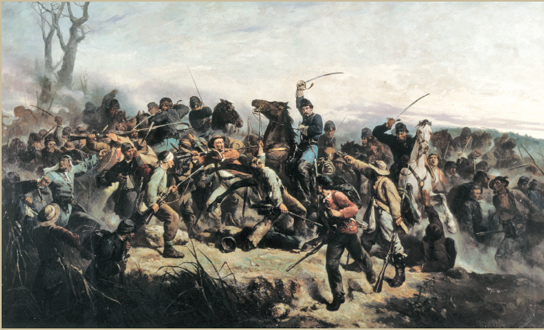
PLATE 21–1
Victor Nehlig hailed originally from Paris and had spent time in Cuba. At the beginning of the painter’s career the art critic Henry T. Tuckerman urged him to focus his gifts on the depiction of historic events, especially the Civil War, calling this eventful period “a work for which his genius is admirably fitted.” Nehlig heeded the advice. Early in the conflict he created a well-regarded depiction of Union volunteers “thronging” a park and then crafted a stirring portrait of a solitary “Picket-Guard” before turning to this bravura cavalry scene. Hailing Nehlig’s masterwork as “a battle-piece” that “fully sustains his younger promise,” the New York Evening Post in May 1863 judged the skirmish scene to be “one of the most spirited contributions to artistic history of Freedom’s war.”
America was still yearning for a level of history painting equivalent to the convulsive conflict it was experiencing. A few years after depicting this small incident, Nehlig would take on a much bigger theme: the 1862 Battle of Antietam.
What, then, inspired Nehlig to take on this less-than-epic subject? For one thing, Henry Hidden came from money; the Webbs were prominent shipbuilders, and painters naturally tended to portray martyrs whose families could pay for artistic tributes. Specifically who commissioned this painting has been lost to history, although it is reasonable to assume that Hidden’s relatives, eager to consecrate his valor, were the patrons, since a member of the Webb family had it in his control ten years after war’s end, when it was handed over to the Society.
Young Hidden had volunteered for service in the Union army on August 15, 1861, and quickly rose to the rank of first lieutenant. In Virginia, he served under the chronically recalcitrant general George B. McClellan, then commander of the Army of the Potomac, who insisted after Hidden’s all but unacknowledged sacrifice that the otherwise unmolested Confederate withdrawal from Centreville had actually marked a triumph of his own leadership. In truth, McClellan’s instinct for delay had allowed Johnston valuable time to retreat unscathed while the Union commander hesitated in the face of what he believed to be an army of over 100,000 men. When McClellan later reached and occupied the abandoned Confederate fortifications, it was evident that they had housed an army less than half that size and that many of the alleged weapons blocking his path were so-called Quaker guns—wooden decoys painted black to look like the real thing.
Hidden’s contrasting, aggressive bravery was not forgotten—even if the action that lost him his life had no strategic value—thanks to his family. Absent Nehlig’s painting it would have been forgotten, which, of course, is precisely why family members likely commissioned it. The episode remained a part of Civil War lore long after McClellan was discredited. In 1890, Frank Leslie’s Illustrated Newspaper published an engraving of the Sangster’s Station skirmish in its publication The Soldier in Our Civil War. TheNew York Evening Post, whose editor, William Cullen Bryant, was an acclaimed poet, published a poem called “First to Fall,” inspired by and dedicated to the young lieutenant.
Hidden’s overall contribution to Union victory was of course negligible, his fateful 1862 charge largely irrelevant, but his bravery, sacrifice, and lost promise earned a significant place in art, poetry, and narrative memory in the early days of the war. It helped that he was, like the martyred Ephraim Elmer Ellsworth before him, young, handsome, and genuinely worthy of a place in history, for scholars generally acknowledge Henry B. Hidden to be the first Union cavalry officer killed in action in the Civil War.