
39

HERE IS A DENSE SINGLE LEAF FROM A MASSIVE, TRULY EXCEPTIONAL archive. This one page specifically testifies to the excitement in New York that greeted a major turning point of the Civil War—Sherman’s capture of Atlanta. But more important, the lengthy manuscript from which it comes is a monument to the disciplined scribe who dutifully recorded this event, just as he memorialized nearly every day of his life from his sophomore year at Columbia College in 1835 at age fifteen until three weeks before his death forty years later. His name was George Templeton Strong, and his diary is one of the most priceless Civil War treasures in the entire New-York Historical Society collection, and certainly the most rewardingly illuminating.
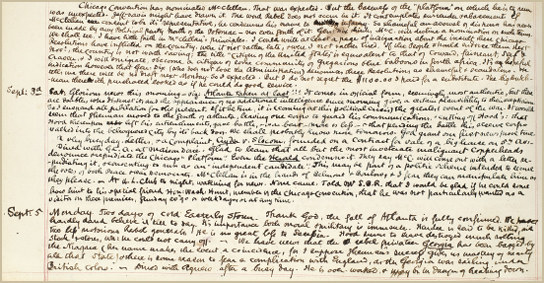
PLATE 39–1
Not surprisingly, since so many men went off to war, nearly all of the great home-front diaries, Northern as well as Southern, were written by women. A rare exception—not to mention a universally acknowledged classic of the form—is the captivating daily journal kept by the New York attorney Strong and unpublished for nearly a century.
The printed edition lacks the startling appearance of Strong’s original, meticulous jottings, which run to more than four million words filling 2,250 pages bound in four morocco volumes, each nine by fourteen inches, the unlined pages miraculously composed in a minuscule but beautifully even and legible hand in characters so tiny and densely packed that each page looks more like the Rosetta stone than a Victorian-era personal journal.
George Templeton Strong was already forty-one years old when the Civil War began and apparently too nearsighted to serve in the armed forces. He had graduated second in his class at Columbia at age eighteen, studied law with his father, a noted attorney, and then joined the elder Strong’s Wall Street law firm, Strong & Bidwell—today Cadwalader, Wickersham & Taft, the oldest continually operating legal partnership in the country. Before the war, George became a trustee of Columbia College and a vestryman at Trinity Church. He was clearly a Renaissance man. Like his parents a devoted amateur musician, he mastered the piano, oboe, and viola, played from time to time in the Metropolitan Opera orchestra as a lark, and later served as president of the New York Philharmonic. His home on Gramercy Park North boasted a specially built three-manual organ so large he nicknamed it Goliath.
When war broke out, Strong performed what service he could from the wartime home front, serving first as paymaster of the New York Rifles (“only playing soldier,” he admitted), then more usefully becoming treasurer of and doing “diligent service” for the U.S. Sanitary Commission and later helping to found the Union League Club. But his exemplary devotion to charitable causes, honest politics, the Union, and ultimately emancipation could hardly match his timeless contributions as a diarist, even though the public did not get a glimpse at his observations for decades. In fact, the friends who knew him best thought George a rather undemonstrative man who seldom commented about his surroundings or contemporaries. Little did they know! For all his talents, Strong might have disappeared into historical oblivion—just another well-meaning New York dilettante who avoided the military draft—had he not, every night before going to sleep, tenaciously recorded his acute and balanced observations of a rapidly changing New York as the city enthusiastically prepared for and then sometimes impatiently endured the rebellion.
Like most New Yorkers, regardless of party (the diarist was a Whig who later joined the Republicans), Strong was infuriated by the Confederate attack on Fort Sumter and enthusiastically succumbed to war fever as soon as local citizens began organizing into volunteer regiments. “Change in public feeling is marked, and a thing to thank God for,” he wrote a few days after Anderson’s surrender. “We begin to look like a United North.” A later entry contained the fervent prayer “GOD SAVE THE UNION, AND CONFOUND ITS ENEMIES. AMEN.” A sudden decline in wealth soured Strong for a time. “This is to be a terrible, ruinous war,” he confided on April 23, 1861, “and a war in which the nation cannot succeed, it can never subjugate these savage millions of the South. It must make peace at last with the barbarous communities off its Southern frontier.”
He regained his bearings once he committed himself to the Sanitary Commission. After digesting books about soldier health, he warned: “An epidemic of camp fever or dysentery or cholera among our volunteer regiments is inevitable within sixty days unless a sanitary system be created for them.…When this army is destroyed by disease, we shall have to raise another, and at a fearful cost. We cannot afford to waste life.” By summer he was worried that New Yorkers were losing their enthusiasm for suppressing the rebellion: “We are not fighting in earnest, not even yet. Our sluggish, good-natured, pachydermatous Northern people requires a deal of kicking to beat its blood. Not a traitor is hanged after four months of rampant rebellion. We must change all this.” We do not know whether he communicated these opinions as forcefully to his friends and allies as he did to his diary, if at all.
Strong approved of Lincoln’s Emancipation Proclamation, but he may have underestimated its impact when he initially predicted: “It will do us good abroad, but will have no other effect.” When the final proclamation took effect in January 1863, however, Strong celebrated: “The nation may be sick unto speedy death and past help from this and any other remedy, but if it is, its last great act is one of repentance and restitution.” Strong denounced the draft rioters as a “purely Celtic…rabble,” observing: “Their outbreak will either destroy the city or damage the Copperhead cause fatally. Could we but catch the scoundrels who have stirred them up, what a blessing it would be…agents of Jefferson Davis, permitted to work here in New York.”
As part of his ongoing work for the Sanitary Commission, Strong occasionally traveled to Washington, where on one memorable morning in May 1864 he met with the forbidding, volatile, and voluble secretary of war, Edwin M. Stanton, who was no friend of civilian relief organizations (he had denounced the commission as a “swindling concern”). Strong bravely advised Stanton that if only the War Department began cooperating with the commission, it would “add fifty percent to the value and effect of every dollar we spend.” By way of a response, Stanton unleashed a barrage of verbal abuse, but to Strong’s delight he at least got to glimpse a surprise visitor toward the end of his interview: Abraham Lincoln.
On seeing the president for the first time back in October 1861, Strong had dismissed the “hard-featured” leader as “among the ugliest white men I have seen. Decidedly plebeian. Superficially vulgar and a snob. But not essentially. He seems to me clear-headed and sound-hearted, though his laugh is the laugh of a yahoo, with a wrinkling of the nose that suggests an affinity with the tapir and other pachyderms; and his grammar is weak.” By January 1862, Strong had revised his opinion—but only somewhat—after listening to Lincoln spin frontier anecdotes with a peculiar, almost indecipherable backwoods accent. “He is a barbarian, Scythian, yahoo, or gorilla, in respect of outside polish,” Strong confided to his diary, “but a most sensible, straightforward, honest old codger. The best President we have had since old Jackson’s time, as I believe.” Two years later, Lincoln seemed a ghost of his former robust self. This is what Strong recorded of that unforgettable May 6, 1864, encounter in Stanton’s office:
I was amazed by the discovery of our importance and that the Secretary of War keeps himself thoroughly posted as to our movements and doings. Whenever he referred to any publication, he rang in his messenger, and said, “Ben! get me so and so of the Sanitary Commission,” which the faithful but seedy creature did with admirable accuracy and promptitude. He failed only once, when he brought in a copy of the Medical Times instead. Whereupon the Secretary damned him and sent him back, soliloquizing, as it were, sotto voce, “It contains another attack on me. I suppose the Commission got that up, too.”
On the whole, this interview was a good thing, though without direct tangible results. We drew Stanton’s fire and can estimate his weight of metal. It is not very heavy. He hates us cordially and would destroy us if he dared, but he fears our constituency. Public favor is the breath of his nostrils. He is not a first-rate man morally or intellectually. His eye is bad and cold and leaden and snakey, even when he is most excited. His only signs of ability at this conference were remarkable memory and capacity for details.
Pending our conference, the long, lean, lank figure of Uncle Abraham suddenly appeared at the door. [Cornelius] Agnew [head of the New York veterans’ hospital and fellow sanitation commissioner] and I rose. Stanton didn’t. Lincoln uttered no word, but beckoned to Stanton in a ghostly manner with one sepulchral forefinger, and they disappeared together for a few minutes, going into a side room and locking the door behind them. We saw Abe Lincoln in the telegraph office as we entered the office, waiting for dispatches, and no doubt, sickening with anxiety—poor old codger! But it’s shameful to so designate a man who has so well filled so great a place during times so trying.
Summer 1864, however, found Strong questioning the president’s chances for a second term. “The great election of next November looks more and more obscure, dubious, and muddled every day,” he wrote on August 16. “Lincoln is drifting leeward. There is a rumor of a move by our wire-pullers and secret, unofficial governors to make him withdraw in favor of Salmon P. Chase, or somebody else, on whom the whole Republican party (if such a thing exist) can heartily unite.” But the diarist’s mood shifted dramatically during the first week of September. First, Strong found reason for hope in the Democratic Party’s controversial antiwar platform, declaring of its notorious peace plank: “So shameful an avowal of dishonor has never been made by any political party north of the Potomac, nor even south of it.”
The very next day came the Union military triumph that would so suddenly change the course of the war—and Lincoln’s prospects for a second term. This is how Strong recorded the event—in the journal entries illustrated in plate 39–1.
Sept: 3d Sat: Glorious news this morning—viz: Atlanta taken at last!!! It comes in official form, seemingly most authentic, but there are doubters who distrust it, and the appearance of no additional intelligence since morning gives a certain plausibility to their scepticism. So I suspend all jubilation for the present. If it be true, it is (coming at this political crisis) the greatest event of the war….
Sept: 5 Monday.…Thank God, the fall of Atlanta is fully confirmed. We hardly dared believe it till today. It’s importance both moral & military is immense.
Two months later, Strong would greet news of Lincoln’s November 8 victory by observing that “the most momentous popular election ever held since ballots were invented has decided against treason on disunion.” A few months later, the diarist would join in the exuberant response to Lee’s surrender at Appomattox, expressing his joy and thanks to heaven by writing in Latin, beginning with the words of the popular Christmas carol: “Gloria in Excelsis Deo. Et in Terra, Pax hominibus bonae voluntatis” (“Glory to God in the highest. Peace on earth and good will toward men”).
At his death in 1875, the New York Times, entirely unaware of his copious journals, summarized George Templeton Strong’s literary achievements by saying only: “Although not the author of any literary works, he contributed many articles of rare merit and essays of elaborate research to several of the leading periodicals.” Even the Times occasionally got things wrong.
Published in four volumes in 1952 with notes and commentary by the great Civil War scholar Allan Nevins, Strong’s diary enjoyed a resurrection in 1990 as a featured source in Ken Burns’s hugely successful documentary on the Civil War. Voiced memorably by George Plimpton as Strong, it was for many Americans their first introduction to George Templeton Strong.