
45

HERE IS A CONVINCING REMINDER THAT EVEN WHEN THEIR LUNGS filled with gunpowder, their mouths choked back vile food, and their heads overflowed with fear, soldiers never lost their nose for news—even if it came in the form of makeshift examples like the meticulously hand-lettered ersatz journal shown in plate 45–1. It qualifies as the limited edition of all limited editions of Civil War publishing. The inhabitants of one crowded prisoner-of-war camp for whom it was published may well have been compelled to share scant copies, but they were undoubtedly thrilled to have the chance to read any newspaper at all, even briefly.
Overall, the Civil War inspired a huge demand for speedily issued, widely distributed news, and it spawned a generation of information addicts no less insistent on rapidly delivered information than today’s aficionados of the World Wide Web. While many Northern publishers responded to this opportunity by making their publications larger, their circulation broader, and their profits greater than ever, Southern publishers enjoyed no such bonanza during this golden age for the journalism business. The Southern demand for newspapers expanded just as the Southern supply of reporters, paper, ink—and even the coins readers needed to buy their favorite dailies—dwindled. By October 1861, the Atlanta-based Southern Confederacy had reduced itself to half the size it had been before the war and was appearing on brown paper. The following June, all four principal Richmond papers, the Enquirer, Dispatch, Whig, and Examiner, began publishing on single sheets—no real surprise in a city where even bread soon grew scarce. And in besieged Vicksburg, as noted earlier, a newspaper appeared on the back of floral-patterned wallpaper (see chapter 30).
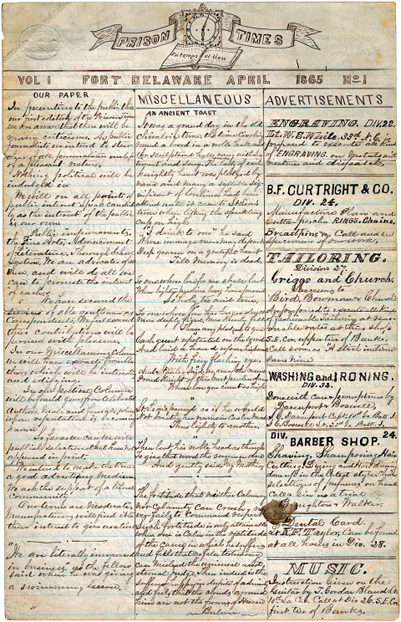
PLATE 45–1
Meanwhile, Northern editors like Horace Greeley of the New York Tribune and his competitors James Gordon Bennett of the Herald and Henry J. Raymond of the Times all flourished between 1861 and 1865. Investing wisely in the hiring of war correspondents, these publishers gained in wealth, stature, and power as readers came increasingly to rely on them for prompt reports of the latest battles—sometimes as breathtakingly early, by nineteenth-century standards, as a day or two after the smoke had cleared; longer, of course, if reports had to be sent from the distant western theater. Like many of their peers, Greeley and Raymond dabbled in politics as well, not only inflecting news reports with their strong partisan views but occasionally questing for public office themselves, seeking to place their acolytes in patronage jobs, demanding lucrative government advertising, raising funds for political parties, and seeking to influence, not just report, administration policy. While the Lincoln administration and the Union military occasionally censored, or closed, dissident papers they judged had crossed the line from political opposition to treason, the remarkable thing about the state of newspaper publishing during the Civil War was that freedom of the press generally thrived.
Additional evidence exists that soldiers, too—even those in woeful prison camps—had an insatiable hunger for news from home. Newsdealers maintained a lively business at Union encampments, even when regiments took up occupying positions in the distant South. Among the favorites were illustrated weeklies like Harper’s and Leslie’s, which even illiterate soldiers could appreciate for their woodcuts. Enlisted men particularly coveted a publication called Waverly Magazine, which contained rather scandalous personal advertisements from women looking for “a soldier correspondent.” But given the choice, enlisted men always preferred to read publications by and for civilians, preferably the variety that carried news from their hometowns. They trusted them more. In desperate circumstances, deprived of all other sources of information, soldiers, as this relic shows, not only made news but made newspapers.
Sometime after the war, the New-York Historical Society acquired this awe-inspiring example of journalistic perspicacity: a four-page newspaper, handwritten in ink, produced by Confederate detainees at the remote Fort Delaware prison camp on Pea Patch Island on the Delaware River. It must have required intense labor and devotion to put it together, considering the circumstances in which its creators lived.
The U.S. Army Corps of Engineers had built the formidable, polygonal masonry fort during the decade before the war as a harbor defense installation; interestingly, among the engineers who worked on the construction was the future Civil War general George B. McClellan. According to an architecture research report published in 1999, the interior alone required two million bricks. No doubt it was freezing in winter and steamy in summer. Beginning in 1862, the fort doubled as a prison—not only for captured Confederates but also for Northern political prisoners and Union soldiers convicted of crimes like sleeping on duty or desertion. Most of the Confederate captives seized at the Battle of Gettysburg in 1863 ended up at Fort Delaware. That year, the prison population swelled, according to one report, to eleven thousand. Among the units assigned to guard duty at the overcrowded facility—no doubt to the white Southerners’ further displeasure—were members of the all-black Corps d’Afrique.
Conditions were, of course, appalling, though significantly better than at truly horrific death camps like Andersonville. One survivor remembered receiving four meals a day at Fort Delaware—but complained that together they still amounted to an “exceedingly light diet” consisting only of bread and unsweetened coffee for breakfast, “a cup of greasy water misnamed soup” for lunch, a two-inch-square cube of beef and more bread for dinner, and another serving of bread and coffee for supper. At the very least, one prisoner conceded, the men got “sufficient” quantities of “well baked” bread there. Others complained of abundant but fetid water, no doubt responsible for the cholera and typhoid epidemics that periodically swept through the facility. A single outbreak of smallpox allegedly claimed twenty-five hundred lives. And yet this swarming, unhealthy, isolated prison somehow produced a sense of community—and a newspaper.
“One of the most remarkable productions of Fort Delaware was the Prison Times,” the onetime inmate Edward R. Rich remembered in his 1898 memoirs, “a newspaper published in April, 1865, by Capt Geo. S. Thomas, 64th Georgia Regiment, and Lieut. A. Harris, 32d Virginia Cavalry who proved himself a most expert penman.” Rich failed to credit several others responsible for its production, including the officer listed first on the masthead of “Editors & Proprietors”: J. W. Hibbs, captain in the 13th Virginia Infantry, and co-editor William H. Bennett, also of the 64th Georgia. Obviously, the paper enjoyed both a severely limited run (each copy had to be written by hand) and an extremely brief “newsstand” life, for this maiden issue bore the date of April 1865, the month the war ended. Harris probably took so long to pen each copy that there was no time to produce a sequel before the war ended. This is one of only four known surviving copies of the one and only issue of Prison Times.
Readers of that first and last issue may have included the remaining members of the so-called Immortal Six Hundred, a group of captured Confederate officers who had been used briefly as human shields at Morris Island, South Carolina, in retaliation for a similarly inhumane scheme employing fifty Union captives as human shields in Charleston. The surviving “Six Hundred” became living Southern martyrs—though they never faced enemy fire as shields—but remained in Union captivity. They were first transported to Fort Pulaski, where their ranks thinned owing to dysentery and scurvy. In March 1865, the survivors ended up at Fort Delaware, where fellow detainees reportedly treated them like royalty. Yet Prison Times surprisingly made no reference to their arrival. Perhaps because it took so long to handwrite duplicate copies of “Volume 1, Number 1,” the editors concluded they could not change the layout even for such a newsworthy special bulletin. Still, what appeared within the paper’s densely packed four pages shines a revealing light onto Civil War prison life—reflecting a displaced society remarkably determined to re-create the commercial and social amenities of home.
Although its tone suggests that in some ways the entire enterprise may have been something of a lark for its bored creators, Prison Times (whose tongue-in-cheek motto was “En temps et lieu”—“In time and place”) did offer highly useful miscellany. Paid advertising included “commercial” notices for such undoubtedly essential services as laundering and haircuts (ten cents), shampoos (fifteen cents), and shaves (five cents); along with guitar lessons; dental work; “fashionable Tailoring at reasonable rates” (“A stitch in time saves nine,” reminded the advertiser); shoe repair; chess clubs; a musical association; and even a debating society (“The Debating Club of Division ‘22’ meets every Thursday night”). A prisoner named B. F. Curtright offered handcrafted “gutta-percha RINGS, Chains, Breastpins, &c.,” while “Davenport & Boswell” offered to do “Washing and Ironing” at a price.
One column featured original inmate poetry (“The Low, Soft Music of the Pines” by A.H. of Florida and “Midnight Musings” by T.G.B. of Louisiana). And yet another provided a “Christian Association Directory,” which noted that regular meetings of the group were held every Friday night. Perhaps the most useful feature of all was a back-page column called “Barracks Directory”—listing the locations of the self-appointed chiefs, adjutants, and postmasters serving each of the prison’s ten inmate “divisions.” The newspaper was probably designed for officers only, but there were more than enough of them packed into the island fortress to constitute a large “captive” audience. As the lead editorial noted:
There are more than Sixteen Hundred officers in our Barrack in an enclosure containing scarce five acres of ground.
One would suppose that the fact of so many men being thus crowded together would tend to create the greatest possible amount of sociability and afford unrivaled facilities for forming and cementing extreme personal friendships.
But there seems to be as much isolation of individuals and as many little cliques and communities as in the largest cities of the world outside.
This is a phenomenon of prison social life to which we can only call attention at present and leave for a longer experience or more profound and skillful annotation to explain.
As our knowledge of the “Great World” outside is fast becoming traditionary or at best confined to “Fresh fish” stories, our news items will be necessary of a purely local character.
In our humble efforts to portray the Prison Times at this place we shall labor to keep our readers posted upon all the events of our little world worthy of record and afford them every facility of knowing who is here and what is being done.
Otherwise, the entire issue carried the tone of rather acid parody—understandable among creative souls trapped in maddening confinement—but the modern reader is left wondering whether the paper may have been designed primarily to consecrate as many individual names as could fit into a four-page periodical. For the savvier reader, it provided some needed relief through dark humor. A column titled “The Markets,” for example, obviously designed to mimic the financial reports in hometown journals, reflected the cynicism of prisoners forced to spend money for black-market “extras.” “Every thing but Tobaco [sic] is still held at extravagantly high rates,” it reported, including poultry and butter—inexcusable, the paper sardonically contended, since the waters outside the prison were “no longer blockaded by ice.”
That initial editorial also clearly indicated that its editors preferred that the paper enjoy no more than a limited run—for one obvious reason aside from the hard work it took to issue the first number: they desperately wanted to go free. “Trusting that the difficulties of conducting an enterprise of this kind under the circumstances are duly appreciated by an intelligent public, we send forth this our first number hoping that ere we can have time to issue many numbers our prison times will be discontinued forever and our patrons and ourselves be far away in our loved Sunny South.”
That is precisely what happened. As Rich would remember: “Prison Times, Vol. 1, No. 1 died almost as soon as it was born, for the ink was scarcely dry on its pages ere the news of Lee’s surrender reached Fort Delaware. No doubt hoping for a speedy parole, the editors suspended further publication of the newspaper.” It had indeed enjoyed a very brief life, but in Rich’s estimation “it was full of interest to its readers, and should anyone whose eye glances over these pages have a copy of it, they will surely prize it as a treasured memento of their Prison life in Fort Delaware.”
Today Fort Delaware is no less isolated but has been reinvented as a state park—accessible, however, only by jitney. For those unable to undertake the challenging journey thousands of Civil War prisoners once made, the Syfy channel has televised two “investigations” on the site, not of prison life there in the 1860s, but of reported paranormal activity haunting the place since.