
46

ON APRIL 9, 1865, A FLUSHED AND UNMISTAKABLY AGED ROBERT E. LEE, his hair and beard, one startled observer noted, now looking “as white and as fair as a woman’s,” slowly rode his famous horse Traveller to Wilmer McLean’s brick home at Appomattox Court House, Virginia. Soon thereafter, Ulysses S. Grant arrived on the scene to accept the surrender of the Army of Virginia—in effect, to end the four-year Civil War.
Among the Union staff aides who gathered for the historic event were Grant’s military secretary, a Seneca Indian named Ely S. Parker (“Do-Ne-Ho-Geh-Weh,” or “the Wolf,” to his tribe), and Captain Robert T. Lincoln (whose own sobriquet was the “Prince of Rails”), recently attached to Grant’s military family as a personal favor to his father, the president. The enthusiastic young Lincoln later brought a Lee photograph home to show off to his family at the White House. But the veteran Parker acquired a souvenir of considerably greater value: this original copy of the generous surrender terms Grant wrote out that day inside the McLean parlor in Lee’s presence. Military conscription had already swelled Union ranks to a level that made them unbeatable, but here is the “draft” that really ended the Civil War.
“Those who watched his face to catch a glimpse of what was passing in his mind could gather thence no trace of his inner sentiments,” another eyewitness remembered of Lee on April 9, 1865. His countenance “wore its habitual calm, grave expression.” Not even Grant could detect any hint of emotion from the dignified warrior who had extended the costly fighting so long yet remained such a flawless hero to his men. “As Lee was a man of much dignity, with an impassible face,” Grant wrote in his memoirs, “it was impossible to say whether he felt inwardly glad that the end had finally come, or felt sad over the results, and was too manly to show it.” Little did the Union victors know, but the previous day, as he pondered what to do next with his battered and starving army, Lee was observed in “a savage mood,” pacing “backwards and forwards…like a caged lion.” The Confederate general John B. Gordon heard Lee state that he “would rather die a thousand deaths” than surrender. “What man,” one of Lee’s other field commanders subsequently marveled, “could have laid down his sword at the feet of a victorious general with greater dignity than he did at Appomattox?”
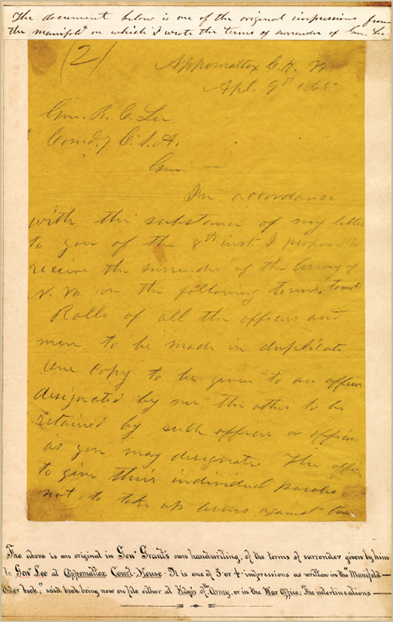
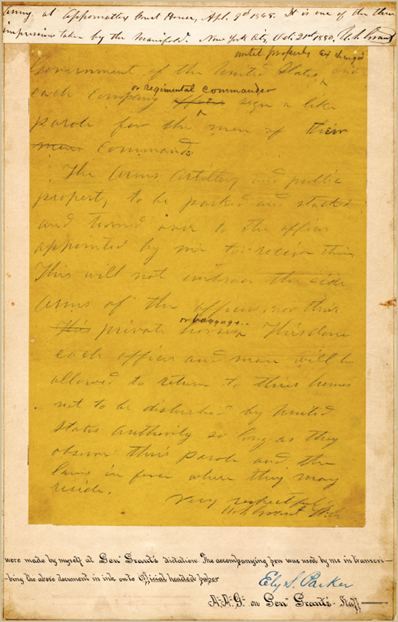
PLATE 46–1
Overshadowed by this legendary show of nobility—which was amplified by Lee’s magnificent appearance that day in what Grant described as an “entirely new” full-dress uniform with “a sword of considerable value” at his side—was not only the sharply contrasting simplicity of his Union counterpart but also the extraordinary generosity of the surrender terms he proposed. Grant had found no time to change clothes before the meeting and was forced to wear his usual “rough traveling suit, the uniform of a private with the straps of a lieutenant-general.” As he admitted: “I must have contrasted very strangely with a man so handsomely dressed, six feet high and faultless of form.” But to Grant, words meant far more than show.
When Lee had sent word the day before that he would meet Grant “with reference to the surrender of this army,” the Union commander had made clear in his reply that he would not address the overall questions of peace and reunion. As he explained with typical bluntness: “I have no authority.” Grant had received scant instruction on how he should treat the Confederates should they be brought to heel, only that he attempt to negotiate nothing more than “the capitulation of Gen. Lee’s army.” At his final war conference with President Lincoln a few weeks earlier, the commander in chief had been conciliatory but vague. He hoped to avoid further bloodshed. He should be glad if Jefferson Davis escaped out of the country so Northerners and Southerners alike could be spared the divisive spectacle of a postwar treason trial. As for the rest of the Confederate fighting force, William T. Sherman left the meeting with the impression that Lincoln preferred to “restore all the men of both sections to their homes” or, in the vernacular of the day, to “let ’em up easy.” As Lincoln later put it more directly, if jocularly, he did not want to hang Confederates; he wanted to hang on to them.
But all that Grant would allow himself to advise Lee before their climactic meeting was: “By the South laying down their Arms they will hasten that most desirable event, save thousands of human lives and hundreds of Millions of property not yet destroyed.” Grant ended his terse preliminary message by expressing the sincere hope “that all our difficulties may be settled without the loss of another live [sic].” Lee had little choice but to accede. His aides selected the McLean home as the venue for a formal surrender.
Cautiously, the two commanders began their meeting there that day by chatting about “old army times.” Grant remembered Lee well from the Mexican War, he offered—gushing, “I think I should have recognized you anywhere”—but Lee stiffly replied that he could not recollect “a single feature” of his opponent, much as he had tried to conjure up his appearance in recent years. Grant took no offense; he thought it natural enough because of “the difference in our rank and years.” In fact, their “conversation grew so pleasant,” Grant recalled, “that I almost forgot the object of our meeting.” General Lee had to call Grant’s “attention to the object of our meeting, and said that he had asked for this interview for the purpose of getting from me the terms I proposed to give his army.” Grant responded that “his army should lay down their arms, not to take them up again during the continuance of the war unless duly and properly exchanged.” Lee acknowledged that he understood and agreed, and he suggested that the terms be consecrated on paper.
It was then that Grant asked Ely Parker for writing materials “and commenced writing out the following terms” at one of McLean’s parlor tables as Lee sat opposite, silently watching. To compose what was arguably the most important document of his entire life, Grant employed a newfangled “manifold writer” that he had probably picked up from a Pennsylvania Avenue stationer during his visit to the capital the year before. By inserting thin yellow paper between its waxy sheets—precursors of carbon paper—a writer could make multiple copies of an original composition simultaneously. Grant reportedly inserted three sheets of paper and began writing. No one kept track of how much time he took.
“When I put my pen to the paper I did not know the first word that I should make use of in writing the terms,” Grant later admitted. “I only knew what was in my mind, and I wished to express it clearly, so that there could be no mistaking it. As I wrote on, the thought occurred to me that the officers had their own private horses and effects, which were important to them, but of no value to us; also that it would be an unnecessary humiliation to call upon them to deliver their side arms.” The terms were simple, straightforward, and devoid of pretense—much like the man who wrote them:
Appomattox C.H. Va
Apl. 9th 1865
Gen. R. E. Lee
Comd.g. C.S.A.
Gen:
In accordance with the substance of my letter to you of the 8th inst. I propose to receive the surrender of the Army of N. Va. on the following terms, towit:
Rolls of all the officers and men to be made in duplicate. One copy to be given to an officer designated by me, the other to be retained by such officer or officers as you may designate. The officers to give their individual paroles not to take up arms against the Government of the United States until properly exchanged and each company or regimental commander sign a like parole for the men of their commands.
The Arms, Artillery and public property to be parked and stacked and turned over to the officer appointed by me to receive them. This will not embrace the side Arms of the officers nor their private horses or baggage.—This done each officer and man will be allowed to return to their homes not to be disturbed by United States Authority so long as they observe their parole and the laws in force where they may reside.
Very respectfully
U.S. Grant Lt. Gn
When Grant finished composing this two-page document, Lee put on his spectacles, crossed his legs, and carefully read the terms over twice, remarking that Grant’s magnanimous gesture regarding horses and sidearms would “have the best possible effect upon the men” and would “do much toward conciliating our people.” Lee asked for but a few minor changes, which were made, then called for writing supplies of his own and inked a formal letter of reply: “General: I received your letter of this date containing the terms of the surrender of the Army of Northern Virginia as proposed by you. As they are substantially the same as those expressed in your letter of the 8th inst., they are accepted. I will proceed to designate the proper officers to carry the stipulation into effect.”
At this point, Grant asked that his own terms, which now bore penciled emendations, be copied professionally and requested that his adjutant, Colonel Theodore S. Bowers, make a clean copy in ink. Bowers, however, was apparently so nervous that he faltered and after several aborted attempts handed the task over to Parker. When it was accomplished and signed on letterhead marked “Head Quarters Armies of the United States,” Parker folded the official holograph letter into an envelope, sealed it, and handed it to Lee’s aide Charles Marshall, who in turn presented it to Lee.
Before General Lee departed the scene, he told Grant that his army was painfully short of food and asked one more concession: Might he supply them with rations? Grant asked how much was required, and Lee requested food for twenty-five thousand. Grant immediately agreed to provide it. The Union commander later said he never entertained a thought about asking Lee to surrender his gleaming sword that day. He had no desire to humiliate him. Nor did he want his own men to celebrate in a way that might embarrass or arouse their vanquished enemies. When one of his officers jubilantly ordered the commencement of a hundred-gun salute to celebrate the victory, Grant halted it midway. The time for firing cannon was over.
After Robert E. Lee stepped back outside onto the McLean house’s “comfortable wooden porch,” mounted Traveller, and headed back to tell his soldiers that their fighting days were over, Grant remained for a time in the parlor. There, he took the copies of the draft terms he had composed on his “Philp & Solomons’ Manifold Writer” and gave one—the second, by most accounts—to Ely Parker as a keepsake. No one knows whether Lee had fully appreciated the irony of the fact that the man who had written out the terms for surrendering an army that had fought to preserve slavery and white supremacy was himself a person of color, albeit what people of the day called a “red man.”
Not that the North had been much more hospitable to him. Though an accomplished attorney and successful engineer before the war, Parker had not found it easy to enter, much less rise in, the Union army—this despite his friendship with its leading general. He had met Grant back in the general’s Galena, Illinois, hometown in the 1850s, and Grant, then down on his luck, had taken an instant liking to him. Not until 1863, however, was the general able to overcome racist resistance to Parker’s commission and name him as a captain on his staff. Parker had since earned promotion to the rank of lieutenant colonel. For his loyalty and good service he now received one of the most coveted mementos of the final act of the long and bloody drama that had claimed some 750,000 lives.
Parker kept the priceless relic for the rest of his life. After the old colonel’s death in 1895, ownership passed to his widow. She in turn sold it to the New York Commandery of the Military Order of the Loyal Legion of the United States. In April 1926, not long after the sixty-first anniversary of its composition at Appomattox, MOLLUS donated it to the New-York Historical Society. Today it is housed in a hinged, book-like wooden frame.
When the surrender conference ended that April 1865 day, Grant introduced Lee to his entire staff, and the Confederate general shook hands with a few and bowed “in a formal manner” to the rest. When he reached Parker, it is said that Lee paused for several seconds, scrutinized what an onlooker called Parker’s “swarthy” features, and, in the only caustic lapse he allowed himself during his surrender ordeal, commented: “I am glad to see one real American here.”
To which Ely Parker replied, no doubt hoping for a more egalitarian postwar future: “We are all Americans.”