
Chapter 14
After the Revolution, the Soviet State conducted a policy of involving women into socially useful work. The emancipation of women, and their entry into traditional ‘masculine’ trades and sports, were presented as the greatest achievement of socialism – here, real equality was manifested, as women were liberated from ‘domestic slavery’.
At the start of the war, thousands of women rushed to the Army, eager not to fall behind the men, feeling that they were capable of enduring all the hardships of military service and, most of all, consolidating their right to defend the homeland with the men. These girls were prepared for courageous acts – having been raised on books full of heroism and adventure – but not for the practicalities of military service. Discipline, ill-fitting uniforms (too large by many sizes), a male environment, plus a heavy physical workload – all combined to create a harsh trial. A searchlight operator, Evdokya Kozlova, remembers:
Initially, they gave us men's uniforms, which we would alter: we'd trim the trench coats, clip the blouses. English-made boots were too big by five sizes. There was no female underwear We sewed bras from rags, issued to us for cleaning weapons.
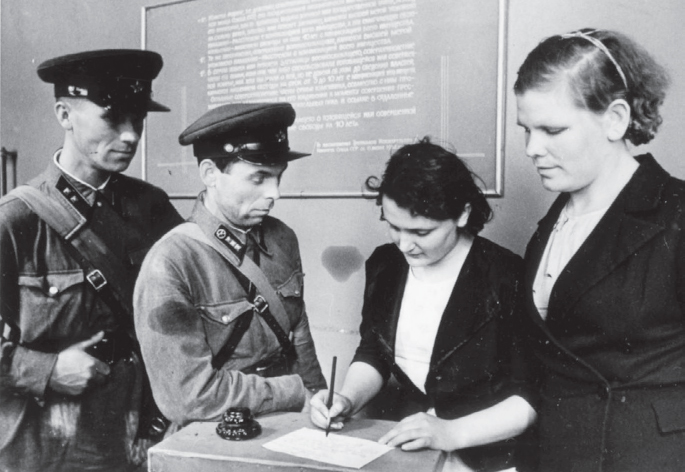
I. Bondarenko and S. Miryuk volunteer for the Army.

In 1942 a special female sniper school was established near Moscow. In twenty-seven months around 2,000 women graduated. Some became very professional and highly decorated. These snipers were armed with Mosin rifles plus PU optical sights. The girl on the right is decorated with the highest military award, the Order of the Red Banner, as well as the Order of Glory 3rd Class. On her right breast is an ‘Excellent Sniper’ badge.
But women always had one way out – get pregnant. In this case, a woman would be discharged from the Armed Forces at the sixth month of pregnancy. An aviation technician, Nina Kounitsina, recalls:
My dear Mum wrote to me: ‘My sweet daughter, your girlfriends have come home, they will give birth to children, why do you stay there? Come home, I won't curse you for a baby’
As for the attitude of men to the presence of women in combat, Nikolay Shishkin, a tanker, remembers:
Our medic was Marousya Malovichka. When one of our tanks was shot up before our eyes, a crewman leaped out, but the Germans were on the spot. They snatched him and dragged him to a dugout. We watched but could do nothing about it. Then she grabbed a machine gun from an assistant – listen up, had I not seen this with my own eyes I wouldn't have believed it – but she leopard-crawled up to the German lines, shot the sentries, broke into the dugout, pulled that tanker out and walked him back to us. She was awarded with the Order of the Red Banner We respected women of that kind. But all sorts of things were said behind their backs: ‘Air raid!’ or ‘Rama!’ [i.e. Russian nickname for the German FW-189 twin-fuselage reconnaissance plane. Basically, the guys were saying ‘Watch out!’ – trans.]. What it meant was this: if there's a woman around, you got to hide. Without women around, the men felt themselves free to talk, but as soon as a woman turned up they tried to be more polite, not to swear They ennobled us. They decided to make radio-operators and machine-gunners out of women in a neighbouring brigade. This idea lasted for a couple of weeks – it's not a female business to fight.
Often, women themselves gave grounds for gossip and anecdotes, having become one of those who were dubbed, contemptuously, a ‘field-marching wife’. Nikolay Posylayev recalls:
As a rule, women who'd found themselves at the front soon became officers’ lovers. There was no other way. If a woman was alone, there would be no end of harassment. But it was a different story if she was with someone [...] However, the most sincere love occurred on the front line too. It was tragic, for it had no future – death separated lovers far too often. But love is strong, it made people live and dream of happiness, even under fire.
I want to conclude with the words of a mortar crewman, Vladimir Logachev, who was badly wounded in the spring of 1943:
Wounded men were washed straight after arrival in the Ufa hospital. This procedure was run the following way: ten strong girls, being completely naked – only in small oilcloth aprons – washed the trench dirt off the wounded men in a well-heated room, cutting off old bandages and cleaning wounds. I passed into the possession of a young, dark-haired Ukrainian girl called Oxana – I can see her now as before. Yet I don't know if this procedure had been worked out intentionally or not, but the young hot bodies of these girls, their tender hands, revived many a wounded man's will to live ...
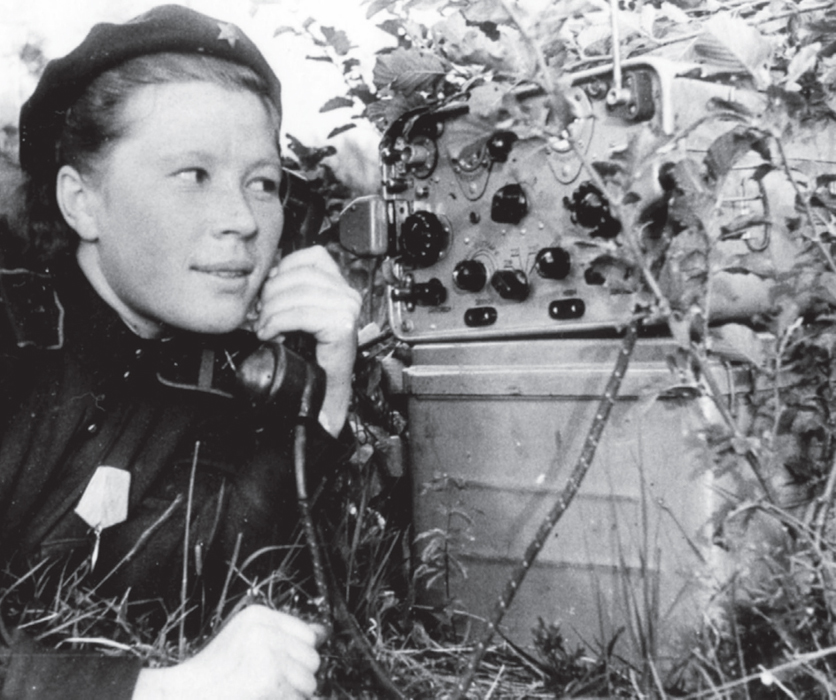
Radio-operator of an artillery unit, A. Ivakhina, with RBM radio set. The girl is decorated with a medal and a badge, ‘Excellent Signaller’ (1944).

II-2 ‘Shturmovik’ reargunner, R. Koriagina. This photo was probably staged or taken after a sortie, since flyers were extremely superstitious and would not allow photos before a mission (1943).

Armament mechanic, M. Khlomova (1943).

The inscription under this photo says: ‘Brigade commander Comrade Sytnik after the concert.’ Pictured near the military man is an actress of a front-line concert team, judging by her civilian dress.
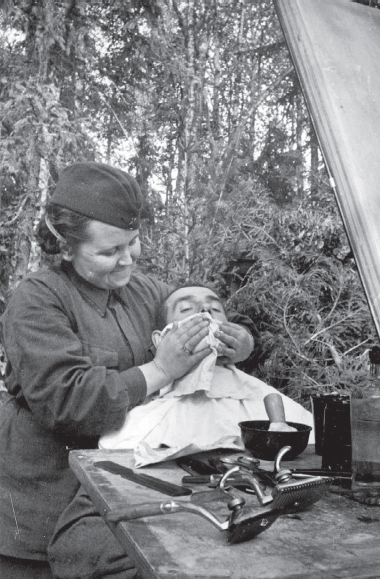
Shaving an officer in a laundry platoon or at an HQ barber's shop. Such a service was practically inaccessible for ordinary Red Army soldiers.
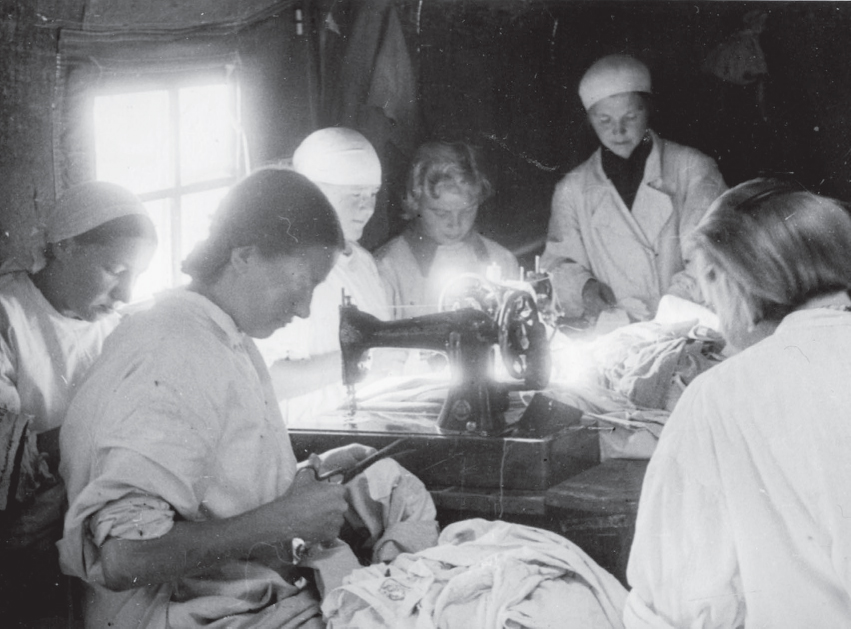
In this photo you can see, most likely, darning of soldiers' underwear in a laundry battalion. But it's also possible the girls in the photo are medical orderlies of a medical and sanitary battalion making bandages out of old underwear. There is a Singer sewing machine on the table – such machines were produced at the beginning of the twentieth century in Podolsk.

Ironing clean underwear in a laundry battalion. Due to the absence of electricity in field conditions, girls had to make do with very heavy coal irons.

A female traffic controller on one of the military roads. To her left is a German Hetzer tank destroyer, put out of action or abandoned by its crew. The traffic controller – armed with a Sudaev submachine-gun – lets a ‘Studebaker’, towing a ZIS-3 76mm gun, pass through. The soldiers in the truck are obviously shouting jokes and inviting the girl to have a ride with them.
Awarding soldiers with medals. In the photo, the major of artillery carefully adjusts the new medal on the soldier-girl's blouse.
