
Chapter 15
As the infantrymen used to say at the front: ‘We don't have much choice: sooner or later the Narkomzem [literally, “People's Commissariat of Agriculture” but this acronym was used as a pseudonym for hell – trans.] or the Narkomzdrav [People's Commissariat of Health Protection – trans.] will take care of us.’ But to let the Narkomzdrav take care of a wounded man, first he had to be evacuated from the battlefield. Riflemen were categorically banned from assisting wounded out of the combat zone – one might have been labelled a deserter; with subsequent commandeering to a penal company. Instead, evacuation was conducted by company medics. At the beginning of the war young females were drafted to fill this position, but to drag a wounded adult man from a battlefield with his firearm (salvation of a wounded man without his firearm was not considered during recommendations for decoration) was an extremely difficult task. Therefore, as a battalion medical attendant, Michael Sitnitsky recalls:
Sturdy mature men aged 30-35 were picked as medics. Not all set hopes upon God, but the soldiers always hoped for the battalion medics and trusted us. They knew that we would save our wounded comrades and wouldn't leave them on the battlefield to bleed to death.
Wounded men arrived at the battalion medical post, where they would get first aid. Then they would be transported to the divisional medical battalions in carts, sleighs or trucks. A medic, Nina Bobovkina, remembers:

Photographers seldom took photos of medical instructors during a real battle. But here is a rare real-life photo on this theme. Far in the background you can see a soldier firing his Sudaev submachine-gun. A wounded Red Army soldier, who receives medical help from a girl in a beret, has a PPD submachine-gun. Due to these details we can date the photo to 1942, and we also can suppose that it was photographed on the Leningrad Front.
Transportation of wounded men was a very difficult duty for girls. Six stretchers were set up at three levels on holders in specially equipped 1/2-ton trucks. Five more, lightly wounded, men would be placed on a folding bench. Badly wounded men – whose coats and boots had been removed – were wrapped in special fur or wool blankets to keep them warm against the cold. A medic would have to hold back the upper and medium level stretchers to prevent the wounded from falling down due to heavy jolting. If a unit was in combat, the flow of wounded was endless.
A fighter pilot, Alexander Shavarev, who found himself in a hospital after his plane had been shot down, remembers:
Oh, I saw a lot of that! Just imagine, a surgeon covered in blood, his sleeves rolled up, and there's a big knife in his hands! He comes up to someone: ‘How's it going, brother?’ The guy says: ‘Oh, painful.’ The surgeon has a look and orders: ‘Shave him up!’ done. The surgeon chops off what's necessary and chucks it into a bowl. He yells: ‘Sister! Dress him up and send him off!’ He does an operation, then goes to a table, gulps half a glass of spirits, and then back to work. The sisters say he's had no sleep for the second day running.
The next step was to send wounded men to a specialized evacuation hospital. Many lightly wounded men did their best to stay in the medical battalion, for it would be almost impossible for them to make it back to their units after convalescence. Having been healed, a soldier would undergo a medical examination, and if he was recognized as fit for combat, he would be commandeered to a transition point, where representatives of units and formations would come up to pick up reinforcements. Thus a soldier had a chance to change his military occupation after being wounded. An infantryman, Dmitry Markov, remembers:
Some ‘buyers’ from the Army came over to the transition point and said: ‘We need soldiers to reinforce an artillery regiment.’ I thought: ‘Enough is enough. I ain't gonna join the infantry, only the artillery.’ Why? For I'd done lots of marching from Kursk and almost to Kiev! There'd been a clear feeling: sooner or later you’re gonna get killed or wounded . . .

Last salute at a comrade's grave. We can date the photo to the very beginning of the war because by the middle of 1942 SVT rifles were almost out of use at the front line.

Funeral of a fallen pilot. In contrast to most frontline soldiers, airmen had the questionable privilege of being buried with full military honours. The pilot's combat comrades come to pay their last tribute to him. The numerous girls in the photo are most likely airfield signallers. The boy on the right looks like a typical ‘son of the regiment’ of an airfield service battalion.
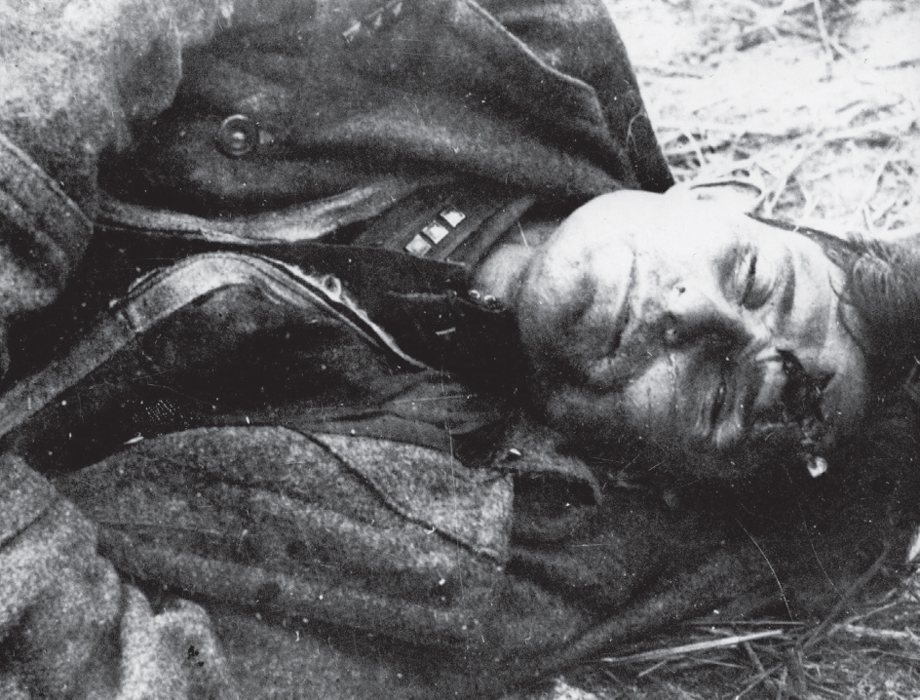
A senior lieutenant or a political instructor of the Red Army killed by a direct hit to his head.

Typical exterior of a soldiers' mass grave – a small pyramid with a star. After the war such improvised battlezone memorials were found every hundred metres. Later, some of these memorials were rebuilt as real monuments, while others were broken. The soldiers' remains were carried to large military cemeteries. Sometimes, however, it was only the names from plates that were removed, and not the actual bodies of fallen soldiers.

A medical instructor bandages a soldier, who has been dragged off the battlefield. Notice that he wears the wide trousers of a camouflage uniform kit. It was more comfortable and safe to crawl in such trousers.
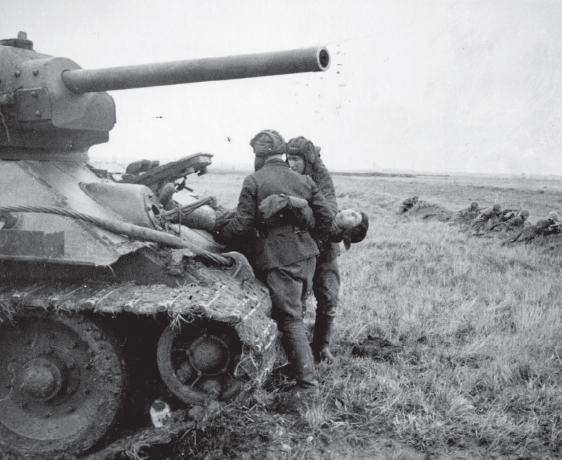
A staged photo used to demonstrate how crewmen pull a wounded comrade from their tank.

Transfer of wounded soldiers from a bus to a hospital train.
Military field dentistry. For many soldiers a visit to the dentist was more frightening than any battle.
