
Chapter 7
It's not often that an ordinary infantryman or a tank commander can recall at which village, town or city a particular action took place. Platoon Commander Vasily Bryukhov observes:
Nowadays, it's astounding to hear some people readily recall the names of settlements near which they fought. How do I remember these names?! After the war, having toured the battlefields, I recalled this Malye [i.e. smaller – trans.] Mayachky sovkhoz [state-owned collective farm – trans.], named after Voroshilov. But could I remember them during the war? You get a task: ‘Move between landmarks one and three.’ And off you go – you look for targets, you shoot.
Only many years after the war (between 1965 and 1975) when several hundred memoirs – mostly written by senior commanders – began to be published, and reunions of veterans began to be run annually, did details of battles get connected with dates and geographical names.

A captain assigns his soldiers to their posts. Soldiers armed with PPSh submachine-guns wearing winter overalls and valenki felt boots.

Guards captain V. Volkov sets a task to IS-2 crews. Because of the white stripes on the tanks we can presume the photo was taken in Berlin or in the city's suburbs after the battle for the city had ended.

A rifle regiment commander shows his battalion commanders the target of attack on the map.
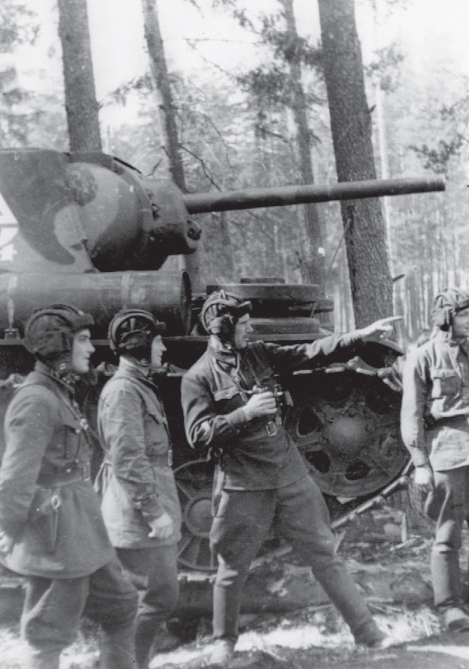
Senior Lieutenant Gnadenberg of the 24th Tank Brigade familiarizes the crew of a KV-1 tank with the combat area.

Commanders reconnoitre the locality. The major on the right wears a wristwatch – considered a luxury item in the pre-war USSR.

A battery commander chooses on a new map positions for a 45mm AT gun. These guns, which were designed to fire over an open sight among their crews, received the nickname: ‘Farewell Motherland’.
Fighter pilots receive their combat task. The commander outlines possible manoeuvres in the sand. In the background stand British ‘Hurricane’ fighters, supplied to the USSR.
