
Chapter 8
The battle efficiency of any army depends on the timely supply of ammunition, arms and fuel. However; during the early stages of the war; the Soviet Union didn't possess enough matériel to supply an army of millions. Furthermore, support services were often incapable of running supplies amid the chaos of constant retreat. As a result, Soviet soldiers had to go into combat without adequate supplies of weapons and ammunition. A signaller; Fedor Mishurov, remembers:
The early period of the war was a time of agonizing and humiliating retreat of the Soviet Army. The Germans had enormous superiority. Our supply was meagre: hardly any submachine-guns, only rifles and hand grenades. And we were on the retreat – over and over again [...] Our powerlessness and anger were especially strong under the attacks of enemy bombers, such as the Ju-87 and Ju-88. It was impossible to shoot them down from the ground.
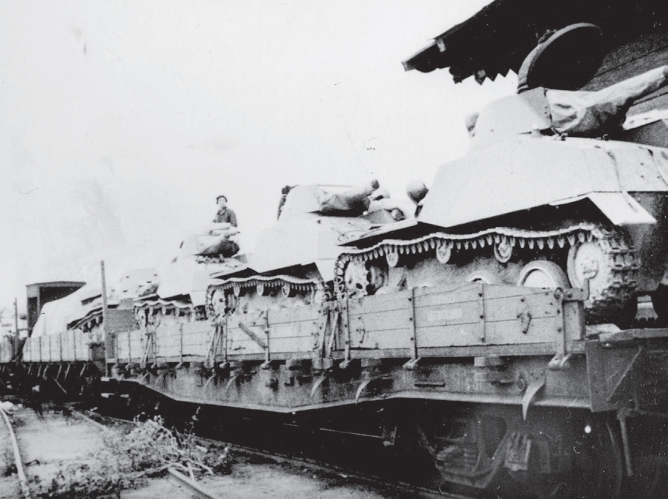
Transportation of T-40 tanks to the front line via rail. Due to the lack of paved roads, railways were vital for supplies.
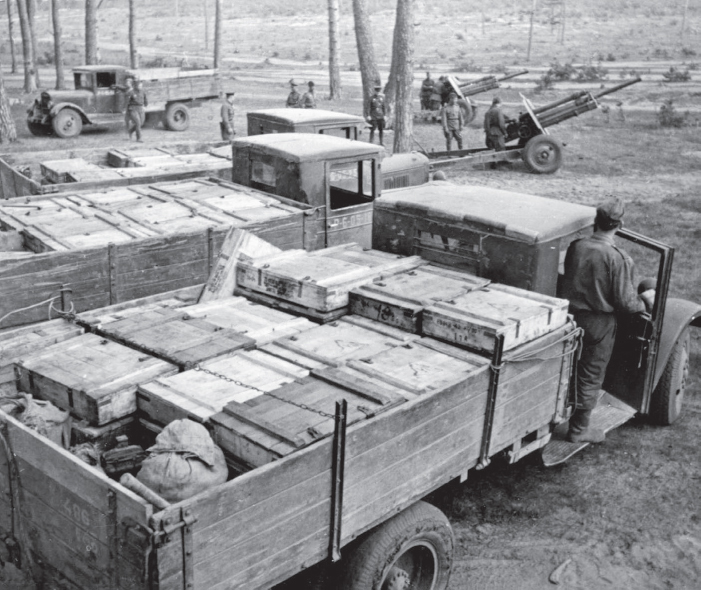
ZIS-5 trucks deliver shells to a battery of F-22 USV 76mm guns (1943).
Nevertheless, the Soviet Command always tried to maintain the ammo supply at a more or less satisfactory level, and only during the first months of the war did serious problems occur An artilleryman, Ivan Pashkov, recalls:
Generally speaking, we were always supplied with ammo at a normal level, and only in 1941 was the situation somewhat worse. And – just in case supplies didn't get through we'd limit our fire rate and leave maybe a third of available ammo as a reserve stock.
Delivery of arms and ammo to fighting units was conducted mostly by trucks like the ZIS-5 and ZIS-6. The ZIS-5 had a carrying capacity of 3 tons but frequently carried up to one and a half times more. And during the slushy season or ‘rasputitsa’, when roads were often impassable, horses were used for logistics.
Throughout the wan supplying armour and aviation units with fuel and lubricants never caused complaints, except for some rare instances. A fighter pilot, Anatoly Bordun, remembers:
Petrol was dispatched to our unit in special fuel trucks. Only once, at Opolje – after the battle for Warsaw – did we run out of petrol due to the rasputitsa, as railroad connections in that area hadn't been restored. But we were required to fly reconnaissance missions and cover important objectives at that time. That was why they delivered us fuel in Li-2 planes. It happened like this a couple of times, and then routine supplies were established.
But at the beginning of the war supply of uniforms left much to be desired. The huge army was even short of footwear Often the infantrymen had shoes with puttees instead of jackboots. A machine-gunner Vasily Gordov, remembers:
We were short of jackboots, and even as an officer I wore boots and puttees. And this is what the puttees were like – a grey band of rough fabric, 3 metres long and 10 centimetres wide. This band overlaps a common boot and then you wrap your legs with it up to the knees, tying it up just below the knee. As a result the boots do not turn into jackboots, but warm you up better anyway, and there's less water dripping into the boots.
Only airmen and scouts were well supplied with uniforms during the initial period of the war. A scout, Leonty Brandt, remembers:
There's no denying, the scouts were in the most privileged situation. We were even called ‘the military aristocracy’. We had the best arms and were supplied at the highest level.
Nevertheless, the military supply had gradually improved during the second half of the war When the Red Army switched to the advance, soldiers had fewer problems with provisions from the rear Even female troops could now expect to be issued with uniforms of the required size – a rarity over the previous years. A motor specialist, Antonina Andryanova, recalls:
It was cold in the winter The motorists were issued with valenki [i.e. felt boots – trans.], and airmen and navigators had fur-lined jackboots. All valenki were too big for me and a sergeant said that he had small jackboots in stock, but would only give them to me with the commander's permission. I got them and began to walk about, dressed in a winter jacket and fur-lined jackboots, and since, in our garrison, nobody knew me apart from those who served in our squadron, everyone below officer rank would salute me!
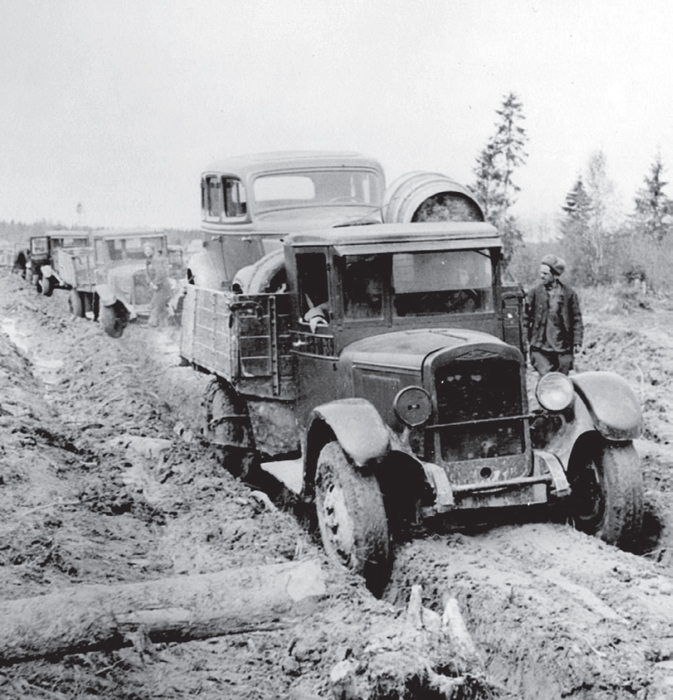
Typical condition of front-line roads. A convoy of ZIS-5 3-ton trucks forces its way along a beaten rut through a sea of mud. There is a Soviet ‘Emka’ (GAZ-MI) passenger car in the rear of the first truck. The ‘Emka’ simply couldn't move through such a quagmire. On the rear wheel of the truck in the foreground you can see a chain, which, in principle, slightly increased its cross-country capability.
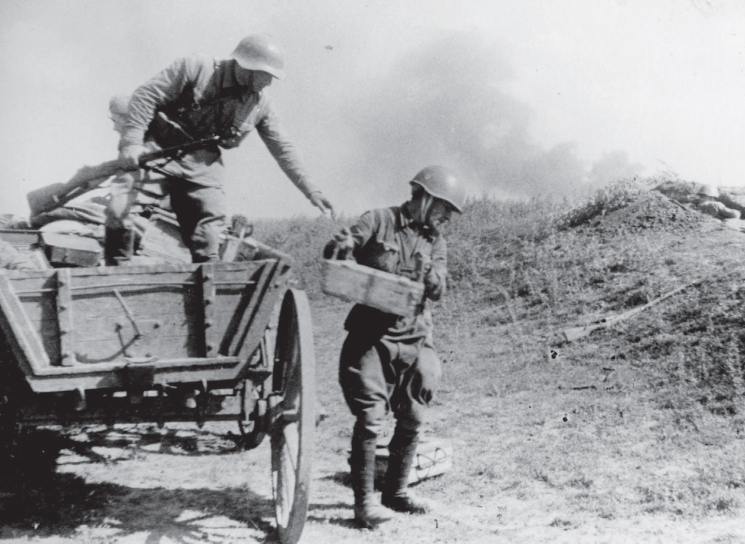
Soldiers unload ammunition delivered to a rifle unit. Notice the individual trench for prone firing on the right. The photo was taken in the early days of the war, since the man on the cart is wearing the SSh-36 helmet, while the man with the box is wearing the SSh-40 helmet.
The Red Army often used ordinary carts to deliver ammunition to the front line. Judging by the motley appearance of these horse-drawn vehicles, we can presume they were commandeered from civilians (1944).
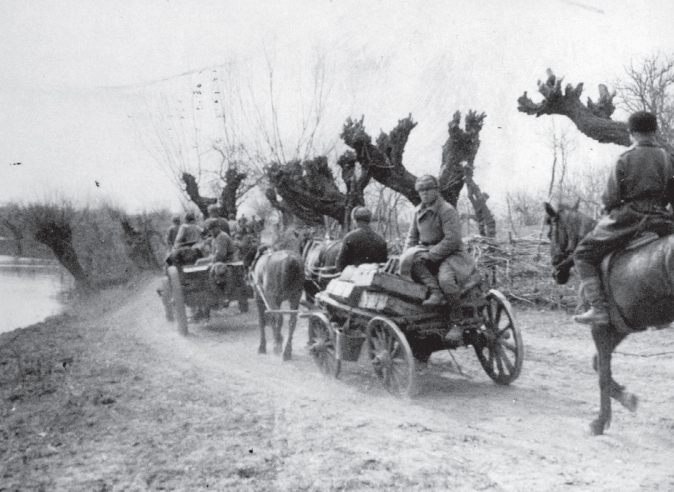
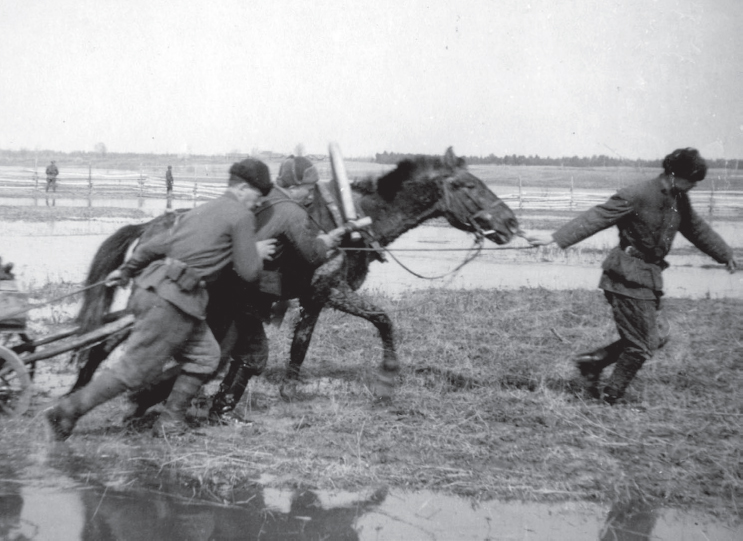
Terrain was frequently so waterlogged that a horse couldn't even pull an unloaded cart by itself.
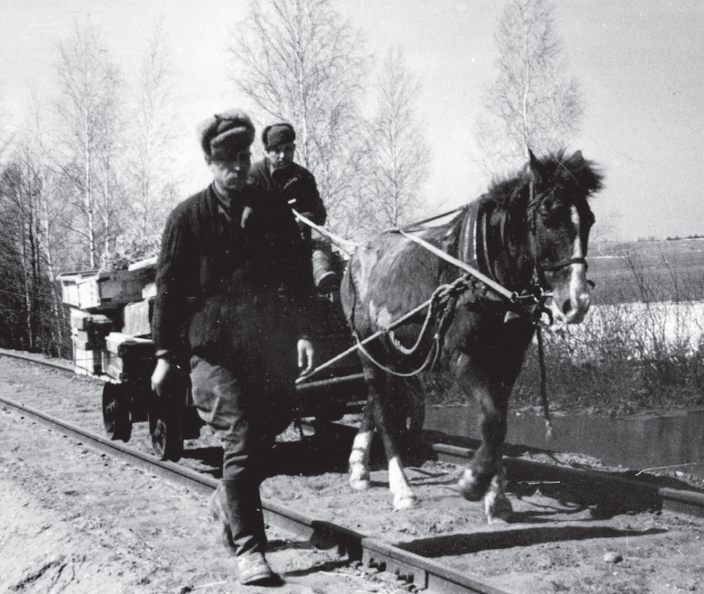
Transportation via narrow-gauge railway. An ordinary horse is harnessed either to a light cart or a broken railway handcar (Western Front, 1942).
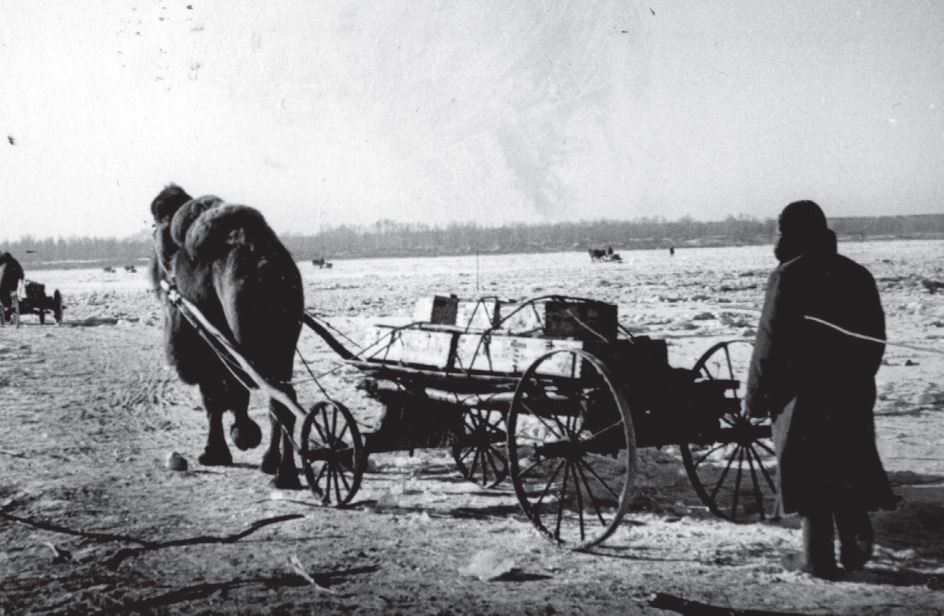
Transportation via camels. These ‘ships of the desert’ were widely used by the Red Army in the steppes (Stalingrad Front, 1942).
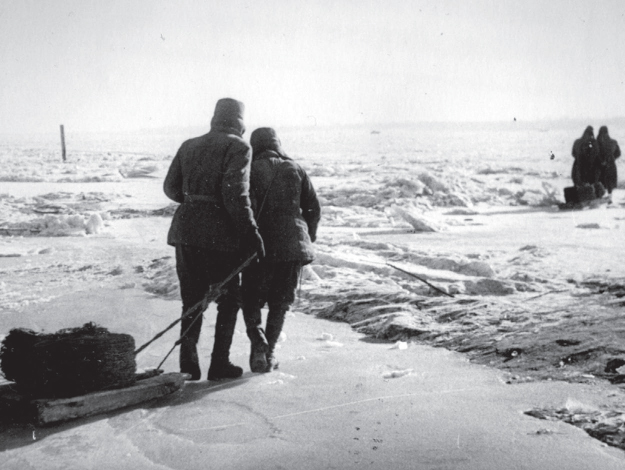
Red Army soldiers had to drag loads over frozen rivers and lakes on home-made sledges.
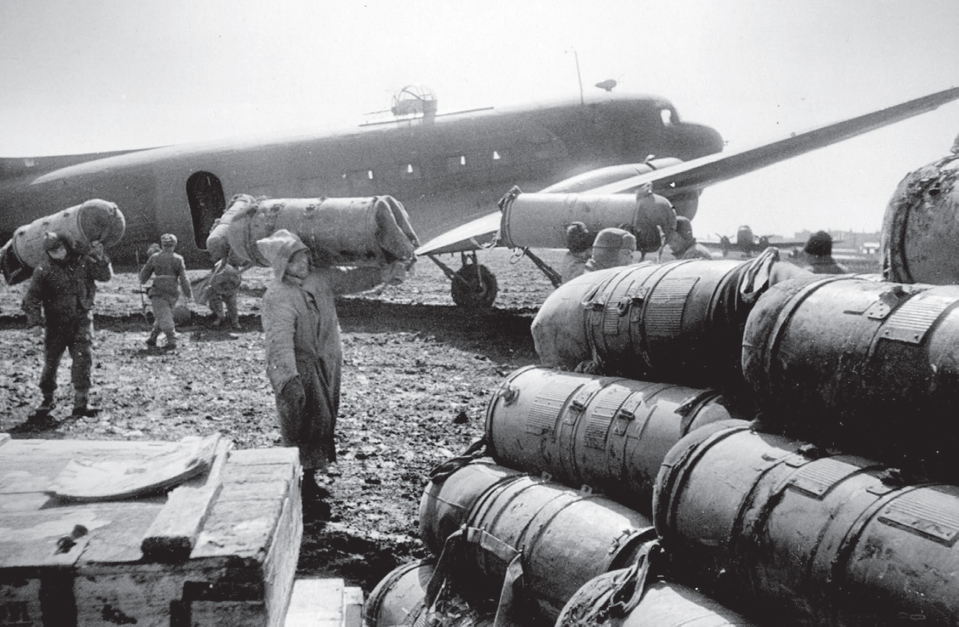
Unloading supply containers from an Li-2 transport plane (1944).
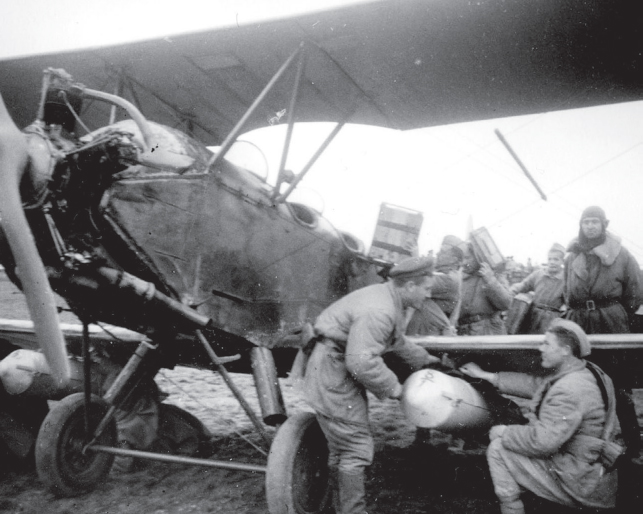
Loading a Po-2 plane. While the pilot and his helpers hang tarpaulin containers with some belongings under the plane's wings, Red Army soldiers put boxes with ammunition on the passenger's seat. Obviously, the pilot will fly alone. Most likely he will deliver his load to partisans (November, 1943).