
Chapter 8
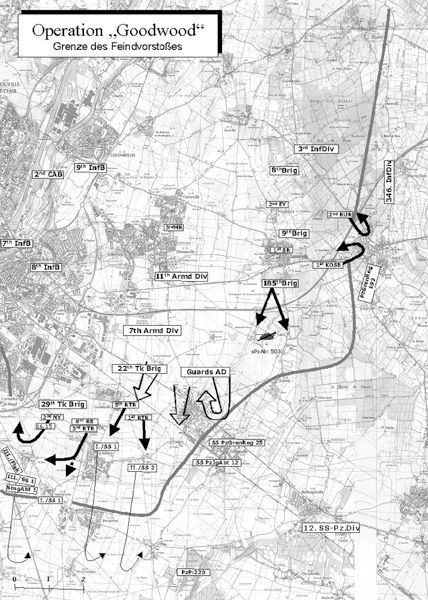
Panzergruppe West started receiving initial reports around 0830 hours concerning “extremely heavy barrage fire and bombing on the east Orne bridgehead at Colombelles in the sector of the 16. Luftwaffen-Feld-Division.” In addition, the LXXXVI. Armee-Korps reported “approximately 100 enemy tanks from St. Honorine to the south.” At 0930 hours, another message followed: “Enemy broken through to just north of Cagny with 40–50 tanks.”
The commander-in-chief of Panzergruppe West, General der Panzertruppen Eberbach, ordered the I. SS-Panzer-Korps to immediately employ the Panther battalion of the 1. SS-Panzer-Division “Leibstandarte SS Adolf Hitler” to engage the enemy tanks at Cagny. This division had just been relieved during the period from 13 to 17 July 1944 by the 272. Infanterie-Division and was the corps’ reserve in the area defined by Tilly la Camgagne–Cintheux–Brettville-sur-Laize–Bully–Ifs.
The Panther battalion of SS-Panzer-Regiment 1 reached the area between Bras and Bouguébus around noon and prepared to launch a counterattack. Grenadiers of the III./SS-Panzer-Grenadier-Regiment 1 and the II./SS-Panzer-Grenadier-Regiment 2 quickly followed behind. From their elevated positions, the tanks had a good overview of the open attack terrain of the British.
The Panthers attacked to the north in small groups and knocked out tanks of the 2nd Fife and Forfar Yeomanry. The Panthers also turned back an attack of the 23rd Hussars east of Soliers in conjunction with the 3rd and 5th Batteries of Sturmgeschütz-Brigade (Feld) 200.
The Panthers pounced from good positions and knocked out numerous enemy tanks. Extremely heavy fighter-bomber attacks on the tanks prevented the continuation of the ordered counterattacks in the direction of Hubert Folie and Frenouville.
In the meantime, the Guards Armored Division had been brought forward with the mission of supporting the attack of the 11th Armoured Division by advancing in the direction of Vimont. The approach of the Guards Armoured Division had been delayed due to the chaos in the Orne bridgehead. Towards 1100 hours, however, the first elements of this division advanced west of Emiéville.
At the same time, the thin defensive line of the II./Panzer-Grenadier-Regiment 125 running from Cagny to Emiéville was reinforced by two Pak of Panzer-Jäger-Abteilung 1039 and a few tanks.
It was not until around 1600 hours that the 32nd Guards Brigade and the tanks of the 5th Guards Armoured Brigade moved out for their first operation in Normandy by heading in the direction of Cagny. Oberstleutnant von Luck ordered the Flak in Cagny to be blown up and the village to be abandoned.
The continued attack of the Guards Armoured Division on the road from Caen to Vimont was turned back with a loss of sixty British tanks. Three guns of Panzer-Jäger-Abteilung 1039 were responsible for twenty-seven enemy tanks all by themselves. By evening, the 11th Armoured Division had lost 126 tanks. The attacking force moved back to the rail line running from Caen to Vimont.
During the afternoon, initial groups of the 12. SS-Panzer-Division “Hitlerjugend” moved up along the Caen–Vimont rail line as additional reinforcements. They occupied positions at Frénouville. The commander-in-chief of Panzergruppe West had urgently requested Heeresgruppe B to release this division at 1305 hours. Because this division had been pulled out of the line for battlefield reconstitution and had been earmarked for employment with the 15. Armee, the OKW first had to grant its permission. This took place at 1500 hours.

Although the attack in the area of the enemy’s main effort outside of Hubert Folie and between Soliers and Four came to a standstill during the afternoon, intense fighting had developed on the flanks. On the western flank, starting at 1030 hours, the 3rd Battalion of the Monmouthshire Regiment and the 1st Battalion of the Herefordshire Regiment of the 159th Infantry Brigade got held up in Cuverville while under heavy artillery fire. Towards 1200 hours, however, the 3rd Battalion of the Monmouthshire Regiment prepared to attack again, this time with tanks of the 2nd Northhamptonshire Yeomanry. Under a blazing midday sun, the men of Monmouthshire advanced through tall grain in the direction of Démouville.
The 1st Battalion of the Herefordshire Regiment linked up with the attack through the fruit orchards east of Démouville. There it was taken under heavy fire by a German tank force that was coming from Emiéville and attacking in the area south of Lirose. The British advanced into Démouville and had the village firmly in their hands by 1400 hours. They took 250 prisoners there.
Following this, the British forces that had taken Démouville linked up with the advance of the 4th Battalion of the King’s Shropshire Light Infantry and moved in the direction of Le Mesnil-Frémentel. At was at Le Mesnil-Frémentel that the British in this sector dug in for the night.
During the night, the 7th Armoured Division arrived in this area. It had also been held up by the chaotic traffic conditions in the narrow bridgehead.
The I./Jäger-Regiment 32 had initially held up the Canadians along the Orne at the Colombelles chateau. The Canadian 9th Brigade suddenly pulled back in its attack sector. An air attack that followed at 1300 hours was the reason. The air assault had no effect, however. Even the defended chateau was not hit. Following this, the entire divisional artillery of the Canadian 3rd Infantry Division suddenly placed barrage fire on the chateau, resulting in fires breaking out in the palace. It had to be abandoned by the Germans at 1515 hours.
After taking the palace, the Canadian attacked in strength along the Orne and through the industrial area of Colombelles. Colombelles proper was lost. The II./Panzer-Grenadier-Regiment 192, which was then being attacked in the industrial area, saw itself in an ever-more precarious position over the next few hours. Eventually, it was surrounded. Although the enemy had difficulty in bringing his armor through the sea of bomb craters, it was not possible for the Germans to hold the industrial area. The battalion fought its way through to the south in the direction of Mondeville.
The Canadian 8th Brigade attacked Mondeville. The fighting revolved around individual bomb craters. The Canadians attacked with special vigor around 1800 hours. The German battalion commander decided to fight to the last and sent a corresponding message to the leadership of the 21. Panzer-Division at 2020 hours.
In the evening, the Canadian 7th Brigade attacked across the Orne against the friendly forces to the left of the II./Panzer-Grenadier-Regiment 192, the 272. Infanterie-Division. French civilians helped the Canadians. Canadian combat engineers quickly erected additional military bridges over the Orne during the night.
Despite the difficult situation, a fleeting opportunity presented itself for the II./Panzer-Grenadier-Regiment 192 to break out to the southeast. By doing so, it was able to maintain its combat cohesiveness.
After it had taken Touffréville, Sannerville and Banneville, the British 8th Infantry Brigade was held up by the III./Infanterie-Regiment 731 of the 711. Infanterie-Division on the eastern side of the battlefield.
The attempt of the British 9th Infantry Brigade to take Troarn miscarried. Under the cover of tanks, the English succeeded in taking a bridge over the Cours de Janville Creek. There was fighting at the brickworks northeast of Sannerville. The 2nd Battalion of the Royal Ulster Riles, which was also supported by tanks, attempted to take Troarn by attacking it from the northwest. Farther to the south, the 1st Battalion of the King’s Own Scottish Borderers attempted to bypass the city of Troarn to the south and then attack it from the southeast. Tanks of the East Riding Yeomanry of the 27th Armoured Brigade supported all of those efforts.
At 1800 hours, the 2nd Battalion of the Lincolnshire Regiment also moved out, although its intent was to divert attention from the advance of the Royal Ulster Rifles in the north. The fighting lasted into the night, and all attempts of the English at Troarn were turned back by the grenadiers of Panzer-Grenadier-Regiment 125 and elements of other units. Troarn remained firmly in German hands on this day.
As 18 July 1944 drew to a close, the front lines in all sectors of Operation “Goodwood” firmed up.
An impressive portrayal of the fighting from the point of view of the British is given in Patrick Delaforce’s history of the British 11th Armoured Division:
The dawn of the big attack! The whole regiment [23rd Hussars] was spread out on a fairly open plain, sloping forward; our objective a high ridge of land in front of us and to the right about five miles away. We had advanced about four miles [behind the 3rd Royal Tank Regiment and ahead of the 2nd Fife and Forfarshire] without much trouble and reached the line of the main railway. So far so good! But now we had no air support and the artillery barrage had ceased. Shells and mortars were still exploding all over the place.
At 0945 3 RTR/8 RB [3rd Royal Tank Regiment / 8th Rifle brigade] had reached the first hurdle of the Caen–Troarn railway line where the very deep ditches slowed down the advance of 3 RTR. Jim Caswell reported that the artillery barrage was now too far ahead. Soon the right flank of my squadron was threatened by three camouflaged Tigers concealed in a wood to our left on Bourguébus Ridge. Most of our twenty tanks were hit in a matter of minutes. We were on the right of our regiment so I ordered the driver to make a left turn so that we could get into a good position from which to fire back … the Germans had by now obviously collected their wits together after the first colossal onslaught and things rapidly became very unpleasant for us. Armour-piercing shells began coming in from all directions and tanks of 3 RTR began brewing up. Then on our left Panthers appeared and the fun really began.
We could see some of the leading tanks on fire and sad little parties began to come back on foot. They were the survivors of the leading crews. All looked smoke grimed and the black-skinned figures of badly burned men staggered along with the help of the more active.
Captain Lemon was now less confident:
We did not hit the crust of the enemy, the 21st and the 12th SS Panzer divisions—it was just as the leading tanks were level with Hubert-Folie when the fun began. I saw Sherman after Sherman go up in flames and it got to such a pitch that I thought that in another few minutes there would be nothing left of the Regiment!
This was 3rd RTR, the most experienced tank regiment in the British Army.
Major Bill Close, OC of A squadron [OC = officer-in-charge = company commander], wrote:
[I saw] several anti-tank guns among the trees … the gunners frantically swinging their guns round towards us. In the cornfield around us were many multi-barrel mortar positions which were already firing over our heads. They were quickly dealt with in some cases by simply running over them with the tank. But the SP anti-tank guns [of Major Becker’s Battery] were a different matter. Opening fire at almost point-blank range they hit three of my tanks out of the nineteen in action, which burst into flames and I could see that the 3 RTR squadron on my left also had several tanks blazing furiously. My orders were to pass on and bypass the village.
So 3 RTR charged through one of the tunnels of the 20-yard tall Caen-Vimont railway embankment to keep moving towards the villages of Bras and Hubert-Folie:
Three Tiger tanks suddenly opened up from some trees on the left. Within minutes most of our tanks were hit. I swung the tank around to a better fighting position. I saw an 88-mm gun pointing right at us—a bright muzzle flash—a missile screamed past just overhead. “Reverse,” I shouted, “Reverse.” Back we went—but we were hit. The gunner was killed instantly. The wireless operator had collapsed badly wounded to the turret floor.
…
There was some firing on our left and we caught up with (Brigadier) Roscoe Harvey in a wooded area facing a little hamlet called Le Mesnil-Frémentel, about 1,000 yards west of Cagny. The area was being heavily mortared, the flail tanks of the Westminster Dragoons were firing at the hamlet and on the left some 300 yards nearer Cagny were a whole squadron of the Fife and Forfarshire Yeomanry all knocked out and some burning. It wasn’t quite so bad as it looked. 3rd RTR had gone on in a south-westerly direction and were now putting a squadron the other side of a high railway embankment which ran from north to south. The Fife and Forfarshire had gone on south leaving Le Mesnil-Frémentel on their right and had now halted because of the decimation of their rear squadron. The 23rd Hussars were well back on the left as some German tanks had come to life in that area.
The General now made a rare mistake. He felt that Cagny must be firmly held since strong fire from there had wrecked the Fife and Forfarshire. So he ordered an 8 RB attack on the village to be cancelled and for the 23rd Hussars to “mask” Cagny without getting knocked out. Theoretically if they kept further west—near Le Mesnil—they would be safer.
So Brigadier Roscoe Harvey ordered 23rd Hussars forward to the Fife’s assistance. B squadron’s first troop was hit and blazing within seconds:
The squadron was in full view of the Panthers and completely outranged by their guns; nearly all their Fireflies were knocked out and the 75s were virtually useless at long range. C squadron on B’s left was now within 300 yards of Four ahead of them. They took out a Tiger [probably the Tiger mentioned above] and a Panther outside Cagny on the left but suddenly without warning the whole squadron was hit by a terrible concentration of fire from Four virtually at point-blank range. Everywhere wounded and burning figures ran or struggled painfully for cover while a remorseless rain of AP riddled the already helpless Shermans.
The 23rd Hussars, who came through the stricken Fife and Forfarshires, who now had only sixteen tanks left, themselves started to take heavy tank losses. They were attacked by Tiger tanks, survivors from the von Luck group from Manneville, now commanded by Lieutenant [Oberleutnant] von Rosen. Two of their eight Tigers went up in flames, shot clean through their armour plate in front as they advanced towards Le Prieuré. British tanks were simply unable to pierce the Tigers’ frontal armour, so it was the Cagny 88-mm anti-aircraft crews, unfamiliar with tank recognition, who had mistaken Tigers for Shermans. The morale of the other Tiger crews suffered and their counter-attack petered out.
Between Frénouville and Four, south of Cagny, 2nd Fife and Forfarshire were caught by flanking Panther fire and both CO [commanding officer] and 2 i/c [second in command] were hit and wounded. So 23rd Hussars in reserve were sent to help, but despite destroying several Panthers they met the same fate, and twenty Shermans were brewed by 88 mm and Panthers in Four. The fields south of the Caen-Vimont-Paris railway embankment were strewn with knocked-out tanks from 3 RTR, 2nd Fife and Forfarshire and 23rd Hussars. Ambulances and stretcher bearers arrived at dusk to search, find and succor the survivors. It was a disaster area.
At the end of the day, the British 2nd Army had gained ground to the south and taken a few villages after destroying the forward-most portions of the German main line of resistance. This was accomplished through an unusually intense air attack that was followed by an artillery barrage and, finally, a massive armored assault. Even though this had been its objective, it had not reached the localities of Bras, Hubert-Folie, Soliers, Four, Le Poirier and Frénouville, all of which were still in German hands.
During the night of 18–19 July 1944, the LXXXVI. Armee-Korps ordered the 21. Panzer-Division pulled from the line to be repositioned. Its former sector from Frénouville to the church at Emiéville was to be assumed by the 12. SS-Panzer-Division “Hitlerjugend.” After the relief-in-place, the division was to occupy a line running from the church at Emiéville–St. Pair–Troarn.
What remained of the 16. Luftwaffen-Feld-Division—two battalions of infantry and a Pak platoon with three guns—was consolidated with the 21. Panzer-Division by order of the corps during the night of 18–19 July 1944. As a result, the end strength of the 21. Panzer-Division was raised by some 1,500 personnel. Excluded from the consolidation order were the officers of the Luftwaffe division as well as its signals and transportation elements. These elements were then employed in the rear area; later on, they formed the cadre and nucleus for the newly forming 16. Volks-Grenadier-Division. A portion of the divisional artillery was transferred to the 711. Infanterie-Division.
The relief-in-place of the 21. Panzer-Division was started with the 12. SS-Panzer-Division “Hitlerjugend,” which was brought forward again, at 0530 hours on 19 July and was completed by noon. Panzer-Grenadier-Regiment 125 of the 21. Panzer-Division assumed the sector starting at the church at Emiéville on the left-hand sector of the division. Panzer-Grenadier-Regiment 192 assumed positions running from St. Pair to Troarn. The friendly forces to the right remained the 346. Infanterie-Division.
In time, twenty-two additional Panzer IV’s were recovered from the crater landscape at Emiéville. After these were repaired, the tanks were assembled at St. Pair by 22 July 1944. The Tigers of schwere Panzer-Abteilung 503 that were operational or capable of being repaired were assembled at Le Mesnil de Bures, east of the Bois de Bavent.
During the night of 18–19 July 1944, both sides attempted to regroup and reorganize and prepare for the continuation of the fighting the next day.
In the meantime, all of the British 7th Armoured Division had also assembled in the area of Le Mesnil-Frémentel, where it encamped. The badly battered 29th Armoured Brigade assembled at Grentheville. During the night, the British succeeded in recovering a large number of damaged and/or abandoned tanks on the battlefield.
The tank losses suffered by the British 11th Armoured Division and the Guards Armoured Division were largely replaced in the course of the night. The situation was quite different on the German side. As a result of the speedy replacement of lost vehicles, the British were able to field three completely full armored divisions for the continuation of the attack.
During the night, the British infantry was able to close up with the tanks. The majority of the artillery was brought across the Orne. The morning of 19 July 1944 started more quietly—in stark contrast to the previous day—even though there was intense fighting at a few places.
Along the Orne, the Canadians had taken all of Mondeville and Fauburg de Vaucelles after the II./Panzer-Grenadier-Regiment 192 had abandoned those two villages and marched off to Troarn.
The 272. Infanterie-Division was unable to hold Fleury-sur-Orne. As a result, the Canadians had taken the suburbs of the city of Caen. The fighting continued in the new sector for the 21. Panzer-Division (Emiéville–St. Pair–Troarn).
The 9th Brigade of the British 3rd Infantry Division renewed its attack on Troarn. At 1000 hours, the 1st Battalion of the King’s Own Scottish Borderers attacked along the road to the train station. Its attack was supported by tanks, but it was rebuffed. At 1045 hours, an attack followed by the 2nd Battalion of the Royal Ulster Rifles. There was bitter fighting around a church. Five British tanks were knocked out.
A German counterattack at La Croix de Pierre bogged down in the face of strong enemy defensive fire.
During the early-morning hours of 19 July 1944, the British 185th Brigade attacked at Manneville and Cuillerville and penetrated into the abandoned villages. The British were able to take in the handiwork of their bombs in the patches of woods at Manneville and Cuillerville. They found four destroyed Tigers from schwere Panzer-Abteilung 503 as well as a number of other destroyed major items of equipment: twelve Panzer IV’s, three Panzer III’s, seven SPW’s with 2-centimeter Flak and 4 PaK.
During the afternoon of 19 July 1944, the English moved out to land another punch in the center of the attack zone. After an intensive barrage on the villages of Bras and Hubert-Folie from the artillery that had been brought forward the previous night across the Orne, the tanks of the 2nd Battalion of the Northhamptonshire Yeomanry attacked Bras from the north starting at 1615 hours.
At the same time, the 3rd Royal Tank Regiment moved out with twenty-five tanks in the direction of Hubert-Folie, which was being defended by the I./SS-Panzer-Grenadier-Regiment 1. When the enemy tanks got to the point that they had reached the previous day, they were once again brought to a standstill in the face of concentrated defensive fire.
When the English attempted to bypass Bras to the west, the enemy tanks ran in the engagement area of an 8.8-centimeter Flak battery of the III. Flak-Korps and the assault guns of SS-Sturmgeschütz-Abteilung 1. The enemy armored forces had ventured too far forward and lost half of their vehicles. What remained pulled back in the direction of Cormelles.
In the meantime, the 3rd Royal Tank Regiment, which had originally been attacking Hubert-Folie again, was sent against the village of Bras from the northeast in a change to the attack plan. This time, the English succeeded in penetrating into Bras. In accomplishing this, they were supported by the motorized infantry of the 8th Battalion of the Rifles Brigade and also helped by the thick clouds of smoke that had been caused by the barrage fire that had preceded the attack.
After succeeding in knocking out nine enemy tanks, the defending grenadiers of the III./SS-Panzer-Grenadier-Regiment 1 and the supporting assault guns of SS-Sturmgeschütz-Abteilung 1 pulled back to a new line some two kilometers south of Bras.
That same afternoon, the British 7th Armoured Division moved out to attack at 1700 hours, following heavy barrage fire on the objective area. The 5th Battalion Royal Tank Regiment of the 22nd Armoured Brigade attacked Soliers with some 70 tanks. The combat outposts of the I./SS-Panzer-Grenadier-Regiment 1, who were screening in the village, pulled back in accordance with their orders to a line some two-three kilometers farther to the rear. Soliers was lost to the enemy.
Another attack, this one by the 1st Battalion Royal Tank Regiment, was launched against Four. This led to the withdrawal of the combat outposts of the II./SS-Panzer-Grenadier-Regiment 2 to their rearward positions. By 1500 hours, Four had already been abandoned, with the exception of a few screening elements.
The fighting was bitter south of Four. A new German line was established north of Bourguébus and La Hogue. For the time being, Bourguébus continued to be held. The attempt by the “Desert Rats” to continue to advance on both sides of Bourguébus was turned back at the new defensive positions of the 1. SS-Panzer-Division “Leibstandarte SS Adolf Hitler.”
Then, at 1700 hours, the Guards Armoured Division attacked Le Poiriere and Frénouville. The attack was turned back from Frénouville thanks to the reinforced SS-Panzer-Grenadier-Regiment 25 (Kampfgruppe Waldmüller), which was supported by SS-Panzer-Jäger-Abteilung 12. Le Poiriere, however, was lost.
While poor weather prevented appreciable enemy air activity during the first part of the day, it cleared up in the afternoon. Enemy aircraft appeared in great number and participated in the fighting against ground targets.
After another heavy artillery barrage, tanks of the 2nd Fife and Forfar Yeomanry attacked Hubert-Folie again, with support from a company each from the 8th Battalion of the Rifles Brigade and the 4th Battalion of the King’s Own Shropshire Infantry. Even though a few Tigers of schwere SS-Panzer-Abteilung 101 and several 8.8-centimeter Flak joined in the fighting, it was no longer possible to hold Hubert-Folie.
For the barrage “spectacle” on Bras and Hubert-Folie, the English fired some 100,000 shells. Although the British 11th Armoured Division had gained some ground, it still had not succeeded in achieving a decisive breakthrough.
During the afternoon of 19 July 1944, Panzer-Grenadier-Regiment 125 moved out of Emiéville and attacked in the direction of Cuillerville with two companies and support from six tanks from Panzer-Regiment 22. The attack bogged down in the heavy defensive fire of the British. Because further bombing attacks were feared during the night, all of the forward positions along the main line of resistance were only occupied by weak outposts. To the rear, the Germans worked feverishly in improving defensive positions. In Bourguébus there was only a single Tiger screening.
From the British perspective, the events of 19 July 1944 looked like this:
Because of the heavy tank losses, General O’Connor now assigned the 11th Armoured Division the limited objectives of taking Bras, some 4 miles south-west of the overnight harbour, and Hubert-Folie, some 3 miles west-south-west. 7th Armoured were to take Soliers and Bourguébus, and the Guards Armoured was pitted against Cagny to the west and Four to the south.…
During the day the division achieved its two objectives, again at a heavy cost. Another sixty-five tanks were written off. The German command had reacted quickly to the massive threat posed by Goodwood.
7th Armoured took Four and the Guards Le Poirier, but Goodwood was now contained.
During the night of 19–20 July 1944, the British attacked the new positions of the 21. Panzer-Division in the area of St. Pair and Troarn. The attack was preceded by a two-hour artillery preparation. Panzer-Grenadier-Regiment 192 was able to fend this attack off.
On the morning of 20 July 1944, the 5th Battalion Royal Tank Regiment attacked again. It was able to take Bourguébus, which was only lightly defended, with its B Squadron. In the process, the single Tiger screening there—turret number 231—was knocked out. In addition, two abandoned Panthers were also captured in the village.
Only combat outposts of the 12. SS-Panzer-Division “Hitlerjugend” were positioned in Frénouville. A new line had been established just north of La Hogue during the night. The attacking 32nd Guards Brigade of the Guards Armoured Division could not be kept out of Frénouville, however, it was stopped from a further advance on Vimont.
Towards 1630 hours, the Canadian 2nd Infantry Division broke through as far as St. André-sur-Orne and St. Martin de Fontenay. It had attacked via Hills 72 and 61 south of Ifs with infantry and tanks after a heavy barrage-fire preparation. Heavy fighting took place into the night along the streets and roads. Both localities remained contested as a result. The Canadians took responsibility for Bras and Hubert-Folie.
On the afternoon of 20 July, the weather turned and there were severe storms and cloudbursts. This began three days of rain. The loamy ground on the plain east of the Orne turned into a morass. The fronts began to solidify, and the men of both sides suffered in their foxholes, which filled up with water.
Still feeling the impact of the tough defense offered by the Germans, the losses suffered and the onset of bad weather, General Montgomery called off Operation “Goodwood.” The commander of Panzer-Regiment 22, Oberst von Luck, commented as follows after the war:
The British failure to capture the Bourguébus ridge was because the British tank advance was too slow and no British infantry was advancing in close contact with tanks to break any kind of resistance. Also a strong British night attack south-east on the 18th could have probably opened the way for further advance on the 19th.
He admitted to one stroke of luck in that the great Allied air bombing had not reached the two anti-tank/anti-aircraft battalions on Bourguébus ridge.
If German troops trained on the Russian front had been entrusted with the attacking role in Goodwood, the attack would have been made very early in the morning with one infantry division in front assisted by armoured assault guns to break through the first resistance followed at once by armored divisions to break through.
General “Pip” Roberts would have agreed. General O’Connor would have disagreed.
The Army commander, General Miles Dempsey, told Chester Wilmot after “Goodwood” had finished:
The attack we put in on 18 July was not a very good operation of war tactically, but strategically it was a great success, even though we did get a bloody nose. I didn’t mind about that, I was prepared to lose a couple of hundred tanks. So long as I didn’t lose men. We could afford the tanks because they had begun to pile up in the bridgehead [500 or more Shermans lying idle]. Our tanks losses were severe but our casualties in men were very light. If I had tried to achieve the same result with a conventional infantry attack I hate to think what the casualties would have been.
The course of Operation “Goodwood” was intentionally described in such detail so as to demonstrate the main burden of the defensive fighting was not necessarily borne by the tanks. As a result of the heavy bombing attacks, they would not have had the chance anyway.
The end result of Operation “Goodwood” is well known. The British were only able to gain approximately twelve kilometers of ground. Of the 877 tanks employed, 437 were knocked out or destroyed. Even now, it is attempted again and again to try to make this and other bad decisions on the part of General Montgomery look good by arguing that the main purpose of the offensive was to tie up as many German forces as possible so that the operations of the Americans could be successfully executed. This does a disservice to the bravery of the German infantry and the few tanks employed there.
What was problematical for the German side, however, was the fact that armored forces that they had hoped to be able to pull out of the line—the 1. SS-Panzer-Division “Leibstandarte SS Adolf Hitler” or the 12. SS-Panzer-Division “Hitlerjugend”— had to be recommitted into the fighting. As a result, any hopes of being able to launch a major counteroffensive in the near term were finally buried after Operation “Goodwood.”
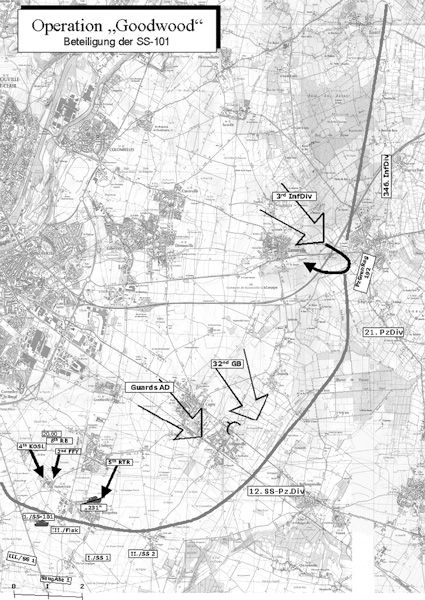
It should be emphasized that schwere SS-Panzer-Abteilung 101 assisted considerably in defending against the British. The armored elements of the enemy’s attack force that had advanced the furthest were engaged and destroyed from positions on high ground near Bourguébus as well as by means of local counterattacks. These were done in conjunction with armored elements of the 1. SS-Panzer-Division “Leibstandarte SS Adolf Hitler.”
Schwere SS-Panzer-Abteilung 101 and its Tigers participated in the following engagements:
During the first counterattack of 18 July 1944, several enemy tanks were eliminated west of Hubert-Folie and north of La Guinguette. One Tiger was knocked out by a Firefly of the 5th Battalion Royal Tank Regiment south of Soliers. (It was dispatched by a round through a haystack.)
On 19 July 1944, there were scattered operations undertaken by the operational tanks. The 3rd Company was employed at Chicheboville. The commander of the company, SS-Obersturmführer Raasch, was knocked out in Tiger 305 by friendly fire (antitank guns) and killed.
On 20 July 1944, one Tiger of the 2nd Company was knocked out by forces of the City of London Yeomanry at Bras. Tiger 231 was knocked out at Bourguébus. The 3rd Company was employed at the Ferme Beauvoire.
On 24 July 1944, six Tigers of the 3rd Company under the command of SS-Hauptsturmführer Heurich were in position in a patch of woods at Garcelles-Secqueville.
It must also be said, however, that the enemy did manage to get out of the confinement of the Orne bridgehead and that the losses sustained on the German side could not be replaced.
Until the last week of July, senior German commanders were counting on a continuation of the offensive by the English and the Canadians in the area south or east of Caen as soon as the bad-weather period ended.
For these reasons, Generalfeldmarschall von Kluge, who had also assumed command of Heeresgruppe B on 19 July 1944 after Rommel had been wounded, reinforced the defensive forces in this area. His first step was to pull the 2. Panzer-Division (Generalleutnant von Lüttwitz) out of the line south of Caumont and replace it with the 326. Infanterie-Division (Generalleutnant von Dabrich-Waechter), which had been brought forward by the 15. Armee.
The 2. Panzer-Division, which had set up for the defense for six weeks behind dense minefields, was assembled in the woods around Bretteville-sur-Laison, Fresney, Les Moutiers and Barbery, all to the south of Caen and east of the Orne.
Generalfeldmarschall von Kluge then requested the 116. Panzer-Division (Generalleutnant Graf von Schwerin) be brought forward into Normandy from the area around Amiens east of the Seine. It had previously been on stand-by there at the disposal of the 15. Armee. It was intended for this armored division to be moved into the St. Lô area to reinforce the 7. Armee, which was being hard pressed by the Americans.
When the 116. Panzer-Division was brought forward, it was initially halted east of the Orne by Generalfeldmarschall von Kluge. He was toying with the idea of relieving the badly battered 21. Panzer-Division with it. It was then intended to earmark the headquarters of the XLVII. Panzer-Korps (General der Panzertruppen Freiherr von Funck) with the command and control of these two armored divisions.
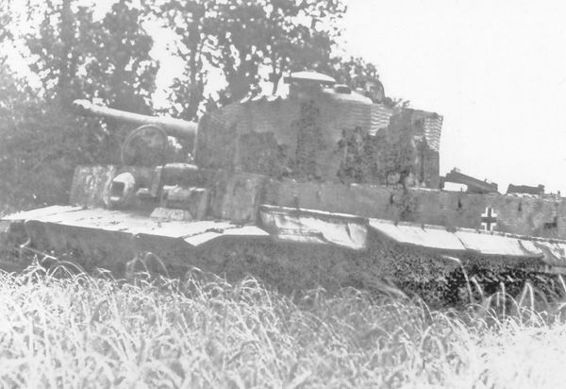
Tiger 231, knocked out at Bourguébus on 20 July 1944. (Jean Restayn)
Up to this point, there had been five German armored divisions fighting in the Caen area. With the addition of the 2. Panzer-Division and the 116. Panzer-Division, there was a total of seven armored divisions, plus all of the heavy tank battalions. Of the armored divisions, six were positioned east of the Orne in anticipation of the continuation of the enemy offensive there.
The bulk of the German armored formations were therefore within the command area of Panzergruppe West.
The 7. Armee, which was defending in the American sector, had considerably weaker armored forces at its disposal: the 2. SS-Panzer-Division “Das Reich,” the Panzer-Lehr-Division and the 17. SS-Panzer-Grenadier-Division “Götz von Berlichingen.”
General Montgomery had thus attained a portion of what he had stated was his intention: to fix the majority of the German armored divisions at Caen by the forces of his British 2nd Army, thus making it easier in the west for the Americans with their U.S. 1st Army (General Bradley) to break out into the open into the depths of France. At the same time, the pressure he was exerting in the area around Caen continued to offer the threat of a breakout towards Paris.
THE BATTLE OF NORMANDY NEARS ITS DECISIVE PHASE
In the first seven weeks of the Battle for Normandy, the Germans had brought up an additional twenty divisions on top of the seven divisions that were already in the area on the day of the invasion. As a result of the almost complete Allied air superiority and the resulting continuous air attacks on the logistics lines of communications, hardly any of the additional divisions that were introduced arrived at full strength and were operational as an integral formation.
As they arrived, they were committed into the fight—as battalions or regiments.
Of the 127,247 personnel that had been reported as killed, wounded or missing within Heeresgruppe B by 27 July 1944, only 14,594 men had been replaced. Of the 225 tanks that had been completely lost during the first few weeks of fighting, a total of 17 new tanks had been issued up to that point to replace them. Tank losses up to 23 July 1944: 406 total losses in Panzer IV’s, Panzer V’s, and Panzer VI’s, with 353 other tanks under repair. During the same time period 75 assault guns were written off and 117 were being repaired. The equipment losses of the enemy during the same period were 2,395 tanks and 402 aircraft.
While all this was transpiring, the Allies were bringing in thirty-six divisions by sea without any interruption. The superiority of the enemy increased daily. Any materiel losses could be replaced by the depots that were already located in the bridgehead. By the last third of July, the Allied bridgehead was ready to burst at the seams. More than 2,000,000 soldiers were facing one another in Normandy.
On 21 July 1944, one day after the attempt on Hitler’s life and still with impressions of the “Goodwood” offensive on his mind, Generalfeldmarschall von Kluge passed on Generalfeldmarschall Rommel’s last estimate of the situation to Hitler:
… under these circumstances it must be anticipated that the enemy will succeed in the not-to-distant future—especially in the sector of the 7. Armee—to break through and advance into the depths of France. The consequences are enormous. Our forces are fighting heroically everywhere, however, the unequal struggle is coming to a close.
I must ask you to draw the appropriate conclusions from this situation.
THE CANADIAN FAILURE
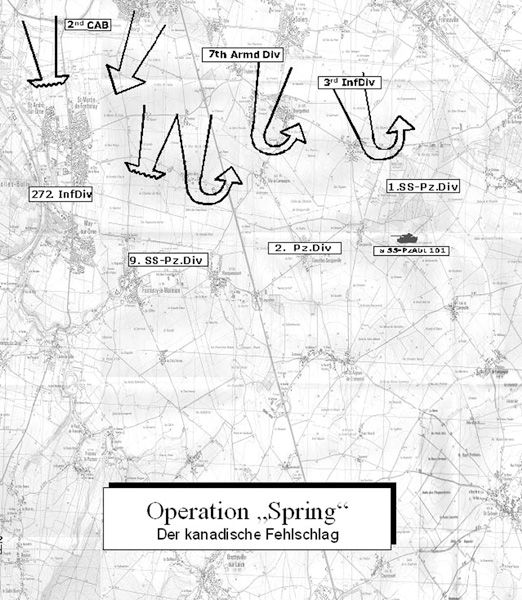
An intense attack started at 0330 hours on 25 July 1944 in the sector of the Canadian II Corps (General G. G. Simonds) on both sides of the Caen–Falaise road seemed to confirm the evaluation of the senior German headquarters that the Allied main effort would continue to be in the Caen sector. This was Operation “Spring,” which was launched together with elements of the British 7th Armoured Division and the Guards Armoured Division.
There was intense fighting for the localities of Tilly-la-Champagne, Verrières, St. Martin-de-Fontenay, St. André-sur-Orne, May-sur-Orne and Fontenay-le-Marmion.
In bitter defensive fighting and counterattacks, the 272. Infanterie-Division, the 1. SS-Panzer-Division “Leibstandarte SS Adolf Hitler,” elements of the 9. SS-Panzer-Division “Hohenstaufen” and an armored Kampfgruppe of the 2. Panzer-Division turned back the Canadians, in what would be their most casualty-intensive fighting of the Normandy campaign.
The Canadian 3rd Infantry Division attempted to bite into granite when it attacked the 1. SS-Panzer-Division “Leibstandarte SS Adolf Hitler” at Tilly-la-Champagne, and it suffered heavy casualties. Tigers from schwere SS-Panzer-Abteilung 101 supported the defensive fighting from good positions at locations such as Garcelles-Secqueville. Even the initial success enjoyed on the left in the sector of the 272. Infanterie-Division was overturned by determined immediate counterattacks.
It was to be in the American sector that the major decision concerning the breakout from Normandy was reached.
OPERATION “COBRA”
After difficult fighting that was also casualty-intensive for the Americans, St. Lô was taken during the evening of 18 July 1944. As a result, the Americans were poised to break out along the St. Lô–Périers road. They had obtained the jump-off positions needed to launch Operation “Cobra,” the breakout into the open terrain of France by the U.S. 1st Army.
Originally, this attack had been planned for 20 July 1944, that is, two days after the start of the British-Canadian Operation “Goodwood,” thus allowing the Germans no respite. Once again, it was intended for an operation to commence with the full impact of all available combat aircraft at one location. The Allied air forces needed two days after the horrific carpet bombing of 18 July 1944 east of the Orne to prepare for another aerial onslaught of this magnitude. But the bad weather conditions on 20 July 1944 postponed this intention in addition to ultimately leading to the breaking off of Operation “Goodwood” east of the Orne.
This delay appeared to benefit the Germans, because it afforded them the opportunity to mass armored forces at Caen. By doing so, however, they went to the wrong place.
The Panzer-Lehr-Division under Generalleutnant Bayerlein had been fighting in the area west of St. Lô ever since 11 July 1944, where it had engaged the Americans in casualty-intensive fighting on both sides in the broken bocage country.
In order to make good the casualties that resulted from the constant artillery fire, the 5. Fallschirm-Jäger-Division of Generalmajor Wilke, which was still in the process of being formed, was brought forward from the Bretagne region.
The Panzer-Lehr-Division and the 5. Fallschirm-Jäger-Division defended in a line running from St. Lô through Périers to Lessay. Both divisions were under the command of the LXXXIV. Armee-Korps (Generalleutnant von Choltitz).
The Americans had placed two armored divisions and four infantry divisions against the Panzer-Lehr-Division. This was a massing of some 140,000 men and 500 tanks. To that number were added some 1,000 artillery pieces.
The Americans hit at 0940 hours on 25 July 1944. The Allied air forces attacked with 2,264 bombers dropping some 6,000 tons of bombs. For the first time, there were some 300 tons of napalm as well. It was dropped in the area of Hebecrevon, south of the Périers–St. Lô road. Once again, it was another carpet bombing, the likes of which were feared by all German combatants in Normandy. It virtually destroyed the Panzer-Lehr-Division.
The divisions of the U.S. VII Corps moved out at 1100 hours behind the barrage fire of American artillery. They broke through the lines from Périers to St. Lô against what amounted to a delaying action. On the morning of 27 July 1944, they advanced across a line defined by Marigny and St. Gilles with the intent of breaking through to the south.
The commander of the Panzer-Lehr-Division sent the following bitter message to Heeresgruppe B and the commander-in-chief West at 2215 hours on 27 July 1944:
1. After 49 days of the hardest fighting imaginable, the Panzer-Lehr-Division has been eliminated today.
2. Broken through on all sides, the enemy is now continuing to roll from St. Gilles to the south.
All requests for assistance in terms of forces have remained unheard up to this point, because one did not want to believe how serious the situation is.
Because the 7. Armee was not in a position to prevent the expected breakthrough of the Americans with its own forces, Generalfeldmarschall von Kluge ordered the immediate movement of the headquarters of the XLVII. Panzer-Korps— including the 2. Panzer-Division and the 116. Panzer-Division—out of the area around Caen and into the area west of St. Lô.
At the same time, the U.S. VIII Corps attacked in the western half of the Cotentin Peninsula to the south from a line running from Lessay to Périers. The corps reached Coutances. By the afternoon of 28 July 1944, it broke though the weakly held lines of the 242. Infanterie-Division and the 91. Luftlande-Division that were defending there.
The left wing of the 7. Armee had been smashed.
The U.S. 4th Armored Division reached Avranches during the evening of 30 July 1944. Advancing further, it established a bridgehead over the Selune at Pountaubault. The door to the Bretagne was then open for General Patton, who was ready to advance into the open French terrain with his U.S. 3rd Army.
In the meantime, the British had also been preparing their next blow.