Tle InfRgt 752 = Elements of Infanterie-Regiment 752
PzJgAbt 654 = Panzerjäger-Abteilung 654
StuGAbt 200 = Sturmgeschütz-Abteilung 200
PzPiBtl 220 = Panzer-Pionier-Bataillon 220
KpfGrp Oppeln = Kampfgruppe Oppeln
FErsBtl 200 = Feld-Ersatz-Bataillon 200 = 200th Field Replacement Battalion
3. FschJdDiv = 3. Fallschirmjäger-Division
PzAufklAbt 21 = Panzer-Aufklärungs-Abteilung 21
Chapter 9
In the area of Caen on the eastern flank of the wavering Normandy front, heavy traffic was suddenly observed on the roads heading towards the west. This was in addition to continued large areas of concentration among the enemy. The English, who were apparently withdrawing their tanks from the high ground at Bourguébus, were taking pains to mask their movements through smoke.

General Montgomery had not been happy with the way the outcome to Operation “Goodwood” was treated among the Allied staffs and in the press in Great Britain and the United States. He felt that his intentions had been interpreted incorrectly. His strategy would be a topic of debate well into the post-war period. He stated the following in his memoirs after the war:
But my primary strategic objective was and remained to concentrate large armored forces on the eastern flank southeast of Caen, somewhere in the area of Bourbuérgus, so as to fix German armored forces there. It was intended, as a result, to facilitate the breakout of the Americans in the west.
We did not advance against the more highly elevated terrain until armored forces of the 2nd Army started Operation “Goodwood” on 18 July 1944. However, as soon as the armored advance did not make any headway—partly due to the heavy rainfall that turned the area into a sea of mud and partly due to the determined resistance of the enemy—I called off the operation. [Reverse-translated from the German text of the original English.]
Certainly also a viewpoint of things designed to divert attention away from mediocre leadership qualities.
General Montgomery’s deliberations after the conclusion of Operation “Goodwood” were simple and his corresponding decisions logical: If almost all of the German armored divisions were assembled in the area around Caen in front of his sector—as was readily apparent—and, by extension, they represented almost all of the German armored forces available on the entire battlefield, then he was compelled to attack at a point where there were no more armored formations at all.
These conclusions were reinforced by the failure of the attack of the Canadian II Corps on 25 July 1944 on both sides of the Caen-to-Falaise road in “Operation “Spring”. In the face of the bitter resistance offered by the 1. SS-Panzer-Division “Leibstandarte SS Adolf Hitler,” the 272. Infanterie-Division and battle groups from the 9. SS-Panzer-Division “Hohenstaufen” and the 2. Panzer-Division, the operation had failed miserably.
On the morning of 26 July, there were four Tigers of schwere SS-Panzer-Abteilung 101 employed in the attack zone of Operation “Spring.” These Tigers supported a counterattack of the 1. SS-Panzer-Division “Leibstandarte SS Adolf Hitler” against the Canadian Royal Regiment, which was attacking at Verrièrres. They engaged a company of the 1st Royal Tank Regiment.
The area in the sector of Montgomery’s 2nd Army where there were almost no more German tanks was on the other end of the battlefield on the western flank. It was the area south of Caumont and Villers-Bocage, where the 2. Panzer-Division had just been pulled out of the line. General Montgomery wanted to have the attack launched there in order to support the anticipated breakout of the U.S. 1st Army west of St. Lô in the western part of the Normandy front.
General Montgomery wanted to create another hot spot in front of the sector of the British 2nd Army so as to continue to fix German forces there. Otherwise, they would most certainly be committed into the area of operations of the 7. Armee, which was being threatened by the Americans.
On 27 July 1944, General Montgomery issued his orders, and the British started considerable repositioning in order to move the focal point of their activities from around Caen to the area south of Caumont. Operation “Bluecoat” was being prepared.
The staff of the Canadian 1st Army (Lieutenant General Crerar) had already been flown into Normandy from England. On 23 July 1944, it assumed command over the Canadian II Corps and the British I Corps, thus giving it command over the eastern flank of the Normandy front on both sides of the Orne.
The first division pulled out of the Orne area—once again moving from east to west—was the British 11th Armoured Division. It was followed by the 7th Armoured Division and then the Guards Armoured Division.
General Dempsey shifted the front of his 2nd Army to the west as far as the area around Caumont. He linked up with the American sector there. The battered British armored divisions had been able to quickly make good their losses from the full equipment depots.
For Operation “Bluecoat,” the following forces were assembled:
• Right (west) flank: British VIII Corps (Lieutenant General N. O. Connor):
• 15th (Scottish) Division
• British 11th Armoured Division
• Guards Armoured Division and the
• 6th Guards Armoured Brigade
• Left (east) flank: British XXX Corps (Lieutenant General G. C. Bucknall):
• 43rd (Wessex) Division
• 50th Northhumbrian Division
• 7th Armoured Division
• 8th Armoured Brigade
The attack objective: The taking of the high ground from Bény to Bocage and the city of Vire. The two corps were to exert pressure, fix the German forces and prevent them from using the dominant Mont Pincon as a defensive bulwark.
General Montgomery’s exhortation to his 2nd Army: “Step on the gas to Vire” General Dempsey had assembled in the area around Caumont no less than three infantry divisions, three armored divisions and two armored brigades, with a total of more than 1,000 tanks. These forces were approaching the sectors of the 276. Infanterie-Division and the 326. Infanterie-Division.
The 276. Infanterie-Division of Generalleutnant Badinski had arrived from southern France on 19 June 1944 and relieved the Panzer-Lehr-Division. This division was facing three British divisions and an armored brigade, all of which had already experienced their baptism of fire.
The 326. Infanterie-Division of Generalleutnant Drabisch-Waechter, which had heretofore enjoyed a quiet time at the Pas de Calais in the sector of the 15. Armee, had just recently arrived in Normandy. This division, the left-wing division of Panzergruppe West, saw itself also facing three divisions, of which two were armored, and an armored brigade.
There were no German armored formations in this area, except for a few damaged tanks still left from the recently relieved 2. Panzer-Division. The only antitank force available to the corps was schwere Panzerjäger-Abteilung 654— equipped with the Jagdpanther tank destroyer—which was in direct support of the corps.
Command and control of these two infantry divisions fell to the headquarters of the LXXIV. Armee-Korps (General der Infanterie Straube), which had just arrived from the Bretagne on 27 July 1944.
The friendly forces to the left—on the right wing of the sector of the 7. Armee of SS-Obergruppenführer Hausser—was the headquarters of the II. Fallschirm-Korps of General der Fallschirmtruppe Meindl.
When an observer looks from the high ground at Caumont to the south, then three groups of hills assume a dominating position over the otherwise broken bocage country: Hill 365, Mont Pincon and, farther to the west, Hills 361 and 309.
Hill 361 was the first day’s objective for the 43rd Wessex Division, which had already been engaged in difficult fighting at Hill 112 (west of Caen) at the end of June. The objective of the 15th (Scottish) Division was Hill 309.
Due to the surprisingly rapid progress of the American attack in the area west of St. Lô (Operation “Cobra”), the start of Operation “Bluecoat” was moved forward two days from its original start date of 2 August 1944. This was done even though not all of the British forces had closed on their assembly areas.
The 30th of July 1944 started with a gray, muggy morning. In the interest of keeping their intentions secret, the British forewent their normal practice of having a long-lasting artillery preparation that had been preceded by an aerial bombardment.
For this reason, identified targets were not bombed and placed under considerable artillery fire until the attack started. Heavy bombers of the British Bomber Command carpet-bombed the positions of the 276. Infanterie-Division four times. Medium bombers of the U.S. 9th Tactical Air Force carpet bombed the area of the 326. Infanterie-Division three times. Low-lying, thick clouds interfered with the bombing runs, so that a portion of the 1,000 bombers could not identify their targets and had to return to base with their bomb loads. The carpet bombing was timed to coincide with the start of the armored attack or shortly afterwards.
The British 50th Northhumbrian Division attacked behind a rolling barrage at 0600 hours. Moving along the Caen–Caumont road and supported by a brigade of tanks, the division moved against the positions of the 276. Infanterie-Division. For the most part, however, it was initially repulsed. The right wing of the 326. Infanterie-Division was also able to hold out initially against the attack at St. Germain d’Ectot. The 326. Infanterie-Division had to pull back in its center, however. Towards noon, forces of the 43rd Wessex Division broke through at Briquessard and reached Cahagnes by evening. They were not able to take their day’s objective of Hill 361.
The 15th (Scottish) Division broke through at Sept-Vents, advanced in the direction of St. Jean-des-Essartiers and then reached Loges. Towards 1900 hours, Churchills of the 6th Guards Armoured Brigade reached the dominant terrain of Hill 309. Infantry of the 46th Brigade quickly followed. The Scots dug in on Hill 309. They dragged their antitank guns up the hill by hand. Counterattacks launched by local reserves of the 326. Infanterie-Division remained without effect.
Although two Jagdpanther of schwere Panzerjäger-Abteilung 654 were able to knock out a few tanks of the 6th Guards Armoured Brigade with their effective 8.8-centimeter main guns at Loges and on Hill 226 around 1800 hours in an immediate counterattack, they were unable to turn back the attackers.
Individual groups of the 326. Infanterie-Division were still holding out east of Hill 309 in La Ferriére-au-Doyen and in the Bois du Homme (Hill 361).
Farther to the west, tanks of the British 11th Armoured Division approached Dampierre while advancing along the Caumont–Torigni road. They had had to breach German minefields, which initially had caused them some difficulties. They took the village of Dampierre in the evening.
Some of the infantry of the 326. Infanterie-Division, who had been overwhelmed by the carpet bombing attacks, fled to the rear in panic. The command post of the 326. Infanterie-Division had been destroyed in aerial attacks and two regimental command posts had been overrun by tanks.
During the night of 30–31 July 1944, the enemy prepared to continue his offensive in a patch of woods north of St. Martin-des-Besaces. At 0400 hours on the morning of 31 July 1944, infantrymen of the 4th Battalion of the King’s Own Shropshire Light Infantry of the 11th Armoured Division reached the road west of St. Martin-des-Besaces. A few tanks of the 2. Panzer-Division that had remained behind knocked out some armored cars and kept the enemy from immediately penetrating into the village. The only other German “tanks” in the area were dummy tanks that had been set up to deceive the enemy.
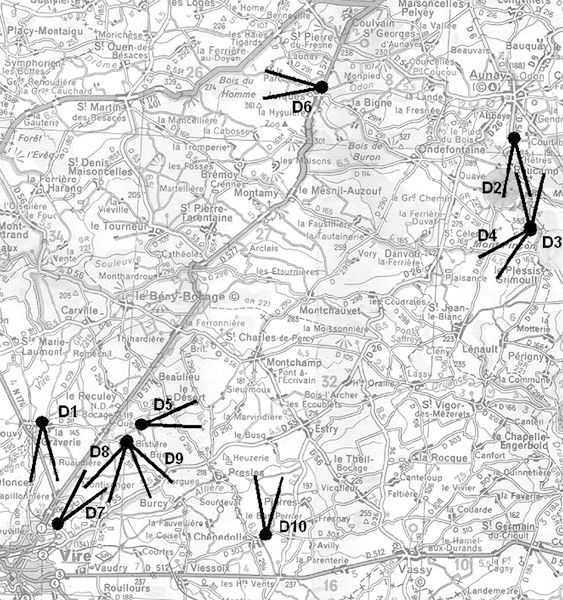
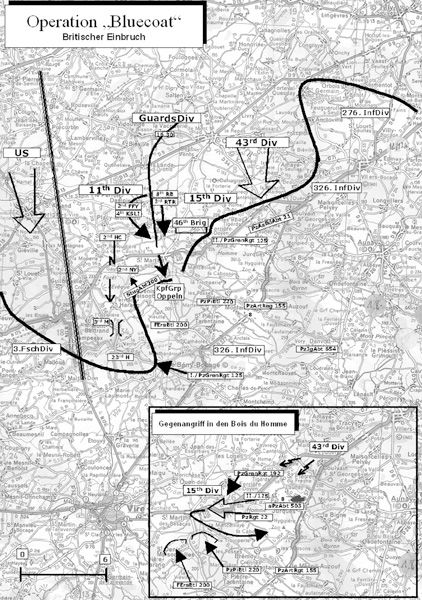
This sketch map shows the location of the vantage points in the photographs that follow for the area of operations of schwere Panzer-Abteilung 503 at Mont Pinçon and to the north, as well as the operations of schwere SS-Panzer-Abteilung 101 at Vire.
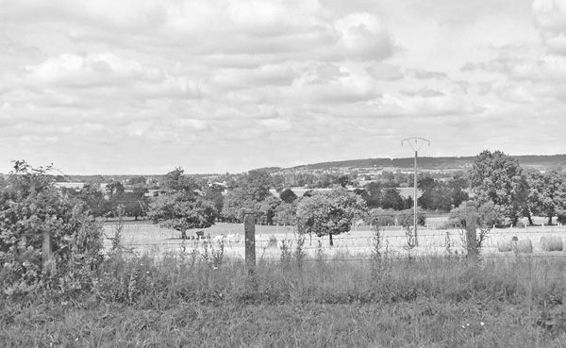
British view to the south in the direction of Vire, which is located approximately in the middle of the picture behind the cut in the ridgeline. For the British, the attack meant an assault of several kilometers over largely open terrain. The Americans, for their part, had already passed Vire on the viewer’s right behind the hill mass.
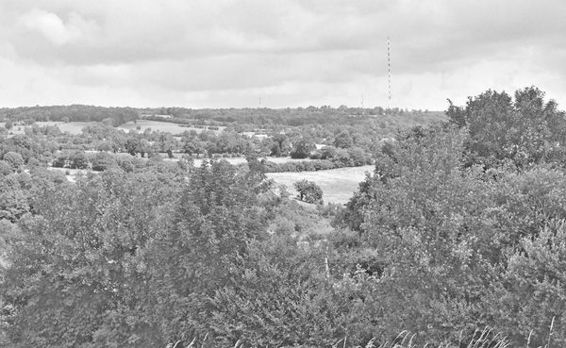
British vantage point to the south from the heights of Mont Pinçon.
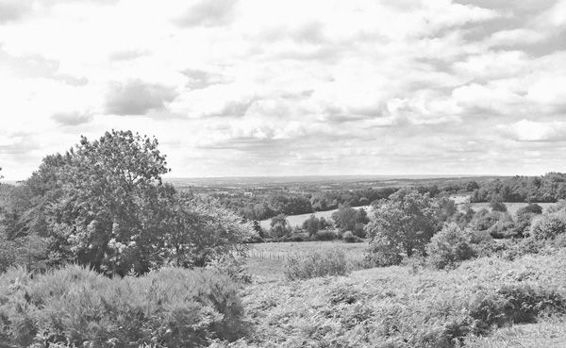
The view from Mont Pinçon towards the British lines. The advantages to the defenders are quite obvious.
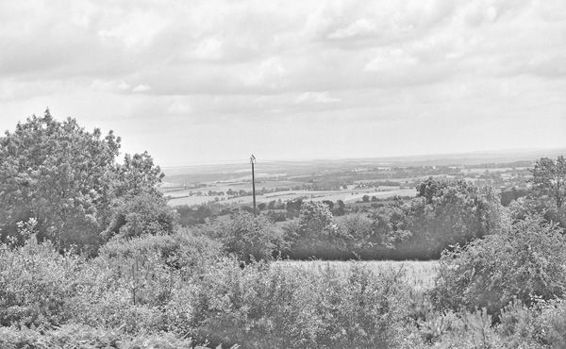
The view to the southwest. The open terrain favors maneuver warfare. For the Germans, it offered little opportunity to effectively hold up the enemy. The objective of Operation “Bluecoat” was to take that terrain, creating the prerequisites for the final breakthrough.
THE EMPLOYMENT OF THE 21. PANZER-DIVISION
The initial reports of the LXXIV. Armee-Korps concerning the start of a new enemy offensive in the area around Caumont arrived at Panzergruppe West around 0800 hours on 30 July 1944.
The extent of the enemy attacks could not be determined yet by Panzergruppe West at that early hour. After the arrival of additional adverse reports, however, the headquarters was already considering the employment of an armored group from the 21. Panzer-Division around 1000 hours. But General der Panzertruppen Eberbach did not order the I. SS-Panzer-Korps, to which the 21. Panzer-Division had been attached since 27 July 1944, to immediately dispatch an armored force from this division to the LXXIV. Armee-Korps.
After hours of uncertainty regarding developments at the sector being attacked south of Caumont, Kampfgruppe von Oppeln left its bivouac area in the Forêt de Cinglais at 1715 hours. It was still light when it started its march to the west and in the direction of Coulvain.
The commander of the Kampfgruppe, Oberst von Oppeln-Bronikowski, had been awarded the Oak Leaves to the Knight’s Cross on the previous day (29 July 1944) as the 536th member of the German Armed Forces to receive this high award. It had been presented for his achievements as commander of Panzer-Regiment 22, which had been in action in the invasion front since the very beginning.
Kampfgruppe von Oppeln consisted of the I./Panzer-Regiment 22 (with approximately 40 Panzer IV’s) and elements of schwere Panzer-Abteilung 503 (15 Tigers), the I./Panzer-Grenadier-Regiment 192, the 1./Panzer-Pionier-Bataillon 220 and the III./Panzer-Artillerie-Regiment 155.
At the end of July 1944, several rail shipments arrived, whereby Panzergruppe West received thirty-four Panzer IV’s and twenty-four Panthers as replacements for all of its forces. Of these, Panzer-Regiment 22 received a grand total of twelve new Panzer IV’s.
The approach march of Kampfgruppe von Oppeln took some time, occurring as it did during daylight conditions and therefore under the constant threat of aerial observation and attack from the enemy air forces. In addition, the road march through the small localities with their narrow streets and across bridges with marginal load capacity for the heavy tanks caused numerous halts.
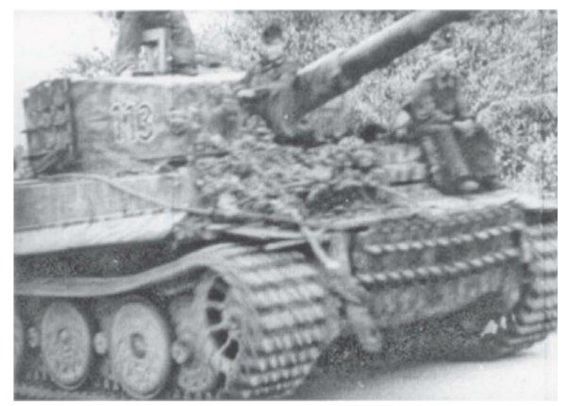
Tiger 131 on the move. It was one of two Tiger I’s of the 1st Company, which was otherwise issued Tiger II’s.
The first elements of Kampfgruppe von Oppeln did not reach the area around Coulvain until around 2200 hours on this 30 July 1944. It took nearly five hours for a march distance of thirty-five kilometers. The commanding general of the LXXIV. Armee-Korps, General der Infanterie Straube, waited impatiently for the arrival of the Kampfgruppe.
He intended to pass the Kampfgruppe through the gap between Hill 309 and the Bois du Homme and push it into the line running from La Ferrière-au-Doyen to Dampierre. This intent was passed on to Panzergruppe West at 0010 hours on 31 July 1944. It in no way corresponded to reality and demonstrated how little the headquarters of the corps understood of the actual situation. By this time, Hill 309 was firmly in the hands of the 15th (Scottish) Division.
Nevertheless, Kampfgruppe von Oppeln received the order from the LXXIV. Armee-Korps to attack north of the Bois de Homme and to the west in the early morning hours of 31 July 1944. The Kampfgruppe was to roll up the enemy and establish a new main line of resistance running from about 1.5 kilometers north of the Bois du Homme road to St. Martin-des-Besaces.
At 1930 hours of 30 July 1944, the Operations Officer of the 21. Panzer-Division was informed telephonically by the chief-of-staff of Panzergruppe West to be prepared for the rest of the division to have to be attached to the LXXXIV. Armee-Korps that evening. At 2200 hours, the divisional commander was personally instructed by the commander-in-chief of Panzergruppe West to join Kampfgruppe von Oppeln as soon as possible.
The commander of the 326. Infanterie-Division, Generalleutnant Drabsich-Waechter, briefed the commander of the 21. Panzer-Division, Generalmajor Feuchtinger, more thoroughly on the actual situation at the infantry division’s command post at 0500 hours on 31 July 1944. In the course of this, it was found out by Generalleutnant Feuchtinger that the assumption of the corps that the 326. Infanterie-Division still held the road on both sides of St. Martin-des-Besaces and the Bois du Homme was incorrect. This had not been the case since noon on 30 July 1944. There were only small groups from Infanterie-Regiment 752, which had been employed on the left of, at and south of St. Martin-des-Besaces. The situation in the Bois du Homme was unclear.
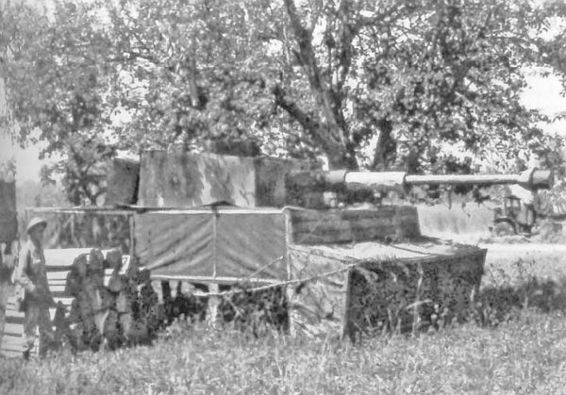
A dummy Tiger in the sector of the 21. Panzer-Division. A fighter-bomber occasionally fell for the deception and attacked the “Tiger.”
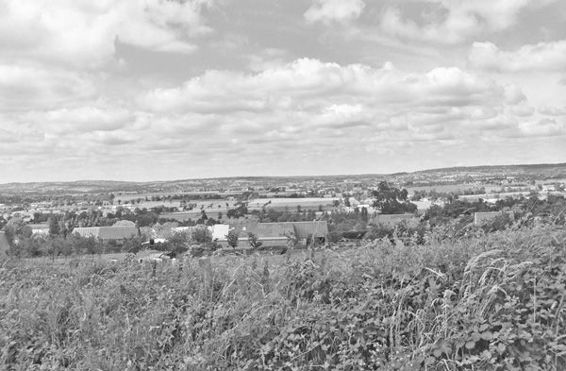
View of La Bistière in the direction of the terrain south of Bény Bocage, affording a look into the British attack zone from the west. Schwere Panzer-Abteilung 503, which was reinforcing the 21. Panzer-Division, was one of the formations that fought on the high ground along the horizon. The II. SS-Panzer-Korps was committed along the viewer’s right. Initially, the British were under extremely heavy pressure.
In fact, the estimate of the situation by the leadership of the 326. Infanterie-Division was also not completely correct. The 4th Battalion of the King’s Own Shropshire Light Infantry did not reach the road west of St. Martin-des-Besaces until 0400 hours on 31 July 1944. In the meantime, Kampfgruppe von Oppeln had established positions southeast of St. Martin-des-Besaces on the road running from there to the Bois du Homme.
It was difficult for the newly arrived German forces to get oriented in their new area of operations. A detailed overview of the actual situation was missing. Under these circumstances, it was initially impossible to even consider an attack during the morning hours, especially since it was paramount at the moment to also screen against the anticipated new enemy attacks.
The leadership of the 21. Panzer-Division was therefore in agreement with the measures taken thus far by Oberst von Oppeln-Bronikowski. It also had to make other decisions itself, since it was already under considerable fire.
The elements of the division that began to arrive were positioned as follows:
• Panzer-Aufklärungs-Abteilung 21: In the area north of the Bois du Homme as far as Benneville
• II./Panzer-Grenadier-Regiment 125: In the Bois du Homme
• II./Panzer-Grenadier-Regiment 192: Attached to Kampfgruppe von Oppeln, south of St. Martin-des-Besaces
• Panzer-Pionier-Bataillon 220: At the disposal of the division, west of Brémoy
• Feld-Ersatz-Bataillon 200: Division reserve, south of St. Martin-des-Besaces
• Panzer-Artillerie-Regiment 155: Behind Panzer-Grenadier-Regiment 125 and Kampfgruppe von Oppeln.
Sturmgeschütz-Brigade (Feld) 200, which was not brought up from the area around Troarn until the afternoon of 31 July 1944, screened south of St. Martin-des-Besaces and southeast of the Forêt l’Evêque. It was intended for the rest of Panzer-Grenadier-Regiment 125, which was still in its approach march, to be funneled into the area of le Bény-Bocage.
The great concern of the LXXIV. Armee-Korps was understandable. The left flank of the corps had been shattered and was open. There was no more contact with the friendly forces to the left, the 3. Fallschirm-Jäger-Division of the I. Fallschirm-Korps of the 7. Armee.
The Forêt l’Evêque, the boundary of Panzergruppe West to the 7. Armee, was completely unsecured, and the situation was also uncertain, which would later prove to have fateful consequences. The danger existed that the enemy could penetrate though this gap to the south.
On the night of 30–31 July 1944, the enemy was also quite busy. He was preparing for the continuation of the fight.
Early in the morning of 31 July, just after sunrise, the 43rd Wessex Division attacked again at Cahagnes. As a result of the immediate counterattack of elements of Panzer-Aufklärungs-Abteilung 21, the fighting proved intense and costly; in some cases, it was close-quarter fighting. Prior to the enemy renewing his attack later, Cahagnes was bombed once again. He then succeeded around 1730 hours in penetrating into the heap of rubble that was once this village. Late in the evening, the enemy reached St. Pierre-du-Fresne. As a result, he was at the foot of the Bois du Homme.
Considerably more dangerous was a development farther to the west. Reconnaissance elements of the 2nd Battalion of the Household Cavalry, which reported directly to the British VIII Corps, were reconnoitering on the road on both sides of St. Martin-des-Besaces.
The 11th Armoured Division then advanced in two attack wedges. Tanks of the 3rd Royal Tank Regiment moved out at 0800 hours along with the 8th Battalion of the Rifles Brigade from the patch of woods north of St. Martin-des-Besaces. Half an hour later, tanks of the 2nd Fife and Forfars Yeomanry and infantry of the 4th Battalion of the King’s Own Shropshire Infantry attacked St. Martin-des-Besaces from the west. All of these formations were well known to the men of the 21. Panzer-Division from their fighting during Operation “Goodwood.”
St. Martin-des-Besaces was lost around 1100 hours. The remaining elements of the 326. Infanterie-Division pulled back to the positions of Kampfgruppe von Oppeln southeast of St. Martin-des-Besaces.
At 1630 hours that afternoon, the Guards Armoured Division, which had previously been held in reserve, was ordered to advance on le Tourneur through St. Martin-des-Besaces. It had been in position in the area around Caumont. Forces from this division then suddenly appeared in the evening south of St. Martin-des-Besaces and in front of Hills 192 and 238.
Heavy fighting ensued, in which elements of the 326. Infanterie-Division, Sturmgeschütz-Brigade (Feld) 200 and Feld-Ersatz-Bataillon 200 were involved. Hill 192 and the village of Le Val changed hands several times.
Even more threatening, however, was the way the second attack wedge of the 11th Armoured Division developed farther to the west. It was there that other elements of the 2nd Battalion of the Household Cavalry found an important gap while reconnoitering. They advanced rapidly across the narrow paths in the woods of the completely unsecured Forêt l’Evêque and through La Ferrière-Harang. West of Le Bény-Bocage, they took an intact and unguarded bridge over the Souleuvre.
The English were encountering resistance from neither the 326. Infanterie-Division of Panzergruppe West nor the 3. Fallschirm-Jäger-Division of the 7. Armee. The enemy had hit the boundary between these two field armies, and he reported his surprising success via radio at 1030 hours.
The leadership of the British VIII Corps recognized the opportunity being offered and reacted quickly.
Initially, six Cromwell’s of the 2nd Battalion of the Northhamptonshire Yeomanry moved through the Forêt l’Evêque towards the captured bridge. East of La Ferrière-Harang, they engaged the assault guns of Sturmgeschütze-Brigade (Feld) 200 that were just then arriving.
Following soon thereafter were the tanks of the 23rd Hussars and the combat-experienced 3rd Battalion of the Monmouthshire Regiment. Starting at 2000 hours, they secured the bridge. The aforementioned assault guns also encountered and engaged tanks of the 23rd Hussars.
In the meantime, the 1st Battalion of the Herefordshire Regiment established contact with the Americans. That evening, this battalion and tanks of the Fife and Forfar Yeomanry screened the western flank of the British 2nd Army west of the road at Pont Aunay.
The British had succeeded in making a breakthrough and the left flank of Panzergruppe West was hanging in the air.
The armored car company of Panzer-Aufklärungs-Abteilung 21, which was reconnoitering in this area, took some prisoners southwest of the Forêt l’Evêque. After they were interrogated by the intelligence officer of the 21. Panzer-Division, the enemy situation became somewhat clearer.
The I./Panzer-Grenadier-Regiment 125 was being hurried into sector from the area of operations of the 1./SS-Panzer-Division “Leibstandarte SS Adolf Hitler” south of Caen. It was being positioned to cover the left flank at Le Bény-Bocage. The battalion suffered casualties during the afternoon as a result of heavy attacks from the air.
By then, the 3rd Battalion of the Monmouthshire Regiment was already combing the woods near Le Bény-Bocage. A counterattack against these elements by the I./Panzer-Grenadier-Regiment 125 that evening proved unsuccessful.
In order to avoid an encirclement, the commanding general of the II. Fallschirm-Jäger-Korps (General der Fallschirmtruppe Meindl) ordered his 3. Fallschirm-Jäger-Division to pull back to the south bank of the Vire during the night of 31 July–1 August 1944. Fallschirmjäger of the division, who had previously screened on Hill 205 west of Le Bény-Bocage, pulled back. That evening, tanks of the 23rd Hussars were on Hill 205.
At this point, the 21. Panzer-Division was faced by the 11th Armoured Division, the Guards Armoured Division, the 15th (Scottish) Division and, north of Jurques, elements of the 43rd Wessex Division. These developments were followed with great concern by the divisional leadership at the command post at St. Pierre-Tarentaine. The enemy was attacking in great force and was once again proving his great superiority in artillery and air resources, which he was employing to good effect.
In contrast, the trench strength of the German mechanized infantry battalions was barely more than 200 men, despite the receipt of replacements and additional manpower from the shattered 16. Luftwaffen-Feld-Division. Facing the few tanks of Panzer-Regiment 22 were a considerably greater number of enemy tanks. It was only thanks to the fact that the bocage country was not good terrain for tanks that the English did not simply move on through and achieve an even greater breakthrough.
Despite the terrible situation, the 21. Panzer-Division and what remained of the 326. Infanterie-Division succeeded by themselves in temporarily holding up the enemy during the course of 31 July 1944, especially in the area south of St. Martin-des-Besaces. The 21. Panzer-Division conducted two immediate counterattacks by infantry against Hill 309 to wrest it from the Coldstream Guards. These did not succeed.
At the conclusion of its approach march, Kampfgruppe von Oppeln had forty-one operational Panzer IV’s, eight Tigers and twelve Jagdpanthers of schwere Panzerjäger-Abteilung 654. Five Tigers were left along the way due to minor mechanical problems. The Kampfgruppe then received orders to support the third attempt to take back Hill 309.
Right at the start of the effort, roughly one third of the Panzer IV’s were rendered non-operational by massed Typhoon fighter-bomber attacks from the 83rd Tactical Group. The remaining tanks attempted to take Hill 192, further to the south, that evening. Hill 192 was along the avenue of approach of the Guards Armoured Division towards St. Martin-des-Besaces.
The fact that the British 11th Armoured Division had made a dangerous breakthrough along the boundary between Panzergruppe West and the 7. Armee could not be ascertained by the German side just yet.
The commander-in-chief of Panzergruppe West and the commanding general of the LXXIV. Armee-Korps had pinned their hopes on a counterattack of the 21. Panzer-Division from its tactical assembly area southeast of St. Martin-des-Besaces to the west in order to eliminate the threat from this area and reestablish contact with the 7. Armee.
The forces of the 21. Panzer-Division were barely sufficient, however, to seal off the breakthrough area around St. Martin-des-Besaces. The enemy controlled the high ground to either side. At the moment, it was imperative for the Germans to establish a new main line of resistance where they were. The possibility of conducting a counterattack, as had been ordered by the corps, was something that needed to be considered only afterwards.
Because the counterattack from the Bois de Homme towards Hill 309 had not yet taken place, the commanding general of the LXXIV. Armee-Korps, General der Infanterie Straube, leveled serious accusations against the leadership of the 21. Panzer-Division on the evening of 31 July 1944.
General der Infanterie Straube ordered the attack again, this time for the morning of 1 August 1944—despite all the objections of the armored division. The 21. Panzer-Division pointed out that the necessary concentration of forces by the division for the counterattack would necessitate its pulling those same forces out of their recently established defensive positions south of St. Martin-des-Besaces. This, in turn, would give the enemy another opportunity to break through to the south. This objection by the division was ignored by the corps. The fateful danger that would be presented to the corps’ continued open left flank by the withdrawal of forces was likewise not noted. Finally, the division stated that the forces of the 21. Panzer-Division were inadequate for conducting such an attack. This objection was also discounted at the heated meeting held at the corps command post around midnight on 1 August 1944.
General der Infanterie Straube insisted on continuing the ordered attack based on a differing estimate of the situation. In fact, he also doubted a reported advance of enemy armored forces that was already taking place west of Le Bény-Bocage. He told the commander of the 21. Panzer-Division that any further contrary discussion from him would result in his being court-martialed.
The senior commands became aware of the fact during the evening of 31 July 1944 that the Americans had reached Avranches. A glance at the map would have given an indication that the collapse of the front in Normandy had started.
THE COUNTERATTACK OF THE 21. PANZER-DIVISION IN THE BOIS DU HOMME
Although he was convinced that he was right and worried about the expected losses, Generalmajor Feuchtinger decided to execute the attack that had been ordered by the commander-in-chief of Panzergruppe West and passed on by the LXXIV. Armee-Korps so as to spare the division the trauma of also receiving new leadership. The division issued the necessary orders.
During the initial morning hours of 1 August 1944, the grenadiers of Panzer-Grenadier-Regiment 192—each battalion with a fighting strength of barely more than 150–200 men—left their just completed positions in the area southeast of St. Martin-des-Besaces. They assembled for the attack at La Ferrières-au-Doyen and established contact with the II./Panzer-Grenadier-Regiment 125, which was screening in the Bois du Homme.
Approximately twelve to fourteen Panzer IV’s of Panzer-Regiment 22 and eight Tigers of schwere Panzer-Abteilung 503 moved to a tactical assembly area in the wooded area, a terrain less than ideal for armor. It was intended for all of the battalions of Panzer-Artillerie-Regiment 155 to support the attack. It was anticipated that there would be no support from the Luftwaffe or separate artillery formations. Oberst Rauch led the attack group.
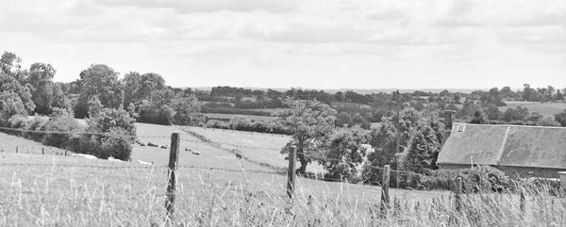
The unrealistic expectations of the commander-in-chief West with regard to the success of an attack on the Bois du Homme are amply illustrated here: A view from the German vantage point towards the woods, which start in the background.
Feld-Ersatz-Bataillon 200 and Panzer-Pionier-Bataillon 220, each with approximately 200 men, then assumed the now very thinly held positions in the area south of St. Martin-des-Besaces. Approximately 70 men of the 326. Infanterie-Division were consolidated with the two battalions.
A few Panzer IV’s from Panzer-Regiment 22 were positioned as “corset stays” among them. Heavy casualties were already being received in the Bois du Homme, even before the attack could begin, as the result of clashes with assault groups of the 43rd Wessex Division, which were reconnoitering in the woods from the direction of St. Pierre-du-Fresne.
As a result, the positioning of Kampfgruppe Rauch was identified by the enemy. The Scots of the 15th (Scottish) Division could also clearly hear from Hill 309 the sounds of tanks in the woods below them and received ample warning.
At 0530 hours on 1 August 1944, a thirty-minute artillery preparation from Panzer-Artillerie-Regiment 155 pounded Hill 309. At 0640 hours, Kampfgruppe Rauch moved out from La Ferrière-au-Doyen to the south and from concealed positions in the northeast portion of the Bois du Homme to the west. At the cost of high casualties, the Kampfgruppe was able to penetrate through the Bois du Homme against heavy enemy resistance coming from Hill 309, which had been armed to the teeth with numerous defensive weapons. Late in the morning, it almost reached Hill 309.
The attack was then carried out from there farther to the west and north of the road to St. Martin-des-Besaces. Every meter of ground was contested in the face of extremely heavy enemy defensive measures, which were effectively supported from the air.
Seven squadrons of Typhoons from the Royal Air Force’s 83rd Tactical Group joined in the fighting. Their main target was the tanks, which they engaged with rockets. Heavy smoke, both natural and artificial, reduced visibility.
As a result of the effectiveness of the heavy enemy artillery fire, predominately from the northern edge of Hill 309, the grenadiers bogged down and were no longer able to follow the tanks. The attack stagnated around noon. Additional forces to sustain the attack were not available.
In his book about the Coldstream Guards, Second to None, Julian Paget presents the following account of the failed attack:
… at dawn on 1 August infantry and King Tiger tanks from 21st Panzer Division counter-attacked from [La Ferrières-au-Doyen]. General von Kluge had wasted no time in moving armour from Caen.
The Panzergrenadiers suffered heavily, but the Churchills made little impression on the Tigers. RAF Typhoons and lack of automotive power, however, hindered the German tanks. Lieutenant Christopher Schofield and his troop bore the brunt of the defence. He called down medium artillery onto the Tigers, forcing their withdrawal around 1600 hours, when they were caught from a flank by the rest of Major Jocelyn Hambro’s No 1 Squadron, who inflicted 200 casualties. Artillery broke up a later attack, but Hill 309—“Coldstream Hill”—was firmly in British hands and Coldstream Churchills supported an attack on La Mancelliere, a mile south.
Around noon, the division received orders from the corps to call off the already failed attack in the Bois du Homme and on Hill 309. The corps finally admitted that the attack could not lead to success, and it needed forces to stabilize the situation on the left wing of the corps.
At the same time, the enemy increased his pressure south and west of St. Martin-des-Besaces by attacks of the Guards Armoured Division as well as continued operations of the 11th Armoured Division in the deep left flank of the 21. Panzer-Division.
Hills 192 and 238, northeast of St Denis-Maisoncelles, were lost. In the effort to retake Hill 192 from the 1st Battalion of the Coldstream Guards, Tiger 112 was hit on the gun mantlet and later developed running-gear problems. In expectation of another counterattack, the British infantry pulled back from the hill. The situation became critical, because the flank guard provided by schwere Panzerjäger-Abteilung 654 came under pressure from the 4/7th Royal Dragoon Guards and one of its Jagdpanthers was lost.
The Dragoon Guards were supporting the advance of the 43rd Wessex Division on La Bigne. A second Jagdpanther was hit when two Tigers showed up by chance. Encouraged by their success, the crews of A Squadron continued to advance. They scaled a steep slope to the top of the hill, where they saw the two Tigers. The two Tigers had had bad luck and had bottomed out; they had been abandoned by their crews. The British tankers set both tanks ablaze, and the crews were soon rounded up.
The division command post at St. Pierre-Tarentaine was attacked by surprise from the west about 1500 hours by British tanks. The command staff had to pull back, losing valuable vehicles in the process.
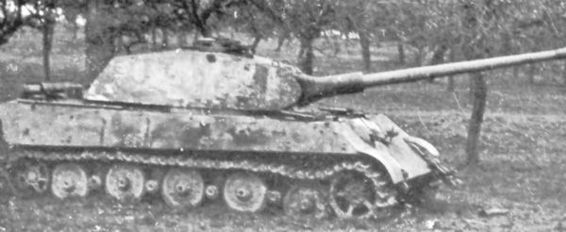
This photograph and the following two show one of the two Tigers abandoned at La Bigne. This tank is Tiger 123. (Bovington Tank Museum)
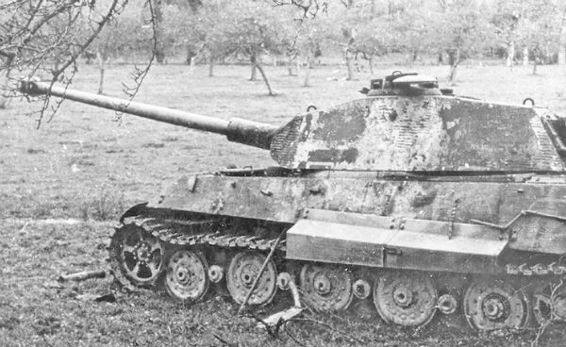
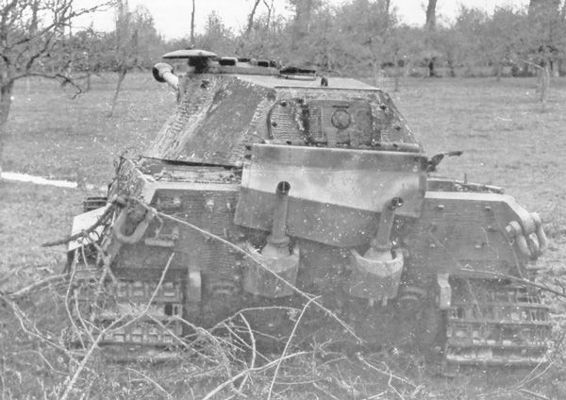
Towards evening, the British approached Le Tourneur. During the first few hours of 2 August 1944, they took another intact bridge over the Souleuvre without a fight. On the left wing of the division, the 11th Armoured Division could not be stopped either. After a fight, the I./Panzer-Grenadier-Regiment 125 had to abandon Le Bény-Bocage on the morning of 1 August 1944. A few armored vehicles were lost in the village.
Forces of the 11th Armoured Division occupied Hill 266 east of Le Bény-Bocage and blocked the important road from Vire to Caen (the current D577) at La Feronnières. Another important bridge over the Souleuvre fell into the enemy’s hands at Cathéolles. There were no more forces available to the division to defend in its center sector and on its threatened left wing.
What the leadership of the 21. Panzer-Division had feared had happened.
The English were already reconnoitering in the direction of Vire without interference and could have taken the city in a coup de main given the right circumstances. After discussions among the Allies, however, the city of Vire was no longer an objective for the British 2nd Army. Instead, the taking of the city was relegated to the U.S. V Corps. The new attack objectives for the British 2nd Army were:
• XXX Corps: Advance to the Orne
• VIII Corps: Advance in the direction of Condé-sur-Noireau and Flers.
After receiving orders from the corps to pull back at 1600 hours, Kampfgruppe Rauch withdrew. It took additional heavy casualties from the enemy’s heavy artillery fire and his forces, which were pursuing from Hill 309. When extremely heavy artillery rounds started impacting in the wooded terrain, several nervous tank drivers bottomed out their tanks—so much so that they could no longer free themselves or be recovered. Several Panzer IV’s of Panzer-Regiment 22 were knocked out or lost through rocket attack.
Crews that tried to recover their tanks or blow them up were taken prisoner. The same fate awaited many of the grenadiers, who were certainly happy to have escaped the hell of the fighting in Normandy. Many armored vehicles and equipment were lost. More than 200 soldiers of the 21. Panzer-Division were killed or lay wounded south of La Ferrière and in the Bois du Homme. The division suffered a 30 percent loss rate among the forces it had employed in the attack.
The Bois du Homme became hell for Kampfgruppe Rauch. The operation conducted on 1 August 1944 in the woods was, in the final analysis, senseless. It was conducted with insufficient forces against an extremely strong enemy who was prepared to defend. The few German tanks that had been available were weakened further by the losses suffered in the operation. The 326. Infanterie-Division also suffered heavy losses.
The following was noted in the daily logs of Panzergruppe West on 1 August 1944:
1930 hours: The attack of the 21. Panzer-Division did not succeed, because the enlisted personnel provided from the 16. Luftwaffen-Feld-Division did not live up to the demands placed on them.
A wildly imaginative account on the part of the senior command.
Forces from the 43rd Wessex Divisions pursued and attempted to reach Hill 361 in the process. As they did this, they captured two field medical treatment facilities and numerous wounded and medical personnel were captured. Under terrible weather conditions and a downpour, the English reached the hill during the night of 1–2 August 1944, where they dug in. With forty men for every gun, they hauled antitank guns up to the top and placed them into position.
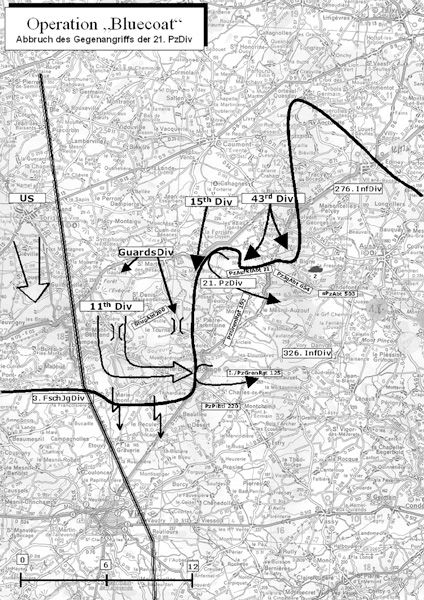
They advanced into the pile of rubble that once was Jurques during the first hours of the morning and then headed in the direction of La Bugne. The 15th (Scottish) Division also pursued. The Scots took Galet and la Mancelliére, southeast of St. Martin-des-Besaces.
Due to the failure of the attack in the Bois du Homme and then the especially threatening development in the area around Le Bény-Bocage, the situation for the 21. Panzer-Division was becoming extremely difficult. It was practically fighting by itself in this sector.
The corps had ordered the division to give up the terrain it had recaptured. It was then to fight a delaying action and establish a new main line of resistance in the area defined by St. Pierre-Tarentaine–north of Le Mesnil-Auzouf–La Bigne, with a strong flank guard oriented towards La Terrerie.
The division’s command made efforts to establish a new main line of resistance running through Hills 301 and 321 and east of Brémoy with Panzer-Grenadier-Regiment 192. Combat outposts were to be placed in Brémoy, west of Montamy and in St. Pierre-Tarentaine. Panzer-Aufklärungs-Abteilung 21 attempted to establish a thin screening line south of Jurques.
Covering the left wing were the I./Panzer-Grenadier-Regiment 125 and Panzer-Pionier-Bataillon 220. They were positioned on both sides of La Terriere but not in it.
Despite the good success enjoyed so far, the commanding general of the British XXX Corps, Lieutenant General B. C. Horrocks, was not satisfied with the way the attack had progressed and ordered a breakthrough to Jurques and Ondefontaine.
To the surprise of both friend and foe alike, a German fighter-bomber attack occurred in the middle of the night. Despite this attack, La Bigne was encircled towards midnight by the 43rd Wessex Division. This was done despite a strong German defense that was supported by high-angle fire and several Jagdpanthers. The English suffered heavy losses. A British tank was destroyed from a distance of nearly two kilometers by a Tiger, whose round struck the rear of the vehicle. This fighting has been recounted in an impressive manner in a book already mentioned, By Tank into Normandy:
On August 2 the squadrons went their own way and our own route became more intense and dangerous. We started at dawn, with my tank about fourth from the front. The infantry of the 7th Hampshires were with us, walking alongside the tank and covering our flank. Then we arrived at a T junction, which was mined, along with the fields around it. The column halted to allow the sappers to come up and clear the mines, when suddenly a Tiger tank emerged from cover and moved to the high ground overlooking the road. It opened fire at about 2,000 yards and hit a tank further back in the column. With both ends of the road now blocked, we were bottled up and the Tiger was out of our range.
I shouted: “Gunner, traverse right. Steady … on … Tiger. Smoke. 1,750 yards. Fire when ready.” Our shot landed just in front of the Tiger and the smoke soon obscured it from view. We fired again, this time just to the left of the tank, aiming to keep plenty of smoke between us and it. Other tank commanders did the same, while the air officer accompanying us called up four Typhoon fighter-bombers off the cab-rank to fire their rockets at the Tiger. We fired some red smoke to identify the target, and then the planes came in, very low and with a tremendous roar. The second plane scored a direct hit and, when the smoke cleared, we could see the Tiger lying on its side minus its turret and with no sign of any survivors. It was an awesome display of firepower and demonstrated only too clearly how important control of the skies was to our ultimate success.
…
We continued on through the afternoon of August 2, heading towards Jurcques [Jurques]. There was increasingly stiff opposition, with several more Tigers being spotted.
…
Sporadic fighting had gone on in the area all through the night and losses were mounting. A Squadron was held up near St Pierre-du-Fresne by a Jagdpanther with an 88-millimetre gun but eventually broke through. Sergeant George Dring, that inveterate destroyer of tanks, stalked a Tiger on foot and then directed his own tank in to kill it.
THE II. SS-PANZER-KORPS IS BROUGHT UP
The commander-in-chief of Panzergruppe West, General der Panzertruppen Eberbach, recognized that despite the continuing danger in the sector of the I. SS-Panzer-Korps on the right wing of his field army (south of Caen and east of the Orne), the decisively critical sector was now apparently on his left wing in the sector of the LXXIV. Armee-Korps.
This estimate of the situation was shared by the commander-in-chief West, Generalfeldmarschall von Kluge.
Based on this development, General der Panzertruppen Eberbach made his decisions and, starting at 1500 hours on 1 August 1944, ordered the headquarters of the II. SS-Panzer-Korps to move immediately from the area around Caen to the left wing of the field army. SS-Gruppenführer Bittrich’s corps consisted of the 9. SS-Panzer-Division “Hohenstaufen,” the 10. SS-Panzer-Division “Frundsberg,” schwere SS-Panzer-Abteilung 102 and Werfer-Brigade 8.
The forces to either side of the 10. SS-Panzer-Division “Frundsberg,” the 271. Infanterie-Division and the 277. Infanterie-Division, had to broaden their frontages to cover the sector of the departing SS division.
The mission of the II. SS-Panzer-Korps was as follows: Bring the enemy attack at Coulvain to a halt and close the gap between the II. Fallschirm-Jäger-Korps (7. Armee) and the LXXIV. Armee-Korps (Panzergruppe West) by counterattacking at Hill 205 (west of Le Bény-Bocage).
The 10. SS-Panzer-Division “Frundsberg” received the mission to eliminate the enemy threat in the Coulvain–Jurques area by counterattacking. It was earmarked to be the righthand neighbor of the 21. Panzer-Division.
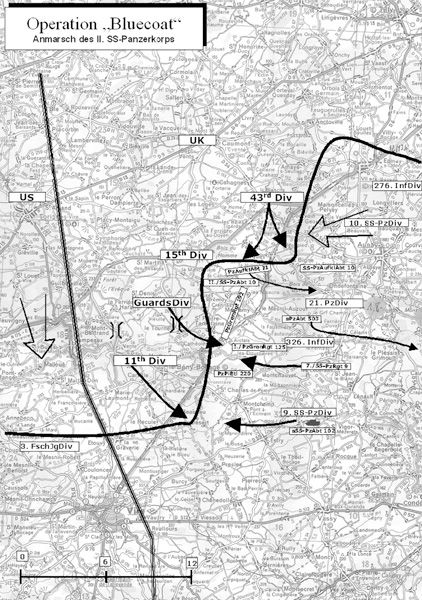
The mission for the 9. SS-Panzer-Division “Hohenstaufen” was to close the gap between the left flank of Panzergruppe West and the 7. Armee. It was to be supported by schwere SS-Panzer-Abteilung 102 and take up position to the left of the 21. Panzer-Division.
The 21. Panzer-Division—or, to be more precise, what was left of it—was attached to the II. SS-Panzer-Korps. The headquarters of the LXXIV. Armee-Korps was left with the command of the 326. Infanterie-Division and the 276. Infanterie-Division.
The first elements of the approaching 10. SS-Panzer-Division “Frundsberg”—SS-Panzer-Aufklärungs-Abteilung 10— reached La Bigne around 2200 hours.
To the great relief of the leadership of the 21. Panzer-Division, the grenadiers of Panzer-Grenadier-Regiment 192 and the reconnaissance soldiers of Panzer-Aufklärungs-Abteilung 21, tanks of the II./SS-Panzer-Regiment 10 arrived into the area south of Jurques and in the Bois du Homme early in the morning of 2 August 1944. They took over securing Hill 301. Panzer-Grenadier-Regiment 192 secured Hill 321, and a portion of Panzer-Aufklärungs-Abteilung 21 could be pulled out of the line.
The first elements of the 9. SS-Panzer-Division “Hohenstaufen” also arrived during the morning of 2 August 1944 in the lefthand sector of the 21. Panzer-Division. These forces included SS-Panzer-Aufklärungs-Abteilung 9, SS-Panzer-Regiment 9 (with thirty-one Panthers, seventeen Panzer IV’s and twenty-eight assault guns) and an SPW battalion. The main body of the division followed in the course of the day.
The boundary between the 9. SS-Panzer-Division “Hohenstaufen” and the 21. Panzer-Division was the Souleuvre River, whereby the latter division was also given the mission of securing the high ground north of the river and south of Cathéolles.
The arrival of two, visibly strong Waffen-SS divisions on both wings of the 21. Panzer-Division was received with a sigh of relief. By the evening of 2 August 1944, the 21. Panzer-Division and the largely destroyed 326. Infanterie-Division were no longer basically alone in their fight in a critical situation on the left wing of Panzergruppe West. Despite this, the 21. Panzer-Division was still engaged in active combat operations.
On the morning of 2 August 1944, the division was being attacked again, this time on the left flank in the sector of Panzer-Grenadier-Regiment 125. The Guards Armoured Division attacked starting from the area of le Tourneur at 0900 hours and attempted to advance on Monchauvet via Cathéolles with additional forces brought up from le Tourneur. An enemy attack on Arclais and Hill 200 was turned back by Panzer-Grenadier-Regiment 125 and elements of Panzer-Pionier-Bataillon 220.
In the heavy fighting and close-quarters combat that ensured, the grenadiers of the 21. Panzer-Division saw that they were no longer fending for themselves. The newly inserted friendly forces on the left, the 9. SS-Panzer-Division “Hohenstaufen,” effectively supported them by employing its 7./SS-Panzer-Regiment 9.
The British Guards Armoured Division attacked with infantry elements on the morning of 3 August 1944 against the positions on the left wing of the 21. Panzer-Division at Arclais. This attack was supported by tanks. Once again, the British were turned back. Additional assaults by the 15th (Scottish) Division were also repulsed at St. Pierre-Tarentaine, Montamy and Brémoy.
Late in the afternoon of the same 3 August 1944, the English repeated their armored attack north of Arclais with reinforced forces. The grenadiers of Panzer-Grenadier-Regiment 125, who had been worn down by the very strong artillery fires, had to pull back. The enemy was able to advance as far as Les Haies, even though several tanks were knocked out. This meant that Montchauvet was directly threatened.
During the night of 2–3 August 1944, elements of the 43rd Wessex Division conducted an attack just in front of Hill 321 on the right wing of the 21. Panzer-Division. This attack and another attempt to bypass the hill were barely turned back by Panzer-Grenadier-Regiment 192. Heavy enemy artillery fire was placed on the adjoining German forces on Hill 301.
Although the 10. SS-Panzer-Division “Frundsberg” was able to turn back heavy attacks on Hill 301, it was unable to completely prevent the enemy from infiltrating into the broad expanse of woods nearby and in the vicinity of hill.
Panzer-Grenadier-Regiment 192 started to falter. By midday on 3 August 1944, Hill 321 was lost. The English reached the road to Jurques and advanced as far as La Bigne. It was apparent that one of their objectives was Le Mesnil-Auzouf.
The friendly forces on the right, the 10. SS-Panzer-Division “Frundsberg,” was then facing the 7th Armoured Division of the British XXX Corps in a line running Saulques–Pitot–St. Georges-d’Aunay. The British division was being employed for the first time. There was bitter fighting for Hill 188. An attack by the British armored division coming from La Bigne and advancing through the Bois du Buron in the direction of Ondefontaine was turned back.
The 10. SS-Panzer-Division “Frundsberg” then launched a counterattack from the areas of Ondefontaine and Aunay-sur-Orne in the direction of La Bigne and St. Georges-d’Aunay. As a result of the seesaw, bitter fighting, it appears that the English temporarily gave up their plans for an attack in the direction of Aunay-sur-Odon
Because of his lack of success, the commander of the 7th Armoured Division, Major General G. W. E. J. Erskine, was relieved of command on 3 August 1944 and replaced by Major General G. L. V. Verney.
A vivid portrayal of this British failure can be found in the history of the 11th Armoured Division:
Four Panthers and a Tiger had attacked the Grand Bonfait position.
On the very far right flank 2nd Northants Yeomanry were patrolling vigorously. One squadron passed through Montisanger and reached the Paris-Granville railway line; another headed towards Etouvy and the third towards Vire via N 177 which appeared to be empty of Germans and Americans.
But by early afternoon Tiger tanks supported by infantry caught and savagely mauled the regiment around La Bistiére, north of Vire, and at La Papilloniére road junction, 2 miles away from Vire.
The following passage appears in The Charge of the Bull by Jean Brisset:
However, after 1400 hours everything changed for the worse. “B” Squadron, returning from Vire, reported that Tiger tanks, accompanied by infantry, were advancing in their direction. Immediately, the F.O.O. [forward observer officer] with them gave the enemy positions to the gunners but at the last moment the guns were ordered to wait because Typhoons were on their way to attack the enemy. An air O.P. [observer pilot] went up to direct them but was promptly shot down by the enemy so that the Typhoons never found their target.
Because of this the enemy tanks were able to get in among the Northamptonshire tanks without a single shot having been fired at them. It was now too late to order the British artillery to intervene because the damage would have been inflicted on both sides. A tank battle started but the Tigers, their sides protected by the slope and thickness of their armour, had no fear of the 75mm’s and immediately took the initiative. Three British tanks were destroyed and the others were hit while retreating to form a new defensive square a little to the north of the highway. While they battened down they were mauled by other Tigers situated on the high ground to the west of Burcy. These same tanks also threatened to cut off the squadron that had reached the Paris—Granville railway line near La Lande. That squadron was ordered to retreat. At the same time another enemy detachment attacked Headquarters Squadron in position at La Bistiere. Soon the three squadrons began to lose one tank after another without being able to do anything to the Tigers. When night fell, it was the turn of the panzergrenadiers to infiltrate into the positions held by the Northamptonshires and they found new victims with their panzerfausts. At daybreak, 31 men did not answer the roll call and many tanks had been destroyed.
That evening the 2nd Warwicks of 3rd British Division were brought into action and behind a barrage and smoke screen retook Presles, thus allowing ambulances to collect the wounded and dead of 8 RB [Rifle Brigade] and 23rd Hussars. It had been a long hot day all along the divisional front line with 4 KSLI [King’s Own Shropshire Light Infantry] stoutly holding their corner, but 3 RTR [Royal Tank Regiment] and 2nd Northants Yeomanry suffering heavy losses of tanks and men.
Problematic for the entire strategic position from the German side was that the German measures lagged behind those of the Allies or that the superiority of the Allies was too great. The impression had been successfully created that the British offensive efforts continued to remain east of the Orne. Although the Germans detected British troop movements, they were not in a position to divine the overall intent of the Allies.
Although the left (eastern) shoulder of Operation “Bluecoat” was able to be held as a result of the employment of the 21. Panzer-Division (reinforced by schwere Panzer-Abteilung 503), the attackers a bit farther to the west were able to advance in the beginning against considerably less resistance. The enemy could not be stopped in his advance south towards Vire.
Towards the end, there was a sort of completion on the part of the British to outflank the enemy. Unfortunately for the Germans, the 9. SS-Panzer-Division “Hohenstaufen” and schwere SS-Panzer-Abteilung 102 were not dispatched to the area until nearly two days after the start of Operation “Bluecoat.” Consequently, they arrived too late. On top of everything else, the American 9th Infantry Division had already broken through farther to the east at La Ferrière Harong.
EMPLOYMENT OF THE 9. SS-PANZER-DIVISION “HOHENSTAUFEN”
Schwere SS-Panzer-Abteilung 102, which had passed its baptism by fire at Hill 112, received orders in the course of the afternoon of 1 August 1944 to move into its new area of operations. It reached Roucamps and bivouacked there after having moved through La Caine–Hamars–Campandre at night.
Although this sounds simple enough, it was quite a different thing for the actual tank crews. Due to the danger from aircraft, which were also active at night—especially the artillery aerial observers—the armored vehicles always moved without lights, always accompanied by huge clouds of dust. In addition, there was the constant artillery harassment fire along the roads and at road intersections, coupled with the lively vehicular traffic—both coming and going—and, in some cases, the difficult, turning road network. At most, only the radio operators and gunners could sleep for periods at a time.
Once at the new location, the armored vehicles had to be refueled as soon as possible, since the tanks had probably used up almost all of their fuel supplies. Just for moving the tracked vehicles of schwere SS-Panzer-Abteilung 102 from one side of the front to the other in the sector of Panzergruppe West, more than 20,000 liters of fuel were consumed. This corresponded to twelve fuel trucks full of gas.
This, in turn, meant that the transportation battalion of the corps had to be brought into support the division. The refueling was done manually in complete darkness. The crews had to haul fuel canisters to their vehicles, sometimes more than several hundred meters. Up to thirty 20-liter (5-gallon) cans of fuel were needed, which then had to be handed up to a waiting crew member on the back deck of the tank. Once emptied, the canisters had to be hauled back to the impatiently waiting logistics personnel. Depending on their location, the crews sometimes also had to try to do all this without making any noise. Occasionally, main-gun and machine-gun ammunition were also stockpiled up front. All this led to the crews being completely exhausted before they even started operations.
Another problem for the formations was the fact that the leaders were not familiar with the situation and the terrain in the new area of operations.
With an effective date of 2 August 1944, schwere SS-Panzer-Abteilung 102 was attached to the 9. SS-Panzer-Division “Hohenstaufen.” In contrast to schwere Panzer-Abteilung 503, which had been attached to the 21. Panzer-Division and fought as part of the division’s tank regiment, schwere SS-Panzer-Abteilung 102 formed a separate Kampfgruppe. Kampfgruppe Weiß—named after the commander of the Tiger battalion, SS-Sturmbannführer Weiß—consisted of the Tiger battalion and the attached SS-Panzer-Aufklärungs-Abteilung 9.
The remaining armored elements of the division—thirty-one Panthers, seventeen Panzer IV’s and twenty-eight assault guns—formed gepanzerte Gruppe Meyer. It was initially intended to employ both Kampfgruppen separately from one another, especially since the area that had to be covered was so large.
The initial mission of Kampfgruppe Weiß was to reestablish contact with the 3. Fallschirmjäger-Division north of Vire and, above all, secure the city. Vire was of great importance, because almost all of the supplies and logistics for the 7. Armee were routed through this city, which was already being heavily shelled.
The battalion’s 2nd Company initially received the mission to move to St. Jean, turn west once there and then screen the large loop in the road three kilometers to the northwest. It was intended for the 1st Company to go into position one kilometer south of its sister company’s location.

By the morning of 2 August 1944, Kampfgruppe Meyer was already in the crisis area. It was screening along a line running Arclais–woods two kilometers west of Montchauvet–Montchamp–fork in the road southwest of Le Grand Bonfait. The commanding general intended to close the gap between Le Beny and Bocage with two flanking attacks from the west and the east. To this end, schwere SS-Panzer-Abteilung 102 was to be moved up through Estry, Chenedollè, Viessoix and Vire to the main road running from Vire to Villers-Bocage. From there, the battalion was to move along the road to the northeast.
But at Chenedollé, the 1./schwere SS-Panzer-Abteilung 102 was already engaged with enemy tanks that had moved forward. It was clear to SS-Sturmbannführer Weiß that it was imperative to move as rapidly as possible to the area outside the northern outskirts of Vire and block there. He therefore had his 1st Company continue to conduct a reconnaissance-in-force in this direction. The company had to engage several enemy tanks. It then continued to move along the Vassy to Vire road in the direction of the latter city.
The lead platoon lost a tank at Le Hauts to an antitank gun. The battalion’s 2nd Company established positions to screen along the Tinchebray–Vire road. Towards evening, contact was established in Vire with forces of the 3. Fallschirmjäger-Division. For the time being, the immediate danger to Vire had been averted.
SS-Rottenführer Trautmann has provided a vivid description of the establishment of contact with the Fallschirmjäger and the initial fighting in Vire and to the north. The account is written in the third person for the most part, so it is important for the reader to remember that Trautmann was the gunner of the company commander, SS-Untersturmführer Martin Schroif:
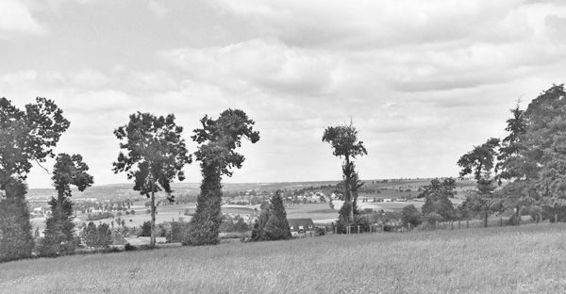
The view from the edge of Vire towards La Bistière shows that the advance of Kampfgruppe Weiß was anything but a “walk in the park,” since it had to approach across relatively open terrain.
Our arrival gave our comrades new hope, especially since all of them were without heavy weapons. It was obvious to us that we had to do something immediately after the initial enemy reconnaissance efforts. Vire—the large roadway transportation hub—had to be set up for defense as quickly as possible, especially concentrating on the roads leading out of town. One Tiger, or even several, at all these points, with Fallschirmjäger providing close-in security. Outposts between the individual strongpoints!
A few Fallschirmjäger accompanied the tanks, acting as guides to lead the Tigers through the shot-up streets to their respective strongpoints. The reconnaissance patrol had barely returned to the tank company when we were told: Orders are being issued! After a brief operations order, the tanks were already rolling out; the Fallschirmjäger were mounted on them.
Loritz’s platoon occupied positions at the train station in the northern suburbs; the other tanks were divided up among the various roads leading out of town. The company headquarters was located on the northern slope, where everything could be observed. A half hour later, all of the Tigers reported that they had occupied their assigned positions.
That night, the motorcycle messengers reported that the objective had been reached; in the morning, the messengers returned with new orders for 2 August. They stated: The company will attack at 1000 hours with the “Frundsberg” reconnaissance battalion. Its objective is the northern exits of La Bistière. The 1st Company moves out from Estry. It will link up with the 2nd Company there [La Bistière], so as to encircle the enemy armored units that have broken through to the south.
The company was resupplied in the morning. It assembled shortly before 1000 hours in the northern suburb of the city. Short meeting to issue orders. To the astonishment of all, the reconnaissance battalion consisted of the commander and about 20 lightly armed infantrymen. A rifle company and an antiaircraft machine gun from the Fallschirmjäger also joined up.
Right at 1000 hours, Schroif raised his arm and gave the signal to start engines. The column then moved out, with Loritz’s platoon in the lead. Things proceeded rapidly at least as far as the fork in the road north of Vire. The tanks moved slightly staggered; that way, at least two of them had fields of fire to the front. The infantry proceeded to the left and right among the hedgerows, thus preventing any surprises from the flanks.
The commander of the reconnaissance battalion had told us that friendly patrols were out to our front. We had scarcely reached the fork in the road, when we were able to identify a tank and several men in the vegetation along the road about 500 meters in front of us. It could not be determined with certainty whether it was the enemy.
Suddenly, however, a small armored car moved up behind the tank and then took off to the north. Because it could only be seen for a few seconds, it could not be knocked out. A fire command was issued immediately: Engage at will!
While the first rounds hit the tank, there was a howling above us in the air. The infantry jumped under cover. Our area was within enemy artillery range.
Schroif issued orders: Continue to march!
Although the tank that had been engaged in front of us had received several hits, it did not fly into the air. Closely behind it and along the side roads were four Cromwells, all of which were knocked out. We then stopped for a short period, until the infantry had closed up.
The terrain in front of us sloped downwards, only to climb again later on. The last three tanks provided cover; the main body rolled rapidly down the hill and then up the other side. The remaining tanks then followed with infantry on board.
Our attack objective, a small village, could be identified about 600–700 meters ahead. The infantry proceeded to the left and the right through the fields; the Tigers then moved out. Soon, the first buildings were reached.
Then it got crazy! Close to the road, protected from observation by buildings and high hedges, were enemy tanks: Shermans! But the two lead tanks, Loritz and Streng, worked in an exemplary fashion together. They knocked out one tank after the other.
Those of us in the remaining tanks also had our hands full. We were getting a lot of fire, especially from the high ground to the left, which was filled with row after row of hedges. It looked like we were dealing with tanks, nothing but tanks! We notified each other by radio whenever we were hit, so the others could get out of the enemy’s fields of fire.
We received a lot of hits, especially in the running gear. Schroif gave orders again and again to fire into this or that vegetation. We slowly found our targets: In one place, a shot of flames rose to the sky, then at another place. The enemy fire became weaker. The road started to climb. When we were next to the last building, the middle of the column was heavily engaged again, while the lead elements continued to advance.
The rounds landed between and among us like dazzling bolts of lightning. There was another hit in the running gear. The company commander had all the main guns fire off to the left! Once again … massed fire … group of vegetation off to the left. Two tanks flew into the air again! It was an engagement at pointblank range: 50–100 meters.
Schroif continued to receive hits from the building he was in front of, until several high-explosive rounds also put an end to this enemy defensive effort. The advance was then continued. The road climbed; the attack objective was reached.
It was then imperative to find a good defensive position in the terrain. The lead elements had reached the hill, when new fire from the left flank was received. We were hit; the radio quit working. Did something bad happen? What was going on with the radio operator? The driver?
By physically grabbing the gunner and yelling at him, he was told to fire in the direction that the fire was coming from. The first round had barely left the barrel, when the Tigers to the rear also joined in. They knew what was going on immediately and supported us with heavy fire. The lead platoon continued to move briskly down the slope and climb again on the far side. Now, at the most important moment, the radio had stopped working. What was to be done? Schroif signaled Harlander to come up to him; Harlander had to pass on orders to the company:
Stop immediately … objectives reached! Jupiter 1: Take position on line with me oriented north! Jupiter 2: Screen to the right and left at the road intersection 100 meters to the rear.
The Tigers rolled into their assigned positions. Rosowski was in the process of turning when he received six damaging hits from about 30 meters away. They took deep chunks out of his turret. The seventh round was Rosowski’s. It went into the hedge from where he had taken the hits. A long tongue of flame shot skyward and a loud bang signaled the effectiveness of this round: The enemy tank flew into the air!
A short while later, an aerial observer flew over our positions. The 2-centimeter antiaircraft automatic cannon took him in its sights, but he disappeared with a dive and was gone. Soon artillery fire was falling in our area.
Around 1500 hours, the commander of the reconnaissance battalion went back to Vire with an SPW and the antiaircraft machine gun to report to the battalion [schwere SS-Panzer-Abteilung 102] that the attack objective had been reached and that 22 enemy tanks had been knocked out without any friendly complete losses. There had only been battle damage in our company. Unfortunately, radio communications did not exist, because the distance was too great.
The area that had been reached was then combed by smaller groups, usually two tanks and a few infantry. In the process, different pockets of resistance that still existed were eliminated. Several additional trucks were knocked out by evening. Two armored cars were captured and a motorcycle messenger was captured.
At this point, we were blocking the approach route of the English Guards Armoured Division. We took a liaison officer, an English captain, prisoner, along with his armored car. The radio set in his vehicle was very loud and we could monitor all of the enemy radio traffic. The vehicle was immediately sent to the corps for exploitation!
The sounds of heavy fighting could be heard off to the right flank. It was [SS-Obersturmführer] Kalss, who was working his way forward to us, supported by rocket launchers. For a period of time, he could only be heard weakly in the radio.
Schroif then sent a patrol off to the right, which was supposed to reconnoiter for enemy positions, the terrain and the approach of Kalss. One tank was sent with the patrol, but it was only able to follow for a short distance, since the terrain was too poor for tank movement. After an hour and a half, the patrol came back with heavy casualties: It had run into an ambush in the broken terrain!
Unfortunately, we could no longer spare anyone to work their way towards Kalss. Besides, we were being increasingly pressured from the north. Assault detachments had to be turned back along the road, especially after night fell.
During the night of 2–3 August 1944, we received supplies. Rations also came in the early morning hours.
About 1000 hours, Kuhlmann’s tank arrived from the maintenance facility. It immediately received a mission: Enemy tanks were again trying to get past us to the left of the road! Skillfully brought forward by a few infantrymen, Kuhlmann was guided into a good firing position. In a short period of time, he knocked out three tanks. The same good fortune befell us a little farther to the rear to the right of the road. Five enemy tanks were in a defile. Three were definitely knocked out there, and the others caught fire and burned up as well!
Towards evening, the enemy tried to get our tanks again with assault detachments. He was approaching from the north on both sides of the road! The Tigers were just waiting for the best moment. Trees in front of us were blown up and then fell across one another on the road. The assault detachment scattered and our machine guns and high-explosive rounds landed among the soldiers.
Despite our efforts, however, the enemy approached closer and closer, because the terrain offered excellent concealment. The few infantry we had with us could not provide close-in security for the entire semicircle of Tigers. As a result, the tanks worked in pairs, firing occasionally to clear the area around them.
Nerves were at the breaking point. Everyone was listening into the darkness for the slightest sound. By doing so, we were successful in keeping the enemy at bay.
At about 2330 hours, Schroif sent a tank to the fork in the road south of us. Its mission was to observe retrograde movements from there, screen to the northwest and, above all, hold up any pursuing enemy so as to allow a withdrawal.
When the order to pull back arrived at 2300 hours, the vehicles with the worst battle damage to their running gear were the first ones sent back with mounted infantry. Bringing up the rear were the vehicles that were still intact.
The withdrawal proceeded in an orderly fashion. Vire was reached around 2400 hours. Large formations were concentrating there. While we held out for two days far to the front, they had established a new front here.
The company set up three kilometers south of Vire on the road and got opportunity to work on repairing its considerable battle damage. Two work sections from the maintenance company were also assigned for this.
Hard days of fighting were behind us, and we had been successful! The company had achieved a respectable success without any losses of its own: 28 enemy tanks had been knocked out and additional ones damaged; 14 trucks had been destroyed; two armored cars had been captured, along with prisoners; and two motorcycle messengers had been taken prisoner and their vehicles captured.
The first enemy contact north of Vire has been portrayed by the British as follows:
Suddenly in the middle of the afternoon some German Tiger tanks and infantry appeared mysteriously from the outskirts of Vire and advanced slowly and ponderously up the road behind B squadron towards RHQ [regimental headquarters]. There was little our Cromwells could do to stop them, and due to some confusion between the gunners and rocket-firing aircraft they got within striking distance of RHQ, who withdrew losing lives and soft vehicles. As the night turned foggy, enemy infantry proceeded to stalk our tanks on foot with bazookas and a number were lost and crews captured.
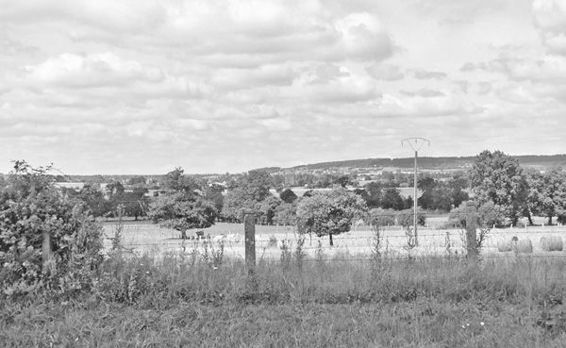
Two views from the British standpoint. Above: From La Bistière towards Vire. Below: From the La Bistière–Vire road to the southeast towards the high ground north of Chênedollé. These views illustrate why the Germans were able to successfully hold up the British for several days.
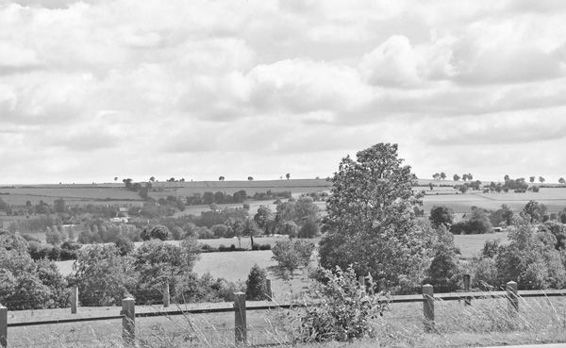
In the meantime, there had been heavy fighting for Montchauvet. The British came to recognise that the headlong advance they had enjoyed was over for the time being. The enemy advance was temporarily stopped at Presles. On the other hand, German counterattacks did not make much progress. As a result, Kampfgruppe Meyer was reinforced with the II./SS-Panzer-Grenadier-Regiment 19.
The fact that the British attack momentum was, in the final analysis, limited by the German resistance is vividly portrayed in the following account that is taken from Operation Bluecoat by Ian Daglish:
By nightfall, the fighting units of 11th Armoured Division were established in good defensive positions. Yet the position of 11th Armoured was far from secure. During the afternoon it had become clear to “Pip” Roberts, in his tactical headquarters at le Reculey, that the advance had progressed far enough. The “horns” of the Black Bull division were its tank regiments. These had plunged deep into enemy territory, and had paid a price. Of the division’s 145 Sherman tanks ready for action at the end of 1 August, thirty-one were reported lost at the end of the day; six of these the vital, 17-pounder armed Fireflies. And the Black Bull’s left flank was a concern. Fresh in Roberts’ mind was the recent memory of GOODWOOD, where the delayed arrival of the Guards Armoured Division had led to his division’s left flank becoming dangerously exposed. Then, he had pushed on and taken heavy losses. Now, Roberts worried about the fluid situation of his rear areas. He frankly dreaded the thought of German armour rampaging among the transport columns that were the life blood of his fighting units.
Yet another legacy of GOODWOOD influenced “Pip” Roberts. Barely a week previously, on 24 July, an 11th Armoured Division conference had been held to review lessons learned from the GOODWOOD battle. One of the first of these was that the final objective should have been a topographical feature. That was to say, an advance should come to a halt on ground that lent itself to being held: “finishing on a tactical feature on which either hull down or covered positions could be occupied.” As things stood at the end of 2 August, the two principal battle groups of the division were established on substantial ridgelines, offering both visibility over the enemy and the relative shelter of the reverse slope. And as the final consideration, in its present positions the entire force of 11th Armoured Division was still within the protective umbrella of VIII Corps’ artillery. Roberts determined that there would be no further advance.
Late in the afternoon, O’Connor visited Roberts at Le Reculey and, as luck would have it, the general’s arrival was heralded by a German artillery strike. Nothing could have been more convincing in support of Roberts’ argument. 11th Armoured Division would hold its ground. What is more, O’Connor promised infantry reinforcements in the shape of 185 Brigade from 3rd (Infantry) Division. By 22.30 hours, the division’s armoured regiments were receiving the order to hold the ground they were on.
The closing of the gap at Vire by Kampfgruppe Weiß is also described by Daglish:
While 11th Armoured Division was putting on the brakes, Kampfgruppe Weiss was pushing forward hard. SS-Sturmbannführer Hans Weiss’s own unit of Tiger tanks had experienced a nightmare journey even to reach the battle area. Setting off after nightfall from their ambush positions on the southern slopes of Hill 112, they drove their 60-ton monsters through the hours of darkness along winding country roads already jammed with west-bound traffic. With the dawn came the added burden of constant watchfulness for signs of an imminent air raid. Their plan was to route southwards from Estry to join the main highway for a straight run west into Vire.
Passing through Estry, it seems that Obersturmführer Kalss’ leading 1st Company decided in mid-afternoon to try a short cut, taking a right turn off the main southbound road to head towards Chenedolle. Shortly after, Kalss reported that he had run into a British armoured spearhead, and had destroyed a number of British tanks. His claim was no exaggeration: it was these Tiger tanks “that had crushed the 23/Hussars’ A Squadron. But Weiss’s travel arrangements had not allowed for an encounter with enemy armour so far south. Like other German commanders that day, he and his subordinates had to update their plans in light of developments. We can safely assume that the tank engaged by the 8/RB PIATs in Chenedolle was likewise a Tiger of SS Pz.Abt. 102 as the column probed to find a clear route to Vire. Weiss was not looking for a fight so far from his objective. But he could not ignore the threat when his was the only available force in the area. Recognising that a major British armoured breakthrough must have taken place, and with no other force immediately to hand, Weiss ordered his 1st Company, under Kalss, to take up defensive positions around Chenedolle. This left his 2nd Company led by Untersturmführer Schroif to complete the battalion’s primary mission.
Bullets rattled against the turret of my tank and great sheets of fire and smoke billowed up where the rockets had hit the ground. Time and again they screamed down on us. Then the attack stopped as abruptly as it had started.
The “tiffies” did little physical damage to the tanks. Though the sixty-pound rockets packed an awesome punch, they were extremely inaccurate and direct hits on tanks were rare. But the air attack was not in vain. As a direct consequence, Streng relates, “Schroif decided to make a detour. We turned back and moved further south.” KG Weiss had been persuaded that the direct highway to Vire was not an option. Instead, Schroif’s company turned back to the Hauts Vents crossroads and detoured south on the Tinchebray road before turning north again for Vire. Time was lost. The company of heavy tanks did not arrive in Vire until 20.35 hours (21.35 Allied time), and reached the northern suburbs only just in time to see last of the Northants Yeomanry’s Cromwells driving off. The extra distance had cost more than time. A night and a day of grinding forward had worn out the heavy vehicles as well as their crews. Streng again:
The Panzers of Reisske and Münster broke down and had to be left at the roadside. We were pushing the engines hard. That and the warm summer evening [were] causing them to overheat.
The second major element of Kampfgruppe Weiss was Hohenstaufen’s reconnaissance battalion. This unit resembled neither the Cromwell-equipped Welsh Guards nor the Household Cavalry with its light armoured cars. SS-Panzer-Aufklärungs-Abteilung 9 was a mixed force of well armed and fast armoured vehicles and infantry. Its five companies included two SPW companies (“Panzerspähwagen”), the first equipped with light, fast armoured cars and the second with turreted half-tracks.1 Two SPW companies (“Schützenpanzerwagen”) were composed of soldiers mounted in small, armoured half-track personnel carriers. A fifth heavy weapons company mounted in medium half-tracks included support guns, antitank guns, and engineers. While specialising in reconnaissance, for which speed was more important than firepower, this battalion could also muster the resilience to hold the line and even the brute force to conduct armoured assaults. Led by the charismatic Hauptsturmführer Viktor-Eberhard Gräbner, the unit had successfully made the transition from the open Russian steppe to the Normandy bocage.
Gräbner’s [formation] was the most mobile element of Kampfgruppe Weiss. About 16.00 hours on 2 August, Gräbner’s headquarters was at Estry. But long before, advance parties from the battalion had been infiltrating the roads from Estry towards Vire. It was not Gräbner’s style to take the same roundabout route as the heavy Tiger tanks, and through the day elements of SS-Panzer-Aufklärungs-Abteilung 9 ranged the country lanes across the path of the advancing British. As we have seen, vehicles of the 2nd Company [armored-car company] had already fallen to the guns of the advancing 23/Hussars and 2/Fife and Forfar Yeomanry. As the day wore on, men and half-tracks of the 3rd Company (SPW) penetrated the British rear areas around Presles and Burcy, as evidenced by the fate of Steel Brownlie’s A Squadron. Using speed and cover, small groups of reconnaissance vehicles penetrated as far as the outskirts of Vire, and by 19.00 hours were able to confirm that the town of Vire, though devastated, was still free of the enemy. Entering the town, they made contact with antiaircraft troops of 3. Fallschirmjäger-Division. The gap blown between two German field armies when Dickie’s bridge fell to the British had begun to close.
By the end of the day, the greatest danger was temporarily over for the German field-army boundary positions. Thanks to the British hesitation outside of Vire, it was possible to once more stave off a collapse of the front.
On 3 August 1944, Kampfgruppe Weiß attacked. It was the mission of the 2nd Company to attack north along the Vire–Caen road along with the 3./SS-Panzer-Aufklärungs-Abteilung 9. It was then to block the road just north of La Bistiére.
The firsthand account of SS-Unterscharführer Streng conveys a memorable impression of this day as well as the extreme psychological pressures the crews were subjected to:
At 0730 hours, the commander of the armored reconnaissance battalion of the 9. SS-Panzer-Division [“Hohenstaufen”] personally issued his orders:
The Tiger company would advance together with the 3rd Company [of SS-Panzer-Aufklärungs-Abteilung 9] along the Vire–Caen road to the north and block the road just north of La Bistiére. Move-out was most likely at 1100 hours, since the grenadier company had to be brought up and the Tigers needed to be topped off.
When you are about to go into combat, you don’t talk about death. You smoke a cigarette and talk about food, about the weather, about superficial things and occurrences and smile about them.
You act like a soldier, even here in a fleeting assembly area on the northern part of the city, a few minutes before a risky attack from which some will certainly not return.
To the minute, at 1100 hours, Loritz headed north as the lead platoon leader on the right-hand side of the road. My 234 and I went to the left of the road. A squad of dismounted grenadiers covered to the outside of each of us.
The main body of the Tigers followed behind us—seven in all—slightly staggered. Behind them was a company of mounted Panzergrenadiere. Bringing up the rear were the self-propelled guns of the light Flak unit, which were providing the antiaircraft defense for the massed power of our attack column.
We were all in a good mood and convinced that our attack would succeed. We were finally moving forward.
The SS grenadiers were marching in column behind one another, their machine guns under their arms and their squad leaders to the front. They had smiles on their faces as they walked along in the roadside ditch; our combat vehicles were moving at a walking pace.
An oppressive, flickering heat from the scorching August sun lay over the countryside; above us was a cloudless, dark-blue summer sky. Nervously alert, the driver sat behind his wheel, the gunner behind his optics and the radio operator at his bow machine gun, operating the receiver and transmitter.
In a somewhat sloppy manner, the loader laid the antitank and high-explosive rounds within reach on the turret floor. From the turret hatches, the tank commanders towered out, denim sleeves rolled up, observing the terrain ahead of them with their binoculars.
After crossing the fork in the road, whose passage was blocked by the skeletons of burned-out cars, the lead elements of the attack encountered the enemy three kilometers north of Vire. The Kampfgruppe hesitated. It was still uncertain whether German tanks of a counterattack that was taking place at the same time as that of our 1st Company had advanced this far. We were forbidden to fire. We radioed our observations back and forth as to whether we should or should not engage. Anxious minutes passed. Schroif continued to hesitate. Suddenly, an English armored car raced up in front of the Cromwell tank, which was at the high point of the slowly rising road that was in the middle of fir trees to either side.
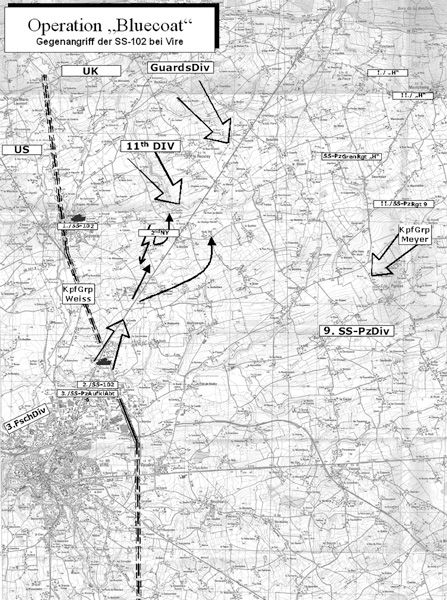
Brown figures climbed up on the tank and looked over at us. Because English armored cars were also being used by German forces at the moment, we were still uncertain.
By then, perhaps eight minutes had passed. On the other side, the brown figures jumped into the four-wheeled armored car and disappeared as fast as lightning behind the high ground. Without awaiting further orders, Loritz and I issued fire commands. The sounds of two thunderous reports from the 8.8-centimeter main guns came at the same time. A flash followed by gray-blue smoke came from the muzzle brakes in front of the vehicles. There were flashes on the far side when the rounds hit the running gear and the upper part of the hull. With clashing and clanging, the loader put the second round into the chamber. The fighting compartment was filled with acrid, blue fumes from the discharge. The ventilator in the turret roof sucked the exhaust fumes into the open.
The next fire command was issued calmly through the intercom system: “Second round … aim higher … fire.” The second round flashed just below the main gun on the upper hull. Hazy white clouds escaped momentarily from the Cromwell. When Loritz fired his second round, the belly-shot enemy tank disappeared completely in clouds of smoke.
I had a start and ducked. My shoulders brushed against the narrow, round opening of the hatch. It was pulsating … whistling … rushing above me. And then impact followed impact into the earth and rocked it. It bellowed and thundered all around us. Shrapnel from the artillery shells landing nearby howled through the air, and pieces of the ground fell back to earth with a dull thud.
Even though the concussion of the exploding shells barely disturbed us inside the tank, thick swaths of powder smoke enveloped our attacking column and blew across our heads like a warm breath. The heavens had descended with smoke and thunder. A torrent of ricocheting rounds on the road. Leaves and branches twirled to the earth from the crowns of the trees.
The engines grew louder. Panzer marsch!
The lead tank elements slowly up the road.
Shortly after crossing the first rise and passing the knocked-out enemy tank, the grenadiers who had hurried on ahead of us pointed out a threat along a path in the woods through their energetic waving. Loritz eliminated this threat from a few meters away. As a result of his antitank rounds striking home, the second Cromwell was knocked out. It was in the path leading off to the right.
Impeded from advancing through the broken and dense terrain, we asked the grenadiers to deploy to both sides of the tanks to protect us against hunter/killer teams. Dismounted squads then secured our flanks in the densely vegetated and wooded terrain. They moved up to 30 meters in front of our lead elements. At this point, we had to pay extremely close attention. I constantly searched the attack area, my neck stretched out and eyes glues to the binoculars. My head was only a little bit out of the hatch above the vision slots. Bending forward and backward, I twisted around on the leather pad of my seat to search the air space above me for enemy aircraft. The tanks of our company rattled and howled as dark, dense objects behind me; they were dispersed at equal intervals to both sides of the road. And, once again, I observe to the front, between the always-suspicious hedges and cuts in the woods, which an experienced opponent knows how to use so well and so successfully for both the offense and the defense.
Often blinded and fooled by the sleight-of-hand offered by the various colors, my eyes sought a brief respite in the shadowy, humidly hot interior of the fighting compartment.
The needle on the tachometer trembled around 1,500 RPM’s; the thermostat was in the red zone due to the snail’s pace we were moving and had already climbed to 90° [194° Fahrenheit]. Fog-like, warm-smelling oil and gasoline vapors penetrated through the slits in the firewall separating the engine from the fighting compartment.
The rising and falling scratchy sounds in the intercom and radios buzzed monotonously.
A glance at my watch. We had been moving for more than an hour. Large vehicular columns came into view in front of us; they were 3,000 meters away and only slightly visible behind the gullies. We immediately took them under fire with high-explosive rounds. The German rounds burst with easily identifiable clouds formed from the explosives among the columns. The vehicles turned off into the next available path in wild panic and raced away from the area. By the 5th and 6th rounds, the road looked as though it had been swept clean, and only individual motorcycle messengers flitted along.
An enemy reconnaissance aircraft flew parallel along our line of advance at low altitude. I could easily make out the colorful rings on the wings. The Englishman was actually flying quite unabashedly low. He turned over the road in a steep spiral and flew placidly to the east of us along our tank column. He was not engaged by our Flak. He seemed to hover about at 200 meters. I swung myself behind the antiaircraft machine gun. Took a quick aim and squeezed the trigger. Damn! The stupid belt jammed! Only a few individual tracers rattled skyward.
In the meantime, this blowfly disappeared behind the hills on the far side of us, flattened out and started to land. Over there they probably had a clear picture of our intentions, strength and direction of march; we would probably not have to wait long for a reaction.
I had the tank pick up speed and was following right behind Loritz and off to the side so as to be able to protect him in the event of any unpleasant surprises.
Unnecessary talking during an attack is taboo inside of a fighting vehicle. Observations are exchanged in shorthand. You can almost hear someone swallowing or clearing his throat through the throat mikes and the headphones.
A mountain slope lying about seven kilometers to the north was then placed under heavy rocket-launcher fire in support of our 1st Company. The entire slope was covered in black, yellow and white clouds of smoke for several minutes.
Loritz and I were at the entrance to the village of La Bistiére by then. A further move to the northern edge of the locality was ordered by radio as well as the taking and securing of the hill beyond it.
Nothing was stirring among the thick shrubs and along the village street. The windowpanes rattled slightly and the walls shook somewhat from the weight of our tanks.
Suddenly, a Frenchman jumped out of his house door to the lead tank. He was yelling something confusing to the tank commander, who was bending over towards him. He gesticulated with his arms and pointed off to the left. Something wasn’t quite right here!
For reasons unknown, Loritz took hardly any time to listen to the civilian; certainly, there was danger in the air.
Only a few meters separated us from the street crossing in the middle of the village. The friendly infantry had not yet closed up. I stayed where I was, waiting to see what would happen.
Loritz stepped on it and moved out. Ten more meters—suddenly, a blinding flash of lightning, a crash, black smoke and vapors. Hit in the left-hand running gear in the middle of the street. At this moment, I expected a lance of flame that would have to shoot out of the vehicle. But the vehicle appeared to be unshaken and moved across the street into the protection of the building facades. I was shaking, but not because the earth was moving. I was trembling from the inside out.
I was sorely tempted to approach and destroy the enemy tank on his left flank, taking my tank through the gardens and the walls, crushing everything without hesitation in front of me. Unobserved and still behind the building, Loritz swung his turret to the left. He had his tank move out and pressed forward onto the other side of the street. Suddenly, a long lance of flame shot out from his main gun; the windowpanes shattered from the concussion of the report of the gun and tiles fell from the roofs. The tank disappeared in a black cloud of gunpowder smoke.
Then it was my turn to get across the road. Driver … Fourth gear … Step on it! The engine roared and the tracks rattled and clanked over the asphalt. As quick as lightning, I looked to the left and to the right. The English tank, 30 meters off to the side in a fruit orchard next to a trail, burst asunder with a huge flash and with a thunderous racket. A massive mushroom cloud of smoke and flame formed for a few seconds above the trees and arched upwards towards the blue sky. Burning flames engulfed the glowing sides of the tank in a sea of fire.
Any remaining resistance in La Bistiére was quickly broken.
The leading elements of the armored attack force were just north of La Bistiére and at the objective just after 1300 hours.
Loritz and I were just about to continue the attack into the next village, when we were urgently ordered back by radio by Schroif to the ridgeline.
I took an excellent pair of binoculars from the light English tank that was behind the high ground and had been abandoned by its crew. But we needed to be careful. After quickly conversing with Loritz, we moved back into position on both sides of the ridgeline on the northern edge of La Bistiére. The grenadier company was then guided into position along the ridgeline that ran all the way around the village. It dug in behind hedges and bushes in a thin line.
For the second time, an artillery or reconnaissance aircraft flew over the attack area. It then set down a short while later at the location of the English battery north of the cemetery and the church adjoining it on the road to the left.
Moments later, I took the terrain behind it under high-explosive main-gun fire. Everything over there panicked and fled in wild disarray.
The enemy defense became increasingly stronger and more perceptible. Enemy tanks moved into position behind the concealment of the vegetation and the hedgerows. An English infantry attack gained momentum as it come out of its attack positions from the gullies. By leaps and bounds, the khaki-brown attack groups hastened through the gullies, jumped over ditches and hedges and got closer and closer.
At this point, German machine-gun fire rattled in from the left and let its bursts of fire hail down upon the advancing troops. Infantry rounds smacked against the walls and the branches, chirped with a singing sound over my head and then ricocheted off to the crowns of the trees.
And then there was impact after impact into the earth. It groaned and rumbled. Salvoes of hand grenades burst off to the left of my firing position; I could not follow their paths through the thick vegetation and hedges.
On the other side of the road, in Loritz’s area, the storming English infantry intended to approach close to the tank using the concealment offered by the folds in the ground and the hedgerows. This was done until the brown rows of attackers finally faltered under the brute force of the automatic weapons and turned around and fled to the rear.
German artillery then joined the fighting. The shells rushed eerily overhead. With a long, drawn-out huuuiiii they raced through the air with a hissing and a swishing sound.
Shell after shell exploded on the edges of the surrounding high ground; they tossed earth, wooden timbers, rocks and trees around like chaff through a thrashing machine. Looking like a broad flag, the smoke wound its way into the clear August sky.
From the other side, the English batteries joined in with increased intensity and displays of firepower.
The branches of the trees split apart in the fruit orchards; the crowns of the trees were tilted. It seemed you could hear them moaning as they broke and fell to earth. A torrent of bursting rounds. It hissed … buzzed … whistled. The dirt splattered. Those were the claw marks of a raging predatory animal.
Thick, gray masses of smoke covered the village and the surrounding high ground.
Our grenadiers, who had dug in as a sort of living bulwark around the village, suffered heavy losses in dead and badly wounded.
According to radio traffic from Loritz, our tanks was to be repositioned to the left to reinforce the defensive sector there, because the enemy was continuously feeling his way forward and attacking in front of the German lines.
While pulling back to the road, the trees and the bushes were pushed to the side under the force of our broad tracks. The tracks churned up a deep impression in the soft, brown earth. While I was still in the process of moving onto the road surface from the vegetable garden and through its fence and the roadside ditch, I received a terrific hit from a main gun on the side of the hull that was facing the street. Its crashing impact knocked the crew out of its seats and tossed the loose interior fixtures around.
Pale, with fluttering eyes, Mahler turned around towards me; for a few seconds, there was deathly silence in the interior of the tank. At any moment, the second round would have to come knocking on the steel walls, and then it would only be by chance that it didn’t penetrate into the engine or fighting compartments and cause the entire steel monster to burst apart with a huge flash.
I yelled shrilly down below: “Driver, back up … move out … move out!”
The engine roared as it received an unrestricted amount of gas. Ott turned the steering wheel sharply to the right in order to get the front of the tank around. For a few anxious moments, nothing happened. The tank did not move. The report came from a voice cracking with excitement: “The vehicle won’t turn.” A paralyzing fear could be seen on the faces. Something had to work. Suddenly, the tank moved. It rolled back along its length and then rolled forward again. It bottomed out diagonally in the roadside ditch.
With flying hands in a desperate situation, I tore the smoke candles out of their mounts on the left side of the turret wall. I took off the safety cap and pulled. I then jerked out of the hatch with my upper body and threw the charge in front of the right side of the tank.
Not unlike a powerful jackhammer on hardened steel, the second main-gun round slammed into the steel plates of the tank from somewhere off to the left along the road. The crew was stirred up again. Why didn’t it happen this time?
From the outside, thick, milky white smoke crossed over the tank in a concentrated form. For a few moments, it penetrated through all of the slots and slits of the hatches.
The second and third smoke candle flew out of the tank. Everything disappeared into a white wall of smoke—all of the street and the adjoining ridgeline. Pressing our sleeves to our mouths, we breathed in the bitter, foul-tasting stuff, gulping and coughing.
I sent an emergency report three times on the radio to everyone and asked for immediate help: “Panzer Streng … north edge of the road … immobilized by fire … recover immediately!”
I stayed at my station with nerves of iron. You just wanted to get out and run away—run away from this tank condemned to death.
The fourth and fifth smoke candles flew in front of the tank. You thought you were going to suffocate and throw up.
Over there, in the enemy’s firing position, they certainly must have thought they had eliminated a German tank. At least there were no more rounds knocking on the armored plate.
I ordered the gunner, Mahler, to go to the company commander in order to bring up help immediately, so as to at least pull the tank into the dead zone of the road.
We had known for some time that the right-hand track of the tank had been thrown. It had been torn apart by the hit and was lying diagonally across the street.
Anxious minutes passed impatiently, while we could do nothing. Wasn’t any help going to arrive? Finally, finally, Rodinger’s tank in the lead, followed by Münster. Rodinger advanced slowly along the road and into a defensive position in front of our tank. Münster stopped off to the side of the road. Everyone jumped out quickly, grabbed tow cables and shackles from their mounts and hooked up the two vehicles.
The cables slowly drew taut, and the tank gave a jerk. Engine roaring, the tow tank pulled our tank out of the ditch and onto the street. Ott was braking on both sides so as to keep the vehicle along its path in conjunction with the tow.
Thank God! At least, it was out of the direct-fire area of the enemy guns at this point.
Rodinger started to engage in a firefight against the enemy guns from the high point in the road.
A heavy German artillery barrage fell once again with astounding impacts on the high ground off to the left of the road. Like the echo of uncountable church bells ringing mightily, the sound of the artillery fire bellowed through the smoke, whimpering and stinking all the way from the crown of the steel-blue sky into some of the German positions. You wanted to hide.
Due to the concussion from a round, my hat twirled through the air and was whipped into a garden area off to the side.
Both the firing of main guns and the arrival of shells lit up the village. The yellow-colored pearl lassoes of both German and English machine-gun fire grabbed for their targets through the crowns of the trees and the vegetation.
The sounds of hell reverberated around us in the bitter infantry, tank and artillery fighting.
All of a sudden, the sound of one threatening main gun round after another being fired could be heard. It came from the group of bushes and hedges off to the right of the road behind the buildings and was aimed at German tanks covering from the rearward road intersection. It was barely 30 meters away.
As a result, the towed and towing tanks that were coming back down the road were in deadly danger. A paralyzing fear overcame everyone; where was this invisible enemy coming from? Once again, another cracking round followed into the middle of the village. Seven round, gaping holes—as thick as a man’s arm—in the turret of [SS-Hauptscharführer] Rosovsky’s tank unmistakably demonstrated the effectiveness of the hits. Three men of the crew tumbled to the ground from the fighting compartment. They were severely wounded from the power of the solid-shot rounds. The remaining two crewmembers had already been killed by the first round.
I jumped over the garden fences in quick bounds and hurried—a hollow charge in my hands—through the walls and the gardens, which covered me, towards what was assumed to be the enemy tank’s location in the group of hedges.
Enemy fighter squadrons circled above La Bistiére; an enemy air attack would bring complete confusion and chaos into our ranks.
Before I could even get to him, the English tank broke out of the vegetation with exemplary bravery and headed towards the middle of the village with clanking tracks. Hammering tracer rounds rattled from the front of the tank against the assembled German tanks. Had this tank commander flipped out? Or was he only acting because he did not know our strength?
Piller’s tank recognized the danger. He was on the field path leading off to the right and was oriented east, hidden by some vegetation. He traversed his turret to the left and fired an antitank round at a distance of 8 meters into the black body of the vehicle that was racing towards him. What followed next took only a matter of terrible seconds.
A powerful flash tore the hatches off and lifted the entire turret; a gigantic flaming mushroom strove towards the August sky in a series of explosions. The English tank commander was tossed as a burning, black bundle out of the tank, until death brought him relief from his inhumane wounds and suffering hours later.
And, once again, round after round impacted into the earth. Unending explosions tore apart whatever fell into their reach with animal-like tearing claws. The air had become impenetrable. The sky had sunk lower with smoke and haze. The sun only penetrated weakly through a thick veil.
Tracer rounds strayed across and down the road. They sparked and rang out when they encountered hard resistance; they diverted into the air or smacked into lettuce and beet beds. Multi-colored signal lights formed pearls of red, green and white as they fell into the village.
Friendly artillery from firing positions behind Vire slung their loads of iron in powerful barrages. A thundering, spraying curtain of iron placed itself protectively in front of the German grenadiers. The fighting raged back and forth.
Despite the raging attacks, the village of La Bistiére remained in the hands of the Kampfgruppe.
The perforated tank 233 was recovered under the cover of the buildings, and my immobilized tank was assigned to it for towing.
Due to the uncertainty of the fighting raging back and forth, Schroif ordered the immediate continued evacuation in the direction of Vire at 1700 hours.
Those wounded lying outside the southern edge of the village were recovered from the roadside ditches, given field dressings and then placed on the hulls of the tanks. They were later transferred to German ambulances that approached us for their onward transportation.
The damaged vehicles crawled along on the road back to Vire at a snail’s pace.
That same evening, based on an order from Schroif received over the radio, both tanks had to hold open the important [La Bistiére to Vire] road for friendly logistics personnel. This was 1.5 kilometers north of the road intersection at Vire and on the high ground that the road crossed, right next to the first enemy tank that had been knocked out.
Messengers and logistics vehicles rolled back and forth on captured motorcycles and armored cars.
We were able to generously treat ourselves to chocolate, crackers, butter, cigarettes—even clean underwear—from what was left on the enemy tanks that had been knocked out along the advance route.
After darkness had fallen, the company commander radioed and stated that the screening duty was considered as ended as of 2200 hours and the vehicles were released to go to the rear command post of [SS-] Panzer-Aufklärungs-Abteilung 9.
The start of the fighting three kilometers north of Vire—the encounter of the lead platoon of SS-Untersturmführer Loritz with the 2nd Northhamptonshire Yeomanry—has been described from the British perspective as follows:
SS-Sturmbannführer Weiss now had his Tiger Battalion assembled in Vire, together with the greater part of (SS) Hauptsturmführer Gräbner’s reconnaissance battalion. The first priority was to reach la Bistière, the designated rendezvous with Kampfgruppe Meyer. Shortly after midday (13.00 hours, British time) a mixed column set off on its five kilometre advance. Nine Tiger tanks led the way, astride the main road, followed by a Zug (platoon) of Gräbner’s infantry, their small reconnaissance half-tracks dwarfed by the heavy tanks, and a pair of self-propelled anti-aircraft guns.
The 2/Northamptonshire Yeomanry had been dogged by misfortune ever since their first actions of the Normandy campaign, and today their troubles were to reach a climax. By sheer bad luck, B Squadron was probing the northern outskirts of Vire as the German column emerged. The Tiger tanks scattered B Squadron’s forward Cromwells, which bravely gave battle but as their War Diary related, “their 75mm guns are no match for the Tiger.” In a further stroke of bad luck, artillery support was withheld to enable a spotting aircraft to direct rocket-armed Typhoons onto the German formation. But the spotting aircraft was shot down and the FOOs were unable to direct the fighter-bombers.
Reaching the road junction at la Papillonnière, the German infantry dismounted to accompany the leading tanks as they attempted to deploy off the main road towards their objective, the high ground around la Bistière at Points 145 and 119 [modern 144 and 127]. Three B Squadron Cromwells were destroyed around la Papillonnière. The outclassed Cromwells slowly withdrew towards la Bistière, where the regiment’s headquarters was trying to improvise a roadblock. Then, to their horror, a further Tiger tank appeared behind them on the rising ground 500 metres to the east of the road and proceeded to pick off a further three B Squadron tanks as they fell back.
Reaching la Bistière, the survivors of B Squadron had new hope. Here if anywhere, the Tiger tank might be at a disadvantage, ambush at close range giving even the Cromwell tank’s 75mm gun a chance of disabling a Tiger. But hope was short-lived. “Though the Tigers were engaged at short range, shells from our guns seemed to have little effect.” The leading Tiger was hit at close range as it roared over an open crossroads but escaped damage and, as soon as it could traverse its heavy turret, dispatched the ambusher in a ball of flame. One Tiger, SS-Unterscharführer Streng’s, was indeed immobilized north of la Bistière, though repeated antitank hits succeeded only in giving the crew a fright and damaging a track so that the tank had to be towed to safety.
KG Weiss had stirred a hornets’ nest. Instead of uniting with Meindl’s paratroops from the west, and still hoping to see KG Meyer approaching from the east, they found only enemies around la Bistière. Attempts to move off the main highway achieved little as the country lanes proved simply too narrow for the huge tanks, yet unsupported infantry fell into ambushes. The close terrain saved the Cromwells of C Squadron lined up along the Etouvy—la Bistière road. C Squadron remained on the ridge through the day, covering the retreat of the Northants’ headquarters from la Bistière. Restricted to the main highway, the heavy Tiger tanks took up defensive positions around la Bistière, two of them pressing forward as far as the slopes above Point 119, and stopping literally back-to-back, guarding the approaches. In fact, they had unwittingly stopped within half a mile of “Pin” Roberts’ 11th Armoured Division tactical headquarters at le Reculey.
Several British attacks were turned back afterwards; six additional enemy tanks and an armored car were knocked out. Hill 119 was taken. Several British attacks there were also repulsed; seven British tanks were knocked out.
During the night, the company screened along Hill 119 and on the road around it. The 1st Company was three kilometers north of Vire at la Graviere and maintained contact with the 3. Fallschirmjäger-Division. Two more German tanks were lost on this day at that location.
The attacks of the 9. SS-Panzer-Division “Hohenstaufen” that took placed further to the west at Burcy and in the area of Montchamp were crowned with little success due to a lack of forces. Only Kampfgruppe Meyer was successful in dislodging the enemy after tough fighting. This was at Presles. As a result, the British forces at Chenedollé and Burcy were threatened with being cut off.
That night and the following day were characterized by bitter fighting that raged back and forth. The village of Presles had been lost to the enemy again, but it was retaken. Further to the north, Montchamp was also taken from the enemy again.
To a certain extent, Kampfgruppe Weiß formed the western portion of the encircling forces around the piled-up British, however, the latter considered themselves to be anything but in a serious crisis situation due to their large numerical superiority.
The 9. SS-Panzer-Division “Hohenstaufen” was too weak by a long shot, even though it had been reinforced in the meantime by Kampfgruppe Olboeter of the 12. SS-Panzer-Division “Hitlerjugend.” The number of armored fighting vehicles on 4 August sank to eighteen Panthers, seven Panzer IV’s and nine assault guns. Of the thirty-four Tigers left, only half were operational.
When considering the overall situation, the reader must take into account that the encirclement of the 7. Armee was starting to take shape after the breakthrough of the Americans at Avranches. In the final analysis, the British really only had to wait.
The 4th of August 1944 was characterized by continuous artillery barrages and enemy attacks. Towards 2000 hours, the enemy exerted strong pressure on La Bistière, and he succeeded in forcing back the German grenadiers. The German artillery fire landed too short and caused friendly casualties. Thanks to the tanks, the enemy attack could be stopped one more time.
Because the 7. Armee had to swing back during the night of 4–5 August 1944, the II. SS-Panzer-Korps also had to react. It took Kampfgruppe Weiß, which was employed on the left, back to the northern edge of Vire.
Kampfgruppe Weiß had screened north of La Biestière as well as at la Gravière on this day and had eliminated six enemy tanks in the process. At 2230 hours, the grenadiers pulled back in accordance with orders. The tanks followed ten minutes later and linked up with them 300 meters south of la Biestière. The northern outskirts of Vire were reached at 2320 hours. The Tigers were resupplied around midnight and then marched further to the rear.
Despite thick fog, overtired crews, and frequent detours around bomb craters, the tanks reached Pierres at 0420 hours and took up rest positions under a tree-lined road. On the way there, Rodinger’s tank fell out due to transmission problems and had to be towed. The crews were not able to rest in their new assembly area, however, as they were ordered to move to Chenedollé.
At Chenedollé, the tankers were briefed by SS-Hauptsturmführer Gräbner, who had already reached this area with his SS-Panzer-Aufklärungs-Abteilung 9. Manning the front at Chenedollé was Heeres-Pionier-Bataillon 600. The three operational Tigers of the 1st Platoon of the 2nd Company were directed to support the 1./Heeres-Pionier-Bataillon 600. The remaining battalion elements established an assembly area along the Tynchebray to Vire road and were in pressing need of maintenance. That same evening, Tiger 212, which was employed up front, received a direct hit by an artillery shell and had to be pulled out of the line. During retrograde movements at night, another one of the tanks burned out due to its engine overheating.
Paradoxically, the exposed position of the enemy then created a dangerous situation for Panzergruppe West. During the next two days, the previous limit of advance could only be held with difficulty. On 5 August 1944, Kampfgruppe Meyer also joined in the fighting at Chenedollé with some success.
In order to defend against anxiously anticipated new English armor attacks, the Tigers of schwere SS-Panzer-Abteilung 102 were brought forward to the northern outskirts of Chenedollé around 0615 hours.
On 5 August 1944, the 9. SS-Panzer-Division “Hohenstaufen” had to limit itself primarily to defensive operations. On this day, the division—not counting the elements attached to it—had only eleven Panzer V’s, eight Panzer IV’s and eight assault guns at its disposal. One of the division’s mechanized infantry regiments, which was employed on the right, had its hands full fending off the continuous threat to its right flank. The German tanks attempted to keep the English infantry and armored forces, which were getting continuously stronger, in check. Burcy, Presles, Sourdevalle and the commanding heights of Hills 224 and 242 were taken back by them and firmly held.
By evening, the English penetration “boil” around Sourdevalle had expanded to the villages of Viessoix and Chenedollé. An attack at 1730 hours by SS-Panzer-Aufklärungs-Abteilung 9 from the area of Chenedollé to the west soon had to be called off as a result of massive artillery fire and aimed fire from tanks. The same was true of an attack by SS-Panzer-Pionier-Bataillon 9 from the area north of Viessoix on Pavée, even though supported by tanks.
It was then intended for the 10. SS-Panzer-Division “Frundsberg,” which was closing up, to attack on 6 August 1944.
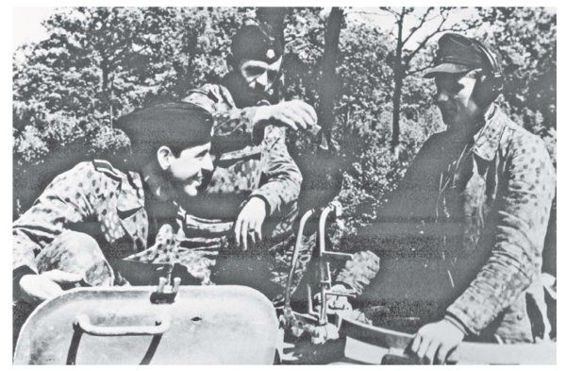
Tiger crew of an SS unit in Normandy wearing the 1944-pattern camouflage uniform.
OPERATIONS OF THE 10. SS-PANZER-DIVISION “FRUNDSBERG”
On 6 August 1944, parts of the 1./schwere SS-Panzer-Abteilung 102 were employed west of Chenedollé and conducted a counterattack on Le Bas Perrier in the morning with elements of the 10. SS-Panzer-Division “Frundsberg” that had arrived in the meantime. Four enemy tanks were knocked out. The British infantry—the 1st Norfolks—were also mistakenly attacked by U.S. Army Air Force Thunderbolts. Some of them left their positions in panic and suffered heavy losses. The German infantry did not exploit this situation, however, and was later stopped by enemy artillery.
Here is a British description of the fighting:
At Le Bas Perrier 23rd Hussars and 2nd Warwicks were soon attacked by Tiger tanks which had infiltrated into the woods during the night.
The Norfolks … were getting out of their trenches. They were slaughtered … I wondered why the German infantry had not put in an appearance to take advantage of the havoc caused by the Tiger tanks.
Although the British gave up Hill 242 just north of Chenedollé, they put up a fight again for Hill 224 behind it. After heavy fighting, the assault detachments of the 10. SS-Panzer-Division “Frundsberg,” which were attacking from three sides, took this hill and also Sourdevalle. At this point, however, the offensive power of these elements was exhausted. Heavy artillery barrages and fighter-bomber attacks nailed down the grenadiers of the division. There were not enough forces to close the gap in the front between Burcy and Presles.
Two Tigers of the 2./schwere SS-Panzer-Abteilung 102 that had been repaired relieved two tanks that had been badly damaged by artillery fire at the northern outskirts of Chenedollé.
The 7th of August 1944 was intended to bring about a positive turn for the Germans. Early in the morning, the XLVII. Panzer-Korps under General der Panzertruppen Freiherr von Funck moved out with its four skeleton armored divisions against the overpowering U.S. 3rd Army—a hopeless undertaking from the very outset.
In the area of operations of the II. SS-Panzer-Korps on this day, the British succeeded in taking Vire. As a result, the pressure mounted outside of Chenedollé. Although it had barely arrived, the 10. SS-Panzer-Division “Frundsberg” was pulled out of the line again and ordered further south. It was to be prepared to also be committed in Operation “Lüttich.” Several Tigers of the 1st Company had occupied good elevated firing positions outside of Chenedollé and prevented every attempt by the enemy to advance to the south.
Tiger 134 of SS-Unterscharführer Fey knocked out all of C Squadron of the 23rd Hussars in the space of thirty minutes, as if they were on a gunnery range. They had carelessly attempted to move out from the farm buildings at Houssemagne. Tigers farther off to the left also scored one “kill” after the other. Of course, none of this changed the fact that the German forces that had been weakened by the withdrawal of the 10. SS-Panzer-Division “Frundsberg” had to gradually pull back.
The still-standing order to counterattack had to be rescinded by the corps in the face of the unfortunate facts. The number of operational tanks available to both companies sank to ten. The division still had twenty-three tanks; Kampfgruppe Olboeter all of seven.
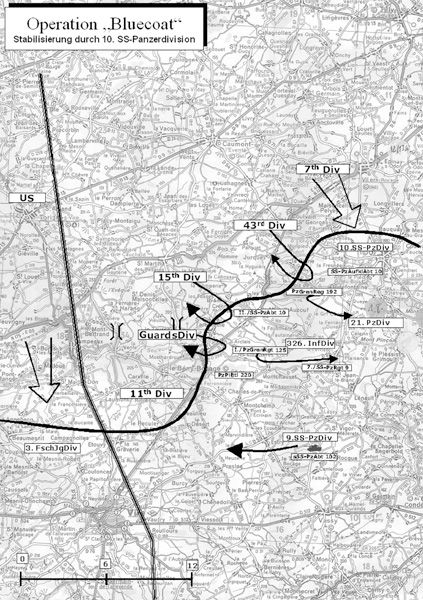
The memorable engagement of SS-Unterscharführer Fey is presented in his own words (Fey writes about himself as the tank commander in the third person):
A few grenadiers to the left of us sounded out the alarm for tanks, and soon we were also able to take in the situation from our Tiger. The Shermans were advancing from out of a patch of woods across a slight rise. We identified 10 … 15 … 20 enemy tanks, with armored cars, halftracks filled with infantry, fully tracked weapons carriers and personnel carriers among them. The entire slope had come alive! The distance was about 1,200 meters. There was no firing as of yet.
Everything looked like a textbook armored attack, with everything that belonged to such an affair. The grenadiers looked at us. You could sense a certain nervousness among them and their company commander. An Oberleutnant climbed up to us on the tank: We needed to be opening fire! But that had to be decided by our commander.
The radio operator was told to send a message to everyone: “Fifteen enemy tanks attacking with infantry from the left flank … we will open fire at 600 meters!”
An order then arrived via radio from the commander, SS-Sturmbannführer Weiß: “Ruderboot [rudder boat] to Ofenrohr 3 [Stovepipe 3]—those were our code names for our Tigers—pull back immediately!”
That was just what we needed at the moment!
Our tank commander gave the order to the radio operator not to acknowledge the order and to turn off the receiver immediately. From this point on, we would only transmit!
The enemy tanks had formed up and were advancing in an inverted wedge towards us. The distance to them was still about 800 meters. The loader had long since positioned his antitank rounds. The driver was informed that when he was ordered he would immediately let the tank roll back a few meters on its left track while simultaneously braking the right track. That way, we could get our Tiger into a good defensive position in a few seconds. Our counterparts across the way also wanted to get in their shot at us. Our flank, which we were offering them up to this point, was a little too sensitive for that!
Then we were at the point of no return: 600 meters.
We maneuvered our Tiger into the desired direction of fire. The gunner had already had his first victim in his sights for some time as a result of the fire command! It was the tank that was furthest forward—right in the middle of the mass of attacking tanks—probably the leader of the group. The second and third targets had also already been established: First the neighbor to the right, then the one to the left! The next targets after that were the Shermans all the way over on the right and the left. They could be dangerous to us if they swung around into our flanks. Even a Tiger was vulnerable within the 400-meter line!
Then the order that triggered everything: “AT … 600 … Fire when ready.”
The first round went over the target. But this only paralyzed us for a moment.
“Sight picture at 400 … fire when ready!”
The round hit pay dirt! A second round after that—Target!
Next target: “Tank to the left … fire when ready!”
This target was also permitted two rounds.
In a short period of time, four Shermans were in flames on the slope. The initial confusion among the enemy was gone by then. He halted and opened fire. We received hit after hit on the turret and on the front slope; nuts and bolts were tossed about in the fighting compartment. The grenadier Oberleutnant, who had previously been in the fighting compartment, left our tank in a mad rush and evacuated the positions with his people. There wasn’t going to be any more attacks started by him here today.
The radio operator sent continuous reports on the course of the fighting; in between, he had ample opportunity to use his machine gun.
The battalion commander radioed again: “Pull back to friendly lines!”
At this point, we were counting six burning and smoking Shermans. There must have been boundless confusion among their ranks! Their infantry had dismounted and were jumping around seeking cover. Vehicles crashed into one another in their efforts to turn around. That was how the seventh and eight tanks were dispatched. While they were driving into one another while attempting to maneuver, our 8.8 tracked them and provided a quick end. They were burning out right next to one another.
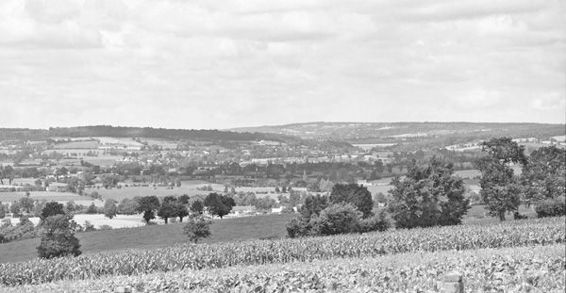
This photograph shows the good firing position of Fey’s tank as it was positioned looking towards the Houssemagne farmsteads in the middle of the image in the valley floor.
Did minutes pass—or were they hours? We did not know. Our loader, a mountain of a man and an ethnic German from the Volga region of Russia, sank to his knees. As the one closest to the breech, he had sucked down too many fumes and had passed out. And rounds continued to crack against our tank. The loss of the loader caused an impasse in our tank. The gunner manned the turret machine gun, while the radio operator had already turned his fourth barrel into a glowing mass of steel.
By this time, all of the Shermans had found the range of our Tiger. We had to see about getting out of the line of fire. Otherwise, they would eventually find a hole in our defenses.
“Driver, back up … Halt!”
It was booming around us once again; the Tiger gave a jump backwards. That was a new caliber; it was an antitank gun! Gunpowder vapors poured through the hatches; the hit had come from the left. It was imperative to do something, because the second round had already landed between the driver and radio-operator stations and had rendered the bow machine gun inoperable.
The driver had taken the loader’s station after he had passed out. At this point, there was no one driving. The left track had been shot off. As a result, the Tiger was immobilized. We could identify the antitank gun by its muzzle flash. It was way off to the left, next to some bushes. The turret was traversed to the 9 o’clock position. Albert was quickly and precisely guided in to the target. An HE round was loaded into the barrel—and then: “Fire when ready!” This enemy cost us three rounds; at that point, pieces tossed high into the air and explosions convinced us that it was over for this well-positioned antitank gun.
The armored engagements continued. We were neither hungry nor thirsty; the fighting had our complete attention. Dripping with sweat and with inflamed eyes, we gasped for breath in the sulfuric stink. After every round was fired from the main gun, a gray-blue cloud escaped from the breechblock closing mechanism. The ventilator attempted in vain to live up to its name. Paul was still lying cross-eyed on the turret floor between Hermann’s legs.
There were still some Shermans opposing us. We certainly did not have it easy! While we aimed at the antitank guns, the Shermans took up a sight picture on us. And if we brought the Shermans into our crosshairs, then there was heavy fire from the antitank guns! It was sheer torment to have to deal with two different opponents at the same time. Thus far, 12 burning vehicles were testimony to our fighting.
At this point the battalion commander radioed in after having received our report concerning our Tiger having become immobilized: “Blow up the tank and fight your way back!”
But we weren’t about to do that. As long as we had a main-gun round and some machine-gun ammunition, we were not going to give up this fight and our tank. Once again, we wrapped ourselves in silence and “forgot” to acknowledge the message.
The radio message from the company headquarters section leader brought out broad laughter despite the shitty situation: “Ofenrohr 3, please don’t forget to confirm your ‘kills’!”
We answered right away: “It would be an honor to receive the headquarters section leader in our tank for the purpose of confirming the ‘kills’!”
After that, the headquarters section leader kept absolutely silent.
By this point, both machine guns were no longer operational; the main-gun rounds were running out. Fourteen Shermans had left this temporal sphere and ended their march on Berlin a bit prematurely during the noon hour on a wonderfully beautiful August day northwest of Vire.
All of this had lasted only 30 minutes!
But then the fight continued. We could no longer see any Shermans that were moving or firing at us. But there had been 15 Shermans identified, hadn’t there?
A depression in front of us that was filled with trees and vegetation demanded our increased attention. Round after round of high-explosive ammunition was fired, and each one seemed to find a target. Abandoned halftracks and all types of supply vehicles went up in flames. Carriers moving at high speed—some of them outfitted with antitank weapons—shared their fate.
The entire slope was covered with dark-blue smoke that mercifully enclosed the completed drama. From time to time, a tank burst asunder with a thunderous explosion accompanied by a ball of flame that was as high as a house. The smoke from the burning vehicles, which covered the entire area of the fight, allowed a few of the opposing soldiers to escape from the inferno with their lives.
Because we did not know how long we would have to hold out in our tank—all the ammunition had been shot up with the exception of a few rounds—we wanted to stock up and enlarge our stocks in the pause in the fighting that had occurred. The tank commander slid down from the tank quickly and then crawled and ran in order to get out of the enemy’s sight. Harassing fire had started. The enemy was slowly raging in on our position after he had realized that his attack in this sector had failed.
Completely exhausted, the tank commander reached a Tiger of our company and made himself visible in front of the driver’s and radio operator’s hatches, both of which were closed due to the continuous artillery fire. After a while, one of the hatches opened, and the tank commander was able to convey his wish for a few antitank rounds—all in vain!
For some inexplicable reason, we were unable to get anything, and the hatches remained closed, whereby every further entreaty echoed away unheard! On to the next Tiger—another few hundred meters of crawling, creeping and jumping! The route taken had not been in vain: The tank commander crept back in the direction of his tank with an antitank round in his arm.
The artillery fire increased continuously in intensity. On top of everything else, we were positioned in the open in the middle of a meadow and received our first artillery hits on the turret and the hull. From one of the last radio messages of this day, we discovered that we were to be recovered by three Tigers of Schwab’s platoon. But it was still a long time until it became dark. For good measure, our radio set then went out as a result of the continuous fire! Fighter-bombers circled above us, dove down and strafed our wonderful Tiger with everything they had. It was standing here—immobilized—and looked like it was on a serving platter. Their bombs were getting damned close! Was this to be our end?
But before the next pair approached, we had the idea of how to save ourselves: Smoke candles were placed on the rear deck and the front part of the tank and we pretended to be a burnt-out, destroyed vehicle. We had enough of these smoke candles on board and were able to escape unscathed over time.
Suddenly, however, we became wide-awake and were torn out of our semi-conscious condition: We heard the trusted sound of tracks clanking. But these sounds were not coming from behind us and from our own comrades. On the contrary, they were off to the right of us, where the depression emptied into vegetation and groups of bushes.
We trained our main gun on the group of bushes. It traversed slowly, almost imperceptibly, and was fully depressed. We still had two antitank rounds; one of them was in the breech. Our nerves were stretched to the breaking point: Was there only one tank or were there two? There was only 100 meters between the depression and us.
The driver and the radio operator were perched to jump from their open hatches. Paul, who had since recovered, held the second and last round in his arm. If these two missed and we were out of ammunition, then there was only one thing left to do: Dismount as quickly as you could!
The sound of the tracks and the rumbling came ever nearer. Seconds became an eternity! Perhaps the other one did not know that a German tank was here and ready to fire? Our other Tigers had been pulled back for some time now, and we were the ones who had been here in the hot spot the entire afternoon. But the time was over for such thoughts!
The bushes parted in front of us. A smooth, long barrel without a muzzle brake became visible—undoubtedly a Sherman. Then the rounded edges of the turret and the hull appeared.
“Fire!”
Our first round ricocheted. The tracer climbed steeply towards the heavens! It was odd how you noticed such small things in such an explosive atmosphere!
“Drop some … fire!”
And we all yelled, because the tracer of our antitank round disappeared right underneath the barrel, that is, right where the turret joined the hull. With a jolt, the tank remained where it was, as if it had been hit by an iron fist. A column of smoke, fine at first, but ever increasing in intensity climbed vertically skyward. The 15th tank of the day. Together with the tank from the same sector from last evening, it was exactly 16—an entire tank company. This did not count the personnel carriers, the halftracks, the small weapons carriers and the other vehicles that were impossible to count. But would we be able to hold up the enemy despite all our successes?!
All of a sudden, it was quiet. We no longer said a word. All of a sudden, we were unspeakably tired and just wanted to wait for the Tigers that were supposed to recover us.
With gratitude, we noticed that a protective wall of fire was suddenly placed in the evening hours on the depression and on the adjoining slope with an unbelievable howl and hissing by rocket launchers. It had to snuff out all life there.
The smoke had barely cleared from the last salvo of the Nebelwerfer, when the three Tigers of Schwab’s platoon appeared and recovered us in accordance with a deliberate plan. Two Tigers were hooked up to the front; one Tiger provided cover. And that’s how we rolled out of there and into the night, our tracks being dragged behind us.
After a short stop at the company command post, where our company commander, [SS-Untersturmführer] Kalss congratulated us on our success. We reached Vassy the next morning. But what did out Tiger look like? Holes you could stick your head into! The drive sprocket with the final drive and the differential had been shot clean through. The round was still sticking in the hull! The Maintenance Company would be busy for a few days patching things together and welding!
The “boil” in the front at Chenedollé was abandoned during the night of 7–8 August 1944. Every opportunity to shorten the front needed to be used. The 8th of August saw heavy defensive fighting once again, before a deceptive calm settled in. The time was used to improve defensive positions. Unfortunately, schwere SS-Panzer-Abteilung 102 was detached from the 9. SS-Panzer-Division “Hohenstaufen” on 9 August 1944. Another lengthy movement across the front—back to the Falaise area of operations—was shaping up. Parallels to the allegory of the tortoise and the hare cannot be avoided …
The counterattacks of the 9. SS-Panzer-Division “Hohenstaufen” and the numerous tank “kills” of schwere SS-Panzer-Abteilung 102 did not result in stopping the offensive operations of the British 11th Armoured Division and the Guards Armoured Division, but it certainly slowed them down.
With the introduction of the 3rd Infantry Division west of the 11th Armoured Division, the enemy had considerably increased his forces in the sector. As a result, the pressure increased not only against the 9. SS-Panzer-Division “Hohenstaufen” but also against the burnt-out 21. Panzer-Division.
In addition, Operation “Lüttich,” the German armored counterattack against the American forces, was increasingly ending in a fiasco. It was possible to check the British attacks to a certain extent until 11 August 1944, but the large-scale withdrawals started in this sector as well on 12 August.
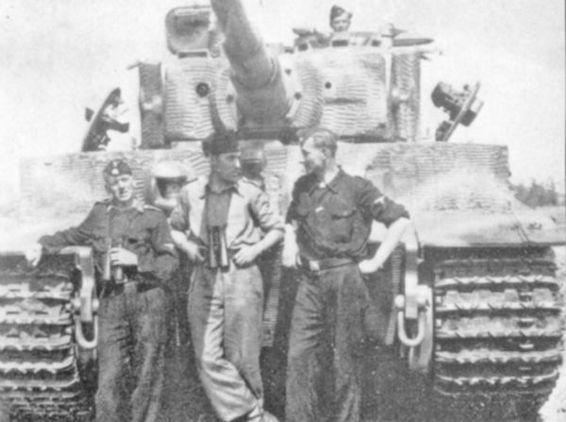
SS-Unterscharführer Fey (viewer’s left in the photograph) poses with other tank commanders of his company.
THE FINAL FIGHTING OF SCHWERE PANZER-ABTEILUNG 503
In order to complete the picture, the final fighting of the reduced schwere Panzer-Abteilung 503 with the 21. Panzer-Division should not remain unmentioned.
On 2 August 1944, these tank elements succeeded in holding their own against the Guards Armoured Division. In addition to other casualties during this fighting, the British lost one tank and one infantry carrier.
On 3 August 1944, the Tigers were employed on the left flank of the 10. SS-Panzer-Division “Frundsberg” at Bremoy and Saint-Pierre-Tarentaine. Because the combat strength of the 21. Panzer-Division had been reduced to about 200 Panzergrenadiere, the division commander, Generalmajor Feuchtinger, requested that his division be pulled out of the line.
During the course of 4 August 1944, the division conducted a fighting withdrawal and pulled back slowly. The Tigers supported Panzer-Grenadier-Regiment 192 on the left flank of the division. The division then received the order to disengage from the enemy and stand by for orders from Panzergruppe West.
Two days too late—around midnight on 6 August 1944—Panzergruppe West ordered the front of the LXXIV. Armee-Korps to be reinforced with schwere Panzer-Abteilung 503, schwere Panzerjäger-Abteilung 654 and a company of Sturmpanzer-Abteilung 17. This was in anticipation of an imminent large-scale enemy attack.
In the end, the Tiger battalion was overwhelmed with its new mission to support the 276. Infanterie-Division. It was intended for the infantry division to unconditionally hold Mont Pincon, since it dominated the terrain for nearly twenty kilometers in the area between the Vire and Odon Rivers.
The front line of the 276. Infanterie-Division ran from La Lande across the Mont Pincon to the southwest of Aunay-sur-Odon, where it formed a boundary with the 277. Infanterie-Division. It ran north from Quesnée as far as Hill 246, where it formed a boundary with the 326. Infanterie-Division. Grenadier-Regiment 986 of the division had dug in along Mont Pincon. The majority of the divisional artillery adjoined the line of high ground and thus dominated all approach routes. Grenadier-Regiment 987 was positioned on the left, including Hill 252.
Despite this, the positions of the division were somewhat undermanned. In addition, the division did not have its third infantry regiment. Grenadier-Regiment 988 had been attached to the 326. Infanterie-Division.
The area around the Druance River had been mined; the crossing as far as La Varanière had been blown up.
Up until 5 August, it remained relatively calm. Then, reconnaissance forces of the 43rd Wessex Division reached Hill 282 near La Roguerie. This had been assisted by the fact that there had been a crisis situation in the sector of the 326. Infanterie-Division at Saint-Jean-le-Blanc, which had then been stabilized somewhat with the assistance of the 21. Panzer-Division.
During the morning hours of 6 August 1944, an enemy penetration in the area of St. Jean was cleaned up in conjunction with Kampfgruppe Schnez (schwere Panzerjäger-Abteilung 654). Kampfgruppe Schnez was employed from the north against St. Jean, while the Tigers, together with a few assault guns, were sent in from the south. The former main line of resistance was reestablished.
During the afternoon of the next day, both grenadier regiments of the 276. Infanterie-Division were hit by heavy attacks of the 43rd Wessex Division that were supported by tanks. The British succeeded in forcing the grenadiers of Grenadier-Regiment 987 from Hill 246. The remaining Panzer IV’s and the few Tigers moved out for an immediate counterattack. To the great joy of General der Infanterie Straube, the commanding general of the LXXIV. Armee-Korps, the English were ejected from the hill.
The British moved out again and suffered heavy losses. The tide turned, however, when British combat engineers succeeded in clearing the mines on the bridge at La Varinière under extremely heavy fire. This enabled the tanks of the 13/14th Hussars to cross. The main body of the German grenadiers left their positions in an orderly fashion, after they had only succeeded in slowing down the English attack. They destroyed eight enemy tanks. With the assistance of twenty Shermans that remained behind, the British succeeded in forcing the last German rearguards from the hill after more than two hours of intense fighting.
Making things difficult for the defenders was the employment of smoke along the high ground and the start of twilight, which made directed fire by the German artillery no longer possible.
The grenadiers occupied a temporary main line of resistance that ran from Plessis–Grimoult–Crépigny–Hill 246. In the sector of the 277. Infanterie-Division on the western flank, however, the British 7th Armoured Division had already broken through. The Germans cobbled together all available forces from their rear-area-services personnel in order to solve this crisis situation.
The few operational Tigers— eleven according to the report of 6 August 1944—assembled at Plessis-Grimoult during the night in order to block the “Desert Rats.” In a surprise thrust from the west, the 5th Battalion of the Duke of Cornwall’s Light Infantry penetrated into Plessis-Grimoult and advanced along the main street towards the center of the village. Two Tigers from schwere Panzer-Abteilung 503 were spotted that were in the process of rearming from a truck. The operation was being screened by a SPW.
The British took this group under fire with several 2-inch mortars, causing the grenadiers to flee and abandon their SPW. Suddenly, one of the mortar rounds hit the ammunition truck, which blew apart with a mighty explosion. The explosion was so powerful that the Tiger II next to it had its turret dislodged, and it caught on fire.
The other Tiger crew had mounted up in time and was able to pull back. The advance of the British into Plessis-Grimoult happened so quickly that the 5th Duke of Cornwall’s Light Infantry suffered only one dead, five wounded and one missing soldier. The 276. Infanterie-Division lost 44 soldiers, and 125 surrendered to the British.
On 8 August 1944, the Tiger of Hauptmann Fromme was ordered in the direction of Saint-Pierre-la-Vielle. The strong, continuous enemy artillery fire forced the crew to remain inside the tank.
At the start of 9 August 1944, the British continued their attack and headed in the direction of Crépigny. During the afternoon, the Tigers and several assault guns moved out to conduct a counterattack between Le Tremblay and Crépigny. They were supported by grenadiers. After one and a half hours of heavy fighting, the British advance was brought to a standstill. However, a second enemy column succeeded in advancing on Saint-Pierre-la-Vielle. This resulted in the remaining German forces being caught in a vise. On top of everything else, the tanks, which were restricted in their movement, were effectively attacked two times from the air by Thunderbolts. In all, six Tigers had to be abandoned. The Germans succeeded in knocking out ten enemy tanks.
On 10 August 1944, the British crossed the Orne somewhat south of Thury-Harcourt. Generalleutnant Badinski decided to commit his armored reserve there in order to support the hard-fighting 277. Infanterie-Division. He likewise employed Panzer-Artillerie-Regiment 155.
On 11 August 1944, Hauptmann Wiegand screened with the last two operational Tigers on the southeastern portion of Saint-Pierre-la-Vieille. Around 1130 hours, the English attacked east past the town with thirty tanks and a large force of accompanying infantry. Hauptmann Wiegand, the commander of the battalion’s Headquarters Company, was in the process of moving out against the enemy with his two Tigers, when his tank was attacked by several fighter-bombers and was immobilized.
Despite still being engaged by the aircraft, Hauptmann Wiegand shifted to the other tank as the first three Shermans came over a rise. He immediately set two of the Shermans ablaze; later on, a third tank was knocked out. He forced the British to temporarily break off their attack.
Several minutes later, this Tiger was also hit by fighter-bombers. Immobilized, it continued the firefight for a short period of time. The British lost another three tanks. The grenadiers of the 277. Infanterie-Division continued the unequal struggle the following day without tank support. In the end, however, they had to abandon the town.
On 13 August 1944, the last two Tigers of the battalion were attached to schwere Panzerjäger-Abteilung 654 at Proussy. During the night, the enemy pushed his way forward to Hill 261, two kilometers northeast of Proussy, and occupied it with tanks and infantry. The Jagdpanthers and Tigers that were in position were blinded by artillery smoke. Both of the Tigers were lost.
That signaled the end of the fighting in Normandy for schwere Panzer-Abteilung 503.
1. Editor’s Note: These were Sd.Kfz. 250/9 light armored half-tracks, armed with a 2-cm KwK 38 automatic cannon.
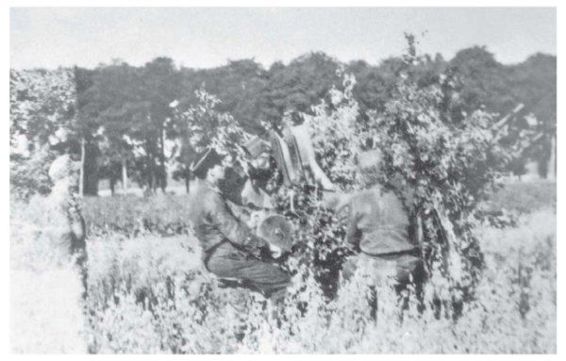
German antiaircraft weaponry engaged in a hopeless struggle against the swarms of Allied aircraft. A quad 20mm Flak of the antiaircraft platoon of schwere Panzer-Abteilung 503 is seen in action.
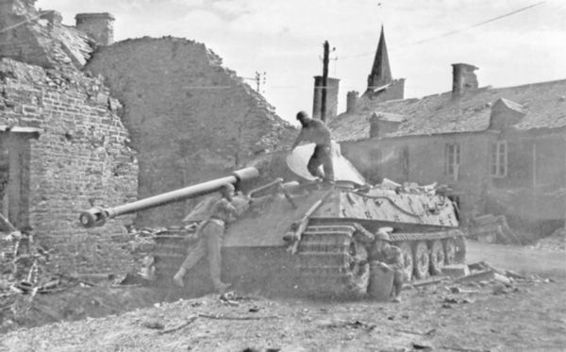
A Tiger II, which was completely destroyed in Plessis le-Grimoult by the explosion of an ammunition truck next to it, is examined by British soldiers after the fighting. The lower photograph shows the same spot today, primarily recognizable by the church bell tower, which now has a clear view to it.
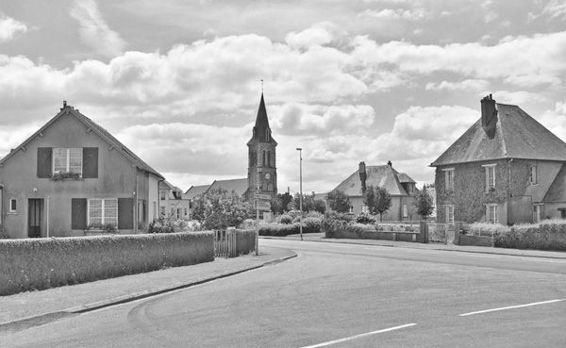
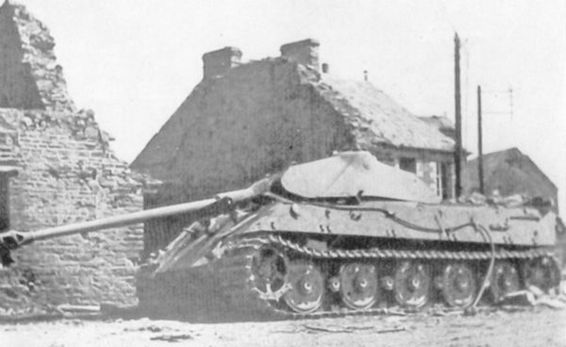
The same tank as seen from the side. Noteworthy is the fact that this Tiger II was one of the few with the one-piece gun mantlet. The bottom photograph shows the same location today.
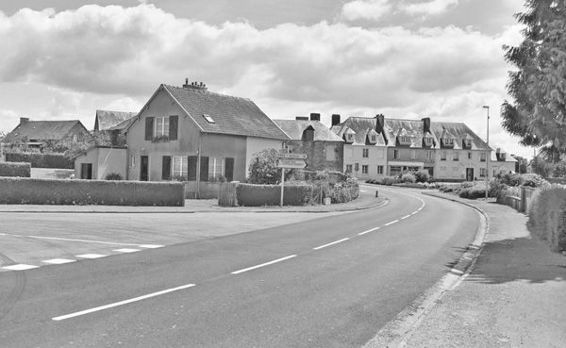
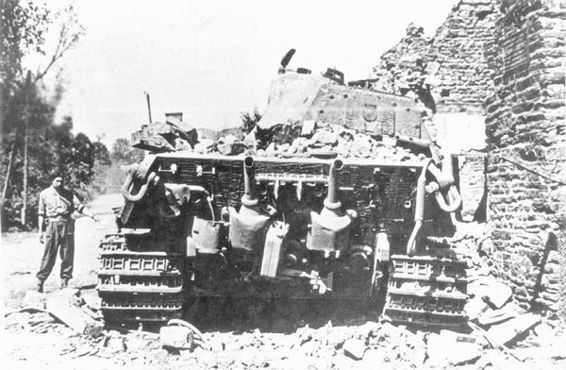
The view from the rear shows the dislodgement of the turret. The silhouette of a “1” and a “3” can be seen around the escape hatch on the rear of the turret. The middle digit cannot be identified. Since 113 was a Tiger I and Tiger 123 had already been lost on 31 July, this tank is most likely Tiger 133.
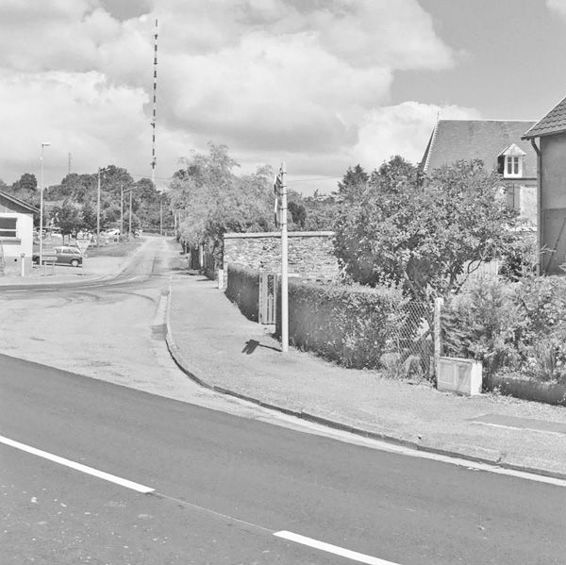
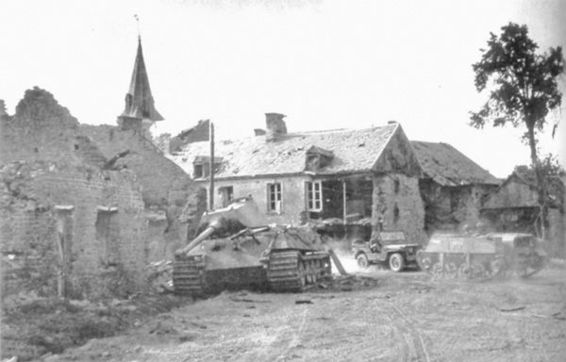
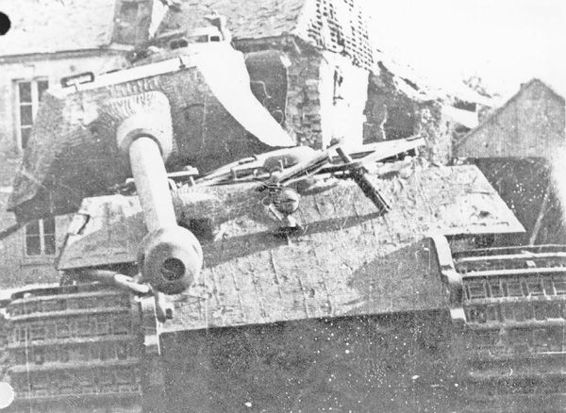
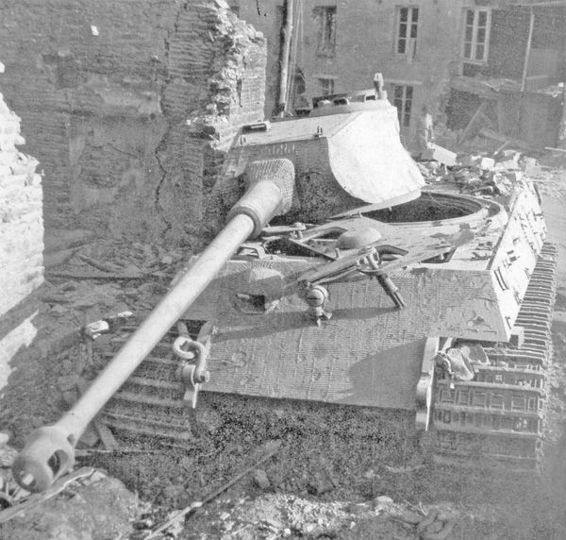
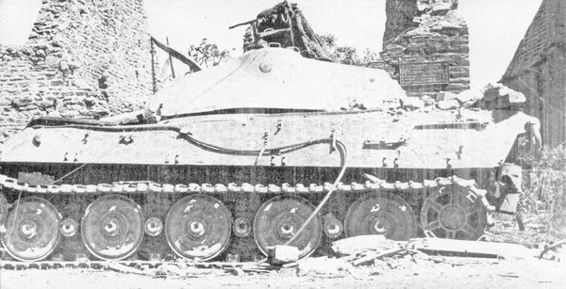
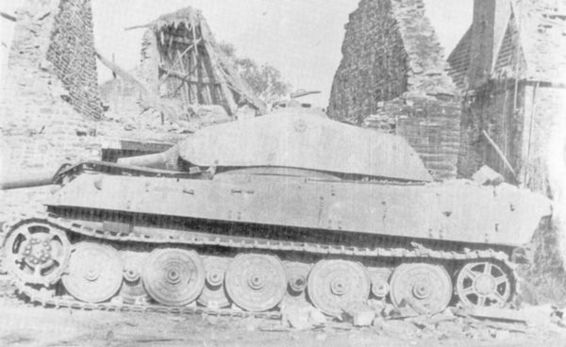
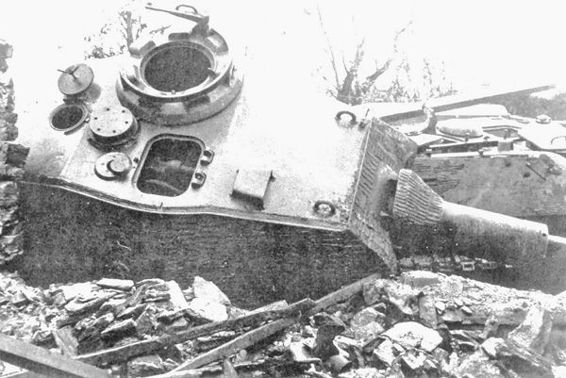
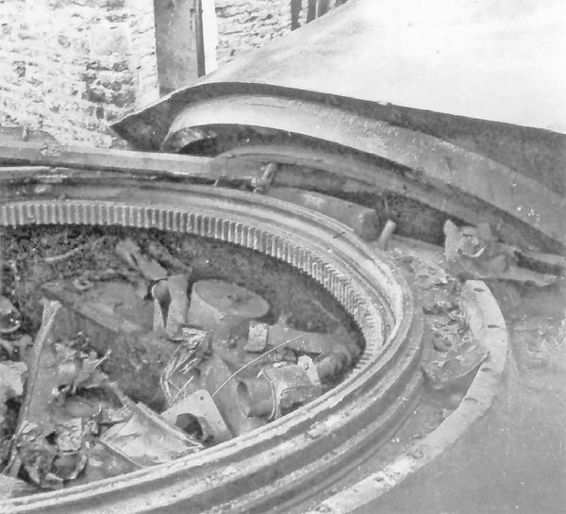
Photographs taken later on show that the tow cable found a new home. At some point later, the turret slid completely off the tank’s hull, revealing the turret race and the interior of the fighting compartment. (IWM)