
5
Because liberal powers tend to organise strategic dialogue through procedures in which the military executes, but does not adjust policy, adequate substantive output from strategic dialogue—sound strategy—is often frustrated in contemporary conflict. To use armed force to have political effect as a direct extension of policy, those on one’s side whose actions involve making political choices, which typically will extend down to the tactical level, need to contribute to policy to keep the gap between desire and possibility as small as possible. The neat policy-operational distinction, an idea firmly entrenched in both constitutional and strategic thought, is untenable in many contemporary conflicts, not least in Afghanistan.
Civil-military relations and strategic dialogue
Strategic dialogue is essential for the desire of policy and the possibility of its implementation reciprocally to inform one another, in order to craft coherent actions that serve the end of policy. In On War Carl von Clausewitz deals with the interaction of policy and war during conflict. He advocates that the head of the Army should have a place in the Cabinet so that the reciprocal interaction between military possibility and political intention can take place.1
Clausewitz died before he could write the last chapter of On War on supreme command, which is promised earlier in the book, so the theme of how this relationship should work is not further developed in On War. In reality the relationships between senior military commanders, senior civil servants and politicians (if indeed there has been a distinction) in any conflict have produced a strategic dialogue particular to that circumstance. While there are many possible variations in the processes by which strategy has been formulated, what consistently comes to the surface is that personality seems to be a more powerful variable than the official state system.
Samuel Huntington’s The Soldier and the State (1957) was one of the most influential post-1945 texts on the subject of civil-military relations.2 While Clausewitz does not figure prominently in this text, Huntington draws on Clausewitz to emphasise the concept of war as an instrument of policy. However, Huntington’s interpretation of Clausewitz is particularly partial, as he makes a connection between war’s instrumentality and robotic military obedience that Clausewitz’s own argument does not sustain.3 Clausewitz’s own view was that: ‘when people talk, as they often do, about harmful political influence on the management of war, they are not saying what they really mean. If the policy is right—that is, successful—any intentional effect it has on the conduct of war can only be to the good. If it has the opposite effect the policy itself is wrong’.4 Clausewitz’s work engages with how policy and war interact during conflict. To see the military as a politically inert executor of policy in a one-way system is to misread Clausewitz.
Huntington locates his propositions in an inaccurate interpretation of Clausewitz’s historical reception. Thus he posits that as ‘disciples of Clausewitz’ von Moltke and von Schlieffen, both chiefs of the Prussian/German General Staff, were strict adherents to this interpretation of the instrumental view, in which war and politics were clearly separated. However, one of Huntington’s problems in terms of argumentative clarity is that he rarely distinguishes, including in this instance, between party politics and government policy.5 This is not only a partial interpretation of Clausewitz but of historical fact. Moltke’s arguments with Bismarck, his civilian master, during the siege of Paris in 1870–71, for example, went against this idea in practice. Huntington asserts that ‘since political direction only comes from the top, the means of the profession [the officer corps] has to be organised into a hierarchy of obedience… His goal [the ‘military man’] is to perfect an instrument of obedience; the use to which that instrument is put is beyond his responsibility’.6
Huntington associates military professionalism, which he sees at the core of this instrumental, robotic, military ethic, as the ideal to which officers should aspire. This military ethic (for Huntington based on a philosophy of ‘conservative realism’) apparently informs the ‘military mind’, which ‘emphasises the permanence, irrationality, weakness, and evil in human nature’. The supposed qualities that make up Huntington’s military ethic elevate it to a cult to which all military officers subscribe. Huntington makes a fetish of the officer corps, and even makes an absurd claim that enlisted personnel ‘can never develop professional motivation and the sense of professional responsibility characteristic of the West Point or St Cyr [US and French Officer Academies] graduate’.7 Did Huntington ever meet a sergeant major during his brief time in the US army?
Huntington’s arguments about the military are seriously out of date, if they ever were in date. Officers think for themselves; they are not robotically programmed by a conservative realist ethic; to argue that enlisted men cannot have the same level of professional commitment is utter nonsense. There is some irony in the fact that a text which jars with the reality of military experience is today still a reference point in the widely held military view that the military should only execute, and not contribute to, policy.
The Soldier and the State makes more sense when read in its historical context. The arguments advancing a clear distinction between policy and the execution of war were already established in US military thought prior to the Second World War. Huntington cites a US Command and General Staff School publication of 1936: ‘Politics and strategy are radically and fundamentally things apart. Strategy begins where politics ends. All that soldiers ask is that once policy is settled, strategy and command shall be regarded as being in a sphere apart from politics… The line of demarcation must be drawn between politics and strategy, supply, and operations. Having found this line, all sides must abstain from trespassing’.8
Huntington saw the Second World War as an unwelcome departure from this principle, as he argued that military chiefs held too much power, which expanded beyond the military domain into diplomacy, politics and economics. He argued that the fixation with victory in war, which obscured the importance of thinking about political consequences subsequent to that victory, was driven by a military domination of policy over civilian authority. He took issue with the fact that by 1945 the War Department was enmeshed in US foreign policy. By the end of the war more than half of the papers of the Operations Division of the General Staff were devoted to matters that went beyond the US army’s traditional military domain.9 Huntington made an astute point that the absence of real opposition to the military’s views on war policy was not necessarily a sign of a well-functioning process: ‘too much harmony is just as much a symptom of bad organisation as too much conflict’.10
Huntington’s key reference point, writing in 1957, was of course the showdown between General MacArthur and President Truman over policy in the Korean War, which led to the former’s dismissal from command. Huntington analysed MacArthur’s desire to expand the war to win in absolute terms as a continuation of the military domination of policy during the Second World War. That MacArthur should challenge the President’s authority was for Huntington an attitude not present before the Second World War, but it had become so overly inflated by 1945 that Admiral Leahy, the Chief of Staff to the Commander-in-Chief (President Roosevelt), and effectively (though not in title) the first Chairman of the Joint Chiefs of Staff, could ‘quite frankly and truthfully say’ that ‘The Joint Chiefs of Staff at the present time are under no civilian control whatsoever’.11
Huntington argues that in the Second World War the American people traded ‘military victory for military security’, as the military domination of policy led to an end state based on total victory that did not necessarily leave the United States in a more secure position.12 He makes the connection with MacArthur’s position in Korea, in which his obsession with total victory, which might have involved the deployment of atomic weapons against China, was not in the US security interest, at least in the President’s view. Hence Huntington’s thesis is not just about constitutional stability, although he is concerned about the ‘weakening of liberalism’ in the Cold War environment.13 His main argument concerns the effectiveness of the US strategy-making process.
Huntington’s advocacy of the military ethic and of an apolitical military officer corps, which should ‘serve with silence’ and in so doing ‘remain true to themselves’, made more sense in the years following the Korean War.14 Given the possibility of escalation to nuclear war, to limit war, rather than to think of war in terms of total victory, was eminently sensible. This required a challenge to what Huntington saw as military domination of policy and a rehabilitation of the tradition of civilian control. This may explain why Huntington does not distinguish between policy and politics: it made strategic (policy) and constitutional (politics) sense for the military to stay away from both. To back up this argument he elevated military professionalism, the inward-looking cult of the ‘military man’ and the officer corps, its guardians, to a state that did not correspond to historical or contemporary reality.
The problem with his thesis is that he requires an ideal to serve his broader argument; in trying to present this ideal as reality he loses purchase on the actual historical record and does not relate to the modern military. In today’s context Huntington’s argument would have the military in contemporary conflict pursue exclusively military goals in the name of professionalism—this would not work in mosaic conflicts, in which tactical actions have a political quality: to refuse to engage in politics would just mean not knowing what political effect one is having, or refusing to discriminate between military courses of actions on a political basis, leading to chaotic outcomes. Huntington’s ideas taken literally today, outside their legitimating Cold War context, isolate the military from wider society. This frustrates, rather than balances, strategic dialogue.
The Soldier and the State is a seminal reference point for the theory of civil-military relations. While its constitutional arguments still make sense, its strategic arguments only made sense in their Cold War context. In contemporary conflict, the effectiveness of strategy must be predicated on an inclusion, not a total separation, of the military in policy. To reject this possibility is either to deny the reality that activity, civilian and military, at the tactical level tends to be highly politicised in contemporary conflict, or to accept this, but to maintain that, even this being so, the military should not have a viewpoint on policy.
While the political nature of war is clearly not a new idea, the extent of the penetration of the military domain by political factors even at the lowest level is a key evolution. Thus when Clausewitz envisions an interaction between political and military officers, he is concerned that generals commanding whole armies, not majors commanding companies, have their opinions on policy heard. While strategic dialogue between statesmen and generals may well be established in Clausewitz, in contemporary conflict, where tactical actions have policy implications in a small but cumulative manner, strategic dialogue needs to be extended much lower down the chain of command.
In short, the necessity of linking political choices at the tactical level with policy outcomes is a strategic necessity in today’s mosaic conflicts. Only in this way can strategy and its expression as strategic narrative be adjusted to local circumstances and actually work coherently. The way in which the West tends to think about strategy frustrates this because it is frequently not understood that strategy is a relationship between policy and tactical action in which both should be adjusted in the light of the other; it is not a one-way road from policy to tactical action.
Strategy has been defined succinctly as a convergence of ends (objectives), ways (actions) and means (resources).15 Colonel (retired) Harry Yarger’s pithy definition of strategy is equally convincing: ‘the calculation of objectives, concepts, and resources within acceptable bands of risk to create more favourable outcomes than might otherwise exist by chance or at the hands of others’.16
Essentially strategy is the dialectical relationship, or the dialogue, between desire and possibility. At the core of strategy is inevitably the problem of whether desire or possibility comes first. Does one start with the abstract idea of what is desired, or should one commence by consideration of what is realistically possible? This is a chicken and egg situation.
The two should ideally be in perpetual dialogue, not just before but also during a conflict. Desire must be grounded in possibility; possibility clearly requires an idea in the first place which informs any analysis of possibility. In the colloquial language often used to describe actual strategic process, this could be described as the continuous tension between ‘top-down’ and ‘bottom-up’ approaches to a problem set. Ideas coming from the top need to be rooted in ground truth; yet an un-coordinated bottom-up approach based only on what works locally lacks a unifying purpose and will be incoherent. This is comprehended in Admiral J. C. Wylie’s argument that the plan produced by strategy ‘is a vehicle for conversion of an idea to a deed’, but as a dynamic process: ‘the link between a thought pattern and reality’.17
Understood as dialogue between desire and possibility, strategy is as much the process that handles this dialogue as the output of the dialogue itself. The former can be seen as the procedural element of strategy (how an actor, typically a state, organises its processes to set up dialogue between policy intention and ground truth); the latter can be seen as the substantive element of strategy (the actual strategy that is produced). This dialogue is very hard to get right in practice. Historical examples in which there has been satisfactory equilibrium are far more seldom found than instances in which desire has not been rooted in reality, or when actions have not had any unifying purpose. Often these last two scenarios are two sides of the same coin.
Taken as concepts, policy, strategy and tactics are representative of distinct types of thought that are universal in all situations. In the abstract, all human action can be understood in terms of the physical expression of intention, or desire. Strategy requires an abstract starting point, an idea, which is typically understood as policy. Clausewitz stated that ‘policy is nothing in itself … we can only treat policy as representative of all the interests of the community’.18 In reality, to reconcile all the interests of the community in relation to a given conflict is often impossible. Even those constituencies who support a military action may well do so for different, and potentially contradictory, motives. The further one moves away from wars fought for national survival, the more likely is one to detect such inconsistencies.
The requirement for strategic narrative to bind its audiences is crucial; that is hard to do when different parts of the audience expect substantially different outcomes, and strategic choices arise that make it impossible to keep juggling alternative versions. To take policy as representative of all the interests of the community, as Clausewitz does, is not a situation one would often expect to find in reality. Yet any analysis of a circular system, in this case strategic dialogue, requires a starting point, and this abstract, simplified notion of representation provides this. The point is stressed in this chapter to make the distinction between abstract analysis and practical reality. While an abstract understanding of strategic dialogue is important, in reality the policy starting point will be far more complicated. Policy aims in reality tend to be woven together and expressed as a strategic narrative; the construction and coherence of strategic narrative is the subject of Chapters 8 and 9. This chapter, however, continues to examine the abstract position.
The actual expression of that abstract desire, in the context of strategic theory, has been described variously as an outcome, an objective, an end, a result, a goal. This expressed idea is also comprehended by policy. The distinction between an end (policy in the abstract) and an end-state (policy achieved) might be illustrated as a line which shows the expression of the idea: it starts with the abstract desire and finishes with the actual accomplishment of that desire. In this sense policy represents not just the starting point, but also the end point: strategic dialogue is a circular system.
The accomplishment of policy is achieved through deliberate action. In war this has traditionally been understood to come about through the use of military force. How one configures and orchestrates that force is an area of technical expertise, and requires specific knowledge. This had traditionally been understood as tactics. Clausewitz defined tactics as the coordination of actions within battle, which he termed the engagement. Tactical thought was distinct and lent itself more to scientific analysis: principles of battle, technical knowledge of military equipment and geometry, for example, were for Clausewitz associated with tactical thought.19
Clausewitz defined strategy as the use of the engagement (battle) for the purposes of war.20 This was more of an art. Hew Strachan has argued that strategic thought in this sense had originated from the growth of standing, professional armies in the eighteenth century as the type of theory which dealt with the general’s plans and manoeuvres in the lead-up to battle.21 As war expanded in scale, predominantly due to technological advances in communication and transportation, what Clausewitz understood as strategy was significantly stretched.
Julian Corbett, the British strategist of the early twentieth century, distinguished between ‘major strategy’ and ‘minor strategy’. ‘Minor strategy’ is what would now be termed ‘operational’ thought, which related to action within war, but outside combat. ‘Major strategy’ was for Corbett the coordination of all military tools of the state to achieve the ends of policy. As Strachan argues, this prefigured conceptions of ‘grand strategy’, or ‘national strategy’ as it is usually termed today.22 Thus, while for Corbett major strategy principally meant coordinating the actions of the army and the navy, this mode of thought has expanded to include within the military, air forces, space and cyber. Beyond the military, national strategy also coordinates diplomacy, economic options and the role of international aid. In this ‘major’ sense, strategy is very close to state policy, and national strategy is indeed decided in most countries at the political level.
The stretching of the distance between policy and tactics can distort the fact that strategy is fundamentally the relationship between the two rather than just a ‘level’ between them. Nonetheless, linear models which see strategy as a ‘level’ of war are more typically encountered than a conception which understands strategy as a relationship. A common formulation is the policy-national strategy-military strategy-operational-tactical ‘levels of war’ model (see Figure 10).
This can be a legitimate model if one recognises that policy is the origin and the destination of strategy: the idea and its expressed form. In this sense strategy not only adjusts actions in light of what is desired, but desire is also adjusted in light of practical possibility. Strategy seeks to reach a destination, and must adjust policy if that destination is not attainable. Strategy is therefore not a one-way road from policy to tactical action (which is the way such a model is often, mistakenly, interpreted); strategy should be a dialogue between the two.
Strategic dialogue ideally produces strategy that situates the desire of policy in the possibility of its execution. This juncture between desire and possibility, the strategic domain, is located at the point where actions have a political quality: the course of action potentially impacts on both the policy aims themselves, and the audiences against whom they are defined. In conventional war that juncture would be very high up the military chain of command, usually at army group or corps level. Thus there is an overlap between the commander of an army group, a very senior military officer that one would expect to have strategic authority, and the location of the strategic domain: while the action of the whole army group may have a political quality, actions of smaller formations and units within it seek a preliminary military outcome which only connect to the policy aim indirectly in their contribution to the actions of the whole army group; the key point is that commanders within the army group lower in the chain of command, the vast majority, do not need to make political choices when discriminating between courses of action. How strategic dialogue is configured in conventional war is therefore relatively straightforward, since it is essentially limited to how politicians and generals interact with one another to adjust policy and actions in light of one another.
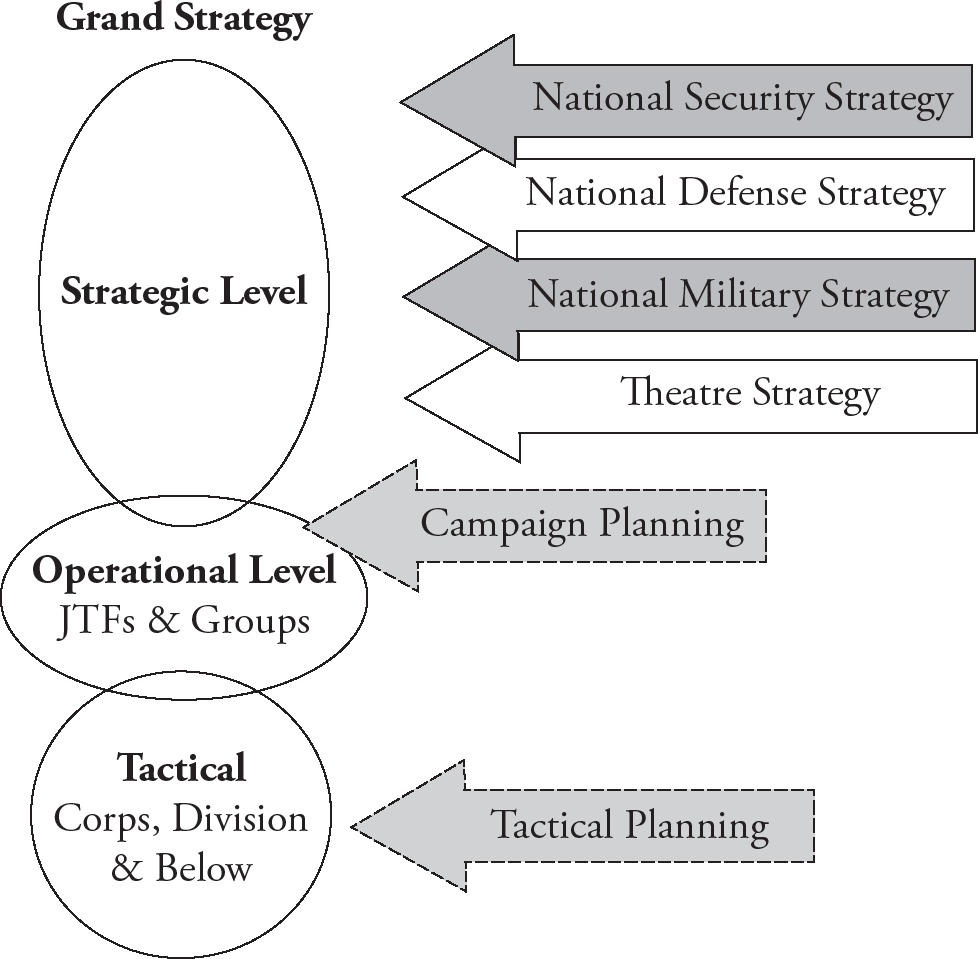
Figure 10: Levels of war and hierarchy of strategy (in a US context). (A ‘JTF’ is a Joint Task Force.)23
The issue is then how effective such interaction is in producing balanced strategy. This depends on constitutional civil-military configuration, and the force of individual personalities. In the case of a military force micro-managed by a military dictator, for example, strategy would probably adjust policy seamlessly. In most liberal powers, strategists tend not to be the primary policy-makers, so this involves the strategists informing the policy-maker that a policy aim is unattainable, or requires adjustment in terms of its content and/or the audiences against whom it is defined.
In conventional war the overlap between strategic authority and the strategic domain means that politicians, if they do listen to their generals, have to consult a relatively small number of people. The problem in contemporary conflict is that the strategic domain often expands far beyond strategic authority, as discussed in the previous chapter: junior commanders routinely make political choices, either consciously or by implication through a course of action; their actions may be of less significance in a mosaic, cumulative sense. The problem is that effective strategic dialogue in this circumstance requires the integration into that dialogue of all those who operate within their strategic domain, which typically includes junior commanders at the tactical level.
Liberal democracies are not constitutionally configured to do that: the notion that the strategic domain and the tactical level can overlap is a reality of contemporary conflict that is deeply uncomfortable because it pits constitutional and strategic arguments against one another.
Constitutional and strategic arguments are only aligned when liberal democracies (mis) understand strategy as a one-way process, in which strategy is an expression of policy, but does not adjust policy; where soldiers do not question the objectives of policy, as posited by Huntington in The Soldier and the State. The endurance of this one-way interpretation of the ‘levels of war’ model is evidenced in the perception of the armed forces in liberal democracies as theoretically apolitical organisations. In a debate at Oxford University in 2010 on how far the military should contribute to policy-making, Professor Vernon Bogdanor, an expert in British constitutional law, argued that:
The distinction between policy questions and operational questions is not an easy one to observe, and perhaps especially difficult in military matters. Nevertheless, the chiefs of staff ought to do all they can to maintain it. It is important for the processes of democratic accountability that the dividing line is not blurred.24
The crux of Professor Bogdanor’s argument is constitutional stability. The idea that the military are controlled by civilians and democratically accountable to them is standard in liberal democracies. This argument is entirely legitimate, and makes sense in a constitutional context. However, it does not make sense in the strategic context of contemporary conflict. This is a major paradox for liberal democracies. The military is often in the best place to assess whether policy is realistic. If the soldier on the ground can see that policy is unrealistic, but is unable to challenge it because he is at the end of a one-way flow of policy direction, policy cannot be adjusted in light of practical possibility. To my mind, while the military, and their civilian counter-parts who act in conflict environments (such as diplomats and development experts), should be involved in policy, they should stay out of politics (which is admittedly difficult to do in practice); this is a fine line, but seems the only way to balance constitutional and strategic arguments.
The enduring prevalence of a Huntingtonian conception of civil-military relations is exemplified by the ineffectiveness of the strategic dialogue that liberal powers have conducted during the coalition campaign in Afghanistan. The coalition narrative has, at the time of writing, shifted essentially to the avoidance of state failure. As of January 2012 the International Security and Assistance Force (ISAF) mission was stated as follows:
In support of the Government of the Islamic Republic of Afghanistan, ISAF conducts operations in Afghanistan to reduce the capability and will of the insurgency, support the growth in capacity and capability of the Afghan National Security Forces (ANSF), and facilitate improvements in governance and socio-economic development in order to provide a secure environment for sustainable stability that is observable to the population.25
General Stanley McChrystal’s re-assessment of the situation on his assumption of the ISAF command, which encouraged an alignment of desire in the light of practical possibility, took place in 2009, although the process had been started by General David McKiernan before him.26 However, it was evident earlier than 2009 that wide policy goals were unrealistic. The assumption that the coalition’s actions earlier in the campaign were always leading to the same end point is an understandable teleological perspective, encouraged by a retrospective viewpoint from the more coherent strategic context that emerged after 2009; but it distorts the historical reality. Many of the coalition’s actions were going a different way before 2009, to satisfy different policy objectives that were at best confused.
The British Secretary of Defence at the time thought of the deployment of British troops into Helmand in 2006 primarily as a reconstruction mission. This was not an illegitimate viewpoint given the absence of a serious pre-existing insurgency. However, that narrative was not agile enough to maintain coherence once real fighting started, and yet it did not evolve, causing a gap to open. As an infantry platoon commander, I met no soldiers or junior officers in my 2007–8 tour in Afghanistan who actually thought that our more idealistic aims were really achievable, at least without a long and well-resourced commitment in most rural parts of southern Afghanistan. At this time Prime Minister Brown would describe in Parliament what British forces were doing in terms which emphasised schools, governance and drug eradication. This may well have been his view, but had little to do with the army’s operations at the time, which were focused on clearing out the Taliban from populated areas through aggressive combat operations.
The Prime Minister by late 2008 came to stop mentioning his previous view of the more idealistic interpretation of the army’s actions, and focused instead on securing Afghanistan from terrorism in terms of UK national security.27 From then on the ‘chain of terror from Afghanistan to the UK’ argument has dominated, although this is increasingly failing to convince people.28 Justification tends now to focus on the mission’s other, to my mind legitimate, goals: state and regional stability, the credibility of NATO and the moral commitment to the Afghan people.
Having moved away from more ambitious policy goals, Western politicians now tend to define the narrative in the negative: ‘we are not building Hampshire in Helmand’ or ‘Switzerland in Afghanistan’ are both expressions that have been used by British politicians. In his speech of 27 March 2009, President Obama declared the objective to be to ‘Disrupt, Dismantle and Defeat al-Qaeda in Afghanistan and Pakistan’, primarily in the context of Western security and regional stability, a significantly clearer and more narrowly focused mission. Afghanistan would need to be secure to achieve this. In terms of the Afghan state, President Obama has been reported to have spoken (confidentially at the time) in the US National Security Council about not having the resources to ‘build a perfect Afghan state’, and possibly achieving ‘Bangladesh levels of corruption’; this is fairly depressing, especially since it is an aspiration.29
However, President Obama’s more pragmatic approach is entirely sensible and more realistic, given what is within the realm of the possible on the ground. Ultimately, to have significantly reduced the policy aims of the war is common sense on the basis that one needs to align what is desired with what is possible.
Discrepancies between aims and their achievability became apparent as both the NATO footprint and the insurgency expanded from 2005–9. The December 2005 revision to the plan (NATO OPLAN 10302, Revise 1) which set out the extension of the NATO footprint into southern and eastern Afghanistan (following the earlier expansion into the North and West) set out a narrow ‘Alliance Political End State’: ‘a self-sustaining, moderate, and democratic Afghan government able to exercise its sovereign authority, independently, throughout Afghanistan’ (note that anti-terrorist operations were still to be conducted under separate authority, such as Operation Enduring Freedom, distinct from the NATO plan).30
To achieve the end state, the plan set out NATO’s mission in Afghanistan: essentially, that in coordination with Afghan security forces, the NATO force would assist with security, the development of Afghan governance structures, and assist reconstruction/humanitarian efforts.31 As far as expansion into southern Afghanistan was concerned: ‘the strategic intent of the southern expansion is twofold. First, to expand the beneficial ISAF effect in Afghanistan by deploying NATO-led PRTs [Provincial Reconstruction Teams] into the Southern Provinces. Secondly, expansion to the south will establish conditions for the assimilation of the remaining provinces into the NATO-led mission…’32
The three levels used here as examples (political end-state, strategic mission, regional application of strategic intent) at which the NATO plan engages can in one interpretation be seen as fairly narrow in their objectives. If the lower level regional direction is read in the light of the political end-state, their ambition is limited to a fairly stable Afghan state, which is not far from the present aim. However, these examples also show that if read individually, and more broadly than was probably intended by the plan’s drafters, there is the potential here to understand the mission more in terms of nation building. Moreover, there was not a large-scale insurgency to frustrate the plan at the time it was published in December 2005. By the time it was being implemented, and partly given the expansion of the insurgency in response to its implementation, the beneficial effects of NATO’s expansion into the south were far less detectable than the vicious fighting that was taking place. Even if the destruction that such fighting brought with it was actually localised, wider audiences were at the time more disposed to have understood the conflict through the lens of aggressive combat operations than reconstruction.
The NATO 2005 plan read how, I think, its drafters would have intended it to have been read makes sense and was not overly ambitious. However, the scope for interpreting it in a broader, more ambitious sense was made apparent by the potentially confusing narratives advertised by Westerners, from political leaders speaking to their electorates to soldiers explaining to Afghans why they were there, sometimes during combat patrols on their land. In the background of the picture was the idea of reconstruction; in the foreground was intense violence, at least in the southern and eastern peripheral areas of Afghanistan. The strategic narrative did not paint a coherent tableau; its conflicting themes were only re-harmonised in 2009 in terms of aims, the resourcing of those aims and their operational execution. The speed at which strategic dialogue was able to harmonise desire and possibility was too slow, and was outpaced by events on the ground.
Afghanistan illustrates how, in any circumstance, possibility will ultimately catch up with desire. If one cannot change the facts on the ground with the means allocated to do so, the facts will catch up with one’s policy and force it to change, or make it fail. If policy is unrealistic, there will come a point when that becomes clear. The key question in a liberal democratic context is to whom it is clear, and the time it takes between being clear to those on the ground, to the policy-makers, and ultimately to the public, their auditors. The lag between perception and reality can be identified when the strategic narrative does not correspond to the reality on the ground. If ground truth and the perception of ground truth by those who make policy are different, the closing of the lag between the two can be politically embarrassing, and worse, lethal.
The alternative to changing policy ungracefully because it is publicly obvious that it is unrealistic is regularly to adjust aims in light of what is possible; thus intention and possibility are not allowed to move too far apart. That implies early recognition of the point at which aims are not being realised on the ground. As this is typically most obvious to those on the ground, it means incorporating them into strategic dialogue.
This may seem to be common sense, but it is by no means common practice. In a Westminster Hall debate on Helmand in 2009, Adam Holloway MP, an ex-army officer, stated:
I wonder what on earth the Government have been doing. The Defence and International Development Committees go out there regularly. Every time we are given the same good news story, but it is not reflected on the ground. It is like smoke and mirrors, with everyone lying and deluding themselves. That is certainly how it feels from my perspective. As one Government employee put it to me yesterday: ‘We realise it is now time to start taking it seriously’.33
There is an argument that the UK government cannot make strategic decisions as a junior partner in an American-led coalition. The need to maintain the credibility of NATO and keep the UK under the US security umbrella are legitimate objectives. However, the lack of clarity over the political command and control of the mission from a junior partner’s point of view in a coalition can lead to correspondingly confused political engagement with the campaign, especially in terms of the expectations of the domestic population. The handover of Sangin (a town in Helmand) to the US Marine Corps in 2010 made complete sense in operational terms, as it allowed UK forces to concentrate their efforts in central Helmand. This set conditions for the relative success which the British army, with adequate force ratios, has had in securing its three districts of central Helmand since then.
However, the fact that so many British lives had been lost in Sangin consumed most of the media attention of the handover; the media coverage also highlighted the corresponding military concern that it would be seen as a British defeat or forced withdrawal. In one sense, to remember British casualties is entirely understandable and correct. In another sense, however, the concern that such a move would be seen as a British defeat (which it was not) exemplifies how the temptation remains for the domestic populations of junior coalition partners to see the conflict too rigidly through the experience of their own troops.
The British public tend to identify Afghanistan with Helmand, for example. A coalition campaign will only work if the coalition maintains political coherence, which often means junior partners acknowledging that policy is made higher up, even if they have some input. To talk about ‘British policy aims’ in Afghanistan only makes sense when understood that this is in a coalition context, unless one is specifically alluding to reasons for British participation in the conflict that are ulterior to what the coalition is seeking to achieve in Afghanistan.
Proper strategic dialogue involves the adjustment of policy in the light of practical reality in relation to various audiences. Such dialogue should be continuous, as it is in domestic politics; politicians are wary of overly idealistic policy, precisely because they understand that it can cause political embarrassment when it fails.
The grammar of war
One of war’s defining features is its strong tendency to evolve in unexpected directions. Clausewitz identified how policy cannot entirely regulate war. In war the particular logic that is brought into being when there is a clash of organised violence had a subordinate, but independent role. Clausewitz described the ‘explosive’ quality of war’s logic, namely its capacity to escalate into something beyond the desire of the policy-maker, and beyond even the desire of both sides: ‘war is an act of force and there is no logical limit to the application of that force. Each side, therefore, compels his opponent to follow suit; a reciprocal action is started which must lead, in theory, to extremes’.34
While war itself was for Clausewitz subordinate to policy, the relationship was certainly not one way. War itself, its internal logic brought about by the clash of violence, either actual or anticipated, had an active role which could push back on policy and change it. Thus policy would ‘permeate all military operations, and so far as their violent nature will admit, it will have continuous influence upon them’. For Clausewitz ‘the political aim is not a tyrant. It must adapt itself to its chosen means, a process which can radically change it; yet the political aim remains the first consideration’.35 Clausewitz summarised the relationship between the uncertainties of violent clashes that war brought into play, which he termed war’s ‘grammar’, and policy, in the argument that war’s ‘grammar, indeed, may be its own, but not its logic’.36 The point is that policy does ultimately regulate war by providing its ‘logic’; yet violence in war produces dynamics which policy cannot fully control.
The capacity of war’s ‘grammar’, even as the subordinate agent, to unhinge policy has revealed itself to some degree in every war. Admiral J. C. Wylie argued that, rather than being a continuation of policy, ‘war for a non-aggressor nation is actually a near collapse of policy’.37 The defeat of one side is the obvious example of this throughout history: the final collapse of policy in war. In this case war is still animated by policy, but the enemy’s rather than one’s own. War can unhinge the policy of the victors too. France and Britain were among the victors of the First World War. Yet the Great War for them was not the war it was supposed to be. It was not over by Christmas 1914; their empires were mortgaged to pay for the conflict; in the long-term it marked the start of the end of a period of European world domination.
War can also unhinge the policy of the victor in other ways than the ‘Pyrrhic Victory’. A victor can find himself so powerful that the outcome of the war forces new pressures on policy which can take it in new directions. The US emerged from the Second World War the pre-eminent Western superpower. The war’s outcome did not unhinge policy in the sense of US failure—quite the opposite; but it did unhinge US policy in the broader sense of the marginalisation of the isolationist position which had acted as a balance in pre-war policy debates.
Clausewitz’s argument about the need for policy to adapt to war’s evolution is problematic for liberal powers today, given their configuration of civil-military relations.38 The political debate concerning whether to go to war in liberal democracies takes place (in theory) before the war has started. Logically, the ‘war’ formally debated in public is war in the abstract because it has not yet started. If politicians adjust war aims during the actual rather than the abstract war they tend to lose credibility, and are considered flip-floppers. Yet the charge of flip-flopping is dangerous because it inhibits the need to tailor policy in light of the reality that war is inherently unstable and will evolve. For liberal powers to insist on political accountability for a war’s original intention is often illogical.
The frequent result, to use a metaphor, can be likened to driving a car through the rear-view mirror rather than looking at the road ahead: it swerves all over the place and may crash. War in reality has so many variables that for policy to insist on the maintenance of aims that were established in the abstract before the main fighting started is to deny the possibility that the original aims are not in fact attainable in reality and should be adjusted. This gives politicians little room for manoeuvre, which does not encourage an agile strategic dialogue. What we are often left with is a public increasingly confused by war aims which correspond to a version of the war which is not the war actually being fought. Moreover the war actually being fought may not correspond to the war policy claims it is conducting. This frustrates the adjustment of policy in the light of how a war evolves. The consequence is that policy usually waits until it is being overtaken by events on the ground before adjusting: only when it is abundantly obvious that current policy is heading for failure is it changed.
The counter-argument would be that states invest huge credibility in conflict, and thus perceive that decisively to adjust their aim is to compromise that credibility. In some circumstances that may be right, although to pursue an unachievable aim is by logic just delaying rather than solving the eventual loss of credibility; and during that delay, soldiers die. The key point here is that big alterations in policy aims are indeed to be avoided if possible on grounds of credibility, but that it is precisely by retaining flexibility, and constantly making small adjustments (which cumulatively, and imperceptibly over time, may add up to a big adjustment), that desire and possibility are kept close. Dogmatically to retain a political aim in conflicts which are of lower stakes than national survival is potentially to push military activity further than its political utility.
For liberal powers continually to adjust policy so that the gap between desire and possibility is as small as possible would be more sensible. This in turn means recognising that the convergence of policy and action in contemporary conflict goes down to the tactical level. Thus political (not just military) analysis at the tactical level must feed into strategic dialogue. Chapter 4 and this chapter have examined the interaction of strategy with its political context in contemporary conflict; the next chapter looks at the interaction of strategy and the operational actions which it orchestrates.