
6
Counter-insurgency in Afghanistan is frequently described as a strategy. It isn’t. Counter-insurgency is an operational approach: a method which organises actions in service of a strategy, but not a strategy in itself. The countering of an insurgency is a means to an end. A strategy connects an operational approach to its ends, the objectives of policy, and adjusts both in so doing. While counter-insurgency is a legitimate and necessary operational approach in the context of Afghanistan, to talk about a ‘counter-insurgency strategy’ is potentially confusing shorthand: it can erroneously suggest that counter-insurgency doctrine can be applied regardless of political context as a strategy in itself, as opposed to being the operational component of a strategy.
This chapter argues that although contemporary conflict tends to be different from war in its Clausewitzian paradigm, the basic conception of strategy that one finds in Clausewitz’s writings still makes sense: the military domain is an extension of policy, not a conceptually sealed-off environment. Strategy’s role is to situate an operational approach within a particular political problem, which requires pragmatic interpretation of military doctrine. If an operational approach is cut off from its political context, it may well become self-referencing, looking inwardly to satisfy abstract military principles rather than connecting outwardly towards its political goals. When an operational approach is thought of as a strategy, or even a policy, what can result are campaigns primarily driven by internal military logic, rather than political objectives.
Clausewitz’s centre of gravity: the association of military action with political effect
Clausewitz’s strategic theory was premised on his conception of war as a political instrument. The strategist in war was required to orchestrate military actions so that they translated into a political meaning, and therefore had to look outwards to policy, not just inwards to battle; hence Clausewitz’s defined strategy as ‘the use of the engagement for the purposes of war’.1 This was to be achieved by the identification of, and decisive strike at, the enemy’s schwerpunkt, which can be translated as ‘centre of gravity’ (or ‘focal/decisive point’).2 The centre of gravity was a physical representation of the centre of the enemy’s ‘will’: ‘by constantly seeking out the centre of power … one will really defeat an enemy’. This is a far more sophisticated idea than defeat corresponding to an arbitrary level of destruction. The centre of gravity would usually be the enemy army, but only in so far as it represented the core of the enemy’s will. In certain circumstances, the destruction of his army would not stop an enemy from fighting on. The centre of gravity could therefore be different. It could be the enemy capital, especially in ‘countries subject to domestic strife’; it could lie in communal ‘interests’ in the case of an alliance; and it could lie in public opinion, especially in cases of uprisings.3
The centre of gravity was simply what mattered to an opponent, or more specifically what could be made to matter. Admiral J. C. Wylie in Military Strategy: A General Theory of Power Control (1967) explains this through the example of Scipio the Elder and Hannibal in the Second Punic War: Scipio ignored the fact that Hannibal’s army was in Italy threatening Rome and deployed his Roman army to Africa, threatening Carthage. Hannibal chased him, and was drawn away from Rome. Scipio was then able to defeat Hannibal on ground of his own choosing at the Battle of Zama in 202 BCE. However, Hannibal did not have to chase Scipio any more than Hannibal’s threat to Rome had to keep Scipio in Italy; Scipio effectively imposed his will over Hannibal. The point Wylie makes is that the strategist needs to use physical force, or its threat, to manipulate the will of his opponent, not just focus on destruction as an end in itself.
The originality of Clausewitz’s centre of gravity lay in its association of military action with a particular psychological, essentially political, result in the minds of an audience. Although Clausewitz did not use the term audience, the key audience was implicitly the enemy in the context of On War. That the centre of gravity connected operational action to a political outcome underscores how Clausewitz did not advocate strategic theory which exclusively looked inwards to a sealed-off military domain.
However, general military principles could be developed once they were situated within a generic scenario, which assumed as a starting point, for example, that the enemy army was the centre of gravity. To avoid confusion, what Clausewitz described as ‘strategy’ and its associated strategic theory is today generally equated with the ‘operational’ level of war: a domain which lies within war, but outside battle. The strategic theory (‘operational principles’ in today’s parlance) that Clausewitz advocates in On War is primarily concerned with how to deal with war in its near absolute state.4
Thus having situated the centre of gravity within this generic context, he defines general principles that would serve to defeat an enemy: to seek out the enemy main force, converge on it with all available force, and destroy it in a major, decisive battle, the hauptschlacht.5 In the context of near-absolute war, which Clausewitz strongly associated with Napoleonic warfare, a major battle ‘provided a provisional centre of gravity for the entire campaign’.6 Andreas Herberg-Rothe has argued that this deduction was particularly associated with Clausewitz’s analysis of the Battle of Waterloo in his study of the 1815 campaign: ‘Clausewitz stresses that no victory has ever had greater moral force than that of Waterloo, which led directly to Napoleon’s abdication’.7 The hauptschlacht was not an inwardly looking military concept, but a means to strike decisively at a political target.
Clausewitz’s operational principles, as they would be described today, were designed to function in a particular context, not in the abstract in any military situation. When the political context changed, these operational principles would have to be adapted. Clausewitz recognised that there were two forms of war: absolute and limited. They were not neatly categorisable, and were defined by degree by distance from the pole of absolute war. Absolute war aimed at the total overthrow of the enemy. Yet the majority of wars, he acknowledged, aimed at more limited political outcomes. Military principles thus had to be attuned to any ‘modification … in the absolute form of war’.8
The central difference is that in absolute war, war only provides a single decision (a single outcome); a more limited political outcome is by logic excluded: ‘within the concept of absolute war, war is indivisible, and its component parts (the individual victories) are of value only in their relation to the whole’.9 In wars which are moderations of the absolute form, individual components can be objectives in their own right, because armed force can be used for direct political advantage. The capture of a fortress, for example, may be of no military significance in absolute war, but may be significant as a prize in wars fought for more limited political advantage. Clausewitz makes clear that the operational approach he advocates applies to wars which approach an absolute state; the more war is ‘tame and half hearted, the less solid are the bases available to theory [theory which deals with war in its ‘ideal’ or ‘absolute’ state]’.10 The more war is a moderation of its absolute form, the less stable a body of operational principles becomes, as progressively greater intrusion of political considerations within the military domain takes place.11
The distinction between absolute war and limited war is necessary to understand Clausewitz’s strategic ideas. When Clausewitz is prescriptive about focusing on the destruction of the enemy army in a decisive battle, he writes about absolute war. However, the centre of gravity concept works just as well in any conflict environment, although it must be differentiated from the operational principles that typically accompany the concept in absolute war. Contemporary conflict is characterised by the fragmentation of strategic audiences beyond the enemy, and thus a corresponding fragmentation of centres of gravity develops. This scenario was not the norm in Clausewitz’s time, but neither was it inconceivable (in coalition warfare, for example) or inconsistent with Clausewitz’s ideas: ‘where it would not be realistic to reduce several centres of gravity to one … There is realistically no alternative but to act as if there were two wars or even more, each with its own object’.12
Military principles and operational approaches
The identification of a centre of gravity is essentially a political appreciation of a conflict situation. It situates the subsequent application of armed force against that centre of gravity within a political intent. To converge on all axes to strike at the enemy main force in a decisive battle makes sense if the enemy has a main force which has been identified as the centre of gravity. Problems occur when ‘principles of war’ are applied without a prior political appreciation having taken place. In many cases, especially in contemporary conflict, a focus on the destruction of the enemy is encouraged by such an application of military principles in the abstract. Principles are not wrong in themselves; they are a vital handrail for planners. However, military principles need to be applied pragmatically to suit specific political conditions, not generically in any circumstance of armed conflict.
In 1827 Clausewitz was asked by Major von Roeder of the Prussian staff to solve a military problem in the abstract. The problem was described in exclusively military terms: if Austria attacked in such a way with so many men, how should Prussia respond given its military dispositions. In his reply Clausewitz argued that one could not draw up a strategic answer without knowing the political context.13 For the mature Clausewitz, policy came first; principles should be adapted to form an operational plan tailored to a particular problem, understood on its own terms.14 This informed Clausewitz’s view that it was not possible to formulate ‘a set of all-encompassing principles, rules, and methods’:
History has certainly not guided us to any recurrent forms … it is plain that circumstances exert an influence that cuts across all general principles… A critic has no right to rank the various styles and methods that emerge as if they were stages of excellence, subordinating one to the other. They exist side by side, and their use must be judged on its merits in each individual case.15
While Clausewitz’s emphasis on pragmatism in the application of military principles makes sense, such an approach is at odds with the endurance, and prevalence, of a tradition of military theory which argues that universal military principles do exist. The most influential military theorist of the nineteenth century was not Clausewitz but Antoine-Henri Jomini (1779–1869), a French officer from Switzerland who served under Napoleon.16 Jomini’s work, which also took Napoleonic warfare as a model, presented an approach based on universal scientific and geometric principles.17 Peter Paret, the American military historian, cites the opening of Jomini’s Résumé des principes généraux de l’art de la guerre (1806): ‘at all times there have been fundamental principles on which good results in warfare depend … these principles are immutable, independent of types of weapon, time, and country’.18 Jomini’s essential conception of strategy involved the application of these principles, namely to operate on ‘interior lines’ to the enemy, and to strike the enemy through concentration at a decisive point.19
The actual principles that Jomini advanced were in many respects very similar to Clausewitz’s, particularly the idea of concentration on the decisive point. The principles themselves made sense in a post-Napoleonic context. The conceptual difference with Clausewitz is therefore not so much the actual principles as the idea that they can be applied indiscriminately and without reference to a political context.20 However, Paret emphasises that the difference in authorial intentions between Jomini and Clausewitz is important to any comparison: ‘Jomini, we might say, writes about warfare rather than war. Clausewitz, on the other contrary, writes to explain war, shaped by society and politics, as it functions according to means and ends’.21 Hence while Jomini’s work takes the general’s perspective and looks down onto the battlefield, Clausewitz examines war as a whole and its interaction with its political context. Moreover, as John Shy has argued, Jomini writes about ‘conventional’ war; his principles may be universal, but within a particular context. He was clearly aware that war among the people was a different phenomenon.22
While an objective comparison of Jomini and Clausewitz indicates how many of their ideas were similar, there is nonetheless a tradition of strategic thought premised on the validity of universal military principles which has taken Jomini as its origin.23 As Daniel Moran has argued, Jomini has only been the most prominent representative of a tradition of military thought that conceptualises the use of force outside a political context:
Jomini detached Napoleon’s achievements from their Revolutionary roots and infused military theory with a political and social naivety from which it still struggles to free itself. Jomini’s work purported to show that the essence of military success lay in rational decision-making, designed to bring opposing armies together in a sequence of violent clashes whose political implications would be readily apparent.24
This tradition of military thought endures. The British Army teaches the ‘10 principles of war’ in the first week at Sandhurst. While these make sense in conventional, high-intensity warfare at the operational level, they are not universal military principles to apply in all circumstances of armed conflict, although this is sometimes how they are interpreted. ‘Concentration of force’, for example, is often cited as an enduring military principle at the operational level. This analysis is inaccurate outside its legitimising context, which could be seen as the experience of Western conventional armies. Most successful insurgencies have succeeded because they have avoided concentration. ‘Selection and maintenance of the aim’ is the holy grail of military principles. Bold strokes and tenacious pursuit of an objective have been the hallmark of several successful campaigns in conventional war. Yet in conflicts which are highly politicised at the tactical level, to have an aim which cannot be adjusted in light of practical reality because it is an immutable principle not to do so can become problematic.
An operational approach must connect back to its political purpose, or risk that self-referencing military logic drive a war much further than its political utility. Karl-Heinz Frieser argues in The Blitzkrieg Legend: The 1940 Campaign in the West (2005) that the German army’s invasion of France was not based on any preconceived notion of Blitzkrieg, but was a series of actions developed by pragmatic responses to the situation on the ground.25 The German army had itself expected the invasion of France to take longer. The formalisation of Blitzkrieg as doctrine came later in the invasion of the Soviet Union in 1941. It did not link back at this later stage to a political goal, because operational thought had been elevated to the level of policy and become an end in itself. The politically indiscriminate application of Blitzkrieg left the German army massively over-extended on the Eastern Front.26
Germany’s response to its experience in the First World War provides clues to its strategic experience in the Second World War, and emphasises the importance of distinguishing operational principles from policy. Hew Strachan argues that ‘the German army entered the First World War convinced that there was only one way to fight a war, and that was a strategy of annihilation resulting in complete German victory: its operational thought was scaled up to the level of policy’.27 Yet the physical destruction of the First World War was not taken into the heart of German territory because the war was (ultimately) regulated by policy. The outcome for Germany in 1945 was far more destructive. Germany’s experience in the Second World War can be linked, Strachan argues, to the fusion of war and policy, with the Führer as the head of state and the military. It was General Ludendorff, among others, who suggested in 1922 that a Führer should unite policy and Kriegführung.28 This idea contributed not only to the confusion of operational thought and policy but to the exaggeration of the war’s consequences.
The necessity to distinguish between operational principles according to political context is a theme which can be detected more widely than the two World Wars. The Vietnam War provides a case study of how the failure to understand a conflict on its own terms encouraged military objectives to become disconnected from political purpose. General Victor Krulak of the US Marine Corps understood that military action had to link into a political outcome. He endorsed the pacification approach that was adopted by the US Marines in I Corps, the northern part of South Vietnam, in 1966. This was an approach which recognised the local political dimension of the conflict, and sought to link villagers to the authority of the South Vietnamese government.
General Krulak was dismayed, however, at the military metrics that General Westmoreland and Secretary of Defense Robert McNamara were using to evaluate campaign progress. These metrics were most obviously symbolised by the body-count, but also emphasised geographical control relative to the enemy as opposed to political measures. Hence for Krulak the question of ‘who held what in the mountains was meaningless because there was nothing of value there’; this was in the context of much military effort being expended in contesting remote areas.
In 1966 General Krulak wrote a private letter to another US marine general in response to a remark by an US army general that the US was ‘winning militarily’ in Vietnam, stating that this was ‘meaningless’: ‘you have to win totally, or you are not winning at all’.29 The possibility that one can ‘win militarily’ but lose a war is indeed perverse logic; it totally unhinges strategic theory, as it disconnects the use of force from political purpose.
Part of the problem seems to have been an institutional culture which saw the army primarily as a tool of conventional war. A RAND Corporation study of 1970 cited a senior US officer in Saigon so as to illustrate the problem of an organisation characterised by inward-looking, self-justifying principles: ‘I’ll be damned if I permit the United States army, its institutions, its doctrine and its traditions, to be destroyed just to win this lousy war’.30 This view encapsulates the problem of military thought which is focused inwards on itself, privileging the satisfaction of military principles—principles that may not be wrong in themselves but that have been inappropriately configured in relation to the nature of the conflict—above the need to adapt and win a conflict.
There is an argument that the US had achieved its aims by 1972: the defeat of the North Vietnamese Easter offensive in that year would support this view. The application of mass US air power prevented a rout of the South Vietnamese armed forces (although this equally suggests a South Vietnamese dependence on extensive US military support, which would indicate that the conflict was not over, especially in terms of the resources and political will required to sustain it). There is a counter-factual argument that if the US had provided the same support in 1975, South Vietnam could have survived. The outcome of the surge in Iraq in 2007 may plausibly lend more credence to such a revision of the historiography of the Vietnam War. This would depend on the evolution of the situation in Iraq, which is unclear at the time of writing.
However, the cost of war to both the Vietnamese and Iraqi peoples, and the costs to the US, must be considered in order to ground such revisionist arguments in the actual political, human and financial realities of what such strategy involves: was it worth it? That question is not the subject of this book; however, it is critical for our actual subject; strategy. Strategy must be clear that it serves policy (even if strategy can adjust policy if necessary, strategy should never be self-serving), and must consider the application of force in relation to the policy objective. Strategy must not allow military ‘metrics’ to become inward-looking and self-referencing.
Military thought today sometimes makes a helpful distinction between ‘measures of performance’ (measurements of actions being taken) and ‘measures of effect’ (measurements of the outcome of those actions). By linking measures of performance to measures of effect the former is not allowed to become self-referencing. Night raids, for example, can be very effective at making the insurgent feel insecure, but may make other people feel anxious. The number of night raids would be a measure of performance, but the number of people coming to the market, responding to improved security, could be a measure of effect. The point is that the purpose is to make the community feel more secure, which depends on how they react to attempts to secure them. If they respond positively, do more of the same; if not, actions need to be adjusted. This is more sophisticated than just measuring performance, such as the ‘body-count’ in Vietnam, which locates a measure against an arbitrary and generic standard that may well not relate to the actual nature of the conflict. The dual measure system is better because it links internal military actions into their broader purpose as defined in real life.
The proposition that the military realm is autonomous from its political context has been encouraged historically by the cultural associations of the verdict of battle with honour. Because the idea of the ‘fair fight’ is culturally conditioned, the degree to which one can gain the moral victory in military terms despite losing the war in general terms depends on the audience. In Afghanistan the coalition characterises the Taliban as dishonourable in their use of roadside bombs and guerrilla tactics. The default Taliban response, which is frequently encountered in banter between the Taliban and the Afghan police on unsecure radio traffic (along with the trading of colourful and amusing insults), is that they would prefer gun-fights but are denied the opportunity for a ‘manly’ fight by the coalition’s unfair use of air power. This would seem fairly sensible from their point of view. (At one point in 2010 an insurgent in our area, who may well have been smoking something, was known to claim that ‘the ISAF have captured a giant milk-fish’, which was in fact a reference to our use of a white Zeppelin-like surveillance balloon that floated above the base tied down by a rope: whether the reader accepts the insurgent’s opinion or mine, this asset was clearly unfair!)
The argument against the ‘fair fight’ idea in relation to tactical methods can be summarised in a saying coined by Conrad Crane of the US Army War College: ‘there are two types of warfare: asymmetric and stupid’. Abstract cultural conditions which allocate military victory or defeat are subjective criteria and are as powerful, or irrelevant, as the audience’s prejudices. That is not to say that there are no boundaries. Certain practices are deemed to be so universally distasteful, such as the use of poisoned gas, or torture, as to have been banned by international law.
War, and armed conflict more broadly, is subject not just to its political context, but also to its cultural context. For an operational approach to locate itself within a military realm separated from its political and cultural context is misguided. The extent to which an operational approach is governed by abstract military principles is a tension that lies at the heart of strategic thought today.
As Hew Strachan has argued, during the Cold War strategic theory became increasingly focused on the use of force short of war, such as nuclear deterrence, which made it more abstract as it drew on theoretical scenarios in the future, rather than actual historical experiences. It also moved strategic theory from the domain of the professional soldier to a domain dominated by civilians. This left a void in terms of the theory of actual war-fighting and the contribution to theory of military practitioners.31 The conceptualisation of the operational level of war in terms of ‘operational art’ filled this void in the 1980s. This was especially in response to a renewed US focus on conventional warfare post-Vietnam, and a NATO re-assessment of its conventional response to the Soviet threat. Strachan posits that such a conception of operational art could take its geo-political and strategic context for granted, and so focus on battle: ‘although presented as a bridge between strategy and tactics, the orientation of the operational level in the late 1980s was towards tactics, not strategy’.32
While successful on the battlefield in the First Gulf War in 1990–91, the geo-political and strategic context of contemporary conflict is significantly different. Yet the divide between strategy-policy and the operational level survives, and has been applied to non-conventional conflicts. This is most clearly articulated in the endurance of the idea that while political direction comes from politicians alone, the military should be left alone to execute that policy. Strachan cites General Tommy Franks’ comment to Paul Wolfowitz, Under Secretary of Defence at the Pentagon during planning for the 2003 Iraq War: ‘keep Washington focused on policy and strategy. Leave me the hell alone to run the war [emphasis original]’.33 The result was that ‘there was no strategy that united the military and the civilian, the operational to the political, with the result that the operational level of war also became the de facto strategy, and its focus meant that a wider awareness of where the war was going was excluded’.34
When military thought is devised outside of a political context, real or generic, it rapidly loses meaning. Edward Luttwak, for example, has pointed out how the distinction between strategic and tactical air power lost meaning because it confused means with ends. Since the Second World War the adjective ‘strategic’ has been used to describe long-range aircraft as opposed to ‘tactical’ short-range aircraft. Luttwak locates the origin of the distinction in the Second World War: long-range bombers were called ‘strategic’ because their effects in terms of bombing cities were strategic; short-range planes provided ‘tactical’ support to ground forces.
Luttwak traces how the adjective evolved from describing an end, to become the means by which that end had been achieved; thus ‘strategic’ became associated with long range and ‘tactical’ with short range. However, in the 1991 Gulf War ‘tactical’ F-117 aircraft were used to attack headquarters in Baghdad, while ‘strategic’ B-52 bombers were employed to attack troop concentrations in Kuwait and other tactical targets. Luttwak also cites examples from the Kosovo War, in which ‘strategic’ B-52, B-1A and B-2 bombers attacked Serbian ground forces, while all the strategic targets in Serbia were attacked by ‘tactical’ F-15Es, F-117s and other such aircraft. Luttwak’s brief history of this distinction exemplifies neatly how no means possesses intrinsic strategic or tactical value, as that can only describe an end, which depends on the particular context in which that means is employed.35
In the same spirit as Luttwak’s analysis, wars and armed conflicts in general are typically classified in terms of their means, not their ends. Thus conventional warfare usually describes the phenomenon of two armies clashing in battle rather than a fight over absolute political objectives. The First Gulf War, for example, was a conventional war because of the clash of regular armed forces. Yet it was fought for limited political objectives. Several non-conventional wars have been fought for far higher stakes. Counter-insurgency is part of a tradition of conflict identified in terms of methods rather than of political objectives: small war, imperial policing, low-intensity conflict and counter-revolutionary warfare, among others. Those who advocate that ‘hybrid war’ is the next paradigm also emphasise method over objective. To classify conflict in this manner is not incorrect, as there are evidently methods which are transferrable. What this type of classification excludes, however, is a particular political context.
General military principles clearly retain value in constructing operational approaches to contemporary conflicts. John Shy makes a compelling case when he argues that such abstract principles, which are frequently dismissed as too rigid and unrealistic, have, for the sensible reason of giving planners a handrail, remained popular in strategic thought since Jomini. He argues that Jomini’s identification of strategic decision-making as a specific area of knowledge remains important; certain principles can help in strategic decisions (as opposed to overly prescriptive theories).36 Indeed the term ‘lines of operations’, which is current in operational thought today, was popularised by Jomini’s advocacy of thinking in terms of lignes d’opérations.37 Shy’s point indicates that following principles in itself can be a useful planning method; the real issue is whether the appropriate principles have been relied upon in the first place, which is a question resolved by the strategic context in which they are applied.
Counter-insurgency operational doctrine usually comprises three generic lines of operation: security, governance and development. In Afghanistan the government of Afghanistan-ISAF has expanded upon this template to create six theatre-specific lines of operation (as of 2011): protect the population, neutralise insurgent networks, develop Afghan security forces, neutralise corruption and organised crime that threatens the campaign (effectively all part of the security line of operation in generic counter-insurgency doctrine), support governance and support socio-economic development. These provide a very useful method of organising effort across an international civilian-military coalition, and with Afghan partners. The point here is that the abstract doctrine has been applied to reality within the specific political context of the Afghan conflict, and thus has more purchase on the reality of the situation.
In summary, properly to situate ‘Jominian’ thought in terms of strategic theory, Peter Paret’s distinction between warfare and war remains crucial. That professional military officers should seek to formulate general principles for generic problems is common sense. However, when that doctrine does not link into its political context, or is used as a substitute for that context, it oversteps its limits.
Pragmatism and counter-insurgency
Counter-insurgency is often understood as a subset of state stabilisation. Stabilisation doctrine, the generic guidance for UK forces involved in this activity, is necessary in order to draw up contingency plans, to train, and to configure state resources appropriately in the anticipation of involvement in future stabilisation missions. The UK military’s operational stabilisation doctrine sets out primacy of political purpose as its foremost principle: ‘The purpose of UK military participation in security and stabilisation is the achievement of the desired UK political aim. This should be at the forefront of the commander’s campaign planning, implementation, and assessment efforts, noting that this may require adaption where political aims change in light of the conduct of the campaign’.38
However, as in conventional war, were operational doctrine to be up-scaled to the level of policy, there would be a risk that it would crowd out real strategic debate: hard political choices about what political end-state is to be sought may well be neglected, as the generic policy aims of doctrine, such as ‘avoiding state failure’, become the actual policy aims. A policy aiming to avoid state failure is a definition in the negative. The definition of a state as having been ‘stabilised’, or as not having failed, is exceptionally broad. Such an end state could range from supporting a repressive tyrannical regime to achieving a stable democracy. Because stabilisation does not provide an end state defined in the positive, it means little in itself.
The result may be a campaign that lacks direction. Susan Woodward, who had extensive experience of stabilisation in the Balkans during the 1990s, has argued that the real issue of state failure today is to do with its consequences, not state failure itself, which is actually very hard to define in practice.39 She argues that genuine strategic dialogue has to be defined against the outcomes of state failure, not the failing of the state itself. Hence the policy component of a strategy is of far more utility if it states what it wants rather than, or in conjunction with, what it does not want.
Like its parent, stabilisation doctrine, counter-insurgency doctrine demands a political context, as it concerns the conduct of armed politics. In the absence of positively defined policy objectives, which should properly be based on an understanding of the conflict on its own terms, an operational approach might well generate an artificial political context: the hypothetical political scenarios upon which the operational doctrine is based, such as generic support for a government versus an insurgency, may be imposed as a template over the actual facts on the ground; the doctrine now fills the policy vacuum and becomes a policy in itself.
When counter-insurgency is (mis)applied in this manner, its critics have a point. Colonel Gian P. Gentile of the US army, for instance, has described counter-insurgency (as articulated in the US Army and Marine Corps Counter-Insurgency Field Manual) as a ‘strategy of tactics’, disconnected from wider political objectives.40 His preference for conventional war is tied to the argument that the US should only engage in wars which it can win decisively, rather than have a conflict’s outcome be heavily influenced by factors largely beyond an operational commander’s control, such as corrupt and incompetent local partners.
Colonel Gentile’s argument presents an important policy choice between two legitimate positions, but does not present an operational choice in the context of the policy objectives of the Afghanistan campaign today. To satisfy the policy goals which the US-led coalition has sought in Afghanistan, an operational approach that excludes counterinsurgency doctrine would be problematic. To conduct exclusively what has been characterised as counter-terrorism would only satisfy significantly distilled policy objectives; conversely, to beat the insurgency through conventional battle would require indiscriminate killing, which would be a massive change of policy which liberal powers would not tolerate.
To distinguish between policy and operational choices is helpful in answering some of the questions that have arisen in the debate about whether counter-insurgency is the right option in Afghanistan, and in future conflict. Edward Luttwak, for example, characterised US counterinsurgency in an article of 2007 as ‘military malpractice’.41 He pointed out that the most successful counter-insurgents, such as the German Army in the Second World War, were successful because they out-terrorised the local population through reprisals. He states, of course, that the United States cannot engage in such activity.
That seems to me to be the point: liberal powers would not want to engage in terrorising populations. Luttwak legitimately points out the limitations of counter-insurgency as applied by the coalition in Afghanistan; but the limitations are there for good reason, and counter-insurgency remains the best operational choice given current policy demands in Afghanistan. Any jettisoning of counter-insurgency, and replacement with a more, or less, intense operational approach, would entail major policy changes; hence the concerns that Luttwak raises, as with Gentile, are to my mind primarily policy problems.
The public debate over counter-insurgency’s utility in contemporary conflict suffers from confusion as to whether counter-insurgency is an operational approach, a strategy or a policy. An article in the Financial Times in March 2011 used all three terms to discuss a change in US approach to the conflict in Afghanistan.42 The title of the article was ‘US shifts Afghan tactics to target Taliban’; the first paragraph stated: ‘the US is escalating its attacks on the Taliban and its supply lines in a shift in strategy in Afghanistan’; the next paragraph asserted: ‘the move, which comes as the Obama administration debates the future of its military presence in Afghanistan after a troop drawdown begins in July, is a sign of the difficulties of the counter-insurgency policy’.
There is legitimate scope for confusion in journalism, not just because it would be unfair to expect journalists to use military lexicon with consistent precision, but also given the US government’s lack of clarity as to whether it understands counter-insurgency in Afghanistan as a policy, strategy or operational approach. The critical policy-level debates relating to the Afghan conflict by the Obama administration in 2009 appeared to be more concerned with operational approaches—whether to prosecute a counter-insurgency or a counter-terrorism campaign—than with policy objectives.
Counter-insurgency is a useful, and necessary, approach to contemporary conflict within a context that recognises two criteria for its use: first, that it is an operational approach; second, that like all operational approaches it must be applied pragmatically. Let us deal with each of these in turn.
The utility of counter-insurgency in contemporary conflict has been most prominently argued in debate between Colonel Gentile and Lieutenant Colonel (retired) John Nagl, both of the US army.43 Nagl argues that counter-insurgency is the most effective approach to many contemporary conflicts. He argues that it has been an effective operational approach in Iraq and Afghanistan, and that coalition forces should adapt to become as effective as possible in this approach to win the wars that they are in.44
In Nagl’s earlier book, Learning to Eat Soup with a Knife (2005), he argues convincingly, by way of comparing the British experience in Malaya with the US experience in Vietnam, that the ability to learn and adapt is the vital variable in armed conflict, more so perhaps than being well prepared at the outset, as reality often unhinges the best laid plans.45 The campaigns of both the British in Malaya, and the United States in Vietnam, experienced low points early on, but differed in their ability to adapt and evolve, as a result of difference in institutional culture. The dramatic changes that General David Petraeus brought about in Iraq in 2007–8 would support Nagl’s thesis. Nagl cites Brigadier General H. R. McMaster to make the point that the conflict we now see in Afghanistan will probably not be anomalous in the future:
Correcting the persistent flawed thinking about future conflict requires overcoming significant obstacles and acknowledging that adversaries will force real rather than imaginary wars upon military forces until those forces demonstrate the ability to defeat them.46
This makes sense. Until there exists a more effective operational approach that can gain purchase in the fragmented political environment of Afghanistan (and its regional context) to achieve current policy goals, counter-insurgency remains the best operational approach. A more conventional approach would require, for a start, a clear enemy, which there is not in Afghanistan. When the coalition tries to force insurgents to fight conventional battles, they generally refuse, leaving a small group to fight a delaying battle while the rest are temporarily evacuated. This was the standard reaction that the Gurkha battlegroup I was part of experienced in 2007–8 across southern Afghanistan; and it was precisely our role to act as the Regional Command South Manoeuvre Battlegroup to strike insurgent base areas.
That the coalition in Afghanistan conducted counter-insurgency adequately across the civilian-military effort before General McChrystal’s 2009 reforms seems untenable, because even if commanders were thinking in terms of ‘armed politics’ (and many, military and civilian, were), resources and structures did not sustain such an approach. Counter-insurgency requires civilian-military cooperation (which is traditionally understood as a policy-level issue) at the tactical level; until the ‘civilian surge’ post-2009 there were very few civilians operating at the tactical level in contested areas, so even if military commanders wanted to apply counter-insurgency pre-2009, there was a basic resourcing issue in terms of the relevant civilian expertise. As Figure 11 illustrates, the configuration of intelligence resources illustrates the same point: in counter-insurgency, most intelligence comes from the ground up, not from the top down, yet the pyramid was until recently still resourced for conventional war.
The second criterion proposed here for counter-insurgency to be used as an effective operational approach is that its doctrine must be interpreted pragmatically. Bob Woodward in Obama’s Wars describes one side of the US Afghan policy debate in 2009 in terms of how ‘failure to perform a textbook counter-insurgency would doom the US mission’.47 He describes counter-insurgency in the Glossary as ‘the doctrine for using military force to protect a local population’.48 While criticism of Woodward is unfair, since he is not a counter-insurgency specialist, his definition is noteworthy because it captures how tranches of the public might well understand counter-insurgency as this narrow, fixed practice of protecting the people to gain their support.
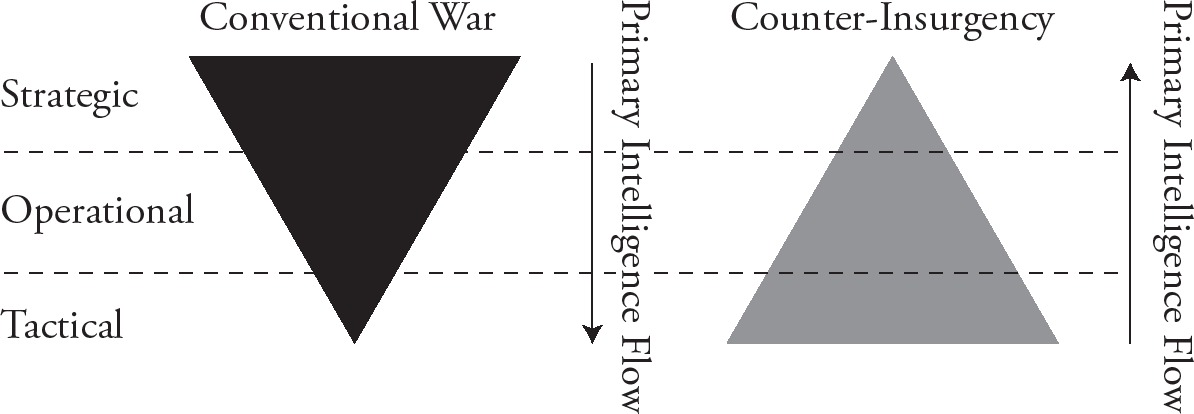
Figure 11: The infill of these pyramids is intelligence resources, human and technological, that are required in conventional war and counter-insurgency. There is a direct correlation between readjustment of resources and operational effectiveness. Counter-insurgency is not just a mindset of ‘armed politics’; it is just as much about the configuration of resources and processes to enable such a mindset to translate into operational effectiveness. This model is idealised to make a point about being top-heavy. In reality resources need to be configured in relation to the particular conflict and may resemble more of a column than a triangle, given the circumstances.
Colonel Gentile is right to challenge dogmatism in application of counter-insurgency doctrine. He takes issue with the maxim that ‘the people are the prize’ in all counter-insurgency operations. The ‘prize’ in any armed conflict is defined according to the goal of policy, which may, or may not, have to do with the political affiliations of the population.49 In my view, in Helmand, for British brigade commanders to have defined the people as the prize (which I think British soldiers started saying colloquially around 2007) was actually a legitimate slogan in that context; it was a useful way at the time of modifying an overly enemy-centric mentality. But Gentile is right that the slogan is not necessarily transferable. Gentile also acknowledges that counter-insurgency as a military method, rather than a strategy, can have utility in certain circumstances, although he specifically defines counter-insurgency in terms of its ‘population-centric’ version, which is a narrower method and a less flexible conception than what is actually available within counter-insurgency as a whole.50
Counter-insurgency theory is the distilled experience of how insurgencies have successfully been countered in the past. In practice, counter-insurgency is simply the countering of insurgency, an end-state which is meaningless outside of a specific political context. Insurgencies have been countered successfully by a diverse range of methods suited to a particular political context. In some cases this has involved large troop numbers, in other cases very few troops have been successful. The appropriate level of force used is subjective and variable. Field Marshal Sir Gerald Templer stated that counter-insurgency was ‘20 percent military and 80 percent political’, but that was said in reference to the specific political context of the Malayan Emergency. This ratio is all too often dogmatically restated in significantly different contexts.
A distortion to the current debate has been caused by those who see ‘population-centric’ and ‘enemy-centric’ forms of counter-insurgency as mutually exclusive. This is incorrect: each situation is distinct, and will require a particular application of means; to emphasise one approach over the other in the abstract rejects the notion that in many circumstances they can be combined, and that their relative configuration will be situationally dependent. To argue in the abstract about the value of any operational approach can be to get into debates with dead-ends. The Roman General Pompey, for example, ‘on hearing that his soldiers were disorderly in their journeys’ ordered his soldiers to put a wax seal on their scabbards during an operation in Sicily in 82 BC, and demanded an explanation for any broken seals.51 His emphasis on restraint to maintain the consent of the local population was common sense. Neither was Pompey averse to highly aggressive combat operations; he was, after all, known as the ‘teenage butcher’ as a young general. He could be said to have blended population-centric and enemy-centric methods!
The need to deal with the enemy threat is common sense in any population-focused approach. One can build medical clinics and schools, and conduct other developmental activity, but if the population cannot use them for fear of insurgent intimidation, they achieve little. Lieutenant Colonel John Paul Vann, in the context of Vietnam, expressed this pithily: ‘security may be 10 percent of the problem, or it may be 90 percent, but whichever it is, it’s the first 10 percent or the first 90 percent. Without security nothing else will last’.52 General Sir Frank Kitson anticipated the need to combine both in his conclusion to Low Intensity Operations (1971). Kitson stated that the operational emphasis of counter-insurgency operations:
will swing away from the process of destroying relatively large groups of armed insurgents towards the business of divorcing extremist elements from the population which they are trying to subvert. This means that persuasion will become more important in comparison with armed offensive action, although both will continue to be required, and both will equally depend on good information.53
Yet the killing or arrest of insurgents in combat, or aggressive targeting of insurgent commanders by special forces, is often reported as not being ‘hearts and minds’ nor ‘not counter-insurgency’.54 Such statements cannot be made in the abstract. The killing or arrest of insurgents who make a peasant’s life a misery may be very well received; conversely, they may be his children: one can only make such judgements in context with reference to one’s actual audiences. The post-1945 history of countering insurgency shows that the pragmatic selection and application of doctrine in relation to a specific, not an abstract, political context is what has distinguished successful campaigns. There is not space here for a full survey, but a few vignettes exemplify the utility of pragmatism in the construction of an operational approach to deal with an insurgency by tailoring it to the particular political problem, and thus dealing with it on its own terms.
‘Classical’ counter-insurgency, which is often associated with the British experience in Malaya 1948–60, was far more about population control than about popular support. ‘Hearts and minds’ in Malaya involved forcing 400,000 ethnic Chinese peasants into ‘strategic hamlets’ which were guarded with barbed wire and searchlights.55 Hearts and minds were meant to attack the insurgency as an idea through a combination of practices, which comprised both carrots and sticks. Basic rights were removed from whole communities unless they stopped supporting the insurgency. Many of these methods would be illegal today. Although Malaya is sometimes taken as an example which underscores the principles of being seen to act within the law, this was clearly a subjective concept. Alex Marshall has argued that the emphasis on action within the rule of law loses meaning when the counter-insurgent is also the colonial sovereign power which has legislative authority.56
The operational approach that worked in Malaya succeeded in a very specific political context. The British had over a century to build up a colonial state, even though interrupted by Japanese occupation during the Second World War. This was essential to the concept of having the military act with legitimacy in support of the civil power. Moreover, the British were aiming to leave. The entire premise of the campaign was the handover of authority to a Malay-dominated government, and not being seen as an occupying power. The communist insurgency in Malaya was strongly associated with the ethnic Chinese community. Hence separation of the insurgent from the population was in many cases the forced internment of the Chinese population which played on existing divisions within Malay society and essentially backed the majority group as the basis of a stable government.
In the early 1960s Sir Robert Thompson, one of the key counterinsurgency theorists in Malaya, was invited to aid the American effort in Vietnam. He lifted the idea of the strategic hamlets programme, which had worked in Malaya, and encouraged its use in Vietnam by President Diem’s regime. In the latter context, the relocation of thousands of peasants was a disaster. It infuriated the peasantry and further encouraged support for the Viet Cong. The programme was abandoned by 1964. The physical articulation of the disjuncture between operational idea and political context was what Neil Sheehan reported as ‘the ghosts of strategic hamlets’ that were visible on the roads in the provinces around Saigon; most of these hamlets remained only as statistics on charts.57 Moreover, given the fine line between government village militias and the insurgents in many areas, several thousand US weapons went to the Viet Cong; one estimate puts the number at about 200,000.58 Sheehan’s narrative suggests that an abstract template, which saw war as polarised between two sides, failed to comprehend the complex political dynamics of the conflict on its own terms.
The Dhofar campaign of the 1960s and 1970s in southern Oman illustrates how a style of counter-insurgency different from that developed in Malaya worked equally well because it was suited to a particular context. While Malaya emphasised the need to have large troop numbers to secure populated areas, the campaign in Dhofar deliberately kept a very low profile. Mass deployment of British troops was not used, as it would have caused more political problems than it solved.
The most effective methods, used by the Special Air Service (SAS), involved the development of local forces, called firqa, who were mentored and could operate in that political and cultural environment far more successfully than foreigners. A report by a British adviser following a year of service with the firqa states that: ‘the main reasons for joining and fighting for a firqat [sic] are financial and political in nature; political control of the individual’s tribal area, and gains in cash, food, land or livestock… The aim must be to select a force of men who have their own motivation for fighting—not necessarily in tune with the aims and motivations of the advisers’.59 This comment identifies how the political dynamics were understood on their own terms, and plans based on this; facts were not straitjacketed by idealised doctrinal models. Indeed the first firqa to be raised failed because it was recruited on a mixed tribal basis. The subsequent recruitment of firqa units on a single tribal basis encouraged the alignment of the tribesmen’s own interests with that of the wider campaign.
The Dhofar conflict exemplifies the importance of the strategic relationship between tactical activity and its political context. The campaign was not going particularly well before 1970: the communist forces based in Yemen were swelling, and the province of Dhofar remained politically very unstable. The main reason for support for the communist cause was that the government did nothing for its people. Elderly Sultan Said Bin Taimur was not liked by many of the tribes, whom he treated badly. When he was deposed in a coup in 1970 and replaced by his son Sultan Quaboos, many of the tribesmen who had fought against the government joined the new Sultan’s cause against what they saw as the godless communists. With very few exceptions, most of the firqa were ex-insurgents themselves, a key indicator of the importance of the change in political context.
This change of political context was a strategic opportunity, exploited by successful operational changes in the campaign after 1970: first, the introduction of the SAS to train indigenous forces; second, the abandoning of the practice of bombing all insurgents, and burning their homes and villages, with complete prohibition by 1972. Third, most crucially perhaps, there was no coherent doctrine of civil development pre-1970 (indeed Said bin Taimur routinely rejected the suggestions of his advisers to invest in civil development), whereas it was Sultan Qaboos’s main promise to all his people after 1970 and perhaps the strongest leverage to get people to reject the insurgents, who offered nothing so tangible60 (which by counterpoint exemplifies why official corruption is such a problem in Afghanistan, and to my mind is a significantly more relevant issue than the insurgency in terms of future state stability).
Another key lesson from Dhofar is that counter-insurgency does not require a large-scale overt presence of foreign troops. A small contingent of British troops, who fought as officers integrated into the Omani forces, as opposed to in discreet units, proved successful, while not ‘taking ownership of the problem’, the key concern with large-scale interventions.
Counter-insurgency post-1945 has also been practised by powers that are not liberal democracies; to ignore that experience is to be partial. Sometimes the methods used, even in recent conflict, have gone beyond what liberal powers would deem acceptable; but those powers, using a form of counter-insurgency, have achieved their aims nonetheless. Some insurgencies have simply been destroyed. For example, in terms of contemporary counter-insurgency, the Sri Lankan government and Russia both subdued two long-running insurgencies against the Tamil Tigers and Chechen separatists using methods which resemble conventional warfare in terms of means used. There are obvious criticisms that can be levelled against these approaches on moral grounds, namely the gross human rights violations involved in both cases. However, the idea that counter-insurgency is the application of fixed principles to any problem involving an insurgency without adaption to that specific political context is incorrect.
In summary, counter-insurgency doctrine allows the strategist to access a wide range of tools that have been successfully used in various historical circumstances. Those tools do not, however, have any intrinsic meaning outside a political context, past or present. Disregard of this caveat is at the core of the confusion about how to deal with contemporary conflicts on the ground. Confusion stems from the belief that operational approaches, and in particular counter-insurgency, are comprehensive solutions rather than tools.
Without wanting to get overly drawn here into technical doctrinal debate, Major Shaun Chandler and I have argued in the British Army Review that kinetic (violent) effects and non-kinetic (non-violent) effects, the current official terms of British military doctrine, do not exist as such.61 They are not categories of effects, but categories of means, which are inert tools; it is how they are used and interpreted that has an effect. No tool inherently possesses the ability to deliver an effect. Thus effects are simply that—effects, usually on people—they are neither ‘kinetic’ nor ‘non-kinetic’. However, the default idea that one should ‘balance’ violent and non-violent means in counter-insurgency is commonplace. Why, in the abstract, should one arbitrarily want to balance the use of two tools? The requirement to balance, if any, depends on the problem.
Kinetic means can be a powerful way positively to influence people (i.e. not by terrorising them, but the opposite, by attacking that which terrorises them). If a village is broadly supportive of the Afghan government, but is being intimidated by a particular group of alien insurgents, it matters not how many leaflets one gives them, or schools one builds; they will still be intimidated and will not subscribe to the Afghan government narrative. If the insurgents who intimidate them are killed or captured, change can come about. When Major Shaun Chandler was commanding a company of Gurkhas in 2010, in a remarkable episode, a group of locals actually came to one of his checkpoints to applaud after a contact in which an insurgent had been killed. This insurgent was part of a group that had been making the villagers’ lives a misery, not least by indiscriminately planting bombs in the village which had killed children (and badly wounded some of our soldiers too). Conversely, in many other circumstances, the use of violent force, even if proportionate and targeted, may be a bad option. To seek the intervention of a local powerbroker may be the best solution.
The deduction is that means, violent and non-violent, do not have an intrinsic ability to influence people in a given way. A mistaken belief that they do can lead to artificial compartmentalisation which frustrates their more imaginative use in any number of combinations in time and space. Moreover, to compartmentalise operations as either ‘kinetic’ or ‘non-kinetic’ is simply an inefficient use of resources (i.e. as soon as one decides to have a ‘kinetic effect’ on a target audience, non-kinetic tools are excluded, and vice versa).62
The effect is the essence; all activity should point to it. This might be summarised in a particularly pithy piece of tactical direction I came across in 2010: ‘Can I, should I, must I?’63 ‘Can I’ is a legal question about rules of engagement; ‘should I’ is about the effect—does the potential action support the purpose of the wider operation; ‘must I’ is a practical moral question which seeks especially to keep potential civilian casualties to a minimum. This last question may seem obvious, but in reality can be the most demanding, and most ambiguous, in that the people who typically are required to answer it are junior commanders in vicious contacts, who have to balance the need for ‘courageous restraint’ with responsibility for their own men.
The key in counter-insurgency is to match actions and words so as to influence target audiences to subscribe to a given narrative. The tension between ‘enemy-centric’ and ‘population-centric’ counter-insurgency introduces an artificial and unnecessary distinction. They are both categories of means, and should rather be used, potentially in combination, in a way that corresponds with the political context. In a fragmented political environment that requires flexibility, to mix and match means to suit particular localities. To insist that one method is, in the abstract, superior to the other would be to frustrate such pragmatic flexibility.
Pragmatism in the application of any operational approach helps to distinguish means from ends: while doctrinal principles are important to construct any operational approach, their attainment should not be goals in themselves. Strategy must not start by forcing the actual political problem presented by the conflict into preconceived categories, such as conventional war or counter-insurgency, and then apply in a literal manner the corresponding doctrine to the problem. The reverse sequence should be applied. Strategy should start by considering the political problem on its own terms and then pragmatically draw upon doctrine to create a tailored operational approach to that particular problem.
The application of counter-insurgency doctrine can be compared to that of a sales technique. One may be the best salesman, and apply the technique, but if the product is poor, one will still struggle to make the technique work. Strategy is about dialogue between the product and the relevant technique which adjusts both (or at least makes recommendations to adjust the product). A technique itself is an inanimate tool. To limit strategic discussion to criticism of operational methods can be like a bad workman blaming his tools, or even a good workman blaming his tools rather than considering whether his task is appropriate for the tools he has.
Clausewitz’s theme of pragmatism in operational thought, which associates method with political intention through the centre of gravity, draws together what makes sense in both Nagl’s and Gentile’s arguments. An operational approach must work on the ground and the army must win the wars it fights; but for that to happen, it needs to operate within a properly forged political context, and that is the role of strategy. The next chapter takes the Borneo Confrontation of 1962–6 as an extended case study of this theme.