
Chapter 9
After a mercifully uneventful voyage, the 24th Welsh arrived at Marseille at 9.00 am on 7 May. The battalion disembarked at 2.00 pm, and at 4.30 pm was assembled before marching to Mousso Camp. The young private from Laugharne, John James John, was now walking in the path his elder brother David had walked in 1916, when the 1st Australian Division moved to France from Egypt.

The harbour at Marseille.
The Germans launched offensive: against the British; on the Lys on 9 April, Operation Georgette. Big gains were made over the next weeks, including all the ground so painfully won during the Third Battle of Ypres. The first train containing men of the 74th Division left Marseille on the night of 7 May, bound for Noyelles-sur-Mer. An officer of the Fife and Forfarshire Yeomanry wrote of the journey:
‘The contrast from the East was indeed marked and delightful, and the long train journey passed quickly in our joy at seeing once more green fields and green trees, villages and farms, long fair hair and fair complexions. We could hardly have had more beautiful scenery than we had during the first day through the south of France. We kept to the branch lines, to the west of the main Rhône Valley Line, and wound in and out all day at the foot of steep hills crowned with old castles and picturesque villages, which looked so peaceful that it was hard to realise that there was a war on. The second day saw us skirting Paris by Juvisy, and gave us a good view of Versailles and the numerous airships at St Cyr. The last day our route lay chiefly through water meadows, and by 9.30 we had reached our detraining station, Noyelles, whence, after a hot breakfast, we marched ten miles to our destination, St Firmin, near the mouth of the Somme.’
While the first elements of the division were already under way, the 24th Welsh had a pleasant first day in Marseille after Stand To on the 9th. The men paraded before heading to the bath house at Mousso Camp, and made full use of them before entraining at 9.50pm that night. Noyelles was not reached by the Welsh until 11.50 am on 12 May and, after detraining, the men marched to billets in the village of Canchy, four miles north of Abbeville, by 6.50 pm. The 24th Welsh were now in a particularly beautiful part of France, near the mouth of the River Somme, where it flows into the English Channel, and by the famous battlefield of Crécy. Some of the officers had an enjoyable stroll in Abbeville, and one found it:
‘strange and uncanny to be in a large town again after being so long in a wild and sparsely inhabited country as Palestine. We spent the next day in visiting the best hotels and ordering the best procurable meals… The country looked very beautiful, with its fields and woodlands - such an absolute contrast to the terrible country we had just left and had spent so many dreary months in …’
On 13 May the battalion assembled for parade, before being inspected by the Commander in Chief, Sir Douglas Haig. The battalion remained in Canchy for several days, where the 74th Division assembled; and the men trained and were supplied with new uniforms and kit. Spence-Jones returned home on leave during this period, leaving the battalion under the command of Major J. B. H. Woodcock. An interesting note in Dudley Ward’s history of the 74th Division mentions that the division was put through bayonet drill, but he remarked that: ‘any one platoon of the 74th Division had probably made more use of the bayonet than any battalion in France’. Haig tended to look down at formations that had fought in other theatres: this was most notable with his judgment of units which had fought in Gallipoli.
During the morning of 23 May the 24th Welsh marched to the village of Gouy en Ternois, about twenty miles north-east of Abbeville. The men entrained there at 8.30 pm, reaching Ligny-Saint-Flochel at 2.30 the following morning, where the battalion detrained, before marching back to billets in Gouy en Ternois. On 25 May the battalion marched to Lattre-Saint-Quentin, eight miles west of Arras. It was billeted here, along with the rest of the division, and on 29 May was inspected by Major General Girdwood. During this period, the division, considered to be ‘green’, trained in tactical exercises of attack, defence and counter-attack. Some of the men were lucky enough to receive leave, a luxury after over two years away from home, while the battalion was reorganised; all the units in 231 Brigade were instructed that a full complement of men in a battalion would be no more than 900 other ranks. Each brigade was to lose one battalion, and on 21 June the Norfolks, the Royal Scots Fusiliers, and the 24th RWF left the division to join the 31st Division, which had held the German attack at Merville in April.
Spence-Jones returned from leave early in June, and the battalion continued on its hard training regime, along with the rest of the 74th Division, for the first three weeks of the month. By 23 June all men had returned from leave, and a draft of 101 other ranks had joined the battalion from Étaples. Two days later the battalion left its billets, and marched to Tinques, where it entrained at 11 am, before heading for Aire, which was reached by 3.30 pm. During the Battle of the Lys the Germans had penetrated the British line to a considerable depth, and although the offensive had petered out, the Allied line there was stretched. Before the German attack on the Chemins des Dames on 27 May, the 8th, 21st, 25th, and 50th British Divisions had been sent there, constituting IX Corps. During the afternoon of 25 June Spence-Jones led the battalion to billets in the village of Bourecq, about five miles south of Aire, in the St Hilaire sector.
On 26 June the whole of the 74th Division had moved to Norrent Fontes, where it was at four hours’ notice for the purpose of reinforcing either XI or XIII Corps, and at twentyfour hours’ notice for GHQ reserve. The men were put to work building rear defences for both Corps, and on 30 June came under orders of XI Corps.

A view across the peaceful fields that once marked the battlefield near St Floris, 11 August 2010.
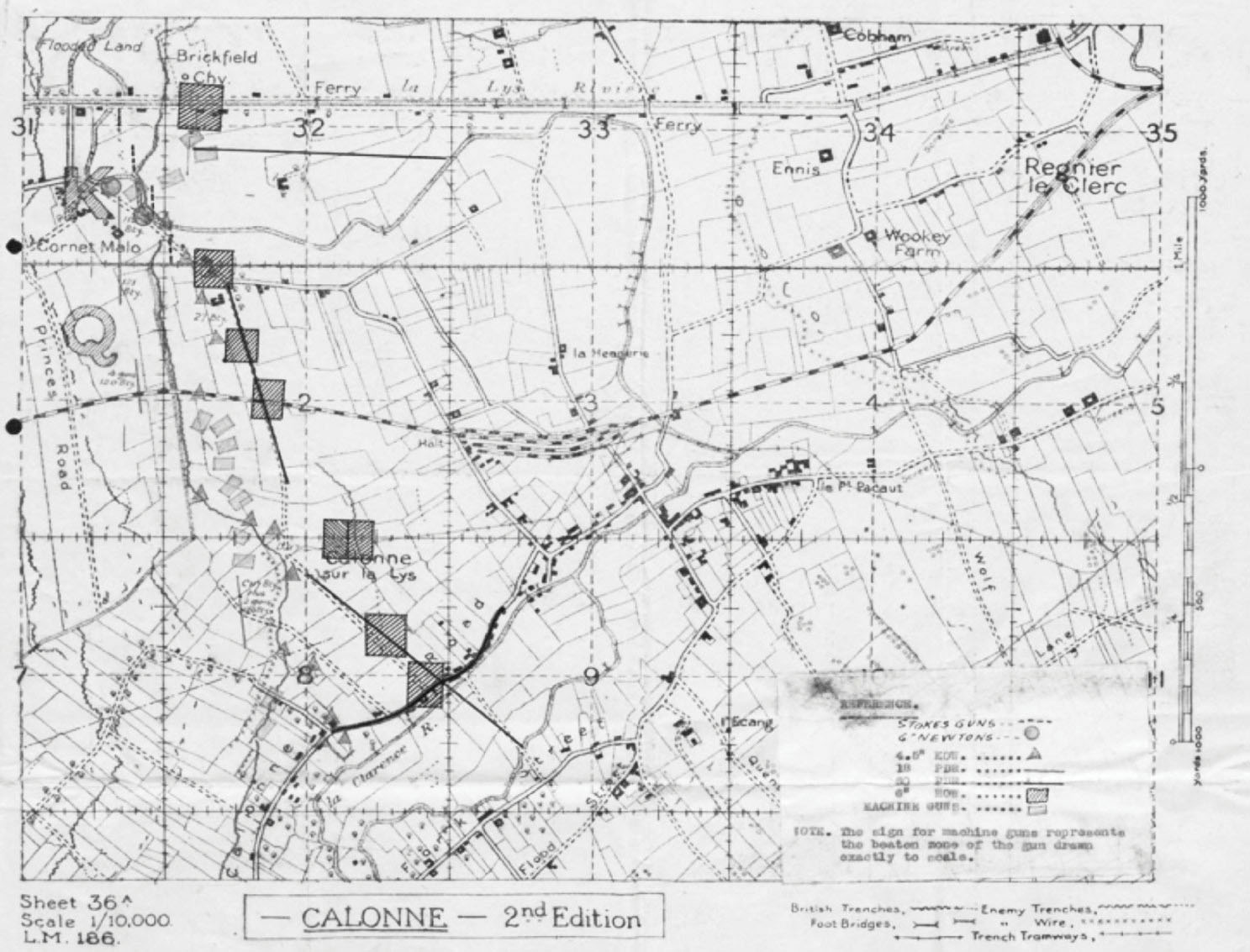
In the meantime, the 24th Welsh had been in billets at Chocques, before relieving the 36th Battalion, Canadian Infantry on 30 June. The 24th Welsh was ordered to prepare to rejoin the 74th Division at very short notice in case of emergency. The battalion remained at Chocques during the coming days, furnishing working parties, while Spence-Jones took out a party of his officers to reconnoitre the front line from Houchin – Lillers – Steenbecque. After further reconnaissance work on 8 July, on the 10th 231 Brigade received its orders to take over the line in the St Floris Sector, and moved up to relieve 183 Brigade of the 61st Division. The 24th Welsh, conforming to its part in the orders, marched from Chocques at 7.30 am, and relieved the 9th Northumberland Fusiliers, billeted in Hamet Billets, moving into Brigade Reserve. The battalion transport moved to billets in Berguette, while a party proceeded to Witternesse. The battalion remained here for the coming days, providing working parties; on the night of 14/15 July it suffered its first casualties in France when Private William John Biddle (320891), of Swansea, and Private William George Whitson (320982), of Ebbw Vale, were wounded. Whitson lived a full life for many years after the war, dying in Oxford in 1981.
On 14 July General Girdwood took command of the right sector of the Corps’ front. The line occupied by the 74th Division was between the La Bassée Canal and the River Lys, with the left resting on the small village of Corbie. The town of Merville, in enemy hands, was some 3,000 yards away. On 16 July the 24th Welsh relieved the 10th KSLI at St Floris, and began its first tour of front line duty in France. The front here was on marshy ground, and as a result did not conform to the usual idea of a strongly defended trench, but rather was a series of outposts, known by the men as Islands, situated along the front, built of walls of sandbags or whatever other material was to be found, which were used to build breastworks.
The battalion war diary of 19 July explained the method used to hold the front line: One company would hold the line, with two companies in support, and the fourth in reserve. On 22 July D Company relieved C Company in the front line, which in turn moved into battalion reserve. The division then began sending out patrols from each battalion’s sector, in order to maintain superiority over the enemy in No Man’s Land and also to gain intelligence. On one such raid on 23 July the 24th Welsh suffered its first men killed on the Western front, although the war diary fails to mention this, reporting that no enemy were encountered.
The men were Corporal John Rupert Mills (61653), of Swansea; and Private George Llewellyn Norbury (57588), of Shotton, Flintshire. Both men are buried in Merville Communal Cemetery Extension. Another man, Private John James Parkinson (58965) was badly wounded, dying later that day at 230 Field Ambulance.
Mills was the son of George Alfred and Elizabeth Mills, of 8 Military Road, Pennar. He was a baker before the war, and lived at Hafod, Swansea. Mills enlisted at Swansea on 25 January 1915 in the Army Service Corps, and served at home before being posted to the Middle East, where he served in Gallipoli and Egypt before being transferred into the 24th Welsh on 31 January 1918. He had a brief spell back at Swansea on leave in June 1918, and married Kitty Grealey, of 47 Vivian Street, Hafod, Swansea on 15 June 1918. He rejoined the 24th Welsh in France, and was twenty six years old when he was killed on 23 July 1918.
Norbury was the son of James and Lucy Norbury, of 58 Trilby Terrace, Shotton. He enlisted at Wrexham on 22 November 1917, and was posted to the 53rd (Young Soldiers’) Battalion, Welsh Regiment. On 21 June 1918 he was posted to the 24th Welsh from Étaples, and was just nineteen years old when he was killed.
Parkinson was the son of Richard and Sarah Alice Parkinson, of The Halfway House, Torrisholme, Morecambe. He worked as a hawker, selling pottery, before the war, and enlisted on 20 January 1916 into the King’s Own Loyal North Lancashire Regiment, before being transferred to the Welsh Regiment at Prees Heath on 20 April 1917. He joined the 24th Welsh in Egypt, and moved to France with the battalion. Parkinson was twenty eight years old, and is buried in Berguette Churchyard.
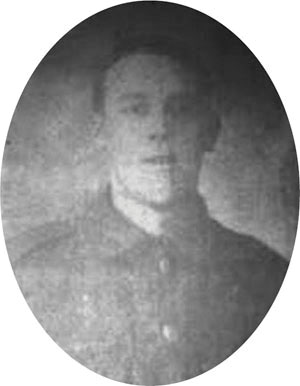
Private John James Parkinson (58965).
On 25 July the weather turned, and it began to rain hard. The defences held by the division soon got into a poor state, but the 24th Welsh had completed its first tour of duty, and on the 28th the battalion was relieved by the 25th RWF and marched back to billets in Hamet. During the first few days of August the battalion remained in Brigade Reserve, supplying working parties for various duties, and on 4 August the brigade moved into divisional reserve, where it remained until 16 August. During this period, on the 6th a draft of officers joined the 24th Welsh: Second Lieutenants W. Temple; A. Lidstone; A. S. Ouzman; G. E. Jackson; and W. T. Harries. On that same day the enemy was found to have begun a withdrawal, and Girdwood advanced the divisional line in the St Floris and Robecq sectors.

The grave of Private John James Parkinson (58965), at Berguette Churchyard.
On 16 August Spence-Jones moved the battalion from La Miquillerie to take over the right of the brigade front in the Robecq Sector from the 15th Battalion, Suffolk Regiment. A and D Companies took up the front line, with C in support and D in reserve. Captain and Adjutant J. F. A. Lewis left the battalion for a staff officer’s course.
The Germans continued to withdraw slowly and, as a result, on 18 August the two leading companies of the 24th Welsh advanced just over 500 yards, taking over a section of trench known as Wolf’s Track. During this advance, Second Lieutenant Charles William Trevor Trask was killed and eleven other ranks wounded. Trask was the son of Charles James and Evelyn E. M. Trask, of ‘Broadshard’, Norton-sub-Harndon, Somerset. He was just nineteen years old, and is buried in St Venant-Robecq Road British Cemetery, Robecq.
The stalemate on the Western front had been broken by this time. Marshal Foch, the Allied supreme commander, had issued the following order for the August offensive:
The British 4th Army and the French 1st Army will advance on the 8th, under the command of Field Marshal Sir D. Haig, the former north and the latter south of the Amiens - Roye Road. The offensive, covered by the Somme, will be pushed as far as possible towards Roye. The French IIIrd Army will attack the left flank of the Montdidier Salient on the 10th inst. The French Xth Army in the Oise Valley (on left bank) will continue to advance eastwards.
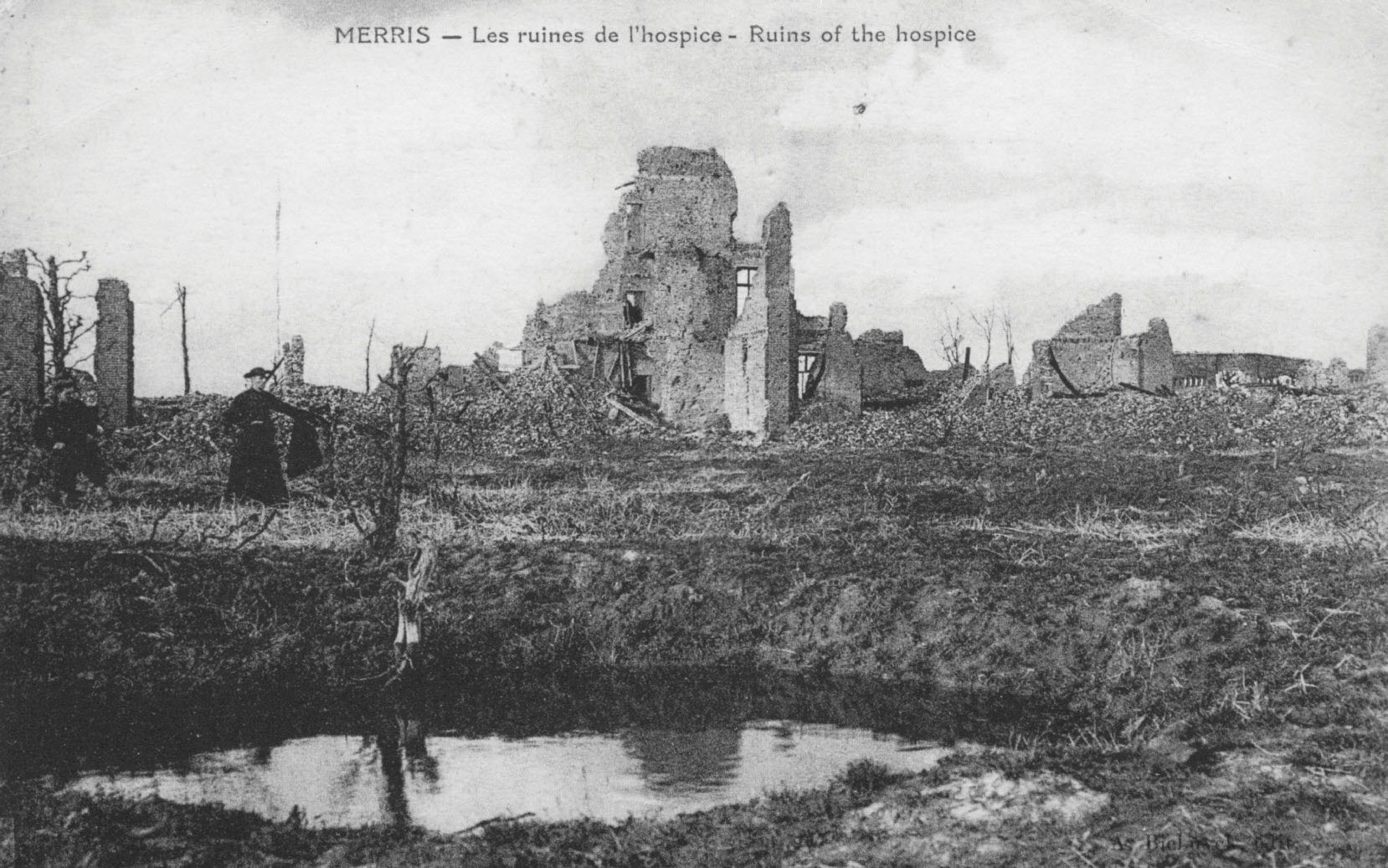
The ruins of the Hospice at Merris, after the German offensive.
On 8 August a combined British, Australian, Canadian and French offensive, centred on Villers-Bretonneux, had smashed open the German front, paving the way for a major advance by the Allies. Ludendorff, the German commander, called it ‘The Black Day of the German Army’. Realising that the situation was dire, Ludendorff ordered a slow retreat back towards the safety of the Hindenburg Line. The Germans were retreating in front of the 74th Division, and on the night of 18 August great fires could be seen in their lines as they began burning supplies which they could not take with them. On the following morning the 24th Welsh had a brush with the Germans while attempting to see what was happening, and Second Lieutenant G. E. Jackson and seven other ranks were wounded.
On the morning of 20 August, Spence-Jones issued orders for the 24th Welsh to advance towards Beaupré, conforming with the battalion on its left and right flanks. The objectives were reached, but at the cost of three men killed and seven wounded. The dead were Sergeant James Cecil Biddle (320692), of Leominster; Private John Edward Bullock (59956), of Bristol; and Private Frederick William Carlisle (57525), of Seedley, Lancashire. The battalion was relieved by the 10th KSLI on the following day, and moved by route march to Quentin, where it bivouacked. Nine other ranks were injured by gas shells during the withdrawal. On 22 August the battalion moved back into the line, relieving the 1st SLI. It held the line until being relieved by the 12th SLI on the night of 24/25 August, suffering one man killed on the 23rd, nine other ranks wounded, and four men gassed. The dead man was Private James Hall (61612), of Grangetown, Cardiff.

Company Quartermaster Sergeant Evan Charles Evans (320161), of Lampeter. Died of wounds on 25 August 1918
During the 24th the battalion moved to St Venant Asylum, in divisional support. One man was killed, and five other ranks wounded by shellfire. The dead man, Private Alfred James Juliffe (60255) was from Llwynypia, and is commemorated on the Loos Memorial.
One of the wounded was Company Quartermaster Sergeant Evan Charles Evans (320161), known affectionately as Charlie. He was taken to the 39th Stationary Hospital in Aire, where he died of his wounds the following day. He was born in 1888, the son of David Hugh and Mary Evans, of 34 Bridge Street, Lampeter, and was serving with the Pembroke Yeomanry at the outbreak of war. He was 30 years old, and is buried at Aire Communal Cemetery.
The day that Charlie died, the entire 74th Division was relieved by the 59th Division on 26 August, and received orders to move to the Somme. At 6.00 am on 28 August the 24th Welsh entrained at Aire, and at 3.30 am the following day arrived at Mericourt l’Abbé. The men marched to Treux, and were billeted in empty houses.
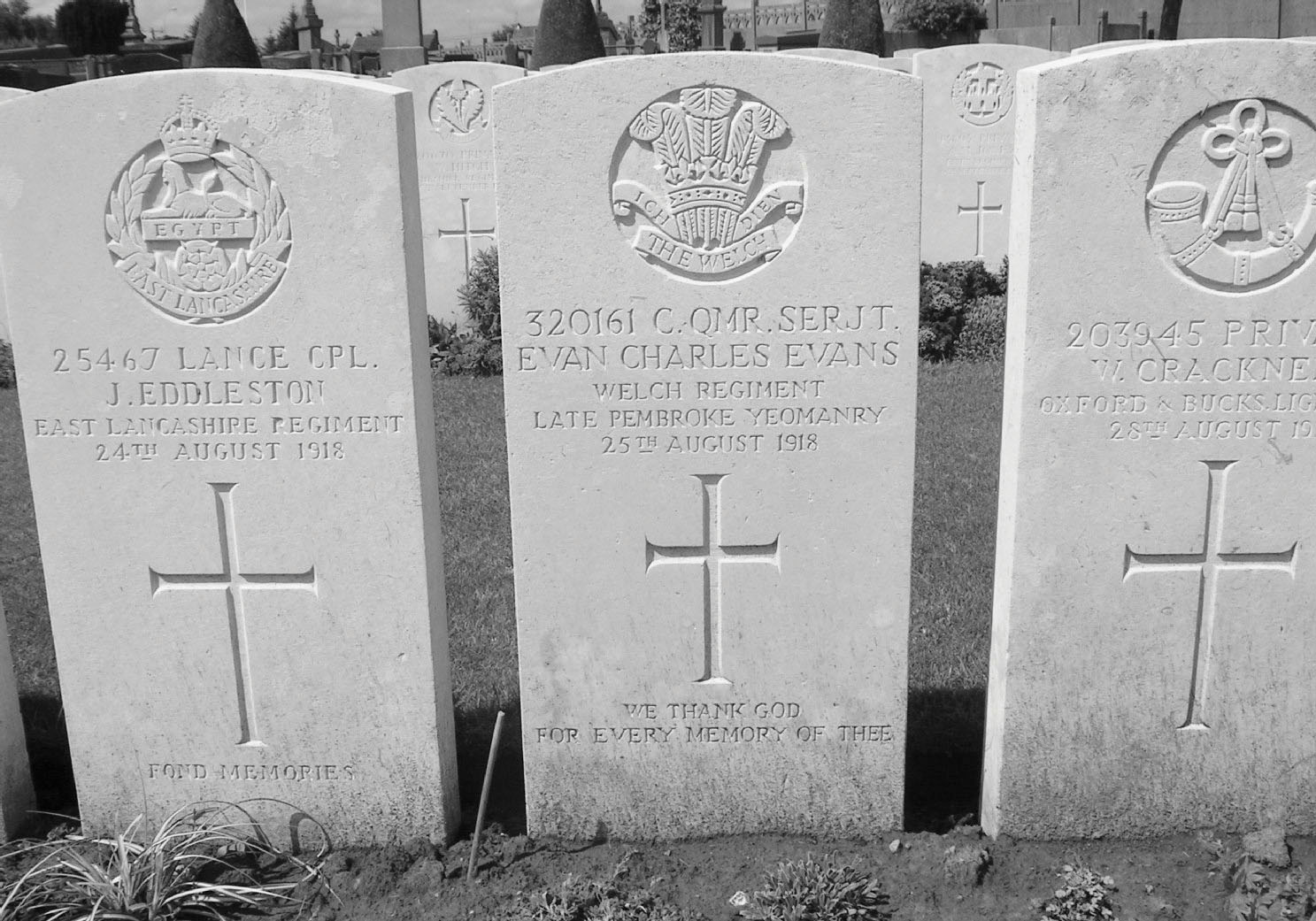
The grave of Company Quartermaster Sergeant Evan Charles Evans (320161), at Aire Communal Cemetery