
Chapter 8
By the time that the New Year came the 24th Welsh were still in reserve, and in torrential rain carried on with road making duties. One man from the battalion, Private Arthur H. Palmer, was comfortably in hospital, after being wounded during the Battle of Beersheba; he wrote to his father in Llanelli;
‘I’m in hospital with a slight wound in my left leg – a little beauty of a wound which hasn’t done any harm as it is in the fleshy part.
‘I suppose you have seen the news of the fights we’ve had in Palestine and of the success that has attended our efforts. I went through the first battle for Beersheba; the manner in which our lads drove the Turks back was positively great. Subsequent to our taking their trenches the Turks fought desperately with the view of regaining them, but the British Tommies were too good a match for them. I also went through the second battle, and just as I was thinking the job was over I got wounded. The second fight was infinitely better than the first as we had to fight a jolly sight harder, every inch of the ground being contested from start to finish.
‘When we had driven the enemy back about three miles, he resorted to a counterattack with a Division of fresh troops whom we fought a good time before retiring a little, after which we resumed the attack, but our energy was flagging when the cavalry dashed up to reinforce us, and my God, dad, we needed the reinforcement as we were only about a dozen and a half left fighting where the counter attack was made. You can imagine how we had to fight, but never mind, Dad, we did the trick, and it was mainly through our efforts that Gaza was taken on the left. Sad to relate though, as the result of these two battles nearly all our Battalion has been wiped out, and the other Regiments as well who participated in it have sustained some nasty knocks. It is consoling to think that the Turks suffered in casualties three or four times as much as we did without taking into account the prisoners we captured on the whole front. I know the prisoners numbered far more than the number reported. I am right by the hospital that Harry is in and I sent him a note this morning telling him I am here and asking him to come and see me.’
His brother, Sergeant Harry Palmer, was in the same battalion; however, by the time the letter was being penned, he was back with the 24th Welsh after a spell in hospital in Alexandria, quite unbeknown to Arthur.
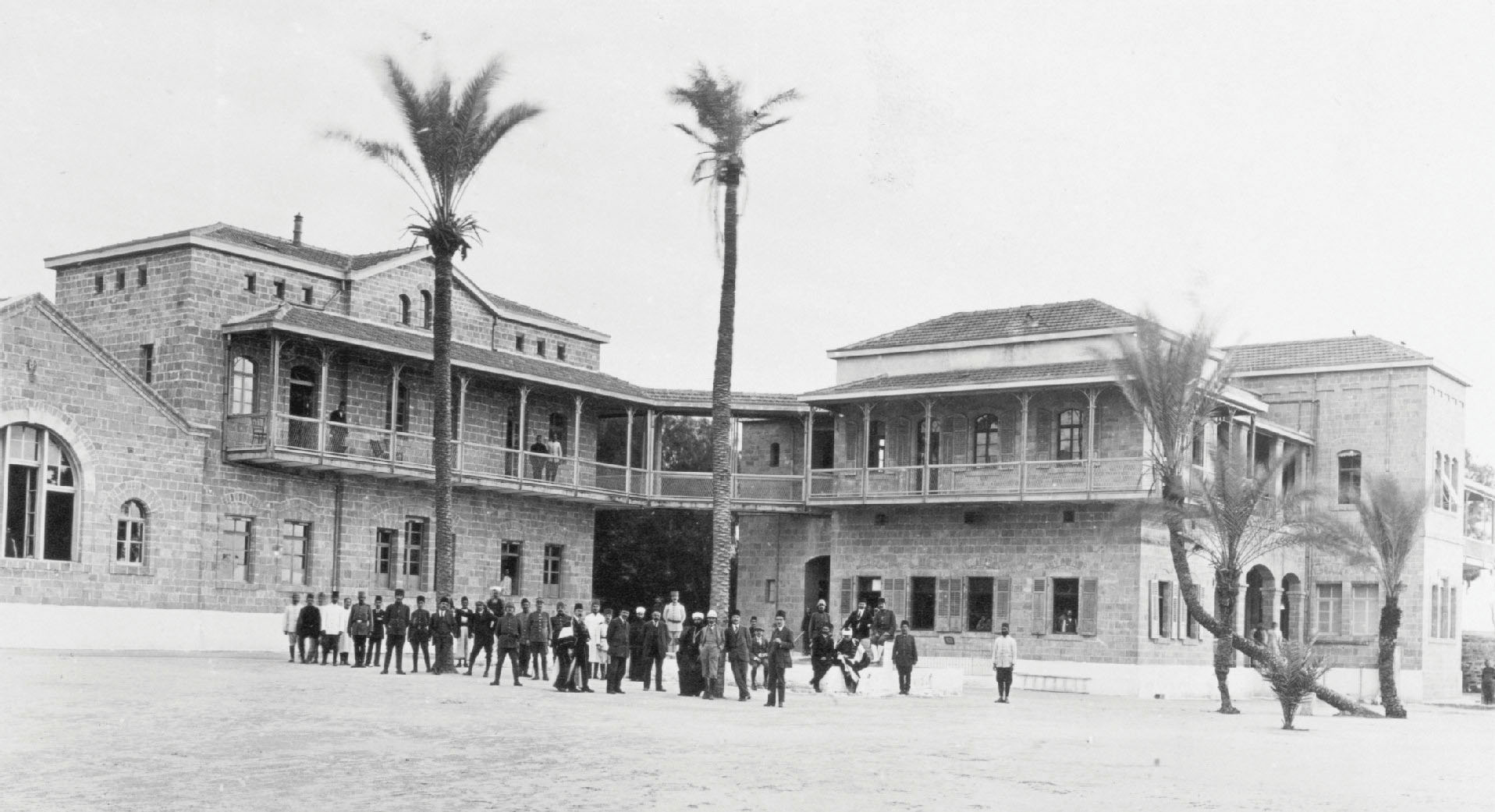
A British Hospital at Gaza.
Another Llanelli man, Quartermaster Sergeant Emlyn Williams, of the 4th Welsh, also wrote home to his parents at Llanelli:
‘I am now discharged from hospital and back with the regiment. I left Beersheba on a motor lorry on December 23rd, and had a most interesting ride, driving through Hebron, which is now a large town built in terraces and abounding in vineyards. I was charmed with Bethlehem which possesses large and beautiful buildings and good cultivation. On the site where Jesus was born is a tremendous church, on top of which is a marble statue of Christ.
‘Later, we passed King Solomon’s Wells and then reached the Holy City of Jerusalem (Jaffa Gate). I walked into Jerusalem and found several of our staff quartered in an empty room, and I joined them. Yesterday I spent a most profitable day in sight-seeing. Not two minutes’ walk is Golgotha, or Calvary. I paid a visit to the tomb of Joseph of Arimathea, where Christ was laid, and saw the stone that was rolled away. I afterwards saw the Mount of Olives and the Garden of Gethsemane. Inside the inner walls of Jerusalem no soldier is allowed without a permit, and must he accompanied by an officer. The quartermaster and I succeeded in getting inside in the afternoon and saw Old Jerusalem. We saw the sites where Christ was tried by Pilate, the prison He was in, and the five stations where He halted with the Cross. The Omar Mosque is about as fine a building as I have seen, all decorated with mosaic work.’
On 2 January 1918 the 24th Welsh moved into billets in the village of Beitunia, in an attempt to escape the miserably wet weather. Road making continued over the coming days, interspersed with various courses for officers at Heliopolis. While the men of the 74th Division were busy road building, Allenby was pressing on with further plans for an advance through the Jordan Valley; the road building that the 24th Welsh was employed in was a necessary part of the plans. A welcome break from this backbreaking work came with a torrential downpour on 13 January, making the ground too wet to continue. In the meantime, Spence-Jones had received verification of his recommendation of the Military Medal to Lance Corporal George Henry Redler (320563) for operations before Hill 1910. Redler was a native of Bristol, who had found work as a collier at Ynysybwl prior to the war, and was a member of the Glamorgan Yeomanry. He served with the Royal Engineers after the war, also being awarded the Territorial Force War Medal, and died in 1965, aged eighty.
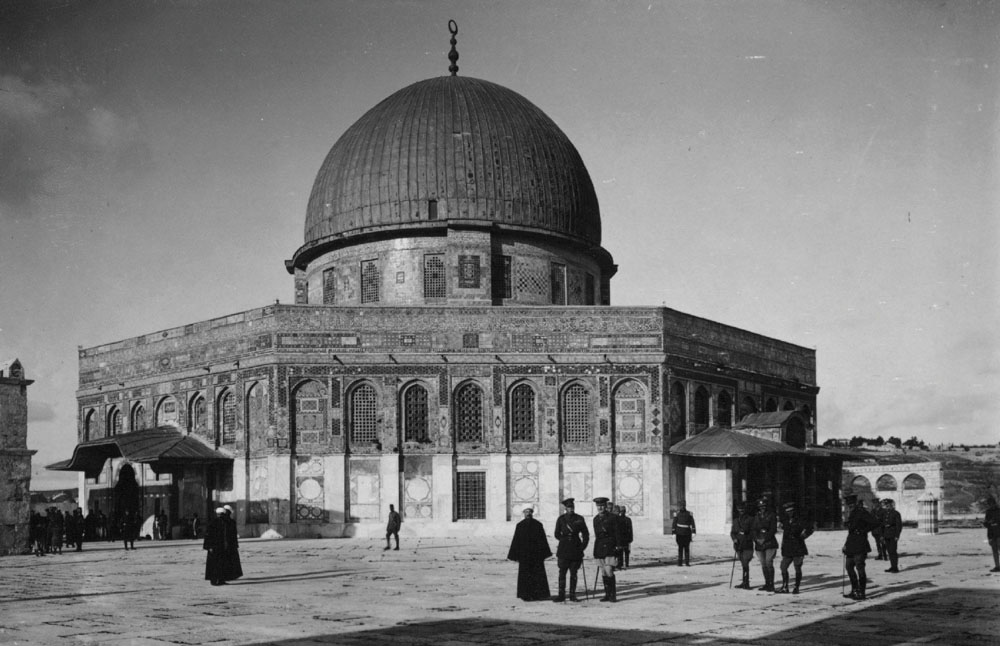
The Omar Mosque.
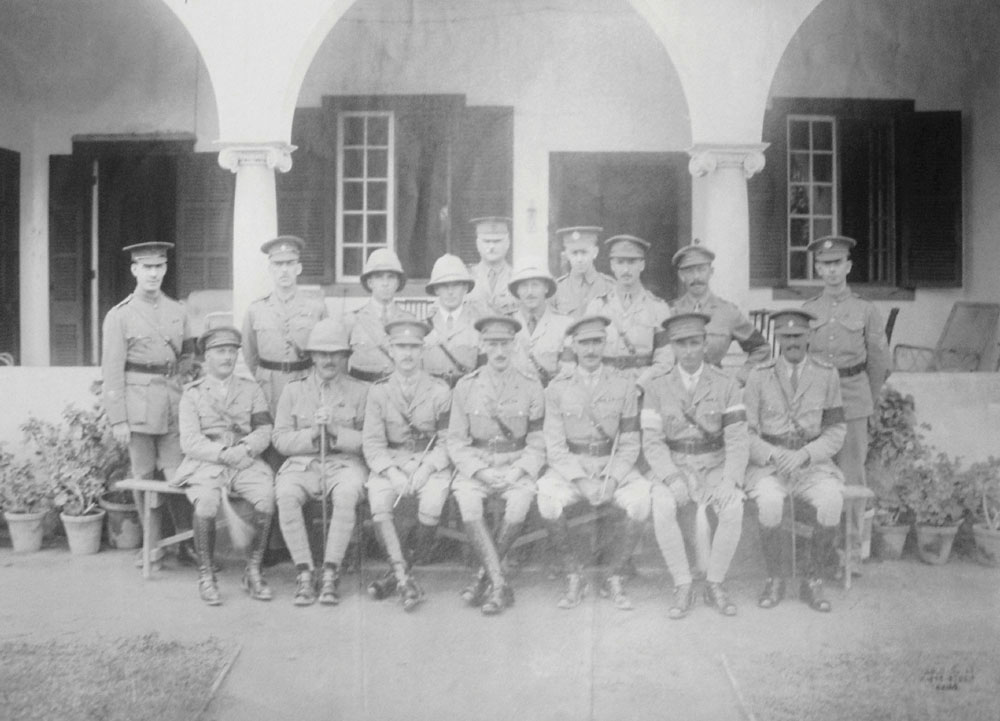
Heliopolis School of Instruction Staff 1917.
On 19 January a party of men of the battalion attended a parade where Sir Edmund Allenby presented decorations to several men from the EEF. One was the award of the Distinguished Conduct Medal to Sergeant Rhys Thomas (320160), the son of Evan and Margaret Thomas of 26 College Street, Lampeter, which was for operations before Hill 1910. The citation was printed in the London Gazette of 1 May 1918, and reads:
‘For conspicuous gallantry and devotion to duty. He was on several occasions instrumental in establishing his portion of the line when driven back by superior numbers of the enemy, who were counterattacking. During the third counterattack, after his company commander had become a casualty, he led the line most gallantly, reorganised the defence of two companies, and held his ground, personally accounting for seven of the enemy with the bayonet. His gallantry and disregard of danger proved a fine incentive to the men.’
The award was for his actions on the night of 26–27 December, during which Captain Yorke was killed. Thomas’s younger brother, David Roderick Thomas, was killed in Salonika on 27 February 1917. While Sergeant Thomas was receiving his DCM, the remainder of the battalion took up a line at Kh Er Ros, where it took part in a brigade outpost scheme. While the 74th Division was on manoeuvre, the 60th and 53rd Divisions pushed the line further to within half-a-mile of Am Yebrud, in readiness for future operations against Jericho. Conditions remained wet and miserable throughout January, with dozens of men taking ill. One of the members of the 24th Welsh succumbed to illness on 30 January, after suffering from the weather. Private Thomas Henry Jones (52907) was the son of Thomas and Selina Jones, of 7, Ordell Street, East Moors, Cardiff, and was forty years old. He is buried in Jerusalem War Cemetery.
On 31 January the 24th Welsh marched from Beitunia, and bivouacked for the night before marching onto Latrun the following day. Conditions were still poor, and supplies were scarce, as the railway had suffered from flood damage and camels could not be used on stony roads that were slippery when wet. The battalion stayed at Latrun for the next few days, spending the 5th disinfecting and washing their tattered uniforms. Eighty two men rejoined the battalion from hospital, and Second Lieutenant H. S. Pryce of the 5th Welsh transferred into the battalion. The weather remained stormy all the while, but on 8 February the battalion marched to Enab, where it bivouacked for the night, and on the following day marched to Jerusalem, encamping in Abraham’s Vineyard in heavy rain. The main Jerusalem to Bireh road was flooded, so on the 11th the men were ordered to begin work on building a parallel road, which ran from Jerusalem to Ramallah, work which continued over the coming days.
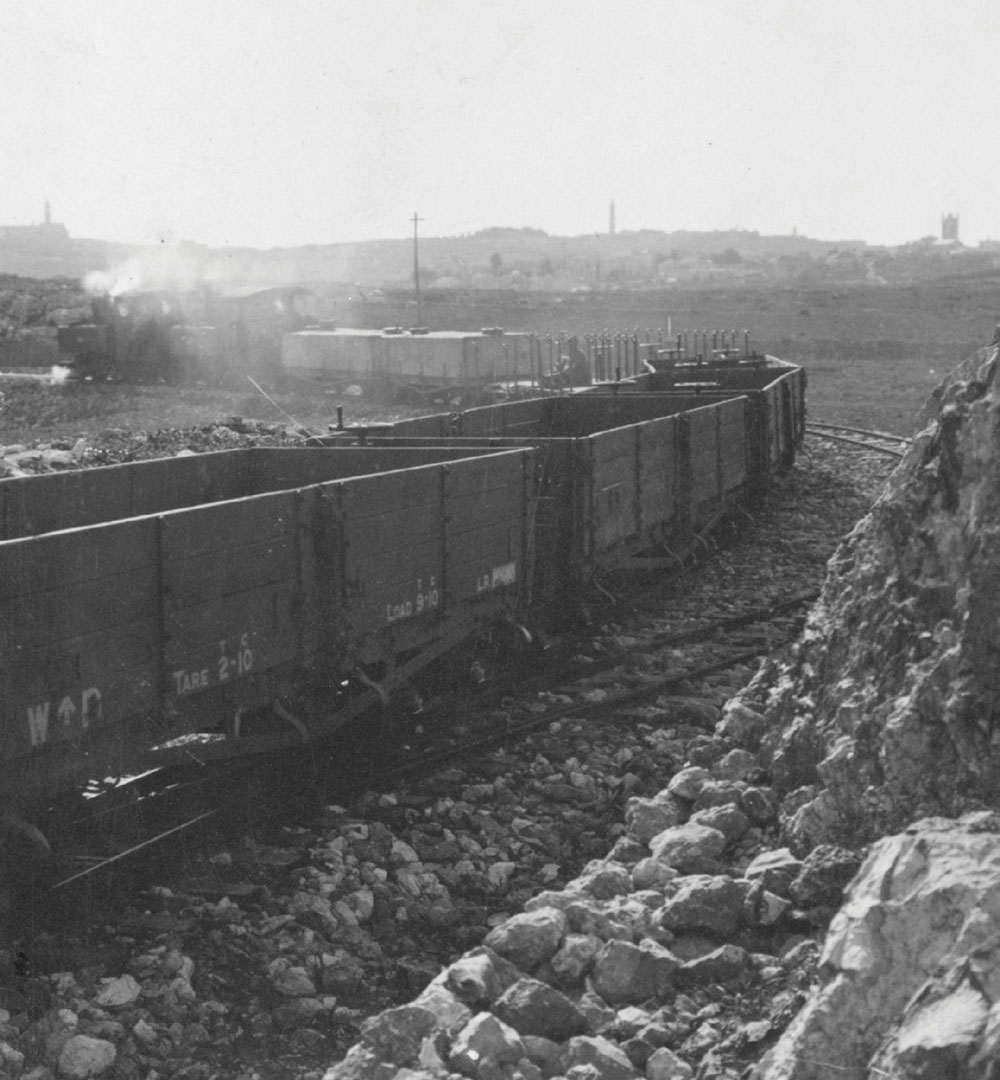
Empty trucks on a Palestinian Railway.
While preparations for the advance into the Jordan Valley were taking place, on the Western Front optimism was falling away. During the autumn of 1917 the Third Battle of Ypres had ground to a close after heavy casualties had been suffered by the Allies, and the Battle of Cambrai, which had began so promisingly, ended in an inconclusive result, with honours even. Russia had collapsed, freeing many German troops, who were moved to France, while the Italians had suffered a heavy defeat at the Isonzo in October/November. Throughout February 1918 it was beginning to become clear that the Germans were getting ready for an offensive on the Western Front, but noone as yet knew exactly where.
Other units of the EEF had continued their movement forwards. By the end of February the Turks were holding a line along the high ground on the north of the Wadi Aujah, and a bridge-head on the west bank of the Jordan, which covered the bridge at El Ghoraniyeh over which ran the road to Es Salt, which was in turn connected to Nablus and Amman by road and by railway. While the remainder of the 74th Division was in action, aiding the 60th Division in the push towards the Jordan Valley, the 24th Welsh spent the remainder of February continuing their work on the road to Ramallah, and also supplied a number of men to mount guard in Jerusalem. Major Ogilvie of the Fife and Forfar Yeomanry, who were also working on the road, wrote:
‘We had to make a new road to link up with the Ramallah Road at Tattenham Corner. It was a most picturesque Wadi, covered with olive trees and, what was more important, with any amount of stones suitable for road-making to hand. On the Latron - Beit Sira Road stones were scarce, and had to be man-handled in limbers, or in baskets often quite a distance, but here there were stones of decent size, and within a few yards of the road. It was a 16-foot road, bottomed with large stones, then two layers of smaller stones, and blinded with gravel. Everyone went at it like a schoolboy on a holiday, and we completed our road two days before scheduled time, on one occasion actually doing 11/4 yards of road per man.’
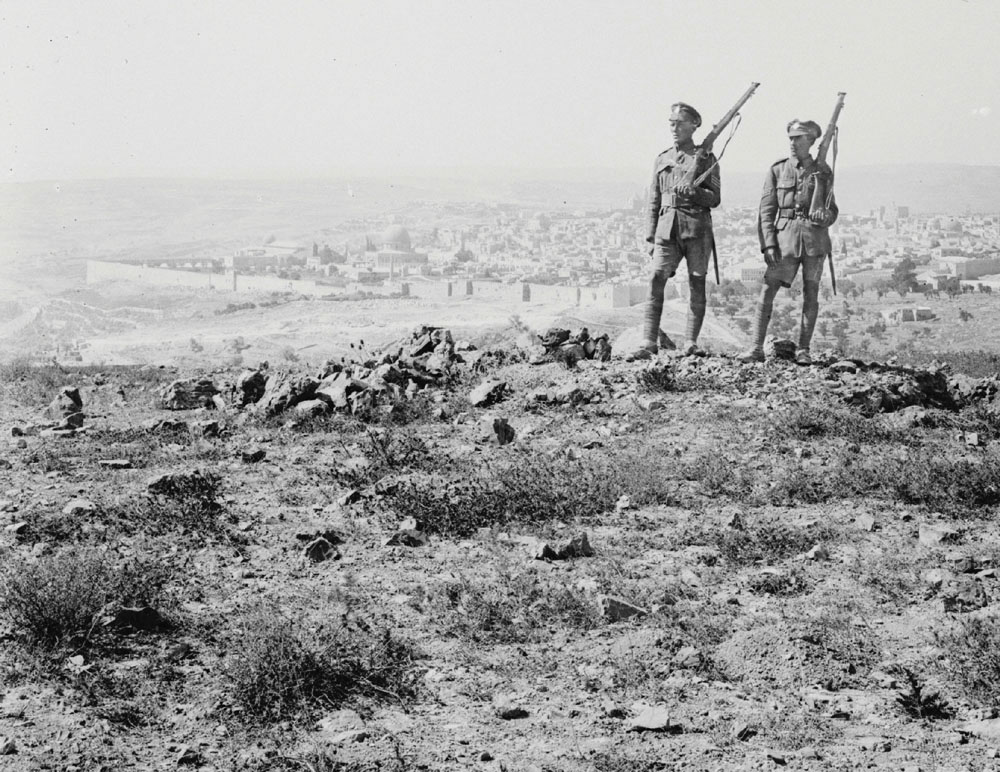
Standing guard over Jerusalem.
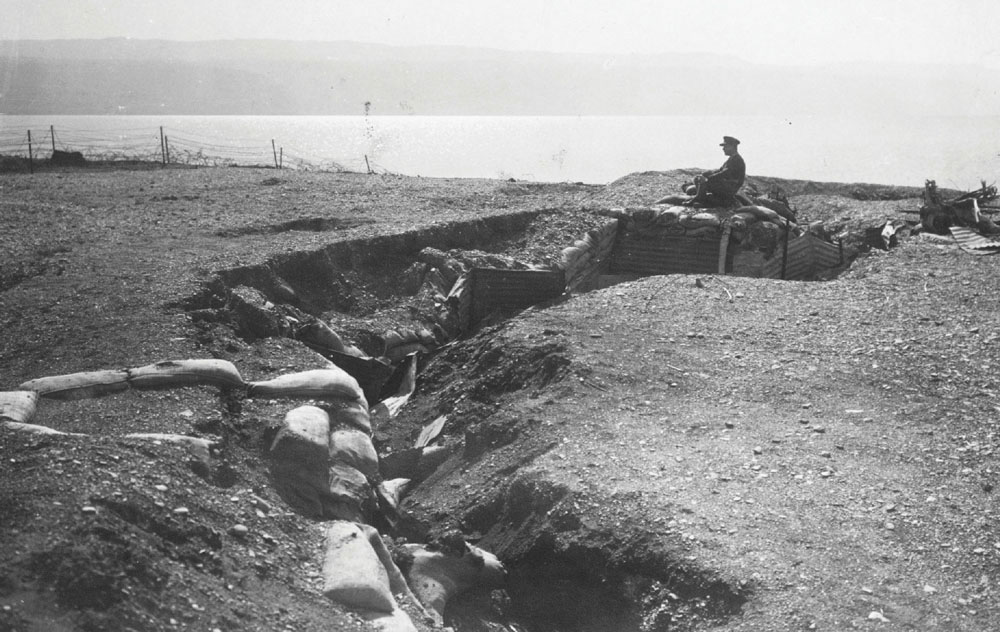
Trenches along the shore of the Dead Sea.
Between 19 and 21 February, Jericho was captured, after a move eastwards from a line running north-east of Jerusalem southwards to Beersheba by the 53rd (Welsh) Division, 60th (2nd London) Division, and the Anzac Mounted Division. The western coast of the Dead Sea was now within the grasp of the EEF, and the possibility of being able to use boats to carry supplies helped lessen the burden on the stretched EEF, which was still struggling due to the poor conditions of the roads. The next stage of Allenby’s plan was for XX Corps to advance on a twenty six mile front, from west of the River Jordan to seven miles west of the Jerusalem to Nablus Road, and the right flank of XXI Corps was to advance in touch with the former. The main part of the advance was carried out by 60th Division, which secured the high ground north of the Wadi Aujah, which commanded the Jordan Valley; the 1st Australian Light Horse Brigade supported their attack, while the 53rd Division held a right angled front, with the 74th Division, now astride the Nablus Road, tasked with the capture of Sinjil.
On the night of 1 March the men of the 24th Welsh laid down their picks and shovels, and marched towards Ain Yebrud, where they had been tasked with capturing the Turkish positions holding the village and Hill M11. On 3 March B and D Companys launched the attack on the Turks, with C Company in reserve, the 24th RWF on the right, and 160 Brigade on the left flank. The positions were captured with little opposition, but Private John Henry Davies (320802), the son of Thomas and Charlotte Davies, of Briton Ferry, was killed. He is buried in Jerusalem War Cemetery. The battalion also lost a Lewis gun, presumably manned by Davies, to the Turks before they withdrew, and the Welsh consolidated their positions gained.
With future undertakings planned against the Hedjaz Railway and the Turks east of the Jordan, Sir Edmund Allenby planned to deprive the enemy of the use of important roads leading into the lower Jordan Valley. As he later wrote in his despatches:
‘It was essential, in the first place, to cross the Wadi Aujah and secure the high ground on the north bank covering the approaches to the Jordan Valley by the Beisan - Jericho Road (this road runs straight down the Jordan Valley, from where the railway from Haifa crosses the Jordan), and secondly, by advancing sufficiently far northwards on either side of the Jerusalem-Nablus Road, to deny to the enemy the use of all tracks and roads leading to the lower Jordan Valley. This accomplished, any troops we might determine to transfer from the west to the east bank of the Jordan would have to make a considerable detour to the north. I therefore ordered the XXth Corps to secure Kh el Beiyudat and Abu Tellul, in the Jordan Valley, north of the Wadi Aujah, and farther to the west the line Kefr Malik- Kh Abu Felah, the high ground south of Sinjil, and the ridge north of the Wadi el Jib, running through Kh Aliuta-Jiljilia thence to Deir es Sudan and Nebi Saleh.’
The 24th Welsh were, unknown to them, about to take part in their final operation in Palestine. On 5 March a reconnaissance aircraft belonging to the Royal Flying Corps reported that the Turks had retired from the line Attara – Sudan – Arura – Abwein – Sinjil– Mezrah – esh Sherkiyeb. Spence-Jones sent an officers patrol from B Company out to check the Turkish lines and which found them deserted. He sent a patrol from C Company to check a hill at N 6 d, and ordered the officers that if that position was not held, to push on to Yebrud and Selwad. The enemy was, however, found to be holding positions at the hill, north of Yebrud, and they opened fire on the patrol, which luckily escaped without harm. The only casualties suffered were several men with twisted and sprained ankles, due to the precipitous nature of the ground they were moving across.
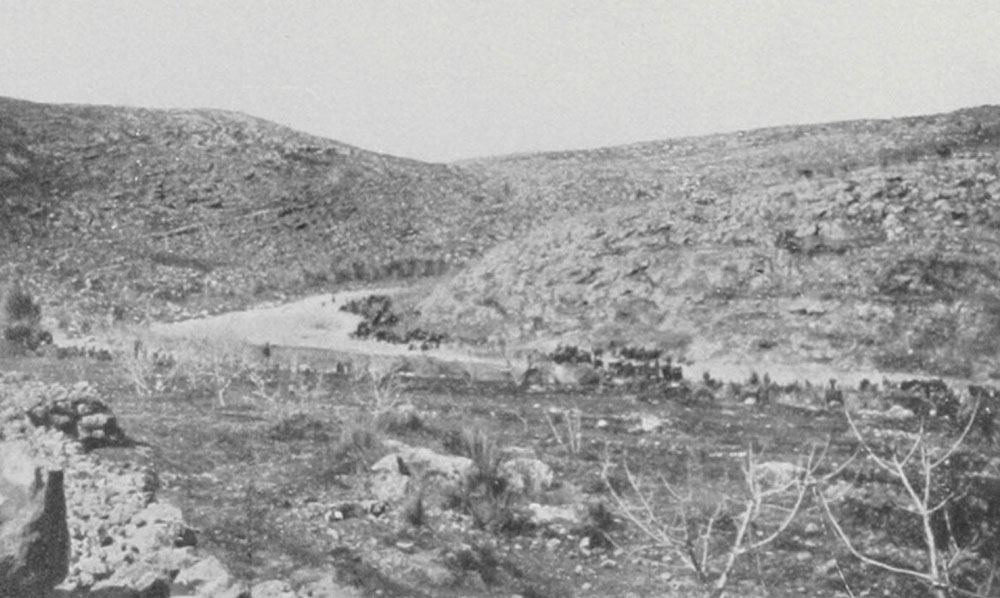
A desolate road north of Jerusalem.
On the night of 6 March, the 24th Welsh marched forward to take the hill, now named Raspberry Hill, but found that the Turks had again withdrawn. Kh Kefrana was also occupied by the 24th Welsh during the early hours of 7 March, again with no opposition, the men finding the bodies of two dead Turks to be the sole occupiers. Later that day the Turks attacked Raspberry Hill, but after over two hours of fighting gave up, and retired, with no casualties suffered by the 24th Welsh, apart from one man who was hit through the shoulder by a spent bullet.
Private Ernest Idris Cumpstone (320756) was born on 7 March 1898, the son of Ernest Edward and Elizabeth Cumpstone (née Ballard), of Llantrisant. He worked as a collier before enlisting into the Glamorgan Yeomanry on 18 September 1914. The young soldier was celebrating his twentieth birthday, having survived over three years of war, and would in later life write his memoirs of the war:
‘The light began to fade and then it came just as I began to feel safe, the bullet entered my shoulder and I sank to my knees. There was a cry for a stretcher – I felt faint but held on and was quickly whisked to safety under a rock. During the darkness most of my pals were able to come to see me and give me the water they had had issued to them. My breathing by now was particularly bad, I was coughing blood, and I was aware that there was no exit to the bullet. With all the water gone I now had to await being picked up by the R.A.M.C. from the advanced field dressing station. Toward midnight I could see a light approaching my shelter and to this day I cannot understand why these three R.A.M.C. men carried this lamp. If the Turks could not see the reflection from that lamp then why did the whizbangs keep following us? I was put on to a stretcher in a sitting up position in order to breathe and spit blood. This meant being left totally exposed when the lads, on hearing a shell coming, dived into shelter.
It was a nightmare of a journey which took hours, winding in and out of those hills. It was daybreak when we arrived at the Dressing Station and I was immediately given the anti-tetanus injection and then continued my journey by mule-cart into Jerusalem.’
The bullet was found to have lodged near his heart, and Cumpstone endured several weeks in hospital in Alexandria before being evacuated to England aboard the Hospital Ship SS Dunluce Castle. The bullet was never removed, but it did not prove to be fatal, as Cumpstone had a full life, living until 1994!
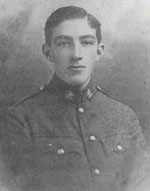
The diarist, Private Ernest Idris Cumpstone, 24th Welsh.
The battalion began consolidation of its newly gained positions. At 6.30 pm on 8 March, Spence-Jones received orders from the commander of the 74th Division, Major General Girdwood, relating to an attack on 9 March. In his orders General Girdwood expressed the hope of the Higher Command that the advance would be so rapid that: ‘the enemy will be driven off the line Turmus-Aya-Sinjil-Jiljilia before he has time to recover from the first blow, and it is hoped that this may also result in the capture of the enemy’s artillery grouped round Selwad and Attara. The operation will therefore be completed in two days.’
According to Dudley Ward, the 53rd Division, on the right of the 74th, had been given the objective of Kh Abu Felah to Mezrah to esh Sherkiyeh. The 10th Division, on the left, attacked in two groups: the right on the objective Attara to Hill 2791, and the left away to Nebi Saleh. The 74th Division, in the centre, would get firmly astride the Nablus Road, with 231 Brigade on the right, driving for positions on the line Mezrah-esh Sherkiyeb-Sheikh Saleh-Burj el Lisaneh, and 230 Brigade would attack a hill 1,000 yards south of Aliuta. At midnight on 8 March the 24th Welsh moved up to support the 10th KSLI, which was tasked with the capture of Selwad. With that position gained, the KSLI would then attack Burj el Lisaneh, while the 25th RWF were to attack Sheikh Saleh and Mezrah. Early in the morning of 9 March the attack was launched. The 25th RWF came under enfilade fire from two hills, and two companies of the 24th Welsh were detailed to clear the enemy from them. In the fighting which followed, Selwad was captured, but the 24th Welsh suffered its last casualties in Palestine. Captain David Lloyd Popkin Morgan MC, and three other ranks were killed, and a dozen men of the battalion were wounded.
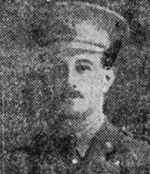
Captain David Lloyd Popkin Morgan, MC.
David Lloyd Popkin Morgan was the son of David Henry and Jane Sybil Morgan, of 98 Bryn Road, Swansea. He had been a keen sportsman prior to the war, and was well known in sailing circles in Mumbles. He was working in Peru as a metallurgist before the war, but returned to Wales to enlist into the Pembroke Yeomanry. He was awarded his Military Cross for the period leading up to the capture of Jerusalem. The citation was published in the London Gazette of 2 July 1918, and reads:
‘For conspicuous gallantry and devotion to duty. When a gap occurred in the line after the capture of an enemy position he made repeated journeys over a fire-swept zone carrying information and keeping in close touch with the situation. By his initiative and coolness he was largely responsible for driving back an enemy counter-attack.’
He is buried in Jerusalem War Cemetery, alongside the three other men killed during the attack: Sergeant William Evans (320117) of Llandeilo; Private John Henry Meade (59987) of White Luckington, Somerset; and Private David Gwilym (52896) of Llanelli, who died the following day. Private Gwilym was the last casualty suffered by the 24th Welsh in Palestine, although a former officer of the Glamorgan Yeomanry, Major Richard Gerald Mansell Prichard, who was attached to the 38th King George’s Own Central India Horse, was killed later in the campaign, on 7 June 1918, and is buried in Jerusalem War Cemetery. Prichard had fought with the Imperial Yeomanry during the Boer War, where he was mentioned in despatches, and had worked as a mines inspector in the years leading up to 1914, before volunteering for service overseas with the Yeomanry.
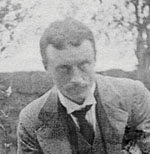
Major Richard Gerald Mansell Prichard, a former officer of the Glamorgan Yeomanry. Died of wounds suffered while serving with the 38th King George’s Own Central India Horse, at Jerusalem on 7 June 1918.
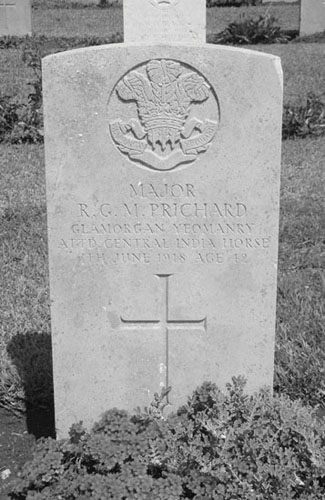
The grave of Major Richard Gerald Mansell Pritchard, at Jerusalem War Cemetery.
On 10 March Spence-Jones led the battalion to Selwad, ordering B and D Companies to support the 25th RWF. Supply of rations and water was a real problem during the day, owing to the terrain, and nothing reached the men until almost midnight. After some food and water, the remainder of the battalion moved after midnight to positions at Mezrah esh Sherkiyeh, arriving just after dawn, to support the 10th KSLI and 25th RWF, before advancing through a wadi towards Sh Selim on the 11th. Patrols were then sent out to attempt to gain contact with the enemy, and returned safely after having come under fire. While the ground being crossed by the 74th Division was treacherous, the 53rd Division were even worse off, being in many places so steep that men had to help each other over ledges and up slopes, due to the precipitous nature of the ground. After further advance by the 74th Division during 11 and 12 March, on the 14th it relieved the 53rd Division, which moved back by stages to Lydda. Two days later, the Westminster Dragoons came under the command of General Girdwood, and joined the 74th Division in its move forward to Kh. el Nejmeh, where the division remained until the first week in April, carrying out several small raids against the Turks.
The 24th Welsh had spent the last two weeks of March back at work building roads, and by 31 March had moved to Ain Siwia, where the men began disinfecting once more. From 1 to 4 April the battalion returned to construction work, on the Jerusalem to Nablus Road, work which finished at mid-day on the 4th. In the meantime, on 3 April General Girdwood received orders to prepare the 74th Division for a move to France.
On 21 March 1918 the Germans launched a huge last ditch offensive against the British line stretching from the south of Cambrai down to St Quentin. This was known as the Kaiserschlacht, or Kaiser’s Battle, and was an attempt to split the allies on the Western Front and at least capture the vital allied railhead at Amiens, forcing the Allies into surrender before the might of the American army could make its presence felt. There were four separate German attacks, codenamed Michael, Georgette, Gneisenau, and Blücher-Yorck.
The Germans launched their initial offensive against the British Fifth Army and the right wing of the British Third Army. The artillery bombardment began at 04.40hrs on 21 March 1918, hitting targets over an area of 150 square miles. This was to be the heaviest barrage of the entire war, with over 1,100,000 shells fired in just five hours.
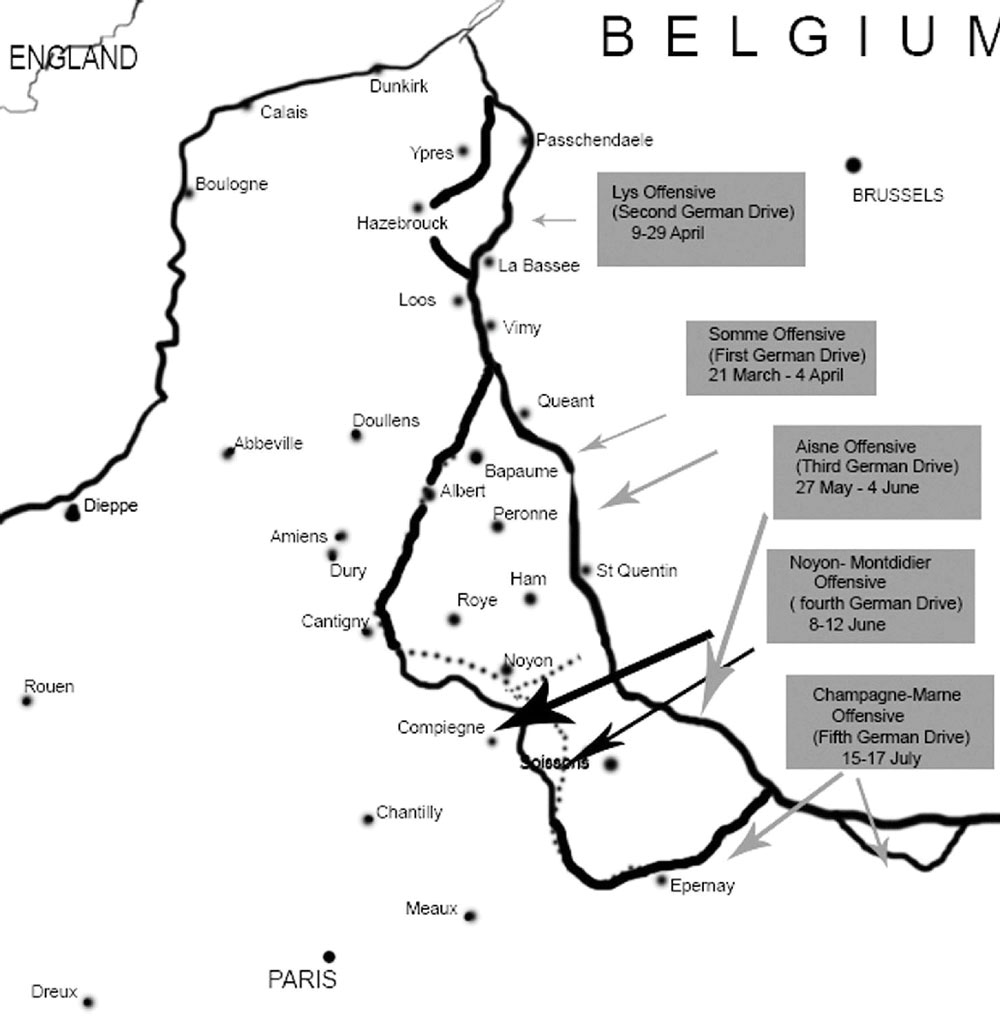
A map showing the German Offensives in 1918.
The German armies involved were the Seventeenth Army under Otto von Bülow, the Second Army under Georg von der Marwitz and the Eighteenth Army under Oskar von Hutier, with a corps from the Seventh Army supporting Hutier’s attack. Although the British had learned the approximate time and location of the offensive, the weight of the attack and the preliminary bombardment was an unpleasant surprise. The Germans were also fortunate in that the morning of the attack was foggy, allowing the elite storm-troopers leading the attack to by-pass the various British redoubts, hardly scathed.
By the end of the first day, the Germans had broken through at several points on the front of the British Fifth Army, and after two days it was in full retreat. As it fell back, many of the redoubts were left to be surrounded and overwhelmed by the following German infantry. The right wing of Third Army also retreated, to avoid being outflanked. The German breakthrough occurred just to the north of the boundary between the French and British armies, but after three days, the German advance began to falter as the infantry became exhausted and it became increasingly difficult to move artillery and supplies forward to support them. Tales of near starving German troops gorging themselves on freshly captured British supplies and French wine became widespread.
Fresh British and Australian units were moved to the vital rail centre of Amiens and the defence began to stiffen. After fruitless attempts to capture Amiens, Ludendorff called off Operation Michael on 5 April 1918. The Allies lost nearly 255,000 men (British, British Empire, French and American). They also lost 1,300 artillery pieces and 200 tanks. All of this could be replaced, either from British factories or from American manpower. German troop losses were 239,000 men, largely the specialist storm-troopers, who were irreplaceable. As a result of this, several units that were in Palestine with the EEF were withdrawn in order to move to France, and bolster the British forces there.
On 5 April Spence-Jones received orders to move, and 231 Brigade concentrated in K29, where it was inspected the following day. On 7 April the battalion began moving to Lydda with the rest of the division, and marched from its camp, reaching a place known as Turks Grave, near Balua Lake, where the men bivouacked for the night. Over the coming days the battalion marched onwards to Lydda, bivouacking each night. Sir Edmund Allenby rode past the column on the morning of the 8th, having left Jerusalem, where he had been invested as a Knight of the Order of St John of Jerusalem in the courtyard of the Tower of David by HRH the Duke of Connaught on 19 March.
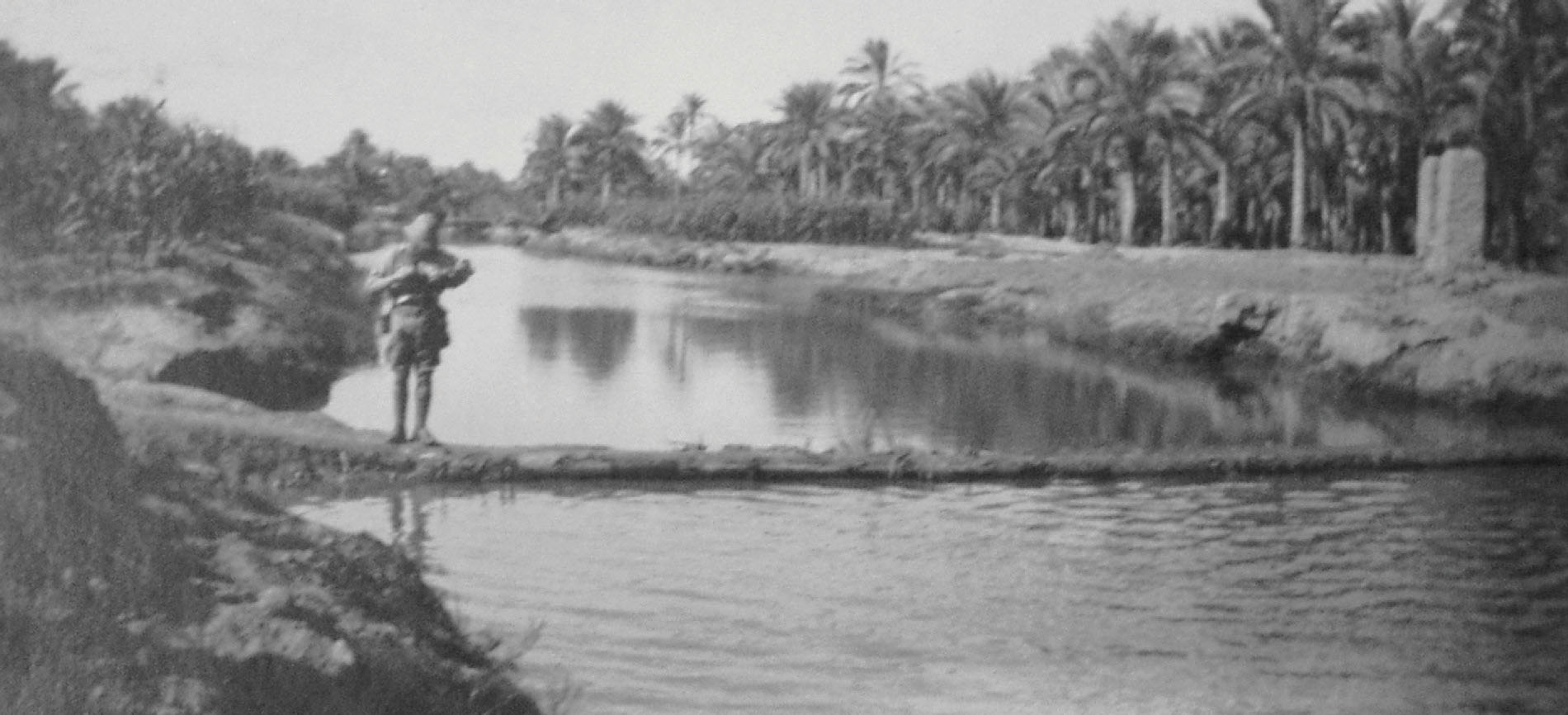
A view of a river near Balua Lake.
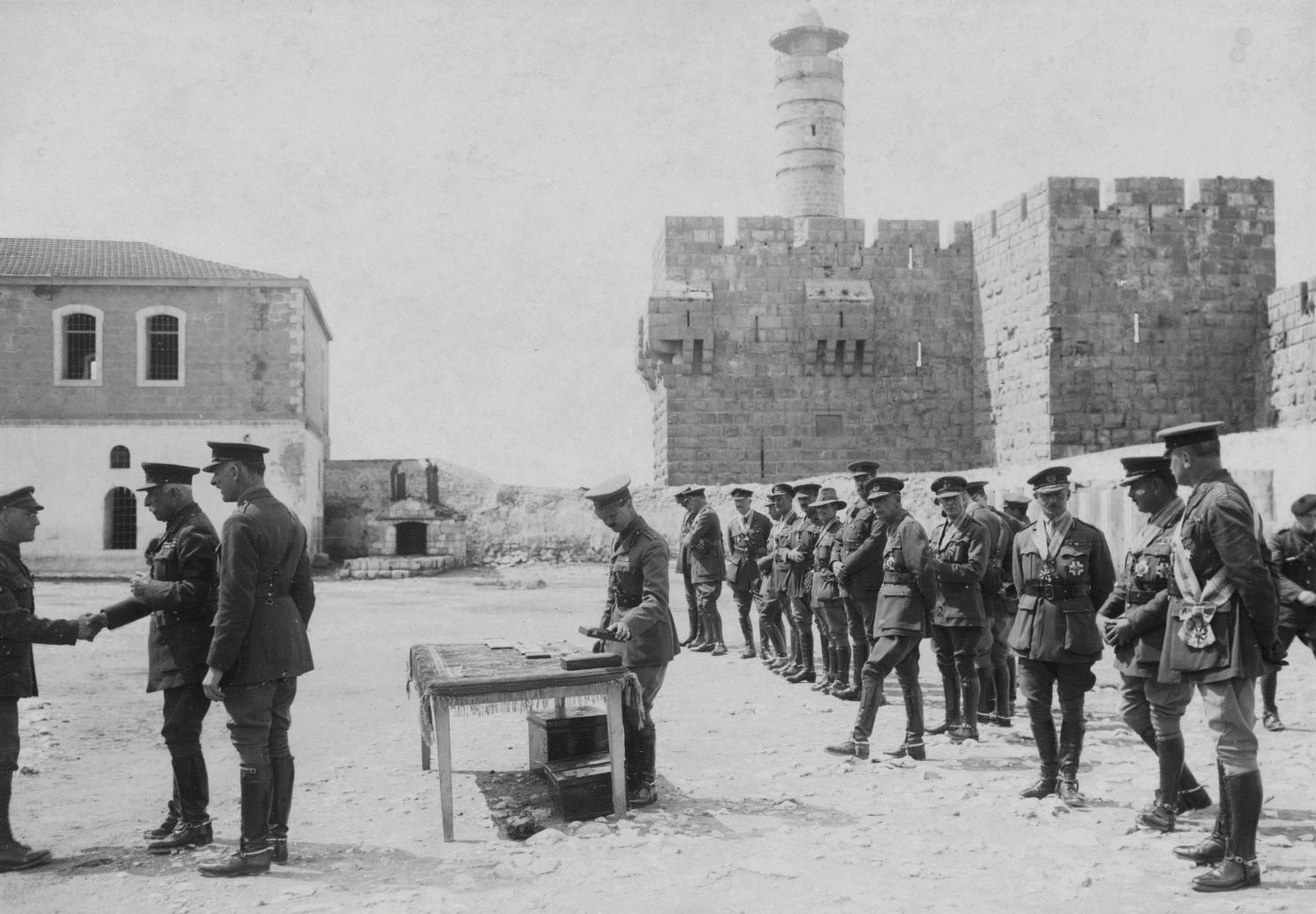
Allenby’s Investiture on 19 March 1918.
By 11 April the battalion had arrived at Lydda. Spence-Jones kept the men busy training under company arrangements, and the men strangely were issued with sun helmets, along with box respirators, gas masks, which they would need in France. On 12 April Spence-Jones split the battalion into three parties, which separately entrained at Lydda for Qantara: the first party left at 5.51 pm; the second at 7.21 pm; and the third at 8.51, arriving at Qantara to join up with the first two parties at 12.40 am on the 13th. Qantara lies on the eastern Suez Canal, a hundred miles north-east of Cairo, and thirty miles south of Port Said. It was a busy garrison town, full of troops from all parts of the Empire: British, Australians, South Africans and Indians, and was well known to the original Yeomanry from the days when it was central to the defence of the Canal. It was also the starting point of the railway that had been constructed during the Palestine offensive, through the Sinai to Jerusalem.
By 10.30 am the 24th Welsh arrived at their camping area at Kilo 4, and over the coming days the new gas masks were fitted to the men and a draft of seven officers and 214 other ranks arrived to bring the battalion back up to strength. Companies were reorganised, and the men subscribed to a fund to erect a memorial to its fallen in Jerusalem. (It is not known if this memorial was ever erected or still exists).
At 11.30 pm on 28 April the battalion entrained at Qantara for Alexandria; the baggage was sent on by motor lorry, and the men were played to the station by the Divisional Band. By 9.00 am the train reached Gabbari Quays, and the men detrained and gathered their kit before boarding HMT Canberra. All of the men were aboard by 1.00 pm, and two hours later Canberra pulled from the quay and remained at anchor in Alexandria Docks, awaiting orders to sail. The convoy had assembled by 2.50 pm on 1 May, and Canberra steamed out of harbour: The 24th Welsh had lost just over a hundred men dead in Egypt and Palestine, and to the men aboard Canberra who had lost close friends, even relatives, in the campaign, who knows what they felt as they watched the dusty shoreline retreat into the distance. The convoy comprised of seven ships, carrying the 74th Division, escorted by Japanese destroyers and several aircraft, as it steamed through the Mediterranean. The sea was a dangerous place to be; German submarines patrolled its waters, and the British had lost many ships as a result, from battleships to transports.
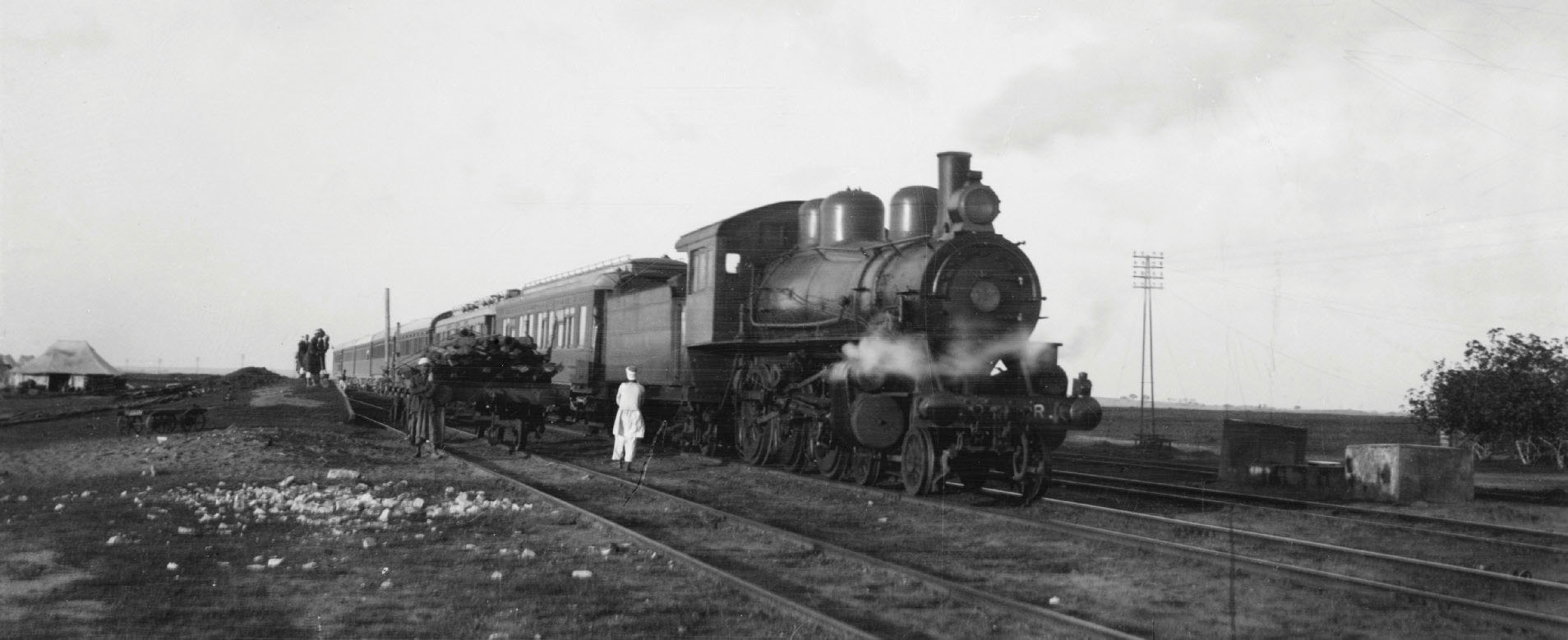
The famous desert railroad, with rails made of Dowlais steel.
Allenby had lost several formations and numerous units: The 52nd Division had left Palestine, preceding the 74th Division by a few days, and nine yeomanry regiments, twentyfour battalions of infantry, five and a half siege batteries and five machine gun companies had left for France. The loss of these troops was made good by the arrival of several Indian divisions, and Allenby continued his successful campaign in Palestine. Both Allenby and the XX Corps Commander, Philip Chetwode did, however, appreciate the good work done by the 74th Division and the latter wrote a fond farewell letter to General Girdwood:
‘XXTH CORPS, JERUSALEM,
3rd April, 1918.
‘MY DEAR GIRDWOOD,
‘The whole of the XXth Corps, and myself in particular, suffer an irreparable loss by the transfer of your gallant Division to another theatre.
‘No man has been better served than I have by them, or could wish to command finer troops. Every task set the 74th has been carried through with uniform gallantry and success, and no division in Palestine has a finer record.
‘We shall watch your deeds and follow your fortunes, wherever you may find yourselves, with the most intense interest and sympathy, knowing beforehand that whatever you set your hands to you will carry through with the same gallantry and devotion that you have displayed since you were first formed into a division.
‘On my own behalf and that of the whole Corps I wish you and your gallant Division God Speed and Good Fortune.
‘Yours sincerely,
PHILIP CHETWODE.’
Girdwood was also sent the following letter by a grateful Sir Edmund Allenby:
‘GENERAL HEADQUARTERS,
EGYPTIAN EXPEDITIONARY FORCE,
9th April, 1918.
‘MY DEAR GIRDWOOD,
‘I cannot let you and your Division go without writing to tell you how sorry I am to lose you.
‘As you will understand, it is not advisable to issue a farewell order, but I want you to know that I am proud to have had you and the 74th Division under my command. Your work has been splendid, and I am sure that, wherever you may go, you will acquit yourselves equally well and win further distinction.
‘You have my warm congratulations and thanks, and my hearty good wishes.
‘Yours sincerely,
EDMUND H. H. ALLENBY.’
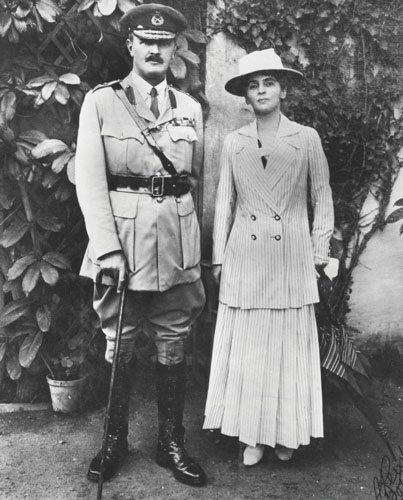
Viscount and Lady Allenby.