
Chapter 3
In August 1914 the British garrison troops in Egypt were the 2nd Devonshire, 1st Worcestershire, 2nd Northamptonshire, 2nd Gordon Highlanders, the 3rd Dragoon Guards, a battery of Royal Horse Artillery, a Mountain Battery and a Field Company of Royal Engineers. The situation on the Western Front required the recall as son as practicable of these troops; they were relieved on 27 September 1914 by the East Lancashire Division, Territorial Force. In October, Indian troops began to arrive.
Egypt, even after years of British administration, was still a province of the Ottoman Empire. The Khedive was actively pro-Turk, and when war was declared on Germany he went to Constantinople. Until Britain declared war on Turkey on 5 November, Germans could roam about Egypt at will and German ships could use its harbours. The aim of the British government was to suppress any rising that might break out and to defend Egypt from invasion, as it was imperative that the Suez Canal would be kept open, to allow vital access to the Indian Ocean and beyond. Egypt as a base for operations against the Turks was the last thing they contemplated.
Egypt was declared a protectorate on 18 December; the reigning Khedive, Abbas Hilmi, was deposed, and his uncle, Prince Hussein Kamel Pasha, was raised to the position with the title of Sultan. On the opposing side was the Turkish Army: Djemal Pasha had been appointed Commander-in-Chief in Syria and Palestine, and his plan was to invade and conquer Egypt. The operation was placed in the hands of Colonel Djemal Bey, who had the German General Kress von Kressenstein as his Chief of Staff.

The German General Friedrich Freiherr Kress von Kressenstein.
The Germans and the Turks hoped to provoke an Arab rising against the British through their allies, the Sultan of Darfur and the Grand Senussi. The first serious enemy attempt was in January 1915, when the Turks tried to cross the Suez Canal. However from then until July 1916, when they again crossed the Sinai Desert, all of the British military operations consisted in the pursuit of a few tribesmen.
Some of the troops who were evacuated from Gallipoli at the end of the campaign were rested in Egypt before moving to the Western Front, in particular the Australians and New Zealanders (Anzacs), who sailed from Egypt to Marseilles, and took up positions in Flanders. Many more were to remain in Egypt, and so the Egyptian Expeditionary Force (EEF) was built up from March 1916 onwards to counter the threat of the Turkish backed Senussi tribesmen and to safeguard the Suez Canal, coming under the command of Sir Archibald Murray, who arrived in Egypt on 9 January 1916. Murray arrived to find that a defensive scheme for the Suez Canal was already in place, after the attempt by the Turks to capture it in January 1915. The area had quietened down after the centre of the fighting shifted to Gallipoli but, with Gallipoli evacuated, Egypt again became a potential crisis point.
Included in the plans for the EEF was the 1st Mounted Division, which had embarked by train from Norfolk for an unknown destination. Sergeant E. Howells Evans, of Aberdare, wrote:
‘After a rush we left yesterday afternoon, and joined a special troop train. We have just left and we are eight in a compartment, Ben Moss amongst them. Where our next stop will be I don’t know, but we are told it will be about 10.30 to-night. At Swindon a Canon treated us to bread, butter and buns, and at Exeter the Mayoress provided us with hot tea and buns. These were very acceptable. The Mayoress had about twelve women on the platform serving the things out. It was very good of them to be up at two in the morning in the pouring rain to look after our comfort. The boys sang to them, and gave them three rousing cheers on leaving, and we in out compartment have written to the Mayoress expressing our thanks on behalf of the boys of the various regiments. We arrived at the port this morning at about 4.30 am, and were immediately shown our quarters on the transport, after which we were put on shipping mules for the A.S.C. It was jolly hard work getting them on board, but it was huge fun and the methods adopted for the most stubborn ones aroused our admiration and amused us at the same time. Our transport ship is about 250 yards long.’

The SS Arcadian, the troopship that ferried the Yeomanry to Egypt.
It was 4 March 1916. Men of the Division had embarked aboard the transport ship HMT Arcadian, bound for Alexandria. The ship was packed, and contained the full complement of men of the Pembroke and Glamorgan Yeomanry, as well as the Shropshire Yeomanry. Their journey was fraught with danger, with German submarines known to be operating in the waters of the Mediterranean, but the Arcadian safely reached port on 14 March 1916. (Arcadian in her pre-war days was a luxury liner, and was the ship on which Sir Robert Baden Powell fell in love with his future wife. Arcadian was later sunk by the German submarine UC74 on 17 April 1917 while bringing troops to Salonika. The UC74’s captain was Wilhelm Marschall, who went on to take charge of the Battleship Scharnhorst in the Second World War.
An article published in the Western Mail of 22 March 1916 lists the following Officers of the 1st/1st Pembroke Yeomanry as being on active service overseas:
|
Lieut.-Colonel |
C. J. H. Spence-Jones. |
|
Majors |
D. W. C. Davies-Evans. |
|
J. A. Higgon. |
|
|
L. Partridge. |
|
|
Captains |
J. W. Bishop. |
|
E. G. Jones. |
|
|
E. Lambton. |
|
|
J. B. H. Woodcock. |
|
|
J. H. L. Yorke. |
|
|
Lieutenants |
C. G. S. Barnes. |
|
T. C. Jones. |
|
|
F. S. Morgan. |
|
|
A. F. J. de Rutzen. |
|
|
2nd Lieutenants |
H. J. Barclay. |
|
G. A. Burge. |
|
|
D. L. P. Morgan. |
|
|
S. H. E. G. Owen. |
|
|
L. W. Penn. |
|
|
L. D. C. Rose. |
|
|
G. A. S. Sheddon, |
|
|
C. H. Williams. |
|
|
AdjutantCaptain |
M. L. Hutchison. |
|
Quartermaster |
Lieut. G. M. Rumball. |
|
Medical Officer |
Captain C. D. Mathias, R.A.M.C. |
|
Veterinary Officer |
Captain H. L. Anthony, A.V.C. |
|
Chaplain |
Rev. R. Jenkyn Owen. |
The Army List of 1915 named the officers of the Glamorgan Yeomanry:
|
Lieut.-Colonel |
D. Venables-Llewellyn, C.L |
|
Majors |
G. T. Bruce |
|
O. R. Vivian, M.V.O. |
|
|
J. D. Nicholl |
|
|
C. F. T. Wyndham-Quin |
|
|
J. G. Moore-Gwyn |
|
|
Captains |
W. Cope |
|
E. Helme |
|
|
R. G. M. Prichard |
|
|
Lieutenants |
Sir F. C. R. |
|
Price G. S. N.Carne |
|
|
Hon. J. H. Bruce |
|
|
R. W. Lewis |
|
|
R. H. P. Miers |
|
|
Second Lieutenants |
J. J. B. Harvey |
|
O.Fisher |
|
|
C. L. Aylett-Branfill |
|
|
E. J. C. David |
|
|
P.Fisher |
|
|
G. R. P. Llewellyn |
|
|
R. C. Wilson |
|
|
Adjutant |
Captain A. G. L. Astley |
|
Quarter Master |
Lieutenant A. S. Barratt |
|
Medical Officer |
Captain R. J. R. C. Simons, R.A.M.C. |
|
Chaplain |
Rev. H. S. Nicholl, A.C.L.D. |
Upon disembarkation, the sea weary troops marched to camp and some of the men settled down to write their first letters home from foreign soil. The Arcadian had also transported reinforcements bound for the 4th and 5th Welsh, who had been so badly damaged at Gallipoli that the units had been merged temporarily into the one battalion, the 4/5th Welsh. A delighted John James John bumped into two of his relatives who were part of this batch of recruits, as well as two old school friends from Llanddowror. In his first letter home to his uncle, Ben John, of Parsons Lays Lodge, Laugharne, John wrote of the chance meeting and a résumé of the letter was printed in the local newspaper, The Welshman:
‘During the nine days and ten nights voyage he met onboard his uncle, Trooper W. Jenkins, late of Cross Inn, Also his cousin Trooper P. J. Saer, and Ptes Evan and John Hughes of Pantymenin, Llanddowror - now of the 4th Welsh. He says that they are encamped in a desert of sand with no sign of any village or town. The weather is so hot that they do nothing between the hours of 11 am and 4 pm. Still, we are all in the pink, and whilst not knowing what is in store for us in this far off country, we feel confident of doing our duty.’

Shipping in the Suez Canal.
Now safely encamped in Egypt, the 1st Mounted Division joined up with four other brigades of Yeomanry who had fought at Gallipoli: the Highland Mounted Brigade the South-Western Mounted Brigade, the Eastern Mounted Brigade and the South-Eastern Mounted Brigade. The strategic importance of Egypt lay in its location, guarding the vital Suez Canal and the north African oil fields, so Britain felt that it had no option but to make Egypt a protectorate; this is the role that these newly arrived yeomen now settled into.
Dudley Ward’s book, 74th (Yeomanry) Division In Syria And France, includes the following description, written by Napoleon, of the journey taken by French troops through the deserts in their campaign of 1798-1801 and gives a good idea of what was facing the Allies:
‘The desert which separates Syria from Egypt extends from Gaza to Salhiya: it is seventy leagues (over 190 miles). Caravans march eighty hours to cross it. Gaza is one hundred leagues from Cairo (250 miles). The desert is divided into three parts: first from Salhiya to Qatia there are sixteen leagues of arid sand; one finds no shade, no water, and not a vestige of vegetation: the caravans march for twenty hours. The French troops covered the distance in two days, but three are necessary for the camels, wheeled vehicles and artillery. Near Qatia are moving sands, very tiring for transport. Qatia is an oasis: there were two wells of water, rather bitter, but, nevertheless, drinkable: there were about a thousand palm trees which could provide shade for four or five thousand men… It is a very exhausting and delicate operation to cross the desert in summer. First the heat of the sand; second, the lack of water; third, the lack of shade, are all capable of perishing an army, or of weakening it, or of discouraging it more than it is possible to imagine.
‘Of all obstacles which can cover the frontiers of empires a desert, similar to this, is incontestably the greatest.’
A little over one hundred years later little had changed and these were the conditions that the yeomen would be operating in for the coming months, a far cry from the lush, green farmlands of south and west Wales.
The great dividing line in the Sinai Desert was the Suez Canal; Sir Archibald Murray divided the Canal into three zones of defence, under the command of Major-General Alexander Wilson, with centres at Suez, Ismailia, and Qantara. The greatest threat here came from the Senussi tribesmen. Prior to 1906 the Senussi had been a relatively peaceful religious sect, who roamed the Sahara Desert, opposed to fanaticism. They had then become involved in resistance to the French occupation. In 1911 the Italians invaded Libya, occupying the coast, while the Senussi maintained resistance inland and in Cyrenaica. During this period they generally maintained friendly relations with the British in Egypt.

Map of the Sinai Desert (courtesy David John).
The outbreak of war raised the tension. The Turks made strenuous efforts to persuade the Senussi to attack British occupied Egypt from the west. In the summer of 1915 Turkish envoys, including Nuri Bey, the half brother of Enver Pasha, and Jaafar Pasha, a Baghdadi Arab serving in the Turkish Army, managed to gain influence over the Grand Senussi, Sayed Ahmed, and convinced him to begin hostilities against the British with Turkish support. The original plan was for a three pronged attack on the British forces stationed here. The Senussi would mount attacks along the narrow strip of fertile land on the Egyptian coast, heading towards Alexandria, and on the band of oases one hundred miles west of the Nile. At the same time the Emir of Darfur would launch an attack on the Sudan. In the event the three campaigns were fought separately and were defeated in turn.
The coastal campaign began first, in November 1915. The British withdrew from Sollum and Sidi Barrani and concentrated their forces around Mersa Matruh. The Western Frontier Force, under Major General W. E. Peyton, was created from the garrison of Egypt, consisting of one cavalry and one infantry brigade, supported by a battery of horse artillery. They were outnumbered by the Senussi, who had 5,000 men trained to fight as infantry, supported by a larger number of irregular troops and with a small number of Turkish artillery and machine guns. Despite their advantage in numbers, the Senussi were defeated in encounters at Wadi Senba (11-13 December 1915), Wadi Majid (25 December 1915) and Halazin (23 January 1916).
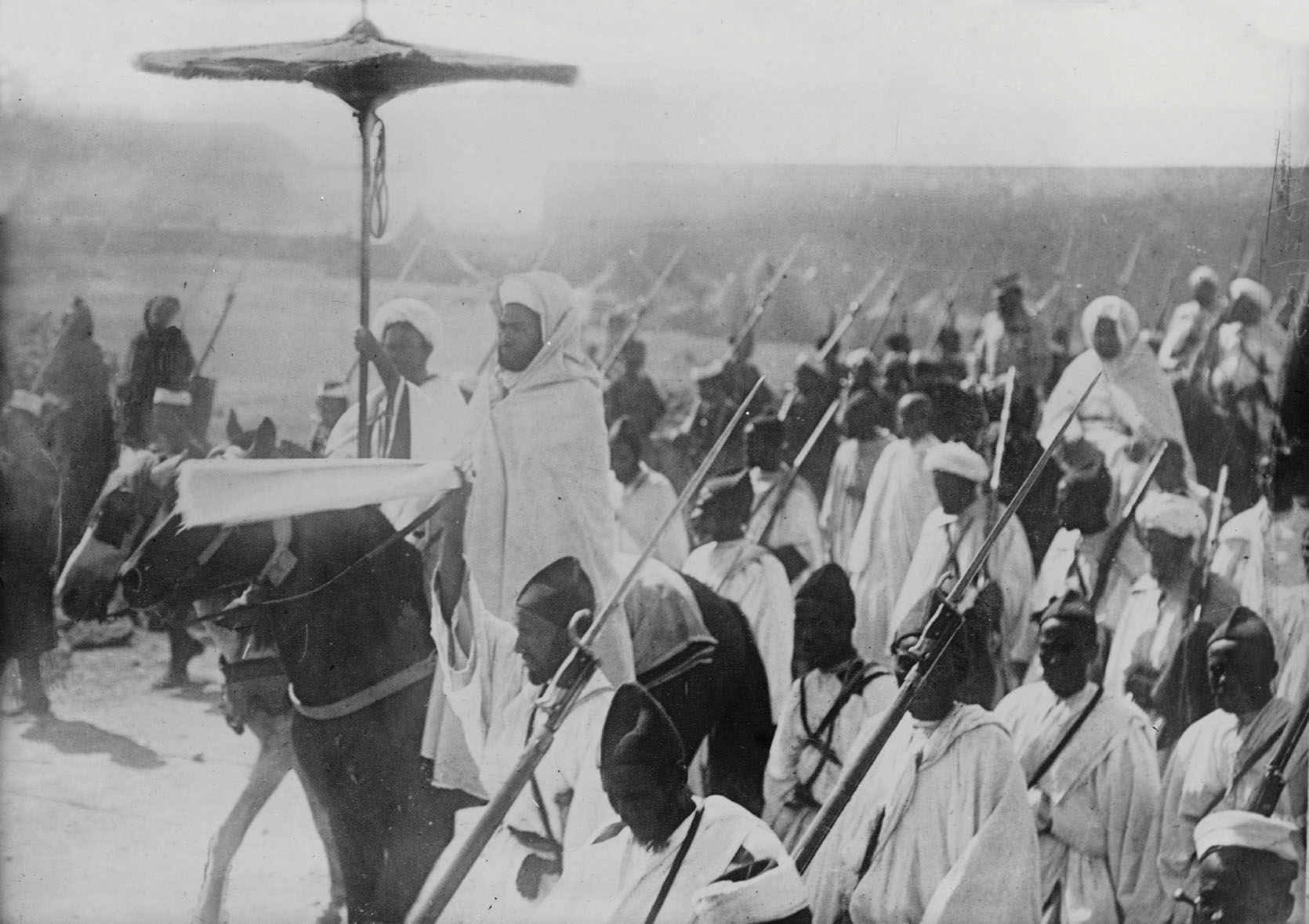
The Senussi going to war.

Prince Feisal, with T. H. Lawrence (Lawrence of Arabia) behind his left shoulder.
The Senussi were finally defeated at Agagia (26 February 1916), on the coast close to Sollum. The Western Frontier Force had been reinforced by the South African Brigade, under Brigadier General H. T. Lukin. A column under his command was sent west to recapture Sollum, encountering and defeating the Senussi on their way west. Jaafar Pasha was captured during the battle, Sollum was reoccupied on 14 March 1916 by a mixed force of South African and Yeomanry troops. Jaafar was kept in captivity in Egypt, but later in the war volunteered to join the forces under Emir Feisal, became commander of the Arab regulars during the revolt and then served as Minister of War and Prime Minister of Iraq under the then King Feisal. Feisal was famously aided in his campaign by a renowned army officer, Thomas Edward Lawrence, better known as Lawrence of Arabia, or El Aurens, who was the British liaison officer serving with Feisal’s Arab army. However, small bands of Senussi tribesmen continued their fight. A fresh campaign against the oases started in February 1916. Sayyid Ahmed occupied the oases at Baharia, Farafra, Dakhla and Kharge, and forced the British to keep a sizable garrison in Upper Egypt while a mobile force was organised to push him back.
On 20 March 1916 the South Wales Mounted Brigade became part of the 4th Dismounted Brigade and was attached to the Western Frontier Force. After a short stay at Wardan, on the banks of the Nile, it moved to the Wadi El Natrun, west of the Nile Delta, and was tasked with guarding the coastal strip, the gateway to Alexandria and to the Nile Delta, an area known as the Baharia front. The role of these newly arrived troops was a simple peace keeping one for the time being, and as garrison troops on the Suez Canal Defences.

Captain Edward Lambton, Pembroke Yeomanry. Died in Cairo on 28 March 1916.
The loss of the first officer of the Pembroke Yeomanry on active service occurred on 28 March 1916, when Captain Edward Lambton, a member of a well known Pembrokeshire family, died in hospital in Cairo. He was born on 5 February 1877, the son of Lieutenant Colonel Francis William Lambton, of Brownslade, Pembrokeshire, late Scots Guards, and Lady Victoria Alexandrina Elizabeth, the eldest daughter of John Frederick Campbell, second Earl of Cawdor. He was educated at Wellington College and Cooper’s Hill, prior to taking up a post as Director of Public Works for the Egyptian government in Cairo. Edward trained with an Egyptian cavalry regiment prior to the war. He returned to England, where he became a captain with the Pembroke Yeomanry. Two of his elder brothers were killed in South Africa during the Boer War.
The distribution of troops administered on the Suez Canal Defences by April 1916, temporarily under the command of the 53rd (Welsh) Division HQ, was:
|
ALAMEIN |
1st Welsh Field Coy. Royal Engineers (Detach.). |
|
53rd Division Signal Coy. R.E. (Detach.). |
|
|
MOGHARA |
1st Denbighshire Yeomanry. |
|
ABBASSIAH.Q. |
53rd Division and 53rd Signal Company. |
|
WADI EL NATRUN |
158th Brigade (less Transport Details). |
|
1st Welsh Fid. Coy. R.E. (Detach.). |
|
|
3rd Welsh Field Ambulance (Section). |
|
|
53rd Division Train (Detach.). |
|
|
BENI SALAMA |
53rd Divisional Artillery (Less one Battery.). |
|
Details 53rd Division R.E. |
|
|
159th Brigade. |
|
|
Transport Details 158th Brigade. |
|
|
1st Pembroke Yeomanry. |
|
|
1st Montgomery Yeomanry. |
|
|
2nd Welsh Field Ambulance. |
|
|
3rd Welsh Field Ambulance (less one Section) |
|
|
53rd Division Casualty Clearing Station. |
|
|
53rd Division Train Details and Bakery. |
|
|
53rd Division Mobile Veterinary Sect. |
|
|
FAIYUM |
160th Brigade. |
|
1st Welsh Field Ambulance. |
|
|
53rd Division Sanitary Sect. (less Detachment) |
|
|
2/1st Welsh Field Coy. R.E. |
|
|
53rd Division Train Details. |
|
|
53rd Division Cyclist Coy. |
|
|
MINIA |
4th Dismounted Brigade. |
|
4th Glamorganshire Battery Royal Field Artillery |
|
|
SOHAG |
2/1st Cheshire Field Coy. R.E. |
|
SUEZ |
53rd Divisional Train. |
In the meantime, the British were forming a regiment of mounted infantry. Members of the Australian Light Horse, which had been badly handled and severely damaged during a futile charge across open ground at the action on the Nek in Gallipoli on 7 August 1915, had been moved to Egypt after the evacuation, and had successfully taken part in mounted campaigns against the Senussi. With the extra horsemen now available to them, due to the arrival of the Yeomanry Brigades, the Imperial Camel Corps was established in January 1916, with a core of six companies of Australian Light Horsemen from New South Wales. Formed alongside them were six British companies, all drawn from the yeomanry brigades. New Zealand personnel formed two additional companies. Later in the campaign motorised units were also formed, using men from the Imperial Camel Corps, to which a detachment of Pembroke Yeomanry and one of Glamorgan Yeomanry were attached. During July a detachment of thirty men under Lieutenant De Rutzen left the Pembroke Yeomanry to join the 6th Company, Imperial Camel Corps. With them went the Regimental Signal Officer, Lieutenant F. S. Morgan, to become Brigade Signal Officer to the Imperial Camel Brigade.
The war seemed a distant thought for some members of the yeomanry who were struggling to deal with life in Egypt. On 4 April 1916, a Pembroke yeoman wrote to the Llanelly Star:
‘Sir, On behalf of the Llanelly boys now with the Pembroke Yeomanry forming part of the Egyptian Expeditionary Force, it is with much pleasure that I write to give our friends at home some idea of how matters are progressing with us in this part of the world. We have been here for some time, and all we see is sand, sand, sand. There are a few canteens in our locality but things are twice as dear as they are at home. The pay we receive, I can assure you, does not last very long, amounting as it does (if we make an allotment, and most of us do) to only 5d a day. By about Tuesday in each week, therefore, we have very little left and are often without even a Woodbine to smoke. We shall be very pleased if you will publish in the “Star” that we will be very grateful for any comforts from the public in Llanelly. The friends at home have been very kind to the boys in many places, and we would much appreciate anything they would do for us in the same way. I am, etc., 1st Troop, B. Squadron, R.D.J. Pembroke Yeomanry, Egyptian Exp. Force, April 4th, 1916.’
The loss of the first officer of the Glamorgan Yeomanry on active service occurred soon afterwards: Capel Lisle Aylett Branfill was born on 29 August 1884, the son of Capel Aylett Branfill and Gwladys Gwendoline Branfill (née Miers), of The Plas, Crickhowell. He lived at Ynistawe, Clydach, with his wife prior to the war. He was initially commissioned into the Glamorgan Yeomanry on 19 April 1909 and by the time the regiment landed in Egypt had been promoted captain. He took ill due to the adverse desert conditions and succumbed to pneumonia in hospital at Cairo on 11 May 1916, aged 31. He is buried in Cairo War Memorial Cemetery. Capel’s short life was full of tragedy. His wife, Susannah Hamilton Williams, was so distressed at the thought of him going to the front, that she drowned herself and their infant child, Gwendoline, in a pool near her parent’s home at Upton upon Severn on 24 January 1915.

Captain Capel Lisle Aylett-Branfill, Glamorgan Yeomanry. Died in Egypt on 11 May 1916.
The main body of the Pembroke and Glamorgan Yeomanry were responsible for patrolling huge swathes of desert, either through the manning of outposts and blockhouses, or by the use of converted Roll Royce armoured cars. Although this routine was relatively safe, it was difficult and dangerous work, in a climate which bred ideal conditions for sickness. By night the men froze, by day their blood almost boiled in the arid heat, and then they had to contend with sand, dust and the myriad flies. On top of all these unpleasantries, the Turks were building up a powerful force in the Middle East, which by mid 1916 had reached a strength of forty-three divisions, all in all over 650,000 men. On 19 July reconnaissance aircraft from the Royal Flying Corps discovered that a large body of the enemy had moved from El Arish; on the morning of the 20th cavalry patrols reported that Oghratina was held by strong forces of the enemy, who were entrenching.
The Turkish 3rd Division, a strong formation, commanded and partly manned by Germans which had Austrian heavy artillery units attached, advanced under the command of Kress von Kressenstein. On the night of 2 July he had pushed his line forward to Sabkhet el Amya - Abu Darem; and on 2 August, he made a strong reconnaissance towards El Rabah– Qatia - Bir el Hamisah. His troops were driven back after several sharp encounters.
Until now, Sir Archibald Murray had been uncertain as to whether the enemy would make the first move, but on 3 August von Kressenstein advanced his line again to a semicircle from the immediate west of Hill 110, past the high ground east and south-east of Qatia, to the high ground north-west of Bir el Hamisah. Both in order to contain this Turkish threat and also in order to change their own position from the defensive to the offensive, throughout 1916 the British drove out further outposts in the direction of Qatia, following up this drive with the building of a standard gauge railway and a line of blockhouses.
The Aberdare Leader published a letter from one of the Glamorgan yeomen on 24 June 1916:
‘Sir, A few of the local lads in the 1/1 Glamorgan Yeomanry, Egyptian Expeditionary Force, have asked me to write you a few lines to let our numerous friends know how we are faring. After remaining so long on the East Coast we are at last actually on service, and although we have not seen action we find that soldiering abroad is far different to that at home. It is terribly hot, and considering that when we left England it was very cold, we have all stuck it very well, and have not a man in hospital with any serious illness. For a time we were in the same camp as the 5th Welsh. We are out in the desert this last month, right away from any town. We have no amusements of any sort except what we try and make ourselves.
‘I wonder if any friend could rummage out a few old [oddly censored out!]. It would be a boon to us, and at night we could sit and sing to our hearts’ content. There are about 20 of us (Aberdare boys) here, among them Sid and Charlie Pontin, Bert Davies (G.W.R. parcels), Percy Morgan (tailor), and Sergeant Jack Allen (Town Brewery). It may interest you to know that I met Lieut. Mostyn George some time ago at Alexandria, and had a long chat with him. He looks exceptionally well, and has grown into quite a big fellow. I also came across Harry Coates (K.S.L.I.). Although he joined our ship at Malta I did not see him until we had disembarked. Thanking you for allowing me valuable space, and hoping that we will receive the [censored].
‘Yours, etc. (for the boys), 1197 Corporal Ben Moss, D Squadron, 1/1 Glamorgan Yeomanry, E.E.F. P.S. Our Squadron D are nicknamed the “Dare Devils”. Why, I will leave your readers to guess.’
Officers of the yeomanry were in the main well trained and highly educated. As a result there was much movement of officers to other units. During June 1916 Captain John Arthur Higgon left the Pembroke Yeomanry to join the 32nd Battalion AIF prior to its move to France, being promoted to become second in command of the battalion. He was killed in action during the futile Battle of Fromelles on 20 July 1916, while commanding the battalion during its attack on the Sugarloaf Salient.

Major John Arthur Higgon, Pembroke Yeomanry. Killed in action at Fromelles whilst serving with the 32nd Battalion AIF.
The first major contact with the Turks was on 4 August 1916, when a large Turkish force under von Kressenstein attacked towards Romani, a strategically important railhead and oasis, eighteen miles from Qantara. The Turks had prepared successive lines of defence as they moved towards Romani. Sir Archibald Murray’s plan was to make a stand at a mound called Katib Gannit, and ordered the 1st and 2nd Light Horse Brigades, under General Chauvel, to cover the position between Katib Gannit and Hod el Enna, on the edge of an area of sand dunes that cropped up along the edge of the flat desert.

Some of the Imperial Camel Corps members of the Pembroke Yeomanry in Egypt.
The Battle of Romani commenced at 3.30 am on 4 August, when the Turks attacked this position. Murray’s troops counter-attacked them in flank from Dueidar and the Canal Defences, whilst a mobile column swung behind, catching the Turks in the rear and cutting the attacking troops off from the main Turkish forces. Soon after 5.00 am four German aircraft attacked Romani Camp, dropping around thirty bombs. By the end of the day, around 4,000 Turkish troops had been taken prisoner, out of a total of 18,000, but von Kressenstein had managed to escape, falling back on the successive lines he had prepared. This first engagement marked the last enemy attempt to advance on the Suez Canal.
The only Yeomanry element involved at Romani was the Imperial Camel Corps; one of the few British casualties suffered was a Pembroke Yeomanry officer, Baron Alan De Rutzen, who was killed on 7 August 1916. His obituary was published in The Sphere:
‘Lieutenant Alan Frederick James, Baron De Rutzen, son of the late Sir Albert de Rutzen, the famous Metropolitan Magistrate at Bow Street, was born in 1876. He was educated at Eton and became a member of the Stock Exchange. He succeeded his uncle as Baron de Rutzen in 1915. At the outbreak of the war he joined the Pembroke Yeomanry, being gazetted in August 1914, and went with them to Egypt in March 1916. Whilst there, he volunteered for and became attached to the Imperial Camel Corps, with which he was serving at the time of his death. He fell leading a company of the Camel Corps against the Turks near Qatia.’

Lieutenant Alan Frederick James, Baron De Rutzen.
The following extract, testifying to his great ability as an officer and leader of men, is from a letter of an officer of the Camel Corps to Lieutenant Colonel Spence-Jones:
‘You will probably have heard, before this reaches you, that Baron de Rutzen was killed yesterday. He was in command of this company and the amount of confidence he put into his men helped considerably towards holding a very tight corner. A brave man and a real topper in the field and out of it. His men simply adored him, as did all his brother officers.’
Baron de Rutzen had travelled extensively. He was greatly interested in horses, hunting and agriculture, and was a keen fisherman. He married, in 1908, Eleanor Etna Audley, the only child of Captain Pelham Thursby Pelham, of Abermarlais Park, Carmarthenshire, and Ridgeway, Pembrokeshire.
News of the award of the Victoria Cross to a former member of the Pembroke Yeomanry also reached Egypt during September. Major Stewart Loudon Shand was the son of John Loudon Shand, of Dulwich, London. He had served with the Pembroke Yeomanry during the Boer War. On 12 December 1915 he became second in command of the 10th Battalion, Yorkshire Regiment. His award of the Victoria Cross was published in the London Gazette of 8 September 1916:
'For most conspicuous bravery. When his company attempted to climb over the parapet to attack the enemy's trenches, they were met by very fierce machine gun fire, which temporarily stopped their progress. Major Loudoun-Shand immediately leapt on the parapet, helped the men over it, and encouraged them in every way until he fell mortally wounded. Even then he insisted on being propped up in the trench, and went on encouraging the non-commissioned officers and men until he died.'
He was killed during the opening assault on the Somme on 1 July 1916 and is buried in Norfolk Cemetery, Bécordel-Bécourt.
In Egypt, the British line had advanced further still after the withdrawal of the Turks, and the railway line extended further in the direction of El Arish in preparation for the following year’s offensive. Apart from minor skirmishes against small bands of Senussi during the remainder of the summer, there does not seem to have been a lot to report. There were comings and goings of officers from both regiments; notable in 1916 was the departure of Major Delmé Davies Evans when, on 19 September, he left the regiment behind to head for France, after being given command of the 5th Battalion, Lincolnshire Regiment. Delmé went on to forge a well earned reputation as a good battalion commander, having been a popular and efficient commander of C Squadron, the Cardiganshire detachment of the Pembroke Yeomanry, for many years.

Lieutenant Colonel Delme William Campbell Davies-Evans.
John James John wrote another letter home to his Uncle Ben during the summer of 1916. He spoke in it of meeting the Australian troops for the first time and had briefly managed to meet up with his brother David, who was about to move to the Somme, to take part in the assault on Pozières Ridge with the 1st Australian Division. The Australians were a breath of fresh air in the British army. Officers had to earn respect in their eyes, and routine discipline was treated rather informally. Their spirit and joviality went down well with the young men of the Pembroke and Glamorgan Yeomanry, and great friendships were formed.
A further letter from John to his Uncle Ben John, which was published some months later, in The Welshman of 22 September 1916, read:
‘Dear Uncle Ben, just a few lines to let you know that I am still in the land of the living, and very much alive too. I am in the best of health and perfectly happy doing my bit. I suppose that you must have been busy at the hay lately, and hope that the harvest is now over. I learn that you had good weather there for it, and that some were falling in the fields through the heat. Well old chap, if they were out here I expect they would fall and never get up again, it being so warm here! We are however getting used to it and are thoroughly enjoying ourselves. Please write soon with all the news from the old home and district, which will be very welcome in this far off country. Give my kind regards to all old friends, and especially to old ‘Llwynog’. I will conclude this time with best wishes, Your affectionate nephew, Jack.
By this time John had not yet heard the news of his brother’s death on the Somme, during the final stages of the battle of Pozières on 18 August 1916. David was buried at Mouquet Farm Cemetery after the fighting to capture the fortified complex was over, but his grave was later lost and he is today commemorated on the Villers-Brettoneaux Memorial. John was not to find out about his brother’s death until the spring of 1917, after an enquiry had been held on the disappearance of the four man patrol that David was leading.
In a sense, this must have felt like a phoney war for many of the troops on the ground, the majority of whom had, as yet, seen no sign of the enemy. It was exciting for the men to be stationed in such an exotic part of the world, and the feeling of bathing in the warm waters of the Mediterranean while off duty must have invoked a feeling of being on holiday.
The main obstacle for the forthcoming offensive was the supply of fresh water for the troops, camels and horses, but by November 1916 this, too, had reached the front, with a newly laid pipeline supplying water from the sweet-water canal. This pipeline was increased again as the front was pushed further east, until it reached Bir el Abd. West of Bir el Abd there had been water for horses, mules, and camels, but to the east there were few wells, and they were widely separated. A desert railway was also being constructed by units of the Royal Engineers who utilised large numbers of native labourers. This railway and the water pipeline would prove vital for the success of the planned operations in Palestine.

Swimming in the Mediterranean.

Natives pipeline laying; they were also used to construct roads and railways.
At the end of November Sir Archibald Murray wrote in his despatches:
‘Every tactical preparation for the offensive had been made, naval co-operation planned, and arrangements made for the landing of stores and construction pipes as soon as El Arish was in my possession. But the difficulty of water supply, even with my advanced railhead, was immense. The enemy was so disposed as to cover all available water in the neighbourhood of El Arish and Masaid. Between his position and ours and south of his position, no water could be found.
‘If, therefore, he should be able to force us to spend two days in the operation of driving him from his position, it would be necessary to carry forward very large quantities of water on camels for the men and animals of the formations engaged. This entailed the establishment of a very large reserve of water at railhead, and the preparation of elaborate arrangements for the forwarding and distributing of water.
‘The water supply for the striking force was not adequately secured until the 20th December.’
In the meantime the yeomen were still carrying out the same routine of manning outposts, detachments, route marches and regimental drill. During this time there were several detachments on a multitude of courses. One Squadron was always on outpost duty at El Garr, and there were detachments to Bir Victoria, Khataba, Sidi Bishr, Sidi Gobbu and Alexandria. There were also many transfers out to the Camel Corps and the Machine Gun Corps during this period, which also saw an end to the Senussi threat, and thus the freeing up of over 30,000 troops. The defeat of the Senussi in Egypt fatally undermined Sayyid Ahmed’s position; it was his being forced out of power in favour of his nephew, Sayyid Mohammed el Idris, who had opposed the campaign, which led to the end of the Senussi threat. He went into exile in Constantinople. Idris would soon be recognised by the British and Italians as Emir of Cyrenaica, and would eventually become King Idris I of Libya.
Conditions were still comfortable for many of the officers. An officer in the 53rd (Welsh) Division wrote:
‘From Qantara we went occasionally to Port Said for the day. As we journeyed home the sun was setting. In the foreground was just the huge expanse of lake, scrub and salt pans. One laughs at the gold, sapphire and ruby idea, but I tell you the colours were deeper and beyond description. Yellow and orange sky, silver and blue water, green and grey scrub. Then, as the light changes, flame coloured sky, a silver band of water in the distance, a great tract of purple scrub, and the nearer expanses of water partly pink and gold reflections, and partly Cambridge blue.
‘The hospitable French Club at Ismailia! Ismailia itself is a perfect little French township, with appropriate two storied houses, plainly but tastefully built, tree shaded, with deep verandas over which climbed innumerable plants. Bougainvillea, hibiscus and roses splash the gardens with rich colours. Through the trees is a glimpse of the Lake Timsah, a deep blue bounded by blazing golden sand. On moonlit nights, as one dined at the Club, or the Café Beige, the trees were silhouetted in filigree against the sky, sweet scents came stealing over from the gardens, and peace and content drove away the troubles of the moment.
‘At Qantara, the town of tents, huts and dumps, bathing in the Canal and riding along its banks were the chief antidotes to care. Passengers on passing liners used to throw tins of cigarettes to the men in the water below.
‘One curious duty was the keeping of the “swept track”. This was a broad track in the sand along the canal bank, and was produced by dragging a very wide brush of branches by mules up and down to meet our next door neighbour. This was done each evening, and each morning a patrol proceeded along it to see if it had been crossed during the night by nefarious feet. The authorities were afraid that a very small enemy patrol might get through with camels and a mine and drop it in the Canal.’
With this threat removed, the troops guarding the western front of the MEF were now free to reinforce the eastern front, to counter the growing threat of the Turks. At the start of the new year of 1917, the three Dismounted Brigades on the western front began to move east. The 2nd Dismounted Brigade was at Moascar by 5 January, El Ferdan on the 15th, Qantara on 5 March, and El Arish (by rail) on the 6th. The Lovat Scouts dropped out of this brigade in August 1916 and were replaced by the Ayr and Lanarkshire Yeomanry Regiments in January 1917. The brigade was renamed 229 Infantry Brigade. The 3rd Dismounted Brigade went to Sidi Bishr on 2 April and to Deir el Belah on the 9th. It was renamed 230 Infantry Brigade. The 4th Dismounted Brigade moved to Assiut on 1 January 1917, Zeitoun on 1 March, Helmia on 1 April, and Khan Yunus on the 10th, and became 231 Infantry Brigade which, under Brigadier General Philip Chetwode, was attached to XX Corps. Part of the new 231 Brigade were the Pembroke and Glamorgan Yeomanry Regiments, which had been merged to form a new battalion, the 24th, of the Welsh Regiment. These three new infantry brigades became part of a newly formed 74th (Yeomanry) Division, with their divisional emblem, the broken spur, to mark the previous cavalry role of the Yeomanry. This emblem was worn as an embroidered cloth patch on the right upper arm of the service tunic, and also on, for example, divisional vehicles.

Officers Mess of the 24th Welsh, in the Managers House of the Salt and Soda Company.
This new division joined a powerful force under the command of Sir Archibald Murray, which comprised the 52nd, 53rd, and 54th Divisions, the New Zealand and Australian Mounted Division, the Imperial Mounted Division, and the Imperial Camel Corps on the Syrian Front. He organised this force into the Desert Column, under Sir Philip Chetwode, and the Eastern Force, under Sir Charles Dobell. The 53rd Division was a Welsh Territorial division; and among its infantry units were the 4th Welsh from Carmarthenshire, and the 5th Welsh from Glamorgan. The former Yeomanry men were to be fighting alongside their South Welsh compatriots at last. By the time of this merger, the two Yeomanry Regiments had lost sixteen men dead between them: the Pembroke Yeomanry fourteen of these, and the Glamorgan Yeomanry two, all of whom had succumbed to sickness or accidental death bar three: Private Harry Brown, of the Pembroke Yeomanry, had been posted to France with the 13th Welsh, and was killed at Boesinghe (Belgium). Private William James Collins was posted from the Glamorgan Yeomanry to the 10th Royal Welsh Fusiliers, and died of wounds suffered at Boesinghe. Both served with the 38th (Welsh) Division, and fought at Mametz Wood during July 1916.

An unidentified soldier of the 74th (Yeomanry) Division. Note his broken spur divisional shoulder patch.
The make-up of this new 74th (Yeomanry) Division was as follows, under the command of Major General E. S. Girdwood, CB, late Scottish Rifles:
229 Infantry Brigade
Commanded by Brigadier General B. Hoare, DSO, late 4th Hussars.
16th Bn. Devonshire Regt. (Royal West Devon and Royal North Devon Yeomanry).
12th Bn. Somerset Light Infantry (West Somerset Yeomanry).
14th Black Watch (Fife and Forfar Yeomanry).
12th Bn. Royal Scots Fusiliers (Ayr and Lanark Yeomanry).
4th Machine Gun Company and 229th Light Trench Mortar Battery.
230 Infantry Brigade
Commanded by Brigadier General A. J. McNeil, DSO, Lovat Scouts.
10th Bn. The Buffs (Royal East Kent and West Kent Yeomanry).
16th Bn. Royal Sussex (Sussex Yeomanry).
15th Bn. Suffolk (Suffolk Yeomanry).
12th Bn. Norfolk (Norfolk Yeomanry).
209th Machine Gun Company and 230th Light Trench Mortar Battery.
231 Infantry Brigade
Commanded by Brigadier General B. A. Herbert, Somerset Light Infantry.
10th Bn. King’s Shropshire Light Infantry (Shropshire and Cheshire Yeomanry).
24th Bn. Royal Welsh Fusiliers (Denbighshire Yeomanry).
25th Bn. Royal Welsh Fusiliers (Montgomeryshire and Welsh Horse Yeomanry).
24th Bn. Welsh Regiment (Pembroke and Glamorgan Yeomanry).
210th Machine Gun Company and 231st Light Trench Mortar Battery.
Royal Artillery
Commanded by Brigadier General L. J. Hext, CMG.
117th Brigade R.F.A. (A, B, 366th and D Batteries).
44th Brigade R.F.A. (340th, 382nd, 425th, and D Batteries).
268th Brigade R.F.A.
X74 and Y74 Medium Trench Mortar Batteries.
74th Ammunition Column.
Royal Engineers
Commanded by Lieutenant Colonel R.P.T. Hawksley CMG, DSO.
No. 5 (Royal Monmouth) Field Company.
No. 5 (Royal Anglesea) Field Company.
439th (Cheshire) Field Company.
74th Divisional Signal Company.
Army Service Corps
Commanded by Lieutenant Colonel J.G. Needham.
447th, 448th, 449th, 450th Companies A.S.C.
Divisional Troops
261st Machine Gun Company, 74th Employment Company, 69th Mobile Veterinary
Section, A Squadron, 2nd County of London (Westminster Dragoons) Yeomanry. This
squadron was moved to act as the Corps Cavalry Regiment on 23 August 1917.