
Chapter 4
The new battalion, the 24th (Pembroke and Glamorgan Yeomanry) Battalion, Welsh Regiment, was officered by a mixture of Pembroke and Glamorgan Yeomanry, but the Pembroke Yeomanry held the upper hand. The Commanding Officer was Lieutenant Colonel C. J. H. Spence-Jones of the Pembroke Yeomanry, with Lieutenant Colonel G. T. Bruce of the Glamorgan Yeomanry his understudy, due to seniority. The remaining officer staff were a mixture from the two units, with the Medical Officer being Lieutenant C. D. Mathias, the Chaplain, Reverend H. S. Nicholl, and three company commanders, J. B. H. Woodcock, J. W. Bishop and J. H. L. Yorke, and all of the Company sergeant majors being Pembroke men. The men themselves were intermingled, creating a truly homogenous unit.
This is how the new battalion was described in the History of the Welsh Regiment, by T. O. Marden:
‘A word must now be said about the 24th Welsh. This Battalion was formed from the dismounted Pembrokeshire Yeomanry and Glamorgan Yeomanry, and brigaded in January, 1917, with the 24th R.W.F. (Denbighshire Yeomanry), 25th R.W.F. (Montgomeryshire Yeomanry and Welsh Horse), and 10th K.S.L.I. (Shropshire and Cheshire Yeomanry) in the 23lst Brigade of the 74th Division, under the command of Major-General E. S. Girdwood. The whole Division was composed of men of superior education and very well officered. The 24th Welsh were commanded by Lieutenant-Colonel J. Spence-Jones, Pembrokeshire Yeomanry, and though they bore the territorial title of “Welsh,” drew their reinforcements from Yeomanry sources and not from the Reserve Battalions of the Welsh Regiment.’
The first ever entry in the new battalion’s war diary, entered on 4 January 1917, was basic in the extreme and simply reads: ‘Two farrier sergeants proceeded to yeomanry base Alexandria.’
On the following day a party of men from the battalion relieved troops from the blockhouses, thus starting life together for the first time as a battalion of the Welsh Regiment.
The third entry in the battalion War Diary mentions the death of Private Robert Scott, the son of Robert and Mary Scott, of Lazenby, Cumberland, and the husband of Amy Scott, of Burry Port, who had been wounded whilst attached to the 6th Company, Imperial Camel Corps. He died in the 3rd Australian Light Horse Casualty Clearing Station on 6 January, and is buried in Qantara.
A lot of shuffling of personnel was still going on throughout the first months of the battalion’s existence. Reinforcements arrived in dribs and drabs, while several NCOs were commissioned. The battalion came in existence officially at midday on 2 February 1917, according to a note in the war diary, and remained at Shousha for most of the month, preparing to join the remainder of the brigade at Zeitoun. An advanced party of officers and NCOs from the 24th Welsh left for Zeitoun on 18 February. Four days later, notification of the award of the Distinguished Service Order to Major Llewelyn Partridge was received. The award, gazetted on 26 March 1917, read:
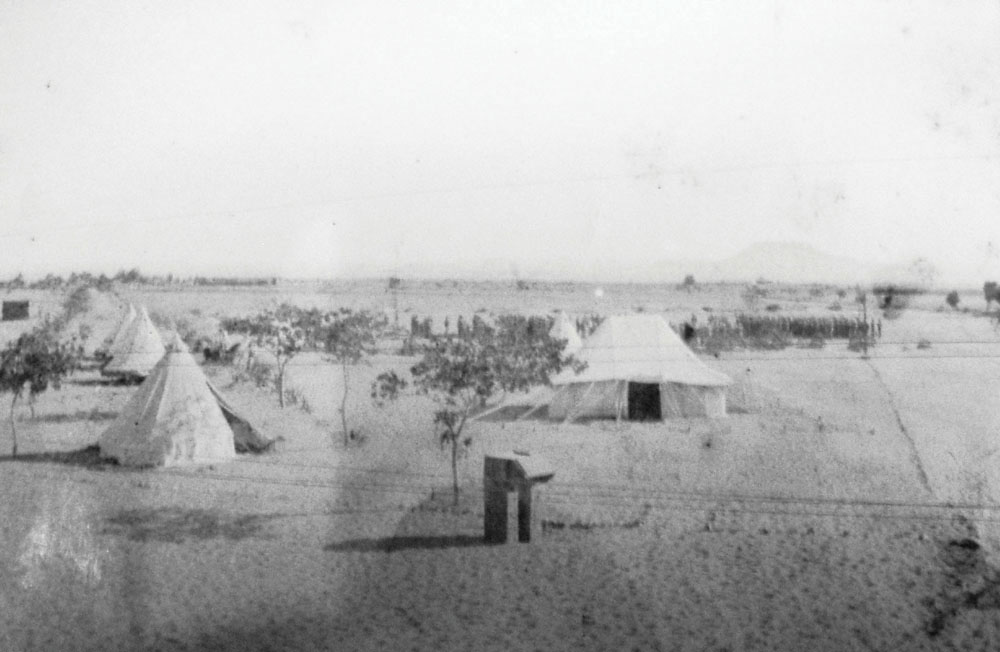
Part of a tented camp of the 74th (Yeomanry) Division. (Shropshire Archives)
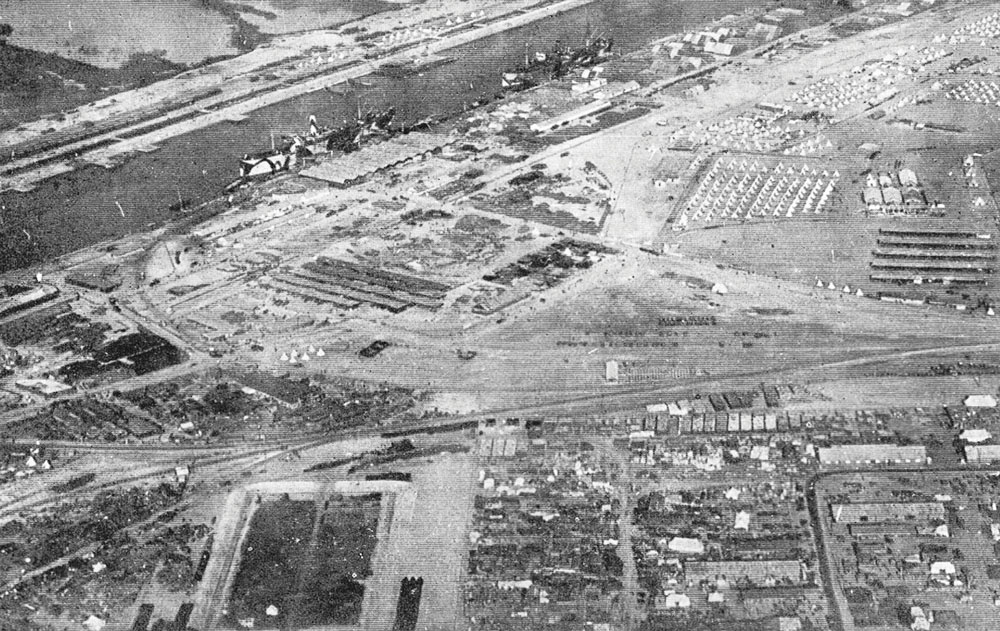
The massive base camp at Kantara.
‘For conspicuous gallantry and devotion to duty. He displayed great judgment and skill in the leadership of his three light patrols, and showed inexhaustible resource in overcoming the most serious physical obstacles. Later, in action he proved himself a dashing and competent leader.’
On 27 February the battalion marched to Samalut station, and entrained at midnight for Zeitoun. The first three weeks of March were spent on the rifle range, and carrying out route marches in the desert, with the only item of note being the trial by court martial of Private Philip Rees Beynon for theft, and the awarding of forty days Field Punishment No. 2. Beynon was later killed at the Third Battle of Gaza, on 8 November 1917.
At the beginning of March Lieutenant General Chetwode, commanding the Desert Mounted Corps, had his headquarters at Sheikh Zowaiid and his troops were covering the construction of the railway along the coast to Rafah. Sir Charles Dobell had the Eastern Force in the neighbourhood of El Arish. By the middle of the month, the railway and pipeline had reached Rafah, and Sir Archibald Murray decided that the time had come to strike a blow at the Turks, who had withdrawn to a strong defensive line running from Gaza on the coast to Beersheba, thirty miles inland, securing the only reliable water supplies.
Palestine has a series of four geographical parallel features. Between the sea and the Arabian Desert lies a long maritime plain, a central range of mountains, the Jordan Valley and the eastern range of mountains. There is a break in the central range, where the Plain of Esdraelon connects the maritime plain with the Jordan Valley. The Turks had their left flank on Beersheba at the foot of the central range and on the edge of the desert, while Murray’s troops were on the coast, with their lines of communication running back through the Province of Sinai along the coastal route. He decided that an attack along the coast towards Gaza was the safest proposition, as lines of communication would be more easily protected along the coast and water would be more readily available. Murray re-formed the Desert Column, which comprised the Australian and New Zealand Mounted Division, the Imperial Mounted Division and the 53rd Welsh Division. With his other two infantry divisions, the 52nd and 54th, in support, the stage was set for the First Battle of Gaza, the objects of which were: to seize the line of the Wadi Ghuzze and cover the advance of the railway; to prevent the enemy from retiring without a fight; and to capture Gaza by a coup de main, and cut off its garrison.
On 24 March the 24th Welsh crossed the Suez Canal to Qantara. The 74th Division would not be involved in this first stage of the campaign, however the following abbreviated account is necessary to give some understanding of the effect on the whole.
During the night of 25-26th March, Dobell’s troops moved into position in readiness for the battle; two mounted divisions and the 53rd Division moved to Deir el Belah, the camel brigade to Abassan el Kebir; the 54th Division to the el Taire hill; and the 52nd Division to Khan Yunis, with one brigade at In Seirat.
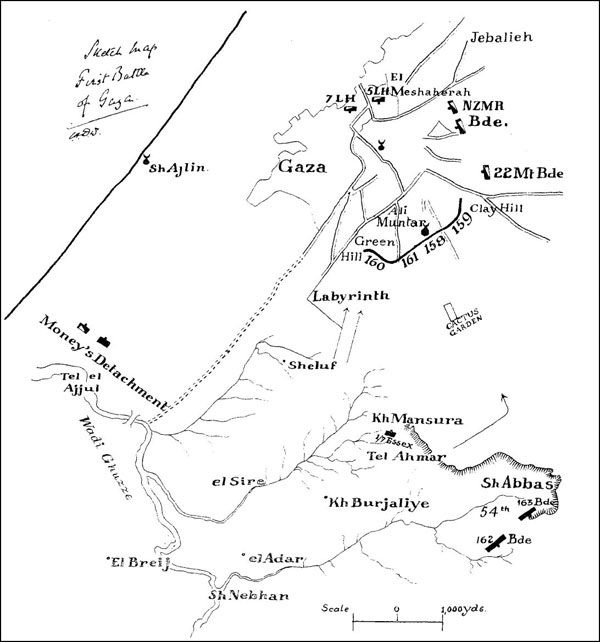
British dispositions for the First Battle of Gaza.
During the early hours of 26 March the troops began to move out, covered by a thick mist that had fortuitously rolled in from the sea. The Australian and New Zealand Mounted Division left Deir el Belah, crossed the Wadi Ghuzze, followed by the Imperial Mounted Division, and headed for Beit Durdis, five miles east of Gaza, while the Imperial Mounted Division made for el Menclur, on the Wadi Sheria. The leading troops then deployed to the sea, thus closing the exit from Gaza. At the same time the 54th Division crossed the Wadi Ghuzze and occupied the Sheikh Abbas Ridge; while on the left the 53rd Division advanced towards Ali Muntar.
The initial stage of the battle was a success and by the end of the day Gaza was surrounded. The 53rd Division had taken the strategically important Ali Muntar position, and the Australians and New Zealanders were fighting in the streets of Gaza. With night falling and Gaza still not captured, Dobell began to worry about watering his troops and horses and, after consulting with Chetwode, decided to withdraw his mounted troops from the town. Dobell had not received the news of the capture of the position at Ali Muntar and Gaza itself was on the verge of capitulation, so this withdrawal of his troops proved to be a costly error which allowed von Kressenstein to reinforce Gaza. The battle ground to a close by 27 March, the Allies withdrawing to Deir el Belah and Khan Yunus. In an attempt to mitigate the failure, Murray over-estimated the Turkish losses, stating in his despatches:
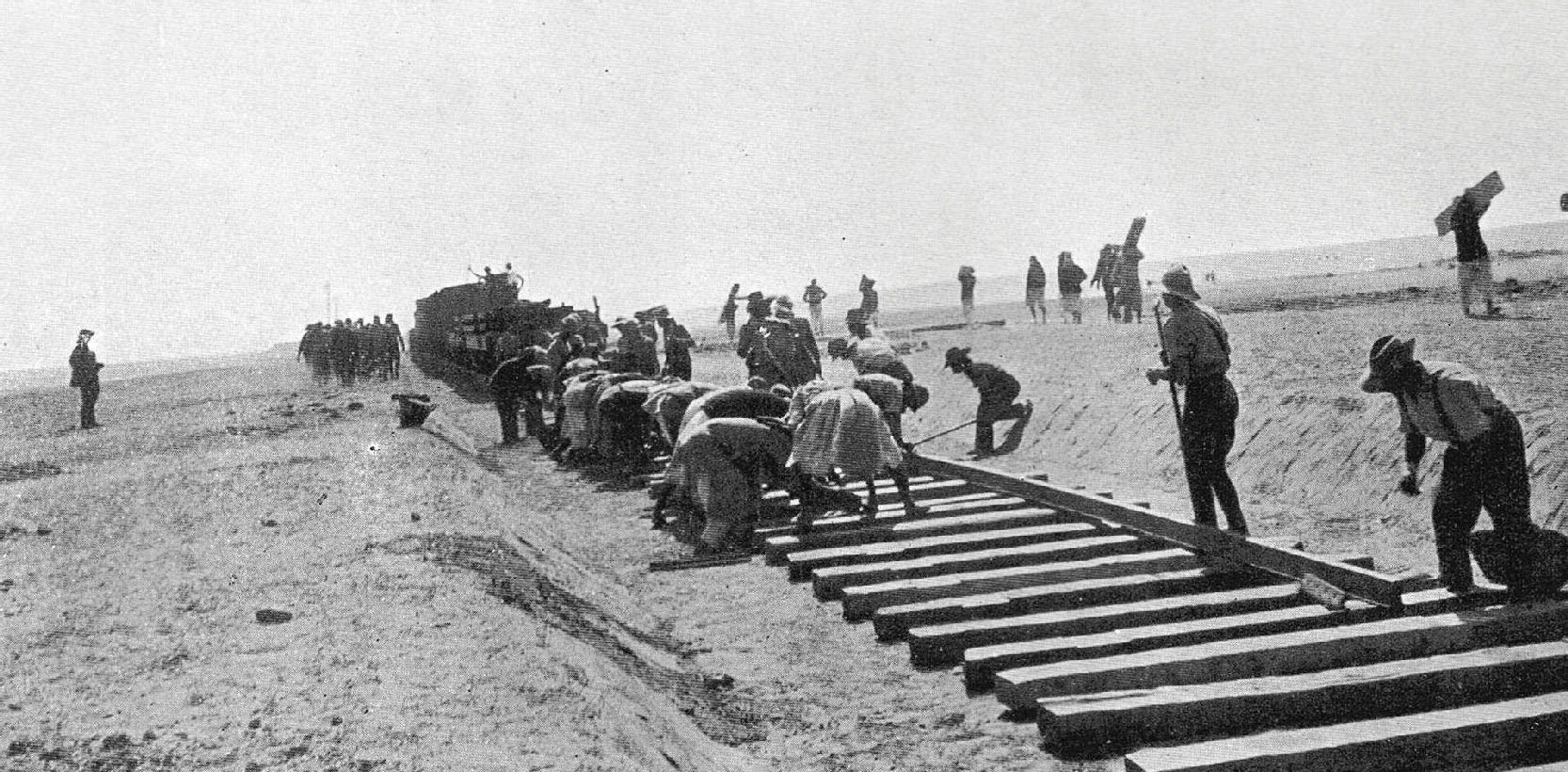
Laying the tracks for the Sinai Desert Railway.
‘The total result of the first Battle of Gaza, which gave us 950 Turkish and German prisoners, and two Austrian field guns, caused the enemy losses which I estimate at 8,000, and cost us under 4,000 casualties, of which a large proportion were only slightly wounded, was that my primary and secondary objects were completely attained, but the failure to attain the third object, the capture of Gaza, owing to the delay caused by the fog on the 26th, and the waterless nature of the country round Gaza, prevented a most successful operation from becoming a complete disaster to the enemy.’