
Chapter 5
On 28 March 1917 all of the officers and men of the 24th Welsh were inoculated for cholera, in preparation for their entry into the campaign. The elements of 231 Brigade assembled at Khan Yunus; the 10th Shropshire’s on 3 April, the 24th Royal Welsh Fusiliers and 24th Welsh Regiment on 4 April, the 25th Welsh Fusiliers and 210th Machine Gun Company on 5 April. Headquarters joined them on 6 April. From Khan Yunus the Division moved to Deir el Belah, where units took over sections of trenches and where 230 Brigade assembled.
As they entered Sinai, the men of the 24th Welsh found the climate to be hotter than they had encountered in Egypt and that water was much more of a problem, even with the pipeline. In a similar move to that made by the Germans during their withdrawal to the Hindenburg Line in March 1917, the Turks had destroyed the desert railway as they retreated east and the 74th Division had to march for long distances over deep sand while repairs were made to the tracks. A novel solution to the problem of marching thousands of men and mules through the soft sand was to lay rolls of wire netting in front of the advancing army; this greatly helped to make the terrible conditions somewhat easier.
In the meantime, Murray had been ordered to advance on Jerusalem without delay and as a result had got to work planning the next attempt to take Gaza. The Turks had now reinforced Gaza, so a different plan was drawn up. The attack was planned to be carried out by the 52nd, 53rd and 54th Divisions, with the 74th in reserve, as it was still assembling and had not yet received its artillery. Along with the artillery supporting the other divisions, however, was a detachment of eight tanks, and the Anzac Mounted Division and the Imperial Mounted Division would provide the mobile element.
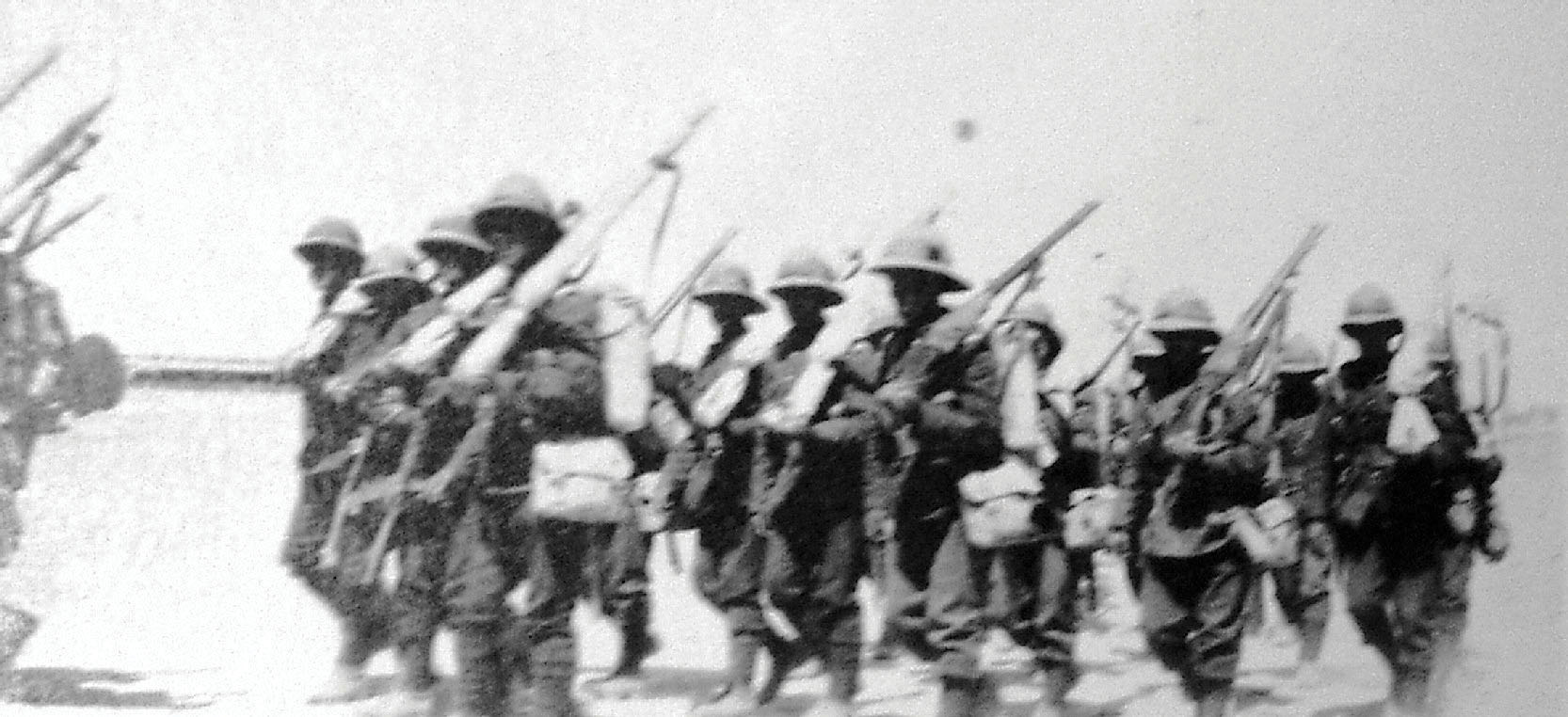
Troops of the 74th Division on a route march.
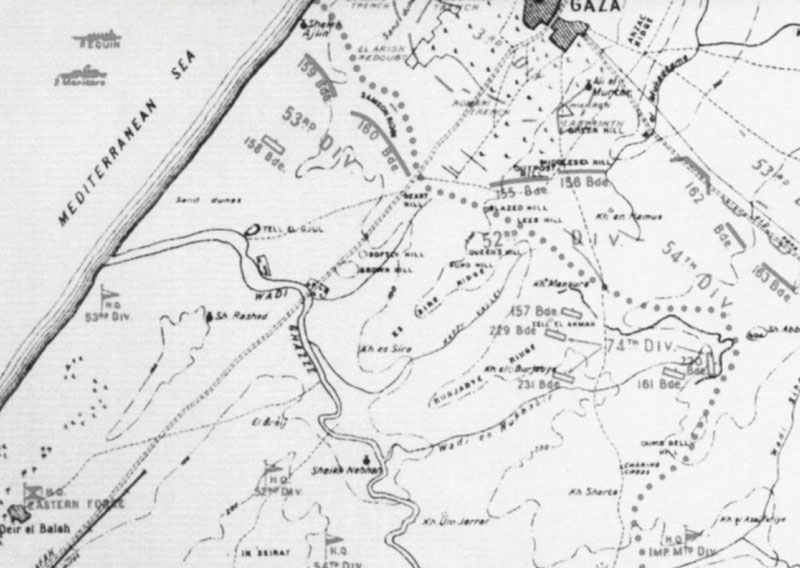
During April the 74th Division took its place in the line at Khan Yunus, relieving the 54th Division. On 14 April General Girdwood issued his orders for the second attack on Gaza although, because the division was in reserve, it played no real part in the battle. 229 Brigade took over the line held on the right sector by 162 Brigade, 54th Division, on 7 April, while 230 Brigade concentrated east of In Seirat and 231 Brigade assembled close up to the Wadi Ghuzee, ready to counter-attack any enemy movement against the right of the 53rd or the left of the 52nd Divisions, as required.
The Second Battle of Gaza opened at 5.30 on the morning of 17 April with the launching of a bombardment on the Turkish positions. British heavy guns south of Gaza were joined by gunfire from the French coastal defence ship Requin and two British monitors M21 and M31. The heavy guns fired on selected strong points, the Requin on Ali Muntar Ridge, one monitor on the Labyrinth, the other on the Warren. The 201st Siege Battery turned its 6-inch guns on Outpost and Middlesex Hills, and its 8-inch on the Labyrinth and Green Hill. The 91st Heavy Battery dealt with the El Arish redoubt and Maghdaba trench, which affected the front of the 53rd Division, and the 10th and 15th Heavy Batteries on other points opposite the 54th and 52nd Divisions. The bombardment also saw the first use of gas shells in Palestine. From right to left, on the right of the British line lay the Desert Column, with an outpost line stretching from el Gamli to the right of the 54th Division, At Sheikh Abbas the 54th and 52nd divisions then carried on the line through Mansura to Kurd Hill; and the 53rd Division held positions stretching from the sand dunes to the sea. Zero hour for the infantry attack was set at 7.30 am.
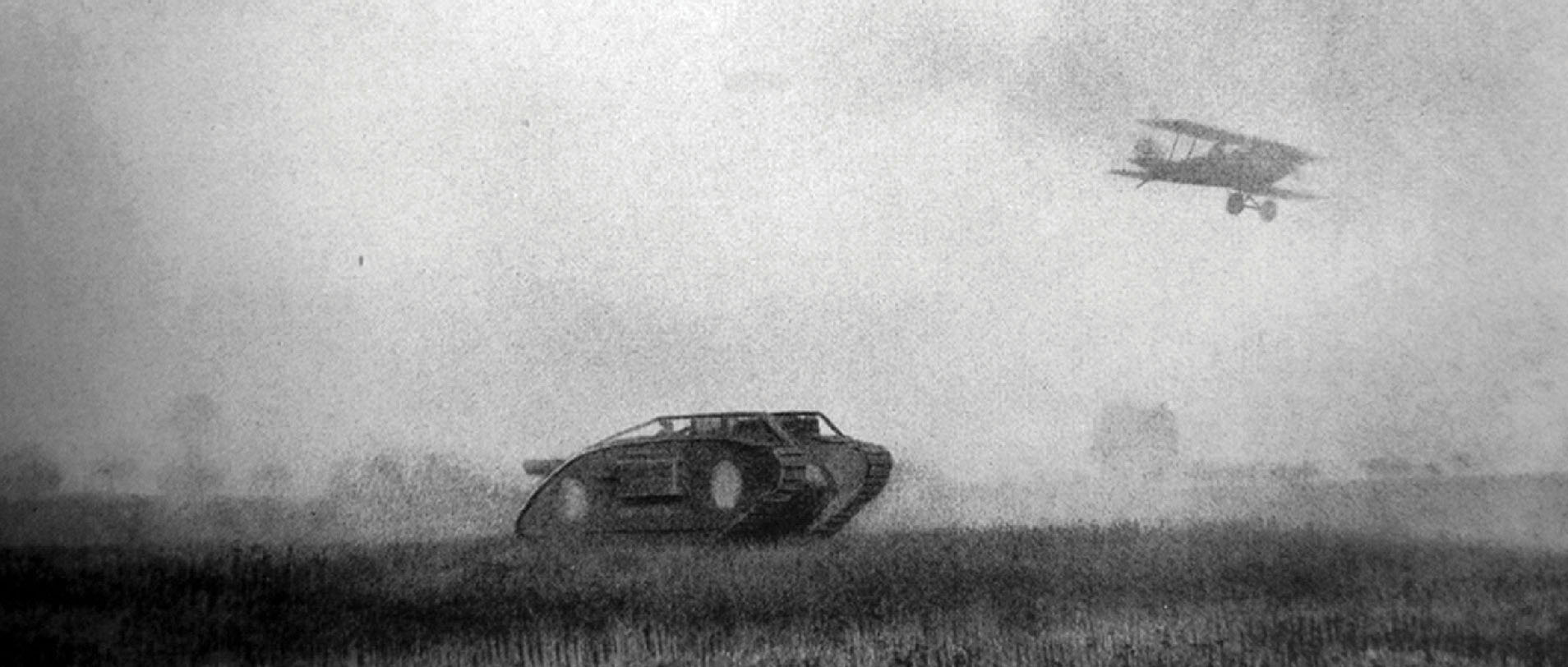
A lumbering British tank, not a pleasant place to be in the baking Palestinian sun.
At zero hour, the two mounted divisions advanced with the object of engaging the enemy in the direction of Abu Hureira and along the Gaza to Beersheba road. On the right flank, one brigade of the Anzac Division went to Tel el Fara, one towards Abu Hureira, and two were held in reserve. The Imperial Mounted Division attacked on foot, and successfully advanced towards Abu Hureira, occupying the Kh Sihan in conjunction with the Camel Brigade on the right of the 54th Division. Their attack diverted the enemy towards them and the Desert Column played a role of protecting the main infantry division’s flanks during the battle.
The 54th Division attacked down the slopes of Sheikh Abbas and Mansura and had to cross a bare plain towards the enemy trenches. There was not sufficient artillery available to cover the advance, and so the enemy artillery reaked havoc among the advancing troops, causing heavy casualties. The men kept moving on and reached the far side of the plain where they were met with Turkish machine-gun and rifle fire.
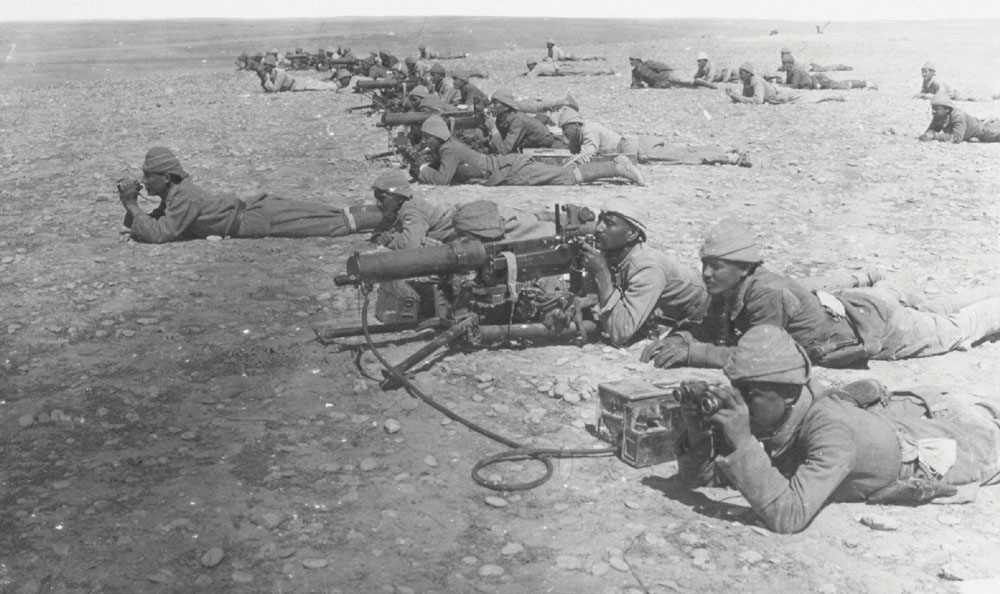
Ottoman machine gunners on the Tel el Sheria to Gaza Line.
It was only on the extreme left of the 54th Division that the attack gained some success, with the 11th Battalion, London Regiment capturing a Turkish trench astride the Gaza to Beersheba road. The remainder of the divisions attack faltered 200 metres away from the Turkish lines; even with the support of tanks, the enemy artillery had proved too accurate.
In the meantime the 53nd Division, led by 155 Brigade, had advanced along the Es Sire Ridge and, when sufficient ground had been captured, 156 Brigade wheeled around to attack Green Hill and Ali Muntar with the aid of a single tank. This attack faltered due to the inability of the brigade to capture and hold Outpost Hill, which was a vitally important position, and heavy fighting raged here throughout much of the day.
Major General Mott, commanding the 53rd Division, sent two of his brigades into the attack, and so 159 Brigade and 160 Brigade moved up along a strip between the coast and the Gaza road, passing through the front line, which was held by 158 Brigade. The former attacking brigade moved towards the high ground between Samson Ridge and Sheikh Ajlin, while the latter attacked Samson Ridge, with one battalion of 160 Brigade keeping in touch with the 52nd Division on the right flank. Each brigade was supported by a female tank. (Tanks were classified as ‘male’ or ‘female’ depending on the armaments carried. The male was armed with a six pounder gun in each sponson together with four machine-guns; the female was armed with machine guns only and was used mainly for anti infantry work).
The attack of 160 Brigade was carried out in full view of the defenders of Gaza and as a result the men came under heavy machine-gun and rifle fire. In support, the 266th Field Artillery Brigade targetted Samson Ridge and the gardens around the outskirts of Gaza with gas shells, while the French battleship Requin also covered the advance with her 16.5 inch guns from her offshore position. Despite this support, by 10 am the assault on Samson Ridge had petered out and Brigadier General Butler reacted by sending in the 2/4th Battalion, the Queen’s into the attack to support the 2/10th Battalion, Middlesex Regiment, which had become bogged down.
The Queen’s found the enemy rifle and machine-gun fire to be heavy and accurate, and suffered heavy casualties, although the battalion machine guns did good work after moving up onto Heart Hill to defend the flank.
The situation was getting desperate for the Allies. The 2/4th Battalion, Royal West Kent Regiment had lost their Commanding Officer wounded and their Adjutant killed, and as a result Major Arthur Preston Hohler, later to command the 1/4th Welsh, assumed command, only to find that the enemy fire was too intense to continue any advance for now.
By 12.45 pm the Middlesex, West Kents and the Sussex had began to advance again and stealthily moved forward to within 200 meters of Samson Ridge, which they then rushed and captured. Beyond the ridge the ground was partly cultivated and was interspersed with cactus hedges and scrub. The main enemy defences were beyond this ground, comprising deep trenches covered by scrub; the ridge had only been an outpost line, so the 1/1st Battalion, Herefordshire Regiment were ordered forward and occupied a ridge running southeast from Samson Ridge.
159 Brigade had fared better during its attack, as the Turkish troops in front of them had fled when Samson Ridge was taken; the brigade occupied its objective with little opposition. Corporal William Jones, of 29, Water Street, Carmarthen, recounted this moment in a letter home to his father;
‘The Turks were entrenched on a hill and we had to cross an open plain to get to them. They stuck there and peppered us until we got to within 20 yards of their trenches. Then the order was given to fix bayonets. That did the trick. As soon as they saw the gleam of our bayonets they jumped out of their trenches, dropped their rifles, and went like the wind. But we were soon after them, and we killed, wounded, and captured thousands of the blighters. The night suddenly came on or we might have been in Constantinople by now as nothing would have stopped us! Our regiment made a great name for itself.’
General Mott then moved up the 5th, 6th and 7th Royal Welsh Fusiliers of 158 Brigade, but it was soon realised that it would be futile for the 53rd Division to attempt any further advance with the ground well defended by Turkish riflemen and German machine gunners.
On the Es Sire Ridge the survivors of 155 Brigade were still barely holding onto Outpost Hill. The situation had now become deadlocked, necessitating reinforcements to enable any further advance. However, Sir Archibald Murray decided not to send the reserve brigade up but to wait and to continue the attack the next morning.
Sir Archibald Murray wrote in his despatches;
“Middlesex Hill, and a large area of extremely broken ground west and north-west of it, had been made by the enemy exceedingly strong. The nests of machine guns in the broken ground could not be located among the narrow dongas, holes and fissures with which the locality is seamed. Partly owing to this, and partly owing to the extent of the area, the artillery fire concentrated on it was unable to keep down the enemy’s fire when the Brigade on Outpost Hill attempted to advance… The reserve brigade of the 52nd had not been employed, and the remaining brigade was in a position to attack Green Hill and Ali Muntar as soon as the progress of the brigade on Outpost Hill on its left should enable it to do so. Up to this time, therefore, only one brigade of the 52nd Division was seriously engaged. The conformation of the ground, however, was such that the attack on Outpost Hill and Middlesex Hill could only be made on an extremely narrow front. It is possible that if the General Officer Commanding Eastern Force had now decided to throw in his reserves, the key of the position might have been taken with the further loss of between 5,000 and 6,000 men… As it was the General Officer Commanding Eastern Force, in view of the information received that our attack had not yet succeeded in drawing the enemy’s reserves, decided that the moment had not come for an attempt to force a decision by throwing in the general reserves.”
Casualties had been heavy during the battle: the 52nd Division had lost 1,365 men; the 53rd Division 584; the Camel Brigade 345; the Anzac Division 105 and the Imperial Mounted Division 547. The 74th Division had remained unused and as a result had escaped any losses; after deliberating with Dobell, Murray decided to cancel the attack and to consolidate the ground which had been won and as a result the British dug in.
Effective Turkish and Austrian artillery fire had concentrated on the attacking troops, and the assault was brought to a halt well short of the objectives, with heavy casualties having been sustained. The Turks had won the Second Battle of Gaza, suffering casualties themselves of 48 officers and 1,965 other ranks.
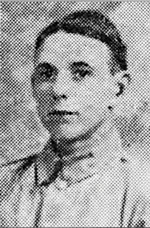
Private Frederick Southgate (320271), of Llanllwni. Killed at Gaza on 21 April 1917.
Conforming to its part in the plan of attack that day, the 24th Welsh had moved to Deir el Belah, taking up positions on Raspberry Hill, and in subsequent days; moved onto Tel el Ahmar and Charing Cross, before reaching outposts along Sharia Ridge on 23 April. By the end of the month the division had reached Tel el Jemhi, in front of Khan Yunus. No resistance was encountered, although a Turkish scout was captured on the morning of the 25th. The 24th Welsh lost just one man, Private Fred Southgate, killed on 21 April. Southgate was born in Ipswich in 1895; he had worked as a farm labourer for Mr. James Davies, of Abercwm, Llanllwni, prior to enlisting into the Pembroke Yeomanry in Carmarthen.
The men had been keen observers as the battle raged, and had watched the attack suffer under accurate Turkish artillery fire, which destroyed all of the supporting tanks. The men suffered from the khamsin, or sirocco, which blew throughout the 19th and 20th, causing much discomfort to men, camels and mules, with several cases of heat stroke suffered among the men and dozens of pack animals killed.
With the battle deemed another failure, Murray and Dobell were both relieved of their commands. In the reorganisation which followed, Sir Philip Chetwode took over the command of the Eastern Force from Sir Charles Dobell, and Sir H. G. Chauvell took over the Desert Column. The front, between Sheikh Ajlin and Tel el Jemmi, was divided into two sections; to the right, patrols of mounted troops took charge.
Sir Archibald Murray’s fourth and final despatch of 28 June 1917 contained a lengthy account of the Palestinian campaign during his time in command and attempted to offer some excuses for the two failed attacks on Gaza:
‘It is perhaps possible that if General Dobell had at this stage pushed forward his reserve (the 52nd Division) to support the 53rd, the result would have been different, but the difficulty of supplying water for men and horses would have been immense and impossible to realise by those who were not on the spot.’ (The First Battle of Gaza)
‘It is possible that if the General Officer Commanding Eastern Force had now decided to throw in his reserves, the key of the position might have been taken with the further loss of between 5,000 and 6,000 men, but this would have left my small force, already reduced, with a difficult line of front to hold against increasing reinforcements of the enemy, who, owing to the conformation of the terrain, could attack from several directions.’ (The Second Battle of Gaza)
Murray had in fact achieved a vital success that had been overlooked. Under his command the EEF had conquered the Sinai Desert and the foundations for the campaign had been laid down securely, with the establishment of the water pipeline, railway and efficient lines of communication and supply that would prove vital in the coming months.
While the 24th Welsh were digging trenches along the ridge at Sheik Abbas on 6 May, a hostile aircraft dropped a bomb on the men, killing twenty three year old Private David Lloyd, a farm worker from Llandovery. He is buried in Deir El Belah War Cemetery. The battalion in fact spent most of the month digging trenches, in awfully hot conditions, plagued by heat and swarms of flies, problems which would characterise the campaign. The conditions were taking their toll on the men. On 12 May 1917 Private Alcquin Christmas Evans (320495), the son of David and Harriet Evans, of Caefadog, Llanarthney, a 23 year old farm worker, died of enteric fever at Qantara. His brother Evan was killed in Belgium just three months later, on 10 August 1917, aged 28, and is commemorated on the Menin Gate Memorial in Ypres. Lieutenant S. H. Kirby was detached to command the 321st Light Trench Mortar Battery on 15 May, but apart from these items of news, the month was just one of hard work, digging trenches and road building.
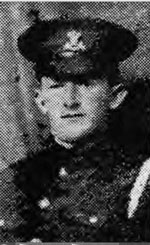
Private Alcquin Christmas Evans (320495), of Llanarthney. Died at Kantara on 12 May 1917.
June followed a similar pattern, interspersed with drafts of reinforcements to the 24th Welsh, with 156 men and three officers joining the battalion at Deir-el-Belah during the month: the most important news came on 27 June, when General Murray was replaced by General Sir Edmund Allenby.
A regular pattern now developed, with the 74th Division in the line, two brigades would hold their positions, while the third would be training and at rest. On 9 July the 24th Welsh was relieved by the 1/7th Scottish Rifles, and marched to Regent’s Park for training, reorganisation and rest. Much of the spare time was devoted to sport and, as well as football and swimming, the 24th Welsh played a series of rugby matches against the 4th and 5th Welsh. Throughout this period the division had begun receiving its artillery at long last, and a new branch of railway was laid from Rafah to Shellal, running along the road towards Beersheba on the south of the plain, interspersed with watering places, readying for the next move on Gaza.
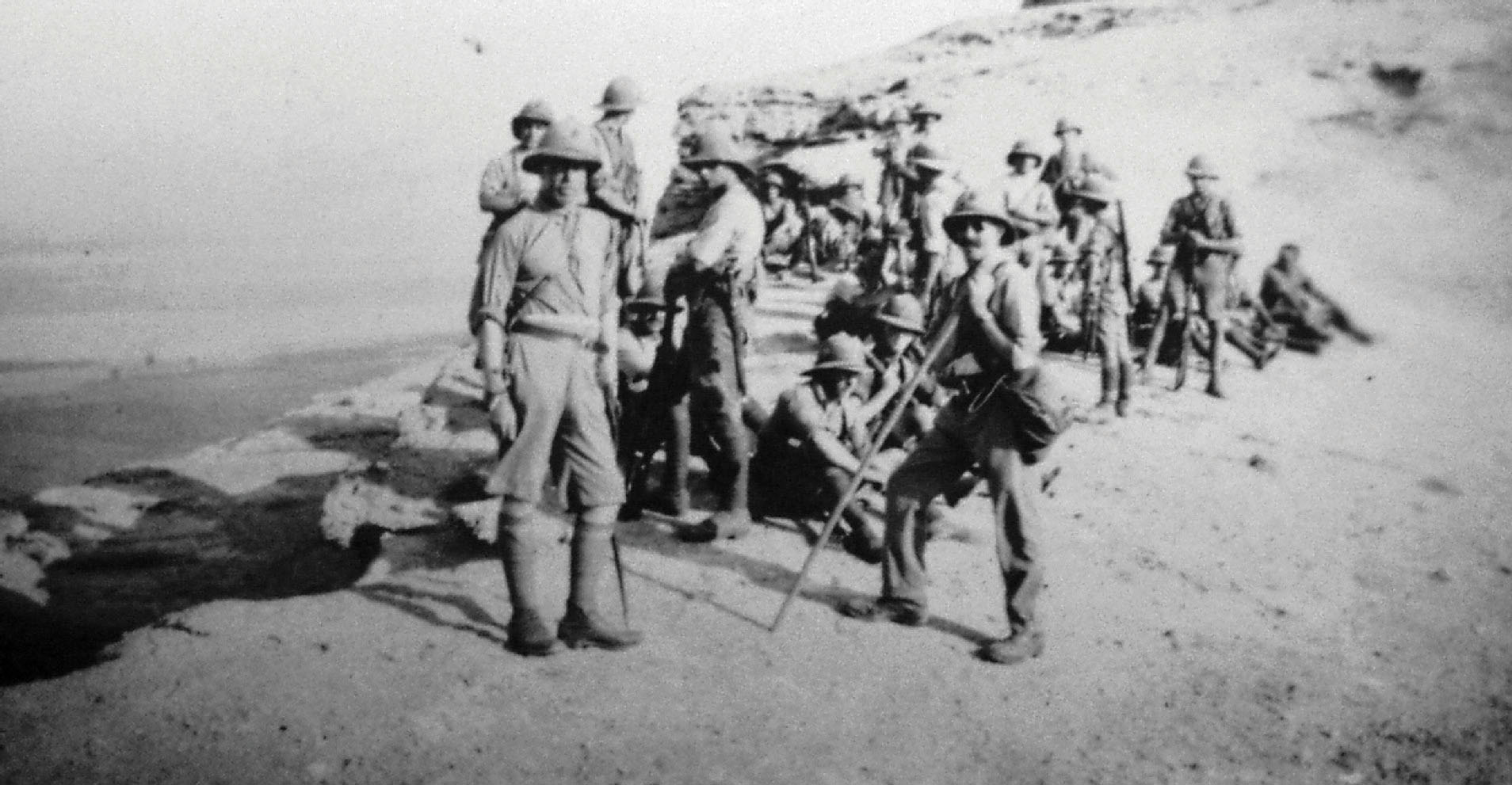
A route march in the Judaean Hills. (Shropshire Archives)