Chapter 6
The battalion lost its long serving medical officer on 13 July when Captain C. D. Mathias left to join the staff of the hospital at Giza. Lieutenant J. Fehily, Royal Army Medical Corps, took over his duties. The month was again uneventful, with a series of batches of men rejoining from hospital and other men falling ill and being sent to hospital. As well as the heat and flies, the desert abounded with scorpions and spiders, and any open wounds festered in the arid conditions. Spence-Jones and G. T. H. Bruce returned home on leave that month, with Major J. B. H. Woodcock taking over temporary command of the battalion. Woodcock was a solicitor’s clerk prior to the war, and had served with the Pembroke Yeomanry since his commission in 1906. He was an able substitute to his two senior officers, taking command of the 24th Welsh at several periods throughout the war.
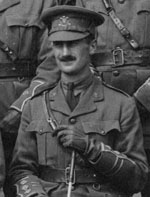
Major John Burrell Holme Woodcock DSO MID, of the Pembroke Yeomanry.
According to Dudley Ward in 74th Yeomanry Division in Syria and France, General Allenby soon got to grips with the situation facing him:
‘He found the Turkish Army covering a front of, roughly, thirty miles, from the sea and along the Gaza - Beersheba Road. Gaza was heavily entrenched and wired; the remainder of the line was held by strong works at Sihan, Atawineh, Baha, Abu Hureira, and Beersheba. There was a gap of four miles and a half between Hureira and Beersheba, and the other positions were about a mile apart. The British lines lay between the sea and Gamli, a distance of twenty-two miles. General Allenby decided to attack the left of the Turkish positions, and his divisions were set to work, readying for the next assault on Gaza.
‘Beersheba was not an attractive place. East of it was the most God-forsaken country, and the Dead Sea. To the north was Jerusalem, but between that place and Beersheba were the heights of Hebron, and the Judean Plateau, an arid, waterless, and mountainous tract of country. But the defences of Beersheba were less formidable than elsewhere, and were easier to approach - and Beersheba had water! With Beersheba in his hands, General Allenby would have an open flank against which to operate, and he was superior in mounted troops.
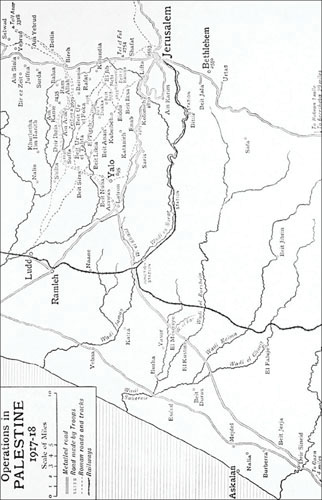
‘His plans, of course, included an advance on Jerusalem, and it would be as well to consider the nature of the country between the Wadi Ghuzze and that city…’
Allenby was known to the men of the Glamorgan Yeomanry who were serving in the battalion. On Tuesday 26 May 1914 he had inspected the Glamorgan Yeomanry in camp at Porthcawl. Allenby was not the only noteworthy commander in Palestine, however, as in the summer the Prussian officer, Erich von Falkenheyn, arrived from Verdun, following a short spell in Transylvania, to take command of the Ottoman army.
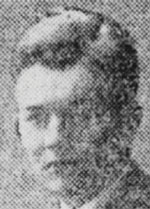
Trooper Frederick Charles Rees, of 6 Park Grove, Barry.
Spence-Jones returned from leave in August, and on the 3rd marched his battalion into a training area in the desert, west of the railway, where they undertook training in platoon formation and field firing. Another court martial took place that month, when Private Archibald H. Collins was charged with casting away his rifle in the face of the enemy. The charge was, however, dropped, and he was instead offered the lesser charge of losing his rifle and bayonet, resulting in the sentence of ninety days Field Punishment No. 2.
Several new drafts of men also joined the battalion during the month, with Second Lieutenant J. O. Rees arriving from the Officer’s School of Instruction at Zeitoun. On the 28th, news of a number of men of the 24th Welsh being mentioned in Murray’s despatch of 18 March 1917 was received by Spence-Jones, who proudly noted all of the men concerned in the battalion war diary: Lieutenant Colonel G. T. Bruce; Major L. Partridge, DSO; Captain R. H. P. Miers; Second Lieutenant C. H. Williams; 320515 Sergeant J. Allen; 320554 Sergeant R. G. Edwards; 320533 Sergeant A. T. Roberts; and 320579 Sergeant J. C. Venables, in the London Gazette of 6 July 1917.
On 31 July, the 74th Division carried out a night march, preparatory to being inspected on the following day by Allenby. A reorganisation of Allenby’s troops also occurred during the month, with the addition of three extra divisions: the 10th (Irish) Division, veterans of Gallipoli and Salonika; the 60th (2/2nd London) Division, veterans of France and Salonika; and the 75th Division, transferred from India.
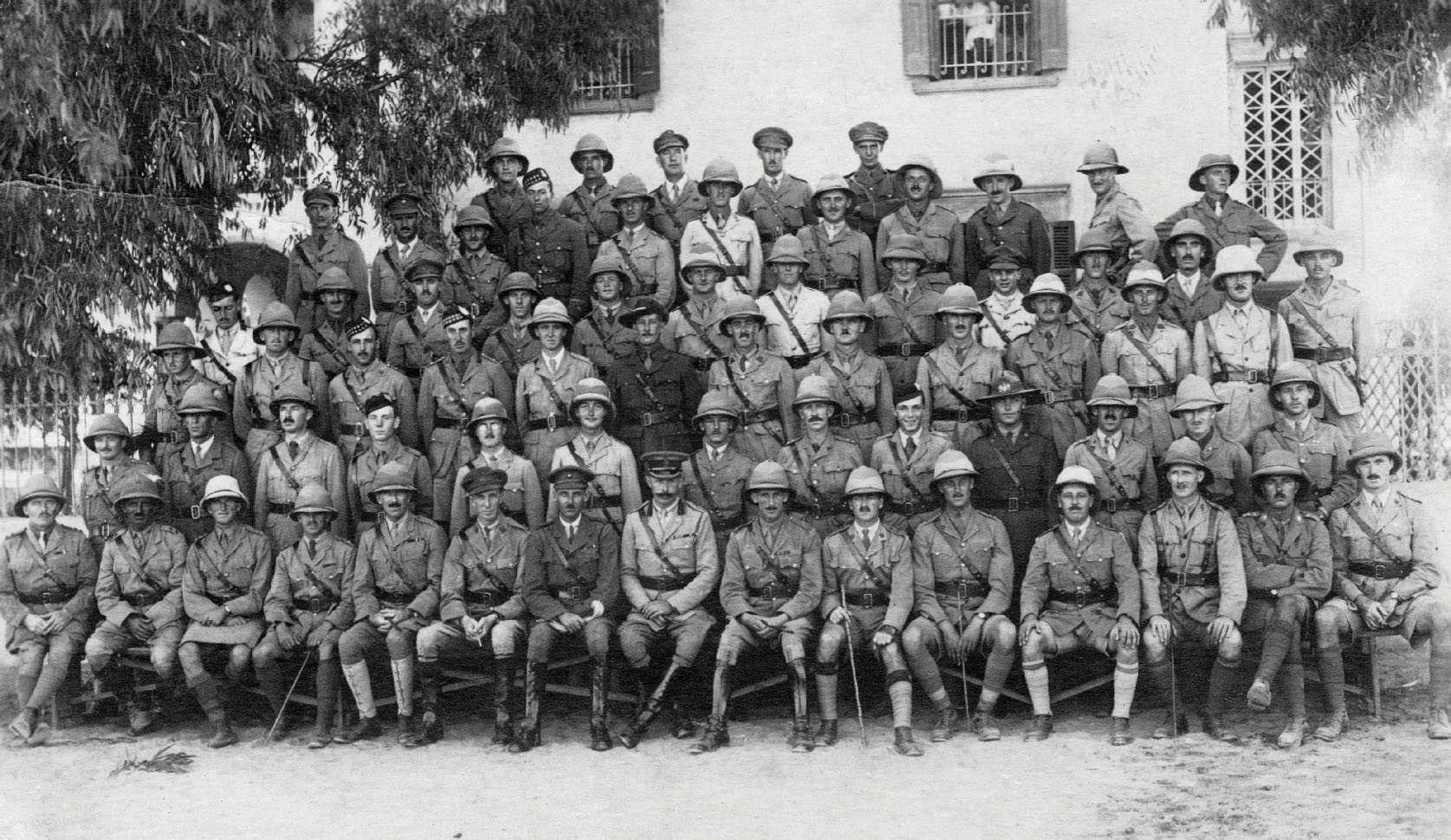
A group shot of the Imperial School of Instruction at Zeitoun, Cairo, on 20 October 1916.
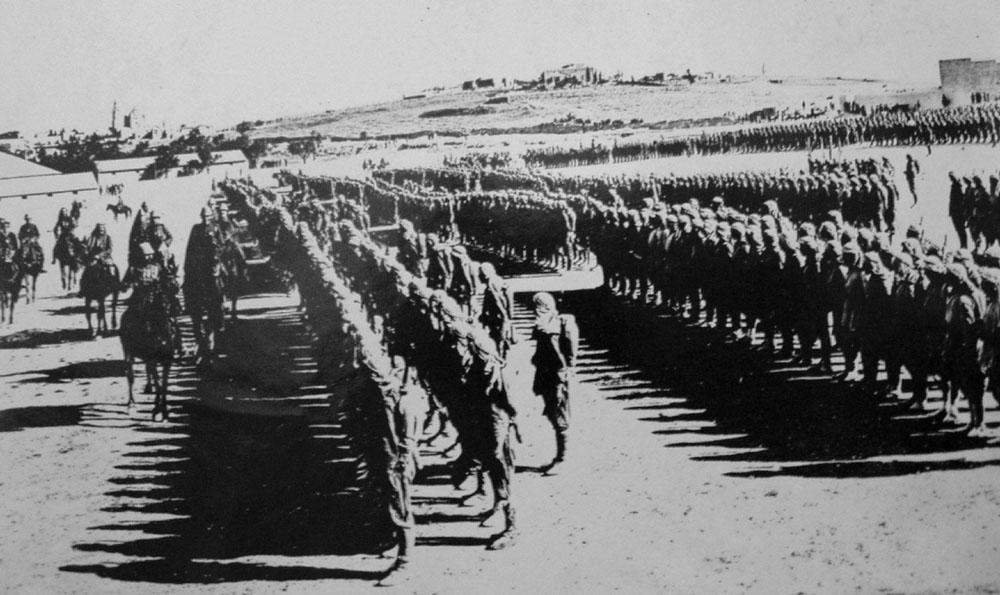
Ottoman troops, ready to defend Palestine.
Three Corps were formed: the Desert Mounted Corps, consisting of the Anzac Mounted Division, the Australian Mounted Division, the Yeomanry Division and the Imperial Camel Corps Brigade, under Lieutenant General Sir H. G. Chauvel; XX Corps, consisting of the 10th, 53rd, 60th, 74th Divisions, under Lieutenant General Sir Philip Chetwode; XXI Corps, consisting of the 52nd, 54th, and 75th Divisions, under Lieutenant General Sir Edward Buffin, with three Brigades of heavy artillery and the 7th Mounted Brigade as Army troops. There was also a composite force of: Imperial Indian Service Troops; 1st Battalion the British West Indies Regiment; a French Contingent; and an Italian Contingent; and the desert air force was also reinforced by the addition of another squadron.
Due to setbacks experienced by the Allies during 1916 at Verdun and the Somme, and in the early part of 1917 at the Champagne and Arras offensives, the Prime Minister, David Lloyd George, saw the need for some good news to bolster morale at home. He realised that Palestine would prove the best chance of this, and his parting words to Allenby had been: ‘I want Jerusalem as a Christmas present for the British Nation’. Also by now Russia had collapsed, freeing German troops for the Western Front, and Turkish troops to reinforce Mesopotamia in order to try and recapture Baghdad, which had been captured by Lieutenant General Maude in March. A successful campaign in Palestine would both bolster morale, and draw Turkish troops away from Mesopotamia.
Whilst building up for the forthcoming offensive, the 74th Division was worked hard throughout the remainder of the summer, and became expert in patrolling No Man’s Land. The mounted troops carried out daily expeditions towards Beersheba, gathering intelligence in readiness for the offensive; the Turks, although building their defensive system, had been fooled into believing that the forthcoming attack would be on the seaward side.
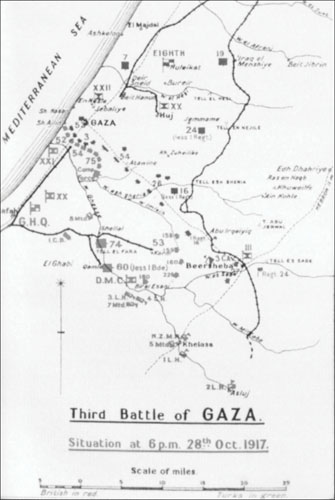
Allenby had realised that a frontal assault would be very expensive, so his plan for the offensive involved deception, to make the Turks believe that the main attack would be on Gaza. It would, in fact, be made towards Beersheba which, once captured, would open up the Hureira - Sharia defensive line, making Gaza undefendable. The date for the attack was fixed as 31 October, and elaborate preparations took place. Forces were moved into place under utmost secrecy; dummy camps were erected; supply lines were planned; motor transport was withdrawn and replaced with camels and mules. Water usage had been calculated at the rate of half a gallon a day per man, and five gallons for each horse, with drinking water to be distributed in copper fanatis (vessels), of which great dumps were built up; the artillery plan was laid down to commence on 27 October, and the naval bombardment two days later.
According to Dudley Ward, Allenby’s plan was that:
‘XXth Corps would deliver the main attack, capture Beersheba, and drive in the enemy’s left flank, while the Desert Mounted Corps would make a wide enveloping movement on the outer flank. The XXIst Corps and the Royal Navy were to occupy the attention of the enemy at Gaza during the early stages of the battle by a continuous bombardment, followed by an attack on Umbrella Hill and the defences on the left, to the sea. This attack was to take place between the attack on Beersheba and an attack on the Kauwukah System in front of Tel el Sheria. The idea of the latter phase was to advance in a north-westerly direction, take the Turkish lines in reverse, and occupy the high ground north of Sheria by nightfall so as to get the use of the water supply.’
The role of the 74th Division would be to assault the left hand section of the Beersheba defences, to the south of the Wadi es Saba, and training began in earnest during October. On 6 October the 24th Welsh marched from its rest camp at Regent’s Park to Apsley House Camp, and the following day onto Sheikh Nakhrur. Over the coming days the men trained as a brigade, taking part in brigade assaults against the ground east of Wadi Ghuzee. After a day spent on the firing ranges, the battalion moved to Abu Sitta on the 25th, Gamli on the 26th, then onto Khasif on the 29th, taking up its positions in the Black Line at Shropshire Wadi on the 30th.
Major General Girdwood’s orders for the 74th Division’s attack were as follows:
‘The attack will consist of two phases: 1st Phase, attack on 1070 works; 2nd Phase, attack on the main line.
‘1st Phase: The attack on the 1070 works will be carried out by the 181st Brigade, 60th Division. The time at which the 1st Phase will commence will be decided by the G.O.C. 60th Division. This operation will commence by registration and wire cutting by the guns of the 60th Division, and by registration and slow bombardment of works Z15 and Z16 by the 268th F.A. Brigade, 74th Division. This operation is calculated to last one hour.
‘During this period the 231st and 230th Brigades will co-operate as follows: A screen of infantry, accompanied by machine guns, will be pushed forward and will perform a double role: (a) assist in the advance of the 60th Division on the 1070 works; (b) cover the deployment in depth of the remainder of each brigade.
‘The 231st will conform to the advance of the 181st Brigade, and will endeavour to occupy the tributary wadis of Whale Wadi, and will engage by fire the enemy trenches Z16, Z15, and Z7.
‘The 230th Brigade will occupy the best available ground along the 960 Ridge.
‘Immediately the 1070 System has been captured, three 18-pounder batteries of the 74th Division will move forward to within wire-cutting distance of Z7 and Z6… The remainder of the artillery of the 74th Division will engage the enemy trenches Z7, Z6, Z5, along their entire front.
‘While the three 18-pounder batteries are moving forward, the assaulting infantry, accompanied by machine guns, will take every opportunity of advancing to the most favourable positions from which to commence the assault. The time the assault will commence will be decided by G.O.C. 60th Division.
‘The 231st Brigade will conform to the advance of the 181st Brigade, on its right; similarly the 230th Brigade will conform to the advance of the 231st.
‘When the main objectives of the Division have been captured, and should the enemy still hold on to the trenches north of the Wadi es Saba, the G.O.C. 74th Division will issue orders for an attack to be made on that system of trenches. This attack will be carried out by the 230th Brigade, 74th Division, from the south of the Wadi es Saba in a northerly direction, while the 158th Brigade, 53rd Division, which will come under the command of the G.O.C. 74th Division, will attack on the north side of the Wadi es Saba, from the direction of el Hathira.’
At 6.00 am on 31 October the Third Battle of Gaza was launched and, together with the remainder of 231 Brigade, the 24th Welsh began their assault on Beersheba at 10.30, attacking the town from the south western side, along the Wadi es Saba. The 1070 Works were captured with little fighting, with 24th RWF and 25th RWF leading the way. The 24th Welsh mopped up behind the leading battalions as they moved forward. The country was open, stony and desolate, with little cover except in the wadis, and the 24th Welsh saw considerable fighting during its advance. Within just a few hours the division had captured its objectives, so the 24th Welsh advanced for 2,000 yards in front of the two RWF battalions, and dug into a new defensive position around Wadi es Saba, where it remained for the night. In the wider scheme of things, XX Corps had successfully captured all of its objectives, leaving the town of Beersheba itself to the Desert Mounted Corps, who captured it later that day after a famous charge by the Australian Light Horse. The surviving Turkish forces withdrew.
Casualties had been relatively light in the battalion’s attack so far, with one officer, Lieutenant William Armine Edwards and eleven other ranks killed; Lieutenants G. W. Abraham, V. Griffiths and D. R. Smith and fifty six other ranks wounded. One of the wounded died on the following day; Private Christopher Burns, of Dublin and, two days later, Private Jack Llewhellin of Carew died of his wounds. Six other ranks were recorded as being accidentally wounded, and another was evacuated, suffering from shell shock.
William Armine Edwards was a well known Swansea personality. He was born on 3 May 1892, the son of William Henry and Margaret Hannah Edwards (née Williams), of The Hill, Sketty. He was educated at Harrow, and became a well known cricketer, playing for Glamorgan County prior to the war. He married Aerona Sails in 1914. He was mortally wounded during the assault on Beersheba, and died a few hours later. He is buried alongside several of his men in Beersheba War Cemetery.
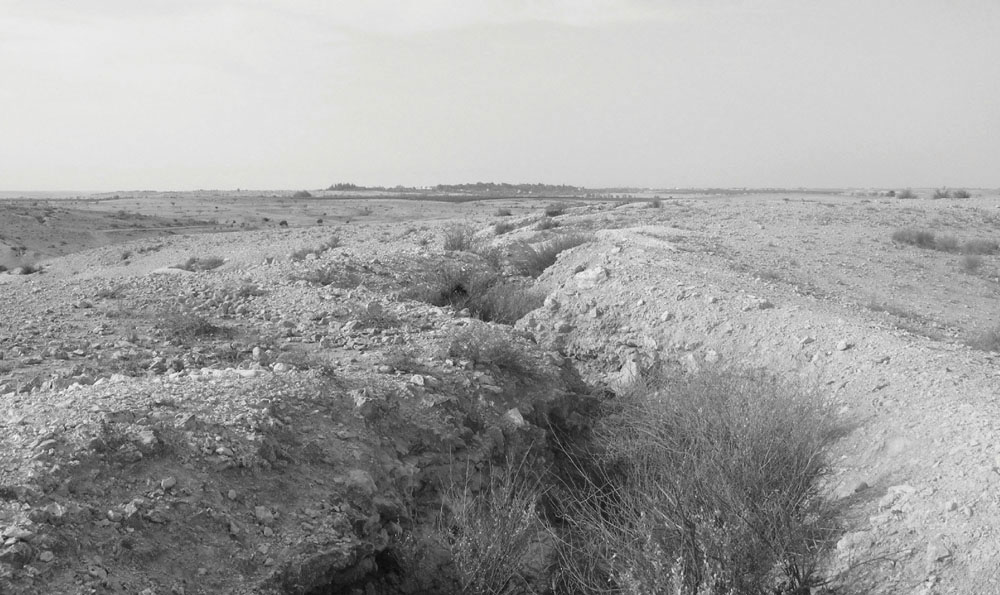
Remains of a British trench on the Beersheba battlefield.
Among the other rank casualties during this initial attack was Private Sydney Ernest Branfield, a poultry dealer from Llangunnor, who was shot in the heart by a Turkish sniper. His parents both died when he was a schoolboy, and Sydney was brought up by his elder brother at Nantycaws, Llandefeilog. He has no known grave, and is commemorated on the Jerusalem Memorial.
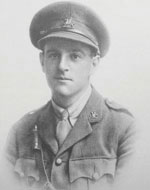
Lieutenant William Armine Edwards, 24th Welsh. Died of wounds suffered at Beersheba 1 November 1917.
Just after midnight on 1 November, the 24th Welsh was ordered to withdraw from their advanced outposts, back behind Wadi es Saba, where the men commenced work on clearing the battlefield. By the 4th, the battalion was in new positions, readying for its part in the next stage of the attack, while a party of officers from the battalion reconnoitred the country toward Sheria. The khamsin hit the troops that day, and the men spent an uncomfortable day sheltering as best they could.
RSM Teddy White wrote a brief letter home to his family on 4 November, chronicling the battle so far, which they received a month later:
‘Just a line to let you know I am quite all right and came through without a scratch. Very pleased to say not one of the boys from Haverfordwest was killed or wounded. We lost a few boys from the battle, but not many considering what they went through. They were simply splendid, taking trenches that were considered impregnable and held by large numbers of Turks and Austrians. The 24th showed their mettle by taking the trenches with the point of the bayonet, killing a considerable number and taking many prisoners. They ran away like rabbits; I shall never forget the sight. At night we had to cross the battlefield in the full moonlight to take up rations. I could tell you heaps more, but dare not, though one thing I can say, and that is, you can tell anybody that the Welshmen fought Johnny Turk in his best position and positively wiped the floor with him. One of our boys is worth ten of his, they are very big chaps and have a most awful looking bayonet with a saw-back, but have not the pluck to use it. We shall be in it again very soon, and hope I shall be lucky enough to come out again safely.’
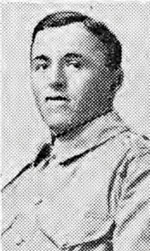
Private Sydney Ernest Branfield, of Carmarthen.
With Turkish attention drawn towards Beersheba, the defences of Gaza were attacked on the 2nd by a strong force comprising the 52nd, 54th, and 75th Divisions, supported by the guns of HMS Grafton, the monitors Nos. 15, 29, 31 and 32, the destroyers Staunch and Comet, and the river gunboats Ladybird and Amphis.
The original plan after the capture of Beersheba had been for the 53rd (Welsh) Division to make a frontal attack on the Kauwukah System, north of Beersheba, while the 74th and 60th took the whole of the fortified area in flank and reverse. However, the Turks had reorganised, and counter-attacked the 53rd Division, so the 60th Division was ordered to attack the Kauwukah System, and the 74th therefore had the original task of two divisions. As a result, at 6.40 am on 6 November 231 Brigade carried out an assault on the defensive works north of the Wadi es Saba. The 24th Welsh played a full part in the successful attack, capturing the works along with seventeen unwounded prisoners and two machine guns. Spence-Jones then took the battalion forward towards its next objective of the high ground south of the Wadi Sheria, known as the Sheria Heights and, after hand to hand fighting, drove the Turks off. The Welshmen dug into their hard won positions, and during the afternoon beat off several Turkish counter-attacks, all the time suffering from enfilade fire from the right flank. Spence-Jones was forced to swing the right flank of the battalion around to a ridge about 100 yards to the rear to protect the main bulk of the men from attack there, but soon after dusk the 6th Mounted Brigade arrived, straightening the line and easing the pressure from the flank.
The 24th Welsh was relieved during the evening by the Dorset Yeomanry, of the 6th Mounted Division, and moved back into support. Casualties had again been relatively light, at least by Western Front standards, with Second Lieutenant John Thomas Richards killed, along with thirty two other ranks. Wounded were Captain Geoffrey William Pepperall Abraham; Second Lieutenants John Oswald Rees and Arthur William Hunt; and 120 other ranks. Several of these wounded men later died as a result: Second Lieutenant Rees died of his wounds on 8 November 1917, Captain Abraham died on 19 November, and Privates Richard Emlyn Davies (60665), Wilfred George Knight (61614), Philip Rees Beynon (320608), Charles Badam Prosser (320262), Hugh Slader Glanville (320229), David John Thomas (320328) and Harold Clifford Edwards (320779) died of their wounds in the following days.
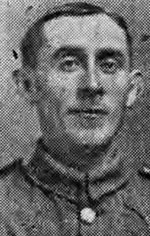
Private John Davies (320373), of Llangain. Killed at Beersheba on 6 November 1917.
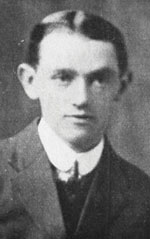
Corporal David Robert Jones (320211), of Lampeter. Killed on 6 November 1917.
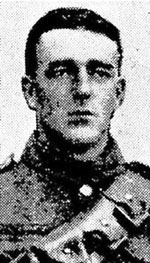
Lance Corporal David Charles Saer (320122), a postman, from Llanboidy. Killed at Beersheba on 6 November 1917.
One of the men killed during the fighting to take the works on 6 November was Private John Davies (320373) of Llangain, near Carmarthen. He worked at his father’s woollen mill prior to the war, and left behind a widow and young child. His brother, William Charles Davies, was killed while fighting with the 10th Battalion, Australian Imperial Force in France on 30 May 1918.
Corporal David Robert Jones (320211), was another man killed on the 6 November. He was the son of John and Sarah Jones, of Cefnbryn House, High Street, Lampeter, and had served with the Pembroke Yeomanry for several years prior to the war.
Private David Charles Saer (320122), was born in Llanboidy, the son of Charles and Phoebe Saer. The family later moved to Capelmair Villa, St Clears. ‘Dai’ worked on the local postal staff pre war and had served in the Pembroke Yeomanry for several years, mobilising in Whitland in August 1914. All three of these men are buried at Beersheba War Cemetery, as are most of the casualties of the battle.
By 8 November the battle had drawn to a close; had fallen on the previous day. The 24th Welsh were employed in clearing the battlefield, salvaging equipment and gathering the dead for burial in Beersheba. Only four of the men killed have no known grave, and as a result are commemorated on the Jerusalem Memorial: Private Moses Jones (320224) of Llanfynydd, another postman; Private Martin Kane (17335) of Swansea, a former member of the Swansea Pals; Private Ezra Howell Rees (320841) of Nantyfyllon; and Private Joseph Smith (59186) of Durham.
Teddy White wrote a letter home on 8 November to update his family about the latest action:
‘Am still all right and going strong, though we have been through a most Hellish fight, the worst we have ever had. Am sorry to say we had heavy casualties, but ended up by taking every trench and redoubt for miles. Our Battalion suffered something terribly. I must not say how many were killed and wounded, but God knows it was too many young lives to be given up. We had our revenge before the end of the day, and a good bit more too. I came across a wounded Turk yesterday while crossing the battlefield, and took out my revolver to shoot him, but bearing his cries for mercy, thought it the better part of valour to take him prisoner instead, though the Turks would not have showed any of us so much mercy. I never expected to write another letter home again, as I thought once it was all over on us, but our boys fought like heroes and drove them out of their trenches at the point of the bayonet when they outnumbered us three to one, but, sad to say, the best and bravest of our boys are gone. I had some narrow escapes, but seemed to have something shielding me all day as we could see nothing but death in front of us, but once we got them on the run, then we had our own back - the cowards! I saw a cavalry charge and shall never forget it, it was grand. We are getting ready for the next fight, but I think we have broken their hearts and have captured a lot of their guns, men and war material. We gave him a top-hole hiding and took all we set out to do. There were many Germans as well as Turks and Austrians among the prisoners we captured. Our boys were simply splendid; nothing could stand in front of them. The old 24th made a name for itself that will never die; the General told us that after it was all over. My word, it was terrible while it lasted. Our boys are hot stuff with the bayonet; the Australians have christened us the Welsh Ghurkhas. I could give you the name of one of the Haverfordwest boys who himself killed eleven Turks and another who with two bombs cleared a trench with twenty Turks in it. My own little bit I’ll say nothing about, but I did my duty, and kept the supply good all day no matter what stood in our way. I am so proud to belong to such a Regiment. Some of the positions we took the Turks had been working on for over six months. Our Colonel and Officers were really splendid and there is no doubt that we have really broken the back of our fighting out here.’
A letter sent home by another member of the 24th Welsh just after the capture of
Beersheba and which is of interest was printed in the Aberdare Leader:
‘A Welsh soldier, who has visited Beersheba in Palestine, says that the place did not appeal to him very much. The most interesting item there was a railway with its rails made in Dowlais. And we in Aberdare, which place is illuminated nightly by the Dowlais works, have a tramway with its rails made in Germany.’
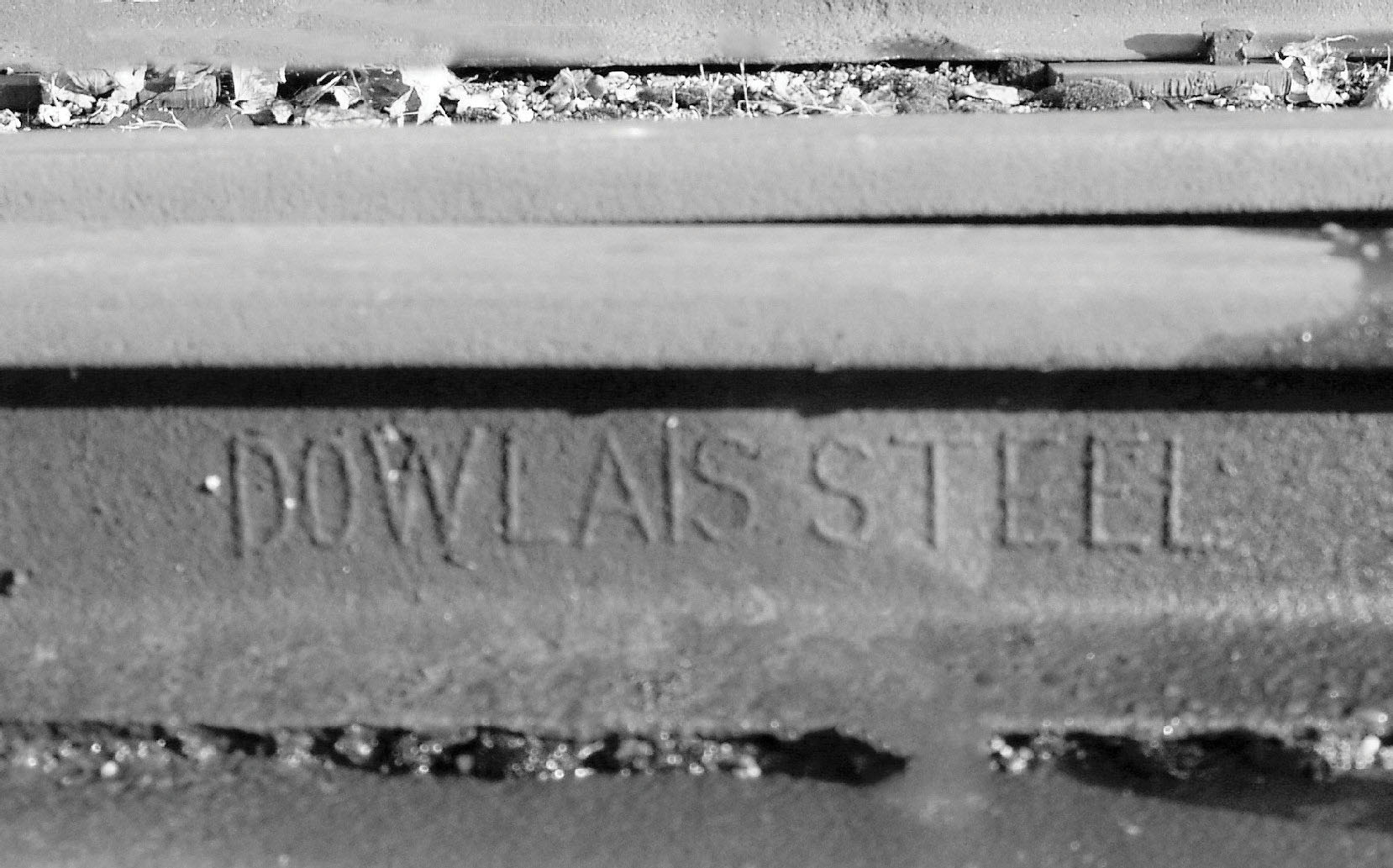
The famed Dowlais Steel.
With the fall of the Sheria position, Allenby now had ample water supply for his troops although, during their retreat, the Turks had smashed all of the windlasses and buckets which were used to draw water from the wells. The only substitute, rigged up by the divisional engineers, were canvas buckets suspended on telephone wire. With the Turks in full retreat northwards, the route to Jerusalem lay open. The 24th Welsh moved to Irgeig on the 9th, before marching to Gos El Bazai. Over the coming days the battalion moved on via Shellal (17 November) and Red House (18 November) to El Majdel, and then onto Nahr Sukreir and Junction Station, which had been cleared by advance elements of the EEF after the Battle of Mughar Ridge on 13 November. Junction Station was an important halt, where the branch line to Jerusalem left the main line from the coastal railway. The capture of this was vital to the success of further advances.