
3
Macedonian kingship rested with members of one clan, the Argeads. Alexander descended from Argead kings who can be traced with some accuracy to the late sixth century. His father Philip was an Argead and his mother Olympias became affiliated with the clan through marriage. The connection by birth, consequently, was an essential factor in the determination of every successive king. The position of king, once secured, brought assets unavailable to others, but it also produced serious threats to the retention of power. Beginning with the history and nature of the Argeadai, we will turn to the way that regal power was utilized by Philip II and the significance of Philip’s accomplishments for his son and successor, and then to the other half of his parentage: by the time of the reign of Amyntas III, Philip’s father, the role of the queen-mothers was not negligible, and Olympias was no exception.
The Argead Line
Through his father, Alexander was a member of the Argead line, the royal clan of the Makednians. Although his mother Olympias was Epirote, maternal lineage seems not to have been a factor that disqualified a king’s son as a potential heir to his father: Philip’s own mother was of mixed Illyrian and Lynkestian ancestry, and all three of her sons were acclaimed king.
In his account of the Persian Wars, Herodotos has good reason to include references to Macedon and its kings, Amyntas I, who ruled until 498/7, and his son, Alexander I, who succeeded his father as king, enjoying a long reign until c. 454. Describing Alexander’s mission to convince the Athenians to join the Persian cause, Herodotos recounts the origin of the Argead line and Alexander’s place in it.
Alexander (I) was the son of Amyntas (I), Amyntas of Alketas; the father of Alketas was Aeropos; of Aeropos, Philippos; of Philippos, Argaios; and of Argaios, Perdikkas — who first won the sovereign power. (VIII.139)
To trace the origin of the line, the father of history continues that Perdikkas I took power over the Macedonians in this way: Three brothers, Gauanes, Aeropos, and Perdikkas, descendants of Temenos, fled from Argos [in Greece] to Illyria and from there crossing into upper Macedonia they settled in the town of Lebaia. There they took on work for the king in exchange for a wage, one tending the horses, another the oxen, and the youngest of them, Perdikkas, the rest of the flocks . . . The king’s wife cooked the food for them. When baking, the bread for the boy Perdikkas swelled to double its normal size. Since this always happened, she reported it to her husband. On hearing this it quickly occurred to the king that it was a sign of something important. Calling for the servants, he commanded them to leave his country. They asked, in all justice, to be paid their wage so that they might leave. While the king was hearing this request for a wage, the sun was shining through the smoke-hole in the house, and the king recklessly said, “I give this just wage to you,” pointing to the sun. The elder brothers Gauanes and Aeropos stood dumbstruck on hearing this. But the boy, who happened to be holding a knife, said “We accept, o king, that which you give,” and traced an outline on the floor with his knife and, gathering the sunrays into his lap three times, he and the others departed. (VIII.138.1—5)
The king decided that there was something strange in all this and sent riders on horseback to stop the brothers. A river allowed the brothers to cross, but its waters then rose so high that the pursuers were unable to proceed. Eventually the young men reached another part of Macedonia, called the Gardens of Midas, where wild roses producing blooms of 60 petals emitted the sweetest fragrance in all the world.
The tale has many signs of folk tale but, at the same time, reveals the Macedonian view of an early kinship with Greece. It may also suggest some uncertainty about the origins of the Argead line due to the existence of alternative accounts of the progenitor of the clan. Another version makes one Karanos - sometimes described as a brother of the seventh-century tyrant of Argos - the founder. However, the Greek word karanos carries the generic meaning of “ruler.” The lineage of the Makednians as given by Hesiod makes the progenitor of the line Makedon. Makedon was the son of Zeus and, through his mother Thyia, the grandson of Deukalion and, thus, cousin of Doros, Aiolos, and Xouthos, who were the progenitors of the Dorians, Aiolians, and lonians (Catalogues of Women and Eioai fr. 3.) Both accounts may reflect attempts to relate Macedonians to the Greeks, and many concur with the view of Eugene Borza that these accounts of the Argeads’ origin in Argos emerged in the fifth century and were centered on Alexander I, who was known as the Philhellene.
Although the origin of the royal family of Macedon remains uncertain, its importance in Macedonian rule cannot be denied. To have any expectation of kingship, membership of the line was essential. At the same time, conditions associated with the increasing size of the clan produced collateral branches, and tensions between them could and often did create grave difficulties for individual Argeads.
An immediately apparent advantage is that birth into the clan offered the possibility of kingship. It was a crucial factor. Normally a king would be succeeded by his own son, as Herodotos’ account of the relationship between the first six kings indicates. However, this was not always the case: on the death of Amyntas III, kingship went to his son Alexander II, but Alexander was succeeded by a brother. Another usual practice was the award of kingship to the first-born son, but again there were exceptions, especially when sons of the deceased king quarreled amongst themselves. Moreover, the nature of our evidence about the internal affairs of Macedon precludes certainty about dates of births. Alexander III, for example, may have been Philip’s second son.
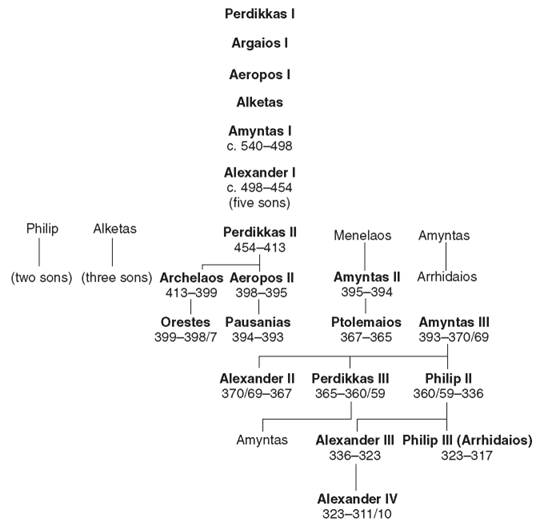
Figure 3.1 Argead genealogy. Rulers are shown in bold
The proliferation of branches further complicated succession. In the struggle following the death of Perdikkas II described in chapter 2, members of three Argead branches held the kingship for short periods. Later, on the death of Philip II, kingship might have returned to the line of his brother Perdikkas, who had preceded Philip as king. Perdikkas had a son, Amyntas, who because of his youth was by-passed for his uncle Philip. By 336, Amyntas was an adult who had a just claim to kingship. Later, when Alexander III died in 323, the choice of the army assembly was Philip’s son, Philip Arrhidaios, while the choice of Alexander’s generals was Alexander’s child, should that yet unborn child be a male. Thus, while the choice seems to have been narrowed to members of the Argead clan for several centuries before the time of Alexander, there were many Argead candidates for succession.
The nature of Argead rule
This bond between the Argead king and the army assembly was essential to succession and subsequent rule. Herodotos described Alexander not only as basileus, or ruler, of the Macedonians but also as strategos, or commander, of the kingdom’s military (IX.44). Precisely what the two terms connoted in the minds of the Macedonians cannot be discerned; it is even uncertain whether the Macedonians themselves knew their leaders as basileis, for the coins struck by Philip II do not bear the title, and it is only toward the end of the reign of Alexander III that we find an inscribed coin connecting the two words Alexandrou and basileos. On the other hand, it is certain that duties and prerogatives associated with command were integral to holding the basileia, or rule, over the Macedonians.
The sum of the powers and prerogatives of Macedonian kings was, in many respects, similar to that of Homeric heroes: both the heroes of epic fame and the Macedonian rulers gained and maintained power by means of personal ability rather than as holders of an official position. Macedonian kings were always more or less successful according to their individual capabilities and, because of the constant threat of invasion from neighboring peoples, proven military leadership was an essential, ongoing requirement. As we have seen, the history of Macedon both before and after Alexander’s reign demonstrates well the dangers inherent in the kingdom’s “middle” position between continental Europe and the Greek peninsula, regularly inviting intruders from every direction.
This need for military strength to preserve the kingdom was mirrored in Macedonian institutions. By the time of Philip II, and perhaps as early as the reign of Alexander I, all free men capable of bearing arms were of primary significance to the preservation both of the state and, consequently, of the power of an individual ruler. It was the right and responsibility of the army assembly to name the king. And inasmuch as the chosen man would lead the army to victory or defeat, he must possess pronounced qualities of leadership in the field, for the king was expected to lead his men not only by his knowledge of logistics and strategy but also through his personal prowess in battle, fighting in the forefront as did Achilles, Diomedes, and all the other leaders of contingents at Troy.
Further enhancing the need for military strength was the nature of internal politics within the kingdom. Other noble families existed even in lower Macedonia before the expansion of the kingdom into upper Macedonia, but that expansion brought into the state a number of clans as “royal” in their own kingdoms as the Argeads were in Macedon. Diplomacy in dealing with these families was important, certainly, but Macedonian soldiers under the command of their king were the foundation upon which diplomacy might be successful. The elite of the enlarged kingdom enjoyed the status of the king’s companions, or hetairoi. Over time, ties of loyalty acquired a force that went beyond the threat of physical retaliation if the ties were broken. We will explore these developments more fully in chapter 5.
One means of forging tighter links came with the expansion of the kingdom’s territory, which provided an opportunity to establish an economic bond between the king and newly recruited companions. It has been argued that land acquired by conquest became the king’s to grant in use to others, in return for certain obligations due him. As a Macedonian king - like Philip - extended the reach of his kingdom, he increased the amount of land available for many purposes, including new Macedonian settlements. Occupants of the newly incorporated territory might include companion warriors recruited from other parts of the Aegean sphere. Nearchos of Crete settled in Amphipolis, the former colony of Athens, during the reign of Philip. Nearchos was one of the companions, or hetairoi, of Philip and, later, of Alexander, for whom he served as a senior advisor. The brothers Erigyrios and Laomedon were from Mytilene on the Greek island of Lesbos; they too settled in Amphipolis and became hetairoi of Philip and, then, of Alexander.
Another means of tightening the bond with other noble families was an innovation attributed to Philip E the policy that the sons of important families of upper Macedonia be sent to Pella to be trained as pages (bodyguards and future officers) of the king and associates of his sons. The arrangement served several ends. It provided necessary elements for efficient civil and military administration both in the present and into the foreseeable future. It also put hostages for the good behavior of their fathers into the hands of the Argead king. Among the sons of the high nobility from other parts of the kingdom were Krateros, Perdikkas, and Philotas, who would be important officers in Alexander’s army. Hephaistion, the person reputed to be closest of any one to Alexander, was also raised in this system at Pella.
A forum in which views were shared among heads of elite families appears to have been a further dimension of the bond between the Argead kings and their near peers. Sources reporting on Alexander’s rule mention his regular meetings with his major subordinates. When he had been informed of the movements of Dareios and his army before the battle of Issos, for example, Alexander gathered his companions to inform them. They encouraged him to push forward, after which he dismissed the meeting (syllogos, joint conversation) (Arrian II.6.1). Later, when the Macedonians were engaged in the siege of Tyre, envoys arrived from Dareios with the offer of 10,000 talents and cession of the land within the Euphrates River extending to the coast of the Hellenic sea. Alexander called together his companions in a syllogos to discuss the offer (Arrian II.25.1-2). Membership and attendance in these meetings would have been fluid, predictably, as officers were dispatched to carry out responsibilities far from the camp of the king or were permanently eliminated by death. It is likely that Philip employed a similar forum for discussion among his key companions; however, it seems unlikely that a fixed body constituting a formal council existed in Macedon before the Hellenistic period. Rather, in Homeric style, those hetairoi at hand and in favor would be consulted at the pleasure of the king.
Embedded in this foundation of military command and of ties of loyalty with other important families were other features of royal power, one of which was religious responsibility for relations with the gods. The identity of Macedonian divinities is difficult to ascertain, especially for the period before the reign of Archelaos (413-399). On the one hand, the link between the Argeads and divinity had a long ancestry inasmuch as the Argeads could claim Herakles, sired by Zeus, as ancestor. And through the Aiacid family of his mother Olympias, Alexander’s ancestry reached back to the line of Achilles, whose mother was the nymph Thetis. But there are grounds for believing that the cults of the Olympians became more important in the kingdom with the hellenization of Archelaos, who established a festival to Zeus and games in honor of Zeus and the Muses (Arrian I.11.1). Images of Apollo, Zeus, Dionysos, and Herakles were stamped on Macedonian coins, and we may infer that Dionysos was familiar to the Macedonians since Euripides’ tragedy, the Bakkhai, was composed while the tragedian was at Pella. By 336, the final ceremony of Philip’s reign included images of 12 gods - surely the 12 Olympians - and a thirteen image of Philip (Diodoros XVI.92.5). Alexander regularly sacrificed to the Olympians, as he did to Athena at Ilium (Arrian I.11.7). Sanctuaries to deities honored in the Greek world also demonstrate affinities between the religious practices of the two cultures.
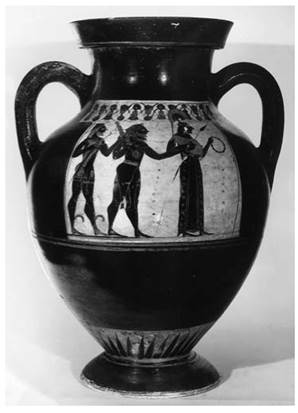
Figure 3.2 Herakles, paternal ancestor of the Argeads, is shown in the middle being escorted by Athena (leading) and Hermes (behind) to be introduced to Olympos.
However, there are traces of other practices, linked with essential aspects of kingship. The king purified the army by sacrificing a dog and he led the procession of soldiers as they marched between the two halves of the sacrificial animal. Moreover, cults of heroes of antique appearance akin to those of Homeric description remained part of Macedonian practice: Alexander established heroic honors for his companion Hephaistion (Arrian VII.23.6-7) and strove to surpass the accomplishments of acknowledged heroes like Herakles. His ancestor Alexander I was buried in a heroön (shrine to a hero) at Aigai, a practice associated with Archaic Greece, to be sure, but one that had largely been superseded by the fifth and fourth centuries.
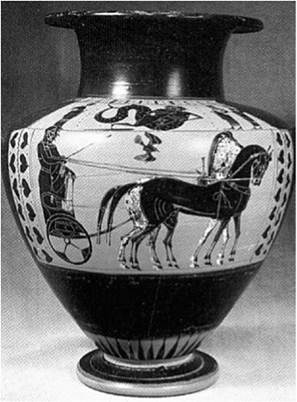
Figure 3.3 Achilles, Alexander's ancestor in his mother’s line, yoking his horses to a dipliros (traveling chariot). Source: I. Kakridis, Greek Mythology, Ekdotike Athenon SA
In sum, it is likely that there were several elements in the Macedonian conception of the more-than-human. Yet, whatever the form of divinity being supplicated, there is no doubt about the importance of the king’s role in this supplication. The grand ceremony planned by Philip mentioned above is a notable example of the centrality of the Argead ruler in aspects of religion. Arrian’s report of the end of Alexander’s life shows the need to perform proper sacrifices even as Alexander was dying:
Next day he bathed, and offered sacrifices . . . On the following day, he bathed again and offered appropriate sacrifices although he was fiery-feverish. He bathed in the evening and after bathing was extremely ill. The next day he was carried to the bath-house and again made appropriate sacrifices. On the following day, however, he was carried to the holy spot and sacrificed only with great distress (VII.25.4-5)
The maintenance of proper relations with the gods was a matter for more than the king; a staff of seers was part of the machinery of governance at Pella while Philip II was king, and at least one of this staff accompanied Alexander on his campaign.
These several characteristics of Argead kingship have deep roots. More recent was another feature that emerged with developments in the late fifth and fourth centuries; growing control of expansive territory and its population brought administrative needs. From the reign of Archelaos, Pella had become an administrative center; Archelaos himself was accorded the status of guest-friend and benefactor by the Athenians. Not only was Pella the residence of the Argead king and his families, but now it was also the hub of the offices of state - a secretariat and its records, managers of resources, units such as the department of military machinery, facilities for envoys. Taxes were levied on the land, use of harbors, mines, and royal domains operated through lease to be worked by tenants. Although the means of collecting the taxes or supervising the use of resources is unclear, such means surely existed for the Argeads, especially in the reigns of Philip and Alexander, who maintained large armies, built roads, fortresses, and ships, and supported a large entourage of family, young men in training to become companions, and visitors at Pella, as well as the staff required for their daily needs.
The consequences of Argead descent
Membership in the Argead line, especially for a male, carried notable advantages and expectations. As a youth, such a male would be trained to demonstrate brilliantly the qualities of a Macedonian leader. Tike Telemachos, Odysseus’ son, he would have to strengthen his wits and his spirit in order to do away with threats to himself and his family either by cunning or in open battle. In the process he would demonstrate that, as king, he could, like Odysseus, do “excellent things by the thousands, bringing forward good counsels and ordering armed encounters” (Iliad II.272—3). Even as a boy, he would be able to ride his horse as well as, if not better than, sons of other elite families and he would be fit to hike seemingly endless distances with the soldiers of his father. When he reached his teenage years, he would be called up to exercise those skills in battle. Philip was enlisted to aid his elder brother at this time of his life, and Alexander held the command of the heavy cavalry at Chaironeia in 338 when he was just 18.
In order to be a contender, a potential heir must be physically capable; consequently, it is not surprising that the physical training of a scion of the Argead line would be onerous, in order to produce a Homeric style of leader among men. Killing a wild boar without use of a net was something any heir would do early in life. And he would meet the requirement of slaying a man sooner than most. Preparing for leadership entailed participation in real events, not set exercises. One of the better-known stories about the young Alexander demonstrates his ability at the age of perhaps 13 or 14 when a horse was brought to Philip for possible purchase. When the animal would allow no one to mount him, Philip commanded that the owner take it away. At this Alexander said, “What a horse they are losing, and all because they don’t know how to handle him, or dare not try.” Philip asked whether Alexander thought he could manage the horse better, at which Alexander offered to pay the high price of the animal. Although those in the company round Philip laughed, Alexander went quickly up to the horse, took hold of his bridle, and turned him towards the sun, for he had noticed that the horse was shying at the sight of his own shadow, as it fell in front of him and constantly moved whenever he did. He ran alongside the animal for a little way, calming him down by stroking him, and then, when he saw he was full of spirit and courage, he quietly threw aside his cloak and with a light spring vaulted safely on to his back. For a little while he kept feeling the bit with the reins, without jarring or tearing his mouth, and got him collected. Finally, when he saw that the horse was free of his fears and impatient to show his speed, he gave him his head and urged him forward, using a commanding voice and a touch of the foot. (Plutarch, Alexander VI)
By the late fifth and fourth centuries, the son of a king would also be initiated into the skills of basileia by means of more formal education. We will discuss the significance of Greek education for the Macedonians more fully in chapter 4. For now, we note that there is no question about the literacy skills of the Argead kings, particularly those of the fifth and fourth centuries. Treaties made between the ruling Argead and other states, peoples, or leagues were recorded, for example that between Perdikkas II and the Athenians in 422 BCE (Inscr. Graee., I2, 71b). Philip II composed letters to the Athenians and received letters from notable Athenians in return. Alexander carried on a variety of correspondence as he marched eastward.
Raised at Pella, a potential heir would gain a sense of the resources of the kingdom and increasingly understand the importance of controlling them. Pella contained many types of resources in addition to the administrative departments located there. An especially vital resource was the young men of noble families throughout the realm who were brought to Pella to be trained as pages to the king, and later to serve as his companions, officers, and councilors. The boys’ fathers arrived occasionally for councils or symposia with his father. And the king’s sons would witness the growing frequency of the arrival and departure of envoys from distant states. It would be known that in other parts of the palace people were keeping records or planning new tools of warfare. With other members of his family, a potential heir would travel from Pella to the older site of Aigai, particularly for ceremonial occasions - the burial of a grandmother in one of the tumulus-mounds, purification of the army, athletic contests, a major sacrifice to one of the deities, or an impressive celebration. In a word, he would begin to realize his special position, one befitting a descendant of Herakles and Achilles.
But there were obstacles to that position. The practice of polygamy was likely to produce more than a single potential heir to the basileia. Philip was one of six sons of Amyntas III, and Alexander III had rivals in a son of Philip by Philinna and in his cousin, Amyntas, the son of Philip’s brother. Intrigue on the part of Philip’s wives for the advancement of their own children would be a hazard of life in the Argead quarters at Pella. Additional threats came from members of other branches of the Argead family, whose number kept increasing. We have mentioned that, on the death of Archelaos, kingship changed hands among members of three branches of the Argead clan in less than a decade. Initially, the young son of Archelaos - Orestes - was recognized as king while Aeropos - perhaps his uncle - acted as regent. Not content with regency, Aeropos did away with his nephew in order to become king. His reign lasted less than four years. Amyntas II of the line of Alexander I then ruled briefly, until he was killed by an Elimiote. A son of Aeropos, Pausanias, succeeded to the kingship for a few months, until he was removed by treachery. The pace of events and the profusion of royal names convey the insecurity of rule all too well.
The advantages of the page-system that produced bodyguards for the king and companions for his sons also could have disastrous repercussions. Should the royal family of an annexed kingdom of upper Macedonia determine to assert its independence from Pella, the scion of that family now living in the royal city might well conspire to take the lives of members of the Argead line. Derdas of Elimeia, the murderer of king Amyntas II referred to above, is likely to belong in the category of noble families of once-independent realms. Consequently, the suspicion and hostility of others, especially companions who had access to one’s private life, would be another danger well known to members of the kingly family.
With all these very real threats, a successful son of a ruling king would have to develop a keen awareness of the need to guard himself against perceived dangers. Those dangers were real and constant and had the habit of occurring without much warning. It was nearly impossible to become king of Macedon without descent in the Argead line. However, as we have seen, the good fortune of being the eldest son of a ruling king was not sufficient to ensure succession. First that son had to demonstrate the characteristics required to lead his people and, second, he must identify and withstand any challenges to his claim to basileia.
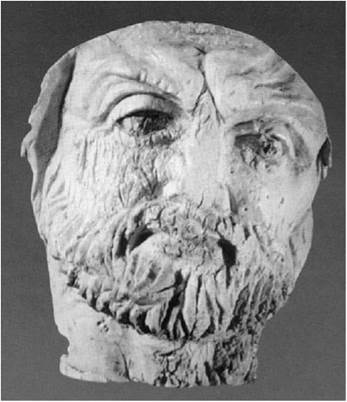
Figure 3.4 Ivory head from the decoration of the chryselephantine bier in the main chamber of Royal Tomb II at Vergina, believed to be Amyntas III. Courtesy of Mrs Olympia Andronikou-Kakoulidou
Philip II
While it was virtually essential to be a member of the Argead line, parentage was also a crucial factor in succession. From the earliest history of rule by members of this clan, families had proliferated. Thus kings were drawn from different branches of the one single family. Moreover, the achievements, or lack of them, of the ruling king weighed heavily in the success or failure of his successor.
During periods of grave challenges to the integrity of the kingdom, scions of branches other than that of the current ruler often succeeded in assuming rule, as the case of Amyntas III demonstrated. On the other hand, immense success on the part of a father might create a swell of support for his son. In these cases, however, enlarging the success of a dynamic father could present real difficulties to his son and successor. Alexander III had an extraordinary father. The fourth-century historian Theopompos, who wrote a history of Philip in 58 books (of which only fragments remain), believed, “Europe has never known a man the like of Philip, son of Amyntas.”
Philip II was born in 382, the third and youngest son of Amyntas III and Eurydike. Amyntas could trace his own ancestry back to Alexander I, who, as we have seen, doubled the boundaries of the Macedonian kingdom and probably enhanced the role of footsoldiers in the process. After Alexander’s reign, however, kingship had passed to another branch of the royal family. Amyntas himself was aided by the more dynastic competition for power that accompanied the assassination of Archelaos in 399; skillfully surviving six years of continuing threats to his claim to power, coming from both other Argeads and external enemies, he secured the basileia in 393/2.
His reign was not peaceful. Early in his rule, he was driven from power when an Illyrian invasion of Macedonia established another, compliant king. Amyntas was able to secure aid from neighboring states nervous about Illyrian belligerency in their own lands: the powerful Greek polis of Olynthos on the western Chalkidian peninsula and perhaps the Thessalians assisted him in recovering the throne. In addition to force, he agreed to pay the Illyrians an annual tribute in exchange for their withdrawal. His own security and that of his kingdom were also in constant jeopardy from major Greek states, other neighboring non-Greek powers, internal rivalry between regions recently incorporated into the kingdom, and the competition among the Argeads themselves.
Philip’s mother, Eurydike, may well have represented in her ancestry the influence of non-Greek powers and the regionalism tugging at the cohesion of the Macedonian kingdom, inasmuch as sources describe her as having Illyrian and Lynkestian blood. Her marriage to Amyntas may represent the alliances that the Macedonian king was attempting to cement. It has been dated to c. 390 on the grounds that the eldest son of the union assumed the king- ship in 369 as an active leader, not a youthful pawn of others. In addition to Eurydike, Amyntas took a second wife, Gygaia, who probably was an Argead, by whom he also had three sons. The practice of multiple marriages among the Argeads was not new. Perdikkas II had children by three women, as did Archelaos, and the five sons of Alexander I may well have had more than a single mother. That only three of them participated in the rule while their father lived and, when he died, only they were candidates for succession suggests the importance of maternal as well as paternal parentage.
Eurydike enjoys prominence in the ancient sources, especially the later accounts. Evidence dated to the period of her husband’s reign reveals her status in association with religion. An inscription in the remains of a small temple at Aigia dated to the early fourth century reads: “Eurydike daughter of Sirrhas for Eukleia.” “Eukleia” is used as an epithet of Greek goddesses, such as Artemis, or it may represent the name of a particular goddess.
Success in coping with and surviving dynastic politics revealed Eurydike’s craftiness in preserving her influence, as well as her life, after the death of Amyntas III. She may, in fact, have lived on for another twenty or more years, years that demanded constant vigil on her part for herself and her three sons. The eldest, Alexander II, was murdered after ruling for roughly two years. It is possible that he was slain by one Ptolemaios, who may have been the son of Amyntas II, who ruled briefly in 395-394. For unclear reasons, perhaps necessity, Euridike allied politically and amorously with Ptolemaios, who may have served as regent for Eurydike’s second son, Perdikkas, on his acclamation to the kingship in 365. Within a year, Perdikkas decided to rule directly and killed Ptolemaios. He himself was killed in battle with the Illyrians five years later. Now the claimants to the Macedonian kingship were Perdikkas’ young son, Amyntas IV Perdikkas’ brother Philip II, the two surviving sons of Amyntas II by Gygaia, and several rivals from other branches of the Argead line. Eurydike lived on into the reign of her third son, Philip II.
That Philip should be alive to contend for the kingship is an accomplishment in itself. His two full brothers had been killed and now his three stepbrothers could lay claim to succeed their father. Apart from threats by other claimants to the basileia, he might not have survived demands made on him while he was in his teenage years: he was endangered during the years that he was in Thebes as a royal hostage between 369 and 367 and, later, his posting away from Pella could have been fatal, especially if his presence was intended to secure the loyalty of a region - Elimeia - still committed to independence from Macedonian control. As events played out, however, Philip’s removal from Pella may well have spared him from joining his brother Perdikkas when he led the Macedonian army against the Illyrian force in 359.
Philip did survive this tangle of threats. Two of his stepbrothers decided that leaving Macedonia would be wise, and he eliminated claimants from other branches of the Argead clan, yet allowed his nephew to live. Philip was acclaimed either regent for his young nephew or king in traditional fashion by the army assembly. There was no time to remove all of his rivals to power, since even more immediately dangerous were the Illyrians, who might well have pressed their advantage through a return incursion into Macedonia. It is surprising that they made no attempt against the vulnerable kingdom.
The weakness of Philip and his army is shown in his initial dealings with the Illyrians; he did not lead a force against the Illyrians, understandably in view of the much weakened Macedonian military, but rather negotiated a temporary settlement and, following his father’s precedent, took an Illyrian wife, Audata, to strengthen the alliance. He may have earlier taken as wife Phila, daughter of the ruler of Elimeia, to cement the union of Elimeia with greater Macedonia. Eventually Philip made seven alliances fortified through ties of marriage. We will return to the situation that multiple marriages produced in examining the role of Olympias, mother of Alexander, later in this chapter. At this point, it is valuable to note that the most significant factor in every case was diplomatic: Philip built or reinforced alliances with important families in other parts of Macedonia, with leaders of rival kingdoms or states, and with another branch of the Argead line. True affection may have played a role in some instances but it was not the initial motivation.
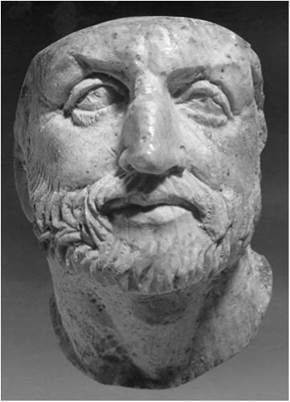
Figure 3.5 Ivory head from the decoration of the chryselephantine bier in the main chamber of Royal Tomb II at Vergina, believed to be Philip II. Courtesy of Mrs Olympia Andronikou-Kakoulidou
Many additional threats hovered ominously. Claimants to the kingship remained: Argaios, probably the person who had replaced Amyntas III as king for a brief period in the 380s, reappeared with Athenian support to regain the throne. Philip dealt with the pretender and his force without difficulty. Ever ready to explode were regions of upper Macedonia; in addition there were pressures from the Thracians to the east, Paionians in the north, Greek states on the very borders of Macedonia, as well as more distant, powerful poleis, particularly Athens and Thebes. Negotiation coupled with monetary gifts brought settlements with the Paionians and Thracians, a treaty with Athens occurred in 359, and marriage with one Thessalian woman occurred probably in 358. In that same year, force was employed successfully against the Paionians and, later, the Illyrians. This combination of diplomacy and force was the pattern for the rest of Philip’s career.
There is sufficient evidence to review in detail the 23 years of Philip’s reign. A map of the boundaries of the kingdom by 336 shows plainly Macedonian involvement in all directions. To paint a more general picture, however, we will follow Philip’s relations as they expanded from dealings with neighboring peoples to enemies as distant as Achaemenid Persia in order to discern the general nature of Philip’s tasks and the reasons for his final success in creating an expansive, imposing realm. It is important to note that the Macedonian army had to be simultaneously active in several directions to deal with enemies who were not only dangerous in themselves but habitually formed coalitions with one another against Macedon.
To the northwest, the Illyrians were a constant threat throughout Philip’s reign. Although a Macedonian campaign in Illyria in 358 brought the defeat of the Illyrian king and 7,000 of his troops, two years later the Illyrians had allied with other northern enemies of Macedon, namely the Thracians and Paionians; from the Greek sphere, Athens also joined the coalition. More than twenty years later, the year of Philip’s death included a campaign against the Illyrians. Although they were not pacified, Philip’s containment of the threat of their ongoing incursions into upper and lower Macedonia may well have been crucial to the absence of hostility from the once-independent regions of upper Macedonia throughout his reign. Epiros, also to the west, was more easily drawn into the Macedonian sphere in 357 by alliance with the ruling Aiacid family and marriage to Olympias, the daughter of the king. On the eastern front, Thrace would occupy Macedonian troops on a regular basis into the late 340s. It is misleading to speak of Thrace as a single entity; rather there were several groups of Thracians led by chieftains who fought one another or, at times, allied against a foreign enemy or found it useful to forge ties with more distant peoples. Only toward the end of his career would it be possible for Philip to look beyond Thrace into Skythia.
In dealing with the Greek states, he began his incursions into the region closest to the kingdom’s borders, Thessaly, in 358. Two of his marriages can be connected with these early incursions: in 358 to Philinna from the ruling family of Tarisa, situated in the north of Thessaly, and six years later to Nikesipolis of Pherai in southern Thessaly. Despite these alliances, Thessaly would require further campaigns into the 340s. In 357 Philip also turned his attention to Greek states in the northern Aegean - the long-established poleis on the Chalkidian peninsula and Athenian colonies or allies on the Macedonian coast itself, as well as east of the Chalkidian peninsula. Gradually, the Macedonian-Athenian quarrel would draw Philip and his forces further east into the eastern Aegean and the Propontis, where an Athenian presence was strong.
On the Greek mainland, increasing success in Thessaly toward the end of the 350s provided Philip with another official position, that of tagos, leader of the military levies of all four regions of Thessaly, thereby empowering him to act formally in the affairs of Thessaly. Hostility from poleis to the east drew the Macedonians into Greek affairs in the Chalkidike, where Philip captured the center of the Chalkidian Teague at Olynthos in 348. Similar victories in other parts of the northern Aegean effectively brought the Chalkidike into the Macedonian sphere. Not surprisingly, southern Greeks with interests in the northern Aegean readied to protect those interests.
At the same time, certain Greek poleis believed that the Macedonian army might be a tool in their own behalf, aiding the cause of one party in the never-ending wars between the poleis. Early in the 340s the Macedonian army was drawn by invitation into Greek civil war in central Greece. Known as the Sacred War, it pitted against one another the 12 members of the long-established body that served as guardians of the sacred site of Delphi, the Delphic Amphiktyony. In retaliation for a heavy fine charged by the other members of the Amphiktyony, the hoplites of the state of Phokis, aided by mercenaries, had seized Delphi and its wealth in 356, provoking warfare throughout central Greece for a decade. An invitation to Philip to help deal with the culprit brought the Macedonian army into central Greece in 347; in the following year, the Phokians surrendered. The victor — Philip — gained another official role in Greek affairs through membership in the long-standing council of the Delphic Amphiktyony.
During the remainder of the decade, Philip turned his attention again to Illyria, campaigning against the Illyrian king; he arranged a political settlement in Thessaly; led his army to Epiros in the west and Thrace in the east, advancing into Skythia; entered new alliances such as the agreement with the king of the Getai; and founded colonies. From southern Greece embassies arrived to negotiate agreements; Messenia and Megalopolis in the Peloponnese, for example, were invited to join the Delphic Amphiktyony alongside the other Greek states and Philip.
At the same time, however, Philip pressed on to strengthen Macedonian presence in the Black Sea. In 340, he laid siege to Perinthos and Selymbria, Greek poleis neighboring Byzantium, which he also attacked. Athens declared war and began to lobby other Greeks to take a coordinated stand against Macedon. When fighting in central Greece flared again early in the 330s, Philip led his Macedonian troops back to Greece as both Macedonian king and Greek official of the Delphic Amphiktyonic Council. Believing that his objectives were grander than defeat of a single, relatively small polis, the Athenians spearheaded the formation of a coalition headed by Athens and Thebes along with Euboians, Achaians, Corinthians, Megarians, Leukadians, and Korkyrians. Greek and Macedonian armies of roughly similar numbers (30,000-35,000) met on the plain at Chaironeia in central Greece in the summer of 338.
The Macedonian victory was decisive beyond the military result. It allowed Philip to reorganize the nature of Greek governance. Philip first made formal treaties with his enemies at Chaironeia, in accord with their differing histories of relationships with Macedon. Some, like Thebes, were garrisoned; others experienced a change of government; certain poleis, such as Athens, were granted nominal independence. Philip then turned to long-term political settlements. Arrangements with individual states and regions prepared the ground for a new collective organization of Greece. The boundaries of states were fixed, reputedly on the grounds of justifications prepared for Philip by Aristotle. With recognized borders, the causes of warfare between states might be removed. Just as significant was the subtle balance created as major powers were weakened while weaker states were strengthened. All states - large and small - were then united in a new league: the Teague of Corinth was both an offensive and a defensive alliance. States were to remain autonomous, but the power struggles of the past two centuries were eliminated. Each member would send delegates to a general council, the number of delegates dependent upon the importance of the state. Philip would be hegemon of the Teague. To ensure military strength against foreign enemies, no citizen was allowed to serve with a foreign power against Philip or the Teague, an element that was essential in the announced offensive of a campaign against Persia, in preparation for which Philip dispatched an advance force in 336.
The outcome of the contest at Chaironeia - both military and diplomatic - in comparison with the defeat of the Macedonian troops led by Philip’s elder brother Perdikkas at the hands of the Illyrians in 359 is a mark of Philip’s brilliance. Another mark is the territorial size of the kingdom at over 16,600 square miles (over 43,000 km2), more than double the size it had been at the end of the Peloponnesian War. A third mark is the unification of once- independent, quite varied regions under a ruler who now wore several insignia of his power.
The foundations of Philip’s successes
It was essential not only to rebuild but also to expand Macedonian military capability in order to have any chance of dealing with the constant threats of invasion and rebellion. The army that Philip inherited included foot-soldiers and cavalry; the former element, we have argued, had been enhanced a century earlier by Alexander I, and the latter remained a prerogative of the elite. However, the size of neither contingent was large. Perdikkas had lost 4,000 men in battle with the Illyrians in 359; Philip needed to repair that loss and to raise an even large force in anticipation of a new Illyrian invasion as well as threats from other neighboring peoples. He seems to have had a force of about 10,000 in 358. At Chaironeia in 338, he commanded an army of 30,000-35,000, as we have seen, an increase that became easier to create as more territories and their populations were annexed to the Macedonian kingdom. For example, of that number, his cavalry had grown from approximately 600 at the start of his reign to 3,000 by its end, in part due to his success in Thessaly, which brought the most effective cavalry force of Greece into the Macedonian army.
Not simply numbers but training and organization seem to have been altered early in Philip’s kingship. That he had in mind the changes he would initiate even before becoming king is likely. His enforced stay in Thebes had occurred at the time that the reformed Theban phalanx was producing an extensive empire. Similarities are obvious between the hoplite army of fourth-century Thebes created by Pelopidas and Epaminondas and that of Philip. In both armies, hoplites carried a longer pike but a lighter shield than traditional hoplites, and perhaps omission of a breast plate made them faster and more mobile. In battle, units of 250 to 300 men were positioned in 16-deep files. Crack troops were important in both Theban and Macedonian formations. In Thebes, a “sacred band” of 150 pairs of lovers formed a special unit, while in Macedon 3,000 royal footsoldiers were the elite infantry. Beyond the innovations he had seen as a teenage hostage in Thebes, Philip utilized other inherited features in new ways. While deploying the best troops on the left wing, he protected them by cavalry on the flank. And he increased the use of light infantry - archers, slingers, and peltasts (light-armed skirmishers) - while also utilizing some of the cavalry as scouts.
There is evidence to show that he encouraged an army “career” by inducements. For instance, moving from ordinary foot-soldier to hypaspist (that is, one of the shield-bearing guards of the king) brought greater compensation as well as higher honor. Another inducement is that the king himself led his army in the field; it was not a delegated responsibility, although as action in separate directions became more and more common, some authority in the field had to be entrusted to subordinates. The twin bond between the foot-soldiers and the king could serve a political end as well as military need. As all Macedonian kings, Philip inherited a socioeconomic structure in which aristocratic families in addition to the Argead line enjoyed significant status and wealth. Especially in those once-independent kingdoms of upper Macedonia, the heads of these families could lay claim to a position similar to that of the Argead king. Winning the cooperation of such figures was a consuming task that many Argead kings could not achieve, as the reign of Philip’s father, Amyntas III, reveals. Philip’s expansion of the number and status of foot-soldiers may well have been a buttress of royal power against aristocratic inroads.
And he may have gained another means of building a royal base of the support of men in command positions as new territory was added to the Macedonian kingdom. Some scholars have argued that conquered land became royal land that could be granted to individuals for their use in return for the performance of obligations in kind. Certainly this was the perspective of Alexander III and his successors. Evidence exists of land grants to entice to Macedonia foreigners - like Nearchos of Crete - who were interested in a following a professional military career. But not all of Philip’s companions and officers were new recruits; he continued to rely - as he had to - on the heads of privileged families for major responsibilities. That they served him well in return for incentives similar to those of new recruits is evidenced by their survival to become supporters of Alexander and, immediately thereafter, of Alexander’s own subalterns on the death of Philip.
Newly won territory strengthened Philip’s resource base in other important ways. Added territory brought greater population, livestock, and natural resources. The acquired land could be used to found or refound settlements in the vicinity of valuable resources to provide control over them and workers to exploit them. New settlements for Macedonians would have the further advantage of being loyal centers in what were formerly non-Macedonian regions. As early as 356, Philip consolidated several settlements to create Philippoi in the northern Aegean, just westward of Thracian holdings. The ores of the Mt. Pangaion region brought 1,000 talents each year to the royal treasury, while the settlement itself advertised a Macedonian presence in what then was still no-man’s-land between Macedon and Thrace. When the Macedonians made inroads into Thrace itself, garrisons were established in remote areas; settlements at Beroi and Philippopolis became important centers of Macedonian control and influence. Three or four years after the creation of the first Philippoi, Philip’s activities in Thessaly produced the colony at Gomphoi, renamed either Philippoi or Philippopolis. Westward, too, military fortresses were planted in the mountain passages. Understanding the value of colonies through the existence of Greek colonies in the immediate vicinity of the kingdom, Philip claimed long-established settlements for similar purposes. As his successes took in the Greek settlements on the Macedonian coast and in the Chalkidike peninsula, Philip was free to trade directly by sea without having recourse to intermediaries. And in gaining the harbors, he added harbor dues to his treasury.
As his involvement in new and different regions of the Aegean expanded, Philip realized the importance of technology. Early connections with Thessaly brought the services of one Polyeides, who is credited with new and more straightforward mechanical designs. What has been described as “Philip’s department of mechanical engineering” may have been established at Pella, where Polyeides implemented his designs and also trained students who would later serve Alexander. While the evidence is not full, there is no doubt that Philip employed arrow-firing catapults, and perhaps torsion engines were developed during his reign. For sieges, Philip’s army had the aid of towers as high as 120 feet (over 36m), rams, and scaling ladders.
This and the various “departments” of a centralized administrative structure were essential to the creation and maintenance of a strong kingdom. Evidence for the nature of this structure is meager inasmuch as written information from Macedonia during the fourth century through the reign of Philip is scarce. Yet there is archaeological evidence, surviving Greek records from these years are informative, and clues exist in the domestic and state circumstances that are known.
Pella had become the node of the kingdom, perhaps as early as the reign of Archelaos (413-399); under Philip, the city expanded. Since it continued to be the capital of the Macedonian kingdom into the Hellenistic period, much of the fourth-century site was overbuilt and, thus, has not been located and excavated. Still, the general plan of the city is relatively clear. At the center of the city was an agora of more than 17 acres (7 hectares) through which a large street - part of the royal road - crossed. A stoa surrounded the agora. The north portion of the stoa had an administrative character while the southwest portion was an archive. Other parts of the complex housed shops and workshops. Administrative units are likely to have been located in parts of the stoa. In addition to the archive, the secretariat staff would have required offices. A fair amount of the treasury would be dispersed from the capital; its management and storage would have occupied another unit. “Departments” where weapons, other military equipment, and siege machinery were designed and produced may have been housed in one area of the extensive stoa.
The palace, situated on a hill to the north of the agora, covers nearly 15 acres (6 hectares). Around a large central courtyard are three separate complexes, each one opening onto a large courtyard.
One of the units had a swimming pool and another may have been a palaistra or exercise ground. Their several uses can be deduced from written accounts of life at Pella. A good portion of the space would be needed for the residence of Philip, his seven wives and their children, other relatives, and the considerable household staff these numbers would entail. Visiting envoys arrived regularly for audiences with the Macedonian king; space would be allotted to their needs while in Pella and also to suitable areas for meetings with the king and members of his staff. A portion of Philip’s cadre of subordinates would also be present at any time; the young men of aristocratic families who were sent to the royal domain for training as future leaders and who were, in effect, in service to the king during these years of training. The famous symposia of the Macedonians called for special furnishings and other equipment, not to mention storage of the quantities of wine consumed. Suitable space for great occasions like weddings and recognition of honors given to Philip himself would also be present in the palace. Elaborate mosaic floors, wall paintings by the Greek artist Zeuxis (attracted to Macedon during the reign of Archelaos), and elegant objects found at Pella and other centers show that care was taken and wealth was invested to create a fair degree of splendor. Sanctuaries, such as the circular area dedicated to Demeter, and cemeteries were also part of the urban landscape of Pella in the fourth century. It is unclear how early Pella was fortified; present evidence dates to the last part of the fourth century.
Many of the features of Pella were anticipated at the older capital of Aigai. That Pella may have been fortified early in the fourth century is suggested by the plan of Aigai. It is useful to note that the residential and administrative center of the old capital had been sited on an acropolis that would inhibit access by unwelcome visitors. In addition, the center was fortified with a wall of carefully constructed masonry. A gate on the east side was protected by a round tower. The palace had residential quarters, large rooms for official functions, and workshops. Surviving mosaics and architectural features indicate both the wealth and the care invested in construction. Integral to Aigai were the theatre at the foot of the acropolis and the sanctuary of Eukleia, mentioned above in connection with the mother of Philip. Burials together with surviving offerings reaching back to the heroön associated with Alexander I are indicative of the rising power of the Argead kings, which in turn fueled the need for the centralization of activities and the breadth of cultural contacts. In sum, while Pella demonstrates a magnification of these same features, it did not emerge de novo.
Nevertheless, the power emanating from Pella during the reign of Philip II is described by first-hand witnesses. Surviving Greek accounts, particularly those of the Athenians Demosthenes, Isokrates, and Aischines, are proof that Philip was adept at winning by diplomatic means as well as military might, both skills demanded of Argead rulers from the origin of the small kingdom. Macedonian kings before the time of Philip negotiated and concluded treaties and alliances in their own names. An inscription discussing the treaty between Perdikkas II and the Athenians reads, “Now in those oaths and treaties which bind this same Perdikkas and those kings with Perdikkas . . .” Later, “[I]t was agreed by Amyntas the son of Arridaios and the Chalkidians to be allies of one another against all men for fifty years.” Philip entered into similar alliances from his first years as king. To be sure, the king was the natural representative of his kingdom and presumably acted in the best interests of Macedonian welfare. However, there appears to have been no official body apart from the king to arrange such negotiations. Consequently, this feature of rule appears to have been a royal prerogative. The growing importance of cementing new alliances through marriage is another element of Macedonian diplomacy that appears to be confined to the Argead rulers. The purpose of most, perhaps all, of Philip’s seven marriages can be understood, at least partly, in this light. Moreover, the number of his marriages is a sign of the rapidly expanding role of Macedon in the larger sphere of the northeastern Mediterranean.
In addition to diplomatic skills and the acquisition of official positions, another useful trait in a successful king was a capacity for subterfuge. Accounts indicate that Philip was especially adept at ruses, for example employing false messages meant to be intercepted by the enemy. To gain an advantageous position for his cavalry in the battle that eventually occurred on the plain of Chaironeia in 338, he “allowed” a dispatch of his to be intercepted by the Greek enemy. Information in the dispatch revealed that he was about to withdraw from his current position. On that welcome news, the enemy forces relaxed, and that same night Philip and his Macedonians burst through a narrow gap in the mountains to achieve their desired position. He had sent a similar false dispatch the previous year when his fleet had been driven into the Black Sea and pinned there by the enemy fleet. The instructions in the message served to divert the commanders of the enemy fleet sufficiently so that the Macedonian ships could escape. He was masterful, too, at dividing his enemies from one another and in supporting pro-Macedonian groups in Greece. Military strength went hand in hand with, and was enhanced by, other tactics.
A combination of these skills allowed Philip to add other official positions to his Macedonian kingship. In Thessaly, he became tagos in 352, a position attested as early as the sixth century, which can be defined as a means to draw the four largely independent regions of Thessaly into cooperative action in situations that demanded a greater force than a single region could mount. It is likely that a “federal” tagos was initially elected for a temporary emergency only but that the growth of larger coalitions in Greece generally in the fifth and fourth centuries converted the position into a permanent office. In the hands of Philip the tagia would provide the basis for the reorganization ofThessaly in 344. Macedonian settlement of the inter-polis warfare in central Greece in 346 brought with it another official position for the Macedonian king: in defeating the rogue polis of Phokis, Philip was awarded its two votes in the Council of 12 member states that oversaw the security of Delphi. He was also invited to organize the new Pythian games and he began the construction of the Philippeion at Olympia’s Altis. More than guarding the sacred site, its members could take concerted action to preserve that security.
More impressive, however, was Philip’s creation of a new league, the League of Corinth, with himself as its leader, or hegemon. Coming in the wake of the Macedonian victory at Chaironeia in 338, it was an expression of Macedonian power over the Greek states. It was also an attempt to create a new order within Greece in which Macedon and its king would be an integral part. Arranging settlements with individual Greek states was an essential first step. The boundaries of states were defined, probably with the assistance of Aristotle and members of his school, in order to remove a major cause of discord in Greece. In the process of determining both the territory and the status of specific states, Philip rewarded some and treated others more severely on the basis of previous relations with Macedon. Thebes, for example, was garrisoned while the Aitolians were given the strategic site of Naupaktos on the Corinthian gulf. Athens was treated generously in spite of its leading role in the struggle against Philip; Sparta was essentially ignored. As we shall explore below, Philip was familiar with treaty-making in the Greek world, in fact he was already party to several alliances: the long-established Delphic Amphictyony; a Common Offense and Defense Treaty (symmachy, fighting together) with the Chalkidian League; the Common Peace agreement between Philip and his allies and Athens and its allies known as the Peace of Philokrates. He employed these familiar practices in building his new alliance, which combined a Common Peace treaty with a symmachy.
After reaching the individual accords, a governing council was created of delegates from the allied states. Decisions were taken regarding joint action in the council, which also served as a court to arbitrate disputes and to take action against any who violated the decrees of the League. Its hegemon - Philip - was both the chief official and commander-in-chief of the league. Delegates from the member states gathered at Corinth for a conference in the winter of 338/7; of the major states, Sparta sent no delegates. Philip announced a Common Peace of which Macedon would be guarantor. In the realization that force would be needed to maintain the peace, a synod of representatives from all member states was established: votes were allotted according to the military strength of the
States. A surviving inscription (Tod ii 177.17-22) describes the oath sworn by members: “If anyone shall act in a way contrary to the agreements I shall give military assistance as the injured require and shall go to war against the offender against the Common Peace as the General Synod requires and the Hegemon orders.” Thus the league was also a symmachy; Philip as its hegemon would levy a force appropriate to the task. Also included in the agreement was the acknowledgment of individual settlements that Philip had arranged following his victory at Chaironeia: boundaries had been fixed and within these boundaries the political structure of each state too was fixed. These conditions applied to Macedon as well as Greece: thus the monarchy of Philip and his descendants was simultaneously secured into the future as were the constitutions of the Greek states. Special officials - perhaps selected from members of the synod - were appointed to watch for breaches of these agreements.
One of the first acts of the synod of the Teague was to declare war against Persia in 337/6 at the behest of Philip. Although an advance force was dispatched to northwestern Anatolia, Philip did not live to undertake the full campaign. If such a campaign were to occur, it would be the work of his successor.
The accomplishments of Philip II
Demosthenes is said to have described Philip as the most clever or frightening of men. The Greek word deinos carries both meanings. In more prosaic terms, we can summarize his accomplishments militarily, diplomatically, and personally to gain a fuller understanding of the man who would succeed him.
Coming to power in the wake of a disastrous defeat that took the life of his brother, then king, and 4,000 men, Philip created a stable kingdom of Macedon. He was able to reaffirm control of regions that had effectively broken away from the kingdom during the first four decades of the fourth century and then add large amounts of new territory. His successes more than doubled the territorial size of the kingdom from its extent at the end of the Peloponnesian War. Population in the region effectively controlled also increased dramatically, from approximately 228,000 at the end of the fifth century to approximately 700,000 during the reign of Philip II. Beyond size, the mechanisms of central authority were strengthened: the army was reformed and allegiance to the king tightened; investment in roads, fortresses, and new settlements in conquered territory enhanced the likelihood of continuing control from Pella; royal management of resources provided the means for these steps.
In expanding the size and durability of his kingdom, Philip extended the Macedonian sphere of influence to encompass Greece, Thrace, and Illyria and Epiros on the Adriatic coast. Deft diplomatic skills won supporters even among the Greeks and further provided him with official positions in venerable, important bodies. He knew Greek institutions well enough to model new bodies of his own creation upon those institutions. A facility in arranging treaties often supported by marriage with a daughter of the other party served Philip well.
The historian Diodoros Sikulos praises Philip’s personal excellence, his bravery, and “the brilliance of his personality” (XVI.1.6). Philip led his troops in battle, receiving wounds to prove that he fought among the forefront, such as the loss of an eye in battle at Methoni. He dealt with his subordinates directly in matters of both war and administration, gathering essential services and resources around him at the capital of Pella. He played a direct role in the councils of his major officials and also in the frequent, grand-scale symposia and at celebrations accompanying great occasions.
On his death in 336, he was readying the resources of his kingdom and allies in the League of Corinth to make further inroads - this time eastward into the territory of the Persian Empire.
It hardly needs stating that Philip was far more than part of Alexander’s world; he constructed the shape and form of that world. Macedon was a vast kingdom with an army and organization that augured durability. From Illyria to Thrace and from Paionia to southern Greece, former enemies had been brought to heel.
Military success was based on a reconstituted, restructured army whose loyalty to its leader - the Macedonian king - had been strengthened by instituting a system of recruiting sons of aristocratic Macedonian families, peasants who were keen to exchange their shepherding for soldiering, and non-Macedonian career soldiers. Pella was becoming the hub of activities essential to a well- organized state. Outside of Macedon itself, Philip created new forms of alliance with once-independent regions, and in those alliances he became the directing force. His success was making Pella an international hub of energy.
In this transformation of Macedonian power, Philip was a model of what an Argead king might accomplish. The successor to such a person would have to be an equally impressive man. Philip had fashioned an inheritance for the next Argead king far superior to the one he had received in 359. But he had also raised the level of personal and professional skills that were now necessary to maintain the effectiveness of the kingdom.
Olympias
The other half of Alexander’s parentage was equally remarkable: his mother shaped her son’s career in ways well beyond her gift of life. Her marriage to Philip was an essential element of the alliance between Epiros and Macedon that allied two ruling families through peaceful rather than military means. As we have seen, however, Philip made six other diplomatic marriages, producing what can be seen as a competitive environment in which wives would strive to ensure their own positions and the future success of their children. A mother would have to safeguard herself and her sons and daughters during their infancy and youth, fashioning conditions in which they could develop and demonstrate capabilities to succeed to the throne or to become the wife of a powerful man. It was not an easy task under the best circumstances, but for Alexander’s mother it was even more difficult, for she was not an Argead.
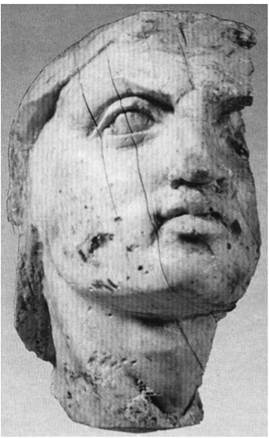
Figure 3.6 Ivory head from the decoration of the chryselephantine bier in the main chamber of Royal Tomb II at Vergina, believed to be Olympias. Courtesy of Mrs Olympia Andronikou-Kakoulidou
Alexander’s mother was Olympias, although her given name may have been Mytale. She was not Macedonian by birth but from Epiros, the northwest region of Greece on the mainland opposite Corfu, roughly adjacent to Thessaly albeit separated from Thessaly by the Pindos mountains. The fourth-century historian Theopompos listed 14 tribes as inhabitants of the region. One of the 14 was that of the Molossians, who succeeded in forming a strong state under their king Neoptolemos by c. 370. Olympias was one of three children of Neoptolemos. She had a sister, Thoas, and a brother, Alexander, who became king of the Molossians in 342, after which he succeeded in creating an expanded unification of Epiros during his 12-year reign. Philip’s marriage to Olympias can be dated to approximately 357; their son was born in 356 and their daughter, Kleopatra, some two or three years later. The union was arranged between Philip and the uncle of Olympias who had succeeded her father as king.
Several mutual benefits encouraged the marriage. Ongoing Macedonian difficulties with the Illyrians, north of Epiros, suggest that the utility of having a friendly ally on the southern limits of Illyrian territory was a significant factor. The relationship between Macedon and Epiros was amicable rather than bellicose, and it was further cemented by a marriage alliance in 337 between the daughter of Philip and Olympias, Kleopatra, and Olympias’ brother, Alexander, now king of Molossia. Strong Hellenic influence was another bond between the two kingdoms by the 350s. Molossians, at least the elite, were Greek speakers and traced their ancestry to Achilles’ son Neoptolemos in a manner similar to the Argead link with Herakles. Plutarch’s report that Philip fell in love with Olympias when they both were being initiated into religious ceremonies on the Greek island of Samothrace may indicate the level of hellenization in both Epiros and lower Macedonia by the mid-fourth century (Alexander I). Clearly, for Plutarch at any rate, it demonstrated that a diplomatic marriage could include personal affection.
Whether or not there was an amorous element to the marriage, it is important to remember that Olympias was but one of Philip’s seven wives. Although the order of the marriages is not entirely certain, by the time of the union with Olympias he had three other wives: Audata, daughter of the Illyrian king; Phila, a member of the ruling family of Elimeia in upper Macedonia; and Philinna, of an important Thessalian ruling family. Late in his career he would marry three times; to the Thessalian Nikesipolis of Pherai; to Thracian Meda; and to Kleopatra of Macedon, perhaps an Argead or, if not of the royal line, a member of a noble Macedonian family. Sources report that this was a match based on love, but as we have seen a king must ensure good relations with the elite of his kingdom.
A wife’s ancestry does not appear to have been a decisive factor in the matter of succession. Philip’s mother Eurydike was of Illyrian and Lynkestian blood, while Gygaia, his father’s second wife, may have been a member of the Argead clan. Eurydike’s sons became the successors of their father; the sons of Gygaia conspired to take the kingship for themselves. In similar fashion, Olympias was Epirote while Philip’s seventh wife was a member of an influential Macedonian family. Decision about the succession, then, was dependent on other factors than membership in the Argead clan; the mothers’ relative influence with Philip was surely of major significance. While clear signs of capability in potential heirs would also be determinative, each mother of a son of Philip can be seen as striving to advance her child’s skills. One way to do that might be causing damage to the chances of rivals.
Where in the palace complex Olympias and Philip’s other wives lived is not known. Perhaps one of the three wings was intended for domestic quarters. Even if the several wives and their children had separate quarters, the situation was certain to produce competition. As we have seen, Macedonian culture was deeply competitive in many respects. The role of Eurydike in securing succession for her sons rather than those of Gygaia indicates that the wives and daughters of elite families acted in similar fashion to Macedonian males. The roles of Olympias and her daughter, also named Kleopatra, demonstrate that women could rule in the absence of kings, could lead armies, could take the lives of rivals.
While the initial purpose of the multiple marriages of Philip and other Macedonian kings was their value in forging alliances with other states, a second purpose became equally important, namely ensuring a line of heirs to the throne of Macedon. Philip had strong evidence that the life of a Macedonian king was insecure: his father and two older brothers had been killed and he had a potential rival in his nephew. As we have seen, one of his first tasks as king was to eliminate other potential rivals, particularly his father’s sons by Gygaia. He was surely aware, also, that many infants did not survive their first years through natural causes. Consequently, a primary responsibility of royal wives was to bear sons and to keep them alive. The second half of the responsibility was difficult even if there were only two wives, as in the case of Philip’s father, Amyntas. Such a contest among the seven wives of Philip produced a far more intricate situation.
Furthermore, it demonstrates another characteristic of Olympias. Dedication to her two children and determination to ensure their success is a prominent trait in the account of her life from the birth of her first child, Alexander, to the time of her own death in 315. She is said to have given drugs to Philip Arrhidaios, the other potential successor to Philip, in order to impair his mind as well as his body (Plutarch, Alexander LXXVII). At the time of Philip’s seventh and last marriage, to Kleopatra in 337, the quarrel that ensued between Philip and Alexander led to the departure from Macedonia of both Olympias and Alexander. A reconciliation occurring in the following year was accompanied by the marriage of the daughter of Olympias and Philip, Kleopatra, to her uncle, the brother of Olympias.
After Philip’s murder in 336 and Alexander’s acclamation as king, Olympias and her daughter exercised considerable power in both Molossia and Macedon when Alexander was campaigning against Persia. Olympias managed to survive the brutal decade that Alexander’s death produced, acting in concert with her daughter Kleopatra and endeavoring to keep her grandson by Alexander and Roxane, Alexander IV, alive so that he might succeed his father. To do so required the elimination of other candidates. Olympias bears responsibility for the death of Philip’s seventh wife and her infant shortly after Philip’s murder. In the period following Alexander’s death she acted in concert with another would-be successor of Alexander, Kassandros, to put to death Philip Arrhidaios and his wife. Olympias eventually died at the hands of this same co-conspirator. Alexander IV and his mother were allowed to leave another five years before they were dispatched. Her daughter survived longer, although living as a hostage in Asia Minor, until c. 309.
Achieving success in raising adept and clever children may have been a full-time task. Evidence does not suggest that women played a formal role in the governance of the kingdom. It may be that the informal power of the king’s mother often increased during the reign of her son. The Athenian statesman-orator Aischines testified that Eurydike — the wife of Amyntas III and the mother of Philip II - had persuaded the Athenian general Iphikrates to safeguard the throne for her two surviving sons after the murder of her eldest son, Alexander (On the Embassy II.26—9). Evidence of Olympias’ influence on Philip may be found in Philip’s elevation of her brother Alexander to the Molossian throne.
Olympias, like Eurydike, played a more visible role during the reign of her son, Alexander. Early in that reign the deaths of Philip’s last wife and her infant were motivated, at least in part, by Olympias’ desire to secure the basileia for her son. Once Alexander had marched against Persia, Olympias and Kleopatra were powerful in their own names. Although Alexander allotted the regency of Macedon to Antipatros after 334, Plutarch’s account has Olympias and Kleopatra intriguing against Antipatros: Plutarch states that they “had divided the kingdom between them” (LXVIII.3). Letters purported to have been written by Olympias and Alexander to one another would indicate, if genuine, a lasting bond between them, although whether it was one of affection or of mutual need cannot be known. Olympias is reported to have made an offering at Delphi of the spoils of war sent by her son. Along with her daughter, she undertook public matters in her own name both in Macedon and in Epiros. An inscription (Supplementum Epigraphicum Graecum ix 2) lists recipients of grain from Kyrene in north Africa: all but two of those listed are states, but Olympias and Kleopatra are listed by name, a situation not unlike the evidence from treaties where the Macedonian king is named as one of the parties.
Even without the umbrella of Alexander’s support, Olympias continued to be a major player in events after the death of her adversary Antipatros in 319. Returning to Macedonia from Epiros in 317, she assumed protection of her grandson, Alexander IV, attempting to secure the throne for him alone rather than continuing the division of power settled upon in Babylon, which shared the rule between Alexander IV and Philip Arrhidaios. The Macedonians cast their lot with Olympias and Alexander IV, perhaps out of affection for the son of Alexander III but also impressed with the powerful figure of Olympias herself. Inasmuch as the young king Alexander was barely six years of age, Olympias determined the course of action, which began with the deaths of Arrhidaios and his wife, a granddaughter of Philip II through his Illyrian wife Audata. It is reported that Olympias also brought about the deaths of a hundred supporters of the son of Antipatros, Kassandros, and of one of Kassandros’ brothers, certain opponents to the nemesis of their father. In 315 Olympias was forced to surrender to the same Kassandros, and her own death followed shortly thereafter.
On the estimate that Olympias was 16 or 17 at the time of her marriage to Philip, she was nearly 70 during the efforts on behalf of her son’s son. That information offers some insight into her nature and personality. She was in full possession of her physical and mental capacities, honed no doubt by the nature of life in Epiros and Macedonia as well as by the struggle to keep herself and her children alive and make them suitable candidates for succession, in the case of Alexander, or important marriage, in the case of Kleopatra.
Her sense of power may well have been enhanced by her religious convictions. Plutarch’s references to Olympias describe how, like many women in “this region,” she was an initiate of both the Orphic and Dionysiac cults. Recalling that Euripides’ tragedy the Bakkhai was inspired by events during the poet’s stay in Macedonia may confirm the general correctness of Olympias’ association with Dionysiac rites. Plutarch continues, “It was Olympias’ habit to enter into these states of possession and surrender herself to the inspiration of the god with even wilder abandon than the others, and she would introduce into the festal procession numbers of large snakes, hand-tamed, which terrified the male spectators” (Alexander II). One night, Philip is said to have discovered one such snake stretched out at Olympias’ side as she slept (Alexander II). She is reported to have told Alexander the truth of his conception: “that her womb was struck by a thunderbolt, and that there followed a blinding flash from a great sheet of flame.”
It is likely that she was proud of her family’s descent from the son of Achilles, Neoptolemos, and reminded her son and daughter of their heroic lineage. She might well have reinforced this and other information in writing even when apart from her children. The accounts of her correspondence with Alexander while he was on campaign indicate her own formal education in literacy, something that can be expected among members of ruling families in hellenized Epiros and Macedon.
In sum, Olympias was a powerful figure in two royal families. Since Macedonian royal women held no formal, recognized positions of authority, her power would derive from personal qualities and accomplishments. Especially in the disturbed situation created by the murder of Philip, then at Alexander’s departure to the east, and in the chaos in the wake of his death, royal women might well exercise greater power, even if they held no titled position. The political worlds of Olympias and Kleopatra offered unusual opportunities. In Molossia, Kleopatra was left as regent when her husband departed for an ill-fated campaign in Italy; she continued in power when he died on the venture. On the death of her husband, Kleopatra also became important as a potential wife of one of Alexander’s successors. Not one of the possible husbands lived long enough to marry her.
Olympias was not sought as a wife. Rather, the struggle for Macedonian kingship opened a door for her activity as long as strong sentiment remained for continuity of rule in the line of Philip. As we have seen, she succeeded in eliminating all potential candidates other than Alexander’s son. And her murder in 315 may have lessened the chances that Alexander IV would survive. By 310/9, many of the successors who had now established themselves in actual power in parts of the empire believed that they might claim the title along with the role of kingship, even without the status of Argead birth. As a consequence of this realization, the last of the line of Philip and Alexander was put to death. In 306/5 two of the successors took the title basileus, king; others followed. For a time, however, the daughters of Philip were important as wives to the successors of Alexander. The aura of the Argead women was still strong. It is feasible to agree with Elizabeth Carney that “Olympias’ long career was a kind of watershed: before her royal Macedonian women were virtually invisible, while after her, in the Hellenistic period, queens often had important roles as co-rulers and regents” (1987: 38).
Olympias’ impact on Alexander
It may be interesting to recall that while Alexander’s visit to the oracle of Ammon-Zeus at Siwah in Egypt is reported to have given him the identity of his true father, namely Zeus, the name of his mother was never in doubt. Beyond the gift of life, Olympias enabled her son to survive through infancy and to become the likely successor to Philip IE Part of her gift was accomplished through her deliberate actions, perhaps impairing the mental and physical abilities of Philip’s only other son. Other aspects of her gift were determined for her, and thus for her son, by circumstances.
One circumstance was that his early years would have been spent largely in the environment of a royal compound at Pella that was wrought with tension. No gauge exists to measure how much of the atmosphere was perceived by Alexander in his youth, but he was not isolated from others of the royal family. Nor is Olympias likely to have been silent on the situation. That she and Alexander were jointly involved in the ongoing competition is indicated by their self-exile from Pella at the time of Philip’s marriage to Kleopatra. Even though marriage was a tool of diplomacy, the wives of the king did not need to be passive creatures, nor did the situation encourage passivity.
Growing up in the palace at Pella brought important opportunities: connection with elite children of his own age - the king’s boys (youthful sons of princely houses) and families who had taken refuge at Pella, such as that of Artabazos, a satrap of the Persian king, whose daughter Barsine was a near contemporary of Alexander. The palace was also the location of symposia, attended by the elite, and the scene of embassies. While not participating until he reached maturity, Alexander would have known of these occasions. And as he grew older, he would have participated in them and, moreover, become familiar with the activities in the lower city at Pella as well as with those carrying them out.
Olympias added to Alexander’s heroic ancestry through her family’s descent from the line of Achilles, making her son the heir of the mightiest hero at Troy as well as the Greek hero of impossible tasks, Herakles. His mother’s devotion to the cult of Dionysos was another powerful source of inspiration throughout Alexander’s campaign. To these elements, it is safe to add Olympias’ probable influence on her son’s formal training in both literacy and an appreciation of Greek cultural elements, which were significant in Epiros as well as in Macedon.
As a result of the maternal role of Olympias, Alexander can be seen as having a conception of his heroic lineage; some difficulties over the role of marriage; knowledge that the world of the Argeads was fraught with competition, and while friends were welcome they could not always be trusted; and the recognition that to succeed to the basileia required mental agility combined with physical stamina and complemented by a great variety of tools. He owed a large debt to Olympias and probably feared her as much as he welcomed her care of his very life.