
5
The descriptions of the region of Macedonia and the kingdom of Macedon in preceding chapters have disclosed vulnerability as well as latent potential in its location, resources, and elements of its culture. As a map reveals, it is situated between the Greek peninsula - part of the larger Mediterranean world - and the continent of Europe. Macedonians were but one of many groups of people endeavoring to create and maintain a secure state in part of this larger region. As we have seen, the task was not easy.
The physical features of Macedonia were of some aid, but they did not offer complete protection: mountains, perennial rivers, and the Thermaic Gulf of the Aegean were deterrents to would-be infiltrators, but passes through the mountains, riverbeds, and ships provided openings to the interior of the kingdom that were regularly discovered and utilized by others. What is more, the impressive resources of Macedonia could serve as strong incentives for others to use these routes for their own advantage. We have seen that hostile incursions were as frequent as peaceful trading exchanges, if not more so.
Barbarian Neighbors
Barbarian neighbors who surrounded the core of the early kingdom possessed a significant advantage over the Macedonians in their numbers and in their explosive military power, which erupted regularly Even the scanty evidence shows that there were far too many of these troublesome neighbors for the Macedonian way of thinking. In fact, many of them had once occupied territory in parts of what would eventually become the center of the Macedonian kingdom. Thracian tribes that had been established in the eastern Aegean since the Bronze Age began, in the Iron Age, to push westward beyond the Strymon River to the Axios River valley. Even closer to the center of Macedonia was one such group - the Pieres - who may have occupied the region of Pieria between the Haliakmon and Peneios rivers. Paionians, too, had occupied lands along the lower Axios valley until the Thracian shift west pushed them further north into the Balkans. Philip began to deal with the Thracian threat in the first years of his reign, and 16 years later, Philip’s forces were still campaigning in Thrace: 342 marked the final confrontation, in which the armies of two Thracian kings were defeated and removed from power, replaced by a deputy of Philip. However, even though nominally under Macedonian control, further campaigns in the region of eastern Thrace were required.
The peoples who entered and settled in Illyria between the tenth and the eighth centuries were a constant threat as they extended their reach in southerly and easterly directions. Amyntas III was driven from his kingdom by one of their invasions; his son Perdikkas III, along with 4,000 of his troops, was slain in battle with Illyrian invaders; one of the first responsibilities of his successor, Philip II, was to raise a levy of 10,000 infantry and 600 cavalry to face the forces of the Illyrian king Bardylis; and an immediate concern of Alexander on his succession drew his Macedonian army to confront the Illyrians and other northern peoples. Not only were their own raids fearful occurrences, but their movements pushed other groups in new directions.
It is incorrect, of course, to think of these peoples as coherent groups. Rather, there were many Thracian, Illyrian, and Paionian tribes under their own kings. Noted above is the Macedonian defeat of two Thracian armies commanded by two kings. Another danger was that several enemies of Macedon might join forces: in 356, an alliance brought together Grabos and his Illyrians, Lyppeios and his Paionians, Ketriporis and his Thracians, and the polis of Athens (Tod ii 157 = IG II2 127).
A Macedonian king must be prepared for the nature of threats from enemies such as “Kersobleptes, a king of the Thracians, [who] continued to subdue the cities along the Hellespont that bordered on Thrace and to ravage the territory” (Diodoros XVI.71.1). Thus an Argead king must be ready to act as Philip did in falling “upon Illyria with a great force. Having ravaged the land and taken many of towns, he returned to Macedonia with much booty” (XVI.69.7). But a Macedonian king had also to be prepared to engage the enemy in pitched battle, as Perdikkas did in trying to defeat the Illyrians in 359.
The Threat of Empire
Another type of vulnerability existed in the higher level of political and economic organization of certain of Macedon’s neighbors. By 530, Kyros of Persia had conquered a massive territory extending from central Asia to the Mediterranean. During his reign from 522 to 486, King Dareios I had organized an administrative structure in which local regions were governed by officials appointed by, and responsible to, a central hierarchy headed by the Great King of the entire realm. In wealth, numbers of subjects, and coordination of economic and military activities, the accomplishment of Persia dwarfed earlier impressive states not only in the ancient Near East but also throughout the entire world.
The conquest had been rapid under Kyros the Great; in his reign of 29 years, Kyros extended the boundaries from the Indos River in the east, through modern Afghanistan, Iran, and Iraq to the Mediterranean coast, and to Anatolia in the north. His son and successor, Kambyses, added Egypt, and the third Great King of Persia, Dareios I, began to push across the Hellespont into Thrace. Attempts at adding further territory here were foiled by the Skythians. However, Herodotos reports that Dareios sought to establish ties with the king of Macedon by sending envoys and, somewhat later, through a marriage alliance between a Persian commander and a royal Argead woman (V.17-20). Persian activity in the northern Aegean would be slowed by the outcome of the attack on Greece in 480-479, but it revived in the circumstances of the fourth century.
Armed confrontation with the Persians would have quite a different nature than conflicts with tribal neighbors. In the first place, the Persian army was a professional force, with members of the Persian elite trained to serve as generals and officers. The Persian Empire’s size and its variety of peoples produced large numbers of troops; a reasonable estimate for the Persian forces led to Greece in 480 is 250,000. Even by the end of the fifth century, the entire population of Macedon within the region effectively possessed was only 228,000. The military talents contributed by individual Persian contingents were diverse: the Persians themselves were expert horsemen; others were well-trained archers; some units fought with battle-axes while other carried spears, javelins, and daggers. In addition to his army, the Persian king had a large and effective fleet. To use numbers from the Persian Wars of 480-479 again, the navy may have consisted of about 1,200 ships. It was not until the reign of Philip II that Macedon would undertake serious ship construction.
Greece too had reached a higher level of sophistication than the young Macedonian kingdom possessed, and interest in the area of Macedonia on the part of the Greek world was closer and far more constant than that of the Persians. Even in the Bronze Age, pottery is evidence of contact with the Mycenaean world by the fourteenth century and continuing into the twelfth century. In addition to imports from Greece, local production imitates Mycenaean examples. The contact seems not to have produced in Macedonia a citadel-centered system akin to that of Greece, at least according to current evidence. On the other hand, it does illustrate the fluidity of contact between Greece and Macedonia. The interaction ended with the collapse of the Bronze Age kingdoms in most of the eastern Mediterranean region. As a result, there was little contact between Greece and Macedonia in the late second millennium and the early centuries of the first millennium.
That situation changed in the ninth century when mainland Greeks began to venture again to the sea. Not surprisingly, the first attempts were made in more local waters, such as the coastal region of the northern Aegean. As early as the ninth century, Greeks from the island of Euboia were founding trading settlements in that region such as Sindos, near modern Thessalonike, which had its origins in the ninth century and enjoyed a long life into the late Roman period. Its early prosperity is demonstrated by the richness of burial offerings there, including elegant gold jewelry by the sixth century and, by the fourth, wealth that allowed the sacrifice of five horses and two dogs in a cemetery of 47 graves - an offering normally associated with elite burials. Greeks from other regions followed suit in planting settlements particularly in the three-pronged peninsula known as the Chalkidike, opposite the small core of the realm of the Macedonian people. In the late seventh and sixth centuries, other Greek states penetrated the Propontis and beyond into the Black Sea. Eventually the littoral of that sea would be the location of many independent Greek communities. Certainly there were non-Greek people dwelling behind the coastal band, but they too would experience both the pressure and the cultural influence of their Greek neighbors.
While the Greek states, or poleis, were small and autonomous, their common culture had produced a powerful military machine in the form of the hoplite phalanx that had been employed by most of the Greek world since the seventh century. Clad in helmets, cuirasses, and greaves, and carrying a round shield called a hoplon on the left and a long spear on the right, the hoplites marched into combat in unison in ranks and rows, protecting one another and ready to step forward should a soldier in the front rank be wounded or killed. The effectiveness of the phalanx defeated the vast army of the Persians at Marathon in 490 and again at Plataia in 479, after which it remained the redoubtable tool of land warfare to the second century. Regular warfare between the poleis was a primary, but not an exclusive, reason for calling up the citizen hoplites; neighboring regions drew the attention of the Greeks more and more in the fifth and fourth centuries.
Naval power as well had grown steadily since the late Dark Age. It was essential for the trade and colonization that jointly propelled the extension of Greek communities from the late eighth to the mid-sixth centuries. But military use of Greek ships is attested early in the Archaic period. That naval superiority was not achieved immediately is revealed by the rout of a Greek fleet off the southern coast of Anatolia reported to have occurred in 696, but the important point is that Greek society was marked by the need for and interest in seafaring from the Neolithic Age. By the early fifth century, when the Athenians had requested Apollo’s advice concerning the best means to withstand the Persian attack, the answer of the Delphic oracle was “Rely on the wooden wall.” Rightly interpreting this, the Athenians used the find of a new vein of silver to create a fleet of 200 triremes. The fleet proved the wisdom of Apollo, particularly at the battles of Salamis and Mycale but later as well.
Once the Persian menace had been repulsed, the fleet served as the core of a league of primarily Aegean states whose purpose was to end the Persian threat permanently. With that goal accomplished, the fleet became the linchpin of the powerful Athenian Empire that grew from the once voluntary league. As discussed in chapter 4, Macedonian timber was essential to the construction of ships for that fleet, one strong lure for Athenian intervention in Macedonian affairs. Athens’ interests in the northern Aegean, established perhaps as early at the late sixth century, were another magnet. Athens grew increasingly dependent on external sources for grain, and an excellent source existed in the states of the Black Sea. The rapidly expanding polis also required ships to deliver that grain, but lacked timber for their construction. Macedonia was one of the best suppliers of timber.
Macedonian Resources to Confront Competitors
In sum, Macedonian borders were fluid because of natural features and the temperament of other peoples in the region. To preserve a political identity would demand constant military vigilance. However, by comparison with the military capability of its neighbors, Macedon was seriously disadvantaged. As mentioned above, Philip levied a force of approximately 10,600 infantry and cavalry in 359. Inasmuch as the threat of the Illyrians was of momentous consequences, it is likely that Philip raised as large a force as possible. By contrast, we have noted that Xerxes levied a force of one quarter of a million for his campaign against Greece. Even the single polis of Athens had a citizen population of between 45,000 and 60,000 adult males, that is, hoplites, in the mid-fifth century. To deal with challenges from the sea, a Macedonian navy was virtually nonexistent well into the reign of Philip. By comparison, Athens alone contributed 200 or more triremes to the united Greek naval force against the Persian invasion in 480.
The early social structure of the Macedonian kingdom increased its weakness as a unified, powerful entity. The majority of the population was accustomed to life in dispersed villages, garnering a livelihood through herding, agriculture, fishing, and hunting. In the smaller regions that were eventually united under the control of an Argead ruler, aristocratic families akin to the Argeads directed the collective life of residents in their sphere of influence. To maintain their own positions and to preserve the independence of their realms, the heads of these families required sufficient wealth and military might. That many of them were able to retain these requisites to power is shown in the history of centralization in the region: unification was not a natural or trouble-free process, since loyalties to important families persisted. Even when centralization was underway, regions could and did break away. During the reign of Perdikkas (454-413), the region of Lynkestis in upper Macedonia was autonomous and efforts to reunite it with lower Macedonia were unsuccessful. The leader of the separatist movement, Arrhabaios, was able to raise a force of combined infantry and cavalry; to defeat that army required a force of 3,000 Greek infantry, all the Macedonian cavalry, 1,000 Chalkidians, and a “great throng of barbarians” (Thukydides IV.124). Loss of regional contingents would be a serious detriment to Macedonia’s capability to defend itself and, indeed, a coalition of regional leaders would likely destroy every semblance of unity.
In the absence of Macedonian documents describing the nature of society, scholars often look to Homeric society for an analogy. In the Iliad and Odyssey, one man exercises greater authority than his peers. Agamemnon is the acknowledged leader of the Greek effort to take Troy, while Odysseus’ elevated position in the island kingdom is the cause of the unhappy situation that has worsened during his 20-year absence from his realm. However, neither Agamemnon nor Odysseus enjoys absolute power: Agamemnon cannot prevent the angry departure of Achilles from the war effort, and Odysseus must slaughter all the aspirants for his position before he can reclaim it. In sum, a king must be able to assert his right to rule by physical means. The story of the Argeads is strikingly similar. In the circumstances at the time Philip became king, rival claimants existed in three stepbrothers, the infant son of his older brother Perdikkas, and members of other branches of the Argead line. Like Agamemnon, an Argead king could not prevent a leader theoretically allied with him from withdrawing, and like Odysseus, Philip removed rivals by physical force.
So also does the role of the non-aristocratic element of Macedonia resemble that of the ordinary men in the Greek force camped near Troy, who, although they are present at gatherings of the entire force, are expected only to listen to the words of their leaders and occasionally shout their approval. The single ordinary man who speaks out at Troy is quickly beaten for his brashness. Though the fellows of the beaten man are sorry for his plight, they collectively feel “Never again will a haughty spirit rouse him to quarrel with the basileis in reproachful words” (Iliad II.276—7). Akin to the mass of Achaians “who are no account in battle or counsel” at Troy, non-aristocratie Macedonians comprise an assembly, an army assembly that has certain rights: acclamation of their kingly leader and decision-making in treason trials. While some modern scholars doubt the importance and regular practice of these rights, they may well have been in place in early Macedonian history in the form of the same rough, spontaneous gatherings that the Homeric epics describe. Even though ties existed with ruling families in upper Macedonia, albeit often tenuous, there was little to forge a bond between the non-elite living some distance from the core of lower Macedonia. Lynkestians would appreciate, and perhaps fear, the power of the Lynkestian royal family far more than that of the ruling Argead, a situation echoed in the several other once-independent states.
If the kingdom of Macedon were to survive, and much more if it were to become a major player in affairs of the Balkan-Aegean region, elimination of its vulnerabilities was essential. The first need was for strong defense of its territory and resources; in other words, the creation of a strong, stable military arm. Since threats regularly came from all directions the force must be large and, at unpredictable times of the year, ready manpower must be constantly available. The core region of Macedon was insufficient in resources and manpower to meet the array of threats and to provide a standing force. It is estimated that an army of between 8,000 and 10,000 constituted the Macedonian force before the time of Philip II. Thus, when the Thracians under Sitalkes attacked Macedonia in 429 with an army of 15,000 men of which 5,000 were cavalry, Perdikkas refused to engage in battle because of the disproportion of forces (Thukydides II.98.3 and II.100.5). Reassertion of alliances with at least the adjacent ring of kingdoms was needed to secure the support of both aristocratic and non-aristocratic elements: ordinary free men to provide the bulk of the infantry, and aristocratic families to contribute the cavalry branch of the army as well as the corps of its officers. The difficulty of the task is shown in the amount of time required to achieve it. Certain steps were taken in the fifth century, but it was only in the reign of Philip II that the loyalty of the people and the aristocracy was more secure.
Somewhat paradoxically, the inherent weakness of fluid boundaries seems to have been the key to a solution. Illyrian attacks from the northwest and Paionian incursions from the north would pass through regions of upper Macedonia en route to lower Macedonia, while Greek hoplite forces could harass the peoples of Elimeia and Pieria as they marched toward Pella. A sense of common danger combined with alliances in the past may well have prompted a perception that some type of union might be in the best interests of the entire region. Moreover, degrees of unification had occurred in the past when the force of centralization had been in lower Macedonia.
Another force for cooperation may have been kinship amongst the peoples of upper and lower Macedonia by the fifth and fourth centuries. As Harry Dell described the geography of the region, its heartland was the Macedonian plain. Beyond the first natural barrier, the Bermion mountain range, the Makednian groups that initially had inhabited the valleys and mountains were only later replaced by the Illyrians. The success of the Illyrian incursion in 360 stirred up more threats in the north as Paionians began to pillage in the upper Axios river valley. The combination may well have been a spur to the unification of the Makednians - if only temporarily. A strong leader might fashion a more lasting union.
Military Means of Unification
If appreciation of a need for common defense ignited the unification, a commitment that would last longer than a temporary crisis had to be forged. Given the nature of leadership in Macedon and neighboring states, success was closely related to the personal skills of leaders.
Our sources refer to the Macedonian king as basileus and his rule as basileia, but whether the Macedonians themselves before the reign of Philip II knew their leaders as basileis cannot be determined. The coins struck by Philip do not bear the title, and it is only toward the end of the reign of Alexander the Great that we find a coin inscribed with the two words Alexandrou and basileos. Even if the term had been used by earlier Argead rulers, its meaning would not be comparable with that sense inherent in the more familiar Greek usage as, for instance, the Athenian archon called basileus, one of several officials whose holders were chosen on an annual basis and for prescribed responsibilities. Rather, the sum of the powers and prerogatives of Macedonian kings was similar in many respects to that of the kings of the Homeric epics: through the reign of Alexander III, the king was essentially a military leader, and his responsibilities and attendant privileges stemmed from that role. In both cases, too, kings ruled by means of personal ability rather than as public, corporate embodiment of the state. Macedonian kings were always more or less successful owing to their individual qualities of leadership - doers of great deeds, speakers of persuasive words akin to Odysseus, and, we should add, exemplars of guile and quick action, often of a ruthless nature. While it seems quite certain that Philip II added administrative elements to rule during his reign, the erection of a full civilian administrative structure would be the task of the Antigonid successors of Alexander in the third century.
A Macedonian king had to possess pronounced leadership ability to personally command and rule; an ability to select capable subordinates was important but insufficient. As the early history of the kingdom demonstrates, the primary function of a king was to defend and preserve the kingdom from internal and external threats. To do so, he led his men in battle personally. Perdikkas found it necessary to seek the intervention of the Spartans to preserve the integrity of Macedon, but when the Spartan force arrived, Perdikkas added a Macedonian contingent under his command, and jointly the forces marched to compel the Lynkestian leader to bring his region of upper Macedonia back into alliance with Perdikkas. If a king could not lead brilliantly and personally in battle he was not fit to be a Macedonian ruler. Thus although kingship often passed from father to son, the son of Perdikkas III was clearly unfit by his age to display this requisite ability; kingship therefore passed from older brother to younger brother, from Perdikkas to Philip. Stature in the eyes of soldiers - especially those from once-independent kingdoms - had to be high to win not only their respect but their initial acclamation.
Inasmuch as Macedonian kingship was a form of personal leadership, personal allegiance rather than a constitutional base provided its underpinnings. The king stood at the center of various ties of loyalty cemented by his own special military, religious, and economic standing. As we have seen, the fundamental source of a king’s power was his military leadership, without which there would be no kingdom to rule. Consolidation of the kingdom and expansion, once control of the core was secure, demanded a strong military presence prepared to act in quick response. While many of the elements of the Macedonian army as it is known from sources concerned with Philip and Alexander had been developed in the fifth century, Philip’s efforts produced what has been described as a military revolution.
The first element was a force of sufficient size. We have mentioned the limited size of the Macedonian army in the reign of Perdikkas. Its small number of troops may be related to the Tynkestian disavowal of allegiance to the Argead realm, thereby eliminating an important source of recruits. In meeting the Illyrian invasion of 360, the king Perdikkas III lost 4,000 of his army, which may have been part of the 10,000 figure generally accepted as the maximum size of a Macedonian army before the reign of Philip II. Obviously Philip’s first responsibility on being acclaimed king was to recruit another force to reckon with the Illyrian menace. We are told that his force was 10,000 infantry and 600 cavalry. By simple mathematics, subtracting the dead left by the Illyrians, this was 4,000 more men than the maximum that the core of Macedon could field. Although we do not know the state of alliances with upper Macedonian realms in 360/59 it is unlikely that they were firm; that the events of the first four decades of the fourth century had undermined the links is shown in the need for Amyntas III to turn to major Greek states for assistance because of the lack of dependable aid closer at hand. It may well have been the Illyrian victory that provided new recruits. Is it far-fetched to propose that the 4,000 or more troops needed to withstand the next invasion of Illyrians - or Thracians or Greeks - came from parts of upper Macedonia in response to the clearly apparent common danger? Support may be found in the presence of Philip’s trusted general Parmenion in the first years of Philip’s reign: Parmenion was from upper Macedonia.
Who would command a force composed of regional contingents? At one level, the leader of each region would be its commander, a command structure comparable to that described in the Iliad. Again, as at Troy, at a higher level, there is recognition in battle that “a situation with many lords is not good. Tet there be one lord, one basileus” (Iliad II.204—5). Certain prestige, previous alliances, and provision of the largest portion of the force would point to the likelihood of Argead supreme command. For a period of time, a bond similar to that between the Argead king and his own contingent would extend to troops from other regions.
The bond was firm between the Argead ruler and the men who were essential to the preservation of the kingdom: each was dependent upon the other. It was the right of the army assembly to acclaim its leader, namely the king, who, in turn, had the responsibility of leading his army to victory. Success would bring rewards - booty, land grants, advancement in rank, and indeed longer life - bestowed by the victorious commander. As early as the reign of Alexander I, sources report the creation of a body of Macedonian soldiery known as the foot-companions of the king (pez-hetairoi) alongside the existing hetairoi or companions of aristocratic status. Although opinion about the accuracy of the attribution is divided, Alexander may well have been sufficiency impressed by the success of the heavy-armed infantry of the Greeks against the Persian forces to introduce a similar formation among his Macedonians. However, as we have seen, few developments in early Macedonian life were permanent; it was regularly necessary to repeat previous innovations.
Consequently, Philip surely made innovations in the role of the Macedonian infantry, a subject we will consider below. To extend the cooperation of regional units beyond the perceived crisis at hand, Philip had to gain rewards to bestow on all of the army’s companies. Such rewards coupled with incentives were likely to cement the bond of allegiance between a more diverse army assembly, drawn from regions beyond the kingdom’s core, and its Argead commander. And inasmuch as there was an obvious need for a standing force, a career as a soldier might be preferable to one as a shepherd in the highland mountains.
Could the aristocratic families of the highlands be similarly persuaded? Philip’s initial success in keeping the Illyrians at bay may have been a powerful incentive to continue the cooperation. Parmenion’s high command position by 356, when he led the Macedonians to victory over the Illyrians, is evidence of at least one convert. The list of adherents from once-independent regions grows fuller over time, as we shall see in developments in Philip’s relationships with other princely houses.
In addition to a sizeable infantry and cavalry force, a general needed subordinate commanders. Branches of the Argead line were a source, but regional royal lines were likely to be preferable: in the first place, these kings were not direct threats to Argead rule and, second, there was a natural bond between these aristocrats and the contingents from their regions. Philip implemented or re-established means of building an incentive to cooperation. Certain features are attributed to the reign of Archelaos, but conditions between his death in 399 and Philip’s accession in 359 had hardly been productive of larger regional cooperation. Earlier steps had to be retaken. The key to Philip’s scheme was a distinction between noble and non-noble military functions, and the qualifications needed to fulfill those functions. The division is noted most basically in the two terms hetairoi and pez-hetairoi. Nobles were the king’s companions while non-nobles were his foot-companions. From the former came his generals and other officials; the latter supplied the larger bodies of infantry (known as shield-bearers or hypaspists) and cavalry. Within each arm of the force special units were royal units. While a king might hope to constantly recruit his subordinates from loyal regions of the realm, he might be well advised to create a cursus honorum or career path.
Philip did just this, early in his reign; by the time of his death it was fully operational (Arrian IV.13.1). A foundation stone was the training of youthful sons of princely houses during their teenage years, when they would reside in Pella to be trained as paides basilikoi, or the king’s boys. Their stay in Pella caused them to be known as “Pellaios” in the sources. The number of these youths may have ranged from about 85 to 200. An expansion in numbers of recruits occurred as the territory of the kingdom increased: the group included youths from upper and lower Macedonia, Epiros, and regions of Greece.
Much of the training would have been physical: the regimentation has echoes of the rigorous Spartan education of males as well as that of sons of the Persian aristocratic families. As Xenophon’s description of the Persian custom concludes, its purpose was that immediately the boys would know how to rule and to be ruled (Anabasis I.9.4). As the king’s boys, they served and guarded him, surely important for any Macedonian king. Especially successful - and hopefully trustworthy - students of this training would eventually gain a permanent position serving as one of seven bodyguards (somotophylakes) of the king, protecting him constantly.
For some of the youths, the experience had an intellectual component as well: the tradition suggests that a few of the king’s boys participated with Alexander in the instruction provided by Aristotle. These close associates of the king’s son(s) are described as being “nourished with” that son - or syntrophoi. The young men who were among the syntrophoi of Alexander included Hephaistion, Ptolemaios son of Lagos, Seleukos, and perhaps Perdikkas and Lysimachos, all of whom would be major officers under Alexander, and all of whom but Hephaistion survived to be counted among the most powerful of Alexander’s successors. Their time at court was also intended to strengthen ties of loyalty to the ruling Argead house, thus undercutting the separatist tendencies that had been problematic throughout most of Macedonian history.
In addition to a personal guard, a king had need of highly trained men who could serve as commanders of divisions of his army. An army of 35,000, the size that Alexander inherited from Philip, would require a number of such officers. Additional officers were required for garrisons and affairs in Pella itself, for the ruling king could not personally oversee all of the training of the king’s boys, or scrutinize the receipt and allocation of revenues, or receive and draft every item of correspondence. Positions of increasing importance would be the goal of the aristocratic youth trained initially at Pella.
However, men entrusted with major responsibilities were more seasoned than the recently graduated king’s boys. An intermediate level of training for the king’s boys seems likely to have involved actual combat. A sensible suggestion is that at the age of 19 or 20, the officers-in-training served in the royal units of the infantry or cavalry that had been distinguished from the regular units by Philip; participants were the elite hetairoi and they would engage the enemy under the king’s own command. Thus those aristocratic young men who had begun their training at Pella would continue to train as his shield-bearers and horsemen under the very eyes of the king.
In addition to the developments in both the structure of the army and the program of recruitment of subordinates, Philip made major innovations in weapons and armor, formation of troops, tactics, and professionalization of the status of the army.
In basic structure, corps of armed infantry continued to be an essential element of warfare, as they had been in Greece from the Archaic Age. The Macedonian infantry, however, differed from the Greek in several respects. Drawing on his personal knowledge of changes introduced in Thebes in the 380 s and 370 s, Philip utilized a deep formation: a Macedonian phalanx unit was 16 ranks deep and 16 rows in width. By comparison the Greek phalanx had been only 4—8 ranks in depth. In the Macedonian formation, those in the front rank were commanders of the men behind them. The soldiers or hoplites were protected by greaves, helmet, a metal breast plate, and a shield; they carried a sarissa, or wooden spear, approximately 13-14 feet (about 4 m) long, and a sword as a secondary weapon. The equipment was lighter in weight than that of the Greek hoplites, a feature that increased the speed of the force in travel.
As noted above, the infantry was more varied than the Greek phalanx. Three thousand men comprised an elite corps of the infantry, the royal hypaspists. Although their origin is unclear, the unit may have begun as a small bodyguard of the king. More lightly armed than the regular foot-soldiers, the elite hypaspists were often stationed on the right wing of the army between the cavalry on the right and the phalanx on the left. Another contingent of even more lightly armed troops of archers and slingers provided long- range capability. Its goals in battle also differed from those of the Greek infantry: its task was to pinion the enemy force so that cavalry units and light infantry could attack from the rear and the flanks, as well as taking opportunities to penetrate gaps created in the enemy’s infantry line.
Equally essential to military success was the Macedonian cavalry. We have noted the suitability of the Macedonian and Thessalian territory for horse-breeding. Unlike the situation of much of the southern Greek world, Macedonian use of horses in warfare was common before the time of Philip, and successful kings had to be accomplished horsemen as well as trusted leaders of their footsoldiers. A token of the status of the cavalry is indicated by the naming of the best cavalry as the “king’s companions”; the king himself commanded this special unit. Formed in squadrons under individual commanders, the units were shock troops intent on penetrating gaps in the opponent’s line. Riders wore breast plates and carried wooden sarissas some 9 feet (3 m) long, as well as long curving swords. The sarissa was pointed with iron at both ends so that it could be used both as a spear and a stabbing blade at closer quarters. As in the case of the infantry, there were various mounted units. Some cavalry were mounted archers while others rode in advance of a moving army in the capacity of scouts.
Before combat, the Macedonian fighting force was assisted by the intelligence that the scouts provided, as well as by improvements in logistics that enabled a full army to move some 15 miles (24 km) a day, and lighter troops to travel at more than 40 miles (65 km) a day To facilitate the taking of fortified centers the army was aided by the siege engines that Philip brought into his art of war, such as torsion catapults that could shoot bolt-heads some 1,600 feet (500 m) and hurl stones weighing 50 pounds (over 22 kg), and huge siege towers. All troops were trained by constant drill, a practice that the Athenian statesman Demosthenes regarded as “cheating”: “Summer and winter are alike to him . . . there is no season during which he suspends operations” (Third Philippic 50).
In naval capability, Philip expanded Macedonian strength by the creation of a fleet. Some ship construction is likely to have occurred in early periods; as we have seen, the excellent timber resources of Macedonia were eagerly sought by Greek states for use in their own ship-building. However, scholars regularly credit Philip with the construction of a fleet, particularly to engage seaworthy neighbors in the eastern Aegean, Propontis, and Black Sea. In addition to possessing the necessary resources, he realized that naval power was essential to any effort to counter the Athenian presence in those regions. By 340, Philip had both a fleet and a motivation to enter those waters, campaigning first in the Chersonese and then in the Propontis. His fleet enabled him to lay siege to both Perinthos and Byzantium. That Macedon had not developed great expertise in Poseidon’s realm is demonstrated in the failure of both attempts. The Athenian fleet of only 40 ships was able to drive the Macedonian fleet from Byzantium into the Bosporos and soon into the Black Sea. On the other hand, that same fleet was able to seize the entire Athenian grain fleet of 230 ships. Macedonian prowess in maritime warfare would be delayed to the second quarter of the third century, but its importance was acknowledged centuries earlier.
The account of extricating the fleet marooned in the Black Sea serves to show another feature of Macedonian military success, namely counter-intelligence. Philip appears to have been adept at sending reports to his subordinate officers that were truly intended to fall into enemy hands. To aid the fleet, he sent orders to Antipatros, the officer in charge of affairs in Thrace, that he should immediately depart the Propontis area. When this “information” happened to reach the Athenian squadron at the Bosporos, as Philip hoped and probably expected that it would, the Greek fleet set sail for the Aegean coast of Thrace, thus allowing the Macedonian fleet to sail without hindrance through the Bosporos into the Propontis. Similar “interceptions” of information recur at many crucial points in Philip’s military career.
Military Personnel
The expansion and diversification of military units required more personnel and greater specialized training of them. Success in the field against opponents could supply both a larger pool for recruitment and recruits with special expertise, such as the Agrianes, who dwelt in the watershed of the Strymon River and were noted for their skill in archery, and the Thessalians, the most accomplished horsemen among the Greeks. Since expansion had been accordionlike during Macedonian history, it is not surprising that military innovations, particularly the strengthening of units of foot-soldiers, are associated with the periods of expansion. Especially notable were the increases in territory during the reigns of Alexander I in the fifth century and Philip II in the mid-fourth. The original core of the kingdom in the sixth and early fifth centuries had been a half-moon shape of territory along the western coast of the Thermaic Gulf, extending a short distance along the north littoral. Under the rule of Alexander I, its size increased to 6,600 square miles (17,200 km2) with the addition of portions of upper Macedonia. By the end of the reign of Philip II, Macedonian control encompassed 16,680 square miles (43,210km2). The size of population in Philip’s time is estimated at 700,000, an increase from 250,000 slightly more than a century earlier. Of this number, 160,000 to 200,000 would be adult males, the pool for military recruitment.
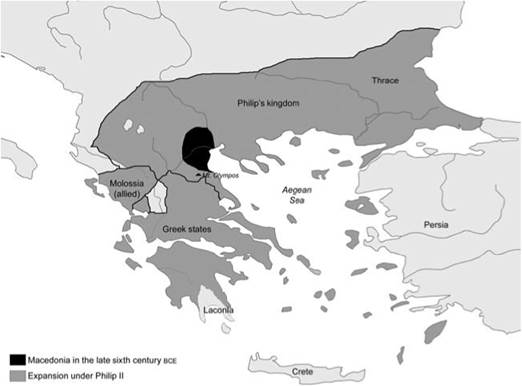
Map 5.1 Expansion of the Macedonian Core under Philip II
Recruits were utilized as both infantry and cavalry. As described above, there were special units among both the foot-soldiers and horsemen, and while the evidence does not describe the nature of training, it does indicate that drill was constant. The cursus kommun of aristocratic youth that began at the early age of about 13 was also constant, designed to produce effective and loyal officers. Evidence suggests that it was very successful, although not entirely. Initial advancement may have been a humbling experience, as it placed an elite youth in the rank of foot-soldier. On the other hand, the young men were part of a smaller, aristocratic unit of infantry retaining a special association with the king. In this capacity they continued to exercise their original responsibility of guarding the king on the field of battle and, in the process, could prove themselves worthy of higher commands. Sufficient information about the officers of Alexander survives to demonstrate the importance of the early training in defining men who were eventually appointed to key positions. A similar hierarchy existed in the cavalry, where an elite corps was the king’s troop. In this capacity, too, the mettle of younger men would be tested for future assignments. Nonaristocrats were also required as officers of the regular hypaspists. Although the majority of these commanders were of obscure background, it seems reasonable to envision a ladder of advancement here as well as for the royal troops.
An especially prized position was to be one of seven personal guards of the king, or somatophylakes, while he was at Pella and also when he was on campaign. The position was held for life unless grounds for dismissal emerged. Three of Philip’s somatophylakes were inherited by Alexander: Arybbas of Epiros, perhaps a kinsman of Olympias, traveled with Alexander as far as Egypt, where he died of illness; one Demetrios continued as Alexander’s guard until he was dismissed on suspicion of disloyalty in 327; and Balakros served with Alexander through the battle of Issos in 333, when he was appointed as satrap in Kilikia. In addition to the personal guards, all of the king’s subordinate commanders were crucial to Macedonian effectiveness in war. The examples of three of the most powerful of Philip’s men will serve to indicate their personal history and the nature of their careers.
Antipatros, born shortly after 400, was Philip’s elder by 17 or 18 years, and thus he had been active in the service of Philip’s father and his older brothers who had preceded Philip as kings. He was the son of lolaos from a place known as Paliouria, whose location is uncertain. That lolaos was of an aristocratic family is supported by his designation by Perdikkas II as general of the cavalry in 432 (Thukydides I.62.2) and by the status of his children: two of Antipatros’ sons - Philippos and lolaos - are attested as somotophylakes of the king, and his daughters were important in forging alliances through marriage. He himself was called on for a full range of services: as general of campaigns; to negotiate terms of peace at the conclusion of the Sacred War in 346 and with Athens after the Macedonian victory at Chaironeia in 338; to represent Philip at important panhellenic events, as at the Pythian Games in 342; and to serve as regent in Philip’s absence. In sum, Antipatros is a representative of the aristocratic families of the core of the kingdom, who, at least in this case, could be relied on as allies of the Argead king.
Parmenion, born at approximately the same time as Antipatros, was if not as important to Philip, then nearly so. Plutarch reported that Philip said that while the Athenians selected 10 generals each year, he had for many years found only one general, Parmenion. (Plutarch, Apophth. Phil. ii = Moralia 177c). The son of Philotas, Parmenion’s origins were probably in upper Macedonia. After assisting Philip in stabilizing his rule in the first troubled years, Parmenion led campaigns defeating an Illyrian force in 356; negotiated terms of peace along with Antipatros in 346; and was selected as one of the commanders of the advance force in Asia Minor in 337. His son, also named Philotas, was one of the king’s boys, and advanced to major positions in the course of his career. A younger son, Nikanor, was an officer of the companion hypaspists and was appointed as governor in western India, while the youngest son, Hektor, died during Alexander’s campaign in Egypt. This important family illustrates the importance of ties with the larger territory of Macedonia, along with their dangers: Parmenion and Philotas, both found guilty of treason against Alexander III, were executed.
Antigonos, known as the one-eyed, had the same birth-year as Philip. Antigonos is described as a comrade of both Philip and Alexander (Justin XVI.1.12), an association that presupposes an importance in the reigns of both Argead kings, although we know little of his earlier activity. Consequently, his status and even the original location of the Antigonids are uncertain, although a case has been made for Beroia, north of the Haliakmon River in southern Hemathia. No clues to his status exist in the surviving evidence of career training for aristocratic youth: no matter what his status was, it is most unlikely that he would have been among the king’s boys given the date of his birth. What is more, the institution took its formal shape during the reign of Philip. Nor would his one son who lived to manhood have been trained at Pella; rather he was raised with his father in Anatolia, where Antigonos was posted by Alexander in 333. Another indication of his original status may be found in his command post at the time of Alexander’s crossing into Anatolia: Antigonos was entrusted with command of the allied Greek hoplites, a major post, to be sure, but not as elevated as a command in the royal units of the Macedonian hypaspists and cavalry. All of these details may suggest a non-elite status. On the other hand, his wife may have been related to Philip as a member of one branch of the Argead line. Combining these few clues may reveal a third category of Macedonians drawn into the military apparatus of the expanding kingdom: members of families resident in the core of the kingdom but not likely contenders for the Argead throne. Not aristocratic by birth, they were nevertheless able to rise in position and stature through marriage and by their proven worth and loyalty to the reigning Argead king. The pool of subordinates had been narrow during much of earlier Macedonian history. Philip had to think creatively about the kind of men who had not only the skills but good reasons for loyalty to a commander-in-chief.
Results of the Military Reformation
In sum, Philip fashioned an effective structure of organization and training for the primary demands of his realm - defense of the core area followed by control over peripheral areas and offensive action against troublesome neighbors at a greater distance. The essential tool was a large, well-trained army ready to act on little notice. Large numbers of troops were needed - ordinary infantry, expert cavalry, special units such as archers. Leadership of these units required considerable numbers of well-trained commanders. The centralization of command was essential to coordinate units and subordinate officials. Without it, regional interests fueled by the ambitions of local leaders would quickly undercut the power of the nominal Argead ruler. One aspect of centralization was achieved by concentrating activities in one location: embassies, development of siege machinery, training of future officers, planning of campaigns, control of resources, and the private life of the king and his family all focused on Pella. As the archaeological evidence from Pella reveals, the picture of a basically unstructured political organization there seems in need of rethinking. While not yet comparable to the institutionalized political organization of contemporary Persia, there are clear indications of regularization. Perhaps, as it has been argued on analogy with medieval European institutions, household functionaries of the king were coming to exercise administrative positions. But even our meager evidence indicates that Pella was the seat of regular departments of state: a secretariat, development of military technology, control of allocation of resources. The proliferation of activities at Pella obviously demanded ongoing oversight by a variety of officials trained for their duties, competent to manage the affairs of others under their charge, and hopefully loyal.
The decisive voice in all of those activities was that of the king: as his campaigns were successful, he had incentives to offer common soldiers and elite forces alike. By building a ladder of training for future officers and locating the training in Pella, Philip forged new links between the adolescent youth who hoped to be major figures in what promised to be lucrative enterprises: only one person at a time might be ruler of an independent Lynkestis or Orestis, but many Lynkestians and Orestians could enjoy a career of important command in the Macedonian state. The Argead king also hoped for personal advantage in the form of his own security, which had so often been at risk through military incursions into the kingdom, through the plots of other members of the Argead line, and through the ambitions of rulers of once-independent realms.
Such emphasis on the importance of kingly leadership ignores the other institutions of administration present in most states. Was there not another political body or institution of major significance in the administrative life of Macedon in addition to personal leadership and the military assembly? There is no indication of a written code of laws regulating justice and its administration. Customary law in oral form appears to have defined rights and responsibilities.
Was there no advisory council? For its early history, there is no indication of the existence of a formal council, although it is likely that an informal council played a role in decision-making. The Homeric analogy may again be relevant. Just as Agamemnon took counsel with various kings, so Philip would consult with his senior officers, men like Antipatros, Parmenion, and Antigonos, to coordinate campaigns or delegate responsibilities. Extant sources relate such consultations between Alexander and his officers. One of the best known is the discussion of Dareios’ offer of concessions as Macedonian successes multiplied:
When these offers were reported in a gathering of the companions, it is said that Parmenion told Alexander that were he Alexander he would be pleased with these terms, ending the war without further danger. Alexander replied to Parmenion that if he were Parmenion he would do just that but since he was Alexander, he would reply to Dareios just as he had indicated. (Arrian II.25.2)
That is, Alexander would not accept the proffered terms.
Participants in these sessions are likely to have come from the king’s closest companions, although this is not to argue that there existed a fixed body of companions forming the council. Those men closest to the king would often be away on other delegated responsibilities. However, the individuals most trusted by the king constituted a powerful force. Alexander owed his assumption of the kingship largely to the support given him by Philip’s companions.
The successes of Macedon during the reigns of Philip and Alexander reveal one side of the results of the innovations of Philip. Jack Ellis has expressed the other side of those results precisely and well:
But if the army was at once the instrument and the expression of the new unity it was all the more essential that military objectives were constantly in mind and, more important, that military successes were won, lest it turn the newly found energies in upon itself and the state. While, that is, the revolution was at least shaped by Philip’s own determination and perception, he was as bound as anyone else by its implications; he was the rider of the tiger he had released.
The new army was the tool for unification, expansion, and centralization under the leadership of a king ruling from Pella. It was necessary for the stability of both the kingdom and the power of the Argead kings. Consequently, it must be permanently in place. Its function, of course, was the maintenance of the integrity of the kingdom whatever its size. As enlargement and pacification of additional lands occurred, new objectives would be needed. Sustaining suitable opportunities for his force became an item of primary importance on the royal agenda.
The security of kingly power was also associated with military innovations both positively and negatively. The king’s boys would be his guard in Pella, and the seven more senior somatophylakes exercised an even more demanding position in protecting their king from danger. Guards in both groups could have personal grievances, however: Philip was killed by one of his “boys,” and one of Alexander’s seven was alleged to have been involved in a conspiracy against the king. Many of Philip’s troops and officers were from upper Macedonian regions and, like Parmenion, they served him well and rose to major command positions. An Alexander of the Lynkestian realm was one of the first to declare for Alexander III on the death of Philip, and he was with Alexander in his Persian campaign, given important positions such as command of the Thessalian cavalry. However, he was suspected of plotting against Alexander and was arrested, imprisoned, and eventually executed in 330. Junior officers, too, could be disloyal: one Amyntas, son of Antiochos, deserted from Alexander to Dareios, leading the Greek mercenaries at Issos. If the regular troops felt anger against their commander, mutiny was always possible in spite of the oath of allegiance they had taken on the occasion of the accession of a king (Polybios XV.25.11; Curtins X.7.9).
The “tiger” had a powerful tail to lash against the Macedonian king as well as against enemies of the king and his kingdom. Its commander was well advised to keep a close watch on the movements of that tail.