
III
6
Touring the area and taking in the site where once stood Mitchelstown Castle, scene of the unforgettable garden party of August 1914 described in Bowen’s Court, it becomes searingly clear just how the world of the Anglo-Irish in this pocket of the country fell asunder from that moment on.
(Sadbh, ‘Tracking Elizabeth Bowen’, Irish Times, 12 June 1999)
1. ‘The mills of God grind slowly’
On 13 August 1922, just eight years after the Cork aristocracy and gentry had gathered there at the outbreak of the Great War, Mitchelstown Castle was burned by evacuating anti-Treatyite troops.1 The great conflagration could be seen for miles around. Alec King-Harman, who was to inherit the ruin, later considered the preparation that must have been necessary to achieve the end result: it was ‘almost impossible’, he reflected, ‘to have burnt the whole of that magnificent building, and the most fiendish ingenuity must have been displayed to accomplish such an end’.2 As the fire lit up the night sky around the town a young boy named Patrick Glavin sat mesmerised on the demesne wall at Cahir Hill; when he went home and explained to his mother why he was so late, she simply remarked: ‘The mills of God grind slowly, but exceeding small.’3
Built c.1823–25 for the 3rd Earl of Kingston, to the design of James and George Richard Pain, at an estimated cost of £100,000, Mitchelstown was reputedly Ireland’s largest Gothic Revival castle. Occupying three sides of a quadrangle – the fourth was a terrace – the principal entrance on the eastern side was flanked by two 106-foot high square towers, while on the northern side there were two equally imposing octagonal towers. The castle had at least sixty principal and twenty minor rooms: the magnificent entrance hall opened into a 100-foot-long gallery, there was a dining room capable of seating 100 people, and three libraries.4 In 1837, Samuel Lewis wrote that ‘The whole pile has a character of stately baronial magnificence, and from its great extent and elevation forms a conspicuous feature in the surrounding scenery.’5
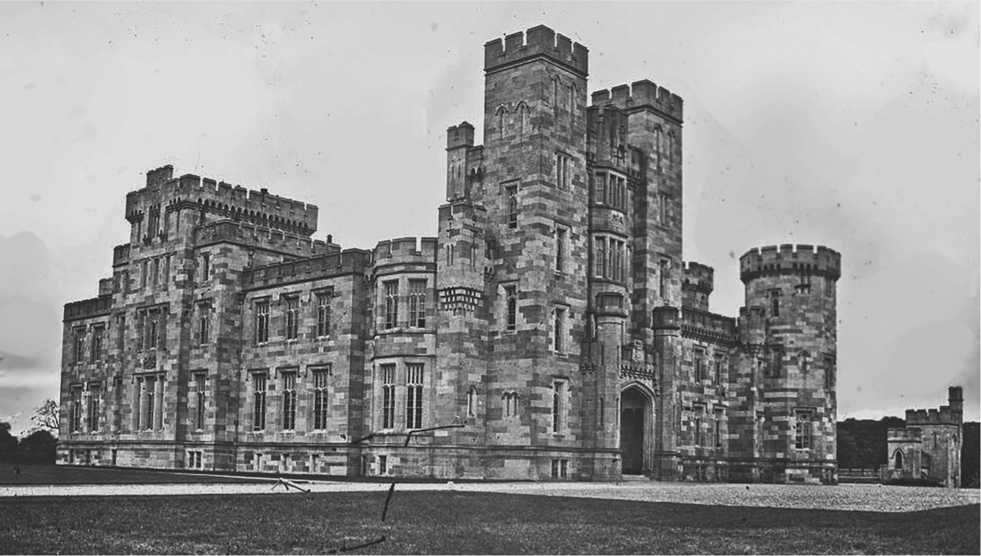
6.1 Mitchelstown Castle, home of the Webber/King-Harman family. Burned by retreating anti-Treatyites in August 1922, it was probably the largest house destroyed in Ireland. Its owner later reflected that it was ‘almost impossible to have burnt the whole of that magnificent building, and the most fiendish ingenuity must have been displayed to accomplish such an end’.
The architectural extravaganza was built rather foolishly at a time when the Irish economy was in a downward spiral that had begun with the ending of the Napoleonic Wars a decade before. A descendant later recognised that George Kingston’s overextended ambition to emulate Windsor Castle had ‘ushered in an era of folly and disaster which led finally to the ruin of the great Mitchelstown inheritance of the Kings’.6 And its baronial magnificence only served as a quintessential symbol of feudalism for later generations of Nationalists; it represented to the tenantry, in this case both rural and urban, the difference between ‘us’ and ‘them’ and, in that context, the wry gist of Mrs Glavin’s remark was revelatory.
This short chapter presents a case study of Mitchelstown Castle as a microcosm of what happened on so many Irish aristocratic estates in the revolutionary period 1920–23. It provides a bridge between what has been written so far and the discussions to follow on looting and compensation.
2. ‘A more final scene than we knew’
In 1922, Mitchelstown Castle was owned by William Downes Webber, second husband and widower of the Countess Kingston, who had died in 1909. In her will, she had stipulated that Webber should ‘leave back the remains of the estates to that member of the Kingston family whom he considered best entitled by birth to come into it’.7 It was her favourite nephew, Alec, that she had in mind.8 On the evening of 29 June 1922, Webber was hosting a dinner party for a small number of family and friends when, late in the evening, they were disrupted by anti-Treatyite forces who forced their way into the castle and announced that they were commandeering it.9 Mitchelstown Castle was an ideal fortress to establish temporary headquarters: massive in scale, it could accommodate a large number of men – according to Michael Casey, one of the IRA officers, there may have been up to 600 soldiers based there10 – and its towers and battlements commanded a sweeping view of the town and surrounding countryside. The anti-Treatyites were led by Patrick ‘Pa’ Luddy, a 23-year-old farmer’s son, whose family had for generations been tenants on the Kingston/Webber estate. Indeed, Luddy claimed in his BMH witness statement that his grandfather had once been ‘in charge of a number of farms on the estate’ and, according to family lore, he ‘was usually consulted by the landlord in connection with such matters as water rights and subdivision in the case of the tenants’.11 Luddy’s memoir has remembrances quite common in IRA witness statements: for instance, he recalled that his father had been ‘out’ in the 1867 Fenian rebellion, and that he was then involved in the land agitation of the 1880s when ‘the men and women of the Mitchelstown district took strong and active steps to ensure that the landlord’s men were effectively dealt with’.12 ‘It was,’ Luddy said, ‘in the atmosphere of the history of those times that I was reared as I listened to the stories of the period being recounted at fireside chats in my home.’13 His witness statement – no different to any other – may be characterised by questionable recall of historical facts but one does get a sense of what Raymond Gillespie describes as ‘the complex evolution of the Irish experience’.14
If ancestral anti-landlord grievances fed into the reasons for the burning of Mitchelstown Castle, it is not difficult to explain why. In the 1880s, the 25,000-acre Kingston estate was front and centre in the extended Land War, not just in Cork but in the country as a whole, and this would channel resentment towards the family and by extension towards the Big House.15 James S. Donnelly has written that before the Land War ‘landlord-tenant relations had previously been harmonious’ on the estate, evictions were rare and rents were generally moderate.16 However, the economic downturn of the late 1870s greatly altered the estate dynamic.17 The refusal of the Countess of Kingston and her agent/husband, William Webber, to grant even a small abatement because of their own enormous debts – including a £236,000 mortgage to the Representative Church Body – led to a threatened rent strike and public tenant demonstrations that, in turn, were met with the serving of eviction warrants that gave rise to riots between tenants and police.18 Tensions so escalated that by the end of June 1881 there were around 700 soldiers and 300 police encamped on the grounds around Mitchelstown Castle to protect its owners; the improvised military camp only served to highlight what the Big House stood for in the colonial landscape and radicalised attitudes towards it. In the months that followed, levels of violence grew as evictions were resisted and ‘grazing grabbers’, those who willingly took on evicted farms, were targeted along with bailiffs, process servers and farmers who, despite the strike, paid their rents behind the backs of their neighbours. Some 200 tenants were evicted but the widespread nature of the agitation, the media attention it attracted and most pertinently the need for income forced the Countess Kingston and Webber to relent and 90 per cent were eventually reinstated. According to Donnelly, the tenants had achieved ‘a great moral victory that inspired the tenants of other estates to resist their landlords’.19
However, the easing of tensions was only temporary. During phase two of the Land War, from the mid-1880s, the National League organised the Mitchelstown tenants to adopt the Plan of Campaign – a blanket refusal to pay rents unless a significant abatement was granted – and this once again shook the Kingston estate to its financial core. The tenants were aware of the Countess’s rising burden of debt – by 1887 the interest due to the Representative Church Body was £15,000 in arrears and the mortgagees were ‘getting restive’.20 Plan leaders exhorted the tenants to ‘steel your hearts and go to war, in the name of God and with the blessing of the [Roman Catholic] Church’.21 Tensions escalated, violence reignited, the tenant representatives urged a unified front to resist eviction. This was the era of Arthur Balfour’s chief secretaryship, after which he passed into nationalist myth as ‘Bloody Balfour’ for his enforcement of the Crimes Act (1887).22 On 9 September 1887, a demonstration in the town of Mitchelstown resulted in police firing into the crowd, killing three men – John Casey, John Shinnick, Michael Lonergan – and seriously wounding twenty others.23 The so-called ‘Mitchelstown massacre’ had national repercussions and in local populist opinion the Kingstons/Webbers were sure to be represented from that point on as usurpers of Irish land. This was a typical outcome of the Land War era: as R.V. Comerford puts it, the Big House was from then on ‘made into a symbol of oppression and decadence in order to justify the long land war, and the dominant party politics of the occupants was sufficient pretext to perpetuate the antipathy into the revolutionary years and beyond’.24 Mitchelstown Castle typified this.
After years of agitation and diminishing income, the Countess, like the majority of her peers, was only too willing to sell the entire estate under the 1903 Land Act, its generous terms too good to ignore. While the bulk of the proceeds, roughly £300,000, was eaten up by the estate charges, there was enough left over, thanks to the 12 per cent cash bonus (£36,000), to allow the Countess and Webber live on in some comfort in the castle. They also retained the 1,200-acre demesne, which Webber farmed progressively. Almost 900 acres were under pasture, while a small corner was given over for the Mitchelstown Golf Club, established in 1908, which brought local elites together from across the politico-religious divides.25
Three years after the passing of the Wyndham Act, an impressive 18-foot-high monument was erected in the town to commemorate John Mandeville, agrarian leader, as well as the victims of the Mitchelstown massacre. William O’Brien, founder of the United Irish League and MP for Cork City, told a crowd estimated at 20,000: ‘Monuments of this sort are not mere monuments to individuals. They are monuments of undying principles. They are landmarks in the history of a race.’26 He encapsulated the polarisation of Irish politics since the alignment of the Home Rule and land questions with the issue of national identity, but still a very large crowd ‘from all parts of the district’ attended the Countess Kingston’s funeral in October 1909.27 The garden party organised by her widower in August 1914 was a much less representative affair. Before she ended her memoir, Elizabeth Bowen returned her mind to the garden party, a pivotal scene in her Big House drama. The Great War, she wrote, would leave ‘[m]any of those guests, those vehement talkers . . . scattered, houseless, sonless, or themselves dead’. Then would come the War of Independence and the burning down of many of the Big Houses, including Mitchelstown, and so, Bowen concluded: ‘The garden party was also a more final scene than we knew, ten years hence, it was all to seem like a dream – and the Castle itself would be a few bleached stumps on the plateau. Today, the terraces are obliterated, and grass grows where the saloons were.’28 This is the story of what happened.
3. ‘At the time there was great bitterness’
Back in 1917, Pa Luddy had joined the reorganised Volunteers, at a time when his brother was serving with the British army on the Western Front. By 1919, he was OC of Mitchelstown Company of the IRA (his rank at the truce was vice OC of Castletownroche Battalion) and his brother, now a returned war veteran, was training officer. He was working at the time with the Mitchelstown Co-Operative Agricultural Society Ltd, which had been formed in June 1919 by a group of local farmers in reaction to the continued exploitation of wartime markets by local seed merchants. In October, following an investment of £100, Webber became the largest shareholder.29 In the tit-for-tat reprisal warfare that characterised the War of Independence from 1920, co-operatives were often the chosen reprisal targets of the Black and Tans, a calculated way to strike at the heart of a local agricultural community.30 It became dangerous for them to have any employees who were suspected IRA officers and so, according to Bill Power, for this reason Luddy was sacked.31 As the war against the RIC intensified in the spring of 1920, Luddy’s men raided the Mitchelstown demesne to steal a large pump on wheels, used to spray weed killer, which the IRA hoped could be used to spray paraffin onto the roof of the local RIC barracks.32 It failed. But no attempt was made on the castle. In truth, it would have been a challenging target given that the military officers based at Kilworth, Fermoy and Buttevant were regular visitors there.33
By the spring of 1922, the British army had left Cork, the RIC had been disbanded and the IRA had split over the treaty with most of Luddy’s Mitchelstown company going anti-Treaty. Without any protection, the castle was in a more vulnerable position than at any time in its history. On the night Luddy’s men commandeered it, they ordered Webber and his family and guests to leave; Webber refused to do so and instead he and his guests spent time lifting carpets and storing paintings, silver and other valuables into two rooms which they then locked.34 Having allowed them the opportunity, Luddy’s men forcibly evicted Webber on 30 June. Two days later, one of the dinner guests, Miss Hare, formerly of Convamore which had been burned in April 1921, was allowed to return to pick up her personal belongings; her story of what she saw was later recounted by Edith Somerville: ‘Photograph frames were smashed and the bits of glass . . . used as darts to throw at the valuable big Rembrandt that they [the family] had not been able to get down in time.’35 If Somerville’s telling of the story is authentic, tearing the Rembrandt to shreds with shards of glass now seems like an act of wanton vandalism, which one might deplore as the destruction of an artefact of international heritage significance. But, in the context of the time, how sensitive was the average rank and file IRA volunteer, mainly drawn from the lower ranks of Irish society, and poorly educated, to the cultural value of works of art, Classical statuary and architecture? Moreover, in the context of war, there was nothing unusual in this type of soldier behaviour, regardless of how the victims might perceive it. In comparison, in August 1920 Lady Adair at Glenveagh in Donegal was disgusted by the ‘barbarians’ and ‘philistines’ who made up the IRA party who invaded the castle and who ‘injured four oil paintings of some value and tore up a group photograph that had Lord Kitchener in it’.36 To the IRA Kitchener represented an iconic figure of the empire they were fighting. And the oil paintings were just as symbolic of an alien culture as was Lady Adair’s Big House. It is questionable what, if anything, the name Rembrandt meant to the Mitchelstown occupiers.
Hardly surprisingly, as soon as the family left Mitchelstown Castle, the locked rooms were broken into, and the contents removed. The carpets were relaid, but not for any enhancement or comfort, for when Miss Hare returned she found them ‘indescribably filthy with cigarette ends, mud and spit’. She was shocked by the fact that lavatories ‘being considered useless institutions, the walls of the corridors were used instead’.37 All the books in the library were used as barricades for the windows, while the heavy furniture was used to fortify the doors. Outside, streams of lorries and motor cars crossed the decorative lawns and the recently refurbished tennis courts. Trenches were dug at the front of the castle and barbed wire fences erected. Urinating on the walls was a gesture of disdain, defiance and provocation, and the destruction of the castle’s contents and its surrounds just another stage in the despoliation of the coloniser’s landscape.
The occupation went on until mid-August 1922 when, as the National Army advanced, and the town of Mitchelstown became caught up in ‘the very danger zone of strife’, Luddy gave the order to evacuate and torch the castle.38 When presiding over the subsequent compensation claim, Judge Kenny condemned its destruction as an ‘act of vandalism’; he could see no military reason why it should have been destroyed.39 One former employee believed it was ‘an act of hostility to the [Provisional] Government of the State’ but it could just as likely have been an act of hostility towards the former regime.40 The residual hostility inherited from the Land War era, and, indeed, before, has to be considered a factor. For example, in 1910 the Weekly Freeman’s Journal carried stories of the Earl of Kingston who had commanded the North Cork Militia during the 1798 rebellion. It noted that ‘tradition has preserved the history of the flogging and persecution of the Catholic population, and the burning of churches by his bloodhounds in those evil times’, and that the militia was ‘composed of the scum of society and was quartered at Mitchelstown Castle’, thereby highlighting it as a symbol repugnant to Irish Nationalists.41 A hundred years later the Land War on the estate added another layer and, as R.V. Comerford concludes of the more general case, landlord and Big House became the ‘synecdoche for all the historical grievances of the nationalist narrative’.42 The family were acutely aware of this. When Colonel Anthony King-Harman paid a visit to the ruins of his ancestral home in 1994, he reflected: ‘To a certain extent we have always felt that the way things were handled by Webber and his wife contributed to the burning of the castle by the IRA’ and concluded: ‘The disasters here were inevitable. I think, at the time, there was great bitterness . . . He [Webber] put it in the position where people wanted to burn down the castle.’43 Back in the 1920s, when compensation was sought from the Irish Grants Committee, the secretary concluded that, if the castle had been rebuilt, ‘In all probability having regard to the local animosity against Colonel King-Harman and his family the Castle would have been burnt a second time.’44 As for the chief perpetrator, Pa Luddy spent his lifetime boasting locally that, by ordering the burning of the castle, ‘He was avenging centuries of landlordism and English occupation, as well as erasing what little was left of the Kingston presence in Mitchelstown.’45
4. ‘Putting stuff behind trees and bushes’
In 2000, historian Bill Power controversially argued another reason for the castle’s destruction, that while military strategy was ‘The Republican’s official line . . . the truth was not so easily confronted by Luddy’s generation or, for that matter, their children. The castle had to be burnt to cover up the looting of the priceless paintings, furniture, and silver by the Republicans, their friends, and supporters.’46 Although generations after the event, this was a painful revisiting of a very sensitive topic in Mitchelstown’s history and Power was excoriated locally. One correspondent wrote angrily to the provincial press:
I see that your historian Mr [Bill] Power is at it again, extolling the virtues of the notorious Kingstons of Mitchelstown. There is no need to write a book on those people because their notoriety has been discussed in every chimney corner over the last 150 years – murderers, cowards, rapists, extortioners, and any other adjectives one could think of . . . I would like to remind Mr Power that the Kingston dynasty have now gone . . . How dare he castigate the republicans of that time who sacrificed their lives so we and he could enjoy the freedom we now have?47
As an aside, but a relevant one, back in February 1924, when the courts were deluged with compensation claims for looting, amongst very many other things, the editor of the Sligo Champion condemned ‘this appalling collapse not only of the national “moral” but of ordinary morality’, and predicted that ‘future historians will pore lovingly’ over the details of such wanton crimes, ‘finding in them material for a series of cynical comments on some of our patriotic war-cries, and a mass of curious illustrations as to the working out in practice of principles which we were told contained all that was necessary to our political salvation’.48 It was a very prescient statement in relation to how aspects of the narrative of the revolutionary period would evolve over the century.49 In fairness to Bill Power, he used all the relevant primary sources available to him – newspapers, BMH witness statements, compensation files and oral evidence; the criticism of his interpretation was merely a very strong indicator of vestigial local hostility towards the Kingstons. There were still those who preferred to celebrate the Luddy interpretation that he and his comrades were ‘avenging centuries of landlordism and English occupation, as well as erasing what little was left of the Kingston presence’. Then again, if that was what the anti-Treatyies had been intent on doing, they might also have considered burning the King’s Square in Mitchelstown, which remains one of the finest rows of Georgian buildings in existence in Ireland.
At this remove, it would be very difficult to prove Power’s theory that a conspiracy to cover up looting was the primary motive but there is no doubt in this case that there was widespread civilian participation in the looting of the castle (see below). When the compensation hearing began in 1924, the Free State government appointed John Butler to investigate on its behalf. In June, Butler ‘heard in Fermoy and Mitchelstown, in the course of conversation with different people, that there had been considerable looting from the Castle, and that the claimants either did not wish to go into the matter or were afraid to do so’.50 Later, he went through the ruins and concluded: ‘There was no salvage, but from my investigation I am perfectly sure there was considerable looting.’51 This was corroborated by several eye witnesses: Miss Needham, for instance, who had been in the castle when the IRA evicted the Webbers, recalled ‘looting about the Castle, and putting stuff behind trees and bushes’.52
No inventory of the contents of Mitchelstown was produced during the compensation case nor is it certain that one even existed. Unanswerables, therefore, remain regarding what exactly was destroyed, what had been removed beforehand – sold or stored for safe keeping before 1922 – and what was left to be looted. Arthur Webber testified that he had been allowed into the castle about two weeks before the fire: ‘The furniture was all over the place, but he could not swear to anything being missing.’53 He later surmised the heavy furniture had, therefore, been burned. Most of it could not physically have been removed and at any rate would have been of little practical value to anyone in or around Mitchelstown, given that most of it had been constructed on site specifically to suit the castle’s Gothic interiors. However, what is illuminating is that all the basement furniture – used for the servants’ quarters – was looted including tables, chairs and beds (and linen), all of which were more practical and more useful to local households. Butler noted: ‘The fire does not seem to have reached the basement, yet none of the contents are to be seen, and all the fine mantelpieces seem to have been forcibly wrenched from the walls and carted away.’54 James O’Neill, a local plasterer, also witnessed men and women dragging furniture from the basement which was ‘stored around the ground for the time’ before it could be safely removed.55
The most valuable contents were the paintings, the family silver and personal jewellery. Robert Douglas King-Harman in his memoir claimed that the most important painting, an impression of the royal palace in Berlin, presented to the family in 1834 by Frederick William IV, last king of Prussia, was ‘like all the others at Mitchelstown . . . destroyed in the fire in 1922’, and concluded, ‘All that remains of Mitchelstown Castle are a few books from the library, a few pieces of family silver, and a few odds and ends like seals and knick-knacks.’ He also lamented the loss of the family archive, especially the manuscripts of Edward, Lord Kingsborough, relating to his work on the Antiquities of Mexico.56 Butler maintained that the silver was looted before the fire, including a magnificent chandelier with over 64 pounds of silver, and a silver tea urn on a stand weighing 7.5 pounds. He was bemused by the fact that the Gardai had been unable to trace the looted goods: ‘I cannot understand why there was no salvage in the case of the silver, the silver could not have been burned away,’ he reported.57 Moreover, two local jewellers, Thomas Hartigan and Thomas Morrisey, later gave evidence of having been offered unspecified silver artefacts by locals. On 14 January 1990, 78-year-old Fr. Edward J. Kilbride, who was 10 years old at the time of the burning, told Bill Power that he remembered ‘several objects were thrown over our back gate possibly by way of restoring them to their owners – which we did’, and these included ‘a silver teapot and broken epergne, as well as a muffin dish – very Victorian’.58
The Hampshire Telegraph also carried a report relating to a local woman, Mrs Florence Williams of Cosham, who was staying in the castle at the time, and whose jewellery box ‘was taken out of the cellar in the Castle and afterwards found broken open in a wood, and the contents missing’. Judge Kenny awarded Mrs Williams £608 in compensation, which possibly verifies her claim.59 According to Power, a local solicitor who he did not identify, ‘with an appreciation of the finer things in life’, removed many of the valuable paintings ‘for his personal pleasure and advantage’.60 In 1957, Sir Cecil Stafford-King-Harman received a letter from D.F. O’Shaughnessy with an address at Kilfinane in Limerick informing him that over forty paintings had been sold at Sotheby’s for almost £101,000 and that one of the anti-Treatyite garrison had told him they had come from Mitchelstown castle.61 Unless more evidence turns up, such claims cannot be substantiated, but neither should they be sceptically dismissed.
5. ‘A delight in wrecking whatever had escaped’
William Webber made a very substantial claim for compensation amounting to £148,000 under the Damage to Property (Compensation) Act 1923 (chapter 8), including £18,000 for contents.62 It cannot be said that Webber was hopeful of rebuilding, nor that he had any great desire to do so. He was elderly and his health was failing but he was also pragmatic enough to realise ‘It is impossible that it, the Castle, can ever be used again as a Family Residence.’63 Webber died on 23 February 1924 before the compensation case was heard. His successor, Alec King-Harman, subsequently endured years of delay and frustration; on several occasions the state solicitor and the state valuer applied for adjournments, leading him to conclude: ‘It seemed plain to me that the State intended to postpone the hearing of my case until they had exhausted my patience.’64 King-Harman later articulated his frustrations to the Irish Grants Committee:
The reported decisions given in compensation cases seemed to follow no general rule, but to depend entirely upon the whim of the Circuit Judge; and when what appeared to be a just decision was given the State invariably appealed. No Loyalist could have any confidence in the Courts, as they were then being constituted, and I felt that I had better accept almost anything that was offered rather than let my case hang on indefinitely, and perhaps get little or nothing in the end.65
It was unrealistic to expect that the Free State government would be in a position, or sympathetic enough, to award such an enormous sum to any single individual owner. There was also the problem, as Robert King-Harman put it, ‘that Alec was not the owner of the castle at the time of its destruction’ and this had ‘a serious and damaging effect on his efforts to get adequate compensation, so that Anna’s [Countess Kingston] will was finally the cause of great financial injury to the family she had intended to benefit’.66 The best King-Harman and his legal representatives could hope for was an out-of-court settlement. Thus, his solicitor Anthony Farrell came to an arrangement with the Ministry of Finance that, subject to the approval of the county court judge, King-Harman would accept a greatly reduced figure of £27,500, of which £25,000 would have to be used towards rebuilding a house on the original site.67 King-Harman later argued that he ‘only accepted the offer in the same way as a starving man will accept half a loaf rather than get no bread’.68
The Minister for Finance made it clear to King-Harman that the state felt ‘it was absurd to build such a vast house in these days’ and that if he did not accept the offer of £27,500 with a £25,000 reconstruction condition attached, he would only get £7,500 with no condition attached.69 Alec was frustrated enough to later complain that ‘The methods of the Government are not much better than those of card sharpers.’70 These were very different times to when his ancestors might have expected such levels of compensation to be paid at the expense of local ratepayers under compensation acts administered by the British government. The Free State government was operating under massive financial restrictions and the aristocracy were only a small percentage of all the total claimants seeking compensation.
On 25 April 1926, the agreed award of £27,500 was sanctioned, though modified in that Webber was allowed to use the money to build houses in Dublin instead of reinstating a house on the original site.71 About a year after the burning, King-Harman advertised salvage from the ruined structure, valued by Hill architects in Cork at £50,000, but there was no local interest.72 This was hardly accidental; no doubt there was an understanding amongst the local population, whether orchestrated or not, that they were not going to pay for the Big House. In 1928, Alec King-Harman described what happened in the intervening years:
It was soon made clear to me that local feeling was still distinctly against the owner of the place; constant acts of annoyance continued for a year or two after Mr Webber’s death; indeed, I can still hardly call the place my own, for it is even now subject to perpetual trespass and damage. Some local people seemed to take a delight in wrecking whatever had escaped the attentions of the Republicans and Free State troops.73
In the 1930s, King-Harman was approached by Dom Marius O’Phelan, the Abbot of the Cistercian Monastery at Mount Mellaray in Co Waterford, who secured the magnificent cut limestone blocks to build a new abbey. Bill Power claims that over a five-year period ‘two consignments were loaded into steam lorries and taken to the site’ about 28 miles east in the Knockmealdown Mountains.74 Three carved stones from the castle went elsewhere, to an ancestral Kingston house in Newcastle, Co Longford, where another stone with the following inscription was placed above them: ‘These armorial bearings were brought from Mitchelstown Castle after it had been wantonly burnt on the 13th August 1922. They represent the arms of successive owners of Mitchelstown; Fitzgibbon the White Knight, Fenton and King, Earls of Kingston.’75
Finally, in the 1930s, under the Fianna Fáil government, the remainder of the demesne was compulsorily purchased by the Land Commission. Some of it was sold to Mitchelstown Co-Op, which, under the management of Eamon Roche, a staunch Republican, built factories on the castle site, which Power contends was ‘an achievement of great political symbolism to his old revolutionary colleagues in Mitchelstown and elsewhere’.76 Some years later, the demesne walls were lowered for ‘safety reasons’, and large gaps began to appear in them as sites were sold to build bungalows. To the north-east the wall was also broken to accommodate an extension to the local golf course that had originally been built on land donated by William Webber. The demesne trees were felled, including some magnificent and exotic species, and ‘The fish-pond became the site of the town sewerage works and the boat lake an effluent lagoon.’77
The remainder of the demesne was redistributed for the relief of local congestion. According to Power: ‘In many cases, the Land Commission’s disposal of the demesne was used to reward local freedom fighters of the War of Independence.’78 This was in line with what had become official government policy under the 1933 Land Act.79 One of those who secured a farm was Pa Luddy.80 As in so many other cases, the burning of Mitchelstown Castle did not merely result in the disappearance of an aristocratic presence that had been there for hundreds of years, it was seen to have benefited the local community in different ways, primarily through the expansion of the local co-operative and the redistribution of lands. But what difference might the existence of Ireland’s largest neo-Gothic castle now make to Irish tourism and the local economy, if Kilkenny Castle is a benchmark?