
7
They are closely knit bands, often little differing from bandits, under local leaders whose names have gained a reputation much like that of some robber thief of the story books. It is often hard to tell where the political outlaw ends and the looter begins.
(Tuam Herald, 2 February 1923)
In their pursuit of rural occupations, they [the aristocracy] afforded much employment, and conduced in no small degree by their patronage to increase the prosperity of the towns in their vicinity, and their loss, if they should decide to leave the country permanently, would be widely felt.1
(Irish Times, 5 November 1921)
1. ‘The fiery torch that flew the country’
If a common narrative of an arson attack on an Irish country house can be revealed, and it would be wise to remember that common narratives hide very many anomalies, it is along the lines that a gang of (armed) men – estimated numbers varied greatly from single digits up to 300 – arrived at a typically isolated country house usually in the early hours of the morning.2 Attacks were rarely spontaneous: an attack on an occupied house, in particular, had to be planned to ensure minimum resistance – during the War of Independence, armed forces were still patrolling the countryside, however sporadically, and officers were frequently being entertained in the Big House. The raiders usually came to the front door – perhaps a deliberate statement that they were no longer subservient or deferential – and they banged loudly, demanding entrance. If that was refused, and it seems to have been seldom the case, the raiders were well prepared and equipped; those who came to Moydrum Castle, as we have seen, were armed with hammers and sledges ‘borrowed’ from a neighbouring forge. Having announced why they were there, raiders piled the heavy furniture into the middle of rooms on the ground floor, or sometimes demanded servants to do so, and then saturated the stacks and the wooden/carpeted floors with paraffin and set it all alight. As in the case of Tubberdaly in Co Offaly, if this was not effective, they used home-made bombs, or, at Ballybay House in Monaghan, locally and widely grown flax was used like dried straw to ignite the fire.3 Windows were broken, holes were bored in the ceiling and slates ripped off the roof to ensure the wind fanned the flames.4 Raiders waited until they were sure destruction was a foregone conclusion and until such time as they departed no neighbour or estate employee who might have witnessed the orange glow of early flames dared come to the scene. As the newspaper report on the burning of Kilbrittain in Co Cork in May 1920 pointed out: ‘No one seems to have attempted to save the fine building. That was, of course, because no one dared so to act. The men may have remained until they were satisfied the Castle would ultimately become a ruin, and any interference would have led to bloodshed.’5
The available sources are generally very restrained in what they reveal about the mayhem and chaos during the destruction of a Big House; seldom do they adequately describe the undoubted fear and terror of owners and occupants, or the nervousness and excitement of raiders, or the despair and jubilation depending on whether victim or perpetrator. A fictionist might imagine much more vividly what the historian can rarely describe factually.6 Lady Fingall’s memoirs fall somewhere in between. On the night of 23 April 1923, when neighbouring Lismullin House in Meath was burned by the IRA, its owner Sir John Dillon got a letter to the Fingalls at Killeen warning them that their house was next. Lady Fingall later recalled the ‘preparation, lest the fiery torch that flew the country . . . should reach us’.7 She gathered her jewellery, put on her fur coat and sat with her husband in front of the study fire and waited and wondered would they see or hear a car approach, would the raiders come to Fingall’s study door as their tenants had always done (was she suggesting that the arsonists were likely to come from that community?), how would Killeen burn, would the servants be got out in time (hardly a very comforting thought for them). Her husband dozed, she stayed awake all night, but the raiders never came.8 At Monksgrange in Co Wexford, Adela Orpen’s apprehensions during the Civil War were not confined to one night; she recorded in her journal:
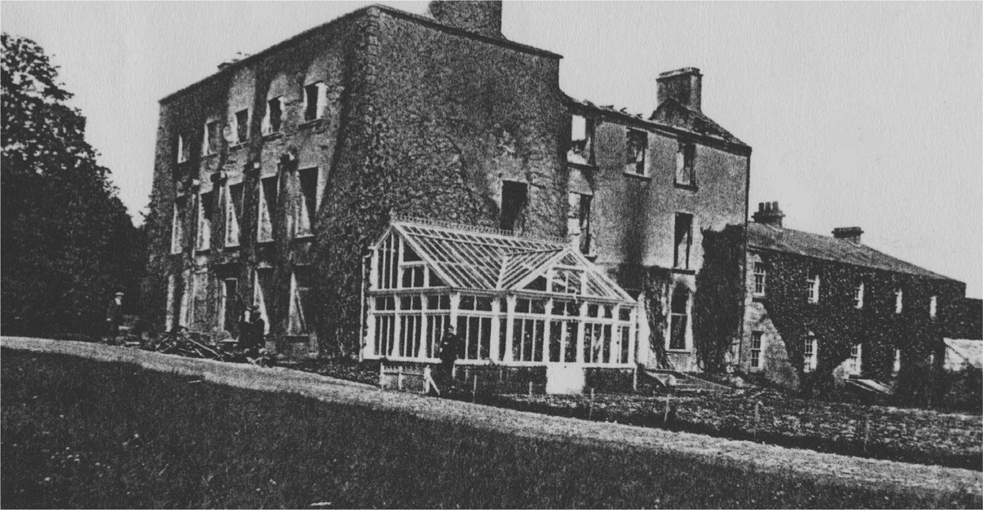
7.1 Lismullin, Co Meath, home of Sir John Dillon, burned by anti-Treatyites in April 1923. Its demesne was later redistributed in part to IRA veterans celebrated by the local press as ‘the breed of men, who fought and wrought and bled for Ireland’.
Oh these terrible long nights. These endless hours when one is waiting to be burnt. I feel so cold, it is as if the heart’s blood had ceased to have any warmth. It beats hard, so that breath comes fast but no other sign of warmth. I suppose this is the effect of terror. We have lived under it so long now, and each night the grim thing draws nearer. So when the dogs barked I was sure the raiders had come. Small wonder if I couldn’t sleep till four o’clock, when the dogs had long been quiet and our home was still standing.9
Yet, during the Civil War Adela and the other women in Monksgrange behaved stoically during several raids by the anti-Treatyites. On 10 November 1922, her daughter Lilian recorded one incident in her diary:
I watched the scene, a curious one for a civilized country. The stable lantern in the middle of the floor lit up the white blankets as they lay in a heap. One man sat on a chair under the better sack with his rifle between his knees, the other, a very tall young man, was standing beside him looking down at the proceedings, while the third was filling the two sacks as hard as he could with our blankets & overcoats while Dad made suggestions as to the best method of getting everything in.10
The same stoicism could be attributed to Lady Castlemaine on the night of the burning of Moydrum Castle; IRA leader Thomas Costello later remembered her being ‘very dignified under the circumstances and never winced. She thanked me for my co-operation in saving her treasures and assured me that she quite understood.’11 But then again Costello’s description of her stoicism also reflected the way he wanted his behaviour to be understood.
There were owners for whom the experience was much more traumatic. When the aged Colonel Spaight’s residence near Skibbereen was burned in early April 1921, it was reported that he and his wife were brought into the library and forced to witness the wanton destruction of valuable works of art, and the breaking up of a valuable bookcase. Mrs Spaight was then taken on to the front lawn to watch looted furniture from the house being loaded onto carts, before she and her husband ‘were marched through the steward’s house, being prodded in the back with rifles as they walked’. From the steward’s house, they were then forced to watch their house burning.12 All of this suggests that a particular form of deliberate punishment was meted out to the elderly couple, and the background to the burning may explain this. Spaight was a retired British army officer who owned the RIC barracks in nearby Leap that had housed a reinforcement of Black and Tans from the autumn of 1920. Shortly after their arrival, the Black and Tans came under attack from the local IRA, and they responded with reprisal attacks on the Roman Catholic parochial hall and local farmers’ houses. The barracks were burned by the IRA and it was subsequently reported in the newspapers that Spaight had claimed £3,000 for it in compensation. James S. Donnelly reasonably concludes: ‘The submission of such a claim to a court no longer recognised by republicans was itself contrary to Volunteer dictates, and the very provision of the barracks meant that the Spaights were linked in the minds of local republicans with the introduction of the Black and Tans into that corner of the county.’13 One of the IRA leaders is said to have told Lucy Spaight that they were burning the house because ‘she was responsible for bringing the Black and Tans into the district’.14
In a similar incident, in July 1921, when raiders came to Ballyrankin House near Enniscorthy in Wexford, they locked W.G. Skrine and his wife into one of the rooms, allowing the servants to leave – a deliberate separation of those who the raiders thought were deserving of punishment from those perceived to be innocent – while they prepared the house for destruction.15 When they were released, the Skrines, who lost everything including their wardrobes, had to walk four miles in their night attire to Newtownbarry.16 On 26 December 1921, during the truce period, a group of men broke into Moystown House in King’s County where Mary Waller-Sawyer lived alone. According to her correspondence with the Minister for Home Affairs, ‘The men got hold of me – a woman and alone – in the hall. They knocked me down, pulled out handfuls of my hair, kicked me about the body, struck me on the face, and repeatedly expressed their intention to have my life.’17 The local IRA arrested six named men, all of whom were later released on bail. Waller-Sawyer wrote angrily to the Minister: ‘As a member of the Provisional Government it is your duty to protect the people of this land from outrage.’18 Some of the servants in Sopwell Hall in Tipperary were subjected to a similar ordeal when it was raided in August 1922. Two Protestant servants were physically assaulted by the raiders, while a Catholic servant went unmolested, again suggestive of deliberate and discriminate separation. The servants were able to identify their attackers, three of whom were subsequently sentenced to ten years penal servitude. The Irish Times vehemently denounced the crime: ‘acts as vile as had ever been committed by the Huns in Belgium, with the difference that the crimes . . . were committed by native Irish upon their compatriots.’19 Mrs Charles Guinness of Clermont Park in Dundalk never recovered from her ordeal, and in 1927, four years after the burning, she was diagnosed as suffering from ‘cardiac angina and extreme nervousness’, which medical experts contended was a direct consequence of the trauma experienced ‘by the trouble she had to undergo in 1923’.20
But reports of such cruel behaviour do not seem to be as common as might be expected in a time of revolution, and historians have now come to accept that ‘Ireland’s wars were not as lethal as they might have been.’21 Certainly not in comparison to the horrendous crimes perpetrated against other aristocracies during twentieth-century revolutions. Some Irish aristocrats even claimed they were treated most civilly by raiders: for instance, in January 1923, the Earl of Mayo said the anti-Treatyites who burned Palmerston House ‘behaved courteously’ and granted him the time to remove his more valuable paintings.22 Sir John Dillon of Lismullin received an apology from those he referred to as ‘courteous arsonists’, who also helped him remove pictures and plate.23 Louisa Bagwell of Marlfield reported the raiders ‘offered no personal violence’ in any way and allowed family to remove personal belongings.24
Compare this to the Russian aristocratic experience of Countess Kleinmichel, for example, whose Petrograd palace was overrun in the February 1917 revolution. She was locked into two rooms along with her servants, while soldiers sang their revolutionary songs and used paintings of the Romanovs along the grand staircase for rifle practice, before they murdered all three of her husband’s brothers, one of whom was a 25-year-old Huzzar: ‘First the soldiers ripped out one of his eyes and forced him to watch as they killed several of his fellow officers; next they took out the other eye, broke his hands, his feet, and then tortured him for two hours by lifting him up on their bayonets and beating him with their rifle butts until he finally expired.’25 Scholten’s study of the Romanian aristocracy, who ‘In the first half of the twentieth century . . . felt strongly attracted by English [aristocratic] culture’ emphasises just how lightly those in Ireland escaped. From the 1940s, first the Nazis and then the Communists burned the Romanian aristocracy’s houses, expropriated their lands, looted their treasures and deliberately destroyed their libraries and family archives.
These events also happened in Ireland, but in Romania aristocrats were brutally tortured – the unfortunate Baron Jozsef Huszar, for example, ‘had a glass ampoule pushed into his urethra, which was then smashed with a hammer, and boiling oil was poured over his wounds’.26 In Hungary in 1951, over 100 nobles and hundreds of other untitled landowners were rounded up and sent to concentration camps in Hortobagy where they were ‘forced to perform hard labour and sleep in stables and barracks, surrounded by barbed wire.’27 The Irish Big House community did not suffer such terrorisation; they certainly were not rounded up and sent to concentration camps. The IRA never adopted the tactics of the Russian Cheka and the IRA leadership had no equivalent of Cheka leader Yakov Peters, whose intent it was to destroy and crush the aristocracy and other enemies of the working classes ‘by the heavy hammer of the revolutionary proletariat’.28 In 1918, the Russian aristocrat Vladimir Golitsyn asked: ‘Who is to blame that the Russian people, the peasant and the proletarian, proved to be barbarians? Who, if not all of us?’29 In contrast, it might be argued that British government reforms for Ireland in the nineteenth and early twentieth centuries were enough to provide the aristocracy with some form of dispensation. In 1920–23, and after, they were merely made irrelevant.
2. ‘A sad picture of the terrible power of fire’
Once the fire was started, trying to quench a raging inferno was inevitably futile: estate firefighting services were useless and fire brigades were too far away and too slow in arriving to be of much assistance. For instance, by the time the police and fire brigade from Trim arrived at Summerhill House in Meath, ‘The fire had gained such a hold that there were no hopes of saving the building.’ The police fired rifle bullets into a large tank of water on the top of the house but the water made no impact on the flames, and nothing could be done to prevent the house being ‘reduced to a mass of blackened ruins’.30 Similarly, in the days after Castlemary in Cork was set alight in September 1920, ‘There were still [flames] licking parts of the building, the walls of which now stand out a skeleton black mass, the very reverse of what the house was in its beautiful completeness.’31 When Castleshane in Monaghan began to burn on Saturday 14 February 1920, the steward, George Morgan, attempted to quench the dining room blaze with a hose but he was quickly defeated by the intense heat and billowing smoke. By the time help arrived, the roof had collapsed.32
A mansion of the magnitude of Castleshane could burn for days and become an attraction of great curiosity and this had further consequences. On Sunday 15 February 1920, crowds of townspeople from Monaghan walked out to witness Castleshane burning: the local newspaper reported that ‘The beautiful lawns around the house were sadly tramped and mutilated by the feet of men and wheels of carts brought to bring the salvaged furniture to a place of safety.’33 The death of Castleshane was vividly captured in a local newspaper report:
In the afternoon of Sunday, the remains of Castleshane House presented a sad picture of the terrible power of fire. What had once been a stately and beautiful building was in a few short hours reduced to a few blackened and smoking walls. The interior . . . was a glowing mass of material of all kinds. The twisted remains of a bedstead could be seen protruding from a mass of brick, and the remains of many other household fittings were in evidence. On all the interior walls the fireplaces could be seen, and this was the only thing to show where the rooms had been.34
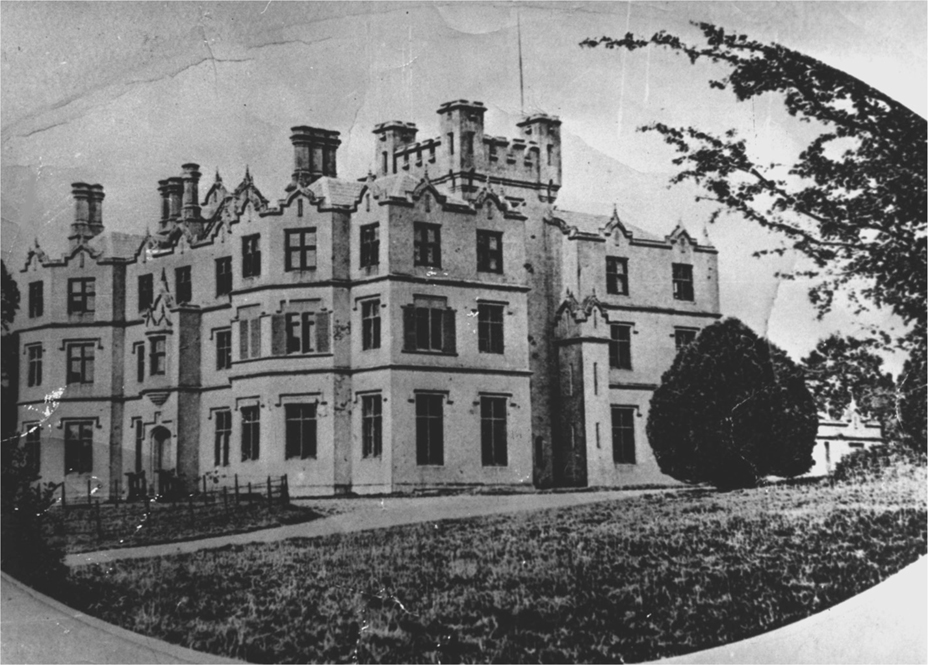
7.2 Castleshane, Co Monaghan, was one of the very first houses to be burned in February 1920. There remains some uncertainty as to whether it was accidental or to prevent its occupation by the crown forces.
The following day the employees raked through the debris, occasionally finding a piece of family silver, ‘no longer of any value except as crude metal – the beautiful workmanship . . . being destroyed’.35 As the IRA increasingly focused on inhabited houses, it was inevitable there would be such significant collateral damage to their interior embellishments and collections: at Castle Bernard there was the loss of a magnificent collection of paintings, furniture, silver plate and a wonderful library. When Mary Gaussen, Lord Bandon’s niece, visited the ruins she found: ‘The ruin is absolute and all one can do is to wander across the mass of debris in those precious rooms’.36 In February 1923, the steward at Moore Hall wrote to Colonel Maurice Moore: ‘There is absolutely nothing left but the walls, not a vestige of glass, timber or even plaster from the ground floor up, such wholesale destruction in a few hours is difficult to understand.’37
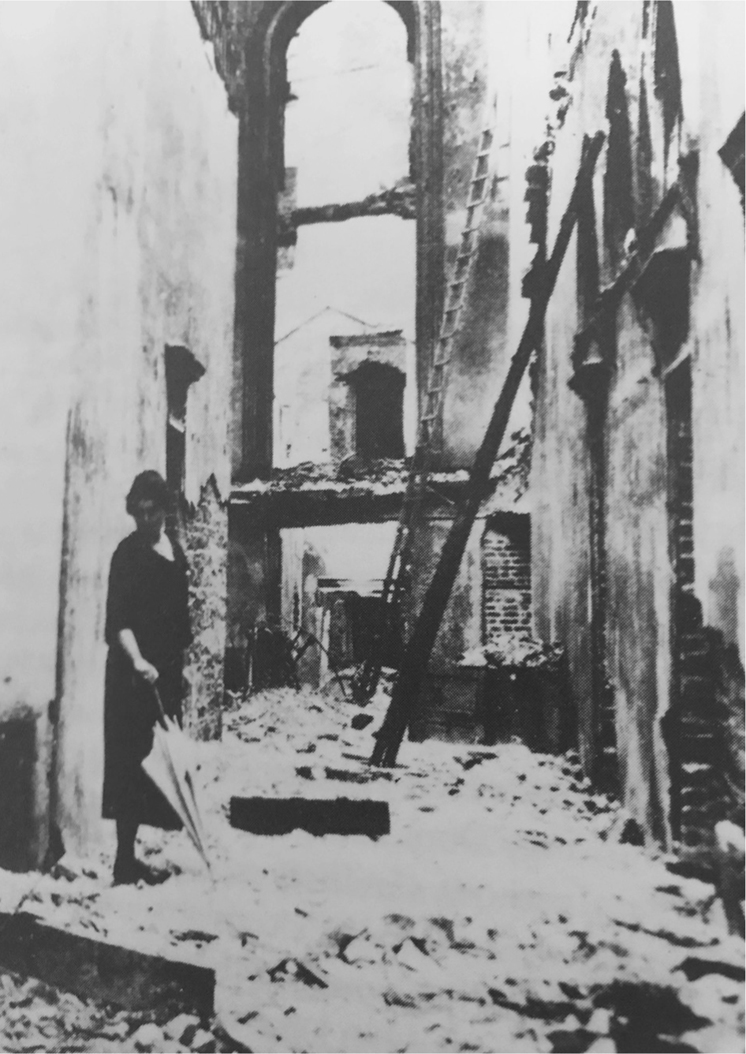
7.3 Mary Gaussen, Lord Bandon’s niece, amidst the ruins of Castle Bernard burned in June 1921 as part of Cork IRA’s counter-reprisal campaign. IRA leader, Tom Barry, later recalled that it ‘blazed half a day before it crumbled in ruins’.
Before the fire was started, family members and servants were usually offered around fifteen to thirty minutes to remove what valuables they could. Then began the pandemonium of trying to decide what to take: the valuable silver plate or the family portraits, paintings or Chippendale chairs. Lady Fingall’s emotive claim – ‘Often it was valueless things that were stacked on the lawn, to be examined when the cold light of day broke on the blackened walls and ashes, while the Romneys and the Chippendale furniture and Waterford glass, or old Irish silver had perished’38 – needs to be treated with a degree of caution in relation to the value of what was lost but it probably fairly reflects the bric-a-brac nature of what was salvaged. And not all raiders were accommodating. Lord Listowel’s niece was told the family had half an hour to remove personal valuables and foodstuffs from Convamore, but they were not allowed to remove any other contents.
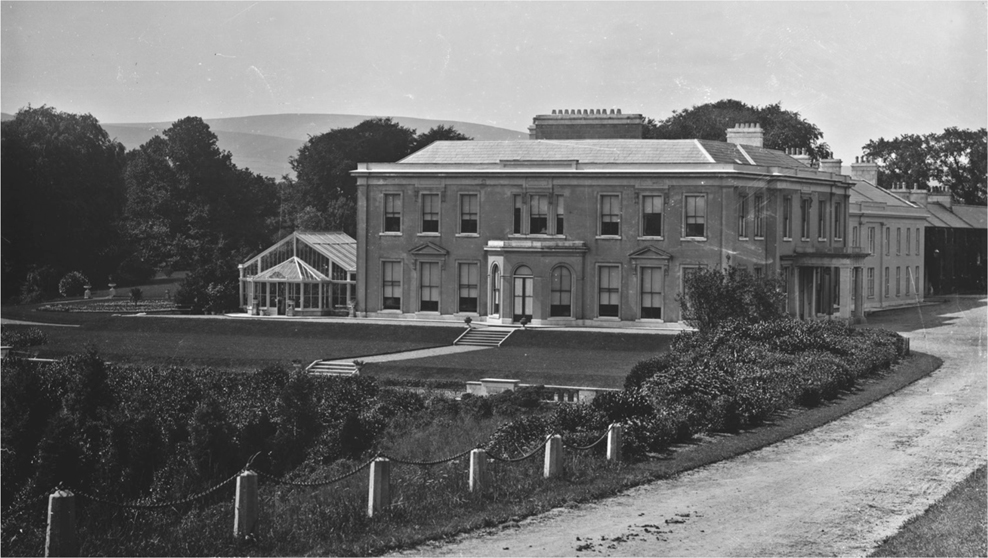
7.4 Lord Listowel’s house, Convamore, Co Cork, burned by the IRA during the War of Independence. Its owner was told by the local leader: ‘You being an aggressively anti-Irish person, and your residence being in the battalion area of enemy reprisals, I have hereby ordered that same be destroyed as part of our counter reprisals.’
When Ardamine House in Gorey was attacked in early July 1921, the raiders allowed the caretaker and his wife to remove their personal belongings but they refused them permission to remove anything belonging to the owner, A.W. Mordaunt-Richards, and so ‘The accumulation of about a century was destroyed utterly.’39 Similarly, when Hazelwood House in Quin, Co Clare, was burned in early July 1921, Gore Hickman was allowed to remove only ‘the clothes on his back’.40
In almost 300 burnings, great treasures were undoubtedly lost (aside from the magnificent decorative plasterwork; Adam, Bossi, Carrera fireplaces; architecturally important staircases; and other historically significant interior artistic features). On 29 June 1921, Stradone House in Cavan, the late-Georgian mansion home of T.J. Burrowes, was burned to a ‘charred shell’, and the paintings reported lost included two attributed to Jacob Ruysdael, valued at £750 and £1,000, one by Peter Lely valued at £500 and two by Godfrey Kneller valued at £150 each.41 At Desart Court, several family portraits were lost, including one three-quarter length of Colonel W. Cuffe by Zoffany, one of the 2nd Earl and another of his wife by Hugh Thompson and one of Agmandesham Cuffe by Kneller.42 In January 1922, Springfield Castle the home of Lord Muskerry – ‘a studious and a most industrious bibliophile’ – was burned with the loss of all the family portraits and the 6,000 volumes in the library.43
When Ballina Castle, the Mayo seat of the Earl of Arran, was burned in September 1922, ‘some 350 pictures were destroyed’.44 The Earl of Mayo reported he saved three Sir Joshua Reynolds, two Titians and ‘most of my hunting clothes’ (rather interesting the value he placed on the latter) but without an inventory there is no way of knowing what exactly was lost in Palmerston House: a headline in the local newspaper merely reported the loss of ‘Priceless Treasures’, and noted the fact that Mayo was ‘one of the greatest living authorities on old English and French furniture. He is president of the Irish Arts and Crafts Society and organised more than one notable exhibition in Dublin when superb collections of Chippendale and Sheraton and Louis XIV and Louis XV furniture were exhibited. His own specimens were of almost priceless description.’45 Kilkenny Castle was not burned but its interiors were greatly damaged during a Civil War siege when the National Army attempted to oust anti-Treatyites who had commandeered the castle on 2 May 1922.46 Incessant machine gun fire ripped through the castle windows; after the siege ended the family went round ‘sadly noting in room after room the favourite bits of furniture, pictures, china, tapestries, which were shattered and damaged, some beyond repair’.47 And in the picture gallery, Lord Ossory found that many of the pictures ‘had been riddled by bullets’.48 There is no mention of what was there at the time but the gallery had in the past housed portraits and landscapes attributed to Van Dyck, Holbein, Kneller, Murillo, Rubens, Lawrence and Reynolds.49 In fairness to Ossory, he was more disturbed by the sight of ‘three or four bodies, contorted in all the hideous agonies of death’ than the material damage.50
It will never be possible to establish all that was destroyed in the houses burned, or if attributions were authentic, not least because owners such as the Earl of Mayo had been so poor at keeping inventories. H.D. Conner KC, who represented Lord Bandon at his compensation trial, admitted that ‘There was no detailed inventory showing what were the contents of the mansion.’ All they had to go on was their memory and that of their ‘confidential servant’ who ‘was intimate with every room’.51 The same applied to Lady Wallscourt of Ardfry, whose solicitors informed the Irish Grants Committee: ‘There was not at any time any list of them [valuables] in existence’, so they had to generalise that they included her ‘wedding presents, furs, laces, fans and wearing apparel’.52 Referring to Bessborough in Kilkenny, M.J. Crotty, solicitor on behalf of the Board of Works, stated: ‘I found that in some cases that inventories of goods destroyed have been prepared with very little care and sometimes copied from old inventories containing goods that had been removed long before the fire.’53
The absence of an inventory for James Mackay Wilson’s Currygrane meant the chief state solicitor was advised that ‘The necessary particulars can only be obtained by verbal enquiries and it would appear that the information can best be obtained from the claimant.’54 Moreover, the same case file strongly suggests the shenanigans that went on in relation to valuables looted, valuables returned and even phantom valuables that never existed in the first place: the state solicitor found out that clothes and other chattels claimed for by Wilson had been shipped to England before the burning. Plate, silver and various other valuables that had been looted on 3–5 September 1922 were recovered by the local Garda Siochána in June 1924, stored in the premises of West Jewellers on Grafton Street, but when the claim came to be settled there was a discrepancy between the list handed over by the Gardai and what was found in West’s, and no one was able to explain where the missing items had gone.
In November 1921, the Irish Times was correct to point out that many lost contents were heirlooms ‘of value only to the family which treasured them’.55 Sir Thomas Esmonde’s house, Ballynastragh in Co Wexford, burned in March 1923, fairly typified this. Esmonde was unusual, in the Parnell mould of a landlord Nationalist who had been an Irish Parliamentary MP for North Wexford from 1900 to 1918, and he was also the first chairman of Wexford County Council in 1899. Initially, he was somewhat philosophical about the burning: ‘The only reason for such an act is that I am a senator of the Free State, and, of course, I am in no worse a position than anybody else.’56 As time went by, he became more aggrieved at what he had lost. He was particularly affected by the loss of the library: ‘After my burning,’ he confided in a friend, ‘I lost heart and gave up books altogether, so much so that I refused to accept books from several literary friends who wanted to give me their publications as I had no place to keep them.’57 He also began to feel resentful that his house should have been burned in light of the contribution he had made to Irish political life as a Nationalist, and that as an agriculturalist – a tillage farmer – he had given all the local employment he could.58 His sense of injustice was fed by correspondence from friends, relatives, acquaintances, representatives of public bodies and members of the various churches. ‘Wanton’ was by far the most common adjective used by them to describe the destruction. Paula Hornstein, for example, wrote to Esmonde: ‘Can it possibly be that a whole life of devotion to your country, so many sacrifices, are rewarded with the blackest ingratitude . . . We live in a very sad time, hatred, revenge ruling everywhere.’59
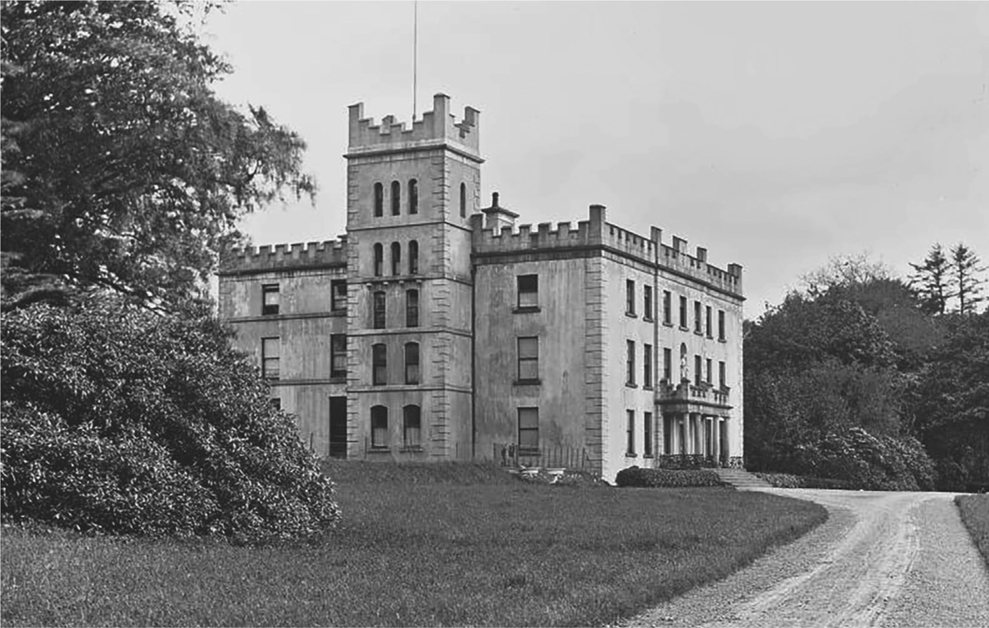
7.5 Sir Thomas Esmonde’s home, Ballynastragh, Co Wexford.
Similarly, Howard Dudley wrote to Lord Dunalley following the destruction of Kilboy: ‘The whole business is too sad for words and we are all profoundly grieved that your beautiful residence has been destroyed and that you have lost so much that is valuable and that no money could compensate you.’60 In other words, Kilboy was more than bricks and mortar, or a repository of fine and decorative arts: it contained generations of family heirlooms, personal mementos, memorials to loved ones that were irreplaceable. Thus, when houses were destroyed it was not always the valuable art collections that first sprung to mind: when Lady Dartrey sympathised with Sybil Lucas-Scudamore after the destruction of Castleshane, her first query was about ‘the picture’, reference to a portrait of Sybil and her late husband painted by Jane Inglis. Sybil’s son, Jack, was also greatly saddened by its loss, and he was also ‘sick about the library going’ and wondered had the gramophone ‘pipped it’ and had the records been melted?61 He had concerns about a more contemporary material culture, while his young sister, Gill, summed up not just her feelings about the loss of the family home, but the feelings of a whole generation who were wearied of war and revolution: ‘I can’t believe it. . . . it seems everything we love goes . . . Is everything we love gone forever? I did so love Castleshane, I don’t seem to think we have any real “home” anymore.’62 Not only had Gill lost everything that was familiar to her, she was also threatened with losing her link between the historical past and the future, something that was extremely important to the aristocracy (as testified to by the existence of works such as Burke’s Peerage, Baronetage & Knightage), and this common experience amongst her peers partially explains the sense of deracination one so often finds in Anglo-Irish literature of the period.
The burning of Castleshane also resulted in the destruction of an important Great Famine archive (1845–51), made up of the correspondence between Robert Peel, when Chief Secretary of Ireland, and Edward Lucas, his Under Secretary, covering the period 1841–46, during part of which Lucas was chairman of the Famine Relief Commission of Ireland. Similarly, Durrow Abbey in King’s County [Offaly] lost a particularly impressive library with many rare manuscripts.63 At Kilboy, ‘A great quantity of historical manuscripts . . . many letters written by George Ponsonby . . . hundreds of letters and interesting documents relating to the period of the Commonwealth, including roll calls of many of Cromwell’s regiments . . . filling twenty-two deed boxes’ were lost.64 In conflagrations across the country these losses meant not just the destruction of a family’s history, but that of a whole community, and, indeed, represented an incalculable loss to the history of the nation.65
3. ‘Tutankhamun’s tomb’
Looting is a universal phenomenon of war and civil commotion; it can be driven by a wide variety of motivations, not least the despoliation of enemy culture. Big House looting in 1920–23 could be justified as another means of plundering the coloniser’s landscape, even a form of retribution for ancestral wrongs; after all, since the Land War era nationalist rhetoric had taught Irish people that landlords had preyed on them for hundreds of years. Moreover, it could also be practised as a form of retribution for the burning and looting carried out by the Black and Tans and Auxiliaries. In February 1921, David Lloyd George in a letter to the Irish Chief Secretary, Hamar Greenwood, condemned the activity of the crown forces, as he knew there were likely to be repercussions:
I am not at all satisfied of the state of discipline in the Royal Irish Constabulary and its auxiliary force. Accounts reach me from too many and too authoritative quarters to leave any doubt in my mind that the charges of drunkenness, looting and other acts of indiscipline are in too many cases substantially true . . . [This is] causing grave uneasiness in the public mind . . . It is vital that the violence and indiscipline which undoubtedly characterises certain units in the Royal Irish Constabulary should be terminated in the most prompt and drastic manner. It is weakening seriously the hands of the executive . . . Public opinion, which is already unhappy, will swing round and withdraw its support from the policy which is now being pursued by the Government in Ireland. There is no doubt that indiscipline, looting and drunkenness in the Royal Irish Constabulary is alienating great numbers of well-disposed people in Ireland and throwing them into the arms of Sinn Fein.66
Stathis Kalyvas has argued that civil war predisposes ordinary people to new levels of criminality, they become immune to violence and crime, and neither plays on their moral conscience.67 It was an argument as old as Thucydides (c.460 BC–c.400 BC), who argued that civil war encouraged the privatisation of war, or Edmund Burke, the eighteenth-century philosopher, who considered that ‘Civil wars strike deepest of all into the manners of the people. They vitiate their politics; they corrupt their morals; they pervert even the natural taste and relish of equity and justice.’68 And whether Minister for Home Affairs Kevin O’Higgins was familiar or not with Thucydides or Burke, he, too, in March 1923, drew similar conclusions about the correlation between civil war in Ireland and the impact it was having on the moral fibre of ordinary people. He wryly told the Dáil: ‘There were persons . . . who would fret for a week if a hen happened to lay away from home. Yet they would cheerfully burn and plunder their neighbours’ houses.’69 The following month, he reiterated that ‘People who possibly considered themselves respectable had no hesitation in looting wholesale.’70 And Big Houses were frequently the targets. Take, for example, two servants at Moydrum Castle – Michael Grady, the butler, and Patrick Delaney, a footman – who shortly after it was burned in July 1921 were both charged and found guilty of the larceny of a fur coat, dress suits, a bicycle and other goods to the value of £360 from Lord Castlemaine. When passing sentence, the judge could only conclude that this was ‘a bad case. These two men, holding positions of trust, had taken advantage of a catastrophe to benefit themselves.’71 But they may very well have got away with much more than they were accused of, and if they did not someone else did, perhaps some of the IRA volunteers who helped Lady Castlemaine collect her valuables, because on 20 April 2018 at Christie’s Exceptional Sale in New York six items from a rare Irish silver collection – an octagonal casket, a pincushion, a pair of covered boxes, a clothes brush and a hair brush – came up for auction with estimates between $60,000 and $90,000 (€48,746 to €73,119).72 It had been bought by Richard Cushing Paine of Boston in the 1930s, and it was rumoured that the set originally belonged to Lord Castlemaine and that it may have been looted during the burning of Moydrum.73
The Moydrum servants were captured, tried and convicted under the British administrative system, but different circumstances prevailed after the Truce when the countryside was denuded of forces of law and order and country house looters seem to have worked with impunity. In late August 1922, four men were charged at a special hearing at Nenagh ‘with the alleged larceny of property belonging to Lord Dunalley’. Before its burning, Kilboy had been raided several times and silver plate and jewellery was targeted; these were valuable items that could generously reward criminal endeavour.74 Despite the fact that the defendants were caught on Dunalley’s property ‘with horses and carts, with the looted goods in them’ they were admitted to bail.75 At the very same time, Thomas O’Connell was given ten years penal servitude for looting a train at Nenagh, in the same district as Kilboy, the two crimes less than a month apart. O’Connell would have been better off looting a country house.

7.6 Desart Court, Co Kilkenny, garden front, c.1900. Lord Desart was awarded £19,000 in compensation for its burning, of which £12,000 was conditional on it being rebuilt. Newly designed by Richard Orpen, Desart’s niece lived there for several years ‘until the anti-English feeling in the neighbourhood made that impossible’. It was demolished in 1957.
Similarly, in March 1923 the Garda inspector investigating the burning of Desart Court in Kilkenny identified four suspects he found on the demesne, local men, who ‘were there for the purpose of removing hidden stuff’ (he believed that while the furniture was burned, smaller valuables such as clocks, silver ring stands, china and pictures were all looted). He also could identify five others who had hijacked and burned a van and lorry at Cuffesgrange carrying away artefacts saved from the house.76 But he was in no hurry to prosecute any of these men, which, as we shall see below in the case of the Garda sergeant in Silvermines, was not unusual.
Kalyvas argues that one of the more ‘powerful attractions’ provided by war is access to ‘looted luxury items’.77 But luxury is, of course, relative to degrees of poverty. When Roslevan was burned in Clare in July 1922, Lord Inchiquin, brother of the owner, offered his personal reflection on the motive and consequences:
On Saturday night Roslevan was burnt to the ground, only the walls left standing. All furniture, linen, blankets, nic-nacs etc. were destroyed and now everybody in Ennis is looting the place. Women with perambulators collecting odds and ends, all the potatoes and vegetables are being taken out of the garden. We got the carriages away and I have sent five carts to get whatever is left such as electric light engine, corn bins, water barrels, horses, mowing machines, if there are now any of them left, which I doubt. I . . . think it was the work of a lot of Free-booters and robbers who looted the place and then burnt it to hide traces of their work.78
Bill Power, as previously noted, came up with a similar motive for the burning of Mitchelstown Castle, and without proof one way or the other should not be discounted. But the theft of potatoes and vegetables from the garden spoke of another dimension to looting: the Civil War coincided with an economic downturn that caused great hardship to very many families, so the poor and destitute who were going hungry saw an opportunity too good to be missed. As a colleague once quipped to this author, it was unlikely local IRA leaders were about to open a fruit and vegetable stall to make a commercial profit, and therefore this type of looting was driven by subsistence.79 In fact, the more general case stated seems to be that the ordinary people looted what might be termed ‘practical luxuries’: a plough, in other words, was more useful to a small farmer than a silver epergne. Thus, in March 1923, Mr Justice Devitt described the looting at Glenfarne, Co Leitrim: ‘From far and near – from Fermanagh, Cavan and Leitrim – the people came with carts and carried away from Glenfarne everything that was portable – the timber, the rails, the whole interior of the house so that only the four walls and the roof were left, and the roof went eventually.’ Devitt found no evidence of this looting being ‘the concerted action of people banded together in an unlawful or seditious association’ and concluded that it ‘was done by people of the neighbouring counties with the object of enriching themselves’.80 Certainly, they were enriching their lives. On 6 August 1922, Samuel Doupe wrote to Lord Dunalley: ‘The inner yard next to the Mansion House was destroyed and the outer farmyard was looted of all agricultural machinery and implements, in fact everything of value.’81 The looters took what was necessary to farming but often unaffordable to smallholders: ploughs, shares, harrows; and from the stables they took saddles, harnesses and bridles. (It has already been suggested that this might have been in the best traditions of Luddism: if his farm implements were stolen, Dunalley could not farm, and this would force him to sell his untenanted lands.)
Similarly, when Leap Castle in Offaly was attacked on successive nights, 30–31 July 1922, ‘endless crowds with donkey and horse carts’ were seen ‘coming and going looting all worth taking’. Michael Walsh, a former employee, later recalled that ‘in front of the house [were stacked] armchairs, tables, bedclothes, shirts, books an’ anythin an’ everythin. You’d think there was going to be an auction.’82 There was no mention of silver plate and paintings; anything on the lawn was practical and useful. When Castlesaunderson in Cavan was abandoned, it became: ‘a sort of Tom Tiddler’s ground for the countryside. Baths, fireplaces, water pipes, doors, windows, and fittings of all descriptions vanished like magic; even the lead from the roof was stripped off and stolen.’83 At Ravensdale House in Dundalk, the steward received several warnings threatening him with death if he dared interfere with locals who removed all the woodwork in the stables, and the lead on the roof of the burned house and outbuildings, while ‘stairs had been cut away with saws, floors had been pulled up, and grates and presses had been torn from the walls’.84 In August 1922, Lord Ashtown reported clothes and numerous breakfast, dinner, tea and dessert services missing from Woodlawn, his Galway home. It did not matter whether these were Minton or Wedgwood: not only would they look well on a kitchen dresser, they were also of practical use.85
Outside on demesnes, ornamental gardens were also plundered. A typical small farmer might know every native flower, tree, vegetable and weed, but he probably never saw an exotic plant before he tramped onto a derelict demesne, and so ornamental plants and shrubs were coveted. In August 1922, the Irish Times reported that:
In the history of looting there has been nothing more scandalous than that which has taken place at Brookfield House, Tullamore, which was recently burned by the irregulars. Everything that could be seized in the ruined building, which was a very fine well-furnished residence, is being taken. The garden at the rear of the premises has come in for particular attention. It was one of the noted fruit and flower gardens in the Midlands. Rare plants have been torn from their roots, and carried away, so have gooseberry bushes, fruit trees, and the well-kept beds have been destroyed. The looters have spared nothing and the place has been completely devastated.86
At Warrenscourt, between July 1921 and May 1923, specimen shrubs and plants, ‘two large plantations of hybrid rhododendrons’ (not a wise choice) and a wide variety of glasshouse plants were all stolen (while the steward also reported that the stones from the demesne wall were carted away ‘by neighbours’ to build cattle sheds). The estate manager knew these people: he could identify Joe McSweeney from Coachford, who took four loads of shrubs from the front lawn, while three members of the Leahy family ‘came and calmly tied up their horse in the yard while they dug up a whole load of valuable shrubs’.87
Timber was scarce and valuable after the war, so demesne woods were also pillaged after houses were burned. Sometimes, this was for firewood as the depression began to impact on the working classes. In March 1921, a year after Castleshane was burned, an old retainer informed Sybil Lucas-Scudamore, then resident in Wales, that people were ‘making a total hand of the woods’ with ‘three out of the one house in it at a time carrying them [trees] out the road and wheeling them home in a barrow, and others even pulling up evergreen shrubs by the root to set’.88 There were also more large-scale operations that must have had some commercial intent. In October 1922, 140 ash, elm, oak, sycamore and beech trees were cut down and carted away after Macroom Castle was burned.89 At Mount Uniacke, between December 1922 and February 1923, 54 beech trees, 23 ash and 10 oak were cut down and removed.90 These operations did not happen overnight, and the fact that they were carried out undisturbed merely reflected the disinterest of the authorities in preventing them.
It is little wonder that on 2 February 1923 the editor of the Tuam Herald, commenting on those involved in widespread looting concluded, ‘It is often hard to tell where the political outlaw ends and the looter begins.’91 The reports on the destruction and looting of Lord Lansdowne’s Kerry property, Derreen, were indicative of this social, rather than political, dimension.92 When Winston Churchill was lobbied by Lansdowne to intervene in the looting of his property, Churchill wrote to W.T. Cosgrave on 22 September 1922: ‘It seems to me from the account to have been an incident of squalid private pillage without even a perverted political motive behind it.’93 Between 1 and 5 September, the house ‘was constantly raided by a large number of men who brought carts and other vehicles and removed the furniture and effects’.94 As was fairly typical, ‘all the beds, bedding and linen . . . and also some of the smaller furniture’ were stolen, but more of the contents, the larger furnishings, for example, were maliciously smashed, being the type of contents that were of no practical value in small homes. For weeks the pillaging was relentless: towards the end of September, Lansdowne’s agent reported that, ‘All the windows, doors, floorings etc. have been taken, motor garage gone . . . all outbuildings either removed or burnt, greenhouses smashed up, laundry pulled down and removed . . . In fact, there is nothing left of Derreen or its surroundings.’95 In June 1923 Eamon Ó Frighil of the Department of Defence informed the Commissioner of the Garda Síochána that ‘farmers and other householders throughout Kenmare and neighbouring unions have built outoffices, and sheds etc. with timber stolen from woods belonging to the Marquis of Lansdowne . . . There is scarcely a house in Gurtamullane that has not had new sheds built near them.’96 According to Lansdowne’s agent, William Rochfort, the looting of the demesne woodland and gardens resulted in ‘the disfigurement of the scenery which has been described by visitors as recalling that of the shell-swept areas of France and Belgium.’97
Cosgrave did not reply to Churchill’s correspondence for a month, until 23 October, when he wrote: ‘We of the Irish Government have been shocked and greatly saddened by it. It is one of the symptoms of the demoralisation which has already seized the whole social fabric when we took over the administration of government.’98 It seems Cosgrave had deliberately waited until the government had established military courts earlier that month to try people for offences including ‘looting, arson, destruction, seizure, unlawful possession or removal of or damage to any public or private property’.99 But the widespread pillaging did not end. In March 1923, Kevin O’Higgins, Minister for Defence, told his Dáil colleagues that the National Army had searched houses which they found crammed with loot and resembling ‘Tutankhamun’s tomb . . . There were hens roosting on valuable oil paintings, there were silver candlesticks and valuable prieu dieux plundered out of the house of a neighbour that had been burned.’100 The middle class politicians such as Cosgrave, O’Higgins, and Hogan had come to view looting in the same way they viewed land grabbing: it was a despicable lower class crime that did not augur well for the credibility of the new Irish Free State and could be damaging to its international credit rating. Cosgrave specifically referenced working class homes where ‘costly candlesticks, trouser presses, gilt mirrors and articles of that kind were found’.101 The Garda Commissioner, Eoin O’Duffy, could hardly have composed any more synonyms in his ‘state of the country reports’ to describe the ‘hooligan element’, ‘rowdy class’, scoundrels, brigands, roughs, marauders and so on who were responsible for everyday crime.102 But, as Gavin Foster has rightly concluded: ‘These criminality discourses and the outraged moral tone in which they were conveyed reflected a deeper anxiety inside the government camp that wider “anti-social forces” were at play in the Civil War and threatened not only the survival of the state but the very social order itself.’103 It was why the Dáil had also been determined to put down landgrabbing.
But looting was not the sole preserve of the lower classes. Bill Power’s claim that a local solicitor ‘with an appreciation of the finer things in life’ removed many of the valuable paintings for his personal advantage from Mitchelstown Castle has already been referenced.104 There is anecdotal evidence of IRA members looting artworks and other treasures and selling them to antique dealers along the Dublin Quays and these, in turn, being purchased by professionals and merchants, strangely incurious about their provenance but arguably complicit in looting as the indirect receivers of stolen goods. More substantive evidence is difficult to find, but in a 1999 Mealy’s and Christie’s auction catalogue advertising the sale of the James Murnaghan Collection it was pointed out that ‘Collecting in the years following 1916 was serendipity. As the large Anglo-Irish houses were dispersed, stock in dealers’ shops along the [Dublin] quays, en route from the Four Courts, bourgeoned, giving collectors ample opportunity to expand their own collections.’105 Justice James Murnaghan had managed to amass a collection of 1,200 paintings in his Fitzwilliam Street home, including Old Masters bought on the Dublin quays in the 1920s, that had once been hung in Big Houses, and in her preface to the catalogue his niece admitted that he did not concern himself with provenance.106 Conceivably, there is a hidden history yet to be unveiled of how local respectables – auctioneers, solicitors, bank managers, men of property – sometimes connived to take advantage of the revolutionary period for personal advantage through the sale of Big Houses, their contents and lands, or acquiring them cheaply as private residences for themselves, as was the case with Lough Bawn in Monaghan, bought by Charles Laverty, a Castleblayney solicitor and the last Home Ruler to have contested a seat in south Monaghan in 1910.
But one of the great imponderables is whether paintings, silver, family plate, Georgian delft and other valuable objects adorned farmhouses and Irish cottages for generations, no one aware of their provenance and true value. Did owners ever retrieve all their valuable contents put into storage for safe keeping in local banks and national institutions such as the National Gallery and Museum? In March 2019, former Bank of Ireland official Jim Connolly revealed to the Irish Times that he had seen ‘huge paintings’ and other artefacts ‘housed in pallets, travel chests, suitcases and trunks’.107 Following Connolly’s evidence to the Joint Committee on Rural and Community Development on 6 March 2019, Deputy Éamon Ó Cuív claimed that opening the vaults ‘would show us some . . . beautiful items that have been hidden away. There is probably a Caravaggio, a Rubens or something else there.’ Whether he was right remains to be seen.
It is true that loot from country houses very often ended up locally. For instance, Bryan Cooper later claimed that when the National Army evacuated his Markree home: ‘Nearly all the furniture left behind was to disappear, some to a neighbouring military camp, some to cottages in Co Sligo.’108 After Durrow Abbey was burned, ‘Some of the furniture from the house that had escaped the flames’ was later identified in the houses of former tenants.109 The night that Woodstock was burned, ‘The contents of the library were moved out, and carted away’, and ‘stray fragments of domestic life ended up scattered on the lawns outside, to be picked up by those people who gathered from miles around’. One of the IRA involved in that burning, Paddy White, later admitted to taking a tablecloth – ‘an exquisite example of Irish linen, with its hand-scalloped edges and embroidered flowers and shamrocks’ – which his son still retained in his Dublin home in 1999.110 When Lord Dunalley’s claim for compensation was dismissed by the county court judge in May 1924, his solicitors wrote to him: ‘We were unable to prove that the things were taken by the Irregulars and as a matter of fact I believe they were not taken by these people for the whole place was plundered principally by the mountainy people [of Silvermines] after the burning.’111 In October 1924, the Garda sergeant in Silvermines told Dunalley that some of the contents of Kilboy were prominent in farmers’ houses in Upperchurch but Dunalley’s solicitor advised him not to undertake the task of identifying them personally: ‘It would be putting you in a most invidious position and would, I think, cause great ill feeling, which has now happily died down.’112
On 3 August 1923, in their determined attempt to combat looting and general lawlessness, and to restore law and order, the government passed the Public Safety (Emergency Powers) (no. 2) Act.113 It promised imprisonment to every person brought before a district judge for the possession of stolen or unlawfully obtained goods. Where stolen property was recovered, it was to be returned to the rightful owner. Significantly, this act worked in tandem with the 1923 Land Act, passed a week later, which threatened to punish those enemies of the state who continued to involve themselves in agrarian crime, most particularly land grabbing (see chapter 9).
4. ‘Cautious faces, emptied cabinets, bare walls’
It should be noted that many Irish country house owners, anticipating attack, put valuable contents into safe storage in bank vaults, galleries and museums, or sent them off to safe havens in England. In March 1921, Ardtully Castle in Kerry was completely gutted by fire, but the castle had been vacated a few days before by the Constable family and most of the furniture removed. Castleffogarty in Tipperary – ‘at one time famous for its large picture gallery, which housed a collection valued at many thousands of pounds’114 – was burned in April 1922 but the paintings had been removed to London in 1920.115 Elizabeth Bowen claimed her father had the good sense to remove the family portraits and other valuables ‘for a sojourn in a cottage at the end of the woods’ so that when the IRA arrived they were met by ‘cautious faces, emptied cabinets, bare walls’.116 Lady Gregory wrote in August 1922 that in Galway: ‘Furniture vans engaged for nine months ahead are taking goods from the country to England.’117 And even when destroyed, the loss of Irish furniture was not terribly regretted. In the early 1920s, it was neither valuable nor popular with dealers: in 1921, R.W. Symonds, the influential English furniture historian, dismissed its ‘heavy appearance, superfluity of carved ornament, and absence of elegant and graceful lines that make its present-day appreciation and value considerably less than that of contemporary English furniture.’118 In a like vein, the judge in the Mitchelstown Castle compensation trial dismissed the value of the furniture destroyed: ‘A good deal of it was built or constructed specially for the Castle, and would be of little use in modern times.’119 The loss of Irish furniture was regretted only when a market for it was manufactured towards the end of the twentieth century.120
Furthermore, the impact of the Troubles should not be overstated in relation to the loss of the most valuable of the original collections. Denuding Big Houses of their contents had begun forty years previously with the passing of the Settled Land Act (Ireland) in 1882. Until then the Big House owner, essentially a tenant for life, had the responsibility of handing down estate, house and heirlooms intact to the next generation. From the late 1870s, the greatly changed economic, social and political climates in Ireland (chapter one) resulted in diminishing landlord rental income and increased indebtedness. The Settled Land Act was basically a trade-off against the government introducing fair rents under the 1881 Land Act. It relaxed the law of settlement, allowing owners to sell heirlooms (and outlying estates) to meet their financial obligations. From then on, financially constrained owners came to regard their collections as liquid assets that could be sold to support their lifestyles, or simply keep a roof on their houses. From the mid-1880s, the sale of paintings and the family silver would help to pay newly introduced death and succession duties, and a generation or so later escalating income and super tax.
In many respects, revolutionary activity was a sideshow to dispersals as families continued to struggle with the unsustainability of their houses. In 1919, years before the damage of the Civil War siege, the Ormondes of Kilkenny Castle were faced with death duties and legal expenses of almost £166,000 that made their long-term continuance in residence impossible. The economic downturn of the 1920s then decimated their share portfolio with the result that they were eventually forced to vacate the castle in 1935 and auction off its entire contents.121 Thus, it was events either side of the revolutionary period, and primarily economic in nature, that ended the Ormonde’s residency of almost 800 years. In September 1921, the Earl of Meath closed Kilruddery in Wicklow because of increased taxation and unaffordability: ‘My father was always a poor man,’ he told his estate employees, ‘his income was never more than from £1,500 to £2,000 a year’ – most of those listening would have been on around £60 per year – and ‘he never knew anything about the present heavy taxation of 6s[hillings] in the pound income tax and super tax.’ That year Meath’s tax bill was almost £4,500 accounting for 43 per cent of the estate charges. He was no longer prepared, he said, to draw on his invested income to supplement the upkeep of Kilruddery.122 He closed the house for years. The havoc wreaked by taxation in Ireland merely reflected what was happening across Britain. In August 1921, the editor of the Irish Times opined:
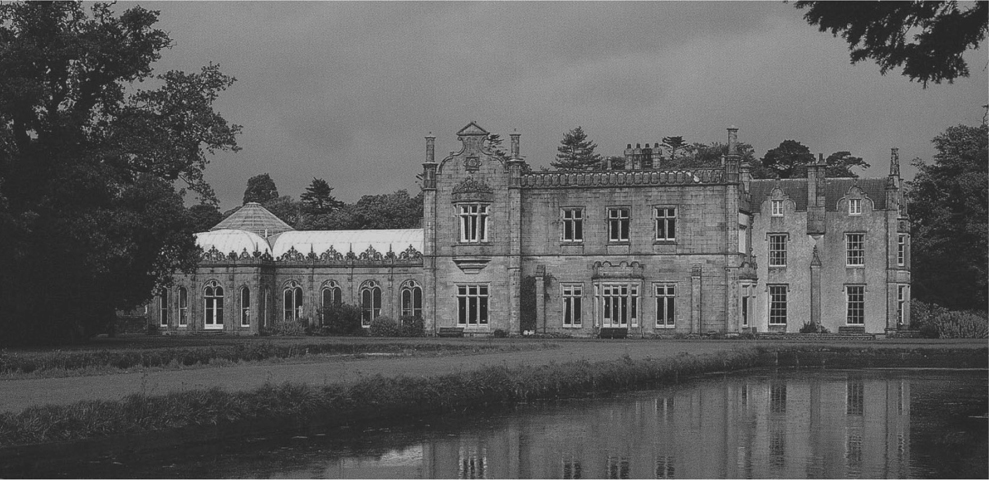
7.7 Kilruddery, Co Wicklow, home of the Earls of Meath. During the inter-war period, the house was closed, shuttered and the furniture covered in dust sheets as Reginald Brabazon, 13th Earl of Meath, claimed he could not afford to live there. Partly demolished in the 1950s, it is still owned by the Brabazon family and is a popular wedding venue and location for films and TV series.
The burden of taxation is crushing the life out of rural England. During the last two years many great landowners have been forced to sell their historic mansions and estates . . . The charges on land, the demands of the income tax collector, and the prospect of heavy death duties . . . [make] a closing down of the larger country houses almost inevitable.123
In Ireland, revolution and its consequences undoubtedly expedited the sale or abandonment of Big Houses; between June 1921 and May 1922, almost sixty houses, their contents and demesne lands were advertised for sale in the Irish Times alone.124 In December 1921, as treaty negotiations were ongoing, Battersby & Co set out their programme of forthcoming sales, which included Bert House in Kildare, a ‘commodious mansion with 198 acres’; Bellamont Forest in Cavan with 800 acres, ‘a fine old Georgian mansion with every accommodation for a gentleman’s family’; Hazelwood in Sligo with 2,800 acres and a shooting estate of 8,250 acres.125 The dates during which these sales took place might suggest owners wanted to get out of Ireland and that they went in search of refuge elsewhere in the empire. But even without revolution and its political consequences, the precarious financial position of the aristocracy would have led to Big House sales and abandonment, as was the case across Britain. Financial difficulties were every bit as damaging as cans of paraffin carried by the IRA. This was because the Irish landed elites’s post-1903 invested wealth had become more susceptible to the vagaries of the stock market during the turbulent post-war years. Their investments were decimated as markets failed to readjust, inflation and deflation negatively impacted fixed incomes and the world’s financial system headed towards eventual collapse in 1929–30.126 This was doubly compounded by the compulsory acquisition of their demesne and untenanted lands under the 1923 Land Act (chapter 9).
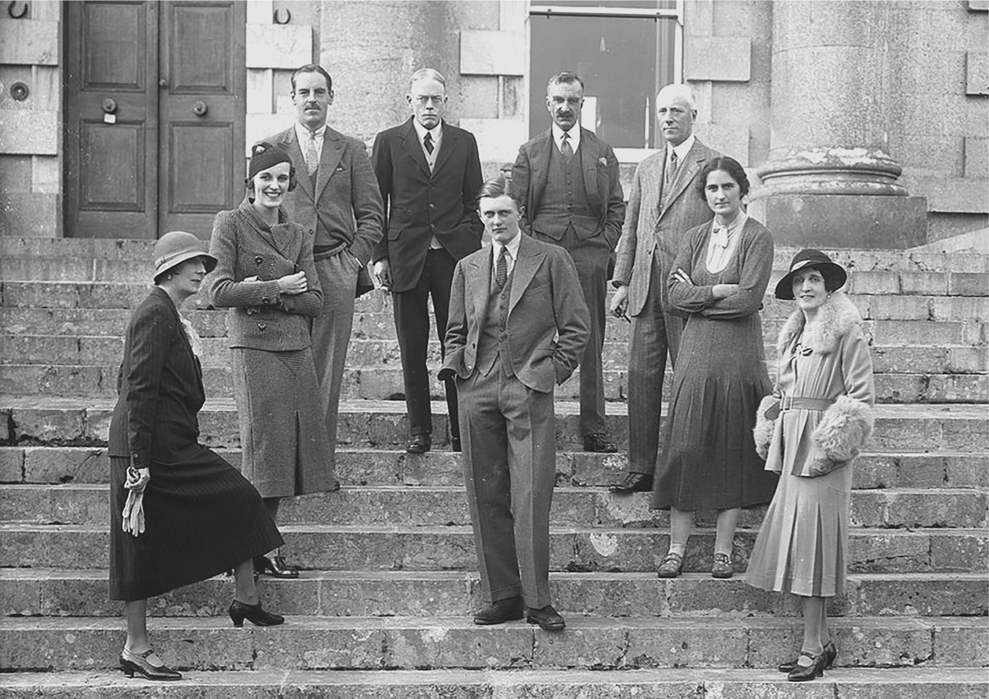
7.8 Lord Dunalley and his family on the steps of Kilboy, 1933, on the occasion marking the coming of age of Hon. Desmond Prittie, at centre front. The house had been rebuilt a few years before.
And this was similarly reflected in the sale of their collections: in the early 1920s, the aristocracy was selling as much as was being destroyed, and they were selling for reasons of indebtedness rather than revolution. The Duke of Leinster’s estate was brought down by family misfortune, poor capital management and an heir’s profligacy rather than the Troubles.127 Just over a week after the 6th Duke’s death in February 1922, the secretary to Edouard Jonas, art expert to the French government, wrote to enquire ‘whether the estate of the late Duke of Leinster includes any valuable pictures or works of art of which you might wish to dispose’, such as Old Masters, Gothic tapestry, Oriental China and French eighteenth-century furniture.128 There is no record of a reply, but evidently the vultures were beginning to circle the carcasses of declining Irish country houses. Following the bankruptcies of the 7th Duke, the contents of Carton were sold off in several high-profile sales between 1925 and the late 1940s.129 And the Leinsters were certainly not alone in this respect. In 1920, over 200 works of art were sold from Killua Castle in Westmeath.130 In the years leading up to 1920, Bennett and Sons sold huge quantities of Irish plate and paintings attributed (often dubiously) to artists such as Gainsborough, Rembrandt, Van Dyck, Verner, Kneller and Breughel, as well as Chippendale and Sheraton furniture, and rare books from the collections of families such as the Moncks at Charleville in Wicklow and their neighbours the Wicklows at Shelton Abbey, Lord Courtown in Wexford and J.R. Garstin at Braganstown in Louth. Courtown, Garstin and Wicklow all had to meet legacy or death duties.131
During the inter-war years American plutocrats exploited the impoverished aristocracies of Europe, creating a market that was impossible to ignore.132 In one auction alone in New York in 1921, hundreds of pieces of Irish silver from Big Houses were sold, the property of Lord Ashbrook of Castle Durrow in Queen’s County, Lady Ardilaun of St Anne’s in Dublin, the Earl of Mayo in Palmerstown (notably before the house was burned), Lord Fermoy of Rockbarton Castle in Limerick and Lady Coote of Ballyfin in Queen’s County, amongst many others.133 And dispersals would continue long into the future. Therefore, the 1920–23 period merely acted as a catalyst in an ongoing process of social and economic decline that had contributed to the sale of Big Houses and the dispersal of contents that went all the way back to the early 1880s.