
It is very difficult to appreciate the sheer scale of Burma, as the Mercator projection generally used for globes and atlases is very misleading since it effectively enlarges landmasses in the north while shrinking those nearer the equator. Extending to the better part of 250,000 square miles (647,000 sq km) Burma is much the same size as France and Belgium combined, and with its huge mountain ranges and thick forests and jungles it is a desperately hard country to fight in, even without consideration of the weather. The western aspect of Burma consists of three ranges of mountains – the Arakan Yomas in the south, the Chin Hills in the centre and to the north, and the Naga Hills. In practice these effectively form one gigantic chain of mountains stretching over 600 miles (965km) from the small coastal town of Gwa in the south until they meet the Brahmaputra valley in the north. The highest of these ranges – the Naga Hills – rise to 12,000ft (3,650m), but even in the lowest range – the Arakan Yomas – peaks in excess of 5,000ft (1,500m) are not unusual. In addition to the precipitous nature of the mountains, they are covered with thick forest and jungle to about 6,000ft (1,830m). There are very few passes and, until 1941, there were no all-weather roads that penetrated from west to east, only a modest number of difficult tracks, most of which were extremely challenging at the best of times and virtually impassable during the long rainy season which generally begins in May and comes to an end in October.
MULES
A hybrid between a horse and a donkey, the mule has a rather undeserved reputation for being stubborn. Easier to maintain than horses and much more powerful than a donkey, mules were used extensively in Burma by both sides. Generally weighing between 750−1,000lb (340−450kg), a mule can be expected to carry about 150lb (70kg) and march for 20 miles (32km) without resting.
For a century or more before the Japanese invasion of 1942 there had been a number of plans to build roads through the mountains which would connect the central plain of Burma with the road and rail systems of Assam in north-west India, but none had come to fruition largely because importing and exporting goods by sea was relatively quick and cheap. The eastern aspect of the central plain is bounded by the Karen and Kachin hills, which run from north to south. The challenging terrain is further complicated by three great rivers which flow southward from the Himalayas – the Chindwin, the Irrawaddy and the Salween. Each of these runs into the Gulf of Martaban to the north of the Andaman Islands and each of them constitutes a major barrier to east-west communication. Only the lower reaches of the Salween are navigable, but the Irrawaddy provides a communications route for nearly 1,000 miles (1,600km) from the sea to Myitkyina and the Chindwin can carry river traffic nearly as far north as Kohima, which lies high in the Naga Hills more than 50 miles (80km) to the west of the river.
Despite the geographical challenges of the country, Burma was an attractive proposition for commercial development. Until the twentieth century, the chief exports had been rice from the central plain and teak from the forests, but in 1942 there were two other significant factors – oil from the Yenangyaung fields and wolframite from Mawchi. The value of the former is self-evident, but the latter was of particular importance in wartime. Wolfram was the major source of tungsten-based materials (which is why ‘W’ is the periodic table abbreviation for tungsten) for electric light-bulb filaments and – crucially in 1942 – the basis for armour-piercing ammunition. Other important minerals included nickel, silver and tin, which was in short supply since the Japanese occupation of Malaya.

20 A convoy approaching Kohima. (AB/AWH)

21 A convoy on the Kohima Road. (AB/AWH)

22 A landslide blocking the road – a common event in Burma. (AB/AWH)
These resources were significant to both sides. Shortages of rice would be a destabilising influence in both Japan and India, and although Japan could obtain wolfram from other sources, Burma provided more than one third of the wolfram available to the British Commonwealth. Equally, although both sides could acquire oil from elsewhere, there was a value to denying it to the enemy and either side could make savings on transport if more accessible supply could be secured.
In addition to these economic issues there were major strategic considerations. As long as Japan was embroiled in a war of conquest in China, her resources would be heavily stretched elsewhere, but in order to keep China in the fight she would need to have a steady stream of ammunition, arms, vehicles and fuel from American and Commonwealth resources which could only be delivered via Burma. A huge amount of this material was produced by the industrial complex of northern India and, so long as Burma was denied to the Japanese, the factories and railway systems would be safe from air raids. Moreover, Burma also provided the means of communication between India and Britain’s colonial possessions in the Far East, which were – until the campaign of 1941–42 – the chief source of rubber and tin for the Commonwealth war industries. Burma was also the only practical route for transferring aircraft to the front in the event of a Japanese invasion of Malaya.

23 Crossing the Irrawaddy River. (AB/AWH)
Finally there were political imperatives, for the British administration of Burma had to face a variety of challenges. In addition to the simple matter of the natural resentment of a foreign power – though given Burma’s social and cultural divisions this was not a universal factor – economic development had encouraged a good deal of immigration from India. This was not limited to technical, administrative, commercial and managerial workers, but had included a large number of money lenders and land speculators who were – rightly or wrongly – widely seen as exploiting Burma and denying opportunities to the local population.
The focus of organised political resistance to British rule was the Thakin party, which largely depended on students and Leftist political activists. The outbreak of war in Europe in 1939 encouraged the Thakin party to become more assertive in their campaign for independence. Naturally, this presented an opportunity to Japan and several Thakin leaders made visits to Tokyo in search of political and material assistance for their cause. Naturally enough, the pro-independence movement was further encouraged by the rapid defeat of Britain and the Netherlands in Malaya, Singapore, Hong Kong and the Netherlands East Indies in 1941–42.
Removing Burma from external control by the Government of India did little to assuage the appetite for independence, but it certainly complicated the military situation. Under new arrangements for partial autonomy, the administration of Burma became responsible for her own defence, albeit under the oversight of British Imperial military structures. Following the general pattern of British military arrangements in India and the Far East, the armed forces available for the defence of Burma consisted of a small number of regular British army units and larger numbers of locally enlisted units with a high proportion of British officers and NCOs. Although Burmese autonomy had made political sense in 1937, the military rationale was far less practical. Toward the end of 1940 Burma had become part of the operational responsibility of Far East Command with its HQ in Singapore.
Since Burma was obviously crucial to the defence of India, the Commander-in-Chief, Gen. Wavell, travelled to London in September 1941 and attempted to have operational control transferred back to India in the belief that this would simplify administrative and operational issues. Although French Indo-China (Vietnam) was, by this time, under effective Japanese control, Wavell’s request was turned down despite the support of the Governor of Burma, Sir Reginald Dorman-Smith. Wavell renewed his request in November and gained the support of the Chiefs of Staff in London, but the Defence Committee decided to put off implementing any decision until the new Commander-in-Chief Far East, Sir Henry Pownall, had time to take up his appointment and it was not until three days after the Japanese landings at Kota Bahru, in north-east Malaya, that the decision to transfer Burma’s operational control to the HQ in India was finally enacted.
In 1937, when Burma was granted autonomy and became responsible for her own defence establishment, it was generally accepted that there was no great risk to her borders from neighbouring countries: India was secure in British control; Thailand was considered far too weak militarily to mount an invasion and was, in case, vulnerable to a British counter-stroke though Malaya; Indo-China was held by the French who had little, if any, interest in expanding their Asian colony; and China to the north was already heavily engaged defending herself against a Japanese invasion. Outside of the major towns and cities there was relatively little hostility to British rule – certainly not enough to indicate an imminent armed insurrection and war of independence. Broadly, Burmese security was seen as more a matter of policing than military action. This being the case, the military establishment was very modest for such a huge country.
When Burma became a separate entity from India there were nine battalions of the Burma Military police which were converted, in name at least, to infantry battalions and were renamed as the Burma Frontier Force. In addition there was a complement of two British infantry battalions – though these units had been stripped of officers and specialists for roles in Britain and India, and had been reduced to roughly half of their theoretical establishment – and four battalions of the Burma Rifles with a small element of engineers and a single battery of mountain artillery. The war in Europe prompted a degree of expansion, including a volunteer formation – the Burma Auxiliary Force – which was recruited from the Anglo-Burmese, Anglo-Indian and European elements of the community and which was largely committed to the defence of the oil installations. Due to the demands of other theatres of war, there was very little to spare for Burma in the way of arms, equipment, money or manpower.
The problems of the Burma command were exacerbated by the expansion itself. Trained officers and NCOs were transferred to new units to assist in training the recruits, with the inevitable consequence that the existing units were seriously weakened twice over. The existing units lost experienced soldiers and a considerable proportion of the men promoted to take their place were not really up to the task.
LEE-ENFIELD RIFLE
The Lee-Enfield rifle design was already fifty years old by the outbreak of the Second World War. Although there had been a number of minor adjustments over the years, the basic weapon of most soldiers in every section of every platoon was virtually the same as the one which had been carried by his predecessors in the Great War. Mechanically robust and reliable, and tremendously accurate, the Lee-Enfield had a calibre of .303in and a ten-round box magazine and continued its service as the primary rifle of the British Army until 1956.
Equipment was, if anything, even more of a challenge. A single anti-aircraft regiment was raised in 1941, but it received no guns until after the opening of the Japanese campaign in Malaya and consequently had had very little practical training before the opening of hostilities in Burma. Beyond that there was a dearth of even the most basic items, such as rifles, machine-guns, mortars, transport, grenades and small arms ammunition were insufficient for training purposes, let alone for combat.
The situation in the air was even worse. At the start of the campaign the RAF had one squadron of sixteen fighters equipped with the obsolete Brewster Buffalo, and there was one squadron of the American Volunteer Group (the famous ‘Flying Tigers’) whose Curtiss P.40 Tomahawks were certainly a great improvement over the Buffalo, but were less manoeuvrable than the Japanese Zero and Oscar fighters.
Despite the clear warnings that war with Japan was, if not absolutely imminent, certainly a distinct possibility in the near future, very little was achieved in the way of putting civil administration on a war footing. Some effort had been made to form an Air Raid Precautions (ARP) establishment, but shortages of suitable materials and labour coupled with difficult geological conditions in most urban areas resulted in there being very few effective air raid shelters, and there was no facility for coordinating rail and water transport to meet military needs.
Wavell was well aware of the problems and did everything he could to improve the situation, but his plans were thwarted by the opening of the Japanese campaign in Malaya. Troops and material – including armour, a divisional headquarters and aircraft – were diverted to Singapore and a series of misunderstandings damaged relations with the Chinese Government, which had committed large numbers of troops to northern Burma despite the fact that they were urgently needed at home.
All of these chickens came home to roost when the Japanese invasion commenced. Although the various infantry battalions had been grouped together into brigades, there had been no opportunity to train the Brigade HQ, or to accustom the individual battalions to operating as teams within brigades or higher formations. There were virtually no anti-tank weapons and a complete dearth of training to deal with armoured vehicles. Japanese air raids caused panic among the civil populace and a great throng of refugees tried to make their way to India, which not only blocked the roads but stripped the dockyards of the skilled labour required to unload the military stores being delivered to Rangoon.

24 Loading a pack howitzer onto a raft for a river crossing. (AB/AWH)
Reinforcements of aircraft achieved some early success against the Japanese Army Air Force which persuaded the commander of Fifteenth Army to abandon the bombing of urban centres and to focus instead on the destruction of Commonwealth air power and the support of troops on the ground, though due to poor surface-air coordination this was of limited value. As had been the case in Malaya, Japanese air forces tended to focus on targets of opportunity along the Allied lines of communication.
Outnumbered and outgunned, and despite a number of local successes, the Allied forces were simply not capable of stopping the Japanese advancing through Burma and threatening north-east India. The damage to the Allied cause was extensive. China was now almost cut off from Allied aid and would, for the foreseeable future, have to fight Japan largely on her own slender military and industrial resources. The Allies were deprived of the agricultural and mineral production of Burma, which would now be exploited by the Japanese, though the effectiveness of the Allied policy of destroying well-head equipment, storage tanks and pipelines meant it would be some time before the Japanese could derive any benefit from the Yenangyaung fields, which they captured on 19 April.
At about this time, the Commonwealth forces on the Burma front were organised into a single formation – Burcorps. This consisted of 17th Indian Division, 7th Armoured Brigade, which had been transferred from the desert only a few months earlier, and 1st Burma Division. The latter was more a formation in name than in practice and lacked most of the headquarters and other divisional assets required to perform its duties adequately. Command of the corps was given to Gen. William Slim, who arrived from India to take charge on 19 March. Slim would go on to have a profound effect on the whole Burma campaign, but there was little he could do to check the Japanese advance without a massive injection of infantry, artillery and, above all, armour so the longest retreat in British Military history continued until mid-May, when the rearguard of Burcorps passed into Assam and brought the campaign to a close.
The effect on the morale of the British, Indian and Burmese troops was as significant as the loss of equipment – much of which had been abandoned during the retreat. British prestige in Asia, already undermined by the defeats in Malaya, Singapore and Hong Kong, fell even further, while the reputation of the Japanese armed forces was considerably enhanced. The liberation of Burma was clearly going to be a long, drawn-out affair and would require the total rebuilding of the British and Indian forces at a time when there was already an excessive demand on the war industries.

25 Commonwealth troops in action in the Arakan. (AB/AWH)
The Japanese invasion drew to a halt at the Chindwin River for several reasons: the coming of the monsoon would hamper any further advance and then rains would reduce the viability of the tracks that would carry their supplies. Additionally, although their combat formations had enjoyed great success, it had come at a price. Battlefield casualties were not insignificant and there had been heavy losses to disease, so the units needed time to reorganise, re-equip and assimilate replacements.
For the Allies, a massive invasion to drive the Japanese out of Burma completely was out of the question; Wavell had already started planning for an offensive in the Arakan, but the administrative and operational command structures were obviously inadequate. A series of operations was considered for late 1942, but only one was really pursued – an advance by 14th Indian Division (commanded by Maj. Gen. Lloyd), which had been formed in June of the previous year. 14th Division was among the first formations to be equipped with the conditions of Burma in mind. In place of the normal quota of heavy trucks, the division had ten transport companies, four equipped with jeeps and six with mules. As a new formation it naturally had no experience and a good deal of the training received was of limited value. To complicate matters further as the operations progressed, additional brigades were committed to the fight until, eventually, 14th Division HQ had nine brigades under command, which represented an impossible burden. By the end of January 1943 it had become abundantly clear that nothing was being achieved and the operation was eventually halted on 5 February. The Japanese response was to mount a counter-attack and, throughout May, 55th Division drove Commonwealth forces northwards.

26 American supply trucks on the Burma Road. (AB/AWH)
On 14 April Gen. Slim was given command of all the Common-wealth forces in the Arakan. His first objective – since he really had no choice – was to concentrate his force in an area out of contact with the enemy where it could rebuild and train for a new campaign. Although it was generally accepted that no major offensive could be undertaken until November 1943 when the monsoon season passed, there was also a need to carry the war to the enemy in some way. It would be very bad for the morale of the army to have achieved nothing in a year of campaigning and it would give the Japanese every opportunity to rebuild their own formations, consolidate their gains and establish their administration throughout Burma. A major conventional offensive was clearly out of the question, but the first of two long-range penetration operations was launched, though with questionable results.
GENERAL WILLIAM ‘BILL’ SLIM
A popular and skilled leader, Slim was eager to promote good health facilities and educational opportunities for the troops. Army schools, teaching everything from basic literacy to civics, sprang up all over northern India. In part, this was to give soldiers something to do other than drink and get into trouble, and in part this was to give them better options when they returned to civilian life. In order to give the troops some sense of liberty when they were on leave, Slim tried to set up ‘no-saluting’ zones in leave areas, but was prevented from doing so – Army authorities feared it would undermine the authority of the officers.
Slim encouraged innovation to offset equipment shortages by using materials that were available locally, such as the introduction of ‘parajutes’ – parachutes made from jute – for dropping supplies, and a temporary road surface made from bitumen and hessian.
Late in the year, a major reorganisation of the Eastern Army took place, leading to the creation of Fourteenth Army under Gen. Slim. The new army consisted of IV Corps, based out of Imphal under Gen. Scoones, and XV Corps under Gen. Christison in the Arakan. Given the widespread prejudice against Indian Army officers, Slim’s appointment was remarkable, though he was very obviously the right man for the job, and he set about transforming the Commonwealth forces in Burma into a well-trained and efficient force. Slim was also ultimately responsible to another new figure, Lord Mountbatten.
Mountbatten had been appointed as the head of another new organisation – South East Asia Command (SEAC). Mountbatten and Slim were both eager to carry the fight to the enemy, and both realised that the campaign could not be won by the Chindit operations – though they accepted that the Chindits could make a valid contribution to the progress of the wider strategy. Equally, both were all too well aware of the fact that the British and American political leaders – Churchill and Roosevelt – had agreed to pursue a European policy: that the Allies would focus primarily on the defeat of Nazi Germany before turning their attention to Japan. Inevitably this meant that resources were hard to come by for Fourteenth Army and, consequently, Mountbatten’s objectives for 1944 were not as ambitious as he would have liked. Three Chindit brigades were sent across the Chindwin to converge around the Meza Valley to disrupt Japanese lines of communication and prevent them deploying reinforcements to the north. In this area, Stillwell‘s Chinese forces were making progress; Scoones’ IV Corps mounted operations toward the Chindwin; elements of Christison’s XV Corps advanced on either side of the Mayu Mountains and toward Maungdaw; and 81st (West African) Division moved down the Kaladan Valley.
Each of these offensives encountered the Japanese in rather greater strength than had been expected, which confirmed the conclusions of Commonwealth intelligence staffs. The participation of the INA (generally described as the ‘Japanese Indian Force’ or ‘JIFFs’ in commonwealth circles) was seen – by Gen. Mutaguchi at least – as a significant factor in the enterprise. He had revealed his plans to Subhas Chandra Bose, the political leader of the INA. Bose had, in turn, discussed the venture with Bhagat Ram Talwar who, in addition to being a leading communist in the Indian independence movement, was also a double agent working for British intelligence. Although he had been forewarned, Slim was limited in his options. Plans were already detailed for IV Corps to mount an offensive eastward into Burma and, by chance, this was to occur at much the same time as the Japanese would be moving west toward Imphal, Kohima and then – if successful – deep into India.
The railway to Dimapur was already operating at full capacity and could not be expected to maintain substantial reinforcements; also, the divisions of IV Corps had been prepared for offensive operations and were not, therefore, ideally placed to react to a Japanese attack. This was, in fact, part of the rationale behind Mutaguchi’s conviction that a major offensive was the only practical course of action. He believed that the Commonwealth forces were still weak in combat compared to his own troops, but that if they were allowed to continue to build up their strength, expertise and confidence they would mount their own invasion of Burma. He was equally sure that any such offensive would grind to a halt in the face of Japanese resistance, but also believed that if the Commonwealth forces made any progress at all – and they were almost bound to make some – it would prove very difficult to dislodge them.
The Allied Arakan offensive of the previous year had been a costly failure, due partly to poor training and low morale among the troops, and partly due to failures in administration and supply. Even so, Mutaguchi was aware that the Commonwealth troops were starting to come to terms with jungle warfare and would become an increasingly formidable enemy in the future. Additionally, he knew that his own situation was not going to improve any time soon. The Japanese Army was heavily engaged in China and across the Pacific, so he could not hope for much in the way of replacements, let alone reinforcements, and there was no prospect of improved equipment, particularly armour.
General Mutaguchi’s 1944 U-Go offensive was ambitious and daring, and if successful would have been a remarkable accomplishment, but it was extremely optimistic. His force was considerably weaker than Slim’s Fourteenth Army, though the ratio of combat troops to line of communication units was rather higher. It was a very dangerous gamble for several reasons. Mutaguchi’s logistical arrangements were poor, so in addition to the relative numerical weakness of the artillery arm, shortages of ammunition were virtually inevitable, particularly for Sato’s 31st Division which would have to rely on mule trains traversing incredibly difficult terrain. Additionally, the invasion force would not be able to count on the air superiority that they had enjoyed in 1942 and the armoured element, though not particularly significant for the force advancing on Kohima, would be at a severe disadvantage in terms of both numbers and quality.
Despite opposition from his own staff and his subordinate commanders, Mutaguchi was successful in persuading his superiors, Gen. Kawabe, Field Marshal (FM) Terauchi and Prime Minister Hideki Tojo, to authorise the operation. Orders were given on 19 January for an attack on Imphal, accompanied by a diversionary attack into the Arakan (Ha-Go offensive), and the intention was that the entire operation would be complete before the start of the expected monsoon rains in May.

Map 2 The Japanese Ha-Go Offensive, February 1944. A diversionary operation designed to force Slim to commit forces in the Arakan, well away from the targets of the main offensive against Imphal. (Butler, p.140)
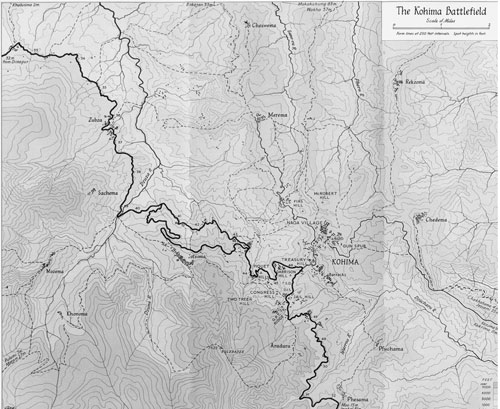
Map 3 The Kohima area. (Butler, p.360)