
CHAPTER ONE
The 106 th Infantry Division was officially activated in the United States 15 March 1943. It was just one of the ninety new formations intended for overseas service as the US Army continued to swell to meet its ‘ commitments in a world conflict, which was devouring men at an ever increasing rate. American troops were ‘blooded’ in the European theatre with the landings in North Africa, Operation ‘Torch’ and the later clashes with Rommel’s Afrika Korps. The training and battle tactics were not up to standard and as a consequence the American elements of the Anglo-American 1st Army suffered at the Battle of Kasserine Pass in January 1943. It took the combined efforts of Patton and Bradley to transform the US 2nd Corps into a first rate fighting force. With the invasion of Europe through Sicily and Italy, and the proposed Second Front in northern Europe on the horizon, raising and training of infantry divisions was high on the list of priorities. The 106th were due for a rigorous training that would equip them to face the most efficient fighting machine the world had seen to date – the German army.

* * * *
Midday on Monday 15 March, 1943. A large limousine pulled up in front of No 2 Outdoor Theatre at Fort Jackson, South Carolina. Alighting from the car was the Honorable Olin D. Johnston, Governor of that State. Along with other dignitaries he took his place on the stage in front of the massed ranks furnished from the parent organization, the 80th Infantry Division. The Divisional Chaplain, Major John A. Dunn, pronounced the Invocation, followed by the Adjutant General, Lieutenant-Colonel Frank I. Agule, who read the official birth certificate – the War Department order for the activation of the 106th Infantry Division. On completion of the speeches, Master Sergeant Jay G. Bower – acting as the representative of the parent 80th Infantry Division – summoned from the ranks of the 422nd Infantry Regiment Private Francis A.Younkin, one of the youngest new recruits. To this new, raw recruit, Sergeant Bower handed over the National Colours entrusting its keeping to the new division. More speeches, and then General Jones gives a brief message to his command ending with the statement,
‘In your hands is held the opportunity to fashion an instrument which will demonstrate to the world that our way of life develops men superior to any other’.
The ceremony came to an end with the Benediction, after which the men were dismissed. The 106th Infantry Division was now officially on the rolls of the Army and the United States.
The idea of these new divisions was to form a nucleus of already well-experienced men and build the newly drafted recruits around them, keep them together so that they would form a bonded team and train them well. The end product would have then been through every conceivable task that would be expected of an infantry division, ‘except come under real fire from an enemy’.
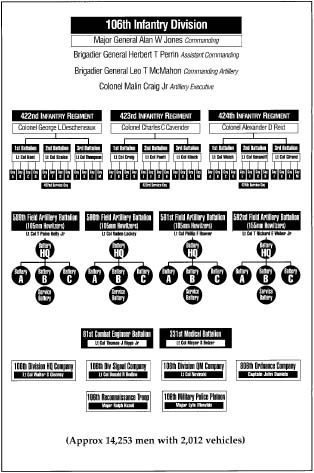
The Divisional Commander was Major General Alan W. Jones; Assistant Commander was Brigadier General Herbert T Perrin; and the Division’s Artillery Commander was Brigadier General Leo T McMahon.
Basic training began on 29 March, 1943, followed on 12 July by Unit training. From October 1943 to January 1944 more training but this time on a regimental and divisional level. This was held in central South Carolina, in the field. For the first time men learned how to cope with mud and freezing rain.
From January to March 1944 the Division took part in gruelling manoeuvres in Tennessee. The area took up the best part of the centre of that state. These were under realistic battlefield conditions. Along with other units, the 106th took part in daily manoeuvres, learning all the skills the Army had to offer them. Even the weather was terrible, and unknown to the men at that time, very similar to what they would be experiencing in the Ardennes – nine months later.
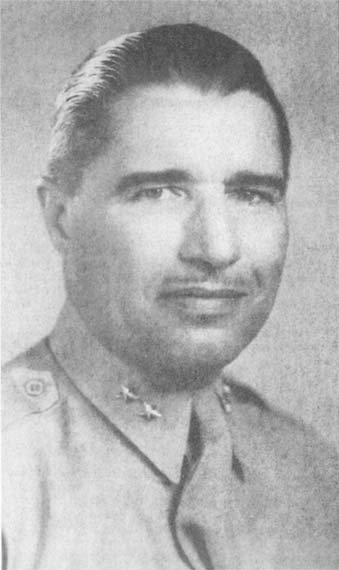
Major General Alan Jones
General Jones went on to say,
‘The months training there were extremely beneficial to us and we came out of Tennessee a trained division, with much experience and great promise. We learned how to get our trucks through mud and country roads, how to make the most of supper eaten at night in the rain without light, how to wear mosquito headnets in a snow storm, we learned through days and nights of discomfort how best to take care of ourselves and, best of all, we learned that, as a fighting division, we were better than most.’
To the men of the division at that time, one thing will always be remembered. It became fondly regarded as the secret weapon of the 106th. This was the ‘Bag Lunch – Ml’. There were quite a few times when the men could not get back to the mess halls due to different tactical situations during exercises. So the cooks would prepare each man a bag meal. These were quite appetizing at first, but soon drifted into boring hastily thrown-together sandwiches, containing who knows what! One such filler was peanut butter mixed with grape jam. After living in the field for days on end the men would eat anything. Well, almost!

Basic artillery training at Fort Jackson, summer 1943.
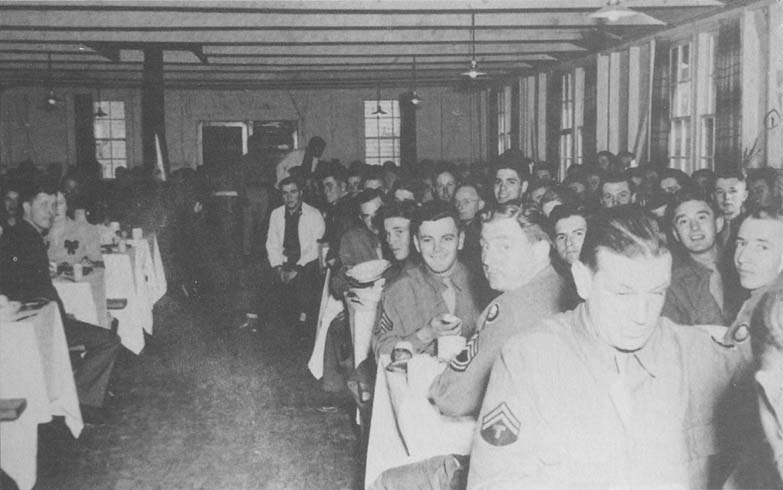
Anti-Tank Company, 422nd Infantry Regiment, Mess Hall Fort Jackson
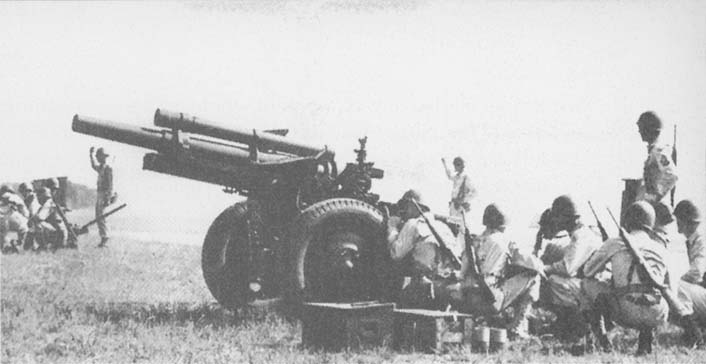
Men of the 589th Field Artillery during live firing practise with their 105mm howitzers, Camp Atterbury, Spring 1944.
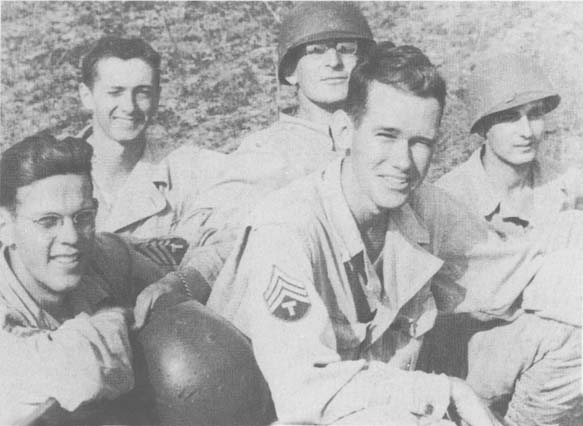
Front centre: T/4 Randolph C. Pierson, 589th FA Fire Direction Center VCO. Clockwise left to right T/4 Ruona, 590th FAB Survey Sergeant anamembers of his crew – Privates Slack, Fienberg and Kaufman.
The Division passed out as average and was now at the peak of readiness; the men and officers were working well together. They were moved to Camp Atterbury Indiana, where they hoped new equipment would arrive before going overseas. Then came the savage blow. The War Department’s axe fell and the authorities drafted just over half of these men as replacements to other depleted fighting units. The Division was being stripped of its highly trained personnel. In their place came young men from all different branches of the Army and Airforce; some were volunteers for the infantry and some were not. The 106th did not recover from this drainage of experienced men. The new men were not to blame. It was the way the War Department went about things. It would take months and months to get the Division back up to scratch, but there just was not the time.
John Hillard Dunn remembers joining Company H (Heavy Weapons) of the 423rd at Camp Atterbury:
‘I was instructed to report to my squad leader. I walked up to him in the barracks and said: “Private Dunn reporting.” And with my face growing red, I added, “I think I ought to tell you, Sergeant, that I don’t know a damned thing about an 81-MM mortar.” He turned to me and replied, “Don’t worry, Mac, You ain’t got a thing on me. I don’t either. I’ve been a mess sergeant in Fort Benning for ten years.”
The days at Camp Atterbury were hard with much training.
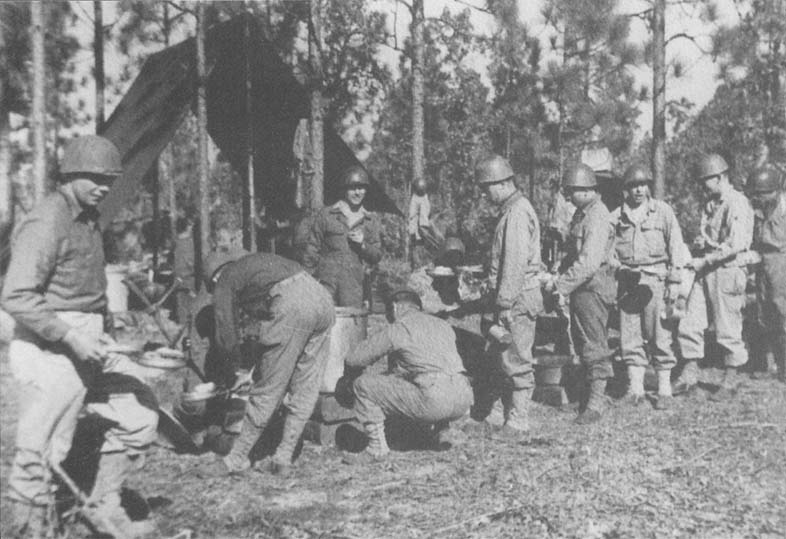
Chow line – men of 422nd Infantry Regiment at Camp Atterbury.
In between training, leave was granted to the nearby places, such as Indianapolis and Columbus. The division took part in many events during their stay there. A demonstration exercise lasting two days on 19 and 20 May, for the delegation of the Hoosier State Press Association, another demonstration on 3 June for the Under-secretary of War Robert P Patterson and an Infantry Day exercise on 15 June for more than 5,000 visitors. On the 4th July 1944 the 106th took part in Independence Day Parades at Indianapolis and Cleveland simultaneously. All these schemes made a welcomed break from the normal routine. During their stay at Atterbury the Cub newspaper went into full swing. It had been started during the Tennessee maneouvres. It still exists today as a quarterly news magazine. The editor at present is John Kline, who is totally dedicated to his work and does a superb job. He is just but one of the many heroes of the 106th.
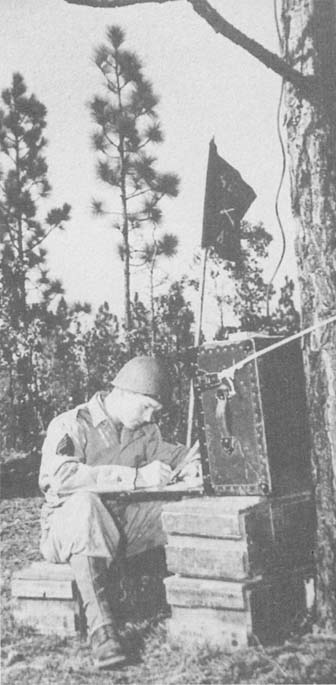
Field HQ, Anti-Tank Company, 422nd Infantry Regiment, 1st Sergeant Widmyer operating a radio.
At Camp Atterbury, Colonel Cavender called in Ivan Long, a Lieutenant, and offered him the Intelligence and Recon Platoon. ‘At this point’ he said, ‘I was unaware of its function. Later, having completed the Army Ground Force Test we came out on top. Out of a possible 1,000 we had a test score of 999.8. One gas can was not completely filled.’
In September the Division moved by rail to Camp Myles Standish at Taunton, Massachusetts. This camp was a well-known staging area before going overseas and secrecy was the word.

Happy days for the men of 422nd Infantry Regiment – camp fire at Camp Atterbury.
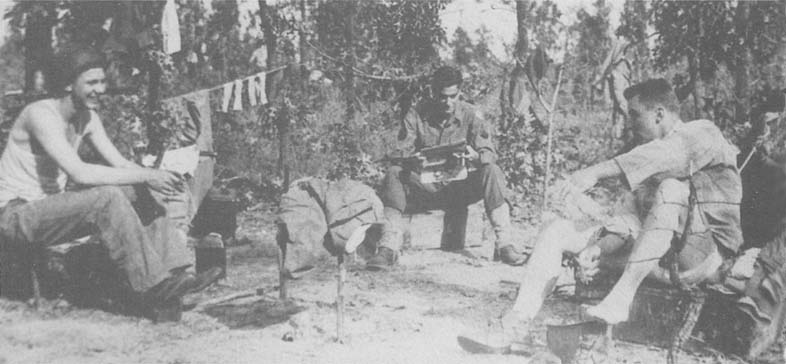
Corporal William Supko (later Staff Sergeant) submits to Field Bath-Foot Care from the Medic (in background).
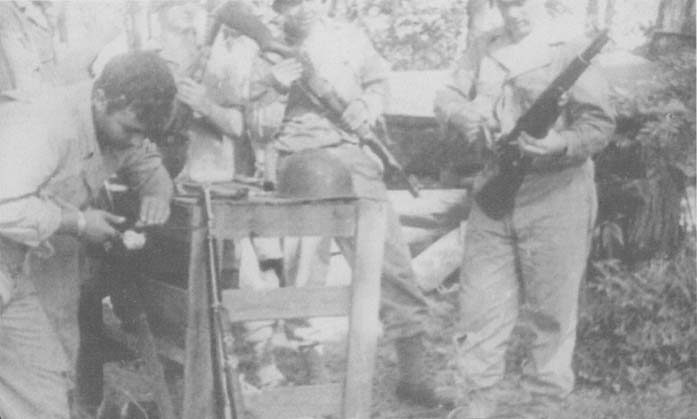
Men of 81st Engineer Combat Battalion cleaning their weapons after firing on Camp Atterbury rifle range. Left to right. Agostini, Gallatin, Hetic and Sullivan.
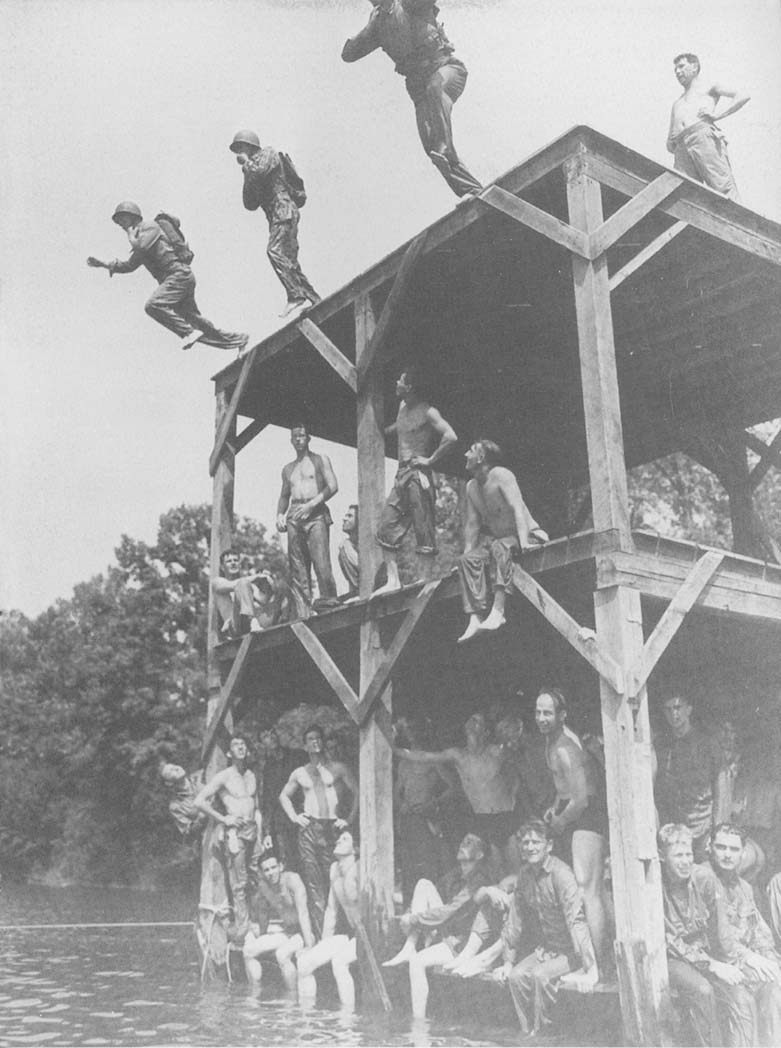
Men of Company A, 81st Engineer Battalion, jumping from a tower during combat swimming training at Camp Atterbury.
Glen Hartlieb, Service Company 592nd FAB recalls the day he left to go overseas:
‘I well remember the day I left Myles Standish. It was 11 November, 1944, raining very hard, I was standing in the rain with all my gear on my back waiting to board the ship. This only added to my misery as I was less than enchanted by the thought of going up that gangplank. A short time later I boarded the ship and was on my way. The next day almost everyone got sick after running into a storm. I won’t go into details on that but I found I had picked the wrong bunk when I reached my compartment. The bunks were five high and I had the centre. I should have been on top.’

Elements of the 106th Infantry Division aboard the Aquitania, October 1944.
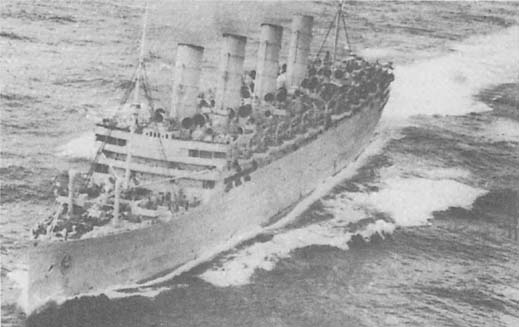
The Aquitania, crossing the Atlantic after carrying part of the 106th to England.
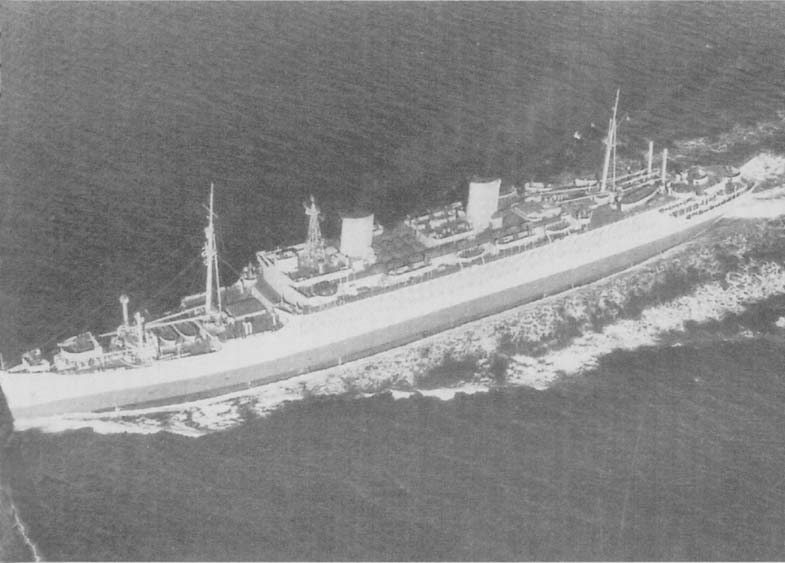
The USCGS Wakefield (formerly the Manhattan). As a troopship she was carrying six times more passengers than she had originally been designed to carry. For the majority of men of the 106th it proved to be a new experience – as they encountered heavy weather.
The 106th shipped out in October-November 1944 and headed for England. After the proverbial coffee and doughnuts, the troops were packed on one time stately ships such as the Queen Elizabeth and Aquitania. One of these magnificent ships was the ex-United States Lines Manhattan. Now assigned as a troop carrier and renamed USCGS Wakefield, crewed by US Coastguards. Jammed packed into their assigned mess-decks the men were excited at the great adventure ahead of them. The Wakefield, like many troopships was carrying six times more passengers than they were ever designed to carry. Men were crammed into bunks five high, made of canvas wrapped around tubular frames. Mae Wests had to be worn at all times other than when sleeping. It was a rough crossing and to add to the gut-wrenching corkscrew motion the ship was travelling at full speed zig-zagging against U-boat threats. Not surprisingly the novelty of being at sea for the first time soon wore off. Meals were served twice a day, the queue stretched nearly the length of the ship which meant over an hour’s wait for those whose stomachs were strong enough. Most meals consisted of mutton stew. The heads (toilets) were an experience in themselves, just a simple trough containing water and waste. John M. Roberts of the 592nd Field Artillery Battalion wrote ‘You never sat on one of the holes at the end. As the water hit the wall at the end of the trough, the water (and whatever was in the water) splashed and sloshed up through the holes’.
On arrival in England they were billeted around the areas of Oxford and Gloucester. A little more training was introduced, but the time was chiefly spent drawing vehicles and equipment. This was how the 106th Infantry Division started its short, tragic life.
It was not long before orders were received. The Division sailed from Liverpool, Southampton and Weymouth on 1 December and spent three long dreary days bobbing about in the English Channel unable to land because of the terrible weather. Finally they docked at Le Havre and Rouen in France and went straight into bivouac in open fields deep in mud and with constant drizzle.
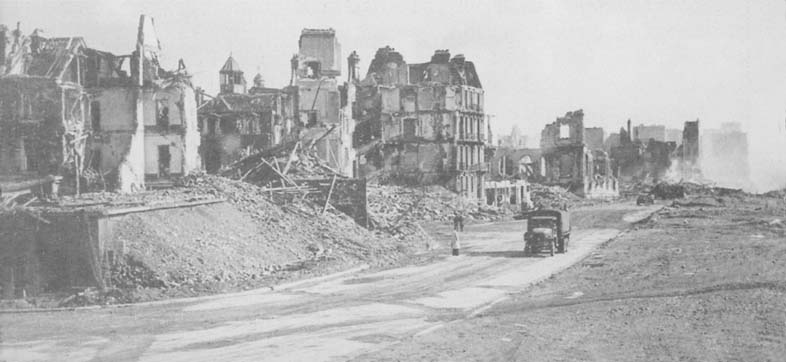
Le Havre in the autumn of 1944. It was here that the 106th landed and were camped before moving out for their place in the line.
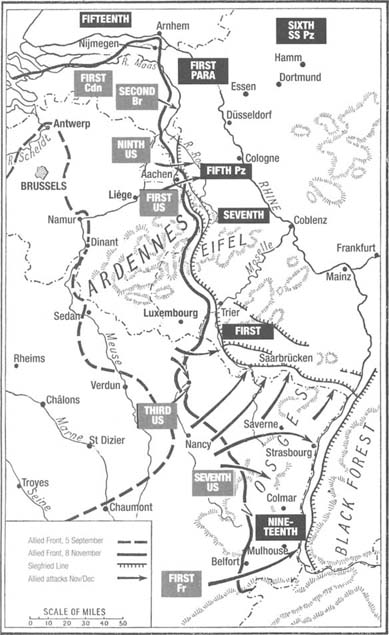
Situation map. By the beginning of December 1944 the German armies had been pushed back to their border and, in some places, the Siegfried Line had been penetrated.