
CHAPTER FOUR
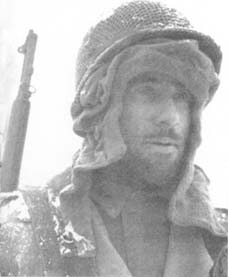
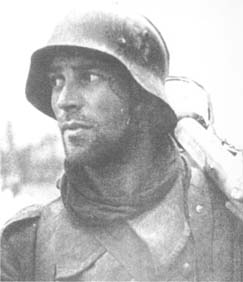
Saturday 16 December at 0530 the German barrage began. Darkness and fitful slumber were still among the young men of the Golden Lions; it was the rudest awakening anyone had ever experienced. Guns of every calibre fired their might on to pre-designated targets up and down the line. Huge 14 inch guns even hit St Vith miles behind the front. Not only had the Germans been watching and noting American key positions but also had actually penetrated with reconnaissance patrols through the gaping holes in the lines to gain vital information. With this intelligence and the fact that they knew the land so well, (after all they had been in the same positions only a few months before) the German gunners were able to hit American targets with uncanny accuracy.
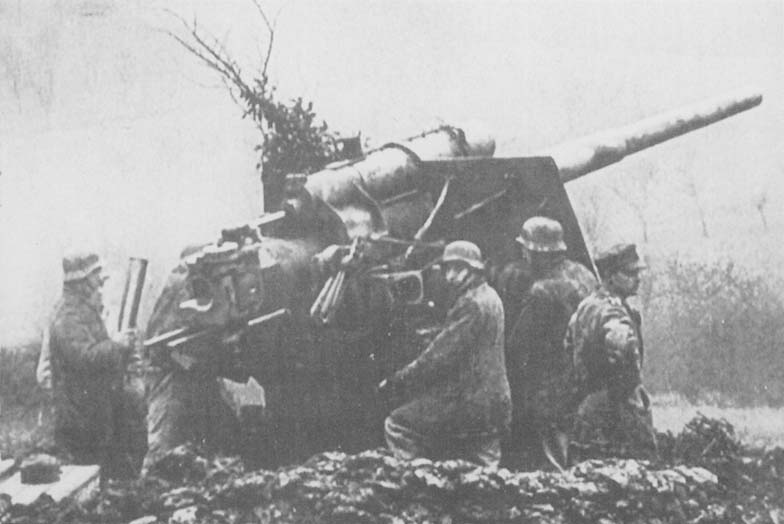
As the attack began the German gunners were able to hit American targets with uncanny accuracy.
Communication land lines were soon knocked out. With absolutely no idea what was going on to the left and right of them, groups of riflemen began to think that the barrage was intended solely for them. Scattered hazy reports began to infiltrate back to divisional headquarters. Men rushed from their warm beds and manned their positions. Gripping their rifles, scared and shocked they stared to their front.
At the school house in St Vith General Jones sifted through the sketchy messages trying to piece together what was happening. VIII Corps had been alerted but was convinced that it was no more than a spoiling attack, but to keep them informed. General Jones was quoted as saying ‘When they drop 14 inch shells on you it’s the real thing’. The messages began to pour in, 0550 am from the 423rd, relayed over the artillery circuit: ‘423 Inf AT Co shelled by arty since 5:30. 2nd Bn 423 Inf alerted. Lines out with AT Co, 2nd Bn and Tr B, 14 Cav Gr’. With these kind of messages buzzing through the airways Jones began to suspect this was no spoiling attack.
By 0615 the barrage had stopped, flares soared into the air and in certain open places, like crossroads, strange eerie lights appeared. These were huge searchlight beams bouncing off the low thick clouds in order to illuminate areas artificially as if by moonlight.
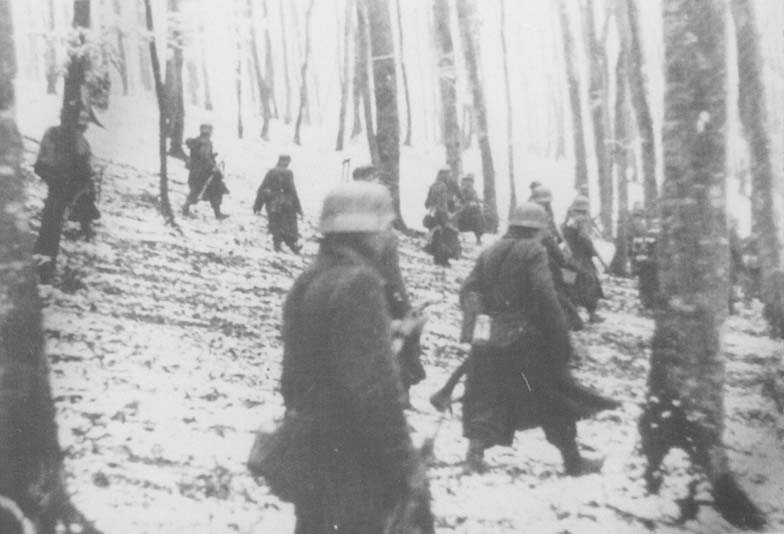
Volksgrenadiers moving up during the attack.
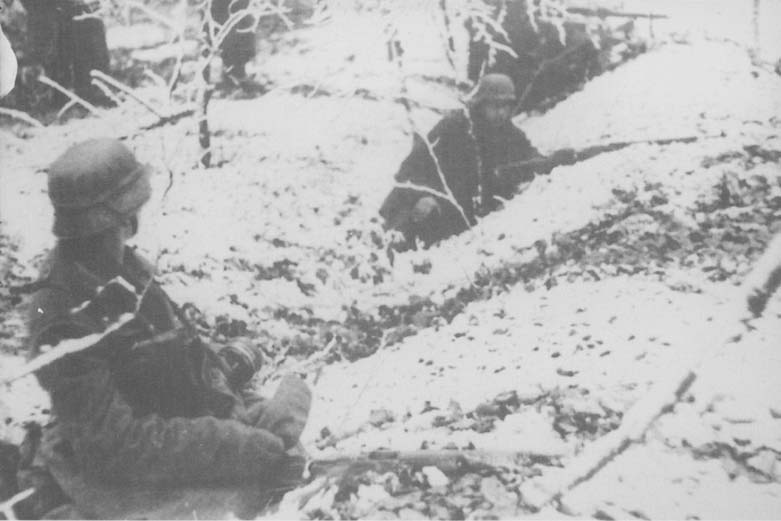
The 18th VGD had only been recently formed in Denmark from Luftwaffe and navy personnel.
The men began to see figures, waves of shadows, some dressed in snow suits leaping through the trees to their front, and now could be heard the noise of vehicles and the clanking of tracks. These figures were the German soldiers of Generalmajor Gunther Hoffman-Schonborn’s 18th Volks-grenadier Division (VGD) and Oberst Friedrich Kittel’s 62nd VGD. The 18th VGD was made up of three regiments, the 293rd, 294th and the 295th. It was formed in late summer 1944 in Denmark, and was made up of many Luftwaffe and Kriegsmarine personnel. By November it had a complement of nigh on 10,000 officers and men, and was training in the Ardennes region. To aid the attack, Hetzers and Sturmgeschütz self-propelled assault guns were attached to the grenadiers. The mission of the 18th VGD was to encircle the Schnee Eifel, close behind the 106th Division at Schonberg and move on to take the important road and rail hub of St Vith. The 62nd VGD was slightly to the south and was to attack between the 424th and 423rd regiments, generally heading north-west, also towards St Vith.
The sole purpose of these two divisions was to open up the road network in the centre of the Ardennes to allow support for the major thrusts west of the Sixth Panzer Army in the north and the Fifth Panzer Army in the south. The timetable they were given was of the gravest importance and stipulated St Vith must be captured by the evening of the 17th or, at the latest, early in the morning of 18 December.
In the Eifel, Hoffman-Schonborn opted to send one regiment around the north, one round the south and to keep his third regiment immediately in front of the 106th positions.
The ‘spooky’, strange happenings of the past weeks were over, the figures coming at the 106th through the German positions were at long last something the Americans could understand.
Sitting in a makeshift log lean-to, built by Engineers, alongside one of the bunkers which had been bulldozed, was Acting NCO Anthony J. Marino of HQ Company 1st Battalion 422 Infantry:
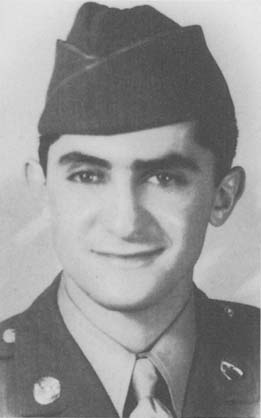
Anthony J. Marino
‘I was in the Command post seated at the telephone table with the log sheets of the companies in deployment. When, crack – crack, two 88mm bursts pierced the darkness, one falling short – one hitting the upper part of the wall where a Lieutenant and a Sergeant were seated. Colonel Kent [Commander of the 1st Battalion] was standing talking in front of the table at which I was seated. Colonel Kent was 6 feet 2 tall. The second 88 burst hit the upper portion of the wall splintering the logs and crashing them across the upper room – Colonel Kent was caught in the burst. He did not have his helmet on. The damage was fatal, splinters entering his neck and the back of his head. Medics attended to him. However, the fatal 16th of December made it impossible for him to be evacuated to an army field hospital where he could have been treated competently. There was this gaping hole in the wall, Colonel Kent was thrown across the table I was seated at. The Lieutenant was hit with a piece of log which caused a severe bump on his back. I scurried in haste – filled with anxiety. Sergeant Kerski came into the command post saying, “There are Germans all through the area”! I yelled, “The fire, the fire put out the fire in the fire place”. I ran and dumped the large coffee pot on to the smouldering fire. It. went out. I said, “We have got to get out of here – we will be easy prey to anyone coming in”. We mutually went for the door. Outside in the subzero temperature there was calm.’
Up to the north the Germans swept through their pre-designated channel like muck through a goose. The 14th Cavalry defending the gap between the 106th and the 99th Division fell back in disarray; not their fault, as like everyone else they had only inherited positions that others had established. Normally a cavalry unit was used for screening and reconnaisance, not to dismount from their armoured cars and light tanks to defend static areas.
The German southerly regiment, the 293rd of the 18th VGD, came spilling out of the village of Brandscheid and up the road from Prum. Their first target was the small town of Bleialf. The right flank of the 423rd regiment poured everything they had onto the massed German attack. The 1st Battalion in and around the Schnee Eifel stood firm but the makeshift forces covering the open ground began to give a little.
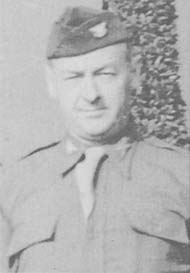
Colonel Charles Cavender
Volksgrenadiers came flooding up the railway cutting just south west of Bleialf, effectively driving a wedge between the 423rd and the 424th Regiments, completely cutting off Troop B 18th Cavalry Squadron. Vast numbers of German troops attacked out of the woods and were soon in and around the town. Bleialf was now virtually in enemy hands with all communications lost. Realizing what was going on, Cavender mustered his only reserve force, a Service Company based at Halenfeld. At 0905 he managed to get a message through to HQ at St Vith telling them that Troop B was in trouble and needed help and that he was committing his reserve. He also requested that he should be given B Company 81st Engineers based at Schonberg, which was approved.
The Engineers moved out and detrucked on the outskirts of Bleialf. They went into action straight away as riflemen; the remnants of Cannon Company and the other units which formed Captain Charles B Reid’s Composite Battalion also joined in the effort to retake the town.
With fire support from Company C 820th Tank Destroyer Battalion and the 590th FAB, the mixed group fought their way through the town in vicious house to house fighting, Cavender sent every available man he had, even his headquarters staff. Bleialf must be retaken to re-establish the southern link.
Bodies now littered the streets, much of the fighting was hand-to-hand. (Two days later when the town’s priest ventured out of his cellar, he found in excess of 200 bodies, both German and American, in the vicinity of his church.) By 1500 the makeshift American force managed to clear the place of Germans and retake the town except for the few houses leading to the railway station. By noon Lieutenant-Colonel Frederick W. Nagle, the Regimental Executive, was sent there to take charge.
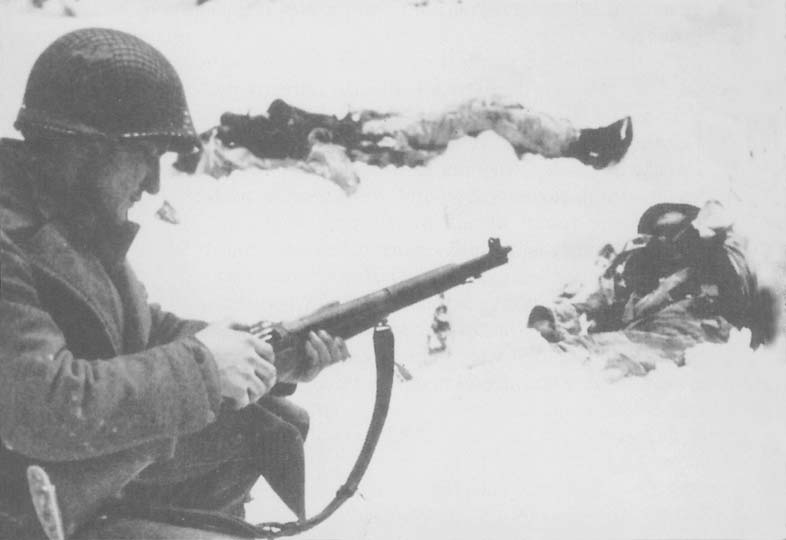
There was heavy fighting for the German village of Bleialf – much of it hand to hand – as 81st Combat Engineers fought as infantry. Here a Gl loads his Garand M1 with new clip. Around him are German dead.
John Hillard Dunn was now a Combat MP (Military Policeman) guarding about fifty German prisoners. Towards evening wounded began to filter into his positions. He had a chance to talk to a man from Cannon Company. His was the story of a forlorn, desperate little action in the German town of Bleialf: ‘So you wanta know what the hell Cannon Company is doing – fighting in Bleialf,’ he said as he rubbed the bandage on his right leg. The god-damned Heinie infantry takes Bleialf in a surprise move. Our rifle companies are too damned busy to do anything about it. Besides, Cannon’s run out of ammunition for the guns by now anyway.’
He stopped to light a cigarette.
‘Understand, I ain’t beefin’, but hell, village fighting with carbines and damned few grenades ain’t no picnic. What the hell, though, somebody’s got to try to take the damned town back. Ain’t no other way of getting to division at St.Vith.’
This made Dunn realize the reason why he had been unable to get his prisoners back to Division. They were cut off.
‘We take her back,’ the GI went on to tell Dunn. ‘Don’t ask me how. They don’t let us keep it long. They come back with artillery fire, and then mortars and then infantry. There’s Cannon guys left back there but they ain’t movin.’
He lit another cigarette from his butt. ‘That’s how it is, Mac. But where the hell do we go from here?’
Whilst all this fighting was going on, the 3rd Battalion 423rd up in the Schnee Eifel sat totally untouched save for a few skirmishes with German patrols. They were, however, helping their neighbours the 1st Battalion by concentrating fire down on to the Sellerich road.
John Kline was a nineteen-year-old heavy machine-gun squad leader, with the rank of Sergeant:
‘I was with M Company 423rd Combat Infantry Regiment, Third Battalion. I was not aware that the Battle of the Bulge, as it later became known, had started. My impression was that Bleialf was to my right rear. My gun position on the Eifel was on the extreme left flank of the 423rd Regiment. In fact there was only one rifleman to my left. There were patrols that passed back and forth through the unprotected area between the 423rd and the 422nd Regiment. My Commander’s command post was in one of the old fortresses, which was located back of me and to the right. From the CP I could see Buchet and some of the valley in between that city and our positions. From my dugout position, on the German side of the Eifel, all I could see was a forest of trees. I think this was the reason we were not aware of the fierce fighting going on at Bleialf. I had a 300–400 yard cleared area in front of my dugout and there was very little daylight that showed through. We had to cross an open field back of us to get to the CP and the mess tent. This on occasion would draw some German artillery’.
The 2nd Battalion, 423rd had been in reserve north of St Vith in the town of Born, but by that afternoon had been alerted by Headquarters and told to move out by truck to Schonberg. Once there they were to dig in and defend the town from possible threat from the south and northeast. By 1730 they were in position. Lieutenant-Colonel Joseph P. Puett, commanding the 2nd Battalion, immediately sent out patrols to see what was going on and by 1930 sent a clear message to St Vith:
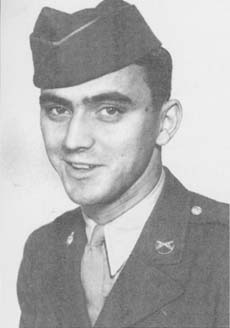
John Kline
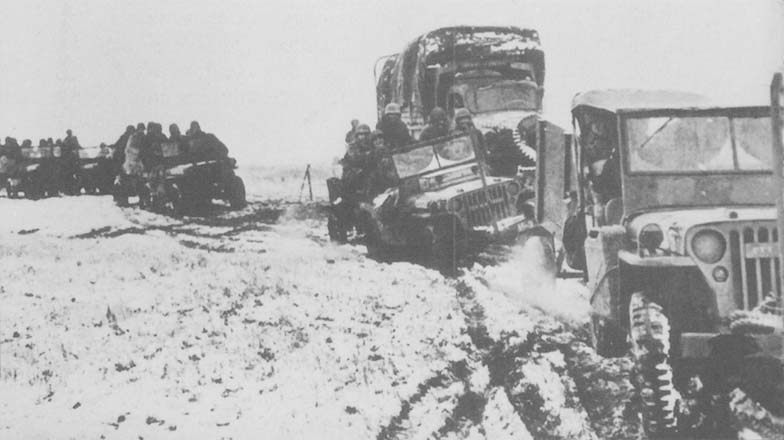
Moving up over difficult terrain.
‘Enemy shelling Schonberg heavily. Cavalry have withdrawn and are mining the road five hundred yards north of Andler. Enemy have completely taken Auw. The 275th Armored Field Artillery have also withdrawn. [This was a 105mm self propelled unit attached to the 14th Cavalry]. Am patrolling in three directions and will have more information at 2000’.
With the 2nd Battalion was Charles Paetschke. He had only been in the Division a short while, transferring from the 104th Division shortly before the 106th shipped out from the States. He and a couple of other GIs had been given some dummy bazooka rounds to fire at a target. To his elation he had scored a direct hit. When it came to a live firing he narrowly missed, but all the same, he was made a bazookaman. Which he now regretted. In Born he was billeted in a school house. Down the road was a bar of a fashion, more like someone’s front room, where they would all sit around a large table buying beers with their occupation currency. Moving by transport to Schonberg, Charles found a large empty building and along with numerous other soldiers tried to bed down for the night.
Communications began to get back in, wiremen from the signal detachments went out in search of broken lines. Joseph Remetta was a lineman in the 106th Signal Company:
‘In the Ardennes, the Signal Company had the Division forward switchboard in Schonberg, and there were four of us trouble shooters staying in the same house as the switchboard. On the first day of the Bulge all the lines went out early to the regiments. Sergeant Davis and myself went to the 422nd and the 423rd, while the other two trouble shooters went to the 424th. After a while we spotted a break in a cable on some open ground. We would be exposed to enemy fire if we went to fix it, but the wiremen from the regiment and myself decided that we would run to the break, hit the dirt, and do what we had to do, then get out of there. While we were making the splice, our artillery from the rear was laying down some pretty heavy barrages. You could hear the shells passing overhead and landing in a wooded area about 300 yards ahead. Also about 10 yards ahead of us, one of our machine-gunners was doing an awful lot of firing. Some of the infantry riflemen were behind us firing from behind a roll in the terrain. So I guess the Germans didn’t have time to pay any attention to us.’
On their arrival back at the switchboard that evening they found the house had been damaged quite a bit, there were large hunks of shrapnel inside.
Meanwhile to the north that morning, the 422nd Regiment was having troubles of its own. The German Grenadiers had driven the 14th Cavalrymen out of the villages of Krewinkel, Roth and Kobscheid and were hammering on the door of Auw. This would jeopardize the entire left flank and also meant the gateway to the rear of the two American Regiments would be open. Company A of the 81st Engineers held this village. When they had been awoken that morning by the German barrage they were astonished to find the occupants of the village already dressed and sheltering in their cellars. The evening before a woman had been spotted going from house to house. Later they suspected she had informed the villagers of the German attack.
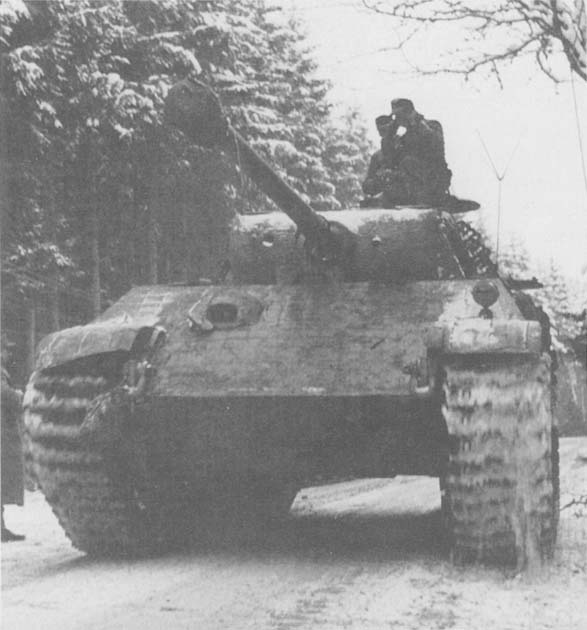
A Panther clears the trees during the attack.
Approximately 15 to 20 rounds fell on the village four of which hit their command post, fortunately no one was hurt. The Engineers, not knowing any better, set to work just like any other day, repairing the damage to the roads. At about 0930 they were interrupted by small arms fire coming from the direction of Roth, the engineers immediately sought cover and returned fire. Lieutenant William J. Coughlin had taken his 1st Platoon to Schlausenbach that morning to work and on hearing the firing up at Auw had dashed back with his platoon to help. They made it back to their quarters and started taking on the Germans milling about on the edge of the village.
Roth had fallen to the Germans by midday and they were now concentrating on their next objective, Auw. The engineers were putting up a brave fight against incalculable odds, but when tanks appeared it was time to get out. Most made it back to Heuem via Andler but one group was trapped in a house with only an open field behind them. With the Germans advancing towards them there seemed no way but to stand and fight until overrun. Sergeant Withee offered to stay and hold off the enemy whilst the rest of his comrades made a run for it. He took on the Volksgrenadiers single-handed, it was not until the building was virtually blown away around him did he stop firing and finally surrendered. Later he had a rest centre at Eupen named after him in his honour and was awarded the Distinguished Service Cross.
Auw was in German hands, and they were now trying tentative thrusts further, towards Andler and up the road (Skyline Drive) that cuts through the artillery positions and leads to Bleialf.
All morning the 589th, 590th, and 592nd Field Artillery Battalions had been saving the day, supporting the infantry everywhere with well concentrated salvoes that crashed down on German formations. However, it soon became clear that the enemy was getting too close for comfort. Early in the afternoon armoured vehicles began to appear through the gloom on the road up from Auw. Lieutenant Eric Fisher Wood Jr, of Battery A, ran to a hillock to his left to get a better view and managed to get a howitzer onto them. Over open sights the cannon managed to send the leading assault gun up in a sheet of flames, causing the following vehicles and troops to withdraw to cover.
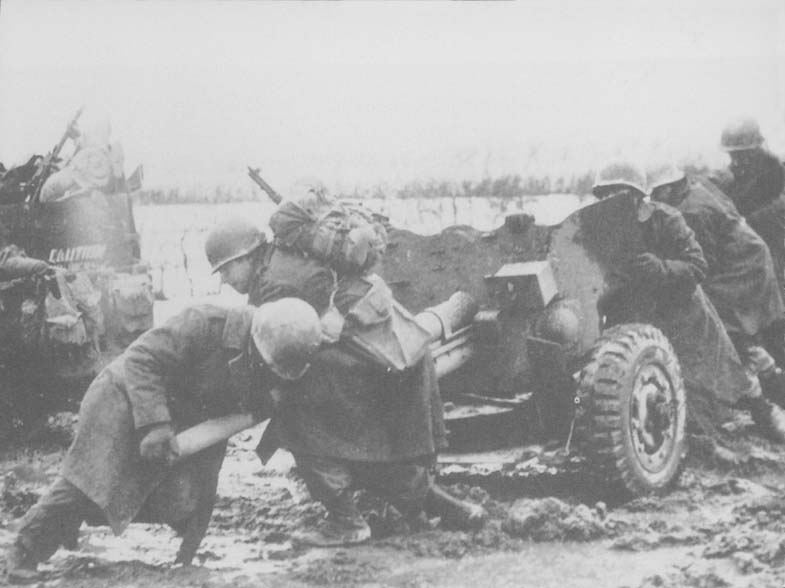
Manhandling a 57mm M1 field piece into position.
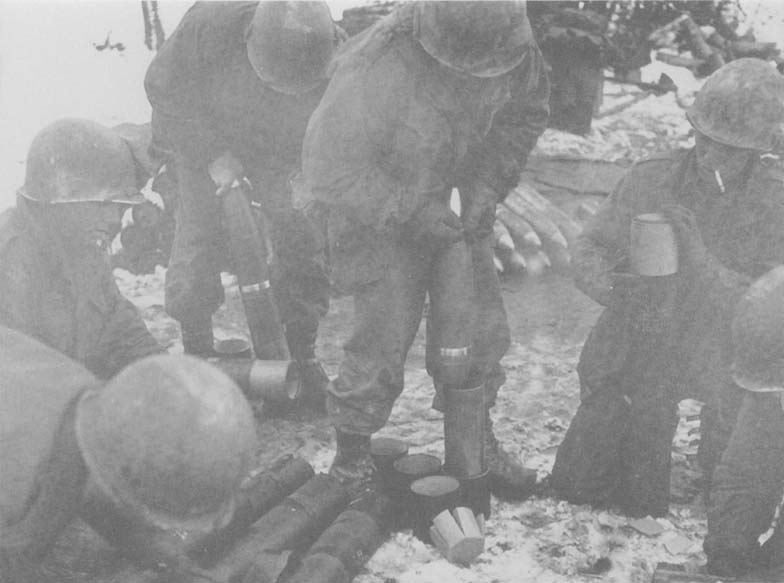
Artillery men of the 106th Infantry Division fusing shells during the battle.
The artillery now began to organize a road block and local security to protect itself from the threats. J. Don Holtzmuller:
‘Our first day of real battle was very harrowing. Our gun was unable to fire on the tanks, which appeared in front of our position since a log fence had been built around our gun and one of the upright posts of the fence was right in line with the tank. Also, a German artillery shell had buried itself in the mud about 20 feet in front of our gun, but luckily it was a dud and didn’t explode.’
Descheneaux, commander of the 422nd, realizing the danger, sent a mixed force of available men up from his HQ area in Schlausenbach to try and retake Auw and secure his left flank. As the men began crossing open ground in front of the village a snow blizzard and heavy enemy fire greeted them. They were forced to turn back and confirmed the news that the Germans definitely were at Auw and in some strength.
Divisional Headquarters now realized the danger that was unfolding all across their front, and decided to get the 589th and 592nd artillery withdrawn. Still Jones awaited some kind of message from his Corp Commander Major General Troy Middleton.
An order to move his Battalion up to the north was received by Puett at Schonberg, directing him to help the two field artillery battalions to displace and withdraw. He was also to protect the left flank of the 422nd Regiment.
The welcome news reached St Vith that the 9th Armored Division’s Combat Command B was on its way to help. Immediately, Jones told them that they were to attack towards Schonberg the following day, and by doing so relieve the situation on the Schnee Eifel.
Back at Vielsalm, under orders from Headquarters the 106th Divisional Band broke up its rehearsals, swopped the musical instruments for weapons and headed for St Vith to become the headquarters guard.
Finally Jones got the call from Middleton. It was a guarded conversation as both commanders thought the line was being tapped. As a result of their clipped conversation both parties failed to understand what the other was saying. By the end of it Jones was convinced that he was supposed to keep his regiments in place, and further, that Middleton was sending the 7th Armored Division to help from its position up north; and that it was due to arrive the following morning. Armed with this mis-information Jones felt much better. He immediately called off previous plans for the 9th Armored and instead sent them south to support the 424th Regiment. When the 7th Armored arrived in St Vith the next day he would send it on to Schonberg. Colonel Slayden, an intelligence officer on loan to Jones from Corps, realized that this was an impossible task – he knew that the 7th could not possibly reach them by the next morning, it was over 60 miles away After the war he admitted he should have said something to Jones, but at the time it would have sounded as though he was calling the Corps Commander a liar.
Meanwhile the 2nd Battalion, 423rd, at about 1930 drove from Schonberg south on the Bleialf road, up Engineers Cut-Off and along the Skyline Drive, finally reaching the artillery positions at about midnight. Charles Paetschke had not been asleep for very long before he heard shouts of ‘move out’! He collected his gear together and went out into the street only to find the jeep with his bazooka in it had gone. He felt a great relief at his loss as he joined others clambering into the back of a truck for the journey up to Auw. Through sheer exhaustion he nodded off to sleep next to the tailgate. The first jolt of the truck sent his helmet flying out the back. What a way to be entering combat for the first time, he thought, no helmet and no bazooka.!
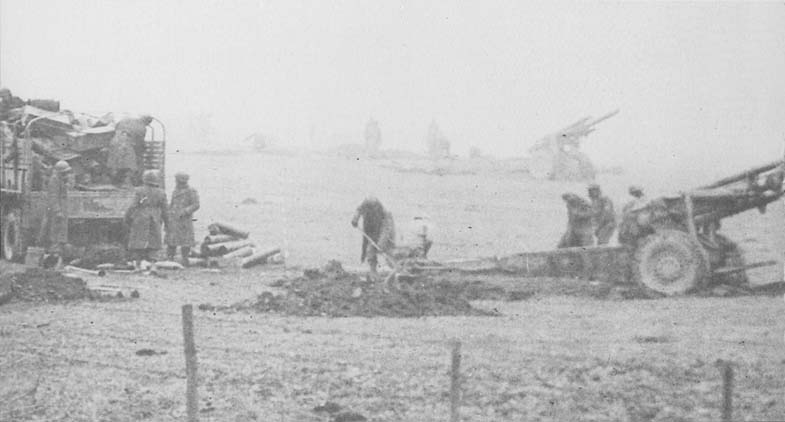
A Battery of 155mm Howitzers taking up a new position during the Battle.
In the meantime, the artillerymen were preparing to get out. It was hard going trying to drag the howitzers out of their muddy emplacements and some had to be left. Finally the 6x6 prime movers got the rest of them going and they set off in the dark snowy night. New positions had been found for them, the 592nd was to go back to St Vith and the 589th to the vicinity of its service battery about three miles south of Schonberg.
J. Don Holtzmuller:
That night, as we were loading up to move back to a new position, machine-gun fire with tracers continually flew over our heads. We were on the edge of a wooded area and the Germans were firing just above the tops of the trees. The enemy must have mistaken the treetops for the ground.’
Whilst all this was going on, Descheneaux swung his left hand Battalion the 2nd, round to face north. So at the end of the first day the 106th had not given much ground. The 423rd Regiment had retaken Bleialf but had not gained contact with its sister regiment to the south, and the 422nd Regiment still held the Schnee Eifel and had swung its left hand battalion around to guard the north and into which Puett’s 2nd Battalion had joined and extended that line.
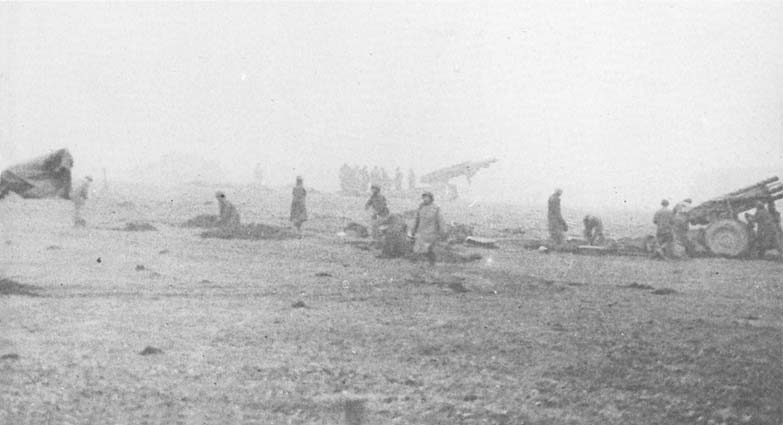
If the German timetable was to go according to plan Schonberg must be taken in the morning, so far the GIs of the 106th had denied them their prize.
Sunday 17th December 1944
Throughout the night of the 16/17 the Germans poured through the now wide open Losheim Gap, desperately trying to by-pass the stubborn resistance of the 106th on the Schnee Eifel. The 14th Cavalry had been pushed back and was still desperately trying to form a solid defence line. The road leading to St Vith was jammed with rear echelon traffic streaming west to get away from the front.
In his headquarters Jones received an order from the VIII Corps commander Middleton, dated 0036 17 December, Troops will be withdrawn from present position only if position becomes completely untenable’. Jones would have to sit tight. About an hour later contact was made with Brigadier General William M. Hoge of Combat Command B, 9th Armored Division. Thinking that the 7th Armored Division would be with them by 0700 Jones sent CCB down the road to help the 424th Regiment at Winterspelt. They would be moving into position at daybreak
The defenders of Bleialf got wind that something major was going to happen to them as early as 0255 when a German prisoner told them of the plan to retake the village. Colonel Cavender forwarded the news onto Division. GI patrols confirmed the threat when they observed Germans building up and preparing for the assault. Incoming artillery fire, of all calibres, was increasing. At 0600 the Germans rushed from the direction of the railway tunnel near the village and swept through the town forcing the defenders to scatter. Immediately the engineers were overrun. The remainder of the defenders made it back to Buchet and the comparative safety of the 423rd Regiment. It was a fighting withdrawal all the way.
With the stubborn defence broken, the German grenadiers of the 293rd Regiment pushed on up the road towards Radscheid and Schonberg. About an hour later the village of Andler, at the northern hinge of the German encirclement, also fell. The small group of men from the 32nd Cavalry Reconnaissance Squadron’s Troop B, in their lightly armed armoured cars, had no chance of stopping the inrush of grenadiers. Some King Tiger tanks from the 506th Heavy Panzer Battalion, which had strayed into the fray by accident whilst looking for decent routes to their own objective, joined in the attack. Troop B withdrew, first to Schonberg where they found that Bleialf had fallen, then back to the village of Heuern The Volksgrenadiers were close on their heels but fortunately for the cavalrymen the Tigers had continued on in another direction.
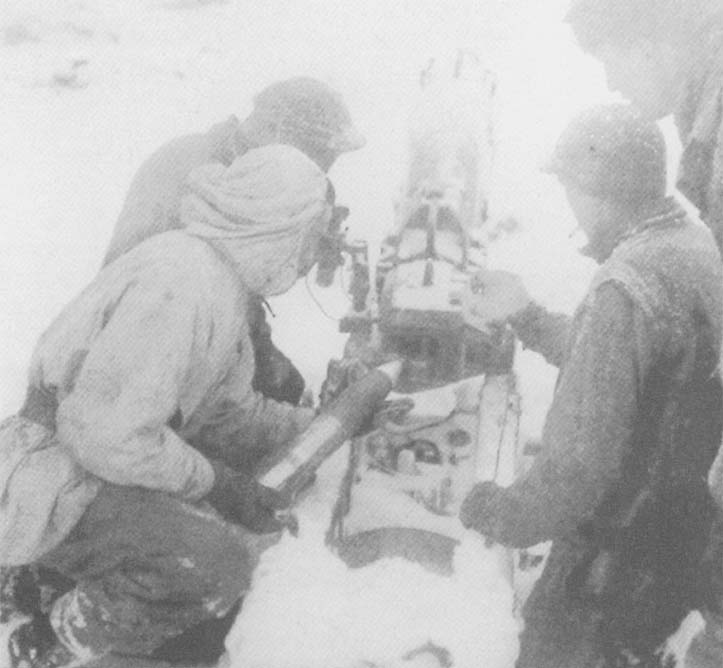
GIs pour fire into the attacking Germans.
The 590th FAB, which had been pouring fire into Bleialf, realized it too was in danger of being overrun.
The 2nd Battalion, 423rd in the old 589th FAB positions sent out patrols which discovered an enemy build up of armour in Auw. At about 0700 three tanks started probing up the road towards their positions. Puett’s 3-inch anti-tank guns made short work of them. However, the attackers were determined and more tanks rumbled into view, this time with infantry riding on the back of them. These were immediately engaged with the result that they were dispersed to cover. Relentlessly, the Germans began to advance again towards Puett’s position. He had lost touch with the 422nd Regiment to his right, also wire communications with Division were out and then his radio was suddenly shot to pieces. There was nothing for it but to withdraw falling back to Schonberg. He sent out patrols to check out the route only to have them report back that ‘Kraut armour was bumper to bumper on the Bleialf-Schonberg road’. His retreat from encirclement was gone. An officer arrived from the 590th FAB and after some hurried consultation the decision was taken for both groups to fall back on to the positions of the 423rd Regiment on the Schnee Eifel. This they did, covering each other all the way. On arrival, Cavender had them slot into the perimeter defence which was already forming around the southern nose of the ridge. He also shifted his command post from Buchet to one of the bunkers in his 3rd Battalion area within the Siegfried Line. The time was about mid-morning.
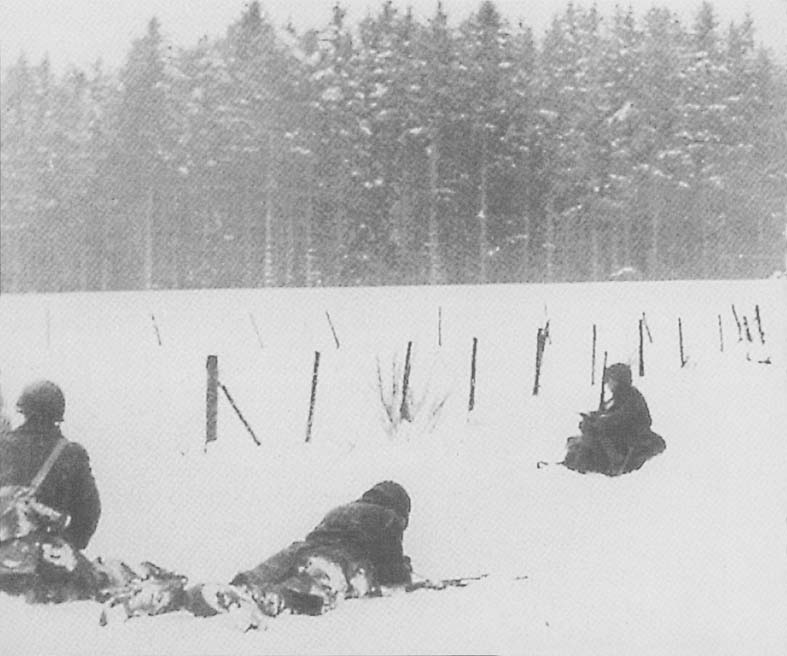
Men of the 106th during the fighting.
Also Descheneaux, commanding the 422nd, realized that his rear was now in jeopardy, what with Puett’s 2nd/423rd Battalion gone and with Germans beginning to feel their way down the Skyline Drive. He adjusted his regiment by taking some of the not as yet hard-hit men from his 3rd Battalion to bolster the fully involved 1st Battalion, which was also being called on to form a rear defensive position. The 2nd Battalion, which was facing north, had rushed into this position the previous evening having left its field kitchens, supplies and kitbags, and was now running short of food. Descheneaux decided to try and feed them from the kitchens of the other two battalions. At 09.30 he sent a message to Division with words to that effect, and added,
‘Estimate sufficient rations to last today, no reserve on hand, out of communications with motor pool… Doubt their ability to leave bivouac. Almost complete unit load of ammunition on hand. Request immediate action to remedy above situation.’
Casualties for both regiments had been surprisingly light up until now. Because of the lack of communications, he had not received the message informing him that the 589th was to withdraw, and so thought he had just temporarily lost touch with them.
The 589th FAB had moved into their new positions at about 07.30. These were just beside the Schonberg-Bleialf road, about three miles south of Schonberg, almost on the Belgian-German border. No sooner had they dropped the guns’ trails, than an urgent message was received from their Service Battery, a little more than a mile to the south, and still occupying their original positions. It reported being under attack from strong German armoured units. Then the lines went dead. Almost immediately a truck appeared coming up the road at speed. The driver brought his vehicle to a halt and, indicating back down the road, shouted that enemy tanks were not far behind him. Once again the men of the 589th set about hitching their howitzers up to the prime movers; this time they were to take them back to St Vith. Yet again the heavy pieces were getting bogged down in the freezing mud. A Battery got three of its howitzers out onto the road and set off through Schonberg and onto St Vith. The fourth piece was proving especially difficult to move, but the crew were determined not to leave it behind. B Battery was also experiencing problems and suddenly bullets began zipping through the air all around them. The pieces were ordered abandoned. The men pitched into their trucks and followed A Battery down the road in the direction of St Vith.
J. Don Holtzmuller, B Battery:
‘No sooner had we made everything ready than someone came running down through the position yelling, “March Order! Get out of here, the Germans are coming!” A weapons carrier then pulled into the lane between where our truck had parked and the howitzer, the weapons carrier got stuck in the mud. We closed trails on the gun and were able to roll the gun out by hand. We were then able to push the weapons carrier out and finally we moved our truck down to the ammunition so that it could be reloaded onto the truck. We hooked up the gun to the truck and drove out to the road with the hope that we were on our way to safety in St Vith. The other three sections had driven off at the first shout.’
Major Elliot Goldstein, acting executive officer of the 589th managed, after much difficulty, to get a message by phone through to Division: ‘Service Battery and one firing Battery overrun, unable to get howitzers into position. Tanks one mile from Schonberg coming up road from Bleialf.’ The time was 0820.
J. Don Holtzmuller goes on to say,
‘We had driven just a short distance down the road and started down the hill into the little village of Schonberg when we suddenly saw a German armoured vehicle parked in the middle of the road. We subsequently found out that the machine we had thought was a tank was really a self-propelled gun. Our driver stopped at once. None of us fired our small arms, nor did the German fire at us as he was parked so that his gun was aimed down the hill and not directed towards our truck. The German then drove off down the hill and around a curve, where we lost sight of him. Immediately thereafter a jeep pulled up behind us and our Executive Officer, Lieutenant Eric Wood, jumped out and asked us why we had stopped. We told him we had just seen a German tank. He said “It couldn’t be. It was probably an American tank”. He climbed into the cab of our truck along with Corporal Knoll, our driver, and Sergeant Scannapico our section leader, and said “Let’s go”.
‘So off we went, down the hill, around the curve and on toward a little stone bridge, which crossed the Our River into the middle of the little village. The Lieutenant then saw a tank parked to the side of a house and said, “See, it’s an American tank”. Then he looked again and said, ‘Hell! no it isn’t! It’s a German! Pour on the gas”. As we passed the tank the German fired at us and missed. Private Campagna, who was manning a bazooka, fired at the tank and also missed but he hit a house and blew a hole in the side of it. We then thought we were home free and on the road to St. Vith, but when we went around a curve we faced another self-propelled gun with its cannon pointed right at us. We also saw about three or four German soldiers with automatic weapons beside the gun. Corporal Knoll stopped the truck and we enlisted men jumped off to the left into a ditch. Lieutenant Wood jumped out the opposite side and ran up the hill into the woods. Immediately after we had got clear the German self-propelled gun fired a round into the motor of our truck, blowing metal and shrapnel all around. One American truck had been stopped before ours and when we escaped from the truck to the ditch, we found that we had joined a Lieutenant-Colonel and four black soldiers from an American 155-mm artillery battalion.
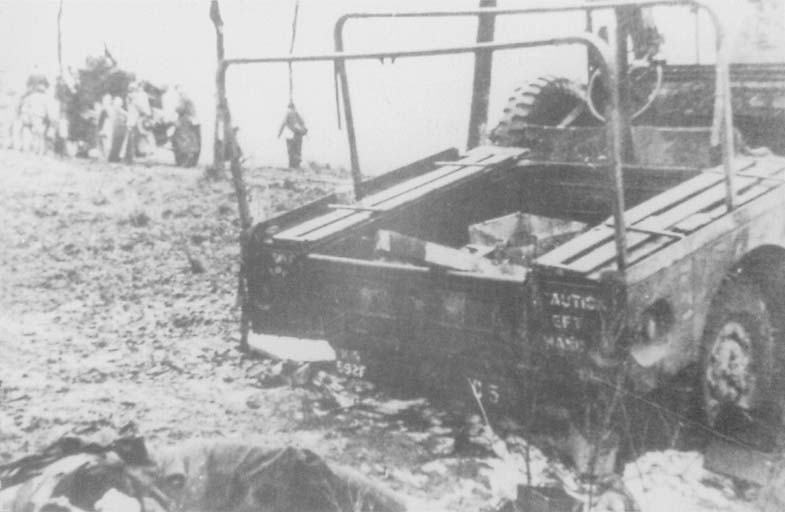
Damaged Weapons Carrier belonging to 592nd Field Artillery Battalion. German horse drawn artillery unit on the road moving west. A dead American soldier lies in the foreground.
There were several of the these artillery battalions around this area, they were Corp units attached to the 106th Division. One of these was the 333rd Field Artillery Battalion dug-in in the Schonberg area, and manned by black soldiers. Beside the road between the villages of Herresbach and Wereth is a newly erected monument in memory of eleven of its members. These men were captured by an SS unit, clubbed, bayoneted and shot then left lying beside the road at this spot. The monument reads: ‘Here on 12/17/44 eleven U.S Soldiers were shot by the SS. [12/17/44 = 17 December 1944.]
‘After discussing the situation, and realizing that there was no cover to run to and that our few carbines would be almost useless against a bunch of automatic weapons, we decided that to do anything other than surrender would be automatic suicide. We walked out of the ditch with our hands in the air. Once out of the ditch, we found the truck driver, Corporal Knoll, lying in the road, shot through both ankles and also wounded with shrapnel from the artillery round. The Germans searched us, taking food, cigarettes, watches etc. They subsequently indicated we should start back up the road towards Germany.’
Quite a few other trucks began to pull up behind Holtzmuller’s and the crews of these were also captured. Holtzmuller wanted to stay and help Corporal Knoll but the Germans had other ideas and forced him on. He subsequently found out later that Knoll was killed in action. Also, whilst walking back, he noticed Sergeant Scannapico’s body lying by the side of the road. At what point the latter had left the truck he never found out, but he had probably left the cab to shoot at some infantry soldiers he had seen and was shot down.
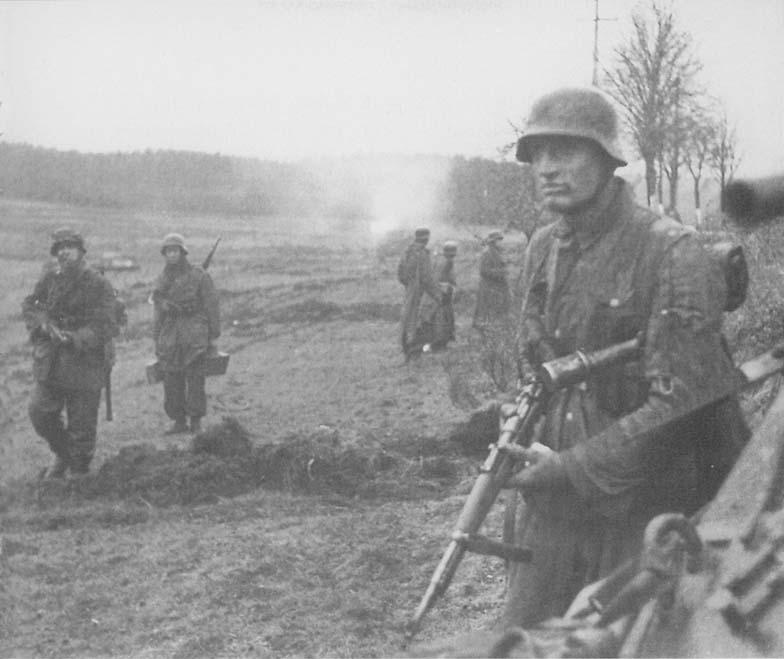
SS Panzer grenadiers during the Battle of the Bulge. Atrocities committed by men of these units did much to stiffen the resolve of the Allied soldiers.
Lieutenant Eric Fisher Wood was the only man to escape this debacle, he had out-run the German bullets and made it to the safety of the dark forest. On 18 December Peter Maraite, a local, was out getting a tree for Christmas when he came across Wood and another soldier and led them back to his house. There they were fed and allowed to stay for the night, despite the fact that the area was crawling with Germans. In statements given by the Maraite family, it appears that Lieutenant Wood had told them that if he was unable to get back to the American lines, he would remain in the area and conduct a war of his own. In the following days small arms fire was heard coming from the woods, and reports from wounded Germans coming back seemed to confirm that they were being ambushed on the rough forest tracks. These were being used by the Germans to avoid the bottleneck of traffic in Schonberg. In February 1945, Wood’s body and that of another American soldier were found and a monument errected at the site. Around them were seven dead Germans. Wood was found to have money on him and his personal belongings, which would indicate he had fought to the death and had been the last to die.
In Schonberg at about 0830 the left hand force from the German 18th VGD coming up from Bleialf met with the right hand flooding down the River Our valley from the direction of Andler. This effectively cut off and encircled the two American regiments and their attachments up in the Eifel. Once the two German arms met at Schonberg the pressure seemed to ease. For now they were more concerned with their next objective – St Vith. The 18th Volksgrenadiers started to move cautiously west along the Schonberg-St.Vith road.
Troop B 18th Cavalry found themselves isolated once Schonberg was captured. Unable to rejoin the 423rd they were given permission to withdraw via Schonberg. Joining them was part of the 106th Recon Troop which had also become separated. The head of the column came out onto the Schonberg-Bleialf road from Amelschied. By mistake a Volkswagen full of grenadiers fell into the column. An American gunner in an armoured car noticed their mistake about the same time that they did – his reactions were quicker – he promptly shot up the vehicle and its occupants. The 3rd Platoon went down the road into Schonberg to ascertain the situation there. The M8 armoured cars crossed the Our river bridge and found the road blocked by a long line of American trucks. They saw the trucks were packed with Germans; prisoners the cavalrymen thought, being taken to the rear. Then suddenly they noticed the Germans were armed. The three front M8’s pulled over to the side of the road, then accelerated past the column of trucks, firing 37mm canister shot and machine guns into the soft-skinned vehicles. However, a MK IV tank rumbled out of a side road and knocked out the armoured cars. Only one got away to report back. Finding no other way out the cavalrymen destroyed their vehicles and formed themselves into small individual groups, split up and tried for St Vith on foot. About fifty actually made it.
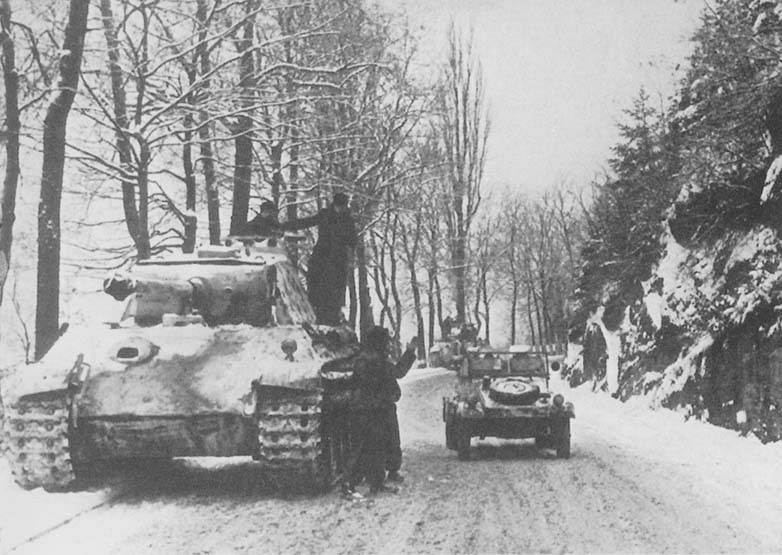
German column on the move during the fighting.
Communications were erratic to say the least. The Germans were jamming all radio frequencies and it could take hours for a message to get through. One such message was sent by General Jones around about mid-morning to the two trapped regiments. It read, ‘Expect to clear out area west of you this afternoon with reinforcements. Withdraw from present positions if they become untenable. Save all transportation possible.’ Lieutenant-Colonel Cavender of the 423rd received this message at approximately 1500 but did not manage to relay it to Descheneaux until just after midnight. Also an airdrop of supplies and ammunition was promised to the beleaguered units and the drop co-ordinates given.
Descheneaux at 1610 sent a situation report to Division giving exact details of where his 422 Regiment was now placed. It did not arrive at St Vith until 2040.
The two regiments tightened themselves up and waited for the relief column to break through and the airdrop to materialize. Neither happened.
In Schonberg early that morning the Divisional Signal Officer Lieutenant-Colonel E. Williams and his wire chief, Master Sergeant C F Foster, were at the forward switching centre when the Germans suddenly appeared. They succeeded in sending a message back to Division reporting their plight before Williams had the switchboard destroyed. He sent his men west to St Vith after making sure everything was inoperative. Then he and Foster left under a hail of small-arms fire. They proceeded to Heuern where they found a mixture of personnel and a tank destroyer. Williams took charge and had the tank destroyer take up position to face in the direction of the pursuing German armour. As the first tank came into sight the tank destroyer let loose and stopped it dead. ‘Time to go!’ yelled Williams. They moved further west along the road, put the tank destroyer into another good position and began constructing a road-block with felled trees. They noticed that their own communication wires were still in place on posts beside the road and tapped into the phone line. Contacting 592nd FAB Williams called for artillery fire onto co-ordinates targeting the road down which the squeak and rattle of tank tracks could be heard. Only minutes passed before salvoes of 155mm shells screamed overhead and began saturating the road with high explosives between Schonberg and Heuern.
Colonel W Slayden, the assistant VIII Corp intelligence officer, had taken it upon himself to go out and find out exactly what was going on. His jeep had got as far as Heuern when he came under enemy small-arms fire. Turning around and heading back he joined up with Williams and his small party. This time Slayden tapped into the line and reported back that he was the last man between St Vith and Schonberg. All that morning they withdrew in a series of short hops carrying out a delaying action at each stage. The Volksgrenadiers kept up relentless advance.
That morning in St Vith, General Jones ordered Riggs to organize a task force and defend the town. At the same time he was given a reserve force in the form of the 168th Engineer Combat Battalion. This gave Riggs a small force consisting of remnants from his own 81st Engineers, the incomplete 168th and a token party of Headquarters personnel. His job was to hold the Germans back until CCB 7th Armored Division could arrive. Riggs relayed the orders to his new command and then set off for his command post in Heuern. About one mile east of St Vith atop a large hill Riggs met his own staff and part of the 168th command group, who had been chased out of Heuern by the oncoming enemy.
Riggs decided this was the place to dig in and make a stand. From this vantage point called the ‘Prumerberg’, good fields of fire could be had for at least 1000 yards down the Schonberg road. As units arrived from the Engineers, they were placed astride the road in a skirmish line. The men dug themselves in on a north-south line amongst the trees. A ‘daisy chain’ of mines was spread across the road and two bazooka teams placed in the woods covering the open ground. A 37mm anti-tank gun was on hand and set up. (This gun was put out of action in the first exchange of fire).
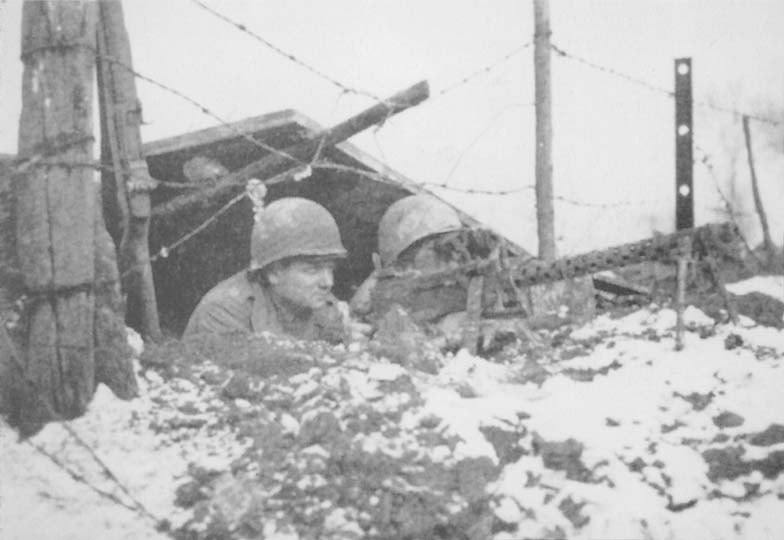
‘Dig in and wait for Heine to show.’ Two GIs man a machine gun post.
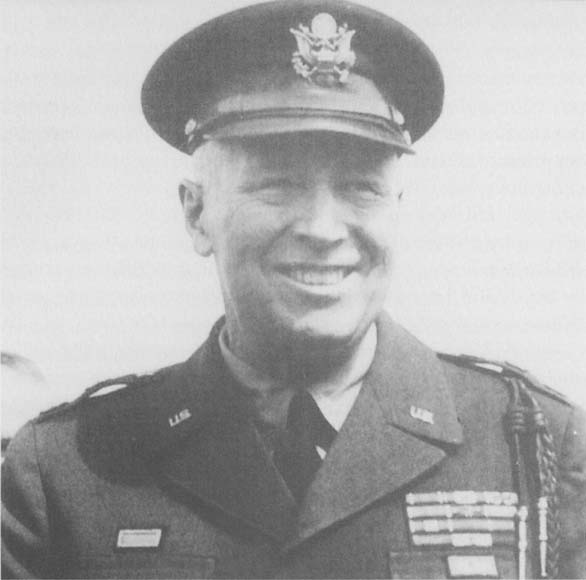
General Bruce Clarke, defender of St Vith.
At about 1000 Brigadier General Bruce Clarke, commander of CCB 7th Armored Division, arrived at St Vith. Jones’s command post was a hive of activity and everyone was relieved to see him. But, that soon turned to dismay when it was found that Clarke was very much the advance party and had no idea when his CCB would be with him – let alone General Hasbrouck with the rest of the 7th Armored Division. It was agreed that when the 7th arrived they would attack towards Schonberg, clear out that area, then move south and aid 9th Armored Division. That way it would free all the entrapped 106th regiments.
General Jones was looking and acting fairly calm, considering what was unfolding around him. He even mentioned to Middleton on the telephone, that there was no need for concern, ‘We’ll be all right when Clarke’s troops arrive’.
But events were indicating the very opposite: early afternoon, in rushed Colonel Devine from the 14th Cavalry, so out of breath and panic stricken was he, he could barely blurt out that he had practically been ‘chased into the building by a Tiger tank’ and that they all ought to get out.
General Clarke knew he was looking at a broken man, who would be of no use at all to his unit. He turned to Jones and suggested he send Devine back to Middleton’s headquarters in Bastogne, and perhaps there, would be able to give a first hand account of what was going on. Devine faded away.
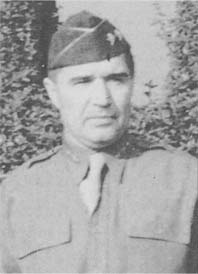
Major General Alan W Jones
A short time later the crackling of rifle fire was heard coming from the east. Jones and Clarke flew up to the top floor of the St Joseph Kloster (monastery) to take a look. It was here that Jones turned to Clarke and said,
‘I’ve thrown in my last chips. I haven’t got much, but your combat command is the one that will defend this position. You take over command of St Vith right now!’
General Jones was under enough stress already; his division was coming apart before his eyes, but to add to all this he had the added anguish of knowing that his only son, 1st Lieutenant Alan W Jones Jr, was with Colonel Cavender’s 423rd Regiment stranded up there on the Schnee Eifel.
Clarke, with nothing else to do until his troops arrived, felt at a loose end. He proceeded to a crossroads just north of St Vith at the village of Rodt to await their arrival.
At about 1300, three enemy tanks and supporting infantry appeared in front of the 168th Engineers. One of the tanks slewed into a field, and the crew casually dismounted, whereupon they were promptly mowed down by a machine-gun crew. The second tank was disabled by a bazooka, and the third, along with the startled infantry, fled for cover back into the woods. This group tried again about an hour later but were driven off by the determined engineers. Riggs had managed to open up an air liaison radio circuit and contacted a lone patrolling fighter, a rare bird in the low-ceiling overcast of December 1944, when the weather had successfully grounded the Allied airforce. This P47 Thunderbolt located the Germans after some low level passes over the woods and strafed them several times, inflicting heavy casualties on the hapless Germans. Meanwhile General Clarke, on the lookout for the leading elements of his division, had come across a monumental traffic jam. Everything had come to a grinding halt. Vehicles of every description were flowing west that day, away from the front, some legitimately and others not. In fact it was much the same on every road. The 7th Armored Division, on its way to St Vith and its commander, General Clarke, found itself bucking against this on-rushing tide of vehicles.
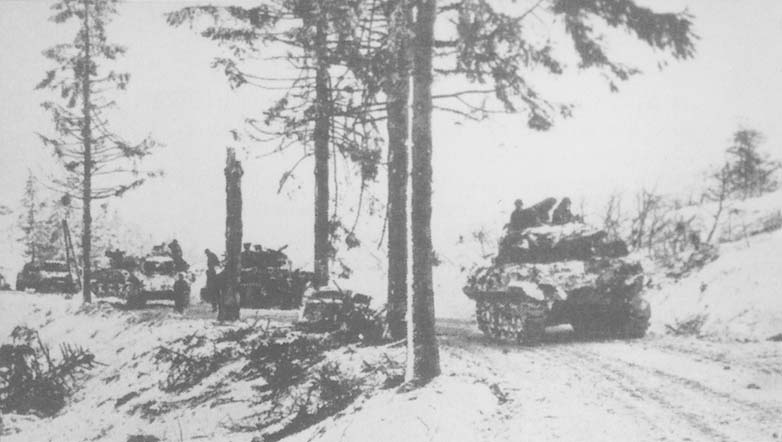
Elements of the 7th Armored Division on the road.
When at last they found each other Clarke, upon turning and urging the leading elements of his division eastward, found the route completely blocked by a retreating artillery unit. The commander was threatening to shoot anybody who interfered. Clarke in short order had the enraged commander in front of him and yelled, ‘You get your damned trucks off this road, so my tanks can get up here. If there’s any shooting done around here, I’ll start it’!
Elements of the 7th Armored Division began rolling into St Vith; the 87th Cavalry Reconnaissance Squadron was the first unit followed by Combat Command B. Troop B of the latter was sent straight out to reinforce the engineers on the Prumerberg. The rest of the squadron were to extend the line north, tie in with the 14th Cavalry, and screen the Wallerode area, which was now wide open to attack.
More elements of the 7th continued to arrive and irrespective of what they were, the units were sent piecemeal straight into the defence of St Vith. Much needed tanks were beginning to get through and were told to head up to the Prumerberg and report to Riggs for positioning. The cheers from the engineers as the tanks rolled up could almost be heard in St Vith.
The 38th Armored Infantry Battalion arrived, less one company and immediately went into the line east of the town. Commander of this unit was Lieutenant-Colonel William H. G Fuller, and on getting his men into position, he was given overall command of the eastern sector. Later that evening he was reinforced with Company A of the 31st Tank Battalion and another company of infantry from the now arrived 23rd Armored Infantry Battalion (AIB). The rest of CCB was being put into an assembly area just west of St Vith.
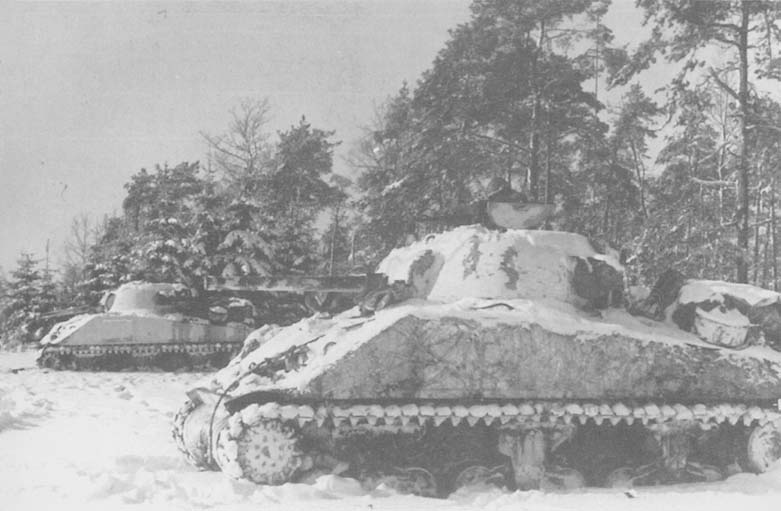
40th Tank Battalion of the 7th Armored Division in position near St Vith.
Artillery was in short supply as it was still held up on the clogged roads. Lieutenant-Colonel Roy U Clay of the 275th Armored Field Artillery Battalion, once attached to the 14th Cavalry found General Clarke, and told him he was sick of retreating, his guns were ready, and he wanted to shoot. He was welcomed with open arms.
By midnight 17 December most of CCB was in an arc from north of St Vith round to the south where it tied in with CCB 9th Armored Division and the 424th Infantry Regiment. It was soon pretty clear that no one was going to be able to counter-attack east to relieve the plight of the surrounded 422nd/423rd. St Vith itself was now under attack and all the forces would be needed to defend the town. It was also obvious that Germans were in full stream either side of St Vith, on their way to their own objectives deep into Belgium. The most serious threats were from the north and east – the defenders were in danger of being surrounded.
If the traffic jams and hold ups on the American side were bad, the Germans had it worse. Everything was being funnelled through gaps that had been cleared through the US lines. Panzers were being held up by horse drawn artillery, chaos was all around. The meticulous planning was going pear shaped. On the night of 17 December two high-ranking German officers became snarled up. General von Manteuffel, Commander 5th Panzer Army, was on his way forward to the headquarters of the 18th Volksgrenadier Division in Schonberg, firstly to see why St Vith had not yet fallen and secondly to put a bit of zest into their attack. At the same time, and on the same road, was Field Marshal Model, commander of Army Group B. They came upon each in the night beside the stalled traffic.
‘And how is your situation, Baron?’ asked Model.
Manteuffel replied ‘Mostly good’
‘So? I got the impression you were lagging, especially in the St. Vith sector.’
‘Yes,’ said von Manteuffel, ‘but we’ll take it tomorrow.’
‘I expect you to,’ responded Model. ‘And so that you’ll take it quicker, tomorrow I’m letting you use the Führer Begleit Brigade.’
Monday 18 December 1944
General Jones surmised that if he could get his two entrapped regiments moving towards the west it would not only free them from their encirclement, but also help in the destruction of the enemy now on the outskirts of St Vith. At 0215 he sent a message by radio to the 422nd/423rd, telling them to shift northwest and, from their dug-in positions south of the Schonberg-St Vith road, destroy the enemy using that road. It was received by them at about 0400, Descheneaux bowed his head and almost sobbed, ‘My poor men – they’ll be cut to pieces’.
Both commanders of the 422nd/423rd agreed over the seriousness of the problem of communications between them. They decided to move out at dawn in column of Battalions the 423rd being nearer to the objective should lead. That was it as far as planning was concerned – no one coordinated anything else.
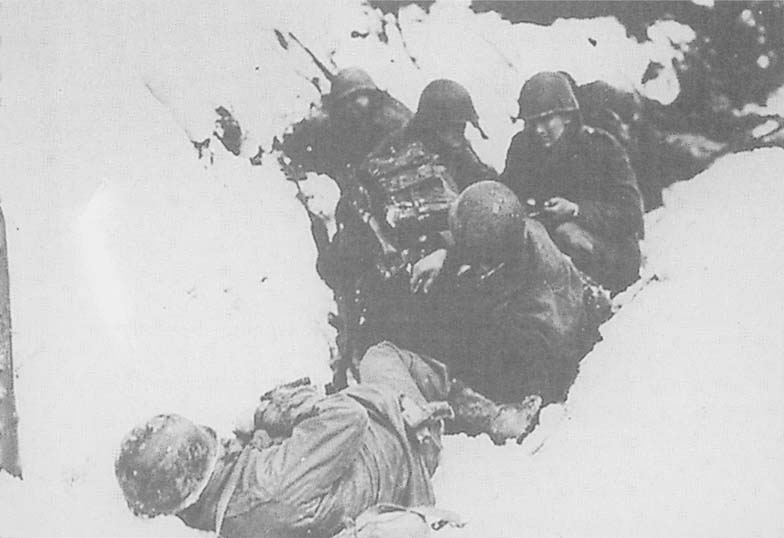
Men of the 422nd/423rd Regiments cut off and ordered to attack enemy traffic on the Schonberg-St Vith road.
In fact the 422nd moved first. It was 0900 when the 2nd Battalion leading, started out across country towards the planned bivouac area in a narrow ravine just south of Skyline Drive, about one mile north of Oberlascheid. Here it was planned to stop for the night and get ready for the attack the following morning. The weather was thick fog and rain. It was hard going for the infantry slipping and sliding along through the myriad of forest tracks.
Boyd A Rutledge was in D Company (Heavy weapons) 1st Battalion, 422nd, he describes the move.
‘The 422nd had no road access and had to make the entire trip cross country with no vehicles. 1st Battalion of the 422nd of which I was a member, started marching out at 1000 in the morning of the 18th and reached a position between Auw and Schonberg at 0100 the morning of the 19th. It got dark shortly after 1600, so nine hours of the journey was in the forest in the dark. We had to touch the pack of the man ahead in order to stay together. You could see absolutely nothing. In at least one place the pack of the man ahead of me all of a sudden disappeared followed by a muffled shout as he lost his footing. We were moving ninety percent of the time. I was carrying in my case full field pack and the bipod of my 81mm mortar up and down hills, through streams, mud, snow and we should have covered 15 or 20 miles. So after 15 hours of march our new position next morning, was by straight line only about three miles from the positions we abandoned. The historians show us moving in a slight arc to reach that position. It ain’t true, and I don’t believe anyone now knows the exact route. When an obstacle appeared, we veered off one way or the other, eventually to arrive at our position for the attack on the 19th. By that time, however, we were so exhausted that the excellent discipline exercised on the march evaporated and we were noisy when we finally reached our bivouac area. The Germans heard us and set up a defensive line a few hundred yards in front of us and awaited our attack in the morning dooming any chance of success.’
During that long march men had discarded equipment, the trails were littered with overcoats and gas mask bags. Also, men were beginning to wonder if it was a wise move. After all they had been safe in their well dug-in positions amongst the fortifications of the Siegfried Line. Now they were exposed to the elements. That night the men hunkered down as best they could, shivering and wishing they had not thrown away that overcoat. Descheneaux joined them in the bivouac area and was heard to say ‘Where in the hell are we?’ He told his Battalion commanders that they would advance next morning towards Hill 504 above Schonberg, 1st Battalion on the right, 2nd Battalion on left, and 3rd Battalion in reserve. They would capture Schonberg, move onto Heuern, and hopefully meet the expected relief forces coming from St Vith. Up to now, apart from the 1st Battalion having a few skirmishes on the right flank they had encountered no opposition.
But it had been enough for the Germans to suspect that the Americans were on the move.
Meanwhile, the 423rd started at about 1000, 2nd Battalion leading, followed by 3rd Battalion and the 1st Battalion bringing up the rear, along with the regimental vehicles and artillery. The route to be taken was Halenfeld – Oberlascheid – Radscheid – Engineers Cut-off and on to Schonberg.
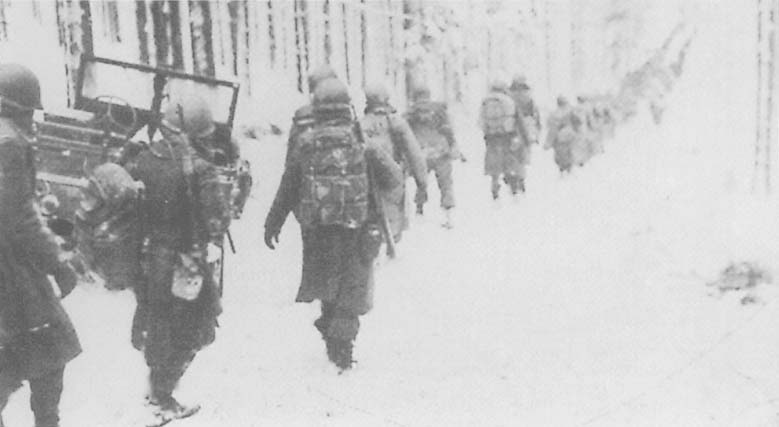
Men of the 106th Division on the move.
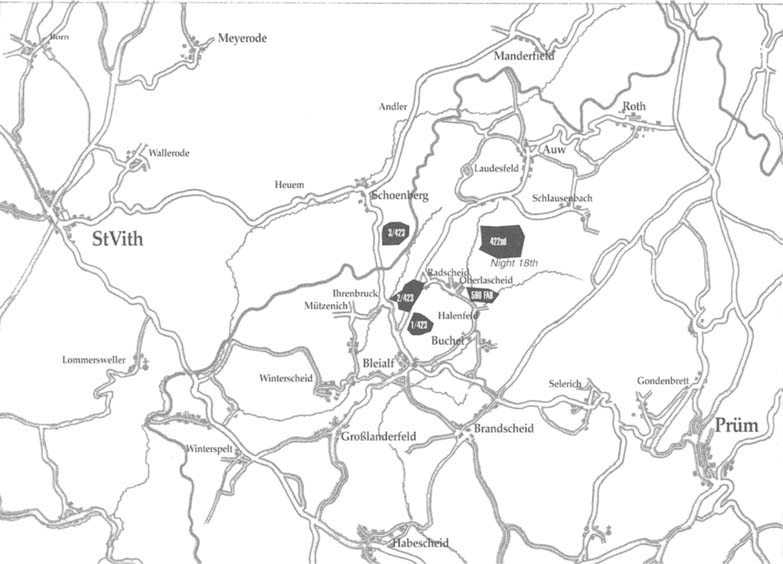
422nd/423rd positions 18th December 1944
At about midday Colonel Puett’s 2nd Battalion had reached Skyline Drive at Radscheid, and immediately started receiving heavy fire from his left flank, from the direction of ‘88 Corner’. Puett immediately turned his Battalion in that direction to meet the threat. The ground was very open, but the infantry, supported by machine guns and mortars, attacked down either side of Skyline Drive to try and clear the area. The Germans were reinforcing the sector all the time from Bleialf, as they needed to keep the route open. Puett called Cavender for aid, and recommended to his Regimental Commander that he commit another Battalion to counter-attack. By this time most of the 2nd Battalion was pinned to the ground between Radscheid and ‘88 Corner’.
It was about this time that another message reached Cavender which superseded the previous plan. Now Division wanted them to advance directly at Schonberg; there was not going to be any counter-attack by the 7th Armored Division, they were to do it all by themselves. Cavender sent a messenger to Descheneaux with the new orders. He then ordered his 3rd Battalion, commanded by Lieutenant-Colonel Earl F. Klinck, to side slip the 2nd Battalion and head north-west. This they did. The Battalion crossed Skyline Drive just above Radscheid, and followed a secondary track down to the Ihrenbach stream. Having crossed this, the Battalion suddenly came under small-arms fire. Managing to avoid a fight, the men climbed the hill and plodded on north west until Company L, with Company K supporting, actually made contact with the Bleialf-Schonberg road to the left of of Hill 536 (Lindscheid Hill). This hill is just south of Hill 504 which directly overlooks Schonberg. Company L drew fire from German anti-aircraft guns being used in the ground role and small arms fire. At this point Lieutenant-Colonel Klinck stopped and dug in for the night. Much to his surprise a large portion of Company F, 422nd joined him, they had over shot their bivouac, some one and a half miles away to the south-east. Things were beginning to get hopelessly mixed up.
He sent runners back to Cavender to tell him of his position – they never got there.
In response to Puett’s request for help, Cavender sent the 1st Battalion under Lieutenant-Colonel William H. Craig as reinforcements. It was now dusk, and the 1st Battalion could make little headway. Confusion set in. Both were told to withdraw to the vicinity of Oberlascheid ready for the move north. The 2nd Battalion had suffered over 300 casualties, and had expended the majority of its ammunition. The 1st Battalion had lost 70 men and was also low on ammunition. The wounded had to be left, along with the medics attending them.
Kenneth Hunt a medic with the 423rd stayed behind with the wounded.
‘On both the 16th and 17th I spent most of my time helping carry litter cases to the aid station from various positions on the field. I was exposed to enough cold and snow to develop frostbite in both feet. By 18 December, we were treating about 25 or 30 wounded Americans. We had also captured four Germans who were only slightly wounded. What I remember about them is that they were very young, about 16 or so. They were smiling and joking among themselves. The war was over for them, they were going to an “American rest camp”. Most of our men had severe wounds. Some had been hit in the stomach or chest. We were cut off from the Battalion field hospital so they couldn’t be sent back there. And many would not survive the ordeal of moving with the regiment. The best decision was to leave them in the aid station with enough supplies to last a few days and to return for them as soon as possible. Major Fridline asked for two medics to stay with the wounded. It was no problem for me to decide to stay behind. My feet were really giving me trouble. I knew that I could never keep up if we had to make a forced march. Major Fridline made sure that we were left with plenty of bandages, plasma, and drugs. He told us not to spare the morphine to relieve pain.’
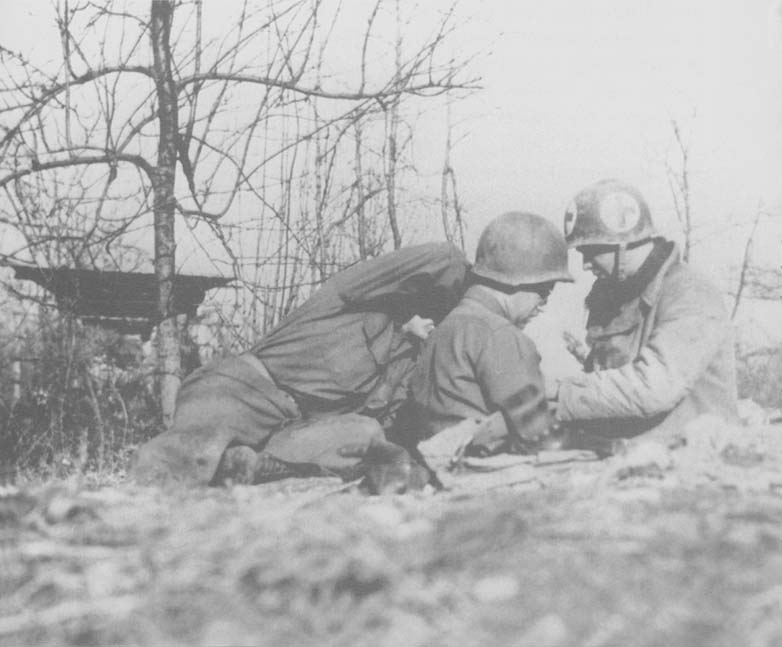
Tending a wounded Gl during the Battle of the Bulge.
Kenneth Hunt went on to say,
‘Soon we heard vehicles, tanks and trucks going along the road. I looked out the window and saw the entire German army passing by. Our patients in the basement could hear but not see the commotion. “Whats going on out there?” they asked. “Those are our men,” I replied. “They’ll pick us up as soon as they can.” It was not until the 4th day that we heard a loud knock on the door. By that time our supplies were running out and our morale was low. Some of the men were in very bad shape.’
Hunt was hoping some kind Germans might pass by and take every one to a clean hospital. On opening the door to check that the Red Cross flag was still in place, he was faced with the muzzle of a rifle.
‘They ordered that I raise my hands while they searched for weapons. When they discovered that I wasn’t armed, they relaxed a bit. The sergeant said, “Don’t you Americans know that you should be home for Christmas?” He laughed sarcastically. Those were the only English words he knew. ‘Do you have any wounded Germans inside?” the officer asked. “Yes, four.” “Let us see them.” We went into the basement. When our men saw the Germans they were silent. Even the German wounded looked grim. “How have you been treated?” the officer asked. One of the Germans replied, “The medics treated us just like their own men. They even gave us white bread to eat.” The next four days which followed were among the saddest in my life. The Germans tossed the American wounded in a truck without regard to the seriousness of their wounds and drove off over an unpaved road. I am sure that many of them did not survive the trip.’
Cavender moved his command post from Oberlascheid up to just north of Radscheid into the original positions of the 590th FAB before the 16th Dec. At 2200 Cavender sent a patrol north to try and locate the lost 3rd Battalion. This, the patrol found dug in on the side of the hill, but the vehicles of the Battalion had bogged down and were stuck in the Ihrenbach stream. Cavender sent patrols east to try and locate the 422nd Regiment but to no avail. At this moment the radio waves became clear and unjammed. Word came through from division. A food and ammunition air-drop was to take place near the bend on the Schonberg road close to where the 3rd Battalion was situated. Then Division sent an irritating message to the 423rd. In fact it was the last message they were to receive:
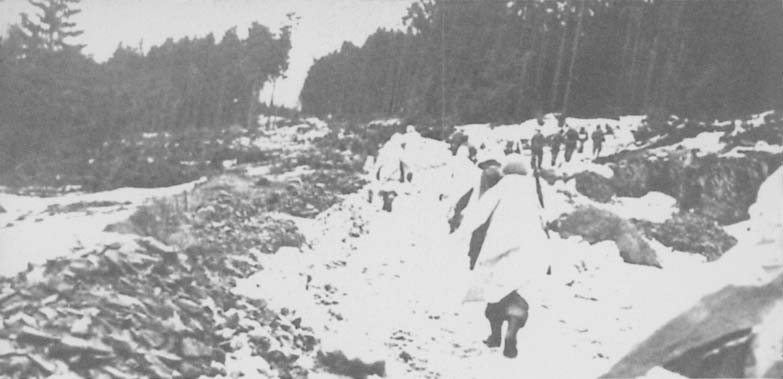
Gls in make-shift camouflage white sheets.
‘Attack Schonberg, do maximum damage to enemy there, then attack towards St.Vith. This mission is of gravest importance to the nation. Good luck.’
After all, were they not doing their very best anyway?
Cavender, message in hand went forward to find Klinck’s 3rd Battalion. He found them dug in, and decided to pull all his regiment forward to that position, ready for an attack on Schonberg the following morning. The 1st and 2nd Battalions had disengaged and moved across the Ihrenbach stream. 1st Battalion left one company in the Oberlaschied area to cover the withdrawal. The two Battalions took up their positions behind the 3rd Battalion, but on the reverse side of Hill 536. This was achieved by the early hours of the 19th, the men were tired soaked and hungry. That night in pitch darkness the 590th FAB had followed the regimental vehicles down the improvised trail into the Ihrenbach valley, about an hour before dawn the 2.5 ton GMCs came to a grinding halt, the way blocked by the abandoned vehicles of the infantry. The artillerymen, totally exhausted, slept in their trucks the best they could and awaited daybreak. The position at the end of the night of 18 December left both regiments not knowing where each other were; the 423rd was consolidated on the hill just south of Schonberg, the 422nd were encamped in a ravine not far away, south of Skyline Drive.’
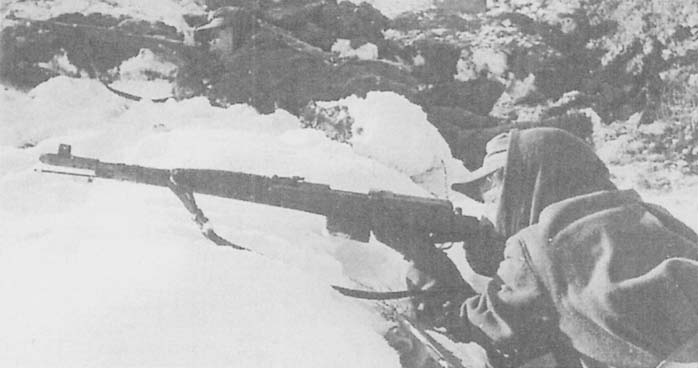
Attacking German grenadiers of the 18 VGD fire on the US lines.
In the north, General Josef ‘Sepp’ Dietrich’s Sixth Panzer Army had met unexpected resistance in the Elsenborn ridge area. It now began to flow south to avoid it.
Needing to get back on track for the Meuse River objective it could do little else but touch on the St Vith area.
The town was hit from three directions that day. The 18th VGD Mobile Battalion streamed out of the woods from Wallerode and onto the main highway that leads into St Vith. At the same time the 1st SS Panzergrenadier Regiment struck at the village of Hunningen only one mile north. The Engineers up on the Prumerberg heights were hit again. All these attacks were driven back by determined efforts from the US defenders. St Vith had now become a finger stuck into the German attack.
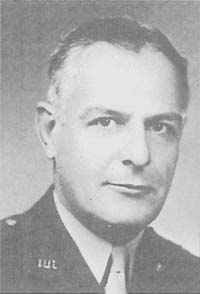
General Robert Hasbrouck
General Hasbrouck had arrived with the rest of the 7th Armored Division and he established his headquarters in the Middle School on the Rue de l’Hotel de Ville, in Vielsalm. With him came Combat Command R which he sent to defend the north of St Vith. His Combat Command A was put into reserve to the south-west, but soon the majority of this unit was thrown into the fray to help the hard pushed northern flank. Because of the pressure on the area, General Jones and his staff also moved back to Vielsalm and established themselves there. General Clarke moved his command post to Crombach where he still directed the defence of St Vith itself. All through the day the Germans exerted pressure on the town, but each time tanks and infantry were rushed to the trouble spots to meet the German threats head on.
One quiet area that day was the north-eastern sector. The highlight came when an M8 armoured car that was concealed in the woods noticed to its front a Tiger tank passing along a fire break in the trees. After the tank passed the M8 roared out of its hiding place and proceeded to catch the tank up from the rear. The Tiger’s commander standing in the turret spotted the armoured car and desperately tried to get his 88mm gun round to bear. The tiny M8, with its driver’s foot pressed to the floor, closed within range and let off three 37mm shells, striking the Tigers thin rear plate. The tank shuddered, there was a hollow explosion, flames and smoke poured from the crippled beast. The impudent little M8 returned to its original hide-out, triumphant.
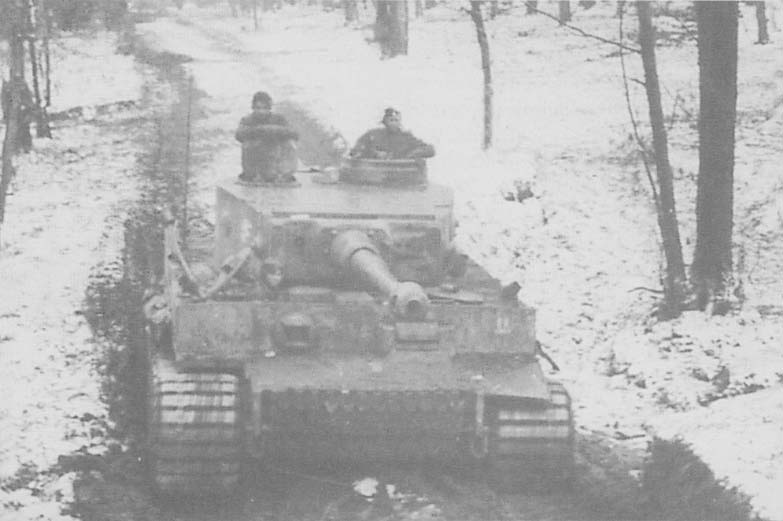
A Tiger rolling through the wooded Ardennes.