
CHAPTER FIVE
Tuesday 19th December 1944
As daylight began to show through the dark woods south of Schonberg, the infantry of the 423rd began to reorganize. The 3rd Battalion was the furthest forward. Behind it the somewhat depleted 1st Battalion and the 2nd Battalion were in position on the reverse slope of Hill 536.
The 590th FAB found themselves in a narrow valley. Steep, densely wooded slopes rose up on either side. There was swampy ground to their right front, and flowing directly across their path was a stream some six or eight feet wide. The infantry, unable to get its vehicles across the stream during the night, had abandoned them completely blocking the way. The infantry which had been protecting them had forged ahead, there was little else they could do but get themselves into position where they sat. Guns were unhitched, A and C Batteries were forward near the stream, while B Battery was about 200 yards to the rear around a curve in the wood line. They would still be able to support the infantry’s attack, although ammunition was now in short supply. An aid station had been set up in the scrub pine along the lower edge of the far slope.
To their right, but unknown to them, Descheneaux’s 422nd Regiment also readied itself for the coming attack. He had learned of the new orders the previous night and had assembled his Battalion commanders for briefing. His plan was to attack the wooded height (Hill 504) above Schonberg with two Battalions forward and one held in reserve. He knew he had no artillery for support but there was still some mortar ammunition on hand. Descheneaux had no idea where the exact location of his sister regiment was but assumed it would be attacking on his left at the same time.
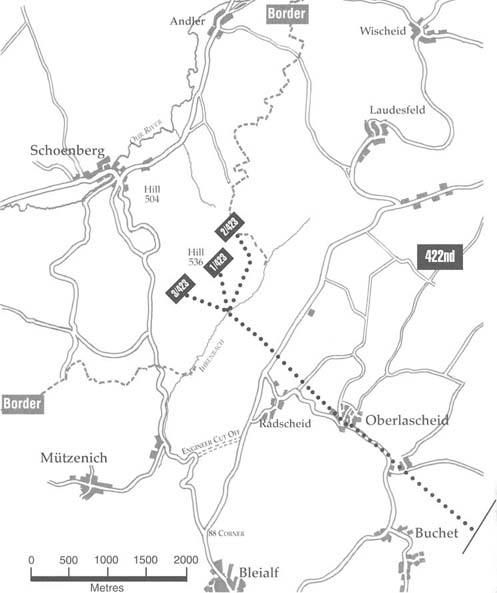
422/423 Positions prior to attack on Schonberg
At 0830 Cavender began briefing his Battalion commanders. Klinck’s 3rd Battalion was to make the main effort and attack down the road to Schonberg. The 1st and 2nd Battalions would be to the right and attack over Hill 504 and down into the village. They started synchronizing their watches, Cavender announced ‘It is now exactly 9:00 o’clock’. As if that had been the signal the Germans had been waiting for they let loose a tremendous artillery barrage which swept the hill. Everyone scattered, trying to find cover. Lieutenant-Colonel Craig, commander of the 1st Battalion, was killed.
The shelling lasted for about thirty minutes, as it lifted a commotion was heard from the rear. The Germans’ shells had caught the artillerymen tightly packed in the valley. Totally defenceless and with machine-gun fire now coming at them from the heights, the 590 FAB could do little else but destroy its weapons and surrender.
The 18th Volksgrenadiers had moved in behind.
For the 423rd there was now only one way to go and that was forward. What vehicles remained were promptly ordered destroyed.
At 1000, what was left of the infantry Battalions jumped off, Klinck’s 3rd Battalion took off quickly, Company L of that Battalion moved on up the Schonberg road supported by machine-gun fire from part of Company M’s heavy weapons.
John Kline from Company M remembers being told to take his 30 calibre water-cooled machine gun and to place it in the edge of the woods in a direction that he took to be Schonberg. His position was a considerable distance up the hill.
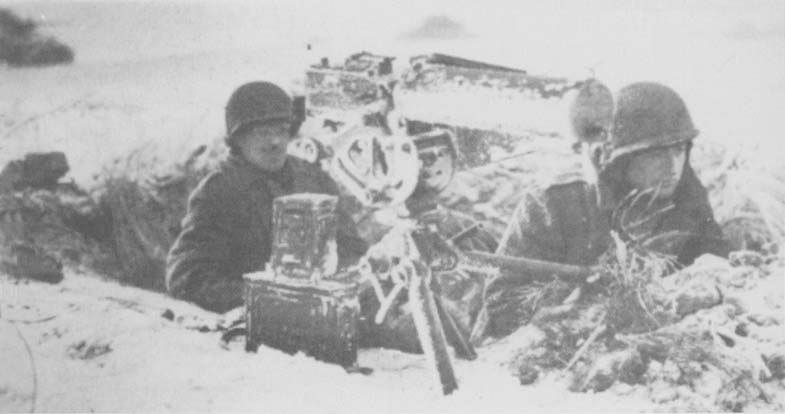
Hastily dug machine-gun post with a .30 calibre water-cooled Browning mg in position.
‘I was not in an area that was receiving small-arms fire, but all of our exposure was to heavy artillery. In fact, once during the day, there was a piece of shrapnel that hit beside my position, close enough that I reached out and touched it, it was at least ten centimetres across and 50–60 centimetres long. It had spent most of its energy, but made a terrifying sound as it came through the trees and hit near me.’
From his position John Kline could see Company L way below him caught in the ditches on the side of the road. He could hear the screams for help and shouts for ‘Medics’ as they were being torn apart. Unfortunately his machine gun was too far back to help the infantry. He could not move either because the same artillery was hitting him.
Another witness to the events taking place commented:
‘Company L was being slaughtered. A sniper was killing a lot of them. We had spotted the sniper, nearby, in a clump of bushes. The range was too short for the elevating mechanism. My squad leader (mortars) was trying to elevate the mortar, by holding it vertically. He was killed by a bullet in the temple. Another mortar man and I grabbed the mortar and dropped three shells in the area of the sniper, killing him.’
It was not long before they ran straight into heavy fire from German 88’s and 40mm anti-aircraft guns being used in a ground role. An American Sherman tank came around the sharp hairpin bend, the GIs thinking this was part of the relieving armour began to stand up, to their horror the tank raked them with machine-gun fire, then withdrew, it had been captured by the Germans. At the same instant the rear of the company was attacked by an estimated German rifle company, which was moving up from the Bleialf area. Captain J. S Huyatt, commander of Company L, detached part of his force to turn around and counter-attack the Germans coming from his rear. This they did and actually drove the Germans back. Through this action, Huyatt’s Company had become separated from the remainder of the Battalion. He managed to get what was left of it, some fortymen, up the side of the hill and dug in.
The Germans came back with a vengeance. By 1330 the remnants of Company L, surrounded and out of ammunition, could do nothing else but surrender. Companies I and K of the same Battalion moved on towards Schonberg, they actually reached the southern outskirts of the village before they too were stopped by intense direct anti-aircraft artillery fire.
By 1500 Lieutenant-Colonel Klinck could get no further, he pulled the two battered companies back up the slopes of Hill 504.
The 1st Battalion added little to the attack from the beginning. Its commander had been killed during the morning’s briefing, so no word had reached the Battalion on what they were supposed to do. Luckily the executive officer, Major C. H. Cosby took command, collected the orders, and proceeded to cross the line of departure almost on time, but with what. Company A was lost in the Oberlascheid area from the previous day, Company D had been caught fully in the morning barrage, had taken many casualties, and also was as good as lost. As the Battalion headed for its jump off position Company C was earmarked for regimental rearguard. So Cosby led the 1st Battalion, in reality now Company B and part of Battalion Headquarters Company, along the eastern slope of Hill 504. Through the thick woods and under constant mortar and artillery fire they pushed forward, finally reaching the road running north out of Schonberg. Here Company B dug in, the headquarters company had become separated and was now lost. Under constant fire they were finally forced to surrender when enemy tanks overran their positions. By 1400 the 1st Battalion had been eliminated.

Surrounded and out of ammunition American soldiers began coming down from the hills.
Lieutenant Austin Sellery, M Company 423rd recalled, ‘Memories about the events that preceded our capture on 19 December, 1944, are rather vague. I recall receiving orders to pull off the line and proceed towards Schonberg on 18 December. When night came we were on a wooded knoll and were told to dig our mortars in. Tree roots and frozen ground made this impossible. Throughout the night we could hear Germans around us. I was amazed at how casual they were in making their presence known. We were told the plan was to jump off at 0900 hours. This was impossible against the Germans overwhelming fire power. Captain Hardy was killed and Lieutenant Weigers was seriously injured within yards of me. It looked certain that we would all be killed and all that was left was for us to fight until we ran out of ammunition. Our remaining senior officer surrendered us to the Germans about 4.00 pm that afternoon.’
The last remaining Battalion in the 423rd was the 2nd. Lieutenant-Colonel J. F Puett led his Battalion forward to the right of the 1st. He soon came up alongside the 1st at a distance of about five hundred yards but separated by a steep ravine, known as Linne Creek. At 1300, knowing that the other two Battalions were being held up by enemy fire, Puett sent a message to Cavender asking permission to be allowed to attack Schonberg from the north east and relieve the pressure. By 1400 he still had not heard anything and realized that communications were virtually impossible because of the thick woods and hilly terrain. He gave orders to attack at 1430. His men were getting ready, when suddenly they came under small-arms fire from their right rear. It was part of the 422nd Regiment who had mistaken Puett’s Battalion for Germans. Although it was only a matter of minutes before aggresive company commanders rectified the situation, his plans had been severely disrupted. During this reorganization Puett sent patrols out to his front and right. At 1515 these patrols returned whilst Puett was in conference with Descheneaux. They both learnt that to their right there were 35 enemy tanks and several self-propelled guns, and to their front there were strong German armoured forces with artillery going into position. Out of touch with his own regiment Puett decided to join forces with the 422nd
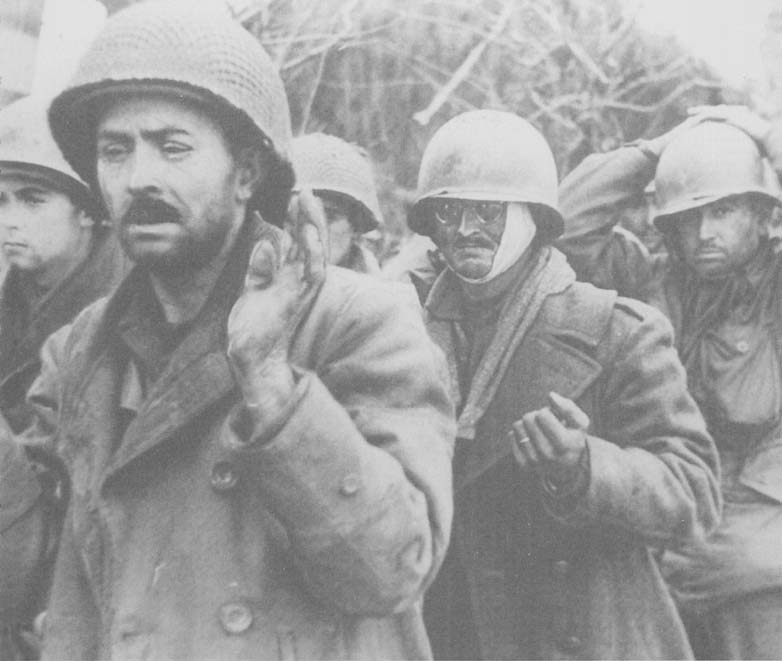
After months of bad news the German people were to be treated to the sight of American prisoners in the propaganda newsreels.
The 422nd Regiment left their bivouac area at about 0730 that morning. The 1st Battalion on the right, now led by Major W. P Moon owing to the original commander Lieutenant-Colonel T Kent being killed on the Schnee Eifel, crossed Skyline Drive. They were immediately hit by fire from assault guns and infantry. Companies A and B didn’t even make it out of the assembly area, they were stopped dead by the sheer force of the German presence. Many of these men were caught in a narrow ravine which led to Skyline Drive, with Germans at either end, and the men bottled up, there was sheer slaughter. However some men from Company C did manage to cross the road and went on to gain a small open height beyond it. These men also received attention from the same Germans from the direction of Auw. Only one platoon managed to get to the assigned area, the high ground beyond the Ihrenbach stream.
Anthony J Marino with the 1st Battalion headquarters:
‘The dawn broke with small-arms fire – then the crack-crack of 88s from Panzer tanks. A Lieutenant came over the hill – he had a rifle bullet go through his forearm. A cry rose up “bazooka ammunition – has anyone got bazooka ammo”? Our Battalion had no support heavy weapons aside from bazookas, and ammunition was sparse, only what men could carry. Also when our bullets were initially expended we were out. The firing lasted for a short time. Then I saw our line companies in rout – running into the ravine upon my left, I could plainly see our infantrymen running for cover. However, with 88s falling in their midst it was a turkey shoot for the Panzers. Then a cry – “surrender”. The 88’s stopped. Men were surrendering. I asked “what do I do”? Captain Mohne told me to destroy my weapon and map case. Then they went off. I buried my map case and destroyed my M1 and pistol, flinging the parts as far as I could. I then went down the hill to join with the surrendering troops’.
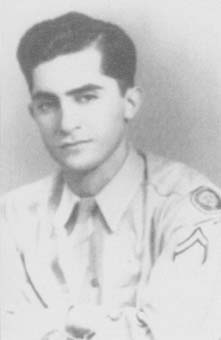
Anthony J Marino
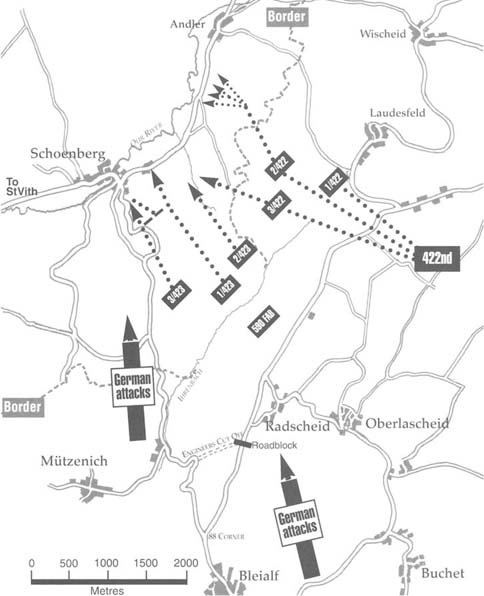
Attacks by the 106th Division, 19 December 1944.
The 2nd Battalion to the left of the 1st did manage to get across Skyline Drive in some order, although they did receive fire upon leaving. Companies E, G and H pushed on to where the platoon from Company C was. Company F of this Battalion had got lost the night before and had somehow joined up with Klinck’s 3rd Battalion.
The men pushed on and finally reached the high ground overlooking the Schonberg-Andler road. Descheneaux joined his men there. Looking down to the road they saw it packed ‘bumper to bumper’ with vehicles. This at long last must be the relief column they thought, or at least vehicles of the 423rd. The dream bubble was quick to burst when they were spotted by vigilant Germans. In a matter of seconds flak half-tracks raked the hill side where they stood.
Company H with its mortars and machine guns began to take on the Germans from the very top of the slope, and started scoring some hits. But before too long the accuracy of the German gunners proved too much. What was left of the three battered companies hauled themselves over the slope to comparative safety and took stock.
Lastly the 3rd Battalion, Lieutenant-Colonel D. F. Thompson led his men across Skyline Drive to the left of the 2nd Battalion, and into the woods of the Linne Creek. His men spotted movement to their left front and immediately opened fire, this was of course Puett’s 2nd Battalion they had seen.
Unable to move in any direction Descheneaux started to form a semblance of a perimeter defence. He now realized the situation was hopeless, wounded men were everywhere, there was no fresh water and no one had eaten anything substantial for some time, ammunition was just about spent. With head bowed he conferred with his battalion commanders and decided to surrender. It was 1600, Descheneaux sent out the white flag, he was not going to waste any more lives needlessly.
Puett, still very much active had been out patrolling, when he returned he learned that the surrender was about to take place, and asked Descheneaux if he could try and lead his battalion to safety, this was overruled on the grounds that it might draw unnecessary fire. Puett went back to his men and told them that if anybody wanted to go they could. A few did drift away. At 1700 when the Germans came up to the heights to take them prisoner, Puett had only 387 men and 14 officers left in his Battalion.
It was at about the same time the same conclusion was arrived at in the 423rd area.
Colonel Cavender had moved his command post up to the 3rd Battalion on Hill 504 and had made contact with the 422nd by patrol. With one of his battalions eliminated and one out of his control, overwhelming German forces and artillery building up all the time to his front and rear things looked bleak. The hill was continually being raked by artillery, mortar and machine-gun fire, casualties were getting heavier by the minute and there was just no way of caring for them properly. Ammunition had just about run out, no food or water. Cavender would not sacrifice any more lives, he told the men that they could try and get out in small groups if they so wished, few made it.
At 1630 on the 19th December Cavender surrendered his Regiment.
An excerpt from John Kline’s wartime diary reads:
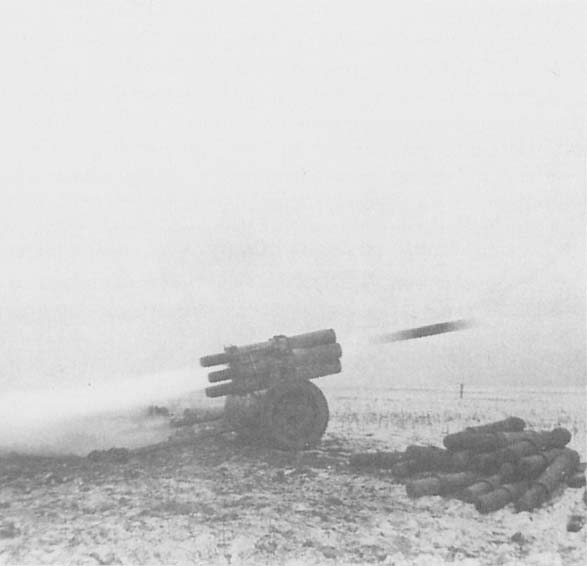
German six-barrelled mortar, the Nebelwerfer – known to the Americans as the ‘Screaming Meemie’.
‘The woods and open areas on the slope leading to the road, was littered with dead and wounded. Some time between 1600 and 1630 a American officer, accompanied by a German officer told us we were surrounded. He told us that we were cut off from the other Regiment, the 422nd, and that our Regimental commander, Colonel C. C. Cavender, was ordering us to surrender. We disabled our weapons by breaking them on tree trunks or by taking them apart and throwing the parts in different directions. After that the Germans led us to a clearing in the forest and directed us to throw down our equipment, eg: ammo belts, packs, hand-grenades and trench-knives. I quickly disposed of the German binoculars that I had found earlier. We were led in a small column down to the Schonberg-Bleialf road in front of the rifle companies. There were Germans on one side of the road and Americans on the other. They had been facing each other, in a fierce fire fight, from ditch to ditch. There were many dead, both Americans and Germans. The wounded were still crying for help.
‘As we approached the Schonberg road, it seemed that hundreds of Germans rose up out of the field. There was a German truck burning in the middle of the road. Behind the truck was an American infantryman lying in the road. He was dressed like an officer, but with no insignia, as would be normal in combat. He was wearing his winter uniform, a heavy winter coat, ammo belt and canteen. He was lying on his back, as if he were resting. The body had no head or neck. It was as if somebody had sliced it off with a surgical instrument, leaving no sign of blood. We were then walked in columns to Bleialf where they herded us into a church courtyard.’
As the weary, hungry men of the 422nd/423rd came down from the heights overlooking Schonberg, almost all of them felt let down and bewildered. Let down because of all the false promises, and bewildered through having to take on such an impossible task. Some did escape, at least for a while. Remnants of both regiments drifted back generally in a south easterly direction.
Second Lieutenant L. R. Walker of Company H, 422nd led a column of men away from the inferno. More men joined him, some from the 423rd, 81st Engineers, artillery and even anti-aircraft units. When he felt safe to do so he took stock, there were men from 15 different companies and six basic units. Keeping on the move they came across the 422nd’s motor pool and supply base just before dark. This was situated just south west of Laudesfeld near Hill 576. Here the men dug in and formed a perimeter defence. In came Major Ouellette, 2nd Battalion 422nd’s Executive Officer, and Major Moon, commander of the 1st Battalion 422nd. In all, about 500 men gathered from all over the area. A little food and some ammunition was foraged and by nightfall the men were established. The Germans were quick to discover that there was still a pocket of resistance and proceeded to shower the area with artillery. There were a few casualties but the GIs had dug in well and had covered their fox holes with logs and dirt. Exchanges of rifle fire with the nearby Germans were frequent. Across the valley came the strains of popular American music being played by a German sound truck. In between songs there were demands for surrender and of how nice it would be to play baseball in the comfort of a prison camp. Soon after noon the following day, Staff Sergeant Richard Thomas could take no more of it. Rounding up a few volunteers he led out a patrol, and put paid to the mobile propaganda machine once and for all with a couple of well thrown hand-grenades.
A German reconnaisance car approached from the direction of Laudesfeld, with German medics on board and an American medic from the 423rd. They met with Majors Oullette and Moon and said they wanted a temporary truce to open up the road network within the area to allow evacuation of wounded from both sides. The two Majors decided to send Lieutenant Houghton of Company D along with them to make sure there was going to be no monkey business. The troops withheld their fire until Houghton returned at about 1830. With him he brought an ultimatum of surrender before 2100 from the Germans. Houghton told of artillery and massed German troops waiting to saturate the area. A conference between the American officers confirmed that it was useless and futile to hold out against such overwhelming odds. Word was got to the Germans that they would surrender at 0800 the next day. Although the Germans were not happy about this, obviously because it was tying up vital manpower needed elsewhere, reluctantly they consented. Major’s Oullette and Moon needed the extra time to give the men a decent rest and to be able to scrounge what food and extra clothing might be about.
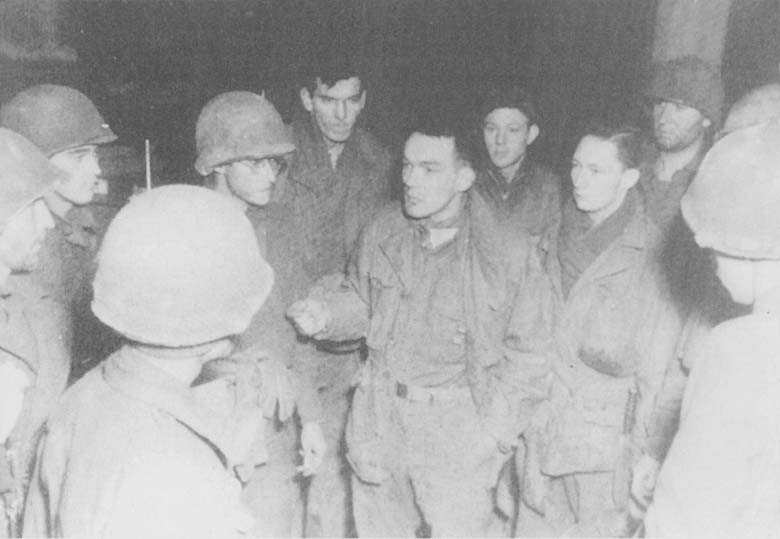
Lieutenant Long brought his Intelligence and Reconnaissance Platoon through the German lines and safely into St Vith where he told of the surrender of two regiments of the 106th Division.
At 0800, 21 December with weapons and vehicles destroyed, (against the German wishes), the last men from the 422nd/423rd Regiments went reluctantly into captivity.
Some men did make it out. Lieutenant Ivan H. Long and his Intelligence and Reconnaissance Platoon had been holding a road block outside Radscheid. They found themselves surrounded. With some other men from different units joining all the time, Lieutenant Long decided to head north, skirt around Schonberg and then make towards the west. They destroyed what vehicles they had with them and set off on foot, approximately forty men in all. Hiding by day in the thick forests and moving silently by night with the aid of a compass, the tired, dirty men entered the St Vith salient on the 21st December. There, they told the story of the two regiments surrendering. After being fed and allowed to rest they went straight back into the line again up on the Prumerberg.
A deadly silence now hung over the area. At last Field Marshal Model and Sepp Dietrich in their respective command posts in the tiny village of Meyerode could now get on with the task in hand.
General Hoffmann-Schonborn’s 18th VGD were, on this day, more concerned with eliminating the Schnee Eifel threat, which had plagued them from the beginning. He could not concentrate on St Vith until the two US regiments were finally eradicated. However, artillery was being brought up in vast amounts to the St Vith area. The American defenders were constantly being shelled and mortared. Other formations came drifting in and were joining in with the defenders.
To the Germans, the fall of St Vith was crucial, already well behind in their timed schedule, things were going seriously wrong. In order to achieve success, the road network in the area must be secured otherwise the entire assault was in jeopardy, the breakthrough in the north had been stemmed by determined American forces on the Elsenborn Ridge, forcing the II SS Panzer Corps south. Unless this unit could break through and get behind the US lines all would be lost. St Vith must now fall in order to unleash the Panzers. German troops were probing all around the US perimeter, (now very much a salient), in order to try and find a soft spot to assault.
It is not my intention to delve to deeply into the actual assault on St Vith as this would take the tour beyond the scope of this book. It would be sufficient enough at this stage to say that all the outlying villages played a crucial part in the Battle for St Vith. Each one would have its own story to tell both by the particular US unit defending, or the German unit attacking, of which there were many. Like Bastogne, but unfortunately not so well publicized, but equally as important, St Vith was virtually surrounded. The valiant defenders gave their all, against superior numbers and probably the best the Germans had to offer at that time.
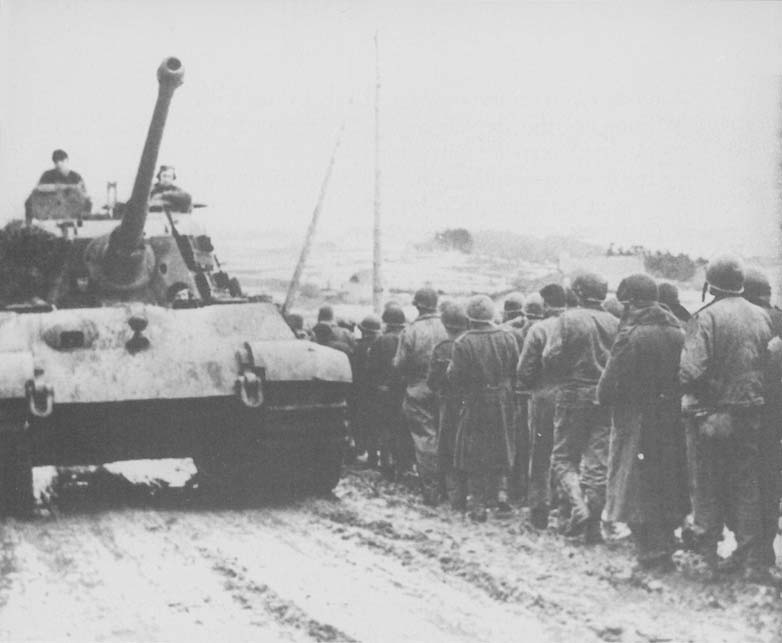
A King Tiger passes a column of American prisoners.
By 21 December, the major forces in the eleven by ten mile salient included, 7th A.D Combat Command A, B and R, Combat Command B of the 9th A.D, 424th Infantry Regiment of the 106th Division, 81st and 168th Engineers and the newly arrived 112th Infantry Regiment from the now split 28th Division, plus numerous other smaller units including artillery, anti-aircraft and tank destroyers.
Colossal German forces were now poised for the final onslaught, the 18th VGD with tanks from the Führer Escort Brigade directly in front of St Vith, the 62nd VGD with tanks to the south, and the 9th and 2nd SS Panzer Divisions from the II Panzer Corps skirmishing around the northern sector.
After a tremendous barrage German troops and tanks attacked from the three sides. The line held yet they tried again and again. Finally, the superior German forces broke the American resistance that evening. General Clarke, seeing that his forces could no longer hold, withdrew his men west of St Vith. A lot of men were trapped unable to withdraw, these were instructed to regroup and attack back through the town to rejoin the new forming line. For many it was just impossible. Lieutenant-Colonel Riggs found himself with about seventy men, too few by half to do any real damage. He told the men to split into small groups and make it back the best they could. Just about all of them, including Riggs, were captured.
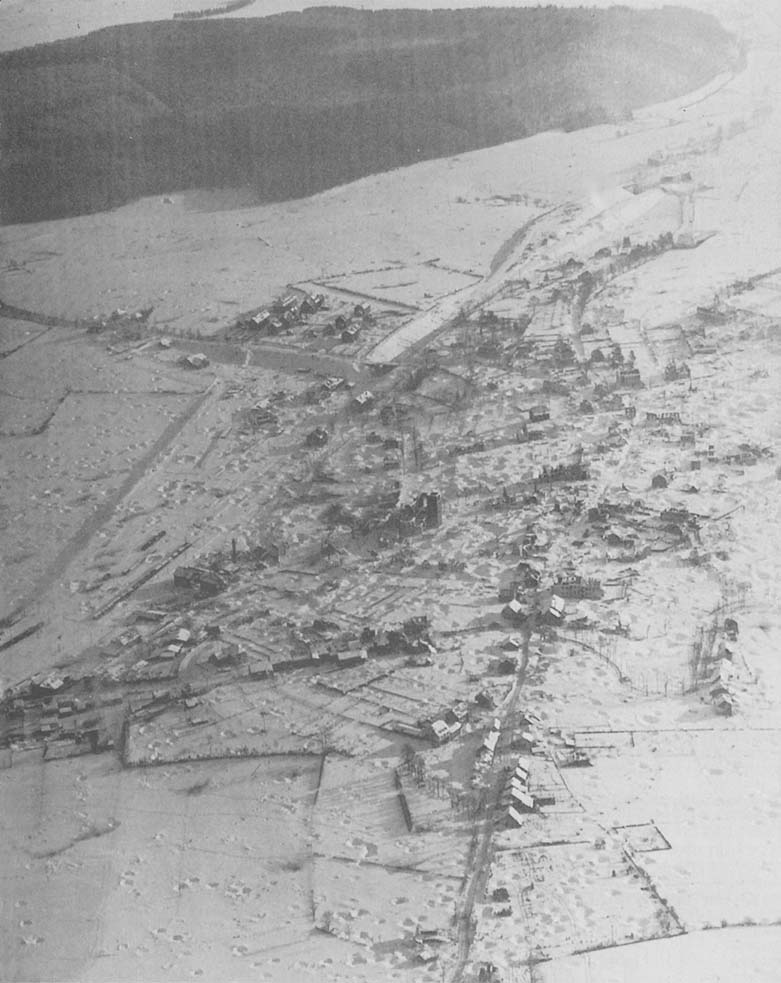
After the Americans had pulled back from St Vith this important junction of roads was heavily bombed.
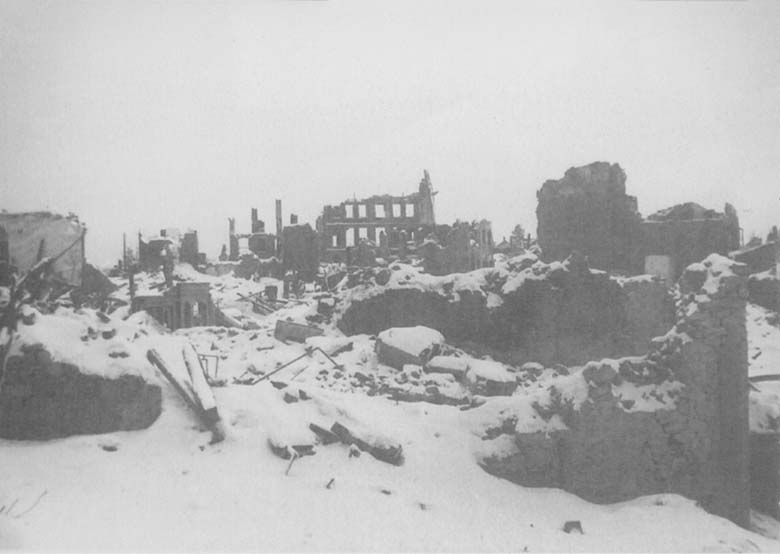
St Vith in January 1945.
Although St Vith itself was now in German hands, they were still being stalled by the fact that the Americans had formed another defensive position. This time it became known as ‘The Fortified Goose Egg’, due to its shape.
It soon became clear that another encirclement of American forces would soon take place. At 0900 on 22 December orders were issued for the withdrawal of all forces within the ‘Goose Egg’ across the River Salm and into the relative safety of the newly arrived 82nd Airborne Division. The way out was by means of forest roads, much of them muddy, slushy and impassable. Men not manning the front lines were employed in desperately trying to make good the roads.
General Montgomery, now in charge of the northern section and Allied troops, sent General Hasbrouck a message saying, ‘You have accomplished your mission – a mission well-done. It is time to withdraw’.
That night someone must have been smiling on the ravished Americans. It froze and froze hard. The once boggy ground became rock solid. The difficult withdrawal took place, it was now or never. The well disciplined men executed the manouevre, some 22,000 of them. It was not for the feint hearted.
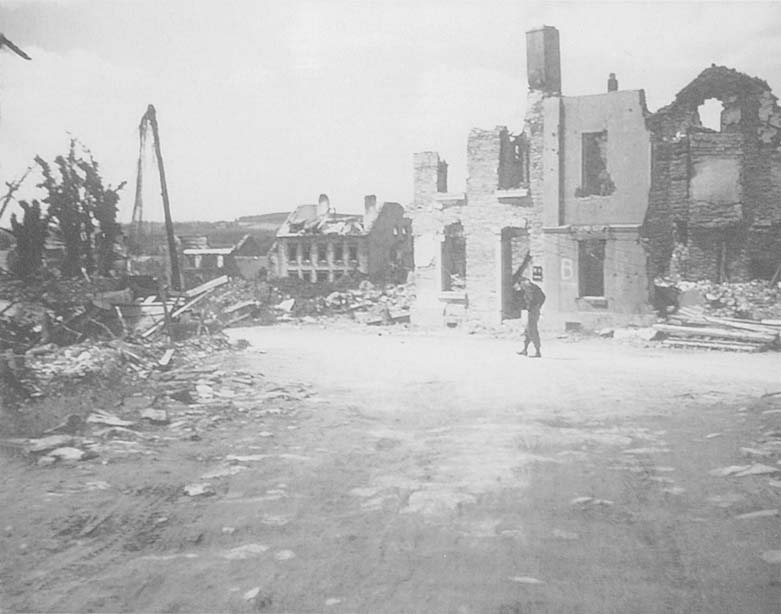
The building in the foreground had been used as 106th Division HQ.
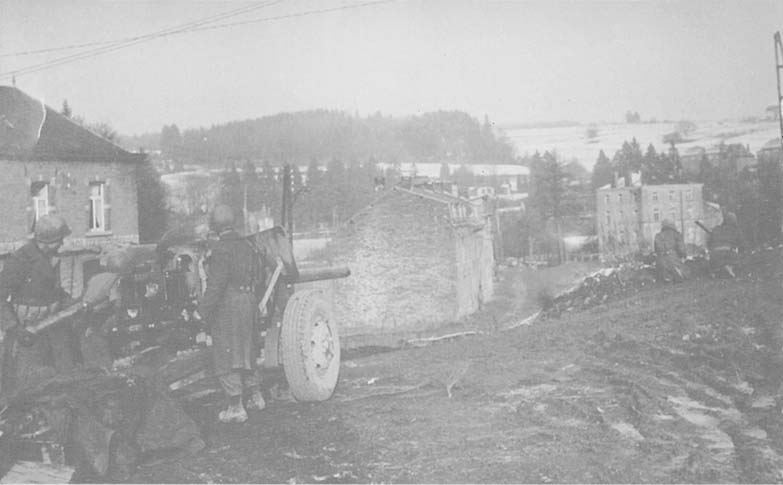
Gunners of the 7th Armored Division provide the first line of defence during the battle.
As the men were reaching the comparative safety of the west bank of the Salm river, General Jones of the 106th Division, so over-worked in his first time in combat finally collapsed. He had suffered a heart attack.
St Vith would stay in German hands until 23 January, 1945, when ironically the 7th Armored Division, supported by the 424th Infantry Regiment to its north, attacked back through the town. After many days of hard combat the ground was regained. They found the town flattened, the airforce had bombed it severely to try and stop the German advance.
The 106th Division in that first week of combat had lost some 416 men killed in action, 1,246 wounded and 7,001 missing in action. Over 60 percent of the division’s personnel were dead, wounded or captured.
Unknown to the men of the division at the time, they had done exactly what was needed of them. They stalled the offensive. The Germans had been so held up by the stubborn resistance on the Schnee Eifel, and on the route to St Vith, that the offensive could not possibly have succeeded.