CHAPTER SIX
With darkness falling, the men being brought down from the heights were herded into assembly areas allocated by the Germans. Senior officers were interrogated at Kessler’s dance hall in Andler by SS officers. Many men were marched to Bleialf where they spent their first night in captivity, shivering and huddled together for warmth in the church yard. The German propaganda photographers had a field day showing the dejected beaten Americans. Great emphasis was made on showing blacks and whites together to give the idea to the German people what a rotten mixture the American army was. At the same time hundreds of other bewildered men were marched to the rail centres of Prum and Gerolstein. Almost all had been relieved of their personnel belongings and much of their warm clothing. Throughout the cold wet night they trudged into Germany. All were already exhausted due to lack of sleep during the last three days of combat. The majority of them had not eaten nor had a drink in the last twenty-four hours, and it did not look to them as though the Germans were going to give them anything. Men began to drink melted snow or even ditch water to satisfy their thirsts brought on by the constant marching.
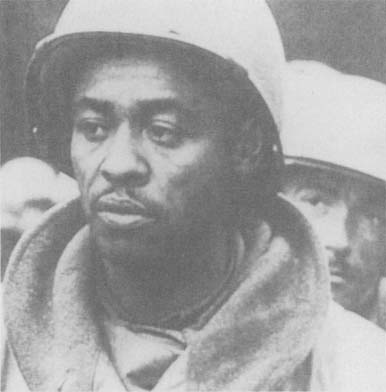
Nazi propaganda made great play on the mixture to be encountered in the American army and how it was proving detrimental to that nation’s fighting skills.
Anthony J. Marino was one of these prisoners of war:
‘We moved for the full day toward a small town. Then we were rested in the early evening and marched further. Late that evening many of us were billeted in a factory or warehouse – most of the men having to settle out in open fields in the snow. Then we were fed hard crackers and yellow cheese. I slept on a shelf for the night. At dawn we were on the march again, all day and into the night. We were assembled into boxcars at a railroad siding.’
J. Don Holtzmuller, of the 589th FAB, has hazy recollections of the journey to the POW:
‘The first town we passed through was Prum. There, a German officer made me give my rubber overshoes to a German infantryman. The first night we slept in a German bunker on the Siegfried Line. While marching back into Germany we passed a plethora of German war equipment along the roads. Many tanks (Tigers and Panthers), trucks, trucks pulling trucks, cannons of all varieties, horse drawn equipment, and armaments and equipment made in all the countries of Europe. Another night we slept in a big warehouse. At one stop we were made to give up one of our outer coats. Unfortunately for me, they took my overcoat, which left me with just a thin field jacket. As it was getting colder every day, I found I was under-dressed. I had taken off my long underwear the day before the battle and was wearing summer underwear when I was captured. Food during these days was practically nil. Water was also scarce and once I drank water scooped out of a roadside ditch with a dirty helmet liner. We were locked in rail cars with no heat or toilet facilities. It was frightfully cold.’
The railway box cars proved a terrible experience for the men. Designed to carry forty men or eight horses, the Golden Lions found themselves jammed packed into the small boxes on four spindly wheels, anything up to eighty to a truck! The floors were covered with a thin layer of straw, many still contained dung from their previous cargo of horses. With no toilet facilities, men had to use their helmets. These were then passed from one man to another towards a small air vent, where they were emptied and passed back. Water was obtained by collecting the condensation which built up inside the wagon or by licking the ice covered steel hinges. It was hardly surprising that the already weakened men became disease-ridden. Dysentery became rife.
The train journeys were long and slow, often they were shunted into sidings to allow more important trains to pass. The tracks were constantly destroyed by bombing, so long and difficult detours were taken to avoid damaged areas. Then there was the fear of being attacked by the Allied Airforce. The British and American pilots liked nothing better than to ‘beat-up’ German trains.
Men began to arrive at the prison camps, officers and enlisted men were segregated.
J Don Holtzmuller arrived at the town of Hammelburg,
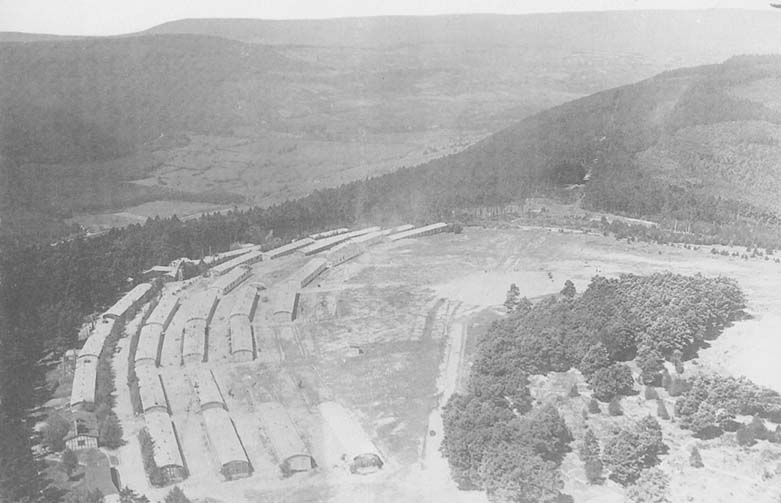
Stalag IX Bad-Orb, Germany, one of the camps used to take 106th Division men.
‘We detrained and marched up a big hill to German Prison Camp XIII-C. Thus, on 26 December, 1944, my 128 days of incarceration in a German prison camp began. We were put in wooden barracks that housed about 80 men. We were given a small piece of German black bread and tin bowl filled with a hot liquid which tasted somewhat like tea. I drank the tea, but the bread tasted so bad that I couldn’t eat it and I gave it away. In a couple of days this bread started to taste like cake! We kept the tin bowl we had been given and this became our eating vessel for the rest of our captivity. Our living quarters were similar to those portrayed on the TV show “Hogan’s Heroes”. The wooden bunks were three high with a thin mattress made of burlap and filled with very little straw. Very few wooden slats supported the mattress. Prisoners, to try to warm the building burned a few slats in some bunks. We found out later that it was a crime against the German State to burn bed slats. The next morning we were assembled outside and the Germans sorted us out; first the black soldiers and the Jewish soldiers were segregated. Initially they thought I was black. The last boxcar in which I had travelled had been carrying what I suppose was black graphite and I was covered with this black material. I had to roll up my sleeve to show I was white. The privates were then taken away. Per the Geneva Convention, privates could be made to work on non-war production jobs and they were put out on what was called Kommandos to do farm work or the like. In a couple of days we non-commissioned officers, corporals and sergeants were moved to new barracks. Our new quarters consisted of a large brick building which had been a horse stable. This area had been a training camp for German soldiers. There were three of these buildings, one above the other on the side of a steep hill. High, triple barbed wire fences surrounded the barracks with watchtowers at the corners. Ten feet inside the barbed wire fence was a single wire supported about afoot off the ground. This wire was called the dead line. All prison compounds had this particular feature. The rule was that if you crossed this trip-wire, the guards in the tower could and would shoot you. One end of our building was filled with 3-tiered steel bunks with the same thin mattresses. The only other pieces of furniture were a couple of benches. There were two small stoves and we were given one small pail of coal each day for each stove. Needless to say, it was never warm in the building, especially since the winter of 1944/1945 was one of the coldest winters in memory. Water for the 80 or so men in this building was made available through only two cold water taps. The toilet facility was an open-air latrine that every so often had to be emptied by hand into a tank and then transported away. Thankfully, I never had that duty.’
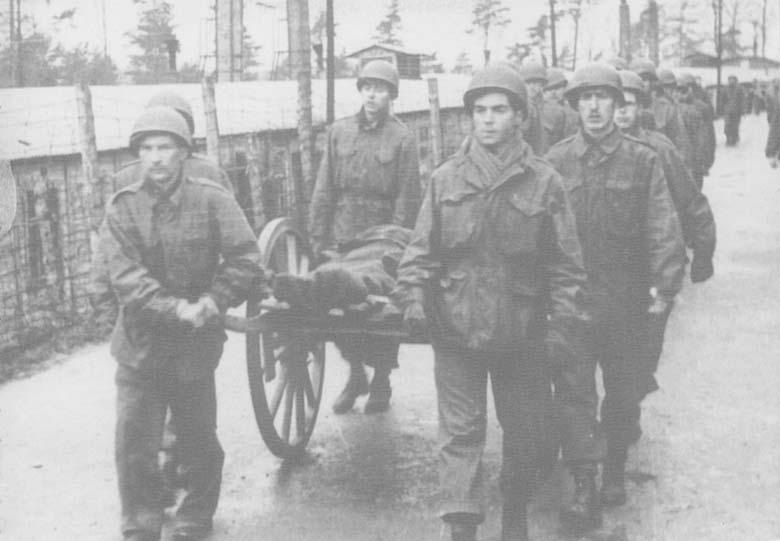
Men of 423rd Infantry Regiment, 2nd Battalion, Company H, on burial detail in Stalag IXB, April 1945. Left to right (clockwise): E M Pretty, Carrie Robinson (hidden), Ray Johnston, Bill Lawson, Paul Trost, Lloyd Diehl.
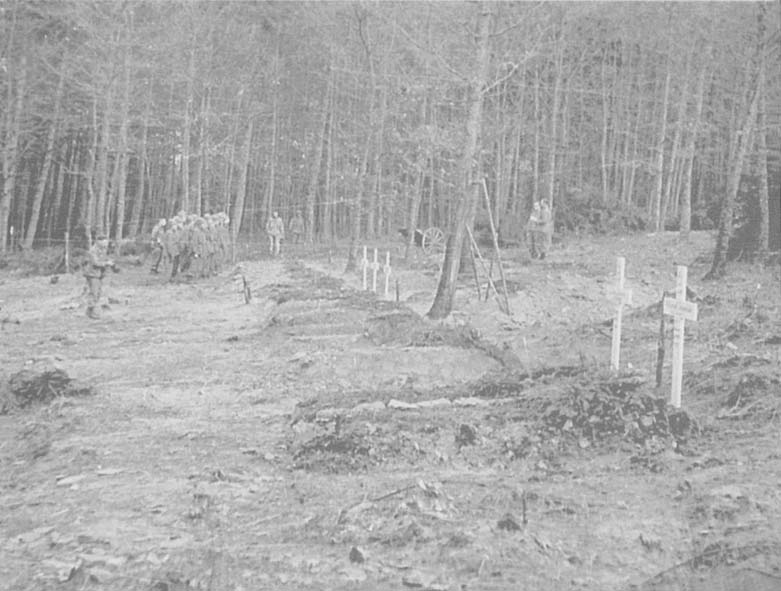
Burial site, outside camp above Stalag IXB, 3 April 1945.
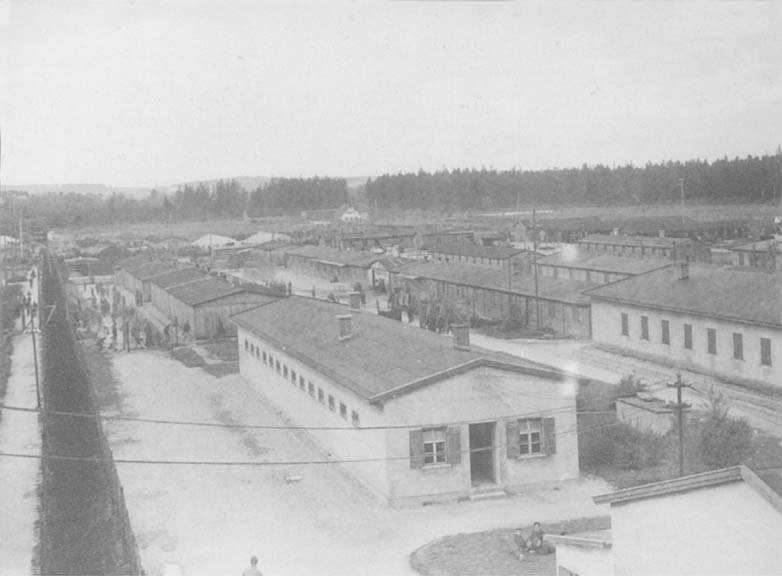
Stalag IIB, Duchenstadt, another camp used to house 106th Division men.
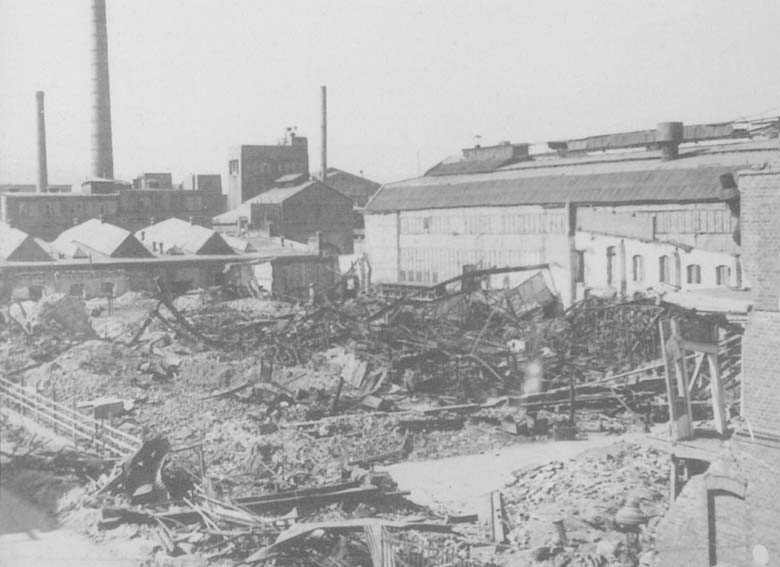
Brick factory at Duchenstadt where prisoners were employed, bombed by the RAF in March 1945.
Then came the tragic nights of 23 and 24 December, cold clear conditions, ideal for bombing. The RAF and USAAF decided to plaster Germany with one of their heaviest raids yet. At Limburg on the night of 23 December, flares were dropped over the prison compound and the men knew they were about to be bombed. A survivor said the bombing actually lasted about 15 minutes but ‘it seemed like a lifetime/When it was over, the prisoner-officers’ barracks was a shambles, with 68 American officers killed and only four or five survivors. This bombing, said to have been by the RAF was one of those terrible needless tragedies of the war.
That same night a train was bombed whilst it stood in the marshalling yards of Koblenz. Many of the men died, hit by shrapnel which pierced the frail wooden box cars quite easily. One truck took a direct hit killing all its occupants. The bodies of the dead men were carried along for another two days before the train finally reached its destination.
John Kline managed to keep a diary, he had marched 110 miles from the point of capture on Hill 504 to the first prisoner transit camp, Stalag XII-A, at Limburg. Arriving there at 10.30 am on the 30 December. During his short stay at the camp he was given a large portion of bread, but no water. The men were then loaded onto the now infamous box cars for another journey to another camp. One of the occupants of his truck tied a can to some string and dragged it along the ground to collect snow for melting into drinking water. A large can was placed in the corner for sanitary purposes. Many of the men now had diarrhoea, and so the stench in the crowded truck was awful. This journey took seven days and six nights before arriving at Stalag IV-B near Muhlberg 7 January, 1945. Here they were finally given a shower and their clothes deloused. Sanitary conditions here were not much better than the train. On 10 January it was John’s 20th birthday. He wrote in his diary,

Sergeant John Kline after PoW fare and a 525 mile walk.
‘I am spending it as a guest of the German government at Stalag IV-B. I had 1/6th loaf of bread, one tablespoon sugar, one slice of margarine and a pint of grass soup with five boiled potatoes as a birthday meal.’
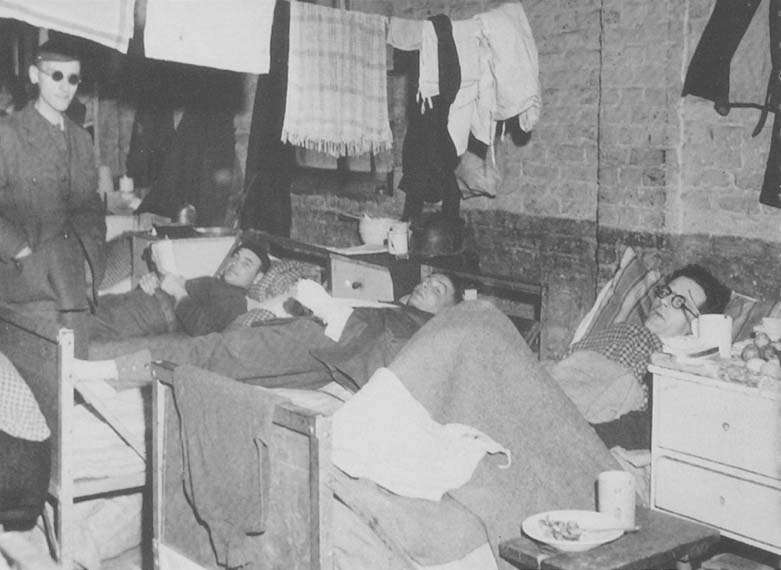
Living conditions in one of the prison camps – nothing much to do but wait for liberation as the Allied armies closed in on Nazi Germany.

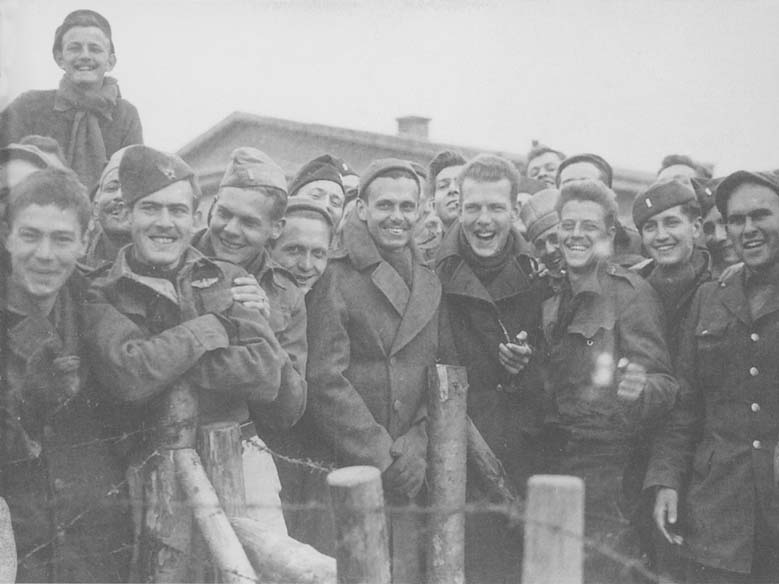
Smiles all round – these 106th Division prisoners would soon be free.

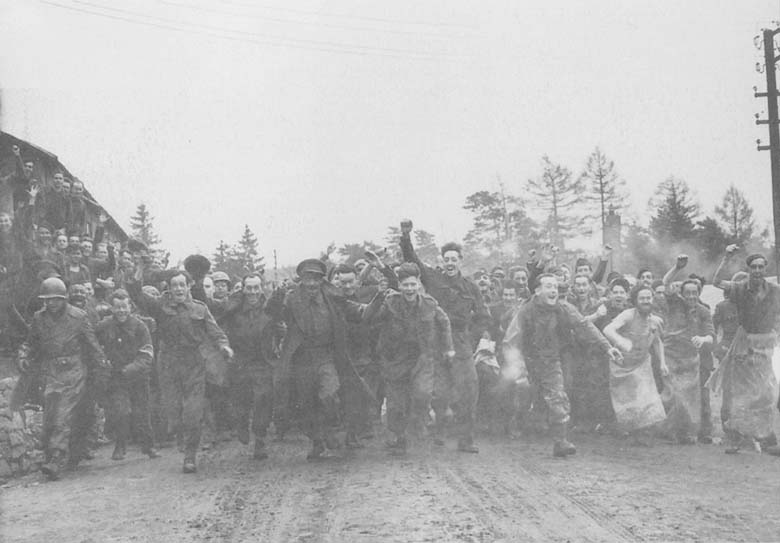
Free at last! It’s all over.
He spent only one week at Muhlberg before being shipped by train to Stalag VIII-A at Gorlitz about seventy miles northeast of Dresden on the Polish border. One month later he was on the move again. This time due to the advancing Russian troops. Valentine’s Day, 14 February, the sixteen hundred Americans headed west. This time to the town of Duderstadt and the ‘Brick Factory’ camp. It was not an official ‘Stammlager’ (Prisoner of War Camp), but just a point where the Germans had decided to accumulate several thousand prisoners.
It was four stories in height with one narrow staircase. Each floor was piled high with clay bricks ready for the kiln.
From here the groups were split up. Some went north-west to Stalag XI-B at Fallingbostel. Or like John went north to a work camp at Braunschweig. By this time John was so weak he could not walk any more. He ended up being housed in a Farben Industries ammunition plant infirmary, in the town of Helmstedt.
At 10.30am on 13 April, 1945, he along with many other prisoners of war in that area were liberated by the American Army.
As a prisoner John Kline had actually walked over 525 miles.
Lieutenant-Colonel Riggs, of the 81st Engineer Combat Battalion also had an amazing story to tell. During the fight for St Vith, Riggs had been grazed on the head by a mortar fragment, knocking him unconscious. On coming to, he was surrounded by German soldiers, and taken to an assembly point where he was grouped with about forty other prisoners. He was then marched for twelve days into Germany. Now and then, the Germans would stop near a village to get food, throwing only the crusts from their sandwiches to the Americans. Riggs finally arrived at a prison camp, Stalag 4. It was not long before he found himself on the move again, this time on his own. Perhaps as punishment he thought, for only revealing his name and serial number. His new camp was in Poland. On going to the latrine one day he noticed that the usual guard was not there. Taking advantage of this he decided to escape. He got to a deserted dining hall and climbed on top of a large walk-in refrigerator and hid. His name was called at roll call and finding him missing the Germans started to search the camp, some with dogs. The German patrols came and went out of the dining hall, but no one thought of looking on top of the fridge. Come nightfall with no guards about he threw himself through a double roll of barbed wire and headed in the direction of Warsaw, which he knew the Russians had taken. Three nights later whilst hiding in a culvert he felt a tap on the shoulder. He explained the best he could to the stranger that had stumbled upon him that he was an American officer. The man threw his arms around him and kissed him on both cheeks – the Polish underground had found him. He was taken to a safe house and fed potatoes, sausage and warm milk. The underground took Riggs to a Russian colonel who said, ‘Come on, Americanski, I’ll have you in Berlin in a couple of weeks and you can meet your own people.’ The promise was kept.
Officers are freed.
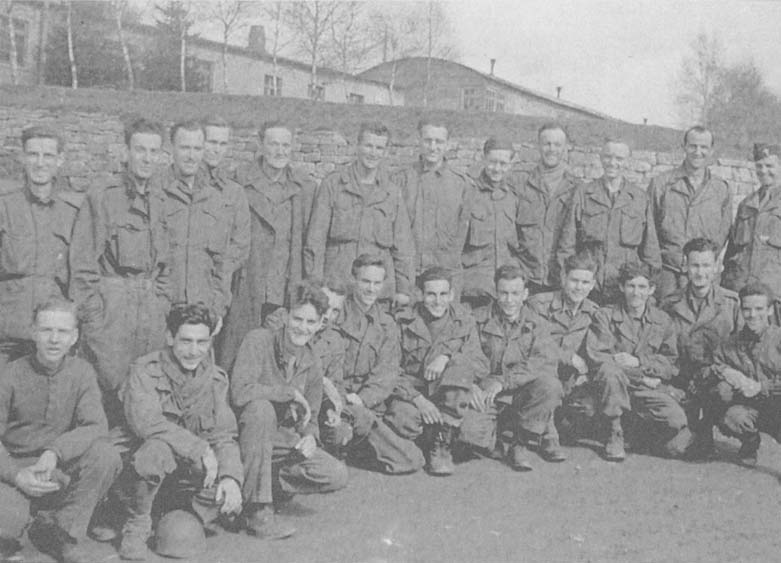
PoWs from two different barracks two days after liberation, 2 April 1945. The camp is Stalag IXB, Bad Orb, Germany.

106th officers after their liberation: medical officers, middle and far right; dentist second left; chaplains, left and second right.
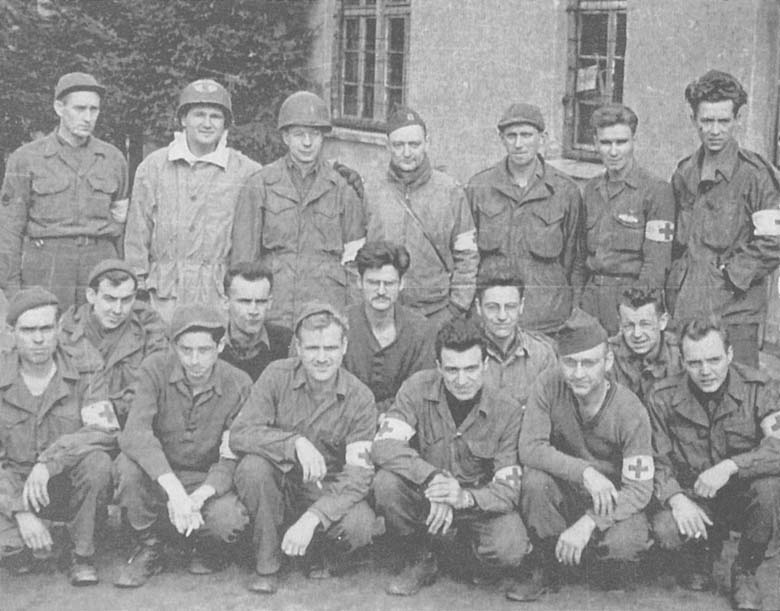
106th medical staff at Stalag IXB, Bad Orb, photographs taken by liberation soldiers.
With Hitler’s Third Reich in ruins, and that despotic dictator’s war-machine utterly defeated, hundreds of thousands of perpetrators and victims of the ‘New Order’ were on the move in Europe – heading home.
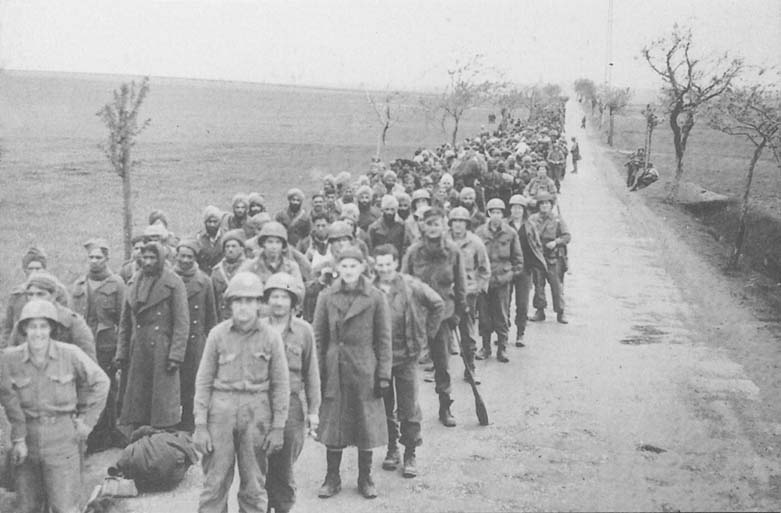
A mixed bag of freed prisoners start on the long road home.
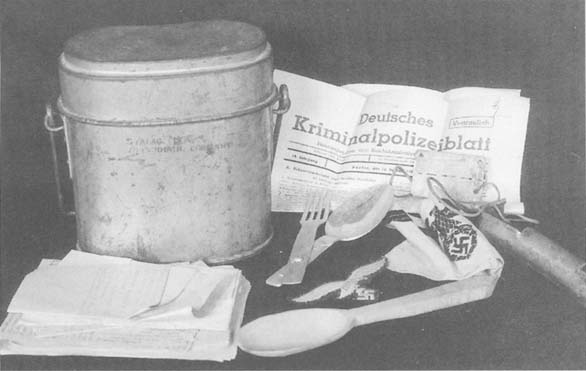
Charles Paetschke’s souvenirs of Stalag XIB: starting with mess kit used to hold the warm ‘coffee’ served as breakfast and the ‘soup’ in the evening. Camp ‘dog tag’, No. 23391, in front of newspaper. Newspaper and armband were taken by him in a quick visit to the camp HQ on the last day in camp. The stack of papers are the names of fellow prisoners plus all the names of foods and restaurants they were able to remember.
Also heading home were those men who had survived that relatively brief, yet brutal, ordeal after being taken prisoner in the Ardennes, in and around St Vith. Some would spend many months in hospital suffering with all kinds of diseases, nearly all had malnutrition. Yet they all held in common one binding factor – all were proud of being part of the 106th Infantry Division.

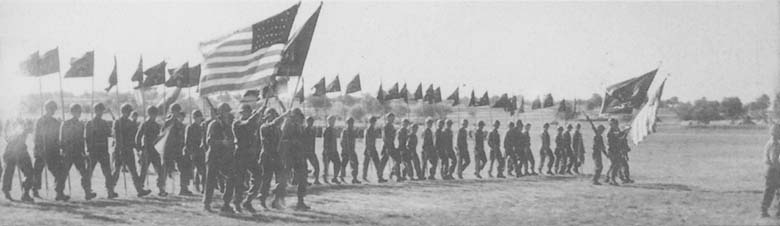
The 106th was reconstituted at Rheims, France. Here the Colour Detail of the 422nd and the 423rd Regiments parade.