
CHAPTER EIGHT
When the Korean War started, the US Navy carriers were mainly equipped with piston-powered aircraft, these being the Vought F4U Corsair, soon to leave service, and the Douglas AD Skyraider, which was destined to have a long and illustrious career. Prior to pure jet aircraft entering service with the US Navy, the service experimented with a mixed-powerplant aircraft. The manufacturer of this most unusual aircraft was the Ryan Corporation, its product being designated the FR-1 Fireball. In appearance the Fireball resembled a small fighter mounted on a tricycle October. The Fireballs were then transferred to VF-41, which undertook seagoing trials aboard the USS Wake Island, Bairoko and Badeong Strait. But after nearly two years of service, the Ryan FR-1 Fireballs were withdrawn. Although the type was successful as far as the concept went, it became obvious that the mixed-powerplant aircraft was not really capable of further development. However, the jet engine was starting to make an impact on the Navy, and would eventually result in the extant vessels and those built in the future being configured to operate jet aircraft from the outset. It was the Grumman Corporation that was the first supplier of jet fighters to the Navy, having already delivered a range of piston fighters and attack aircraft to the same service. The first type from Grumman was the F9F Panther, the prototype of which had flown in November 1947. The aircraft that was delivered was a single-engined, straight-winged fighter armed with four 20 mm cannon plus pylons under the wings for a range of weaponry and fuel tanks to supplement those mounted on the wingtips. First deliveries began in May 1949 to VF-51, and eventually a total of 1,092 fighters were delivered, including a short run of reconnaissance aircraft. The straight-winged model was followed by a swept-wing version–the F9F Cougar. The prototype made its maiden flight in September 1951, while the first operational unit, VF-32, received its first examples in 1952. Eventually a total of 774 examples, including reconnaissance models, were constructed. Grumman ramped up the specifications of its fighters when the F11F Tiger was ordered by the US Navy in April 1953, although deliveries did not begin until 1955.
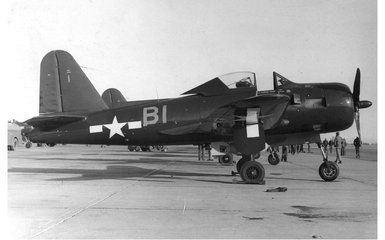
The Ryan FR-1 Fireball was a mixed-power aircraft that had a piston engine in the nose and a jet engine in the tail. It was obvious that the Navy was utilising the type for trials purposes, as few were purchased. This example was operated by VF-66, based at North Island in 1945.
(US Navy/NARA via Dennis R. Jenkins)

The Grumman F9F-8P Panther became the primary reconnaissance aircraft for the Navy before its place was taken by the Vought RF-8 Crusader.
(John Ryan Collection)
undercarriage. The primary powerplant was a Wright piston engine mounted in the nose, while mounted in the tail was a General Electric turbojet rated at 1,600 lb st. The first production aircraft were delivered to VF-66 at San Diego, this unit being formed specifically for this purpose. This squadron undertook the initial carrier qualifications, although it would be decommissioned in
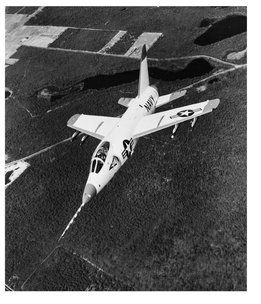
After the F9F series of fighters, Grumman produced the F11F Tiger, the prototype of which is seen here
. (US Navy/NARA via Dennis R. Jenkins)

The Douglas F4D Skyray was assigned to the Navy squadrons during the 1960s, its primary role being that of all-weather fighter. The machine was allocated to VFAW-3 when photographed.
(Terry Jones Collection)
The Douglas Aircraft Company entered the jet fighter market with the F4D Skyray in January 1951, when the prototype first flew. As with most jet aircraft of the period, the Skyray took some time to enter service, the first not joining the Navy until April 1956, the first recipient being VC-3. When production ended a total of 420 machines had been delivered.

These McDonnell F3H Demons were assigned to VF-31 when pictured. The Demon suffered from engine problems, although the design did lead to the F-4 Phantom II, a much better aircraft
. (US Navy/NARA via Dennis R. Jenkins)
It was the appearance of the McDonnell, later McDonnell Douglas, Aircraft Corporation in the Navy’s roll of suppliers that caused some surprise, as it was better known for supplying the Air Force with aircraft. The reason for choosing McDonnell was that the major suppliers were fully occupied in manufacturing programmes for the Navy. Another reason for choosing such a company was that such a young and inexperienced team would not be so restricted by previous programmes. This team’s first product was the FD/FH Phantom, which entered service in July 1947. Many of these aircraft were used by the USMC, although the type’s service life was short, as better and more powerful aircraft were already preparing to leave the drawing-boards. Following on from the Phantom came the F2H Banshee, which bore a strong resemblance to its older sibling. First deliveries began in March 1949, with VF-171 being the recipient. The earlier models were mainly used in the day-fighter role, and a total of 436 were delivered, these including night-fighters and reconnaissance versions. Following on from these early models, a further 400 were constructed, these having a nose-mounted search radar and extra internal fuel. A complete change in the McDonnell design ethic appeared with the F3H Demon. Gone were the two engines and straight wings of the earlier McDonnell machines, and in their place came a single engine, sharply swept back flying surfaces, a belly full of cannon and the capability to carry and launch a variety of air-to-air missiles. While the type suffered from problems with its Allison engine, the F3H Demon was an important stepping-stone towards that doyen of naval fighters, the McDonnell F-4 Phantom II.
Another major USAAF aircraft supplier that entered the US Navy lexicon for a short period was North American. Better known for the B-25 Mitchell and P-51 Mustang, North American was awarded a contract for a jet fighter that would eventually satisfy the needs of both the USAF and the US Navy. The aircraft for the US Navy was the FJ-1 Fury, which was a straight-winged, single-engined fighter. While it was a somewhat unprepossessing aircraft, its performance was adequate enough to enter service in 1948 with VF-5A, later VF-51. These first Furies only lasted in front-line service for fourteen months before being reassigned to the Naval Reserve Units. The follow-up to the straight-winged Fury was a far more advanced design, which divided into two separate programmes–the F-86 for the USAF and the FJ-2/4 Fury. The initial contract was issued in February 1951, the resultant aircraft having folding wings, an AN/APG-30 radar, four nose-mounted cannon and a wider-track undercarriage. The first model was delivered in 1953, with all aircraft being delivered to the USMC. The following versions, FJ-3 and FJ-4, would be the models delivered for naval service, the FJ-3 being delivered from September 1953, while the FJ-4 entered service in February 1955.

The North American FJ-4 Fury was the primary fighter for the US Navy during the late 1950s and early 1960s.
(Terry Jones Collection)

One of the most usual aircraft operated by the US Navy was the Vought F7U Cutlass. It took a lot of development for the type to become a viable proposition. This F7U-3 is pictured undertaking trials aboard the USS Hancock.
(US Navy/NARA via Dennis R. Jenkins)

After their stint in the Pacific, the Grumman Avenger was used in the carrier onboard delivery role. Here a COD Avenger prepares to depart from an unknown carrier.
(US Navy/NARA via Dennis R. Jenkins)
It was Chance Vought Aircraft Inc. that provided one of the most unusual jet aircraft to enter US Navy service. The basis of this aircraft was research gained from Germany after the end of the war. The result was the F7U Cutlass, which featured a sweep of 38 degrees, to the rear of which were elevons that controlled pitch and roll. The resultant aircraft had a high rate of climb and a high top speed, allied to which were outer wing panels that could be folded for stowage. The first production machine flew in March 1950, with four units eventually being equipped, these being VF-81, VF-83, VF-122 and VF-124. The initial model, the dash 1, had numerous stability problems, which were ironed out in later versions, and these also had provision for launching guided missiles. Production ended in December 1955, while service use ended a couple of years later.
The aircraft of choice for carrier operations over Korea was the Grumman F9F Panther, which was not only reliable, but could carry a reasonable amount of external weaponry. They were already deployed aboard the Valley Forge, and the next carrier to deploy them was the USS Princeton, which was pulled out of reserve in July 1950 and prepared for combat service. The Princeton arrived in Yokosuka at the beginning of December, having spent the intervening period bringing the mostly reserve crew up to operational standard, and departed for Korea in the middle of the month. This first adventure only lasted a couple of days, the first sorties being launched in the early hours of 21 December. The selected aircraft types were a single F4U Corsair and a Douglas AD Skyraider, both being dispatched on heckler raids. They were successful, hitting targets at Chakto-ri and Hongwon, with trucks being destroyed and a building napalmed. The next mission was launched a few hours later, utilising a pair of Skyraiders, both of which visited the same region and attacked road and rail traffic. Six aircraft were launched after breakfast, and they too visited the same area, hitting buildings and rail and road traffic. Lunchtime saw a further ten aircraft, of which two were Grumman Panthers, the others being a pair of Corsairs and the remainder Skyraiders. Targets hit and destroyed included a pair of ox-drawn carts, a favourite method of moving weapons and ammunition, a fuel dump was hit with napalm and the ADs concentrated on hitting buildings and the airfield at Yonpo. Once the Skyraiders had departed Yonpo, the airfield was attacked again by Grumman Panthers and F4U Corsairs, which caused further destruction. Two smaller raids followed in the evening, each involving a pair of Skyraiders that continued the work carried out earlier that day. On 22 December the early-morning hecklers consisted of a single AD and a single F4U. As before, the raiders returned to the previous day’s area, attacking anything they could find, using rockets, bombs and napalm. The next group of raids included two Grumman Panthers and a mix of Corsairs and Skyraiders, which attacked the usual range of targets; a troop concentration was also hit. The next wave of aircraft was launched in mid-morning and was a mix as before, with each flight concentrating on applying pressure to the North Korean forces by attacking mainly communications targets. The midafternoon strike concentrated their efforts on the Hamhung area, where a command post was destroyed, as were other buildings suspected of housing military personnel. The final sortie for the day was dispatched in late afternoon and consisted of a pair of F4U Corsairs, which were directed to attack railway and road traffic. After both aircraft had returned to the Princeton, she withdrew to Yokosuka for replenishment and restoring.
The Princeton departed from Japan on 29 December, arriving in theatre on 1 January 1951 and launching the first strike, eight F4Us and six ADs, at breakfast time. Arriving at the zone attacked on the previous visit, the carrier’s aircraft came under the control of the Mosquito FAC, who directed the aircraft to attack numerous troop concentrations and emplacements, using bombs, rockets and napalm bombs. Another large strike mission was launched in mid-morning, consisting of seven ADs and five F4Us, and yet again they came under the control of the Mosquito FAC, being targeted against a train parked in a tunnel. This was attacked with bombs and napalm, the former being skip-bombed into the tunnel mouths. The final mission for the day was dispatched in the early afternoon, and consisted of four each of F4Us and Skyraiders. This mission concentrated upon destroying buildings that were either occupied or could be used by the enemy. There was no early heckler mission launched on 2 January, the first sortie consisting of six F4Us. Their targets were a pair of bridges, which they only damaged, but more success was gained against a warehouse and other buildings that were completely destroyed. A further six F4Us and an equal number of ADs were launched soon afterwards, and again a range of buildings and vehicles were destroyed. The midday mission consisted of ten Corsairs and six ADs, their targets being military vehicles pointed out by the Mosquito FAC, together with some ammunition oxcarts that exploded satisfactorily.
The pattern for 3 January was similar to that of the preceding day, although the first mission was directed at the village of Hoeyang, where the four F4Us and four Skyraiders concentrated upon destroying three command posts and any military material in the vicinity. A much larger sortie was dispatched at midday, and consisted of two groups of Corsairs, five and seven respectively, plus a flight of four Skyraiders. The latter initially attacked troops and vehicles in the operational area, after which they moved on to bombing the town of Pongsuwon, leaving many buildings burning. The larger group of F4Us, meanwhile, were ordered by the Mosquito FAC codenamed Cottonseed to attack troop concentrations and their military vehicles. As this flight departed the combat area, they destroyed one last target, a radio antenna. The smaller flight of F4Us meanwhile concentrated upon buildings and troop concentrations, being guided by Mosquito FAC Tumbleweed. At the conclusion of these raids the Princeton withdrew from the area to undertake refuelling.
After refuelling, the Princeton returned to the operations zone, resuming flying in the early morning of 5 January. A total of twelve Corsairs and three Skyraiders were dispatched and undertook attacks on troop concentrations, which were successful, as was the follow-up on the buildings they had been occupying. A further attack was launched at midday consisting of ten F4Us and four Skyraiders, concentrating upon the targets from the previous attack, and further casualties were inflicted on the North Korean forces, using a full range of weaponry.
The Princeton withdrew from the area and set sail for Sasebo for restoring and refuelling, arriving there on 7 January. She remained in port until 18 January, joining up with TF.77 the following day, and combining with the USS Philippine Sea, Valley Forge and Leyte. All four carriers were operating off the east coast of Korea and were tasked with providing close support to Allied troops where requested and interdiction against enemy forces where needed. As before, the carriers launched hecklers to keep the enemy on their toes, and these were followed up by a full range of sorties to suppress any enemy troop movements. While the strike force was attacking enemy forces on the ground, the anti-submarine Skyraiders were ensuring that no enemy submarines were in the area. After the day’s attacks had been completed, photo-reconnaissance flights were undertaken by Grumman F9F-2P aircraft to assess the damage. Over the following fifteen days the carriers of TF.77 undertook a full range of missions against enemy forces before withdrawing for refuelling on 8 February 1951.
Although the Princeton and her consorts returned to the east coast of Korea the following day, the weather was not good enough for general flying, although a special mission was launched to attack the railway tunnels near Sinpo. Two Corsairs and four ADs were launched, and the tunnels were attacked using rockets, bombs and napalm. Although the damage inside was undetermined, the railway tracks were destroyed. The following day the weather had cleared, and so the Princeton was able to launch a full attack, which comprised twenty-two Corsairs, eleven Skyraiders and four F9Fs. These sorties covered close support, deep penetration attacks and strikes on bridges and buildings determined to be housing enemy forces. A similar mission was launched the following and saw the air groups supporting forces around Seoul and attacks further afield against targets near Wonsan, Hamhung and the Choshin reservoir. The Princeton spent the next day refuelling and restoring at sea before setting out for Yokosuka, where she arrived on 15 February.
On 23 February the Princeton departed Japan and rejoined TF.77, joining up with the Philippine Sea and the Valley Forge. Three days later the carrier groups launched a massive attack on enemy concentrations at Pyongchang and down towards Seoul. These attacks destroyed numerous vehicles, troop concentrations and buildings. These strikes were followed up by jet reconnaissance flights to determine the extent of the strikes. The following attack was launched although the cloud density meant that bombing was radar guided. The following day saw a much larger force dispatched, concentrating on the usual range of targets. Over the next two weeks the Princeton air group undertook a similar range of missions, with short breaks for refuelling, before departing the area on 4 April and arriving at Yokosuka two days later.
After ten days in port, the Princeton set sail from Japan, arriving off the coast of Korea, where it joined up with TF.77 and the Boxer and Philippine Sea. The carrier joined up with the task force just in time to participate in that afternoon’s strikes against enemy forces in the Hamhung area. The following day, 19 April, saw limited operations as the weather was inclement, although it cleared the following day. This was fortuitous, as the UN ground forces were being heavily attacked and required close air support to deter the enemy forces. The Princeton launched twelve F9Fs, twenty-six Skyraiders and forty-two Corsairs. Using the full range of available weaponry, the aircraft, under the command of a forward air controller, mounted attack after attack on the enemy positions. Such was the intensity of flying that stocks of some items began to run low, resulting in the dropping of a kitchen sink attached to one of the few bombs still available. A similar quantity of aircraft was launched the following day, undertaking similar missions as before, while those of 22 April saw an even greater number of aircraft being launched, as the North Korean forces were pushing the UN forces hard.
The Princeton departed the combat zone after the aircraft had returned, although this absence was cut short because the carrier had to return to the area when her aircraft were desperately needed to counter a Communist attack that had just been launched. Virtually the whole air wing was launched, over eighty aircraft, to provide close air support for the UN troops. However, the air strikes, though effective, were not enough to halt the Communist advance. The following day, 25 April, saw another maximum effort launched, although this time the purpose was to protect the UN forces that were withdrawing in good order. Over the following seven days the carrier continued to launch maximum efforts although she suffered her first loss on 6 May when the F9F being flown by Ensign Sullivan of VF-191 was hit by anti-aircraft fire, which caused the engine to explode, killing the pilot. The air group suffered another loss four days later when the F9F of Ensign Brewer was also struck by anti-aircraft fire, which caused his aircraft to explode. After a two-day break due to inclement weather, operations resumed, the air group continuing to launch maximum efforts in support of retreating UN troops. A further three days of intensive flying saw the Princeton attacking the usual troop concentrations before departing for Yokosuka.

A flight of Vought F4U Corsairs from VF-884 overfly their home carrier, the USS Boxer.
(US Navy/NARA via Dennis R. Jenkins)
While en route to Yokosuka the Princeton was recalled in order to provide the maximum amount of aircraft from TF.77. A full air strike was launched, although two losses were incurred, these being Commander Merrick, the air group commander, whose Skyraider was hit by anti-aircraft fire, and Lieutenant Hawkins of VF-871, whose F4U was also struck by anti-aircraft fire. The Princeton launched its last sorties for the period on 19 May, after which she departed Korea and headed for Yokosuka, arriving there on 22 May. The Princeton rejoined TF.77 at the end of the month, combining with the USS Boxer and Bon Homme Richard, and resuming operations on 2 June, launching thirty-two aircraft to undertake the usual range of missions. The following day saw ninety-four aircraft launched, as close air support was required along the central front. A similar pattern followed over the next two days, during which a pilot, Ensign Randolph, was killed when his F9F hit the round-down of the flight deck while landing. After refuelling the Princeton continued combat operations during the next three days,. However, the air group suffered another loss when the AD-4Q of the air group commander was seen to crash near Kunsong: both Commander Stapler, CAG-19, and AT1 Blazevic were killed. After searching for CAG-19 the air wing resumed flying operations on 11 June, continuing to support UN troops and attack FAC selected targets, although these came at a cost, including Lieutenant (jg) Harris of VA-55, whose Skyraider crashed during a strafing run. At the conclusion of this period the Princeton departed for Yokosuka, arriving there on 3 July.
After nine days of rest and recuperation, the USS Princeton departed Japan under the aegis of Operation Order 22-51, which outlined the carrier’s mission for this period. This included close air support, interdiction, reconnaissance and bombing missions in support of UN forces. By 14 July the Princeton had arrived off Korea, where she linked up with the Boxer and Bon Homme Richard and the remainder of TF.77. Over the following twenty-eight days the Princeton conducted air operations in concert with the other two carriers in support of the operations order, although yet again the air group incurred losses. The first loss occurred on 16 July when the F4U piloted by Lieutenant Martin of VF-871 crashed during a napalm run. VF-871 lost a further pilot, Ensign Moody, who was shot down by anti-aircraft fire that set his F4U ablaze. The other Corsair unit aboard the Princeton, VF-821, lost a pilot, Lieutenant (jg) Ray, whose aircraft crashed soon after take-off. The final casualty occurred on 9 August when VF-821 suffered the loss of Lieutenant (jg) Hughes, whose Corsair was also hit by defensive fire. This deployment ended on 11 August, and the carrier arrived in Japan the following day.

With its destroyer escort turning in concert, the USS Bon Homme Richard moves into position to launch its aircraft. The air wing on this vessel operated F4U Corsairs, Douglas Skyraiders and Grumman Panthers.
(US Navy/NARA via Dennis R. Jenkins)

Airborne early warning had started to play a significant part in the Pacific campaign, the favoured mount being the Grumman Avenger. During the Korean War and after it would be the Douglas Skyraider. Here an aircraft from VC-11 taxies up the deck of the USS Boxer.
(US Navy/NARA via Dennis R. Jenkins)
The Princeton departed Japan and headed for the United States for a much-needed refit. After returning to Japan, she later rejoined TF.77 and the Boxer and Philippine Sea on 30 April 1952. Air operations resumed for real on 1 May, and continued until 16 May, when the Princeton returned to Yokosuka. She returned to the east coast of Korea on 4 June. As in the previous deployment, the air group suffered some losses, the first being Lieutenant Tennyson, whose AD-4 was hit by anti-aircraft fire during a bombing run on a railway line on 4 June. The next loss, on 12 June, concerned another VA-195 pilot, Lieutenant Jackson, another victim of ground fire. Yet again the pilot had been undertaking a bombing run on a railway line. On 14 June the Princeton lost her first jet when the F9F of Lieutenant (jg) Cross of VF-191 was hit by anti-aircraft fire during a railway bombing run. As this was a period of maximum launches, the number of losses was commensurate with the number of sorties flown. This operational period ended on 26 June, the carrier arriving in Yokosuka two days later.
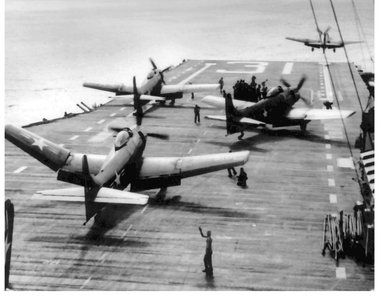
A stream of Douglas Skyraiders proceed to the catapults on the USS Bon Homme Richard. Once airborne, the aircraft will undertake attacks in support of UN forces.
(US Navy/NARA via Dennis R. Jenkins)
The Princeton resumed operations on 6 July in company with the Boxer, Philippine Sea, Bon Homme Richard, the Philippine Sea being replaced by the Essex part-way through the deployment. Flying operations began on 7 July and continued until 3 August, the carrier departing for Japan the following day. During this deployment the Princeton’s air group undertook more than 1,100 sorties, although three pilots were killed in action. The carrier returned to Korea on 18 August. Flying operations resumed on 22 August when almost the entire air group was launched against targets in the Changp-yong-ni on the Korean west coast, where the F9Fs engaged MiG 15s without suffering any losses. Much of the flying scheduled for the remainder of August was cancelled due to adverse weather conditions. The following month was not much better, as the weather deteriorated again, but even so some 1,000 sorties were flown before the carrier departed for Japan on 20 September. By 4 October the Princeton was back on station, linking up with the carriers Essex, Bon Homme Richard and Kearsarge. During this deployment the carrier groups encountered numerous MiG 15s over the Wonsan area. Most of the sorties during this period were close air support missions in support of UN forces. Over 700 missions were undertaken, during which two pilots were killed. The Princeton departed Korea on 16 October, arriving in Japan two days later.

Refuelling at sea was an important part of the process of keeping the fleet close to the area of operations. Here the USS Lake Champlain is fuelled by an oiler, as is an escorting destroyer.
(US Navy/NARA via Dennis R. Jenkins)
The Princeton departed Japan for another refit before returning to the Korean theatre in March 1953. The carrier rejoined TF.77 on 9 March, linking up with the Valley Forge and the Philippine Sea. Combat operations resumed on 14 March and continued until 31 March. During this period the carrier flew more than 1,000 sorties, undertaking mainly close air missions in support of UN ground forces. Fortunately losses were light, being one pilot killed and one wounded. At the conclusion of this deployment the Princeton returned to Yokosuka, arriving there on 3 April. After ten days in port she was back in the combat zone, rejoining TF.77 and the other carriers on station, these being the Oriskany, Valley Forge, Philippine Sea and Boxer. All five carriers were heavily involved with close air support missions in support of UN forces. These began on 17 April and ended on 14 May, with more than 1,500 missions being flown. Given the number of sorties flown it is surprising that only seven pilots were lost operationally. The Princeton returned to Sasebo on 16 May, although by 19 May the carrier was in Hong Kong for a visit.
The Princeton rejoined TF.77 on 11 June, where she linked up with the carriers Lake Champlain, Philippine Sea and Boxer. Combat flying resumed on 12 June, the deployment lasting until 1 August. Again the mission tally was high, passing 1,500 during the period, and only three pilots were killed. The Princeton arrived at Yokosuka on 3 August.
After eleven days in port the Princeton departed Japan, arriving on station to join TF.77 two days later. The other carriers already with the task force were the Boxer, Kearsarge and Lake Champlain. Combat operations began on 18 August and lasted until 1 September, although three days were lost due to bad weather. The USS Princeton departed for Yokosuka on 2 September, arriving there the following day.

Caught just at the point of touchdown is this Douglas AD Skyraider of VA-35 assigned to the USS Leyte.
(US Navy/NARA via Dennis R. Jenkins)
One of the carriers that had a short deployment was the Essex-class vessel USS Leyte that was deployed to Korea in October 1950. The Leyte departed from Sasebo on 5 November in company with the USS Missouri and Valley Forge, arriving off the west coast of Korea the following day. From 6 to 8 November the Leyte undertook 220 sorties against railway vehicles, and close air support missions to cover UN forces. After a day spent refuelling, she returned to the west coast to link up with the Philippine Sea and Valley Forge, and all three carriers conducted operations against enemy forces in the Chongjin and Namsan-ni areas, during which the Leyte launched 102 sorties. Further sorties were carried out in the same region the following day, although this time the targets were railway orientated. Refuelling took place on 13 December, the carrier rejoining TF.77 the following day. It was the Myongchong and Kapsan areas that were the focus of the Leyte air group. As before, the air group flew missions in support of UN forces before withdrawing for refuelling.
Upon returning to the west coast, the Leyte air group resumed air support operations during which, on 18 November, a VF-31 Grumman Panther shot down a MiG 15 and damaged another. The Leyte entered a cycle of two days’ combat followed by a refuelling day, although some days were lost due to bad weather, which included severe snowstorms. The Leyte, in company with her fellow carriers, launched a maximum effort in support of UN forces on 30 November, this continuing for a further four days before she withdrew for refuelling. Normal missions resumed on 6 December and continued for the next five days. On 12 December the carrier resumed missions after a refuel break, continuing her task against targets in the Wonsan and the Fusen reservior area against Red Chinese troops. Close air support missions continued until 24 December, the Leyte departing Korea on Christmas Day, heading for Sasebo.
Another carrier that was an early Korean arrival was the USS Boxer, which arrived in Japan at the beginning of September 1950. After refuelling and taking on extra stores the Boxer, with Air Group 2 aboard, left Sasebo on 14 September, joining TF.77 the following day. The mission for the task force during this period was to continue the already established air supremacy missions, isolate enemy forces in the Inchon area and provide close air support during the Inchon landings that began in the early morning of 15 September with a US Marine assault on the island of Wolmi-do, where the shocked and dazed North Korean troops were completely overwhelmed, this being the result of three days of continuous air and sea bombardment. During this period the Boxer was running with one engine shut down and locked off as the main reduction gearbox had failed, which reduced the carrier’s top speed to 26 knots, although 28 knots could be achieved for short periods. The Boxer completed this deployment on 2 October, and entered Yokosuka dockyard for repairs to number four engine. She departed Yokosuka on 11 October, joining TF.77 three days later, bringing the number of carriers available to three, as the Philippine Sea and Valley Forge were already on station. During this deployment TF.77 undertook missions against the Wonsan harbour area in preparation for a landing, for which purpose countermining, reconnaissance, gunfire spotting and attack sorties were to be flown. The landing against Wonsan began on 20 October, the harbour and its environs being declared safe five days later. During this period the air wing suffered no losses, and so it was a relatively happy ship that arrived at Yokosuka on 25 October. The Boxer returned to America to have the attendant problem of number four propeller shaft dealt with, having completed the previous deployment on three engines, with number four propeller removed to reduce drag and vibration.
At the completion of repairs the Boxer undertook work-up exercises around Hawaii before departing from Pearl Harbor for a direct transit to Korea and TF.77, arriving on station on 26 March 1951. Having taken part in the Wonsan and Inchon support missions, the air group aboard the Boxer found its priorities changed as the mission brief was now to include close- and long-range air support, interdiction, reconnaissance and air bombardment. The Boxer stayed on station until 19 April, during which period the air group undertook air strikes on targets as specified by command orders or at the request of Mosquito FACs. During this period at least two pilots were lost, both aircraft being brought down by anti-aircraft fire.
After nine days in port the USS Boxer departed Japan on 30 April to rejoin TF.77 off the Korean coast, arriving on station on 2 May. The other carriers on station during this period were the Philippine Sea and the Princeton. During the period 3 May to 3 June the Boxer air group, in concert with the other carriers, undertook the full range of assigned sorties. On 6 May a small celebration was held to commemorate the 41,000th landing aboard the Boxer. While much of this deployment was uneventful, some days’ flying were lost in June due to inclement weather, although the air wing managed to launch 1,495 propeller and 404 jet sorties respectively. Some losses were incurred during this period, as North Korean anti-aircraft batteries had increased in number. The first loss occurred on 7 May when the AD-4 Skyraider piloted by Lieutenant (jg) Robbins assigned to VA-702 was shot down during a close air support mission. The next loss was that of an F4U Corsair of VF-884, the pilot, Lieutenant (jg) Dragastin, being killed on impact. Another VF-884 Corsair was lost on 18 May, the pilot, Lieutenant-Commander Carmichael, dying of his injuries soon after rescue. The USS Boxer departed the combat zone on 2 June, arriving at Yokosuka two days later. While in port the opportunity was taken to carry out major repairs to the jet blast deflectors, catapults, deck planking and the engines.
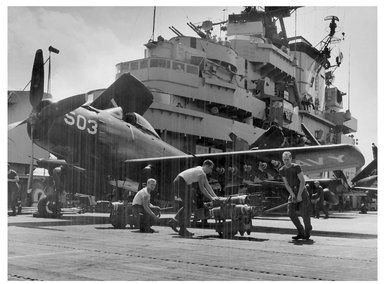
In good weather the Douglas Skyraiders of VA-115 aboard the USS Philippine Sea are armed up for their next mission.
(US Navy/NARA via Dennis R. Jenkins)
When the Boxer departed Japan on 15 June 1951, Air Group 2 had been replaced by Air Group 101, the two days’ transit time being used to bring the new air group up to operational standard. The mission briefing was the same as that of the earlier deployment, although protection and support of UN troops was given a higher priority than previously. The carrier rendezvoused with TF.77 on 17 June, launching its first sorties soon after arrival. This deployment continued until 15 July, although by this time the amount of close air support work was leading to a significant increase in fatal casualties. The first occurred on 20 June when the Corsair of Lieutenant (jg) Shaeffer crashed into the sea three miles south of Songjin after the aircraft had been badly damaged by ground fire. Two days later an AD-2 Skyraider piloted by Lieutenant Arrivee was seen to crash in flames while strafing a ground target. A luckier pilot was Ensign Nelson, whose badly damaged F4U-5NL was abandoned over Wonsan Bay, the pilot being rescued by helicopter a few minutes later. A further three aircraft were lost during this period, although the crews were rescued. The Boxer departed TF.77 on 15 July, arriving at Yokosuka two days later.
The Boxer was back on station by 28 July, linking up with the Princeton, the other TF.77 carrier. Combat operations began immediately after arrival and continued until 22 August except for breaks for a refuelling and bad weather, which included a diversion to the north on 20 August to avoid the attentions of Typhoon Marge. Losses to enemy fire during this period were nil. However, Lieutenant (jg) Rines of VF-721 was killed after launching when the engine of his F4U failed. At the conclusion of this operational period the Boxer departed for Yokosuka once flying had ceased on 22 August, the carrier arriving in port two days later.
On 5 September the Boxer returned to the fray, having departed Japan some two days earlier. Upon arrival the carrier linked up with the USS Essex, also part of TF.77. Operations began the following day and continued until 3 October. During this period the usual range of targets were attacked, while on 16 September the resident air group had to make room for some guests, as many aircraft from the USS Essex were diverted to the Boxer due to an F2H missing all the arrester wires and the crash barrier, and ploughing into the aircraft sitting on forward deck park. As many were fuelled and armed, the resulting conflagration stopped flying while the fire was suppressed. This meant that the Boxer received a total of six jet aircraft that remained on board overnight. These six aircraft were later factored into the next flying programme of the Essex, and so they launched the following morning to join up with the remainder of the Essex strike wave, as the carrier had been declared fit to continue, although the starboard catapult was temporarily out of action. The first loss of this cruise happened on 17 September when the F4U of Lieutenant Pederson, assigned to VF-884, was shot down during a close air support sortie. The wingman’s aircraft was also hit during this attack, although the pilot managed to make an emergency landing at K-18, an emergency landing strip. At the conclusion of flying on 3 October, the Boxer departed Korean waters to return to the United States, calling at Yokosuka en route.
After a much-needed refit the USS Boxer returned to Japan, arriving at Yokosuka in March 1952, having collected Air Group 2 from Hawaii on the way. The Boxer departed Japan on 29 March, having spent the intervening period working up to an operational standard. Two days later the carrier joined TF.77, where it linked up with the Philippine Sea and Valley Forge. Combat operations began soon after arrival that same day and continued until the end of April. The mission for the TF.77 carriers was as before, to strike at the enemy as directed and to cause as much disruption and destruction as possible. However, such operational intensity was not without casualties the first occurring on 18 April when the AD Skyraider piloted by Lieutenant-Commander Neel of VA-65 was seen to crash after the port wing root failed, apparently due to enemy fire. This accident was the event that would spur concerned pilots to press for armour plate to be fitted to the AD, which would allow it to survive such wounds and bring its crew to safety. Fortunately no other aircrew were lost during this period, and so the carrier was able to depart Korean waters on 30 April, arriving at Yokosuka on 2 May.

A VA-65 Douglas Skyraider taxies down the deck of the Philippine Sea after returning home. Of note are the exhaust stains down the side of the fuselage.
(US Navy/NARA via Dennis R. Jenkins)
The rest period concluded on 12 May when the Boxer, in company with the Philippine Sea, departed Japan and headed towards Korea to undertake further operations against Communist Chinese and North Korean forces. Both carriers and their escorting destroyers rendezvoused with TF.77 on 14 May, although combat operations did not resume until the following day. During the period 15 to 26 May, over 250 sorties were launched, the air group suffering only one loss, that of Lieutenant (jg) Kordefleski, whose Corsair was shot down while he was undertaking a rescue support mission. The Boxer departed Korean waters after she ceased flying on 26 May, setting course for Yokosuka, where she tied up two days later.
On 9 June 1952 the Boxer again departed Yokosuka for Korea, where she joined up with TF.77 on 11 June. As this was to be a period of maximum effort, three other carriers were already on station when the Boxer arrived, these being the Princeton, Philippine Sea and Bon Homme Richard. Standard air operations were conducted over the three days before the force was refuelled. Maximum effort attacks began on 16 June and saw over 200 aircraft launched from the four carriers against targets in the Kowon area of North Korea. The following day saw a similar assault against targets in the Hungham area, but it was not achieved without casualties as three aircraft and pilots were lost. Two were AD Skyraiders from VA-65, which were hit by anti-aircraft fire, the pilots, Lieutenant (jg) Rowe and Ensign Faler, being killed. The third aircraft was an F4U of VF-63 piloted by Lieutenant (jg) De Masters, which was observed going down with a wing missing; while a trailing parachute was observed on the ground, the pilot was never observed. On 23 June another maximum effort was launched by the carrier air group, again with over 200 aircraft dispatched to their targets of hydroelectric facilities in North Korea. Fortunately, despite a strong defence by the enemy, no aircraft were lost, although the F4U piloted by Lieutenant-Commander Miller of VF-63 was hit by defensive fire while attacking the Koysen hydroelectric plant. Although the aircraft was badly damaged and had a tendency to flame when fuel touched hot metal, the pilot managed to go ‘feet wet’, ditching his fighter just south of Tanchon, from where he was picked up by a rescue helicopter. Group-strength strikes were launched over the following four days, this being followed by a refuelling day and a two further days’ down time due to bad weather. Full air operations resumed on 2 July and continued until 5 July, although the combat record was saddened by the loss of Lieutenant Griffith of CAG-2 staff, who was flying an F9F on a photo escort mission over Wonsan. The carrier refuelled on 6 July, after which it departed Korea for Yokosuka in company with the USS Philippine Sea, arriving in port two days later.
The next deployment for the Boxer was a short one that lasted from 21 to 24 July. The carrier had departed from Yokosuka on 21 July, taking station off Japan. The purpose of this short deployment was to provide simulated attacks against the bases on the Japanese islands, with strikes being launched against Tachikawa, Yokota, Atsugi, Misawa and Chitose bases over the next three days. All of these simulated attacks were deemed successful, as the defending forces failed to intercept the attackers until the aircraft were departing the targets. At the conclusion of this exercise the carrier returned to Yokosuka, where it remained until 1 August.
On that day the carrier departed on its fateful deployment, joining up with TF.77 and the USS Essex three days later. Operations began on 5 August when 106 sorties were launched against a range of pre-determined targets. These sorties were conducted without loss. The following day saw the launch of eight sorties, when there was an outbreak of fire in the hangar deck that quickly developed into a raging inferno. It immediately set off the fuel in one aircraft, and this spread rapidly to the others in the hangar. Also on the deck were aircraft fully armed for the next missions, and so bombs, rockets and cannon shells were set off, further increasing the danger to the ship and its crew. The captain and his officers were faced with the choice of launching the remaining aircraft to clear the deck or to taxi the aircraft forward, dump the ammunition and slow the ship, and then concentrate upon fighting the fire. The latter was the chosen course of action. Initial reports had indicated that only the port side of the hangar was afire, although the entire hangar was confirmed as being enveloped within minutes. This being the case, the only way to fight the fire was through No. 2 elevator, which was in the raised position. In order to present the fire-fighting crews with a better chance, the decision was made to turn the carrier to starboard. Even so, the fire crews faced a dangerous task, as ammunition was still exploding, and this was reinforced by the explosion of a 500 lb bomb that sprayed shrapnel across the hangar. The change in the carrier’s direction also allowed more than sixty crewmen who had been trapped to jump over the side, being quickly rescued by the attending destroyers. Although the fire crews were battling valiantly, the smoke pall that enveloped the ship and the tenacity of the fires led the captain to contemplate abandoning ship. Praise was later heaped on the engineering team who kept the engines running, which in turn allowed the ship to be handled in support of the fire teams’ efforts. While the fire crews continued their battles below deck, on the flight deck handling parties began to remove any ammunition from aircraft and ready lockers and off the deck, heaving all of it into the sea, thereby reducing the chances of further explosions. The ammunition clearance teams having done their bit, they turned their attentions to fighting the fires in other parts of the ship. After more than four hours the crisis was declared over, and so the task of sorting out the ship and assessing the chances of making it combat ready began. Given the severity and spread of the fire, it was fortunate that casualties were so light–eight killed, one missing, one critically injured, one severely burned and a further seventy suffering from smoke inhalation effects.
With the fires out the crew then set about repairing the ship and preparing the Boxer to resume flying operations, although eighteen aircraft were either destroyed or badly damaged, while much of the available ammunition had been heaved over the side. While higher command praised the efforts of the crew, it was decided to return the Boxer to Yokosuka for further assessment and repairs as needed. As the carrier departed Korean waters the commander of TF.77 sent this signal to the Boxer: ‘My admiration for you and your fine crew is greater than ever. Performance was magnificent.’ On 8 August the carrier departed TF.77 and headed towards Japan, arriving in port on 11 August. In dock an inspection of the ship’s structure revealed many buckled frames and bulkheads, while the flight deck itself was peppered with access holes cut to allow access to the fire below. While on the face of it the damage would keep the carrier off the line, it was estimated that with minimal repairs the Boxer could resume operations.
Repair work kept the carrier in Japan for a few extra days while emergency repairs were effected. On 23 August the repaired Boxer departed Yokosuka, joining TF.77 three days later. Operations commenced on 27 August, the targets being in the region of Wonsan, being followed by strikes on the Choson area on the following day. Also aboard for this final deployment was GMU-90, with its selection of F6F-5(K) Hellcat drones and a pair of AD-2(Q) drone controllers. Their deployment required that a pair of Skyraiders were left on shore. The first use of these drones took place on 28 August when a single drone was launched under the control of the command aircraft. Further drone launches were undertaken on 29 August, 1 September and 2 September. After these launches the Boxer departed Korean waters for the last time on 4 September, arriving in Japan two days later. During the transit the carrier’s excess aircraft were flown off to Atsugi. After a rest period in Japan the Boxer returned to the United States to await full repairs.
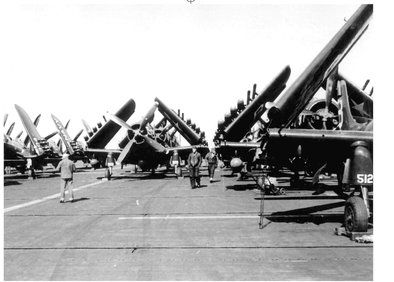
The USS Princeton also undertook operations off Korea. Here a range of Skyraiders, already armed, are lashed to the deck before being dispatched on their next missions
. (US Navy/NARA via Dennis R. Jenkins)
One of the longest-serving carriers in Korean waters was the USS Philippine Sea, the last of the Essex class. Having arrived in Japan in late July, the Philippine Sea departed Okinawa for Korean waters on 4 August, arriving in theatre the following day. Also in TF.77 was the carrier Valley Forge. Sorties were launched soon after arrival and were aimed at providing close support for UN forces, although these were not completely successful as the operation suffered from overloaded communications and problems in utilising the carriers’ aircraft. This resulted in many running short of fuel before they could undertake an attack. Up to 14 August further sorties were launched to provide close support for UN forces, although the only time the system worked correctly was on 11 August, resulting in complete destruction of enemy forces. At the conclusion of that day’s flying the Philippine Sea returned to Sasebo for rest and restoring. The rest period was short, as the carrier departed from Japan the following day to return to Korean waters. This combat period lasted until 18 August, the carrier operating off both coasts during this period. The Philippine Sea returned to Sasebo for rest and restoring, and remained there for four days. She then resumed combat operations in support of UN forces. However, by this time most of the communications and scheduling problems had been dealt with, so that many of the attacks were successful. The carrier departed Korea on 5 September, arriving in Sasebo the following day.
A break for a short refit followed before the Philippine Sea returned to Japan to undertake further service. This resumed on 23 November, and her air group was fully involved in driving back a combined North Korean/Chinese force pushing hard down the peninsula. From this date until 7 December 1950 the carrier’s air group continued to support the withdrawing UN troops. During this period Air Group 11 supported the US Marines in repulsing the Communist forces all the way to Hungnam. At the conclusion of this operational period the carrier departed for Yokosuka for rest and recuperation.
The Philippine Sea resumed operations on 4 April 1951 in company with the Boxer and Princeton. Combat flying resumed the following day and consisted of close air support and interdiction of enemy supply routes until 8 April, after which the group refuelled. The carrier resumed flying on 11 April, remaining on station for the following two days. A refuel period occupied the group over 14/15 April before it returned to Korean waters the following day. Combat operations continued between 16 April and 3 May before the carrier returned to Yokosuka. Between 4 and 16 May she remained in port before rejoining TF.77 on 17 May. During this period the carrier launched maximum air strikes in order to repulse the Communist offensive, after which she returned to Japan. At the conclusion of this deployment the Philippine Sea returned to the United States, entering the dock at San Francisco for a much-needed refit. After working up and cruising off the western American coast, the Philippine Sea redeployed to the Korean theatre. The carrier undertook combat operations against the Sui-Ho dam and took part in a combined operation against Pyongyang. The carrier returned to San Diego in August 1952, rejoining TF.77 in December with Air Group 9 aboard. As before, operations were conducted in support of UN forces, after which the Philippine Sea returned to America.

Deck crew struggle across the deck of the USS Essex as the blizzard continues to blow. As flying is cancelled, the aircraft are lashed down and have their covers secured to keep the snow out.
(US Navy/NARA via Dennis R. Jenkins)

The USS Essex would be the only carrier to operate the McDonnell F2H Banshee operationally over Korea. Here one comes up on the elevator while a helicopter of HU-1 takes off in the background.
(US Navy/NARA via Dennis R. Jenkins)
The class-name ship, the USS Essex, also served off Korea for much of the war, arriving there in early August 1951. On 22 August the Essex joined TF.77 off the west coast of Korea in company with the USS Boxer and the Bon Homme Richard. Combat operations began on 23 August, and unfortunately the air wing lost its first aircraft, an F4U piloted by Lieutenant (jg) Franz, whose aircraft crashed near Wonsan harbour. Combat operations continued over the next two days without major incident before the Essex withdrew for refuelling. Operations resumed on 29 August and continued until 19 September. Losses during this period included Lieutenant (jg) Smith and ATAN Black, who were killed when their AD-4 burst into flames and crashed after take-off on 26 August. The next loss was Lieutenant Sistrunk in an F4U that was shot down on 3 September, while on the same day the F9F of Ensign Armstrong was also lost. The following day was no better, as two F9Fs were lost and their pilots, Lieutenant (jg) Bramwell and Lieutenant (jg) Ashford, were killed. Four days later the Skyraider piloted by Lieutenant (jg) Parse was shot down during a bombing run. The Essex was one of the few carriers to deploy the McDonnell F2H Phantom operationally, and it was one of these that wreaked havoc on the flight deck of the Essex on 16 September. On a second landing attempt Lieutenant (jg) Keller missed the arrester wires, bounced over the barrier and crash-landed into the aircraft parked on the forward deck, destroying a pair of F2Hs and two F9Fs. Three personnel were killed, four were declared missing, and a further sixteen were injured. Once the fire had been contained, and the wreckage and injured removed, the Essex was declared fit for further operations. After flying was completed on 19 September, a more sober carrier and its crew departed for Japan, arriving at Yokosuka two days later.

VA-75 was one of the Skyraider squadrons aboard the USS Bon Homme Richard during the Korean conflict. Here one of the unit’s aircraft, well loaded with bombs, awaits its turn to depart.
US Navy/NARA via Dennis R. Jenkins)
After a period of rest and recuperation and the replacement of crew and aircraft, the Essex put to sea on 1 October, joining up with TF.77 on 3 October. Air operations continued until the end of the month except for those days lost to refuelling and bad weather. The second day of operations saw the loss of Lieutenant (jg) Teague, whose AD-4 was hit by anti-aircraft fire, subsequently crashing. Another loss occurred on 16 October when an F2H piloted by Lieutenant-Commander Oxley was hit by ground fire, and the aircraft was later seen to crash and explode. Eight days later one of the Essex F4Us piloted by Ensign Bateman was shot down by enemy ground fire. After the final combat operations had been flown, the Essex departed Korean waters on 30 October, arriving in port the following day.

Douglas AD Skyraiders of VA-728 sit on the bow catapults on the USS Antietam, while others of the same squadron wait behind for their turn to launch.
(US Navy/NARA via Dennis R. Jenkins)
The USS Essex rejoined TF.77 on 14 November, linking up with the other carrier on station, the USS Bon Homme Richard. Combat operations occupied the Essex air wing until 12 December, and included attacks on targets mainly over North Korea, during which two pilots were killed, while another four required rescuing by rescue helicopters and ships. At the completion of this deployment the Essex departed Korean waters on 12 December, arriving at Yokosuka two days later. The Essex departed Japan on Boxing Day 1951, arriving off Korea on 28 December to join TF.77. Air operations resumed on 28 December and continued until they were interrupted on 3 January 1952. The cause of this interruption was a 20 mm cannon whose breech-block lock failed and allowed the air supply to fire off a single round that in turn hit an F9F on the flight deck. The Grumman fighter then exploded, injuring five personnel. On the flying side five pilots, including a USAF exchange pilot, were lost to enemy action, while a similar number required rescuing. At the conclusion of flying on 31 January the carrier prepared to leave Korea on 1 February 1952, arriving at Yokosuka two days later.
On 18 February the Essex departed Japan to rejoin TF.77, where it linked up with the carriers Valley Forge, Antietam and Philippine Sea. The Essex carried out its support operations from 21 February to 5 March, during which two pilots were killed and another required rescuing. The Essex returned to its Japanese home port on 7 March, transferring some of its spare aircraft to the Valley Forge, while the remainder were flown to the Atsugi pool. The Essex departed Japan on 11 March and headed for San Diego for a much-needed refit, calling at Pearl Harbor en route.
The Essex’s refit was completed in June 1952, with the carrier returning to Japan in early July. On 29 July she departed Yokosuka to rejoin TF.77, arriving on station on 1 August. Combat operations began that same day and continued until 2 September against targets in North Korea, and some were flown in support of UN troops. Losses were slight during this period, and so the carrier was able to depart Korean waters on 4 September with a full complement aboard. The Essex was later deployed to the China Sea as part of the Peace Patrol before returning to Puget Sound for refitting in mid-1955.
As well as the five long-serving Essex carriers, another six undertook tours in Korean waters for short periods. The first of these was the USS Leyte, which commenced combat operations over Korea on 10 October 1950, the aircraft being supplied by Air Group 3. Missions covered the usual spectrum and included support for the Wonsan and Songjin invasions. The Leyte completed its operations on 29 October, arriving in Sasebo two days later. She returned to combat on 7 November, joining TF.77 and the Valley Forge. As before, the air group undertook the usual range of missions in support of UN forces, including a maximum effort on 30 November against enemy forces in the Chonjin reservoir area. This maximum effort flying continued until 24 December, after which the Leyte departed for Sasebo, where she arrived two days later. The carrier returned to action on 7 January 1951, resuming her role within TF.77 in company with the Philippine Sea, Princeton and Valley Forge. Combat operations were delayed until 13 January due to bad weather, and the carrier remained on station until 19 January. During this period over 400 sorties were flown, after which the Leyte departed for Sasebo on 19 January, staying there for a short period before returning to America.

A batsman guides a Sikorsky helicopter from HU-1 aboard the aircraft carrier USS Boxer. The helicopter proved invaluable during this and following conflicts.
(US Navy/NARA via Dennis R. Jenkins)
The USS Bon Homme Richard had been recalled to action in January 1950 for use off Korea. The carrier’s first deployment began on 30 May, the assigned aircraft being Air Group 102. Within its make-up the air group consisted of VF-781 and VC-61 flying versions of the Grumman F9F, VF-783 and VF-874, plus VC-3 flying F4U Corsairs, VA-923 and VC-11 and VC-35 operating versions of the Skyraider, and HU-1 with rescue helicopters. The carrier launched its first missions that same day, and continued to generate sorties until 17 June, when she arrived in Sasebo on 16 June for rest and recuperation. The Bon Homme Richard departed Japan at the end of June, returning to TF.77 the following day. Combat operations resumed that same day and continued until 28 July, the carrier returning to Sasebo and thence to America for a refit soon afterwards. The Bon Homme Richard returned to Korean combat in May 1952, this lasting until December. Aboard the carrier was Air Group 7, which comprised VF-71 and VF-72 flying F9Fs, VF-74 operating F4U Corsairs, VA-75 with Skyraiders, plus VC-4, VC-12, VC-33, VC-66 and HU-1 flying Corsairs, Skyraiders for the other three VC units and helicopters for rescue purposes. At the conclusion of this deployment the carrier returned to America for refitting and conversion.
In October 1951 the USS Antietam was deployed to Korea for war service. Aboard was Air Group 15, which comprised VF-713 operating Corsairs, VF-831 and VF-837 flying F9Fs, VA-728 with Skyraiders, and VC-3, VC-11, VC-35, VC-61 and HU-1 flying the same types as aboard the Bon Homme Richard. The Antietam began operations with TF.77 on 11 October, continuing these until 16 November and returning to Yokosuka two days later. The Antietam returned to Korean waters on 18 January 1952, resuming its combat operations the same day. These continued until 2 February when the carrier returned to Japan, where it remained until departing for the United States soon afterwards.
The USS Kearsarge was an unusual ship in that it had undergone SCB-27A modifications before undertaking its Korean tour. During its short deployment the Kearsarge operated in company with the Bon Homme Richard and Princeton. On 14 September 1952 the Kearsarge departed from Yokosuka and headed to the east coast of Korea, where it joined up with TF.77 on 16 September. The Kearsarge deployment continued until 18 October, when the carrier departed for Yokosuka, arriving there two days later. She resumed operations with TF.77 at the end of the month, remaining on operations until March 1953, when she returned to her home port of San Diego.
The USS Oriskany was another short-term participant in Korean operations, having departed San Diego on 15 September 1952 and arrived at Yokosuka on 17 October with Air Group 102 aboard. The carrier joined Task Force 77 off the Korean Coast on 31 October, beginning combat operations the following day. The air group aircraft attacked their targets with bombs and rockets, also strafing enemy supply lines and co-ordinating bombing missions and surface bombardments along the coast. The carrier’s air group pilots also downed two Soviet-built MiG 15 jets and damaged a third on 18 November. Strikes continued until 11 February before the Oriskany returned to Yokosuka for rest and recuperation. Departing Japan, the Oriskany returned to combat on 1 March 1953, remaining in action until 29 March before making a short port call at Hong Kong, after which the carrier resumed its air strike duties on 8 April. The Oriskany departed the Korean coast on 22 April, returning to Yokosuka for a short period and departing for San Diego on 2 May, arriving there on 18 May before returning to San Diego. She departed San Francisco on 14 September to enforce the uneasy truce in Korea, arriving at Yokosuka on 15 October. From Korea the carrier cruised the Sea of Japan before she returned to San Diego on 22 April 1954.
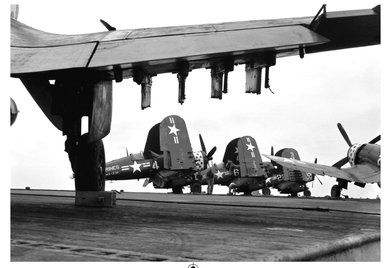
The location for the F4Us of VMA-332 is the escort carrier USS Point Cruz, this being one of the USMC escort carriers utilised during the Korean War.
(US Navy/NARA via Dennis R. Jenkins)
The USS Lake Champlain was another carrier that had undergone SCB-27A modifications being recommissioned again in September 1952. After her shakedown cruise the carrier arrived at Yokosuka on 9 June 1953. Combat operations began on 13 June as part of TF.77, and she remained on station until 27 June when she retired to Japan, arriving at Yokosuka on 29 June. After carrying out some secondary peacekeeping missions, the Lake Champlain returned to her home port of Maryport in December.
Only one of the Independence class of light carriers was involved in the Korean war, this being the USS Bataan. A veteran of the Pacific campaign, the Bataan was prepared for war service again in early 1950. She was recommissioned on 13 May 1950 at Philadelphia. In July the carrier entered San Diego, being loaded with USAF cargo and personnel and departing for Japan soon afterwards. Upon returning to the United States, the Bataan embarked a USMC fighter-bomber group comprising VMA-212 and VMA-312, both flying F4U Corsairs. The carrier also had a detachment of HU-1 helicopters for planeguard and rescue duties. The Bataan headed for the Far East, arriving in Japan on 16 November. After working up, the carrier arrived in Korean waters on 15 December, where she undertook missions in concert with TF.77. By the end of December the Bataan had arrived at Sasebo for a period of rest and recuperation. Departing Sasebo on 1 January 1951, she was initially ordered to join up with TF.77. However, the orders were changed en route, and so the carrier was diverted to the west coast of Korea to join TG.96.8. Between 3 and 8 January she undertook close air support duties on behalf of UN forces before departing for Sasebo, arriving there on 9 January.
The Bataan departed Sasebo on 15 January to link up with TG.95.1, replacing the Royal Navy carrier HMS Theseus under the command of Vice-Admiral Andrews RN. With TG.95.1 the Bataan launched continuous sorties against North Korean forces throughout daylight hours. Except for 21 January the carrier launched sorties over the period 17–25 January, during which period the USMC fighter-bomber squadrons lost two aircraft and pilots to enemy ground fire. At the conclusion of flying, the Bataan departed Korean waters and headed for Sasebo, arriving there on 26 January, having handed over support duties to HMS Theseus.
The Bataan left Sasebo on 3 February, arriving off the Korean coast on the following day, where it replaced the Royal Navy carrier. As before, she undertook duties in support of UN forces before departing for Japan on 13 February, having been replaced by the Theseus.
Ten days later the US Navy carrier had relieved its British counterpart, remaining on station until 4 March. By the following day the carrier was off Pusan, where she swapped VMF-212 for VMF-312 before heading to Sasebo, arriving there on 7 March. After a six-day break, the Bataan returned to the fray, relieving the Theseus and remaining on station until departing for Yokosuka on 22 March. The Bataan departed Yokosuka on 30 March, returning to the west coast of Korea to replace the Theseus. The Bataan remained with the task group until 6 April before returning to Japan. She continued her turn and turn about with the Theseus before departing Japan and heading for the Bremerton Naval Yard, arriving there on 9 July 1951 for a much-needed refit. The Bataan was ready for service again in November, departing for Yokosuka in January 1952. Upon arrival the carrier was involved in working-up exercises before departing for Korean waters and arriving off the west coast on 29 April. Combat operations were carried out by VMF-312 Corsairs against Communist targets in support of UN forces. The Bataan remained on station until 10 May, when, after recovering her final aircraft, the carrier headed for Sasebo, having been relieved by HMS Ocean.
The Bataan returned to the west coast on 19 May, remaining there until relieved by the Ocean on 28 May, the American vessel returning to Sasebo for her scheduled break. The Bataan relieved HMS Ocean on 5 June, continuing her role of supporting UN forces, using the Corsairs of VMF-312 to prosecute her mission. Ten days later the Bataan was replaced by the Ocean, the American carrier returning to Sasebo. Combat operations resumed on 24 June, with the Bataan replacing the Ocean as the west-coast carrier. The carrier remained on station until relieved by the British carrier on 3 July, and she arrived in Japan the following day. On 21 July the Bataan had again relieved the Ocean as part of TG.95.11, launching her Corsairs against the usual range of targets. This deployment ended on 23 July 1952, the Bataan departing soon afterwards for Bremerton, where she arrived on 11 August to await refitting.
The Bataan was back at Sasebo by the beginning of March 1953, with VMF-312 and its Corsairs aboard. The carrier departed her Japanese base on 6 March, heading for the west coast of Korea, where she replaced the Royal Navy carrier HMS Ocean. The Bataan remained on station for the next ten days before returning to Sasebo. After a period of rest and recuperation the carrier returned to the west coast on 11 April, remaining on station until relieved by her British counterpart on 19 April. The Bataan’s last deployment was undertaken between 27 April and 6 May, after which the carrier returned to San Diego to await further usage.

The USS Block Island was one of the carriers that used units from the USMC to provide the strike force.
(US Navy/NARA via Dennis R. Jenkins)

The USS Cabot would also operate USMC F4U Corsairs while engaged in combat operations over Korea. (
(US Navy/NARA via Dennis R. Jenkins)
While the majority of US Navy air operations were carried out by the Essex-class carriers and the single Independence-class light carrier, technically a US Marine Corps vessel, some use was made of the large escort carrier fleet held in reserve. Only five CVE carriers were used, and all came from the Commencement Bay class. The first of the class to deploy was the USS Sicily, which arrived in Kobe to collect the USMC unit VMF-323 and its twenty-three Corsairs. After working up the air group, the carrier put into Sasebo for a refuel and restoring, departing on 13 June 1951 to join up with TG.95.1 on the west coast of Korea. Combat operations continued until 22 June until she was replaced by HMS Glory. After a break in Sasebo, the Sicily returned to Korea on 1 July, resuming combat operations in support of UN forces. Nine days later the carrier had been replaced by the Glory and returned to Sasebo. The break for the Sicily ended after ten days, when the carrier returned to the Korean west coast on 19 July. This stint lasted ten days, much of it in concert with the Glory, as a maximum effort was needed to repel a North Korean and Chinese attack. After this effort the Sicily departed the war zone on 29 July, returning as ever to Sasebo. She resumed her combat operations on 4 August, remaining on station until relieved by HMS Glory on 14 August. By 25 August the Sicily was back on station, resuming her attacks on designated targets. This deployment was completed on 1 September, when she returned to Japan. The carrier remained in port slightly longer than usual, and so she did not replace the Glory until 9 September. Operations off the west coast continued until 16 September 1951. The Sicily undertook two further tours off the Korean west coast, these taking place between 4 and 13 September and 6 and 16 October 1952. At the conclusion of the Korean conflict the USS Sicily returned to the Far East, where she helped support the shaky Korean truce. This deployment lasted from 14 July 1953 to 25 February 1954.
One of the shortest deployments was that of the USS Rendova, which lasted from 25 September to 6 December 1951. During this period the carrier had VMF-212 and its Corsairs aboard. During this period the Rendova swapped over with the Australian carrier HMAS Sydney. At the conclusion of this deployment the Rendova was replaced by the USS Badeong Strait and headed for San Diego.

The USS Essex continued in service after the Korean War. This view of the carrier clearly shows the locations of the forward elevator and the deck-edge elevator to the fore of the landing deck.
(US Navy/NARA via Dennis R. Jenkins)
The USS Badeong Strait undertook Korean combat tours during the period 29 July 1950 to 23 January 1951, 2 October 1951 to 14 February 1952, and 6 October 1952 to 11 February 1953. During these periods the carrier embarked USMC units, the first being VMF-212, followed by VMF-312, as part of Task Group 95.11. At the conclusion of her war service the carrier underwent conversion for anti-submarine duties. Another escort carrier with a reasonably long Korean war service was the USS Bairoko. The Bairoko was recommissioned on 12 September 1950, undertaking three deployments to Korean waters from 14 November 1950 to 15 August 1951, 1 December 1951 to 9 June 1952 and February to August 1953, supporting UN forces. The embarked USMC unit was VMF-312 and its Corsairs. In a similar manner to the other escort carriers deployed to Korea, the Bairoko was part of Task Group 95.11. On 9 May 1951 the carrier had five men killed and thirteen injured by an explosion and flash fire in Japanese waters. From the early part of 1951 the Bairoko was reworked as an anti-submarine carrier and remained as such until the end of hostilities. The shortest deployment of all concerned the USS Santa Cruz, which lasted from 26 August to 29 October 1953. This carrier had no air group assigned, being used as a platform to land an Indian peacekeeping force under the aegis of Operation Platform in the Korean demilitarised zone. This brought an end to the US Navy’s active deployment in the Korean conflict.